Daryl Braithwaite: The Life Story Behind the Horses Star
In this post
Ask an Australian crowd to name the singer behind “The Horses” and almost everyone can answer before the question is finished. Ask the same crowd who wrote that song and most of them will guess wrong. Daryl Braithwaite never wrote it. He heard it, understood it, and sang it so completely that the country handed the song to him anyway. That strange twist sits at the centre of his career: a man whose biggest triumph came from somebody else’s words, delivered in a voice nobody could mistake for anybody else.
There are two peaks in his story, and they sit about fifteen years apart. The first came in the 1970s, when he fronted Sherbet, a band that stacked up twenty Top 40 singles and turned cricket into a chart-topper with “Howzat”. The second came around 1990, when his solo albums “Edge” and “Rise” both went four times platinum and “The Horses” spent its time at number one. Between those peaks there is a stretch that most pop biographies skip over: the band breaking up, club gigs he hated, a few weeks on the dole, and a job digging roads in Sunbury. He does not hide that stretch. He has talked about it openly, and it makes the comeback that followed feel earned rather than lucky.
What holds the whole story together is the voice itself. It is high, clear, and full of lift, the kind of voice that sounds hopeful even on a sad line. Producers kept coming back to it across five decades because it could carry a bright pop chorus in 1975 and a slow, wide-open ballad in 1991 without sounding like two different singers. Braithwaite is seventy-seven now, and he still tours. The crowds still raise their hands when the opening notes of “The Horses” begin. This is how a tradesman from Melbourne became one of the most recognised voices in Australian pop, lost the band that made him, and then rebuilt himself as a solo star.
A Trade, a Dockyard, and a Singer Waiting to Happen
Melbourne gave the world Daryl Braithwaite on 11 January 1949. The city he grew up in had a strong local music life, with dances, radio hits, and bands forming in suburbs all over town, but his first working life had nothing to do with any of that. He took up fitting and turning, and he served his apprenticeship at the Cockatoo Island dockyards in Sydney. Four and a half years of it. He finished the trade, properly, before music took over his life. That detail matters, because it explains a lot about the way he later handled fame: he had already learned what a full working day felt like, and he had a skill to fall back on if singing ever stopped paying.
Sydney in those years was a long way from the Melbourne pop world he would soon join, and the dockyard was not a place that handed out encouragement to young men who wanted to sing. Braithwaite did the work, qualified, and then walked away from it. In March 1970, at the age of twenty-one, he joined Sherbet as a professional singer. The band already existed and had already put out a single. What they needed was a frontman, and Braithwaite, fresh out of his apprenticeship, stepped straight into the job. There was no long period of struggling in small clubs behind him at that point, no years of hawking demo tapes around record companies. One life ended at the dockyard gate, and another began on stage.
That sudden switch gave him a reputation he would carry for years: the singer who had done a real trade and chosen music anyway. It also gave him a toughness that showed up later, when the band ended and he had to start again from nothing. A man who has already finished an apprenticeship and dug roads for a living does not panic when a record deal dries up. He knows how to work, and he knows how to wait.
Sherbet: Twenty Top 40 Singles in One Decade
Sherbet formed in 1969, and by the time Braithwaite joined them in March 1970, the shape of the band was settling. Garth Porter played keyboards, Tony Mitchell played bass, Alan Sandow played drums, and Clive Shakespeare played guitar. Harvey James would join on guitar later in the decade. They were a pop band in the truest sense: bright harmonies, sharp choruses, and songs built to be sung along to. Braithwaite’s voice sat on top of that sound like a flag on a pole. You could pick it out of a radio broadcast within two seconds.
Their first Top 40 entry came with “Can You Feel It, Baby?” in 1971, and from there the hits kept arriving. “Cassandra” reached the Top 10 in 1973. In October 1974, their remake of Cilla Black’s “You’re My World” went to number one in Australia, the first of two chart-toppers Braithwaite would sing in his career. The following year, “Summer Love” also reached number one and finished 1975 as the year’s biggest-selling single in the country. Then came the song that travelled furthest of all. “Howzat”, written by Porter and Mitchell, took the umpire’s cry from cricket and turned it into a pop chorus. It reached number one at home in 1976 and climbed to number two in Britain, a rare feat for an Australian band singing about a very Australian game.
The numbers behind Sherbet still look startling. Twenty Top 40 singles across the decade. Fifteen albums and thirty singles in total. They were the first Australian band to pass one million dollars in record sales at home. In 1976, the King of Pop Awards named “Howzat” the most popular Australian single of the year. Overseas, in Britain and America, the band recorded under the name Highway, because another group already held the Sherbet name there. Back home, they were regulars on “Countdown”, the television show that decided what the country listened to, and their faces were familiar in every Australian living room.
What made them last, though, was not the statistics. It was the live show. Sherbet toured constantly, playing to teenagers who knew every word, and Braithwaite learned his stagecraft in front of those audiences: how to hold a note until a hall went quiet, how to hand a chorus to a crowd and let them carry it, how to keep a band tight through a long set. Those skills, learned in the 1970s, would still be paying him in the 2020s, when audiences old enough to be grandparents brought their grandchildren to hear the same songs.
When the Band Stopped: Dole Queues and Road Digging
Sherbet came to an end in 1984, after fourteen years with Braithwaite at the front. Bands rarely end cleanly, and Sherbet was no exception. The hits had slowed, the members had their own plans, and the machine that had carried them through the seventies simply ran out of road. For a singer who had spent his entire adult life inside one group, the silence afterwards was strange. He was thirty-five, famous, and suddenly without a band, without a record deal driving his diary, and without a clear next step.
He did what working singers do: he took club gigs. Small rooms, solo spots, the kind of dates that keep a voice warm but do little for a reputation. He has said plainly since then that he did not enjoy that period much. The rooms were wrong for him, the audiences were not his, and the work felt like a step backwards. So he stopped. For about four or five weeks he was on the dole, and the employment office found him a job digging roads in Sunbury, in Victoria. A former pop star with two number one singles, holding a shovel on a road crew. It is the kind of detail that sounds invented, which is exactly why it is worth recording: Braithwaite himself has told the story in interviews, without embarrassment, as the moment that sorted out his thinking.
The lesson he took from Sunbury was simple. He did not want to dig roads for the rest of his life, and if music was going to pay his way again, he would have to build it himself rather than wait for someone to offer it to him. His wife Sarah was central to what happened next. With her help, and with a handful of other people around them, he put together the money and the plan to record a comeback album, bringing in investors to back the sessions. Then they took the finished record to Sony Music, which was then CBS, and sold it to them. That is not the usual pop story, where a label discovers a singer and hands him a career. Braithwaite financed his own return, and then persuaded a major label to buy what he had already made.
Edge: Four Singles and a Number One Album
Recording on the comeback album began in April 1988. The record was called “Edge”, and it arrived in November of that year. Four singles came off it, and all four found the charts: “As the Days Go By”, “All I Do”, “Let Me Be”, and “One Summer”. The last of those was the one Braithwaite himself would later pick out as a favourite, because he had written it about a good friend of his. When interviewers asked him, years afterwards, which of his own songs he would choose to be remembered by, he named “One Summer” ahead of the far bigger hit that followed it. A songwriter’s pride, not a chart-writer’s pride.
“Edge” went to number one on the ARIA Albums Chart in 1989, and it kept selling until it had passed four times platinum. At the time it became the best-selling album ever released by Sony Music Australia, a striking result for a record that had started life as a self-funded gamble by a singer in his late thirties. Radio played it, which was the part Braithwaite had been least sure about. He has recalled the uncertainty of those weeks: the record existed, the label had bought it, and the only question left was whether radio would give it a chance. It did, and the gamble paid off in full.
The album mattered for a second reason, beyond the sales. It proved that Braithwaite could stand alone. Sherbet had been a team, with harmonies, shared writing, and a band sound that cushioned the singer. “Edge” had none of that cushion. It was one voice, one name on the cover, and a set of songs that had to work on their own. They did. The solo career that followed was not a footnote to Sherbet. It became a second career in its own right, with its own audience, its own sound, and, within two years, its own number one single.
The Horses: A Song He Did Not Write
The follow-up album, “Rise”, came out in 1990, and by the end of 1991 it had become Australia’s biggest-selling album of the year. Like “Edge”, it went four times platinum. Its title track and “Higher Than Hope” both drew attention, but one song on the record outgrew everything else around it. “The Horses” was released as a single in January 1991, and it went to number one in Australia, giving Braithwaite his second chart-topper and his first as a solo singer. The single went four times platinum. It was named Song of the Year at the 1991 Australian Music Awards, and Braithwaite was nominated for Best Male Artist at the ARIA Awards in both 1991 and 1992, with “The Horses” also nominated for Song of the Year in 1992.
Here is the twist that makes the song endlessly discussed. Braithwaite did not write it. “The Horses” was written by the American singer Rickie Lee Jones and Walter Becker, and Jones wrote it about her daughter. Braithwaite heard the song, asked what it was about before he agreed to record it, and then sang it in his own way. He has explained since then that it is not a song about horse racing, and not really a song about horses at all. For him, the horses are an image of rising up into the sky, of floating free, of a feeling too large for plain words. He first spoke to Jones about the song in 2017, more than a quarter of a century after his version had become famous, and she performed it herself at Bluesfest in Byron Bay, with the crowd singing along.
Why did his version take hold so firmly? Part of it is the voice, which gives the chorus a lift that feels like the image in the words. Part of it is timing: the record arrived when Australia was ready for a big, open-hearted anthem, and radio played it until it belonged to everyone. And part of it is the way the song refuses to be pinned down. A listener can hear it as a love song, as a song about freedom, or as a song about youth, and none of those readings is wrong. Braithwaite’s gift was not writing the words. His gift was hearing a song that other singers might have passed over, knowing it fitted his voice, and singing it as though he had lived every line of it.
The Long Afterlife of a Chorus
Most hit songs fade. “The Horses” did the opposite. In the years after 1991, it turned into something closer to a national habit. Sporting change rooms adopted it as a post-match celebration song. Braithwaite has performed it at AFL and NRL Grand Finals, where tens of thousands of people sing the chorus back at him. It plays at weddings, at parties, at school formals, at country pubs, and at the end of long nights when a crowd wants one last song they all know. The internet gave it a second life as well, with memes and jokes about the song’s hold over Australian crowds, and Braithwaite has taken the teasing in good humour, pointing out the irony that the track he is most famous for is one he had no hand in writing.
The song also kept opening doors that had nothing to do with nostalgia. On 4 March 2023, Braithwaite joined pop star Harry Styles on stage at Accor Stadium in Sydney, and the two of them performed “The Horses” together in front of a stadium crowd, most of whom had not been born when the single first reached number one. Moments like that explain why the song refuses to age. Each generation hears it fresh, claims it, and passes it on, and the singer who made it famous keeps meeting new listeners who learned the words from their parents.
Braithwaite has kept recording alongside the touring. Later albums followed across the nineties and beyond, including “Snapshot”, “Afterglow”, “Forever the Tourist”, and “The Lemon Tree”. None of them repeated the sales of “Edge” and “Rise”, and none of them needed to. They kept his catalogue growing and gave his live shows new material to sit beside the old hits. In November 2017, he released “Days Go By”, a career-spanning collection that also carried four brand-new recordings made specially for it: “When We Were Kings”, “If You Leave Me Now”, “In Your Eyes”, and “Motor’s Too Fast”.
Four days after that collection came out, the formal honours arrived. On Tuesday, 28 November 2017, at the Star Event Centre in Sydney, Braithwaite was inducted into the ARIA Hall of Fame at the ARIA Awards, presented by Jimmy Barnes. The citation covered the whole arc: the Sherbet years, the solo comeback, and the song that had become an anthem. He was sixty-eight, still touring, still singing the same chorus night after night, and the induction came while he could still enjoy it on stage rather than from a distance. In the years since, he has kept going: Red Hot Summer Tour dates, festival slots, and his own headline shows, with no sign of the retirement that interviewers keep asking him about.
Why the Crowd Still Sings Every Word
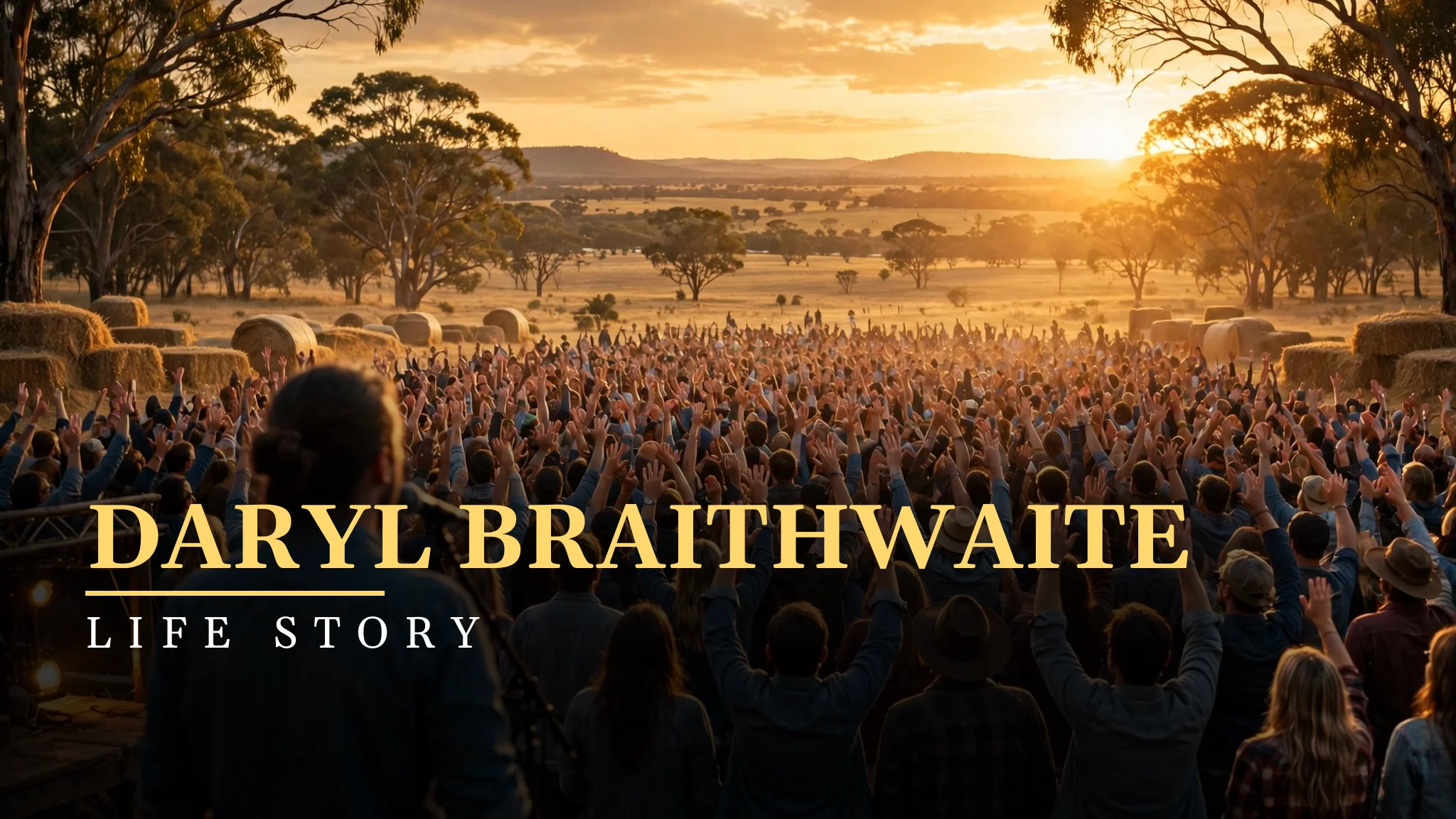
Stand in a Braithwaite audience when “The Horses” begins and you will see the answer to that question in real time. Hands go up before the first chorus. People who have never met sing the same words at the same moment, and for three or four minutes a room full of strangers sounds like one voice. Few songs can do that, and fewer singers can make it happen on demand, night after night, year after year. The effect does not come from volume or from stage tricks. It comes from a voice that invites joining in, and from a chorus that is built like a staircase, rising a little higher with each line until the whole crowd is standing on the top step together.
The rest of his catalogue explains why the crowd stays for the whole show rather than waiting for one song. “Howzat” brings back the seventies, the cricket summers, and the bright pop of Sherbet. “Summer Love” and “You’re My World” carry the same warmth. “One Summer” and “As the Days Go By” show the solo singer at his most personal. Put together, they add up to a set that covers two careers, two decades of hits, and a voice that has not thinned with age. That range is rare. Plenty of singers have one great decade. Braithwaite has two, separated by a spell of digging roads, and the second one produced the song that outlived them both.
His place in Australian music now rests on three facts that are easy to state and hard to match. He fronted a band that scored twenty Top 40 singles and became the first Australian group to pass a million dollars in sales. He rebuilt himself as a solo act with two four-times-platinum albums and a number one single. And he gave the country a chorus that sporting teams, wedding guests, and stadium crowds have all adopted as their own. The voice that started the story was trained in a dockyard, not a music school, and it still sounds like a man who is glad to be singing. That gladness, more than any award, is what the crowds keep coming back for.
Sherbet, too, has refused to stay in the past. The band has come back together on stage in the years since the 1984 split, with Braithwaite back at the front for reunion and anniversary dates, and the old songs have proved sturdier than anyone expected. Hearing “Summer Love” or “Howzat” played by the men who first recorded them, decades later, gives those songs a weight that a tribute band could never match. The reunions also say something about the band itself. Groups that fall apart in anger rarely share a stage again. Sherbet’s members kept enough goodwill, and enough pride in what they had built together, to return to it. For audiences, the reunions offer a rare thing: the chance to hear a seventies band play its hits with the original singer, in the same voice that carried them up the charts the first time around. Braithwaite treats those nights as celebrations rather than history lessons, and the crowds respond in kind, singing choruses they first learned as teenagers and have now taught to their own children.
My Take:
I keep coming back to the dockyard. That is the part of Daryl Braithwaite’s story that stays with me longest, more than the number one singles, more than the Hall of Fame night, more than the stadium sing-alongs. A young man spends four and a half years learning fitting and turning at Cockatoo Island, qualifies, and then walks away from a safe trade to sing in a pop band. Then, fourteen years later, when the band is gone and the club gigs are miserable, he digs roads in Sunbury for a living. Twice in his life he has stood at a fork in the road where the safe, ordinary option was right there in front of him, and twice he chose the uncertain one. I admire that, because most of us only get one such choice in a lifetime, and most of us take the safe road. Braithwaite took the risky road twice, and the second time he had a wife and a reputation to protect, which makes it braver, not easier.
What strikes me about the Sunbury weeks is how little bitterness there is in the way he tells the story. He does not dress it up as a tragedy, and he does not pretend it never happened. He says he was on the dole for four or five weeks, the office found him road work, and the experience taught him that he did not want to do that for the rest of his life. That is it. No self-pity, no blaming the record industry, no grand speech about being misunderstood. Just a plain fact and a plain decision. I think that plainness is the key to his whole character. He is not a singer who wraps himself in mystery. He is a tradesman who sings, and he talks about his life the way a tradesman talks about a job: what happened, what he learned, what he did next.
The comeback that followed is, for me, the most instructive part of the story, because it was not a comeback handed to him. He and Sarah put the money together, brought in investors, recorded “Edge”, and then sold the finished album to Sony. Think about what that means. He did not wait for a label to believe in him. He believed in himself first, with his own money and his friends’ money on the line, and then asked the label to buy something that already existed. That is a completely different kind of courage from the courage of a twenty-one-year-old joining a band. A young singer risks nothing much; if it fails, he is still young. A thirty-nine-year-old risking his own money on his own voice is betting on himself when the world has already stopped betting. I want to remember that the next time I hear someone say it is too late to start again. Braithwaite was nearly forty, out of a band, out of fashion, and digging roads, and he still found a way back to number one.
I also find myself thinking a lot about “The Horses”, and about the honesty of a singer who is famous for a song he did not write. Some singers would hide that fact, or blur it, or let the audience assume the song was theirs. Braithwaite has never done that. He tells interviewers plainly that Rickie Lee Jones and Walter Becker wrote it, that Jones wrote it about her daughter, and that he only spoke to Jones about it for the first time in 2017. He also tells them that he would rather be remembered for “One Summer”, a song he did write, about a friend of his. There is something deeply likeable about that honesty. He is not trying to steal the credit. He is saying, in effect: I did not write this song, but I knew it was mine to sing, and I sang it well. That distinction, between writing and singing, is one that pop music often gets wrong. A great singer is not a failed songwriter. A great singer is a person who hears what a song needs and gives it. Braithwaite gave “The Horses” a lift and a warmth that the song needed, and the country has been thanking him for it for more than thirty years.
What he heard in the song interests me too. He has said it is not about horse racing, and not really about horses at all, but about an image of rising up into the sky and floating free. That is a strange, dreamlike reading of a pop song, and it tells me that he listened to the song the way a singer should listen: not for the literal story, but for the feeling underneath it. A lesser singer would have sung it as a song about horses and left it at that. Braithwaite sang it as a song about freedom, and that is why it works at weddings and grand finals and parties, in rooms where nobody is thinking about horses. They are thinking about the feeling of being lifted, of being free, of being young, and his voice carries that feeling straight to them.
Then there is the question of the two peaks, and what they say about a long career. Most pop singers get one. Braithwaite got two, fifteen years apart, in two different shapes. The first was a band peak, built on harmonies, bright choruses, and the energy of five young men on stage together. The second was a solo peak, built on one voice, a few carefully chosen songs, and the trust of an audience that had grown up with him. The two peaks sound different, and they should. A singer at twenty-one and a singer at forty are not the same person, and Braithwaite did not pretend they were. He let the solo records sound older, warmer, and more patient than the Sherbet singles, and the audience followed him. I think that is a lesson about ageing in public. You do not have to chase your younger self. You can let the work change as you change, and the people who loved the early work will often love the later work too, if it is honest.
I think about the memes as well, because they could have been cruel and they were not. The internet decided that “The Horses” was funny, in the way that a song everybody knows is funny, and Braithwaite took the joke with grace. He understood that being memed is, in a strange way, a compliment. It means the song has passed out of the charts and into the shared language of a country, where people can joke about it because they all know it. A singer who fights that would look bitter. Braithwaite laughed, kept singing it, and then sang it with Harry Styles in front of a stadium of young people in 2023. That moment matters to me. A seventy-four-year-old singer sharing a stage with one of the biggest pop stars in the world, singing a song from 1991, and the crowd knowing every word: that is not nostalgia. That is a song still doing its job.
The Hall of Fame induction in 2017 is another moment I keep returning to, because of its timing. It came when he was sixty-eight and still touring, not after he had stopped. Jimmy Barnes presented him, at the Star Event Centre in Sydney, and the citation covered both halves of the career, Sherbet and solo. Too many honours arrive when the artist can no longer enjoy them, or when the audience has already moved on. This one arrived while Braithwaite was still on stage every week, still meeting the crowds, still able to hear them sing back. I am glad it happened that way. A lifetime achievement award should feel like a party the artist is actually at, not a plaque on a wall.
For a young reader, I think the most useful lesson in this story is not about music at all. It is about the value of having a trade, a skill, a fallback. Braithwaite learned fitting and turning, finished it, and carried that knowledge with him. It did not make him a worse singer. It made him a steadier one, because he knew he could earn a living another way if he had to. And when he did have to, in Sunbury, he did it without shame. That is a kind of freedom that pure fame never gives you. If your only skill is being famous, then losing fame is losing everything. If you have a trade, or a craft, or a second way of earning, then a setback is a setback, not a disaster. I wish more young people heard that message.
There is also a quieter lesson about choosing songs, or choosing work, that I take from “Edge”. Braithwaite did not write all the songs on that album. He chose them. “As the Days Go By”, “All I Do”, “Let Me Be”, “One Summer”: four singles, four different moods, all of them suited to his voice. Choosing well is a skill, and it is a skill that gets too little respect. We celebrate writers, and we forget the singers, actors, and performers whose judgement turns a good piece of writing into something the public loves. Braithwaite’s judgement, across fifty years, has been remarkably steady. He picked “Howzat” as a band single, he picked “The Horses” as a solo single, and both times he was right.
I also want to say something about Sarah, his wife, because her role in the comeback is easy to miss and should not be. Braithwaite has said plainly that the “Edge” sessions came together with a lot of help from her and a handful of other people. Behind many comebacks there is a partner who keeps the faith when the industry has moved on, who handles the practical things, who says the words that keep a singer going. She did that, and the record that followed went to number one. I do not know the details of their life together, and I should not pretend I do, but I can say that a comeback built with a partner’s help is a different kind of success from one built alone. It belongs to two people, even if only one name is on the cover.
If I have a sadness in this story, it is only that the Sherbet years are now so far away that young listeners know the band mainly through their parents’ records. The band scored twenty Top 40 singles, they were the first Australian group to pass a million dollars in sales, and they were regulars on “Countdown” at a time when that show decided what the country heard. That scale of success is hard to picture now, when music comes in a thousand fragments and no single show holds the nation’s attention. I hope young listeners will go back and hear “Summer Love” and “Cassandra” and “You’re My World”, not just “Howzat” and “The Horses”, because the full picture of Braithwaite is a singer with a long, bright catalogue, not a man with two songs.
In the end, I think his story comes down to three things: a voice, a work ethic, and a willingness to begin again. The voice is the gift. The work ethic came from the dockyard and the road crew. The willingness to begin again is the rarest of the three, and he has shown it twice. He began as a singer after finishing a trade. He began again as a solo artist after digging roads. Each time, he came back stronger. That is why I do not worry about him retiring. A man who has started over twice does not stop easily. And as long as he keeps singing, Australian crowds will keep standing up, raising their hands, and singing the chorus back to him, because they are not just singing a song. They are singing along with a life.
One more thought stays with me, and it is about the image at the heart of “The Horses”: rising up into the sky, floating free. Braithwaite has lived that image in his own way. He rose out of the dockyard, out of the band, out of the road crew, and into a career that has now lasted more than half a century. He did not rise once. He rose again and again, each time a little higher, each time carrying a new audience with him. That is a good image for a life in music, and it is a good image for any life. Keep rising, keep singing, and do not be afraid to start again.
Frequently Asked Questions
Who is Daryl Braithwaite?
He is an Australian singer, born in Melbourne on 11 January 1949, who first became known as the frontman of Sherbet and later as a solo star. Before music took over, he finished a fitting and turning apprenticeship at the Cockatoo Island dockyards in Sydney. His two best-known songs are “Howzat” with Sherbet and “The Horses” as a solo singer.
What is Daryl Braithwaite’s most famous song?
“The Horses”, released as a single in January 1991, is the song he is most associated with. It reached number one in Australia and went four times platinum. He did not write it; Rickie Lee Jones and Walter Becker did, and Jones wrote it about her daughter. Braithwaite’s version turned it into a crowd anthem that Australian audiences still sing word for word.
What band was Daryl Braithwaite in?
He joined Sherbet in March 1970, at twenty-one, and stayed with the band until it ended in 1984. Sherbet scored twenty Top 40 singles in Australia during the 1970s, including the number ones “You’re My World” in 1974, “Summer Love” in 1975, and “Howzat” in 1976. The band also recorded overseas under the name Highway.
What is Howzat about?
“Howzat” takes its title from the appeal a cricket fielder shouts to the umpire, and turns it into a bright pop chorus about a summer game. Garth Porter and Tony Mitchell, two of Braithwaite’s bandmates in Sherbet, wrote it. It reached number one in Australia in 1976 and number two in Britain.
What albums has Daryl Braithwaite released as a solo singer?
His comeback album “Edge” came out in November 1988 and reached number one on the ARIA Albums Chart, going four times platinum. “Rise” followed in 1990 and finished 1991 as Australia’s biggest-selling album of the year. Later solo records include “Snapshot”, “Afterglow”, “Forever the Tourist”, and “The Lemon Tree”.
Was Daryl Braithwaite inducted into the ARIA Hall of Fame?
Yes, on 28 November 2017, at the Star Event Centre in Sydney, with Jimmy Barnes presenting him. The induction covered both halves of his career: his years fronting Sherbet and his solo success with “Edge”, “Rise”, and “The Horses”. A greatest-hits collection, “Days Go By”, came out in the same month.
Why is Daryl Braithwaite important to Australia?
He connects two eras of Australian pop: the Sherbet hit years of the 1970s and the solo comeback of the late 1980s and early 1990s. “The Horses” has gone beyond the charts into sporting change rooms, grand finals, weddings, and parties across the country. His career also shows a rare second act, rebuilt after the band ended, a spell on the dole, and road work in Sunbury.


