David Robinson: The Life Story Behind Basketball's Admiral
In this post
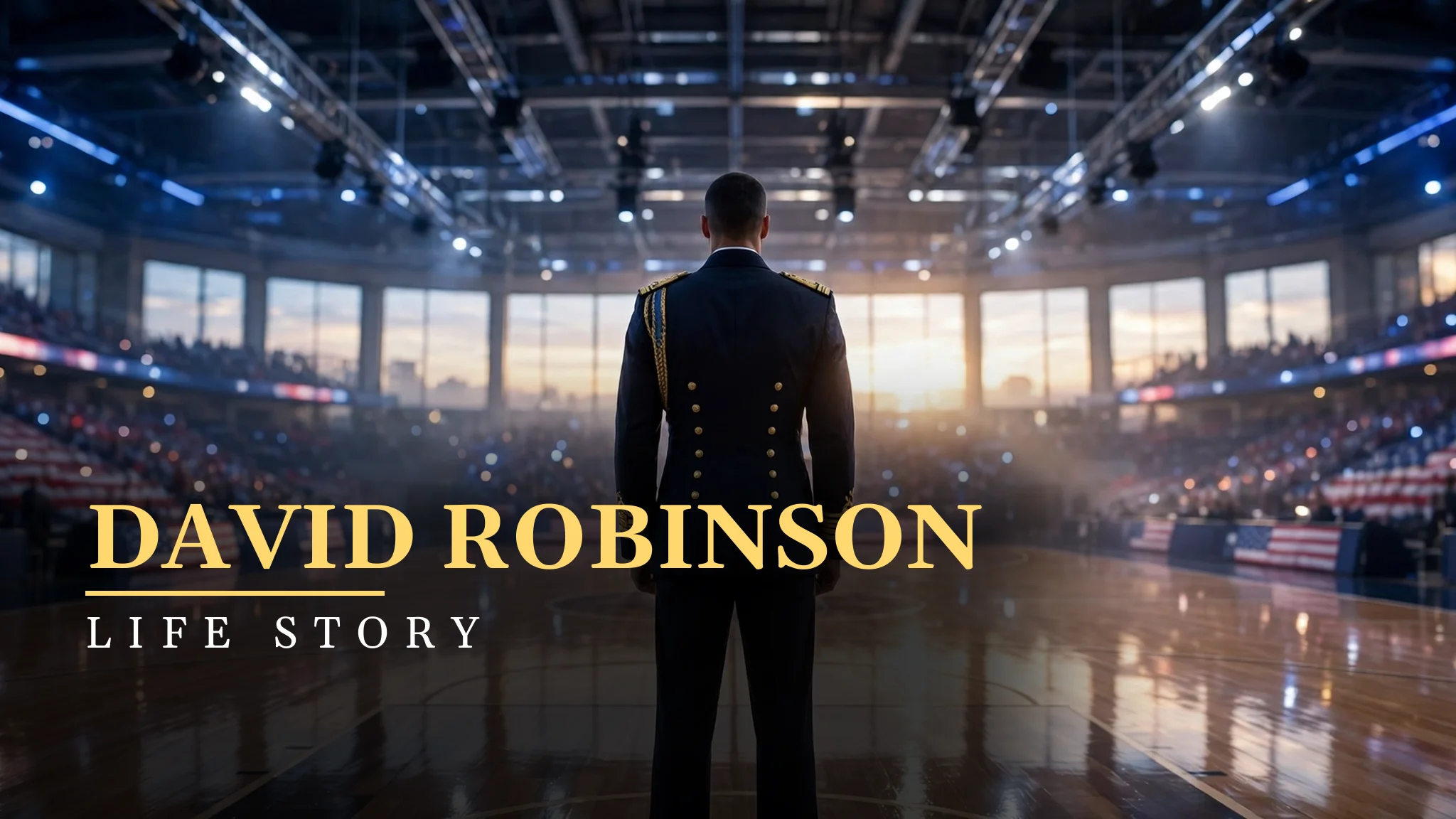
David Robinson is known by a nickname that tells you almost everything about him: “The Admiral”. It is a nickname he earned honestly, because before he became one of the greatest basketball players of his generation, he was a midshipman at the United States Naval Academy, training to become an officer in the United States Navy. He did not grow up dreaming only of basketball. He grew up in a military family, moving from place to place, learning discipline and duty, and when he finally grew tall enough to play the game seriously, he brought the values of the Navy with him onto the court. He was polite, he was hard-working, he was humble, and he played the game the way an officer would: with preparation, with control, and with respect for everyone around him.
His basketball story is unusual in almost every way. He did not play organised basketball until he was nearly grown, and he was not tall as a young teenager. He was five feet nine inches when he started high school, and coaches did not look at him twice. Then he grew, and grew, and grew again, until he stood seven feet one inch tall, and the boy who had been too small became one of the biggest and fastest players the game had ever seen. He went to the Naval Academy, where he studied mathematics and became one of the best college players in America, and then he did something almost no other star has ever done: he put his basketball career on hold for two years to serve his country, because that was the duty he had promised to fulfil.
When he finally joined the San Antonio Spurs in 1989, he changed the team at once, and over the next fourteen seasons he became its heart: Rookie of the Year, Most Valuable Player, Defensive Player of the Year, a scoring champion, an Olympic gold medallist, and, at the end, a two-time NBA champion alongside Tim Duncan. And when his playing days were over, he did not walk away from the world. He built a school for children in San Antonio, he gave away millions of dollars, and he showed that the Admiral was not only a nickname for the court, but a way of living.
A Navy Childhood and a Late Start
David Maurice Robinson was born on 6 August 1965 in Key West, Florida, where his father, Ambrose Robinson, was serving in the United States Navy. His mother, Freda, raised David and his younger siblings while the family moved from one naval base to another, living in places across the United States as his father’s postings changed. It was a life of new schools, new friends, and new towns, and it taught David early how to adapt, how to be polite to strangers, and how to work hard without complaining. The family was close, and faith was important in the home, and David grew up with a sense of duty that stayed with him for the rest of his life.
As a young boy, David was not tall. He was an ordinary-sized child, and he played many sports, but basketball was not the one that stood out. He played American football and baseball, and he was good at them, but nobody looked at him and saw a future basketball star. When he started high school, he was only five feet nine inches tall, and he tried out for the school basketball team and did not make it in the way he hoped. It was a disappointment, but it did not break him, because he had other interests, and because his family had taught him that a setback is not the end of a story.
Then, in his last years of school, he began to grow. He grew several inches in a short time, and by the time he finished high school in Woodbridge, Virginia, he was six feet seven inches tall. Suddenly, the boy who had been too small for basketball was tall enough to play it seriously, and coaches began to notice him. But his growth had come late, and the big college basketball programmes had already chosen their players, so Robinson’s options were limited. He was a good student, especially in mathematics and science, and his father suggested that he look at the service academies, where he could get a fine education and serve his country at the same time.
He chose the United States Naval Academy in Annapolis, Maryland, a place where the rules were strict, the days were long, and the standards were high. It was not a school for young men who wanted an easy life. It was a school for young men who wanted to lead, and Robinson, with his height, his intelligence, and his calm manner, was exactly the kind of student the Academy wanted. He arrived in 1983, and he kept growing, until he stood seven feet tall, and the basketball coaches at the Academy realised that they had something extraordinary on their hands.
The Naval Academy and a Seven-Foot Midshipman
At the Naval Academy, Robinson lived the life of a midshipman, waking early, attending classes, drilling, and studying, and playing basketball in the time that was left. It was a demanding life, and it made him stronger in every way. He studied mathematics, a subject he loved, and he learned to think clearly under pressure, a skill that would help him on the basketball court as much as it helped him in the classroom. He also learned the values of the Navy: honour, courage, and commitment, words that were not just painted on a wall at the Academy, but lived every day by the men and women around him.
On the court, he became a star. He was tall, but he was also fast, and he could run the floor like a much smaller player, block shots, rebound, and score with a soft touch around the basket. In his junior year, he led the Navy team to the Elite Eight of the NCAA tournament, a remarkable achievement for a service academy, and he was named one of the best players in the country. In his senior year, he was even better, averaging more than twenty points and more than ten rebounds a game, and winning almost every individual award in college basketball. He was a young man who had come to the Academy to become an officer, and he was leaving it as one of the most famous college players in America.
The problem was his duty. Every midshipman at the Naval Academy owes the Navy years of service after graduation, and for most graduates that means five years of active duty. Robinson’s height made him unusual: the Navy had a rule that officers could not be taller than six feet six inches for service on ships and submarines, and Robinson, at seven feet one inch, was far too tall. The Navy agreed to let him serve for two years instead of five, working on shore, and then to let him play professional basketball. It was a fair solution, and Robinson accepted it with gratitude, because he understood that the Navy had given him an education and a future, and that he owed it something in return.
In 1987, while he was still at the Academy, the San Antonio Spurs selected him with the first overall pick in the NBA draft, even though they knew they would have to wait two years for him to finish his service. It was a remarkable show of faith by the team, and it was a remarkable show of patience by Robinson, who spent the next two years serving as a naval officer while the whole basketball world waited for him. He worked in civil engineering, he learned about leadership in a real workplace, and he grew up in a way that no other young basketball star ever has.
Waiting Two Years: Service Before Stardom
The two years Robinson spent in the Navy were not a pause in his life. They were a part of it, and they shaped the player and the man he became. He was stationed at a naval base, and he worked as a civil engineer, helping to plan and build the things a base needs to function. He wore the uniform, he followed orders, and he learned what it means to be responsible for other people, not only for yourself. It was a life far from the bright lights of the NBA, and it gave him a sense of perspective that most young athletes never get. He learned that basketball was a gift, not a right, and that the world was bigger than a court.
During those two years, he also played basketball for the Navy and for the United States national team. In 1988, he played in the Olympic Games in Seoul, South Korea, and he won a bronze medal with the American team, a team that lost to the Soviet Union in the semi-final. It was a disappointment, but it was also an education, because it showed him the level of the best players in the world, and it gave him a taste of international competition. He also played in exhibition games and in tournaments, keeping his skills sharp while he waited for his professional career to begin.
The Spurs waited patiently, and the fans in San Antonio waited too, hearing stories about the seven-foot naval officer who would one day come and save their team. The team had been struggling, and the city needed hope, and Robinson became that hope before he had played a single professional game. When his service ended in the spring of 1989, he was ready. He had kept himself fit, he had kept his skills sharp, and he had kept his humility, and he arrived in San Antonio as a 24-year-old rookie, older and wiser than any rookie the league had seen in years, and ready to lead.
His time in the Navy also gave him something else: a deep respect for service and for sacrifice, and a belief that a person who has been given much should give much back. That belief would shape the second half of his life, when he used his money and his fame to build schools and to help children, and when he spoke about leadership not as a way to get what you want, but as a way to serve the people around you. The Admiral was not a nickname he wore for show. It was a life he had lived.
Rookie of the Year and the Spurs Reborn
Robinson joined the Spurs for the 1989-90 season, and the change was immediate. The team, which had won only 21 games the year before, won 56 games with Robinson, a turnaround that was one of the biggest in NBA history. He averaged 24 points, 12 rebounds, and nearly four blocked shots a game, numbers that no rookie had put up in years, and he was named the Rookie of the Year by a wide margin. He was also named an All-Star in his first season, and he was named to the All-Defensive team, because coaches understood at once that his defence was as important as his scoring.
What made Robinson different from other great centres was his speed and his grace. He could run the floor like a guard, he could jump over other big men, and he could score with either hand around the basket. He was also a fine free-throw shooter for a big man, and he took his free throws with the same calm he brought to everything else. Opponents found him hard to guard, because he was too fast for the big men and too tall for the small men, and he was hard to score against, because his long arms seemed to be everywhere at once. He was, in the words of many who played against him, a player with no clear weakness.
In the years that followed, Robinson became the face of the Spurs, and one of the best players in the league. He was named the Defensive Player of the Year in 1992, and he was named the Most Valuable Player in 1995, after a season in which he averaged 27 points and 11 rebounds a game. In 1994, he won the scoring title, and in the last game of that season, against the Los Angeles Clippers, he scored 71 points, one of the highest single-game totals in NBA history, a performance that showed the whole league what he could do when he was at his best. He was named an All-Star ten times, and he was named to the All-NBA and All-Defensive teams many times, and he became one of the most respected players in the game.
But for all his individual success, the team success did not come at once. The Spurs reached the playoffs every year, but they lost in the early rounds again and again, and Robinson began to hear the same criticism that follows every great player who has not won a title: that he was too nice, that he was not tough enough, that he could not lead a team to a championship. Those words hurt him, because he was a competitor, and because he wanted to win as much as anyone. But he did not change who he was. He kept working, he kept leading by example, and he waited for the right teammate to arrive, a teammate who would help him carry the load.
Tim Duncan, the Twin Towers, and Two Titles
That teammate arrived in 1997, when the Spurs drafted Tim Duncan, a young forward from Wake Forest University who was, like Robinson, quiet, hard-working, and humble. The two men became known as the Twin Towers, because they were both tall, both skilled, and both impossible to guard at the same time. Duncan was a brilliant low-post player, and Robinson was a fast, athletic centre, and together they gave the Spurs a front line that no team in the league could match. They also shared a way of living: both men were modest, both men put the team first, and both men avoided the spotlight. The Spurs became a team built on those values, and the city of San Antonio loved them for it.
In the 1998-99 season, a season shortened by a labour dispute, the Spurs finally broke through. They played superb basketball in the playoffs, and in the NBA Finals they beat the New York Knicks in five games to win the first championship in the history of the franchise. Robinson was 33 years old, and he had waited ten seasons for that moment, and when the final whistle sounded, he was emotional, because he knew how long the road had been. He had heard the criticism for years, and he had carried it without complaint, and now he had answered it in the best way possible: by winning.
The second title came in 2003, in Robinson’s final season. He was 37 years old, his knees were sore, and his role had changed. Duncan was now the best player on the team, and Robinson was the veteran, the leader, the man who did the hard work and set the example. The Spurs beat the New Jersey Nets in the Finals in six games, and Robinson’s last game was a championship game, a perfect ending to a career that had begun with two years of waiting. He retired as a champion, and he retired knowing that he had helped to build something that would last: a team culture based on humility, hard work, and trust, a culture that would go on to win more titles long after he had gone.
The partnership with Duncan was one of the great partnerships in basketball history, not only because of what they won, but because of how they won it. They did not argue, they did not compete with each other for attention, and they did not try to be the star. They shared the work, they shared the credit, and they shared the joy. Robinson has often said that Duncan made him a better player, and Duncan has said the same about Robinson. It was a friendship as much as a partnership, and it is a model for how two great players can work together without ego getting in the way.
Olympic Gold and the Dream Team
Robinson’s international career was also remarkable, and it gave him some of the proudest moments of his life. He played for the United States at the 1988 Olympics in Seoul, winning a bronze medal, and then he played for the famous Dream Team at the 1992 Olympics in Barcelona, a team that is widely regarded as the greatest basketball team ever assembled. That team included Michael Jordan, Magic Johnson, Larry Bird, Charles Barkley, and other legends, and Robinson was one of the centres, playing alongside Patrick Ewing. The Dream Team won the gold medal easily, beating every opponent by a wide margin, and Robinson’s presence on that team was a sign of how highly he was regarded by the best players in the world.
He won a second Olympic gold medal at the 1996 Games in Atlanta, playing on home soil in front of American crowds, and that medal meant a great deal to him, because it came after the disappointment of 1988, and because it was won in his own country. He played in three Olympic Games in total, winning two gold medals and one bronze, and he represented his country with the same pride and discipline he had shown as a naval officer. For a man who had served in the Navy, wearing the uniform of the United States on a basketball court was a natural extension of wearing the uniform of the Navy, and he took both duties seriously.
The Dream Team changed basketball around the world, because it showed millions of people in other countries what the game could look like at its best, and it inspired a generation of young players in Europe, Asia, and South America to take up the sport. Robinson was part of that change, and he understood its importance, because he had seen, as a naval officer, how sport can bring people together across borders. He was proud to be part of it, and he was proud to have represented his country, and those Olympic memories stayed with him long after his NBA career had ended.
The Carver Academy and a Life of Giving
When Robinson retired in 2003, he did not retire from work. He turned his energy to the thing that had always mattered most to him: helping children. In San Antonio, he founded the Carver Academy, a school for children from poor families, named after George Washington Carver, the scientist and educator. The school gave children a safe place to learn, with small classes, caring teachers, and a focus on character as well as on lessons. Robinson gave millions of dollars of his own money to the school, and he spent time there himself, talking to the children, encouraging them, and showing them that a man who had been given much could give much back.
His giving went far beyond one school. He gave away a large part of his fortune to charity, and he set up a fund with the money he earned from his business ventures, using the profits to help children and families in need. He has spoken about his faith as the reason for his giving, and about his belief that wealth is not something to keep, but something to use for good. He did not give for praise, and he did not give for attention. He gave because he believed it was the right thing to do, and because he remembered the values he had learned at the Naval Academy: that leadership means service, and that service means putting other people first.
He was inducted into the Basketball Hall of Fame in 2009, in a ceremony that honoured his playing career and his character. He was also honoured by the NBA with awards for his community work, and he has been held up as an example of what a professional athlete can be. In San Antonio, his name is spoken with a respect that goes beyond basketball, because the people of the city know what he did for their children, and because they know that he stayed in the city after he retired, and that he kept working for them.
Today, Robinson lives in San Antonio with his wife, Valerie, and their three sons, and he remains involved in business, in charity, and in the life of the city. He is a man who has lived three lives in one: a naval officer, a basketball champion, and a giver, and he has lived each of them with the same quiet discipline. His story is not only about points and rebounds. It is about what a person can do when talent is joined to character, and when success is used not for oneself, but for others.
My Take:
I think David Robinson is the player I admire most in the whole history of basketball, and I say that knowing how many great players there have been. I admire him not only because he was a wonderful player, but because he was a wonderful man, and because the two things were joined together in him in a way that is rare. Most great athletes are great at one thing, and ordinary, or even careless, in the rest of their lives. Robinson was great at basketball, and he was also great at the things that matter more: duty, humility, generosity, and service. That is why I think his story should be told to young people, not only to young basketball players, but to any young person who wants to know what a good life looks like.
The first thing that strikes me about Robinson is that he waited. He was picked first in the draft in 1987, and he could have demanded to play at once, and many young players would have done exactly that. He did not. He went and served his country for two years, because that was the promise he had made, and because he believed that a promise matters more than a pay cheque. I think about that a lot, because we live in a world where people break promises easily, and where money is often treated as the most important thing. Robinson showed a different way. He showed that a man’s word is worth more than a contract, and that duty is not an old-fashioned idea, but a living one. I respect that more than any dunk or any blocked shot.
I also think about how late he started, and what that teaches us. He was five feet nine inches when he started high school. He did not make the team in the way he hoped. He was not a child star. He was not a boy that scouts followed from the age of twelve. He grew late, and he learned late, and he still became one of the greatest centres who ever played the game. That tells me that it is never too late to find your gift, and that the people who are written off early in life can still surprise the world. I think about all the children who are told they are too small, or too slow, or too late, and I want them to hear Robinson’s story, because it tells them that growth comes at different times for different people, and that patience is a kind of talent too.
What I love most about his game is that he played it the right way. He did not trash-talk. He did not show off. He did not argue with referees. He ran the floor, he defended, he rebounded, he scored, and he went home. He treated his opponents with respect, and he treated the game with respect, and the game respected him back. I think that matters, because sport is not only about winning. It is about how you win, and about the example you set for the people who are watching. Young players who watched Robinson learned that you can be fierce without being cruel, and that you can be competitive without being rude, and that is a lesson that stays with a person long after the game is over.
The partnership with Tim Duncan is the part of his story that I find most beautiful, because it shows what happens when two good men decide to work together instead of competing with each other. Robinson was the star of the Spurs for ten years, and then Duncan arrived, and Robinson stepped back and let the younger man lead, without jealousy, without bitterness, and without a public word of complaint. How many stars in any field could do that? How many people could give up the centre of the stage and be happy to stand at the side, doing the hard work, so that the team could win? Robinson did it, and the team won two championships because of it, and I think that selflessness is the highest form of leadership there is. It is easy to lead when you are the star. It is much harder to lead when you are no longer the star, and Robinson led in both ways.
I also think about the criticism he faced, and how unfair it was. People said he was too nice to win a championship, as if kindness were a weakness. They said he was soft, as if humility were the same as fear. They said he could not lead a team to a title, as if one man could win a championship on his own. Those words were wrong, and they were cruel, and they were said by people who did not understand the man they were talking about. Robinson answered them in the only way that matters: he kept working, he kept leading, and when the right team came together, he won. He did not answer with words. He answered with a championship, and then with another one, and I think that is the best answer of all.
His charity work is the part of his life that I think about most, because it is the part that will last the longest. Points are forgotten. Records are broken. Championships are won by new teams every year. But a school is different. A school changes children’s lives, and those children grow up and change other lives, and the good goes on long after the man who started it is gone. Robinson gave millions of dollars to build a school for poor children in San Antonio, and he gave his time as well, and he did it quietly, without asking for praise. I think that is the mark of a truly great person: that he used his wealth not to buy more things for himself, but to give children a chance he had been lucky enough to have. I wish more rich athletes would do the same, and I wish more rich people of any kind would do the same.
There is a lesson in Robinson’s life about the meaning of success, and I want to say it plainly. Success is not only about what you earn. It is about what you give. Robinson earned a great deal: money, fame, awards, championships. But he gave a great deal too, and the giving is what makes his story different from the stories of other stars. I think about young players today who earn more money in a single season than Robinson earned in his whole career, and I wonder what they will do with it. I hope some of them look at Robinson and see that the greatest use of wealth is not to show it off, but to share it, and that the greatest use of fame is not to enjoy it, but to use it to help people who have no fame at all.
I also admire his faith, and I say that with respect, because faith was clearly the centre of his life, and it guided his decisions in a way that I find moving. He did not use his faith to judge other people, and he did not use it to make himself look good. He used it quietly, to guide his own choices, to stay humble when he was famous, and to stay generous when he was rich. I think that is what faith should do, and I think Robinson is an example of a man whose beliefs made him better, not prouder. That is a rare thing, and it is worth noticing.
If I could speak to a young person who is reading this, I would tell them to look at Robinson’s whole life, not only his basketball career, and to ask themselves what kind of person they want to be. Do you want to be famous, or do you want to be good? Do you want to be rich, or do you want to be useful? Robinson was famous and rich, but he was also good and useful, and he chose to be good and useful first. That choice is available to all of us, whether we are tall or short, rich or poor, famous or unknown. We can all serve someone. We can all give something. We can all keep a promise, even when it costs us something. That is the lesson of the Admiral, and it is a lesson that will still matter long after the last basketball has been bounced.
In the end, I think David Robinson’s story is the story of a man who understood that basketball was only a part of his life, and not the whole of it. The Navy taught him duty. Basketball taught him excellence. And his faith taught him generosity. He put those three things together, and he lived a life that was bigger than any single achievement. When I think about him, I do not only think about the 71-point game, or the MVP award, or the championships, although all of those were wonderful. I think about a school in San Antonio, full of children who might never have had a chance, learning because a tall, quiet man from the Navy decided to help them. That is what I will remember about David Robinson, and that is why I think he is the finest player the game has ever produced.
I also want to add one more thought, because I think it matters for anyone who is reading this and feeling small. Robinson was small once. He was five feet nine inches, and he was not chosen, and he was not noticed, and he could have given up on basketball entirely. He did not give up. He kept studying, he kept working, and when his body grew, he was ready. I think many of us feel small in some way, not tall enough, not rich enough, not clever enough, not lucky enough, and Robinson’s story tells us that small is not the end. Small is only the beginning, if you are willing to wait, and to work, and to keep your character strong while you wait. That is a message I want every reader to carry away from this story.
And finally, I think about the name they gave him, The Admiral, and how perfectly it fits him, not because he wore a uniform, but because he lived like an officer in the best sense of the word. An admiral does not only command. An admiral serves. An admiral looks after the people under his command. An admiral puts the mission before himself. Robinson did all of those things, on the court and off it, and he did them without asking for thanks. I think the world needs more admirals like him, in basketball and in every other part of life, and I am glad that his story is still being told.
I also keep coming back to the 71-point game, because it shows a side of Robinson that people sometimes miss. He is remembered as a gentle man, and he was, but on that night in 1994 he was also a fierce competitor who wanted to win the scoring title, and who went out and took it with one of the great scoring performances in the history of the game. That tells me that kindness and competitiveness are not opposites. You can be a kind man and still want to win badly. You can be humble and still believe you are the best player on the court. Robinson held both of those things together, and I think that is why his teammates trusted him so much: they knew he was gentle with them, and they knew he was ruthless with opponents, and they knew both things were real.
There is another lesson in his story that I want to name clearly, and it is about how a team should be built. The Spurs became the most respected team in the league not by buying stars or by shouting the loudest, but by choosing good men, by teaching them to work together, and by letting them grow slowly. Robinson was the foundation of that culture, and Duncan carried it on, and the team kept winning for twenty years because of it. I think every organisation, in sport or in business or in any part of life, could learn from that. Choose good people, treat them well, give them time, and let them lead each other. It is slower than buying success, but it lasts longer, and Robinson proved it.
One last thought stays with me, and it is about the two years in the Navy. Most people would call those two years a delay, a waste of time, a pause before the real career began. I think they were the most important two years of his life, because they taught him who he was before basketball made him famous. He learned to serve, to lead, and to live without applause, and when the applause finally came, it did not change him. That is the danger of fame: it arrives early, and it tells a young person that they are special, before they have learned how to be ordinary. Robinson learned how to be ordinary first, in a uniform, doing a job, and that is why fame never spoiled him. I wish more young stars could have two years like that, away from the cameras, learning who they are.
Frequently Asked Questions
Why was David Robinson called The Admiral?
He earned the nickname because he attended the United States Naval Academy and served as an officer in the United States Navy before joining the NBA.
Why did David Robinson wait two years before joining the NBA?
He had to complete two years of active naval service after graduating from the Naval Academy, as the Navy allowed him a shorter service period because his height made ship duty impossible.
How many NBA championships did David Robinson win?
He won two NBA championships with the San Antonio Spurs, in 1999 against the New York Knicks and in 2003 against the New Jersey Nets, in his final season.
What was David Robinson’s highest scoring game?
He scored 71 points against the Los Angeles Clippers in the final game of the 1993-94 season, a performance that secured the league scoring title for him that year.
Who were the Twin Towers?
The Twin Towers were David Robinson and Tim Duncan, the two tall stars of the San Antonio Spurs whose partnership brought the team its first championships.
What school did David Robinson found in San Antonio?
He founded the Carver Academy, a school for children from low-income families in San Antonio, to which he gave millions of dollars of his own money.


