Debra Winger: The Life Story Behind Hollywood's Fiery Star
In this post
- A Cleveland Girl in California
- Wonder Woman, Slumber Party, and the First Steps
- Urban Cowboy and a Breakthrough
- An Officer and a Gentleman and Terms of Endearment
- Shadowlands, a Third Nomination, and Walking Away
- Rachel Getting Married and a Return
- Cannery Row, Black Widow, and the 1980s
- Patriot, The Ranch, and the Later Years
- The Lovers, Kajillionaire, and the Later Years
- My Take:
Debra Winger is one of the fiercest actresses Hollywood has ever known. She does not act like a movie star. She acts like a real woman, with real anger, real love, and real pain, and she brings that truth to every role she plays. She was nominated for three Academy Awards, she played some of the most loved women in American film, and then she walked away from Hollywood at the height of her fame, because she refused to play by its rules. That walk-away is as famous as her films.
She came from Cleveland, from a family that ran a meat-packing business, and she grew up in California, where she dreamed of a different life. She worked on a kibbutz in Israel, she studied acting, and she built a career that took her from a small part in a film about a roller-skating waitress to the biggest films of the 1980s.
Her story runs from Ohio to Hollywood, from a cowgirl in Texas to a naval officer’s wife to a mother dying of cancer, and from the top of the film world to a quiet life on a farm, and then back again. It is the story of a brave, honest woman who chose her own life over fame, and who paid a price for that choice, and who never regretted it.
A Cleveland Girl in California
Debra Lynn Winger was born on 16 May 1955 in Cleveland, Ohio, to a Jewish family. Her father ran a meat-packing business, and her mother worked in the family business as well. The family moved to California when Debra was young, and she grew up in the San Fernando Valley, in a world of sunshine, schools, and ordinary family life. She was a bright, restless girl, and she did not fit easily into the life that was expected of her.
As a teenager, she was in a serious car accident that left her in a coma for a time, and the experience changed her. She has spoken about how the accident made her think about life, about what mattered, and about how short life can be. It gave her a sense of urgency, a feeling that she should not waste time on things that did not matter. That urgency stayed with her, and it shaped the way she worked and the way she lived.
After school, she travelled to Israel, where she worked on a kibbutz, a communal farm, and where she lived a simple, hard life. She also spent time in the Israeli army, an experience that taught her discipline and that gave her a taste of a very different world. She was a young woman looking for meaning, and she was willing to go far from home to find it.
She returned to California and began to study acting, taking classes and working in small productions. She was not a child star, and she did not grow up in show business. She was a young woman who had lived a real life, who had been hurt, who had travelled, and who had something to say. That real life became the foundation of her acting.
Wonder Woman, Slumber Party, and the First Steps
Winger’s first work in Hollywood was small. She appeared in the television series Wonder Woman in 1977, playing the younger sister of the heroine, and she took small parts in films, learning how to act in front of a camera. She was a young actress in a business that was full of beautiful women, and she had to fight to be noticed for her talent rather than for her looks.
Her first film role was in Slumber Party ‘57 in 1976, a small film, and she appeared in other low-budget pictures, building her name one job at a time. She was patient, and she was willing to take small parts, because she believed that good work would lead to more good work. She did not chase fame. She chased the craft, and she trusted that the work would speak for itself.
She also worked as a waitress and in other jobs to pay the bills while she waited for her break. It was a hard life, and it was not glamorous, but it taught her about ordinary people. She met all kinds of men and women in those jobs, and she listened to the way they talked, the way they joked, and the way they lived. That listening became part of her acting, and it gave her characters a truth that other actresses could not fake.
The early years were slow, but they were important. She learned how to act on camera, how to work with directors, and how to make a character feel real. By the end of the 1970s, she was ready for the role that would make her famous, and she had the skill and the life experience to carry it.
Urban Cowboy and a Breakthrough
Winger’s breakthrough came in 1980, when she played Sissy in Urban Cowboy, a film about a young man from Texas who moves to Houston and who finds a new life in a honky-tonk bar. Sissy is a tough, independent woman who works in the bar, who rides a mechanical bull, and who falls in love with the hero, played by John Travolta. Winger played her with a fire and an honesty that made the character unforgettable. She was not a background girlfriend. She was a full person, with her own desires, her own anger, and her own pride.
The film was a huge hit, and it made Winger known around the world. She had played a Texas woman with a truth that audiences believed, and she had done it opposite one of the biggest stars in Hollywood. She was not overshadowed by Travolta. She held her own, and she made Sissy one of the most loved characters in the film.
In the years that followed, she appeared in many strong films. She played in Cannery Row in 1982, a film based on the novel by John Steinbeck, and she built a reputation as an actress who could play strong, complex women. She was not a typical leading lady. She was a thinking actress, and directors valued her for her mind as much as for her presence.
Urban Cowboy changed her life. She was now a star, and she was offered many more roles. But it also set a pattern. People began to see her as a tough, fiery woman, and she had to fight to show that she could play many other kinds of characters. She fought that fight for the rest of her career, and she won it, again and again.
An Officer and a Gentleman and Terms of Endearment
In 1982, Winger starred in An Officer and a Gentleman, playing Paula Pokrifki, a factory worker who falls in love with a naval officer candidate played by Richard Gere. The film was a huge hit, and it became one of the most loved romantic films of the decade. Winger played Paula with a warmth and an honesty that made the character feel real. She was not a fantasy. She was a working woman, with a real life, a real family, and real hopes, and audiences loved her for it.
Her performance brought her an Academy Award nomination for Best Actress, and it made her one of the biggest stars in Hollywood. She had played a woman who was strong, loving, and proud, and she had done it without any tricks. She was a real woman, and the audience could feel it.
A year later, in 1983, she played Emma in Terms of Endearment, a film about a mother and daughter, played by Shirley MacLaine, whose relationship is tested by love, marriage, and illness. Emma is a young mother who marries, who has children, and who dies of cancer, and Winger played her with a tenderness and a truth that moved audiences deeply. The film won the Academy Award for Best Picture, and Winger was nominated again for Best Actress. It is one of the most loved films about mothers and daughters ever made, and her performance is at its heart.
The two films, made one after the other, made her one of the most respected actresses in the world. She had played a factory worker and a dying mother, and she had made both feel real. She was not a star who played the same role again and again. She was an actress who could play almost any kind of woman, and who could make each one feel like a person you might know.
Shadowlands, a Third Nomination, and Walking Away
In the years that followed, Winger continued to take strong roles. She played in The Sheltering Sky in 1990, a film about a couple travelling in North Africa, and in A Dangerous Woman in 1993, playing a woman with a troubled mind. She also played in Shadowlands in 1993, playing Joy Gresham, the wife of the writer C. S. Lewis, a role that brought her a third Academy Award nomination for Best Actress. She played Joy as a sharp, funny, and brave woman who faces death with courage, and the performance is one of the finest of her career.
But by the mid-1990s, she was growing tired of Hollywood. She felt that the roles offered to women were getting smaller, that the industry valued youth and beauty more than talent, and that she was being asked to play parts that did not interest her. She spoke openly about her frustration, and she made a decision that shocked the film world: she stopped acting. She left Hollywood, and she went to live a quiet life.
She moved to a farm, she raised her children, and she lived away from the spotlight for many years. She has said that she needed time to live a real life, to be a mother, and to find out who she was outside of acting. It was a brave choice, and it cost her work, but it gave her something more important: a life of her own. She did not regret it, and she has spoken about it with honesty and with pride.
Her personal life was full during these years. She was married to the actor Timothy Hutton from 1986 to 1990, and they had a son, Noah. She later married the actor and director Arliss Howard in 1996, and they had a son, Gideon. She has spoken with warmth about her family, and about the importance of being a mother. She is a woman who has always put family first, and that priority shaped her decision to leave Hollywood.
Rachel Getting Married and a Return
In 2008, after more than a decade away from major film roles, Winger returned to the screen in Rachel Getting Married, a film about a family wedding that brings old wounds to the surface. She played the mother, a woman who is trying to hold her family together, and her performance was praised for its honesty and its depth. It proved that she had lost none of her talent during her years away, and that she could still command the screen with a quiet look or a few soft words.
She has continued to work since then, appearing in films and television, including the series In Treatment, where she played a therapist, and The Ranch, a comedy series on television. She has also written a memoir, Undiscovered, published in 2008, in which she wrote about her life, her career, and her decision to leave Hollywood. The book was honest and brave, and it helped readers understand why she had walked away.
She has also become a teacher, sharing what she has learned with younger actors, and she has spoken about the need for Hollywood to offer better roles to women, especially to older women. She is a voice for change, and she has used her experience to speak out about the industry she left and then returned to.
Today, Debra Winger stands as one of the most respected actresses of her generation. She is fiery, she is honest, and she is unafraid, and her performances in Urban Cowboy, An Officer and a Gentleman, Terms of Endearment, and Shadowlands will be watched for many years to come. She is a reminder that a great actress is not defined by fame, but by truth, and that sometimes the bravest thing an actor can do is to walk away.
Cannery Row, Black Widow, and the 1980s
In 1982, Winger played Suzy DeSoto in Cannery Row, a film based on the novel by John Steinbeck, about the people who live in a poor fishing town in California. Suzy is a tough, independent woman who works in a brothel and who falls in love with a marine biologist played by Nick Nolte. Winger played her with a fire and an honesty that made the character feel real. She was not a fantasy. She was a working woman, with a real life, a real past, and real hopes, and audiences loved her for it.
In 1986, she played Laura Kelly in Legal Eagles, a romantic comedy about lawyers, opposite Robert Redford. The film was a hit, and Winger played Laura with a sharp, funny manner that showed she could be light as well as serious. She was not only a dramatic actress. She could play a comedy, and she could hold her own against one of the biggest stars in Hollywood. She was a versatile performer, and directors valued her for that.
In 1987, she played Alexandra Barnes in Black Widow, a thriller about a woman who marries rich men and then kills them. The role was dark and complex, and Winger played it with a cool, careful intelligence that made the character fascinating to watch. She was not a simple villain. She was a woman with a plan, and she played the part with a precision that made audiences wonder what she would do next. It was a completely different kind of role from Emma in Terms of Endearment, and it showed that she could play almost any kind of woman.
She also appeared in Betrayed in 1988, playing an FBI agent who goes undercover, and in Everybody Wins in 1990, a film about a private detective. She continued to take strong roles through the 1980s, building a career that was based on talent, not on glamour. She played lawyers, detectives, mothers, and lovers, and she made each one feel like a real person. She was one of the finest actresses of her generation, and she proved it again and again.
Patriot, The Ranch, and the Later Years
In 2015, Winger took on a leading role in the television series Patriot, playing Bernice Tavner, the mother of a secret agent who is struggling with his work and his mind. The series is dark, funny, and strange, and Winger played Bernice with a warmth and a humour that made the character one of the most loved in the show. She was a mother who loved her son, who worried about him, and who tried to help him, even when she did not understand his world. It was a beautiful performance, and it showed that she had lost none of her talent during her years away.
She also appeared in The Ranch, a comedy series that ran from 2016 to 2020, playing Maggie Bennett, the ex-wife of a rancher and the mother of two sons. The role was warm, funny, and loving, and Winger played it with a humour that made audiences smile. She was not a dramatic actress in that show. She was a mother, a friend, and a woman who had lived a full life, and she played the part with the same honesty she brought to all her work.
In 2017, she appeared in The Lovers, a film about a long-married couple who are both having affairs and who fall in love with each other again. She played Mary, a woman who is tired, funny, and brave, and her performance was praised for its honesty and its depth. In 2020, she appeared in Kajillionaire, playing Theresa Dyne, the mother of a young woman who has grown up in a family of con artists. The role was strange and moving, and Winger played it with a tenderness that made the character feel real.
She has continued to work in films and television, taking roles when they interest her, and she has become a teacher, sharing what she has learned with younger actors. She is a voice for change in Hollywood, speaking out about the need for better roles for women, especially for older women. She is a brave, honest woman, and her work will be remembered for many years to come.
The Lovers, Kajillionaire, and the Later Years
In 2017, Winger played Mary in The Lovers, a film about a long-married couple who are both having affairs and who fall in love with each other again. Mary is a tired, funny, and brave woman, and Winger played her with a tenderness and an honesty that made the character feel real. The film is about love in later life, about people who have been together for many years and who are trying to find each other again, and Winger’s performance is at its heart. She was sixty-two years old, and she was still playing romantic leads, still showing that love does not belong only to the young.
In 2020, she played Theresa Dyne in Kajillionaire, a strange and moving film by Miranda July about a young woman who has grown up in a family of con artists. Theresa is the mother, a woman who loves her daughter but who has never really known how to be a mother, and Winger played her with a tenderness that made the character feel real. The film is odd, funny, and sad, and Winger’s performance is one of the reasons why it works. She was willing to take on a strange film, because she cared about the work, not just about the fame.
She has also written a memoir, Undiscovered, published in 2008, in which she wrote honestly about her life, her career, and her decision to leave Hollywood. The book was brave and direct, and it helped readers understand why she had walked away from fame at the height of her career. She did not pretend that everything was perfect. She told the truth, and that truth mattered. She has also become a teacher, sharing what she has learned with younger actors, and speaking out about the need for better roles for women, especially for older women.
Today, she is remembered as one of the most respected actresses of her generation, and as a woman who chose her own life over fame, and who never regretted it. She is fiery, she is honest, and she is unafraid, and her work will be watched for many years to come. She is a reminder that a great actress is not defined by fame, but by truth, and that sometimes the bravest thing an actor can do is to walk away.
My Take:
When I think about Debra Winger, the first word that comes to mind is fierce. She is not a gentle actress. She is a woman who brings fire to every role she plays, and that fire is real. When she plays Sissy in Urban Cowboy, you believe she is a tough Texas woman who will not be pushed around. When she plays Emma in Terms of Endearment, you believe she is a mother who loves her children with all her heart. That fierceness is her gift, and it is why audiences remember her.
I admire how she started. She was a girl from Cleveland, she grew up in California, she was in a serious car accident as a teenager, and she went to work on a kibbutz in Israel. That is not a typical start for an actress. It is a real life, full of hard experiences, and it gave her something that other actresses did not have: a deep understanding of what it means to live, to be hurt, and to keep going. She brought that understanding to her acting, and it made her performances feel true.
What I find most interesting is her performance in Terms of Endearment. She plays Emma, a young mother who marries, has children, and dies of cancer, and she plays the part with a tenderness that is deeply moving. The film is about a mother and daughter, and Winger’s scenes with Shirley MacLaine are some of the most powerful in the film. She shows Emma as a woman who is loving, funny, and brave, even when she is dying. That is a very hard thing to play, because it asks the actress to show both life and death at the same time. Winger does it, and she does it beautifully. I think it is one of the great performances in American film.
I also think about An Officer and a Gentleman, because it shows a different side of her. She plays Paula, a factory worker who falls in love with a naval officer, and she plays the part with a warmth that makes the character feel real. She is not a fantasy. She is a working woman, with a real job, a real family, and real hopes. Audiences loved her for that, because they recognised her. She was not playing a movie star. She was playing a person, and that is why the film worked.
There is something sad in her story too, and it is the sadness of Emma’s death in Terms of Endearment, and of Joy’s death in Shadowlands. Winger seems drawn to women who die young, who love deeply, and who face death with courage. I think that is because she understands loss. She was in a serious accident as a teenager, she came close to death, and she has lived with that knowledge ever since. That knowledge gives her acting a depth that other actresses cannot fake. She knows what it means to be afraid, and she shows it.
I admire her decision to leave Hollywood more than almost anything else in her story. In the mid-1990s, she was at the top of her career, she had been nominated for three Oscars, and she could have kept working for many more years. Instead, she walked away, because she felt that the roles offered to women were getting smaller, and that the industry did not respect her. That takes real courage. Most actors cling to fame, even when it is not working. Winger let it go, and she went to live a quiet life on a farm, raising her children. I respect that deeply. She chose her life over her fame, and that is a brave choice.
Another thing I notice is her honesty. She has spoken openly about Hollywood, about the roles offered to women, and about her own frustrations. She wrote a memoir, Undiscovered, in which she told the truth about her life and her career. She did not pretend that everything was perfect. She talked about the hard parts, and she did it to help other people understand. That honesty is rare, and it is valuable. In a world where famous people often pretend, Winger tells the truth.
I also think about her return in Rachel Getting Married. She had been away for more than a decade, and she came back to play a mother at a family wedding. Her performance was quiet, honest, and deeply moving, and it proved that she had lost nothing during her years away. She was still one of the finest actresses in the world, and she could still command the screen. I love that she came back on her own terms, when she was ready, and not before. That is the mark of a person who knows herself.
If I have a criticism, it is that Hollywood wasted her talent after she left, and that it took too long to welcome her back. She was one of the finest actresses of her generation, and she should have been offered many more leading roles, even after she returned. Instead, she has worked in smaller films and in television, and she has not always been given the parts she deserved. I think that is a shame, and I think it says more about Hollywood than it says about Winger. She proved, again and again, that she was a great actress, and the industry should have listened.
For a young reader, I think the lesson of her life is about knowing yourself. She knew what she wanted, she knew what she did not want, and she was brave enough to walk away when the work no longer felt right. That is a useful lesson: you do not have to keep doing something just because it makes you famous. You can stop, you can live a real life, and you can come back when you are ready. Winger did that, and she is happier for it. That is a powerful message for anyone who feels trapped by success.
I also think her story teaches something about fire. She is a fiery actress, and she brings that fire to every role. But fire can burn you, and it can burn the people around you. Winger has learned to control her fire, to use it when it matters, and to let it go when it does not. That is a hard lesson to learn, and she has learned it well. She is still fierce, but she is also calm, and that balance is what makes her great.
When I look at her whole life, I see a woman who was born in Cleveland, who grew up in California, who worked on a kibbutz, who became a star, who was nominated for three Oscars, who walked away from Hollywood, who raised her children on a farm, and who came back to act again on her own terms. That is a full life, and it is a life built on courage, honesty, and fire. I think that is why people still love her, and why they will keep loving her.
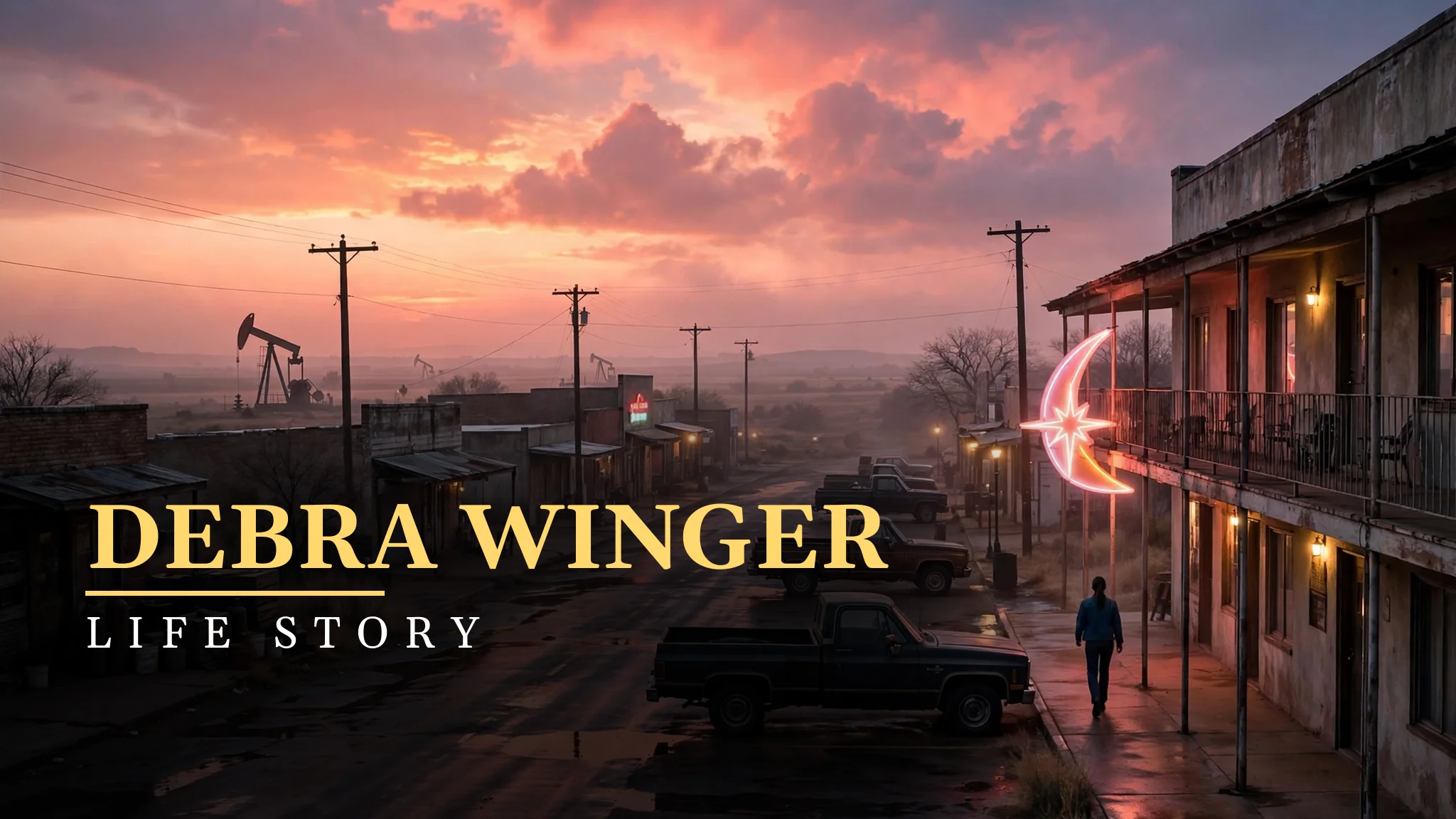
One more thought stays with me. When I picture her, I picture the small-town street in the image for this story: a woman walking down a wet road at pink dusk, past old trucks, with a neon moon glowing above her. That is a good picture of her life, because she has always walked her own road, alone, in the fading light, with no one to guide her, and she has never been afraid of where that road would lead.
I also think about Black Widow, because it shows a completely different side of her. She plays Alexandra Barnes, a woman who marries rich men and then kills them, and she plays the part with a cool, careful intelligence that makes the character fascinating. It is a dark role, and it is very different from Emma in Terms of Endearment, but Winger plays both with the same honesty. She does not judge her characters. She just plays them as they are, and she lets the audience decide what to think. That is a brave way to act, and it is why her performances feel so true.
Another thing I notice is Legal Eagles, where she plays a lawyer opposite Robert Redford. It is a romantic comedy, and she plays the part with a sharp, funny manner that shows she could be light as well as serious. She was not only a dramatic actress. She could play a comedy, and she could hold her own against one of the biggest stars in Hollywood. I love that she could do both. She could make you cry in Terms of Endearment, and she could make you laugh in Legal Eagles, and she could do both in the same year. That range is rare, and it is why she was nominated for three Oscars.
I think about Patriot as well, because it gave her a leading role on television in her sixties. She plays Bernice Tavner, the mother of a secret agent, and she plays the part with a warmth and a humour that makes the character one of the most loved in the show. It is a dark, strange series, but Winger brings a light to it, a mother’s love that makes the story feel human. I think that performance is one of her finest, because it shows that she had lost nothing during her years away. She was still one of the best actresses in the world, and she could still command the screen.
When I think about The Lovers, I feel a deep admiration for her courage. She plays Mary, a woman in a long marriage who is having an affair, and who falls in love with her own husband again. It is a funny, sad, and honest film, and Winger plays Mary with a tenderness that is deeply moving. She is not a young woman anymore. She is a woman in her sixties, with a real body, a real life, and real feelings, and she shows all of that on screen. That takes courage, because Hollywood rarely lets older women be romantic, funny, and sexual. Winger refused to accept that, and she played a full, real woman. I respect that deeply.
I also think about Kajillionaire, where she plays Theresa Dyne, the mother of a young woman who has grown up in a family of con artists. It is a strange film, but Winger plays the part with a tenderness that makes the character feel real. She is a mother who loves her daughter, but who has never really known how to be a mother, and she shows that confusion with honesty. I think that role tells me something about Winger herself. She is a mother, and she knows that motherhood is not simple. It is messy, it is hard, and it is full of love and mistakes. She brings that knowledge to her acting, and it makes her performances feel true.
One more thought stays with me. When I think about Debra Winger, I think about a woman who was fierce, honest, and unafraid, in a business that often punishes women for being those things. She spoke her mind, she walked away when the work no longer felt right, and she came back when she was ready, on her own terms. That is a remarkable life, and it is a life that teaches us something important: you do not have to play by other people’s rules. You can make your own rules, and you can live by them, even when it costs you. Winger did that, and she is happier for it, and her work is better for it.
I also think about The Lovers, because it shows that love does not belong only to the young. She plays Mary, a woman in a long marriage who is having an affair, and who falls in love with her own husband again. It is a funny, sad, and honest film, and Winger plays Mary with a tenderness that is deeply moving. She is sixty-two in that film, and she is still playing a romantic lead, still showing that an older woman can be funny, sexy, and full of life. That takes courage, because Hollywood rarely lets older women be romantic. Winger refused to accept that, and she played a full, real woman. I respect that deeply.
Another thing I notice is her memoir, Undiscovered, because it shows her honesty in a different form. She wrote about her life, her career, and her decision to leave Hollywood, and she did not pretend that everything was perfect. She told the truth, and that truth has helped many readers understand why she walked away. I think that is a brave and generous thing to do. Many famous people write memoirs that make their lives sound perfect. Winger wrote a book that told the truth, and that truth is more valuable than any perfect image, because it helps real people who are facing real choices about their own lives.
Frequently Asked Questions
Where was Debra Winger born?
Debra Winger was born on 16 May 1955 in Cleveland, Ohio, to a Jewish family, and she grew up in the San Fernando Valley in California. Her father ran a meat-packing business, and she was a bright, restless girl who dreamed of a different life.
How did Debra Winger start acting?
She began with small parts in television, including Wonder Woman in 1977, and in low-budget films, while working other jobs to pay the bills. She had also worked on a kibbutz in Israel, an experience that gave her a real-life depth she brought to her acting.
Who did Debra Winger play in Urban Cowboy?
In Urban Cowboy from 1980, she played Sissy, a tough, independent woman who works in a Texas honky-tonk bar and falls in love with John Travolta’s character. Her fiery, honest performance made her famous around the world.
What is Debra Winger’s role in Terms of Endearment?
In Terms of Endearment from 1983, she played Emma, a young mother whose relationship with her mother, played by Shirley MacLaine, is tested by love, marriage, and illness. The film won Best Picture, and Winger was nominated for Best Actress.
How many Oscar nominations has Debra Winger received?
She has been nominated for three Academy Awards for Best Actress: for An Officer and a Gentleman in 1982, Terms of Endearment in 1983, and Shadowlands in 1993. She has not yet won a competitive Oscar.
Why did Debra Winger leave Hollywood in the 1990s?
In the mid-1990s, she felt the roles offered to women were getting smaller and the industry valued youth over talent, so she stopped acting and lived a quiet life on a farm, raising her children. She returned to major film work in Rachel Getting Married in 2008.
What book did Debra Winger write about her life?
She published a memoir called Undiscovered in 2008, writing honestly about her life, her career, and her decision to leave Hollywood. The book helped readers understand why she walked away from fame at the height of her career.


