Derek Jacobi: The Life Story Behind the Shakespeare Star
In this post
Derek Jacobi is one of the finest Shakespearean actors Britain has ever produced, a man whose clear voice, whose deep understanding of language, and whose ability to make old words sound new have made him a legend on the stage. He is the kind of performer who can play a Roman emperor, a medieval monk, a king, and a modern grandfather, and each time he makes the character feel real and human. Millions of people know him as Claudius in the television series I, Claudius, the stammering and limping emperor who survives by being underestimated, and millions more know him as Brother Cadfael, the monk who solves murders in medieval Shrewsbury. Behind those famous roles lies a long career that began at Cambridge, moved through the National Theatre, and ended with a knighthood and a place among the greatest actors of his generation.
He was born in Leytonstone, in east London, and he grew up in a working-class family where his father worked in a shop and his mother was a secretary. He did not come from a theatre family, and he did not go to drama school as a young man. He went to Cambridge University, where he studied history and where he acted in student plays, and it was there that he discovered his love of Shakespeare and his talent for the stage. That university path gave him a love of learning and a deep respect for words, and it shaped the kind of performer he became.
What makes his story worth telling is the clarity and the intelligence of his work, and the way he has played the great roles of classical theatre with a freshness that makes them feel new. He was not a man who chased fame, and he did not try to be a star in the loud sense. He chose good work, he played complex people, and he let his talent speak for itself. This is the story of how a boy from Leytonstone became Sir Derek Jacobi, and how he did it by working hard, by loving Shakespeare, and by staying true to himself.
A Leytonstone Boy and a Love of Words
Derek George Jacobi was born on 22 October 1938 in Leytonstone, London, England. His father, Alfred, worked in a sweet shop, and his mother, Daisy, was a secretary, so the family was working class and money was not plentiful, but there was a love of books and of learning in the home. Derek went to school in London, and he showed an early talent for acting, taking part in school plays and discovering that he loved the feeling of standing on a stage and telling a story to an audience.
He was a bright and thoughtful boy, and he won a place at Cambridge University, where he went to St John’s College to study history. At Cambridge he joined the student theatre, and he acted in plays by Shakespeare and by other great writers, learning how to speak verse, how to move on a stage, and how to work with other actors. He was not a student who wanted to be famous for the sake of fame. He loved the words, he loved the stories, and he loved the feeling of bringing a character to life.
At Cambridge he played Hamlet, one of the greatest roles in all of theatre, and his performance was noticed by people who saw that he had a rare talent. He was only a young man, but he could make Hamlet’s long speeches sound natural and real, and he could show the prince’s sadness, his anger, and his humour all at once. That early success gave him the confidence to follow acting as a career, and it set him on a path that would lead to the National Theatre and to the great stages of Britain.
Those early years mattered because they gave him a strong love of language and a deep respect for the written word. He learned that Shakespeare is not old and dead, but alive and full of feeling, if you read it with care and if you speak it with honesty. That lesson stayed with him for the rest of his career, and it is one of the reasons his performances feel so fresh and so true. The boy from Leytonstone who loved words had found his calling, and he was ready to follow it.
Cambridge, the National Theatre, and Hamlet
After Cambridge, Jacobi joined the Birmingham Repertory Theatre, where he worked for several years and learned his craft in the hard school of repertory, playing many different roles in a single season. He played in plays by Shakespeare, by Chekhov, and by modern writers, and he became known as a reliable and thoughtful actor who could play both comedy and drama. Repertory work is hard, with short rehearsal times and a new play every few weeks, but it gives a young actor a wide range of experience, and Jacobi used those years to grow in confidence and skill.
His great break came when he joined the National Theatre company under Laurence Olivier, one of the greatest actors of the twentieth century. Olivier saw something in the young Jacobi, and he gave him a chance to work in a company that was full of talented actors and directors. Jacobi learned from Olivier, from the other actors, and from the hard work of playing many different roles, and it was the best training he could have had. He played in plays by Shakespeare, by Chekhov, and by modern writers, and he showed that he could handle both the great classical roles and the small, difficult parts.
He played Hamlet at the National Theatre and on tour, and his performance was praised as one of the finest ever seen. He played the prince as a young man who is thoughtful, angry, and funny, and he made the long speeches sound like real thoughts, not like poetry recited from a book. Audiences loved him for it, and critics wrote about his clarity, his intelligence, and his ability to make Shakespeare feel new. He also played in Othello, in Much Ado About Nothing, and in many other plays that showed his range.
The National Theatre years gave Jacobi a strong base, and they taught him how to work with a company, how to listen to other actors, and how to make a play feel alive every night. He was a serious and dedicated actor, and he prepared carefully for every role. He did not seek attention for himself, and he did not try to be a celebrity. He simply did the work, and he did it well, and that is why directors kept asking him back.
He also worked at the Royal Shakespeare Company and in the West End, and he became known as one of the finest Shakespearean actors of his generation. He won Laurence Olivier Awards for his stage work, and he was praised for his performances in plays by Harold Pinter, by Anton Chekhov, and by other great writers. By the time television made him famous, he was already a respected actor in Britain, and he was ready for the next stage of his career.
I Claudius and the Emperor Who Survived
Jacobi’s great breakthrough on television came in 1976, when he played Claudius in the BBC series I, Claudius, a drama about the Roman emperors based on the novels by Robert Graves. Claudius is a stammering and limping man who is thought to be a fool by his family, yet who survives the murders and the plots of the court and becomes emperor. Jacobi played him with a mixture of humour, sadness, and intelligence that made audiences love him, and his performance was praised as one of the greatest ever seen on British television.
He played Claudius over thirteen episodes, showing how the character grows from a frightened young man into a wise and weary emperor who understands the price of power. He made Claudius’ stammer feel real, not like a trick, and he showed how the emperor uses his apparent weakness to survive in a dangerous world. Audiences watched him week after week, and they came to see Claudius as a hero, not because he was strong, but because he was honest and because he tried to do what was right.
The series was a huge success, and it made Jacobi known to viewers across Britain and around the world. It won many awards, and it is still regarded as one of the finest television dramas ever made. Jacobi’s performance was the heart of the series, and it showed the world what he could do on screen. He had already been a great stage actor, but now he was also a television star, and he handled that fame with the same calm that he brought to his acting.
I, Claudius changed his life, because it brought him to a wide audience who had never been to the theatre. Suddenly, he was a familiar face in homes across the country, and he was recognised as one of the great actors of his generation. He used that fame to keep working in the theatre and in other television dramas, choosing parts that interested him rather than simply taking the biggest pay cheque. He did not let the success of one role define him, and he kept choosing new parts that would challenge him.
Cadfael, Films, and a Wide Range of Roles
After I, Claudius, Jacobi took on a wide range of television and film roles, showing that he was far more than a Shakespearean actor. He played Brother Cadfael in the television series Cadfael, based on the novels by Ellis Peters, about a medieval monk in Shrewsbury who solves murders with his knowledge of herbs and of people. Cadfael is a gentle and wise man, and Jacobi played him with a warmth and a humour that made audiences love him. The series ran for several years, and it became a favourite with viewers who loved a good mystery told with care.
He also appeared in films such as The Day of the Jackal, in which he played a small but memorable part, in Gladiator, in which he played Gracchus, a Roman senator who opposes the emperor Commodus, and in The King’s Speech, in which he played the Archbishop of Canterbury. Each of these roles showed a different side of his talent, and each one was played with the same care and the same thoughtfulness. He could be a monk, a senator, an archbishop, or a detective, and each time he made the character feel real.
He played in the film Gosford Park, in the film The Golden Compass, and in many other British and international films, often playing characters who were intelligent, kind, and a little bit sad. He moved easily between big Hollywood films and small British films, and he brought the same care to each one, whether he was playing a leading role or a supporting part. He understood that a good film needs good actors in every part, not just in the leading roles, and he was happy to be part of a company.
These film and television roles made him known to audiences around the world, and they gave him a financial security that he had not known in his early years. Yet he never lost his love of the theatre, and he kept returning to the stage when a part called to him. He understood that film fame can fade, but the craft of acting lasts, and he kept his craft sharp by working in both worlds.
Last Tango in Halifax and Later Television
In his later years Jacobi took on a role that brought him to a new and younger audience when he played Alan Buttershaw in the television series Last Tango in Halifax, a drama about two older people who find love again after many years apart. Alan is a kind and gentle man who has been married before, and who finds happiness with Celia, played by Anne Reid. Jacobi played him with a warmth and a humour that made audiences love him, and the series became a great success, winning awards and a loyal following.
He also appeared in the series Vicious, in which he played Stuart, an older gay man who lives with his partner Freddie, played by Ian McKellen. The series was a comedy about two men who have been together for many years, and Jacobi played Stuart with a sharp wit and a deep love that made the character unforgettable. He showed that he was not afraid to play a gay man openly and honestly, and that he understood the humour and the sadness of a long relationship. His work with Ian McKellen was a joy to watch, because the two actors had been friends for many years.
He also appeared in the film The Riddle, in the series The Crown, and in other productions that showed he was still able to surprise an audience. He did not stop learning, and he did not stop taking on parts that asked something new of him, even when he was in his seventies and eighties. He was knighted in 1994, becoming Sir Derek Jacobi, in recognition of his services to drama, and the honour was a fitting mark of a lifetime of great work.
The later years were a time of great happiness for Jacobi, because he was working with actors he admired, and with directors who respected his talent. He became a mentor to many young performers, and he taught them by example how to be a professional. His work in those later television shows will be remembered for as long as people watch Last Tango in Halifax and Vicious, and it is a fitting part of a long and great career.
A Private Life, a Partner, and a Quiet Dignity
Jacobi’s private life was kept largely out of the public eye for many years, and he preferred to let his work speak for itself. He is gay, and he lived for many years with his partner, Richard Clifford, a theatre director, whom he married in 2006 when same-sex marriage became legal in Britain. He spoke about his life with honesty and with dignity, and he showed that it is possible to be a great actor and to live openly and happily as a gay man, even in a world that has not always been kind to gay people.
He was known for his kindness to young actors, for his generosity, and for his sense of humour, which was dry and sharp. He did not seek attention for his private life, and he did not court the press, but those who knew him spoke of a man who was kind, funny, and deeply loyal to his friends and his partner. He lived in London, and he enjoyed a quiet life away from the stage when he was not working, spending time with Richard, with his books, and with his love of the theatre.
He was also known for his love of Shakespeare, and for his belief that the plays are for everyone, not just for scholars. He often spoke about the importance of speaking Shakespeare clearly, of making the words sound natural, and of trusting the audience to understand. He understood that the theatre is a place where people come to feel and to think, and he brought that understanding to every role he played.
Through all the years of fame, Jacobi kept a strong link to the theatre, and he kept returning to the stage when a part called to him. He understood that fame can fade, but the craft of acting lasts, and he kept his craft sharp by working in both worlds. He was a man who loved his work, loved his partner, and loved to tell stories, and that is a good life by any measure.
A Legacy Built on Language and Truth
Derek Jacobi’s legacy is not measured in one famous television show or one hit film, but in the many performances he gave, the many audiences he moved, and the many younger actors who learned from his example. He was a leading light of the National Theatre, of the Royal Shakespeare Company, and of British stage, and he helped to keep the tradition of great Shakespearean acting alive for new generations. His work as Claudius, as Cadfael, as Hamlet, and as Alan in Last Tango in Halifax will be watched and remembered for years to come.
His influence can also be seen in the way younger actors now talk about Shakespeare. Many of them speak of him as an example of how to speak verse clearly, how to make old words sound new, and how to play a great role without showing off. He showed that Shakespeare is not a museum piece, but a living thing, full of feeling and full of truth, if you read it with care and if you speak it with honesty. That is a gift that will last for a long time.
He is also remembered for his dignity, for his kindness, and for his courage in living openly as a gay man in a world that has not always been kind. He showed that it is possible to be a great actor and to be yourself, and that honesty makes your work stronger, not weaker. That is a lesson for all of us, in our own lives and in our work, and it is one that Jacobi’s life teaches well.
Today Derek Jacobi stands as one of the great actors of his time, a knight, a winner of many awards, and a performer whose work has touched audiences in theatres, cinemas, and living rooms around the world. His story is one of talent, intelligence, and honesty, and it shows that a long career built on real skill can be more lasting than a short burst of fame. He did the work, he did it well, and he kept doing it, and that is a legacy any actor would be proud to leave.
He is also remembered for his clear voice, for his warm smile, and for his love of words, and those memories will stay with the people who knew him and who saw him work. He was a man who could make Shakespeare sound like a conversation, and that is a rare gift. That is a life well lived, and a legacy that will last for generations to come.
My Take:
When I think about Derek Jacobi, the first thing I feel is respect for a person who loves words and who treats them with care. I have seen many actors who rush through Shakespeare, and I have forgotten most of them. Jacobi does the opposite. He speaks slowly, he listens to the words, and he lets them mean something. When I hear him as Claudius, I feel as if I am listening to a real emperor, not to an actor reciting lines. That is a rare gift, and it is one that made him unforgettable.
I think his performance in I, Claudius is one of the greatest things ever seen on British television, and I feel sad that many younger people have never seen it. Claudius is a man who stammers and limps, and who is thought to be a fool, yet he survives and becomes emperor. Jacobi plays him with a mixture of humour, sadness, and intelligence that makes audiences love him. I watched that series and I felt as if I understood what it is like to be underestimated, and to survive by being clever rather than strong. That is a powerful lesson.
I admire the way he played Hamlet, because it is one of the hardest roles in all of theatre, and he played it as a young man at Cambridge and later at the National Theatre. He made Hamlet’s long speeches sound like real thoughts, not like poetry, and he showed the prince’s sadness, his anger, and his humour all at once. I think that is what great acting is: making difficult words sound natural, and making a character who lived four hundred years ago feel like a person you might know today.
I also think about his role as Brother Cadfael, and I admire how much warmth he brought to a monk who solves murders. Cadfael is a gentle man, and Jacobi played him with a kindness that made audiences feel safe. I watched that series and I felt as if I was in medieval Shrewsbury, with a wise monk who understands people and who uses herbs to heal them. That is a lovely image, and it shows how Jacobi could make a simple story feel rich and true.
What moves me most in his story is his honesty about being gay, and the dignity with which he has lived his life. He lived with Richard Clifford for many years, and they married in 2006, and he spoke about it with a quiet pride that I admire. I think that is brave, because the world has not always been kind to gay people, and many actors were afraid to be open. Jacobi was open, and he showed that honesty makes your work stronger, not weaker. That is a lesson for all of us.
I also think about his work in Last Tango in Halifax, and I feel that it is one of the most moving things he has done. He plays Alan, an older man who finds love again after many years, and he does it with a warmth that makes audiences smile and cry at the same time. I think about older people who think that love is only for the young, and I feel that Jacobi’s performance tells them otherwise. Love can come at any age, and it can be just as real and just as beautiful when you are seventy as when you are twenty.
I think about his friendship with Ian McKellen, and how they worked together in Vicious and on stage. I admire the way two great actors can be friends and can work together without jealousy, and can make each other better. I think that is a model for how artists should work: with generosity, with humour, and with a shared love of the craft. Jacobi and McKellen showed that, and their work together is a joy to watch.
I also think about his knighthood, and I feel that it was well deserved, but I also think it does not tell the whole story. A title is a nice thing, but the real honour is the respect of other actors and the love of audiences who have seen your work. Jacobi has both of those things, and they are harder to earn than a title. He earned them by showing up, by learning his lines, by listening to his fellow actors, and by giving his best to every part.
I think his story teaches us about the value of education and of reading. He went to Cambridge to study history, and he learned to love words and to think about the past. I think that gave his performances a depth that other actors do not have. He was not just playing a character. He was thinking about history, about power, and about what it means to be human, and he was inviting the audience to think about those things too. That is a generous kind of acting.
I also feel that his work in Gladiator and in The King’s Speech shows how a small part can be important. He plays Gracchus in Gladiator, a senator who opposes the emperor, and he plays the Archbishop in The King’s Speech, and both times he makes the character feel real, even though he is only on screen for a few minutes. I think that is a lesson for young actors: you do not need to be the star to matter. You can be the person who makes the scene better, and that is a valuable thing to do.
When I look at his later work, I see a performer who never stopped growing. He played in Last Tango in Halifax, in Vicious, and in other productions when he was in his seventies and eighties, and he was still able to surprise an audience. I think that is a hopeful message for older people, because it shows that life does not end at sixty or seventy. It can get richer and more interesting, if you keep learning and keep working.
I think about his love of Shakespeare, and I wish more people would share it. Shakespeare’s plays are full of feeling, full of humour, and full of truth, yet many people are afraid of them because the language is old. Jacobi shows that the language is not a barrier. It is a gift, and if you speak it clearly and honestly, audiences will understand it. I hope young people will watch his performances and feel less afraid of Shakespeare, because he makes it sound like a conversation.
In the end, I think Derek Jacobi’s story is about talent, intelligence, and honesty. He did not chase fame, he did not chase money, and he did not chase the easy roles. He chased good work, and he found it, again and again, for more than sixty years. He played emperors and monks, kings and grandfathers, and he played them all with a clarity and a warmth that made audiences love him. I admire him for that, and I think his life is a lesson for anyone who wants to do something well.
One more thought stays with me, and it is about the quiet power of his voice. I have heard many loud actors, and I have forgotten most of them. Jacobi’s voice is clear and calm, and it stays with you. It is the voice of a person who has read the words, understood them, and made them his own. I think that is the best kind of acting, and the best kind of life: not loud, not showy, but true.
I also think about how he made Claudius feel like a real emperor to a whole generation of viewers. Many people who saw I, Claudius will never forget his stammer, his limp, and his quiet intelligence, and that is a wonderful thing. He gave them an emperor who was human, and he made ancient Rome feel like a real place. I think that is a gift that will last for a long time.
I also think about his partner Richard Clifford, and how their marriage in 2006 was a happy moment for them both. It showed that love can be recognised by law, and that a long partnership can be honoured. I think that is a hopeful message for many couples, and it shows that society can change for the better, even if it takes a long time.
Finally, I think his story is a reminder that a long career built on real skill can be more lasting than a short burst of fame. He worked for more than sixty years, he played hundreds of roles, and he left a legacy that will be remembered for a long time. I am glad that I have had the chance to learn from his life, and I hope that other people will learn from it too, because it shows what happens when talent meets hard work, and when intelligence meets honesty.
I also think about the boy from Leytonstone who went to Cambridge, and how far he travelled from that small beginning. He became a knight, he became Claudius, and he became one of the greatest Shakespearean actors of his time, yet he never forgot where he came from. That is a good lesson for anyone who leaves home to follow a dream: you can go far, you can change, and you can still carry the best parts of home with you.
One last thought stays with me, and it is about the way he listened on stage. In every role I have read about, he listened to the other actors as if what they were saying truly mattered. That is a rare skill, and it is one that makes every scene better. I think we could all learn from it, in our own lives, to listen more and to speak less, and to give other people the same attention that Jacobi gave to his fellow actors.
I also think about the many people who have learned Shakespeare from watching him, and how grateful they must be. He made the plays accessible, he made them funny, and he made them sad, and he showed that they are about real people with real feelings. That is a gift to education, and it is one that will last for generations.
One more lesson I take from him is about not being afraid to be yourself. He was a gay man in a world that was not always kind, and he lived openly and honestly. I think we should all try to be more like that, to be ourselves, and to trust that our own voice is enough. That is a lesson I carry with me when I think about my own life.
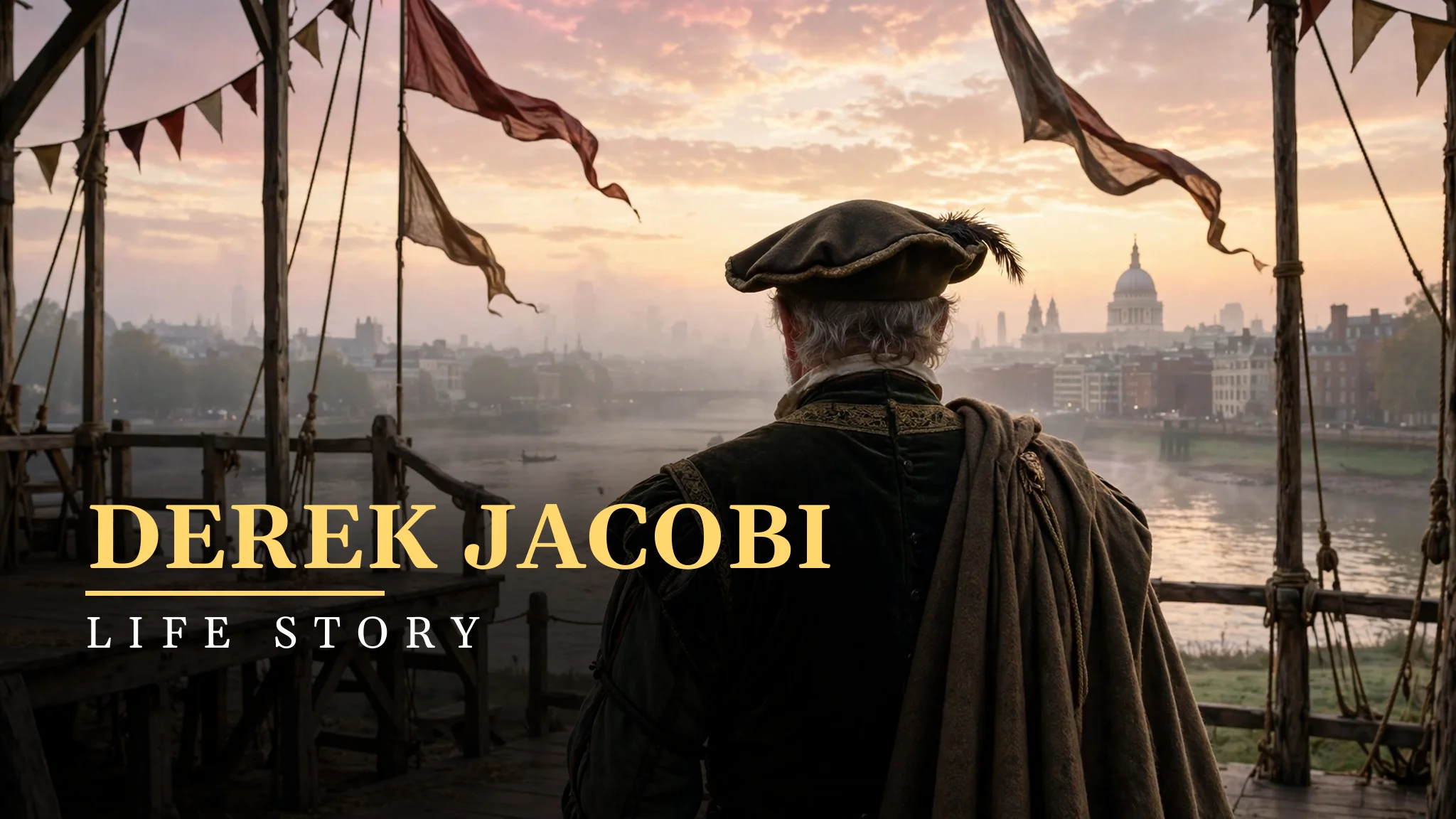
Finally, I think about the image of him standing on a wooden stage by the river, in Tudor costume, looking at the London skyline at sunset. It is a fitting image for a man who has spent his life on stages by the Thames, telling stories that are old and new at the same time. He knew that people are not simple, and that even an emperor can be afraid. That is a truth worth remembering, and it is one that Jacobi’s life and work teach us well.
I also think about the students at Cambridge who first saw him play Hamlet, and how lucky they were. They saw a young man who could make Shakespeare sound new, and they must have known they were watching something special. I hope that feeling stays with them, and that they pass it on to others, because great acting is a gift that should be shared.
I also think about how he has shown that a small, quiet man can play a great emperor, and that power does not come from size or from shouting. It comes from intelligence, from patience, and from understanding people. That is a lesson for anyone who feels small or overlooked: you do not need to be loud to matter, and you do not need to be strong to survive. You need to be clever, kind, and true to yourself.
Frequently Asked Questions
Why was Derek Jacobi’s Claudius in I, Claudius so famous?
He played the stammering emperor who survives by being underestimated, in a performance praised as one of the greatest ever seen on British television.
What did Derek Jacobi play in Cadfael?
He played Brother Cadfael, a medieval monk in Shrewsbury who solves murders with his knowledge of herbs and of people, in the popular television series.
Did Derek Jacobi play Hamlet?
Yes, he played Hamlet at Cambridge and later at the National Theatre, and his performance was praised for making the prince’s long speeches sound natural and real.
Was Derek Jacobi knighted?
Yes, he was knighted in 1994 for his services to drama, becoming Sir Derek Jacobi, one of the most honoured actors in Britain.
What was Derek Jacobi’s role in Last Tango in Halifax?
He played Alan Buttershaw, a kind older man who finds love again with Celia, played by Anne Reid, in the much-loved BBC drama.
Who is Derek Jacobi married to?
He married his long-term partner, theatre director Richard Clifford, in 2006, and they have shared a life together for many years.
What did Derek Jacobi play in Gladiator?
He played Gracchus, a Roman senator who opposes the emperor Commodus, in the 2000 film starring Russell Crowe.


