Die Toten Hosen: The Life Story Behind the German Punk Rock Band
In this post
- Düsseldorf in 1982: Five Young Men and a Loud Idea
- The First Albums and the Long Climb
- Kauf MICH! and the Band Becomes Huge
- Songs That Became Part of German Life
- Politics, Football, and Standing Up
- Growing Older Without Slowing Down
- The Legacy of a Band That Never Sold Out
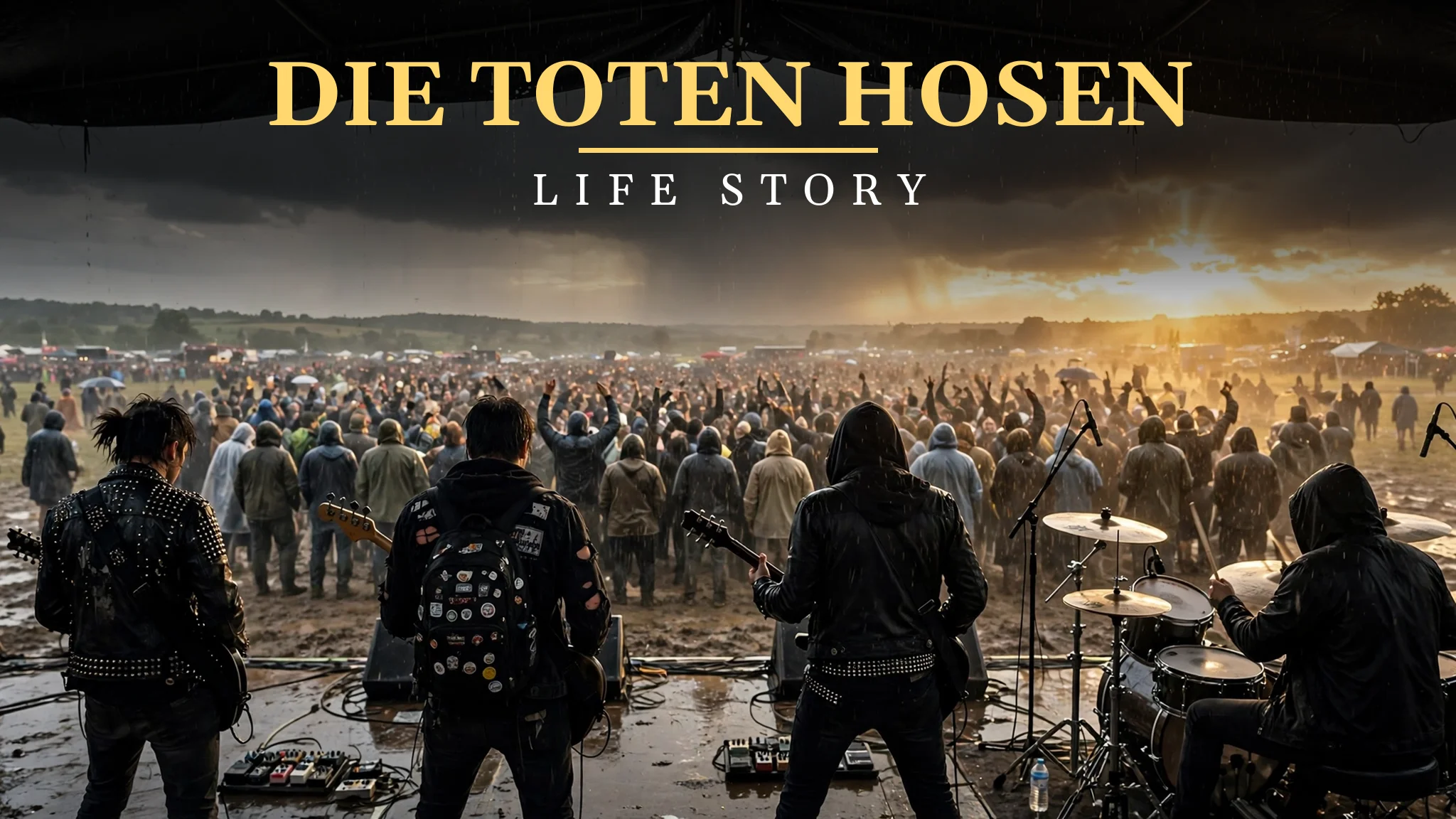
- The Band on Stage: What a Show Feels Like
- My Take:
Die Toten Hosen are one of the most loved rock bands to ever come out of Germany, and their story is a story of friendship, loud guitars, and staying true to a set of beliefs for more than forty years. The name means “the dead trousers” in German, which sounds strange in English, but in Germany it became a name that millions of people know. The band started in Düsseldorf in 1982, in the middle of the German punk scene, when five young men decided that they wanted to make fast, honest music and say what they thought. They did not come from rich families, and they did not have a plan for world fame. They had guitars, drums, strong opinions, and a love of playing live in front of people who were ready to shout along.
The singer of the band is Campino, whose real name is Andreas Frege. His voice, his energy on stage, and his habit of speaking plainly about politics made him the face of the group, but the band was always a team. Andreas von Holst, known as Andi, played guitar. Michael Breitkopf, known as Breiti, played guitar as well. Andreas Meurer, known as Kuddel, played bass. The drums changed hands over the years, and since 1999 the drummer has been Stephen George Ritchie, known as Vom Ritchie. Together they built a sound that mixed punk speed with big melodies, and songs that people could sing in a stadium as easily as in a small club.
What makes this band special is not only the length of their career. It is the way they kept their values while becoming hugely successful. They supported their local football club, Fortuna Düsseldorf, for many years. They spoke out against racism and the far right. They gave money to good causes. They played for people who had little money, and they kept ticket prices low when they could. Their biggest song, “Tage wie diese”, became an anthem in Germany in 2012, sung at weddings, at football matches, and at parties. This is the story of how a small punk band from Düsseldorf became a national institution without losing the spirit that made them start in the first place.
Düsseldorf in 1982: Five Young Men and a Loud Idea
Düsseldorf in the early 1980s was a city with a strong punk scene, and the young men who formed Die Toten Hosen were part of it. Punk had arrived from Britain and America in the late 1970s, and in Germany it took on its own shape. Young people were angry about unemployment, about the Cold War, and about a society that felt stiff and old-fashioned. They wore torn clothes, they played fast music in small clubs, and they made their own records because the big record companies did not want them. Campino and his friends had already played in earlier bands, and they knew the small stages of Düsseldorf well. They had seen how a good punk show could turn a room full of strangers into a community for one night.
The band came together in 1982, and the early days were hard in the way that the early days of most bands are hard. They had little money, they rehearsed in cheap rooms, and they played wherever someone would let them play. Their first single was “Wir sind bereit”, followed by “Reisefieber”, and their first album, “Opel-Gang”, came out in 1983. The album was raw and fast, and it sold slowly at first, but it found listeners among punk fans who liked music that sounded honest rather than polished. The songs were in German, which mattered. At the time, many German bands sang in English because they thought it sounded more serious, but Die Toten Hosen sang in the language they spoke every day, and their fans felt that difference.
Life on the road in those years was rough. The band travelled in old vans, slept on floors, and played in youth clubs, squats, and small halls. They learned how to win over a crowd that did not know them, and they learned how to keep going when a show went badly. Campino was already a strong frontman. He talked to the crowd between songs, he joked with them, and he made people feel that the show belonged to them as much as to the band. That connection with the audience became the most important part of the band, and it stayed with them for the whole of their career.
The name itself told people what kind of band this was. “Die Toten Hosen” sounds like a joke, and it was meant to be funny, but it also sounded like a band that did not care about being polite. In those early years, the German punk scene was full of bands with strange names, and a funny name helped people remember you. Behind the joke, though, there was a serious idea. The band wanted to make music that ordinary people could enjoy, music that talked about real life, about drinking with friends, about love, about anger, and about the country they lived in. They were not trying to be clever for the sake of it. They were trying to be direct, and directness became their style.
The First Albums and the Long Climb
After “Opel-Gang”, the band kept working at a fast pace. Their second album, “Unter falscher Flagge”, came out in 1984, and it showed that they were growing as songwriters. The songs were still fast, but the words were sharper, and the band sounded more confident. They toured Germany again and again, and each tour brought them a few more fans. In the punk world, a band grows by playing live, not by radio play, and Die Toten Hosen understood that. They played everywhere they could, and they treated every show as if it mattered, because for a young band, every show does matter.
The next albums, “Damenwahl” in 1986 and “Ein kleines bisschen Horrorschau” in 1988, marked a big step forward. The 1988 album was inspired by the book and film “A Clockwork Orange”, and it contained the song “Hier kommt Alex”, which became one of their most famous songs. The song is about Alex, the violent young man from the story, and it is driven by a strong guitar riff and Campino’s urgent singing. It became a hit, and it showed that the band could write a song that was both intelligent and exciting to hear in a large room. People who had never listened to punk before heard “Hier kommt Alex” on the radio and wanted to know more about the band.
Success brought new problems. A band that starts in small clubs has to learn how to play in large halls without losing the feeling of closeness that made the small shows special. Die Toten Hosen managed this by keeping their shows loud, fast, and full of energy, and by keeping the talk between songs warm and funny. Campino learned how to hold the attention of thousands of people, and the rest of the band learned how to make their sound big enough for a stadium. They also learned how to deal with the music business, which is not always friendly to a band that wants to do things its own way.
By the end of the 1980s, the band had also started to play outside Germany, in Austria, Switzerland, and other parts of Europe. They sang in German, and that limited how far they could go in countries where people did not speak the language, but their live shows were so strong that language did not matter as much as energy. Fans in other countries came to see a band that played with total commitment, and they went home singing songs whose words they did not fully understand. That is a rare thing, and it says a lot about how powerful the band’s performances were.
Kauf MICH! and the Band Becomes Huge
The early 1990s brought the band to a new level of fame in Germany. Their album “Kauf MICH!” came out in 1993, and it was a huge success. The title is a play on words, and the album dealt with consumerism, with buying and selling, and with the way money shapes modern life. The song “Alles aus Liebe” became a hit, a love song that was tender without being soft, and it showed that the band could write about feelings as well as about anger. The album sold very well, and the band became one of the biggest acts in Germany, playing to crowds of tens of thousands of people.
With fame came a bigger stage, and the band used it to talk about things they cared about. In 1993 they released the song “Sascha… ein aufrechter Deutscher”, which was a strong attack on right-wing violence in Germany. At the time, there had been terrible attacks on foreigners and asylum seekers, and many people in Germany were afraid. The band wrote a song that named the problem plainly, and they played it at their shows. This was not a safe choice for a popular band, but it was an honest one, and it won them deep respect. They were not just entertainers. They were citizens who used their fame to say something that needed saying.
The mid-1990s brought more successful albums, including “Opium fürs Volk” in 1996 and “Unsterblich” in 1999. The band toured constantly, and their live shows became legendary. They played long sets, they invited fans on stage, and they created a feeling of a big party where everyone belonged. Campino often drank beer on stage, talked to people in the front rows, and made jokes about the local football team. The shows felt less like a performance and more like a gathering of friends, even when there were twenty thousand people in the room.
During this period, the band also faced changes in their line-up. The drummer, Wolfgang Rohde, known as Wölli, had to stop playing because of health problems, and Vom Ritchie took over the drums in 1999. A change of drummer can break a band, because the drummer sets the speed and the feeling of every song, but Vom Ritchie fitted in well, and the band kept its sound. The fact that they could make such a change and keep going showed how strong the friendship and the shared purpose inside the band really was.
Songs That Became Part of German Life
Some bands have hits. Die Toten Hosen have songs that became part of everyday life in Germany, and that is a different thing. “Hier kommt Alex” is played at parties and on the radio decades after it was written. “Alles aus Liebe” is a song that people choose for weddings. “Bonnie & Clyde”, from 1996, is a playful song about a couple on the run. “Azzurro”, their German version of an Italian song, became a summer favourite. Each of these songs has its own story, but together they show a band that could write about many sides of life: love, friendship, anger, fun, and the passing of time.
The biggest of these songs came in 2012. “Tage wie diese”, from the album “Ballast der Republik”, became the band’s most successful single. The song is about days that feel perfect, days when everything goes right and you want the moment to last forever. It is simple, it is joyful, and it is easy to sing, and that made it perfect for large crowds. Football fans sang it in stadiums. People sang it at New Year parties. It became the sound of a good day in Germany, and it brought the band a new generation of younger fans who had not been born when the band started.
The album “Ballast der Republik” was itself a big success, and it showed that the band still had something to say after thirty years. The songs dealt with growing older, with looking back at a long life, and with the things that still matter after many years. The band was no longer young, but they were not tired. They played with the same energy as before, and they wrote songs that were honest about age. That honesty is one reason their fans stayed loyal. The band grew up with their audience, and they did not pretend to be twenty years old forever.
What is striking about these songs is how they travel across generations. A father who saw the band in the 1980s can now take his children to a show, and both can sing the same songs. That is rare in popular music, where most bands belong to one generation only. Die Toten Hosen belong to several generations at once, because their songs are about feelings that do not change: the joy of a good day, the pain of losing someone, the love of a home town, and the wish to stand up for what is right.
Politics, Football, and Standing Up
From the start, Die Toten Hosen were a political band, but their politics were simple and direct. They were against racism, against the far right, and against anyone who tried to divide people by where they came from. They supported refugees and migrants, and they played benefit concerts for good causes. They did not do this quietly. They said it on stage, in interviews, and in their songs, and they accepted that some people would dislike them for it. For the band, staying silent would have been worse than losing a few fans.
Their love of football was part of the same spirit. The band supported Fortuna Düsseldorf, their local club, for many years, and they even sponsored the club’s shirts at a time when the club needed money. Campino is a well-known football fan, and he has often talked about the game with the same passion he brings to music. Football, like punk, is about community, about standing together, and about loyalty to a place. The band understood that connection, and their fans, many of whom are football supporters, understood it too.
The band also used their fame to help people in practical ways. They supported charities, they played for good causes, and they gave money to projects that helped young people. They kept ticket prices as low as they could for many years, because they remembered what it was like to be young and short of money. They wanted their shows to be open to everyone, not only to people who could pay high prices. That choice cost them money, but it earned them trust, and trust is worth more than money to a band that plans to be around for a long time.
There were times when their views brought them into conflict with others. Some people thought a band should only play music and stay out of politics. The band disagreed, and they said so plainly. They believed that a person with a microphone has a duty to speak when something is wrong. Their fans mostly agreed, and the band’s political stand became part of why people loved them. In a country where the past makes the fight against the far right especially important, a famous band that takes a clear stand matters, and Die Toten Hosen took that stand again and again.
Growing Older Without Slowing Down
Most punk bands do not last for forty years. They break up, or they lose their energy, or their members go in different directions. Die Toten Hosen kept going, and they did it by changing slowly without changing what mattered. Their later albums, “Laune der Natur” in 2017 and “Alles ohne Strom” in 2019, showed a band that was still curious. “Alles ohne Strom” was recorded without electric instruments, with acoustic guitars and a different sound, and it showed that the band could still surprise their listeners after so many years. They were not repeating themselves. They were trying new things, and they were doing it with care.
The band also celebrated their history. They released anniversary editions of their early albums, they played special shows, and they looked back at their career with pride but without nostalgia that stops them from moving forward. They know that many of their fans have grown up with them, and they treat that shared history with respect. A concert by Die Toten Hosen is now a meeting of people of many ages, from teenagers to people in their sixties, and that mix is part of what makes the shows feel special.
Campino has also worked outside the band, acting in theatre and writing, but the band has always been his home. The other members have their own lives and families, and the band has learned how to balance work with private life. That balance is one reason they have lasted so long. They do not tour all year without a break. They take time to rest, to write new songs slowly, and to come back to the stage when they are ready. That patience is unusual in the music business, where bands are often pushed to work until they are exhausted.
The band’s long career also means they have faced loss. Friends and fellow musicians have died, and the world around them has changed in many ways. Germany changed after reunification, Europe changed, and the music business changed completely with the arrival of streaming. Through all of it, the band kept their core idea: play honest music, treat your fans well, and stand up for what you believe. That idea is simple, but it is hard to hold on to for forty years, and the fact that they did is the heart of their story.
The Legacy of a Band That Never Sold Out
Today, Die Toten Hosen are one of the most successful German bands of all time, with many albums at the top of the charts and millions of records sold. They have won awards, they have played in huge stadiums, and they are known far beyond Germany. Yet they are still, in many ways, the same band that started in Düsseldorf in 1982. They still play with energy, they still speak plainly, and they still care about their fans. That is why people use the phrase “never sold out” about them, and why it fits.
Their legacy is not only in their songs. It is in the example they set for younger bands in Germany. They showed that a band can sing in German and still be huge. They showed that a band can be political and still be loved. They showed that a band can stay together for decades if the members respect each other and share the same values. Many German bands that came after them learned from that example, and the German rock scene is stronger because Die Toten Hosen existed.
The band’s story is also a story about a city. Düsseldorf is proud of them, and they are proud of Düsseldorf. They have always talked about their home town with love, and they have played there many times. A band that stays loyal to its home town tells its fans something important: success does not mean forgetting where you came from. It means carrying that place with you, and sharing it with the world.
For new listeners, the best place to start is simple: listen to “Tage wie diese” for joy, listen to “Hier kommt Alex” for power, listen to “Alles aus Liebe” for tenderness, and listen to “Schrei nach Liebe” by their friends Die Ärzte to understand the scene they came from. Then go and see them live, if you can, because that is where the band truly lives. On stage, in front of thousands of people singing every word, Die Toten Hosen are not a band from the past. They are a band that is still happening, still loud, and still honest, and that is a rare and wonderful thing.
The Band on Stage: What a Show Feels Like
A Die Toten Hosen concert is not like a normal rock show, and anyone who has been to one will tell you why. The band plays for more than two hours, often for close to three, and they fill that time with fast songs, slow songs, jokes, stories, and moments when the whole crowd sings together. Campino talks to the audience between songs, he asks where people have come from, he jokes about the local football team, and he makes a stadium feel like a small club. The other members play with total commitment, and the sound is loud, clear, and full of energy from the first song to the last.
The band has played at many of the biggest festivals in Germany, including Rock am Ring, one of the most famous rock festivals in Europe. At a festival, a band must win over a crowd that may not all be fans, and Die Toten Hosen are very good at that. They start fast, they play their best-known songs early, and they build a feeling of excitement that spreads through the crowd. By the end of the set, even people who came to see another band are singing along. That ability to win strangers is a rare skill, and it comes from decades of playing live.
Their shows also have a special relationship with the audience. Fans bring banners, they wear the band’s shirts, and they know every word of every song. When the band plays “Tage wie diese”, the whole crowd sings the chorus, and the sound of twenty thousand voices together is a powerful thing. Campino often lets the crowd sing alone, stepping back from the microphone and listening, and that moment of shared singing is one of the most loved parts of the show. It is not a performance. It is a shared experience.
The band has also played special shows in small places, in clubs, and in unusual venues, because they never forgot where they started. They know that a show in a small hall can be as important as a show in a stadium, and they treat both with the same care. They also play benefit concerts, and they have used their shows to raise money for good causes. A concert, for this band, is not only about music. It is about community, about friendship, and about using a stage to do something good.
For many fans, a Die Toten Hosen concert is a tradition, something they do every year with old friends. They meet before the show, they sing on the way there, and they go home hoarse and happy. That tradition, repeated year after year, is part of why the band has lasted so long. They are not just a band people listen to. They are a band people live with, and their shows are a part of many people’s lives.
My Take:
When I think about Die Toten Hosen, the first thing I feel is respect for staying power. I have seen many bands that burn bright for a few years and then fall apart, and I have seen many singers who lose the fire that made them interesting. This band did the opposite. They started in 1982, and more than forty years later they are still playing, still writing, and still filling stadiums. That is not luck. That is the result of hard work, of friendship, and of a clear idea about what the band stands for. I admire that more than any single hit song, because a hit can happen by chance, but forty years of honest work cannot.
I admire Campino most of all for his honesty on stage. He does not hide behind a character. He talks to the crowd like a real person, he jokes, he gets angry about the right things, and he sings with his whole body. When I watch footage of their shows, I see a singer who is fully present, who is not thinking about the next photo shoot or the next interview, but about the people in front of him right now. That is a rare quality in a famous person. Many stars seem far away even when they are close. Campino seems close even in a stadium of twenty thousand people, and that closeness is the band’s greatest gift.
What I love about their music is that it is simple without being empty. A song like “Tage wie diese” has a simple idea: some days are perfect, and you wish they would never end. Anyone can understand that idea, and anyone can sing it. But the song works because it is true, and because the band plays it with real joy. I think many songwriters try to be clever, and they write songs that are hard to understand and hard to remember. Die Toten Hosen write songs that are easy to understand and impossible to forget, and that is much harder than it looks. Simplicity is a skill, and they have practised it for decades.
I also think about their political courage, and I respect it deeply. It is easy to be political when everyone agrees with you. It is hard to be political when your words might cost you fans, or money, or comfort. The band wrote “Sascha… ein aufrechter Deutscher” at a time when right-wing violence in Germany was a real and frightening problem, and they did not soften the message. They named the hate, and they stood on the other side. I think that matters, because music reaches people that speeches cannot reach. A young person who would never read a political article might hear that song, and might think differently because of it. That is a real use of fame, and I wish more famous people used their fame that way.
There is something else I admire, and it is their loyalty to their home town and to their football club. In a world where famous people move to London or Los Angeles and forget where they came from, this band stayed close to Düsseldorf. They supported Fortuna Düsseldorf when the club needed help. They talked about their city with pride. They played there again and again. I think that loyalty tells you who a person is. It is easy to love a place when it is fashionable. It is harder to love it through the bad years, when the team is losing and the city is struggling. The band did that, and their fans noticed.
I also think about what it means to grow old in a punk band. Punk is supposed to be young music, fast music, angry music. What happens when the punks turn fifty, or sixty? Most punk bands cannot answer that question, because they break up before they have to. Die Toten Hosen answered it by growing up in public. Their later songs talk about getting older, about looking back, about the friends who are no longer there. That is brave, because it means admitting that time passes. I find their later work moving for exactly that reason. They did not pretend to be young forever. They wrote about the life they were actually living, and that honesty made their music stronger, not weaker.
If I have a criticism, it is a small one, and it is about how hard their music can be to reach for people outside the German-speaking world. They sing in German, and that is part of their identity, so I would never ask them to change it. But it does mean that a listener in England or America or Pakistan may hear the energy of the music without fully understanding the words, and the words are a big part of what makes the band special. I think that is a fair price to pay for being true to yourself, but it is still a loss for people who might love the band if they could understand every line. The band did record some songs in English, and they toured abroad, but their heart has always been German, and I respect that choice even as I notice its cost.
Another thing I keep thinking about is the friendship inside the band. Five people staying together for forty years is almost unheard of in music, and it does not happen by accident. It happens because people learn how to disagree without breaking apart, how to give each other space, and how to share the work fairly. The band lost drummers, they faced health problems, and they went through the normal strains of a long career, but the core of the band held. I think there is a lesson in that for anyone who works in a team. Talent matters, but trust matters more, and trust is built slowly, show by show, year by year.
I also love the way their concerts feel like a community. I have watched videos of their shows, and what strikes me is not the size of the crowd but the feeling in it. People of all ages are singing together. Strangers have their arms around each other. The band is on stage, but the crowd is part of the show. That is what punk was supposed to be in the first place: not stars on a high stage and fans far below, but people together in a room, sharing something loud and joyful. Die Toten Hosen kept that feeling alive even when the rooms became stadiums, and that is a remarkable achievement.
For a young reader, I think the lesson of this band is simple and strong. Find something you believe in, find people who believe in it too, and keep doing it, year after year, even when it is hard. Do not chase every new fashion. Do not sell your values for a quick success. Work hard, treat people well, and speak up when something is wrong. If you do that for long enough, you may not become famous, but you will build something real, and something real lasts longer than fame.
I think about “Tage wie diese” again, and about what it means to have a song like that. It is a song about a perfect day, and it became the sound of many perfect days for many people. That is a beautiful thing for a band to give the world. They gave people a song to sing at weddings, at football matches, at parties with old friends. They gave people a way to say, in three minutes, that life can be good, that friends matter, and that some moments deserve to be remembered. I am grateful for that, and I think Germany is grateful too.
In the end, I believe Die Toten Hosen matter because they prove that a band can grow up without growing dull, can become famous without becoming false, and can stay political without becoming preachy. They are loud, funny, serious, and warm, all at the same time, and that mix is hard to find. When I think about what I want from music, I want songs that tell the truth, shows that bring people together, and artists who use their voice for something good. This band gives me all three, and after forty years they are still giving. That is why I will keep listening, and why I think their story is worth telling to anyone who loves music that means something.
One more thought stays with me. The band’s name is a joke, and their early image was a joke too, but the work behind the joke is completely serious. Behind every loud show there are years of rehearsal, years of travel, years of writing, and years of standing by your friends. The joke gets people to listen, but the work is what makes them stay. I think that is a good model for any kind of work. Be funny if you can, be welcoming, do not take yourself too seriously, but take the work seriously, and take the people seriously. Die Toten Hosen did that, and forty years later the crowds are still singing. That is the best review any band can ever get.
I also think about the band’s sense of humour, and how important it is to their success. They are a serious band with serious beliefs, but they are also funny, and they do not take themselves too seriously. Their name is a joke, their early image was a joke, and their shows are full of jokes, but the work behind the humour is completely serious. I think that balance is hard to achieve, and it is one reason the band has lasted so long. A band that is only serious becomes tiring. A band that is only funny becomes shallow. Die Toten Hosen are both, and that mix keeps their music fresh.
Another thing that stays with me is the way the band treats its fans. They keep ticket prices low when they can, they play long shows, they talk to the crowd, and they make people feel welcome. That is not a marketing trick. It is a belief that music should be for everyone, not only for people with a lot of money. I respect that belief, because it shows that the band remembers what it was like to be young and short of money, and it shows that they have not forgotten the fans who made them famous. Loyalty goes both ways, and this band understands that.
I think about the future, and I wonder what the band will do next. They have already made many albums, played many shows, and won many awards, but they do not seem tired. They seem curious, and they seem ready to try new things, as they did with their acoustic album. I hope they keep going, because German music needs them. It needs a band that is loud, honest, political, and funny, all at the same time. It needs a band that can fill a stadium and still feel like a group of friends playing in a small club. That is a rare combination, and I am glad it exists.
When I listen to their music now, I hear something different from what I heard at first. At first, I heard loud guitars and a strong voice. Now I hear forty years of friendship, of hard work, of standing up for what is right, and of growing older without giving up. That depth is what makes their later songs so moving, and it is what makes their story worth telling. A band can be famous for a year, but to be loved for forty years, you need something more than hits. You need trust, and this band has earned it.
I also want to say something about Campino as a person, not just as a singer. He is known for his energy, his humour, and his politics, but he is also known for his loyalty to his friends, his family, and his city. He has stayed in Germany, he has stayed close to Düsseldorf, and he has stayed close to the people who knew him before he was famous. That loyalty is a quiet quality, and it is easy to overlook, but I think it is one of the most important things about him. Fame can pull a person away from their roots. Campino stayed close to his, and that is why his fans trust him.
In the end, my feeling about this band is simple: I am grateful. I am grateful for the songs, for the shows, for the laughter, and for the example they set. They showed me that a band can be successful without selling out, that a singer can be political without being preachy, and that a group of friends can stay together for forty years if they respect each other. Those are lessons that go beyond music, and they are lessons I will carry with me. When I hear “Tage wie diese” again, I will think of a perfect day, of old friends, and of a band that made that day a little better.
One last thought: the best bands do not just make music. They make a world, a place where people can belong, where they can sing together, laugh together, and feel less alone. Die Toten Hosen made such a world, in Düsseldorf, in stadiums across Germany, and in the hearts of millions of fans. That world is still open, still loud, and still welcoming, and I hope it stays open for many more years. If you have never been to one of their shows, go. If you have never heard their songs, listen. You may find, as I did, that a punk band from Düsseldorf has something to say to you, too.
Frequently Asked Questions
When did Die Toten Hosen form and where are they from?
Die Toten Hosen formed in Düsseldorf, Germany, in 1982, in the middle of the German punk scene. The founding members came from earlier Düsseldorf bands, and they built their name by playing live in small clubs before growing into one of Germany’s biggest rock acts.
Who is the singer of Die Toten Hosen?
The singer is Campino, whose real name is Andreas Frege, born in Düsseldorf in 1962. He has been the band’s frontman since the start, known for his energetic stage presence and for speaking plainly about politics and football.
What is the most famous Die Toten Hosen song?
“Tage wie diese” from 2012 is their most successful single, a joyful anthem about perfect days that is sung at parties, weddings, and football matches across Germany. “Hier kommt Alex” from 1988 is also one of their best-known songs.
What does the name Die Toten Hosen mean?
The name means “the dead trousers” in German. It was chosen as a joke in the punk tradition of strange band names, and it helped people remember the band in their early years in Düsseldorf.
Did Die Toten Hosen take a political stand?
Yes, the band has always spoken out against racism and the far right in Germany. Their 1993 song “Sascha… ein aufrechter Deutscher” attacked right-wing violence, and they have played many benefit concerts and supported good causes over the years.
Are Die Toten Hosen still playing live today?
Yes, the band is still active after more than forty years, touring Germany and Europe and releasing new albums such as “Laune der Natur” in 2017. Their live shows remain famous for their energy and for crowds of many ages singing along.
What football club do Die Toten Hosen support?
The band supports Fortuna Düsseldorf, their home-town club, and they famously sponsored the club’s shirts when the club needed financial help. Campino is a well-known and passionate Fortuna supporter.


