Dino Merlin: The Life Story Behind Bosnia's Beloved Singer
In this post
- A Poor Boy in Sarajevo With a Dream of Music
- The Band Merlin and the First Hits
- War in Sarajevo and Songs That Kept People Going
- Burek, Solo Stardom, and Songs for a Whole Region
- Eurovision, Stadiums, and the Love in Rewind Years
- Family, Privacy, and a Quiet Life Off Stage
- A Voice That Belongs to Bosnia
- Stadium Nights, the Diaspora, and Songs That Travel
- My Take:
Dino Merlin is the voice of Bosnia and Herzegovina, a singer and songwriter whose songs have been the soundtrack of weddings, of long drives, of first loves, and of hard times for more than forty years. His real name is Edin Dervišhalidović, but almost no one calls him that, because in Bosnia and across the Balkans, he is simply Dino Merlin, a name that means music, and a name that people say with love.
He was born in Sarajevo, in a poor neighbourhood, and he grew up with little money, with a mother who worked hard, and with a dream of making music that mattered. He started a band called Merlin in the 1980s, he wrote songs that became hits, and then, when war came to his city, he kept singing, because music was one of the few things that could give people hope when everything else was falling apart.
What makes his story worth telling is how deeply his songs are woven into the life of his country, because for many Bosnians, a Dino Merlin song is not just a song, it is a memory, of a summer in Sarajevo, of a person they loved, of a time before the war, or of a time after it when life began again. He has filled the biggest stadiums in the region, he has represented his country at Eurovision, and he is still, in his sixties, the singer everyone wants to hear.
This is the story of a boy from a poor part of Sarajevo who became the most loved singer in Bosnia, a songwriter who turned his life, his city, and his country’s pain and joy into songs that millions of people carry in their hearts.
A Poor Boy in Sarajevo With a Dream of Music
Edin Dervišhalidović, known to the world as Dino Merlin, was born on 12 September 1962 in Sarajevo, the capital of Bosnia and Herzegovina, which was then part of Yugoslavia. He grew up in the neighbourhood of Alifakovac, an old part of the city on a hillside, in a family that did not have much money, and his mother, Fatima, raised him largely on her own after his father left, working hard to give her son a decent life. It was not an easy childhood, but it was a loving one, and it taught him the value of hard work.
As a boy, he was drawn to music, and he listened to everything he could hear, from Bosnian folk songs to rock music from the West, and he began to sing and to play the guitar. He did not have expensive instruments or lessons, but he had a good ear, a strong voice, and a hunger to learn, and he practised whenever he could, in his room, with friends, and on the streets of his neighbourhood. Music gave him a way to dream, and a way to imagine a life beyond the hard streets where he lived.
He went to school in Sarajevo, and he worked at ordinary jobs while he dreamed of music, because a career as a singer seemed like a distant dream for a poor boy. But he did not give up, and he kept writing songs, kept playing, and kept looking for a chance to perform. He was a determined young man, and he believed that if he worked hard enough, someone would notice him, and that belief carried him through the hard years.
The Sarajevo of his youth was a lively city, with cafes, with music, and with a mix of cultures, and a young person with talent could find a stage, even a small one, if he looked hard enough. Dino found those stages, in youth clubs, in small halls, and at local events, and he learned what it felt like to sing for a crowd, to make people listen, and to make them feel something. Those small stages were his school, and they taught him more than any classroom could.
His mother was the most important person in his early life, and he has spoken about her with great love, saying that she sacrificed a great deal for him, and that her strength shaped him. She worked, she raised him, and she believed in him, and when he became famous, he never forgot what she had done. His songs often carry a feeling of gratitude, of love for family, and of respect for the people who raised him, and that feeling comes from his childhood.
The Band Merlin and the First Hits
In 1983, Dino formed a band called Merlin, with friends from Sarajevo, and they began to play rock music with a Bosnian flavour, mixing Western rock with the sounds and feelings of their own city. The band’s name was simple, and it stuck, and Dino took the name Merlin as part of his own stage name, so that he became Dino Merlin, a name that would soon be known across Yugoslavia. The band played in clubs, in youth halls, and at festivals, building an audience one concert at a time.
Their first album, Kokuzna vremena, was released in 1985, and it made them a known name in Yugoslavia, with songs that were catchy, honest, and full of the energy of young men from Sarajevo. They followed it with more albums, including Teško meni sa tobom, and they became one of the most popular bands in the country, playing to large crowds and earning a reputation for live shows that were loud, joyful, and full of heart.
Dino was the heart of the band, writing most of the songs, singing lead, and shaping the sound, and his songwriting was already showing the qualities that would make him famous, simple words that said something true, melodies that people could remember, and a feeling that the song was about real life, not about fantasy. He wrote about love, about the city, about friends, and about the small moments that make a life, and audiences recognised their own lives in his songs.
The band’s success in the 1980s gave Dino a career, and it gave him a name, but it also taught him the music business, how to record, how to tour, and how to handle fame. He was still young, but he was learning fast, and he was building a loyal audience that would stay with him for decades. The band Merlin was not just a stepping stone. It was the foundation of everything that came after.
By the end of the 1980s, Merlin was one of the biggest bands in Yugoslavia, and Dino was a star in his own country. He had gone from a poor boy in Alifakovac to a singer whose songs were played on the radio across the country, and he had done it by writing honest songs and by working hard. It was a remarkable journey, and it was only the beginning, because the hardest years of his life were still ahead of him.
War in Sarajevo and Songs That Kept People Going
In 1992, war came to Bosnia, and Sarajevo, Dino’s home city, was put under siege, one of the longest sieges in modern history, lasting for almost four years. Life in the city became a daily struggle for food, for water, for safety, and for hope, and many people died, many left, and many lost everything they had. Dino stayed in Sarajevo for much of the siege, and he lived through the shelling, the snipers, and the fear, like everyone else in the city.
During the war, music became more important than ever, because it gave people a reason to gather, to sing, and to feel human when everything around them was falling apart. Dino sang, he wrote songs, and he performed when he could, and his music became a source of comfort for people who were living through a terrible time. He did not pretend the war was not happening. He sang about it, about the pain, about the loss, and about the hope that life would go on.
After the war, he released the album Fotografija in 1995, and then Sredinom in 2000, and his songs became anthems for a country trying to rebuild. His music spoke to people who had lost loved ones, who had lost homes, and who were trying to find a way to live again, and it did so with honesty and with warmth, not with anger or with bitterness. He became a voice for Bosnia, a singer who could say what many people felt but could not put into words.
One of his most loved songs from that time, and from his whole career, is about Bosnia itself, about the land, the rivers, and the people, and it is sung at gatherings, at weddings, and at national events, as a song of pride and of love. His songs became part of the national story, not because he planned it, but because people adopted them, and made them their own. That is a rare thing for a singer, and it shows how deeply his music touched his country.
The war changed Dino, as it changed everyone who lived through it, and it gave his music a depth and a seriousness that it had not had before. He was no longer just a pop singer. He was a witness, a person who had lived through a siege and who had used his music to help his people through it. That is a responsibility he has carried ever since, and he has carried it with grace.
Burek, Solo Stardom, and Songs for a Whole Region
In 2004, Dino released the album Burek, named after the famous Bosnian pastry, and it became one of the biggest albums of his career, with songs that were played everywhere, from Sarajevo to Belgrade to Zagreb. The album was a mix of pop, folk, and rock, with his trademark simple lyrics and memorable melodies, and it showed that he was not only a Bosnian star, but a star for the whole region, a singer whose songs crossed borders that politics could not.
He followed Burek with Ispočetka in 2008, which means from the beginning, and with Hotel Nacional in 2014, and each album added to his reputation as a songwriter who could write a hit, and as a performer who could fill the biggest venues. His concerts became events, with tens of thousands of people singing along to every word, and his tours took him to stadiums and arenas across the Balkans and to Bosnian communities in Europe, America, and Australia.
His songs are known by heart by millions of people, and they are sung at weddings, at birthdays, and at gatherings of friends, because they speak about love, about home, and about life in a way that feels personal to each listener. A Dino Merlin song is not just a song on the radio. It is a memory, of a summer, of a person, of a time, and that is why his audience is so loyal, and why his concerts feel like a family reunion.
He also wrote songs for other singers, and he worked as a songwriter for Eurovision, writing the Bosnian entry in 1999, which was performed by Dino himself with Beatrice, and he became known as a songwriter who could write a song that would touch a large audience. His skill as a writer is as important as his skill as a singer, and it is what has kept him relevant for so many years.
By the 2010s, he was not just a singer. He was an institution in Bosnia, a national treasure, a man whose name was known to everyone, and whose concerts were the biggest music events in the country. He had gone from a poor boy in Alifakovac to the biggest star in Bosnia, and he had done it by writing honest songs and by never forgetting where he came from.
Eurovision, Stadiums, and the Love in Rewind Years
In 2011, Dino represented Bosnia and Herzegovina at the Eurovision Song Contest in Düsseldorf, Germany, with the song Love in Rewind, a song about love, about memory, and about looking back, and he finished in sixth place, which was a great result for Bosnia. The song was a hit, and it introduced him to a European audience, and it showed that a singer from a small country could compete on a big stage with a song in English that still carried his own style.
Eurovision was a proud moment for Bosnia, and it was a proud moment for Dino, because he had taken a song from Sarajevo to a European stage and made people listen. He performed with confidence, he sang with feeling, and he represented his country with dignity, and his audience at home watched with pride. It was not his first time at Eurovision, since he had written songs for it before, but it was his first time as a performer, and it was a moment he had earned.
His concerts in the years that followed became bigger and bigger, with shows at the Koševo stadium in Sarajevo, one of the largest venues in the country, drawing tens of thousands of fans. These were not ordinary concerts. They were celebrations, with people singing every word, with lights, with emotion, and with a feeling that the whole country had come together for one night. Dino has said that those concerts are among the proudest moments of his life, and it is easy to understand why.
He also performed for Bosnian communities abroad, in Europe, in America, and in Australia, where people who had left Bosnia during the war came to hear him sing, and to feel close to home again. For those audiences, a Dino Merlin concert was not just entertainment. It was a link to the country they had left, a night when they could sing in their own language, and feel that they were home again, even for a few hours.
In recent years, he has continued to record, to tour, and to write, and he remains the most loved singer in Bosnia, a man whose songs are part of the national story. He is in his sixties, and he is still filling stadiums, still writing songs, and still touching people with his music, which is a remarkable achievement for any singer.
Family, Privacy, and a Quiet Life Off Stage
Off stage, Dino Merlin is a private person, and he has kept his family life largely out of the spotlight. He is married, and he has children, including a daughter, Naida, and a son, Hamza, and he has spoken about how much his family means to him, and how being a father changed his life. He does not share much about his family in interviews, and he has kept them away from the press, which is a choice he has made to protect them.
He lives in Sarajevo, in the city where he was born, and he is a familiar figure there, a man who walks the streets, who goes to cafes, and who is greeted by people who love his music. He has not moved to a bigger city or to another country to chase more fame. He has stayed home, and he has built his life there, which is a sign of how much Sarajevo means to him, and how much he values his roots.
He is also known for his generosity, and for supporting charities and causes in Bosnia, especially those that help children, and those that help people who suffered during the war. He has performed at benefit concerts, he has given money, and he has used his fame to help others, without making a show of it. He is a quiet philanthropist, and that is a part of his story that deserves to be remembered.
His private life is a contrast to his public life, because on stage he is a star, with lights, with crowds, and with noise, while off stage he is a quiet man, a husband, a father, and a neighbour. That balance is part of what has kept him going for so long, because he has a life outside music, a life that gives him strength, and a life that keeps him grounded.
For people in Bosnia, he is not just a singer. He is a neighbour, a friend, a man who stayed, and a man who understands what they have been through, because he has been through it too. That is why his audience loves him so deeply, and why his concerts feel like a family gathering, not like a show by a distant star.
A Voice That Belongs to Bosnia
Looking back, Dino Merlin’s career is a story of a boy from a poor neighbourhood who became the voice of a country, through hard work, through honest songs, and through staying with his people in the hardest times. He did not become famous overnight. He started a band, he wrote songs, he played small stages, and he built his audience one concert at a time, until he became the biggest star in Bosnia.
His legacy is clear. He gave Bosnia songs that will be sung for generations, he gave people hope during a war, he represented his country with pride, and he showed that a singer from a small country could fill stadiums and touch millions of people. His songs are part of the culture of Bosnia, and they will be sung long after he stops performing.
Young singers in Bosnia look up to him, not only because he is famous, but because he is honest, because he writes his own songs, and because he stayed true to his home. He did not chase fame in another language or in another country. He sang in his own language, about his own city, and the world came to him. That is a lesson that lasts.
He remains, in the end, a man from Sarajevo, a boy from Alifakovac, who became a legend, and who never forgot where he came from. His story is a reminder that a song can be more than entertainment. It can be a memory, a comfort, and a home, and that is a story worth telling.
Today, when people in Bosnia hear a Dino Merlin song, they smile, they sing along, and they remember. That is the best tribute a singer can receive, that his music has become part of people’s lives, and that it will go on being part of their lives for a long time to come.
Stadium Nights, the Diaspora, and Songs That Travel
His stadium concerts in Sarajevo are among the largest music events in Bosnia, with the Koševo stadium filling with tens of thousands of fans, who sing every word, who wave lights, and who create a sea of sound that can be heard across the city, and Dino has said that those nights are among the proudest of his life, because they show that his music belongs to everyone, not only to a few, and that a song can bring a whole city together, for one night, in joy.
Those concerts are not just shows, but gatherings, with families, with friends, with people who have travelled from other cities, and from other countries, to be there, and with a feeling that the whole country has come together, to sing, to remember, and to celebrate, and that feeling, of a shared song, is a powerful thing, and it is a sign of a singer whose music has become part of people’s lives, not just a product, but a memory, and a home.
He has also performed for Bosnian communities abroad, in Germany, in Austria, in Sweden, in America, in Canada, and in Australia, where people who left Bosnia during the war, or for work, come to hear him sing, and to feel close to home again, and for those audiences, a Dino Merlin concert is not just entertainment, but a link to the country they left, a night when they can sing in Bosnian, and feel that they are home, even for a few hours, and that is a gift he gives, with his music, and with his presence.
His songs have also been covered by other singers, in many countries, and they have been translated, and they have been sung at weddings, at birthdays, and at gatherings, far from Bosnia, by people who love the melodies, even if they do not understand every word, and that is a sign of a great song, that it can travel, and that it can speak to people in many languages, through a tune, through a voice, and through a feeling.
He has worked with other musicians, with producers, and with young singers, helping them to find their sound, and to write songs that matter, and he has been generous with his time, and with his knowledge, sharing what he learned over forty years, with a new generation, who look up to him, as a mentor, and as a legend, and that generosity is a part of his story, and a part of why he is loved, not only as a singer, but as a person.
He has also received honours in Bosnia, including awards for his music, and recognition for his contribution to the culture of his country, and he is regarded as a national treasure, a man whose name is known to everyone, and whose songs are part of the national story, and that is a title that cannot be bought, but must be earned, song by song, year by year, and he has earned it.
Today, he continues to record, to tour, and to write, and he remains the most loved singer in Bosnia, a man whose concerts are the biggest music events in the country, and whose songs will be sung for generations, by people who were not yet born when he started, and who will learn his songs, from their parents, and from their friends, and who will sing them, as if they were their own, which, in a sense, they are, because a great song belongs to everyone who sings it.
My Take:
I think the first thing I feel about Dino Merlin is warmth, because his songs feel like a friend, like a voice that has been with people through good times and bad, and that is a rare thing for a singer. I have not lived in Sarajevo, and I have not been through a war, yet when I listen to his music, I feel the love he has for his city, and I feel the hope he gives to people who have been through hard times. That is a gift, and it is a gift that cannot be faked.
I admire his songwriting most of all, because his songs are simple, and simple songs are the hardest to write. He does not use big words or clever tricks. He writes about love, about home, about a mother, about a city, and he writes in a way that makes people feel that the song is about them. That is a skill that takes years to learn, and it is a skill that he has mastered. A song that feels personal to millions of people is a miracle, and he has written many of them.
What moves me about his story is the way he stayed in Sarajevo during the siege, and the way he sang when singing was one of the few things that could give people hope. I try to imagine what that was like, to live in a city under shelling, to be afraid every day, and still to pick up a guitar and sing. That takes a kind of courage that is easy to miss, because it does not look dramatic, but it is brave, and I respect it deeply.
I also think about his mother, and about the way he speaks of her with love and gratitude, because she raised him on her own, she worked hard, and she believed in him. Many stars forget the people who raised them when they become famous. Dino did not forget. He carries her with him in his songs, in his interviews, and in his life, and that tells me something important about his character. He is a man who remembers who helped him, and he is grateful.
His decision to stay in Sarajevo, to live there, to build his life there, also matters to me, because he could have moved to a bigger city, to London or to New York, and chased more fame. He did not. He stayed home, and he made his home the centre of his work. I like that choice, because it says that success does not mean leaving. It can mean staying, and making your home a better place, and that is a lesson I think many young people need to hear.
I think about Eurovision too, and about Love in Rewind, because it was a proud moment for a small country, and for a singer who had worked for decades to get there. He did not win, but he finished sixth, and he sang with dignity, and he represented Bosnia with pride. That is a success in itself, and it shows that a singer from a small country can stand on a European stage and be heard, if the song is good and the singer believes in it.
There is a sadness in his story as well, and it is the sadness of war, of a city under siege, of people who died, and of a country that was torn apart. Dino lived through it, and his music carries that sadness, even in his happiest songs. I think that is why his songs touch people so deeply, because they are not only about love. They are also about loss, about survival, and about the hope that life goes on. That depth makes his music more than pop. It makes it a part of history.
For a young songwriter, I think the lesson is to write about what you know, about your home, your family, and your life, because Dino wrote about Sarajevo, about his mother, about love, and the whole world listened. He did not try to copy American pop stars. He wrote in his own language, about his own life, and people in many countries loved it. That is a brave way to work, and it is a reminder that honesty is more powerful than fashion.
I also learn from him that a long career is built on loyalty, to your audience, to your home, and to your songs. He has been singing for more than forty years, and his audience has stayed with him, because he has stayed with them. He did not abandon them when he became famous, and he did not change his style to chase a trend. He kept writing, kept singing, and kept showing up, and that loyalty is why people still fill stadiums to hear him.
His concerts matter to me too, because they are not just shows. They are gatherings, with tens of thousands of people singing every word, and with a feeling that the whole country has come together. I have seen clips of those concerts, and the emotion in the crowd is real. People cry, they smile, they hold each other, and they sing. That is not just entertainment. That is a community, and Dino is the person who brings that community together.
I also respect the way he keeps his family private, and the way he lives a quiet life off stage, because it shows that he understands what matters. Fame is loud, and it can take over a person’s life, but he has kept a private life, a home, and a family, and he has protected them. That balance is hard to keep, and I admire him for keeping it for so many years.
Another thing I notice is how generous he is with his time and his music, performing at benefit concerts, helping charities, and using his fame to help others, without making a show of it. Many stars talk about charity. Dino does it quietly, and that quiet generosity tells me more about him than any interview ever could. He is a man who remembers where he came from, and who wants to give back to the people who helped him.
I think about his song about Bosnia, and about the way it is sung at gatherings, at weddings, and at national events, as a song of pride and of love, and I realise that a song can become a part of a country’s identity. That is a huge thing for a songwriter, and it is a responsibility too, because the song will be sung long after the singer is gone. Dino carries that responsibility with grace, and he has earned the love that comes with it.
For a reader who has never heard his music, I would say to start with his most loved songs, to listen to the words, and to feel the love for Sarajevo in them, because that love is the heart of his work. You do not need to speak Bosnian to feel it. You can hear it in his voice, in the melody, and in the way the crowd sings along. That is the power of a great song, and Dino has written many of them.
In the end, I think Dino Merlin teaches us that a song can be a home, a memory, and a comfort, and that a singer who writes honestly, who stays with his people, and who never forgets where he came from, can become a legend. He did not become famous by chasing fame. He became famous by singing the truth, year after year, and by being there for his audience in the hardest times. That is a legacy I would be proud of.
One more thought stays with me, and it is about his mother, Fatima, and about the poor boy from Alifakovac who became a star. She worked, she sacrificed, and she believed in her son, and he repaid her by becoming a man she could be proud of, and by never forgetting her. I think that is the real heart of his story, not the stadiums, not the awards, not the fame, but a mother’s love and a son’s gratitude, and a song that carries that love to millions of people.
I also think about what his story means for Bosnia, a country that has been through war, and that is still rebuilding, and I believe that his music has helped that rebuilding, by giving people a shared song, a shared memory, and a shared pride. A country needs songs, and Dino gave Bosnia songs that will be sung for generations. That is a gift that lasts longer than any building, and it is a gift that he gave with love.
Finally, I think Dino Merlin reminds us that a long life in music is not about being the loudest or the richest. It is about being true, about writing songs that matter, and about showing up for your audience, year after year. He has done that for more than forty years, and he is still doing it, and I hope he keeps doing it for many years to come, because the world needs singers like him, singers who sing from the heart, and who never forget home.
I keep thinking about his stadium concerts, and about what it must feel like to stand on a stage in Sarajevo, in front of tens of thousands of people, all singing your songs, word for word, and I realise that this is not just fame, but a kind of love, a love between a singer and an audience, built over forty years, through war, through peace, through good times and bad, and that love is a rare and precious thing, and it is a sign of a singer who has given his audience songs that matter, and who has never let them down.
I also think about the diaspora, about Bosnians in Germany, in America, in Australia, who come to his concerts, to hear a song in their own language, and to feel close to home, and I find that moving, because it means his music is not only for Bosnia, but for Bosnians everywhere, a link to a country they left, and a reminder that home is not only a place, but a song, and a voice, and a memory, carried in the heart, wherever you go.
His generosity as a mentor also matters to me, because many stars keep their knowledge for themselves, and they do not help young singers, but Dino shares, he works with young musicians, he gives them songs, and he helps them find their sound, and that generosity is a part of his character, and a part of why he is loved, not only as a singer, but as a person, who wants the next generation to succeed, and who is willing to help them do it.
I think about his songs being sung at weddings, and about how a song can become part of a family’s story, played at a wedding, sung at a birthday, and remembered for a lifetime, and I realise that Dino’s songs are not just hits, but memories, for millions of people, and that is a legacy that no award can measure, because it lives in people’s lives, not on a shelf, and it will go on, long after he stops performing.
Another thought that stays with me is about his mother, Fatima, and about the poor boy from Alifakovac who became a star, because she worked, she sacrificed, and she believed in her son, and he repaid her by becoming a man she could be proud of, and by never forgetting her, and that story, of a mother’s love and a son’s gratitude, is the real heart of his life, not the stadiums, not the awards, not the fame, but a family, and a song that carries that love to millions of people.
I also reflect on the war, and on how his music helped people through the siege, and I think about the courage it took to sing, when singing was one of the few things that could give people hope, and I realise that a singer can be a hero, not with a gun, but with a song, and that Dino was such a hero, for Sarajevo, and for Bosnia, and that is a kind of heroism that deserves to be remembered, and honoured, for a long time to come.
There is a lesson here about staying, and it is a lesson I want to remember, because Dino stayed in Sarajevo, he lived there, he built his life there, and he made his home the centre of his work, and he did not leave for a bigger city, or for more fame, and that choice says that success does not mean leaving, but can mean staying, and making your home a better place, and that is a message I think many young people need to hear, in a world that often tells them to leave.
I think about his songwriting, and about how he writes simple songs, with simple words, that say something true, and I realise that simplicity is the hardest thing to achieve, because it takes a lifetime to learn how to say a lot, with a few words, and Dino has learned that, and his songs prove it, because they are simple, and they are deep, and they are loved by millions of people, who hear their own lives in them, and who sing them, as if they were their own.
His Eurovision performance also deserves more thought, because it was a proud moment for a small country, and for a singer who had worked for decades to get there, and he sang with dignity, and he represented Bosnia with pride, and he finished sixth, which was a great result, and it showed that a singer from a small country can stand on a European stage, and be heard, if the song is good, and the singer believes in it, and that is a lesson for any artist from a small place.
I also think about the future, and about young singers in Bosnia, who look up to him, as an example of a singer who writes his own songs, who stays true to his home, and who never forgets where he came from, and I hope they learn from him, not only about music, but about honesty, about loyalty, and about the importance of staying with your audience, through good times and bad, because that loyalty is what makes a long career, and what makes a singer a legend.
In the end, I think the extra chapter of his life, the stadiums, the diaspora, and the songs that travel, makes his story richer, because it shows a singer whose music is not only for Bosnia, but for Bosnians everywhere, and for anyone who loves a good song, and that is a legacy that crosses borders, and that will last, long after the concerts end, in the hearts of people who sing his songs.
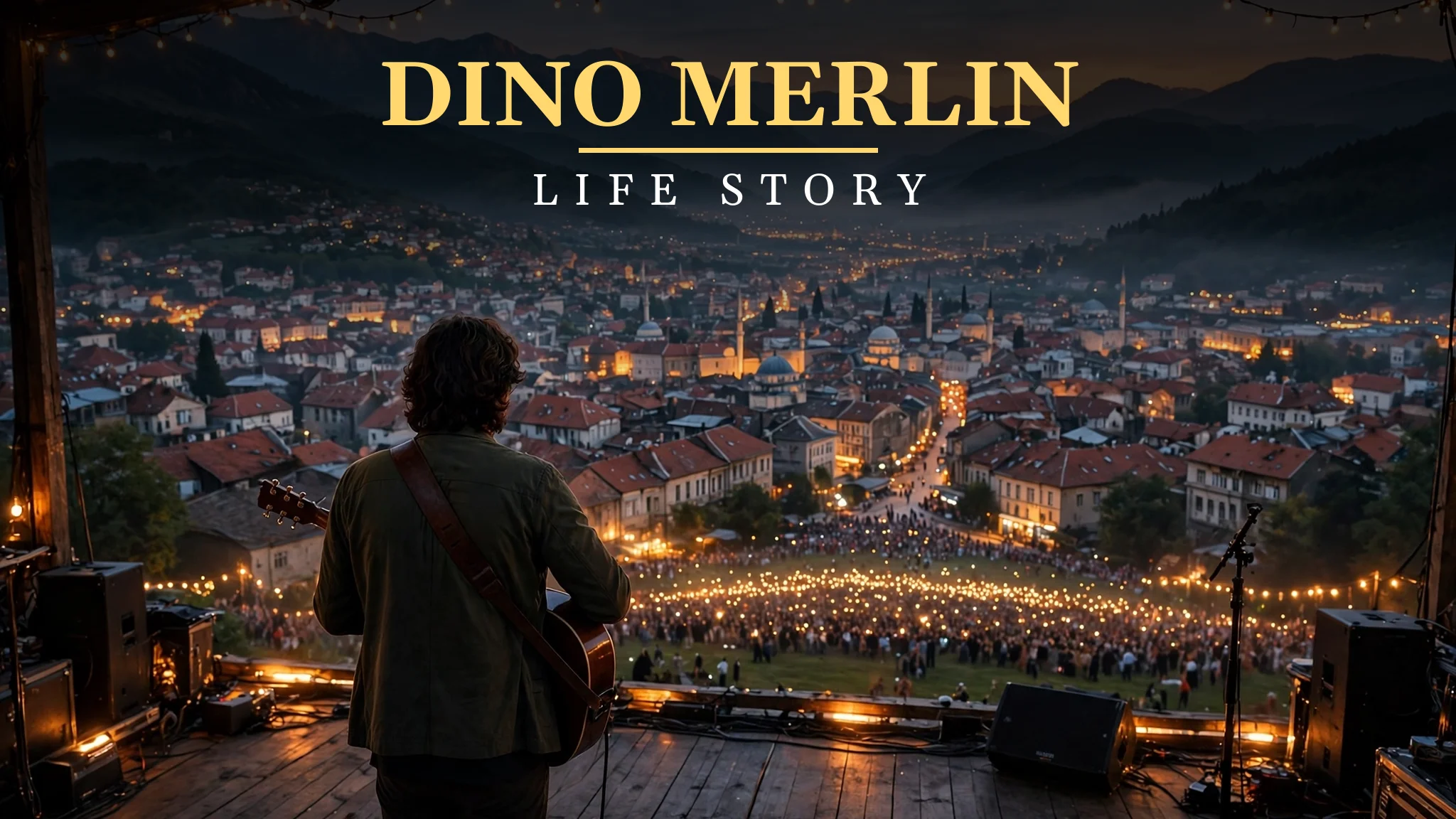
Finally, I return to the image of the stage at dusk, with a man and a guitar, looking over a valley city glowing with lights, because that image captures his story, a singer on a stage, above his city, with his guitar, and with thousands of people below, singing along, and I hope that image stays with readers, as a picture of a boy from Alifakovac, who became the voice of Bosnia, and who never forgot home.
Frequently Asked Questions
When and where was Dino Merlin born?
Dino Merlin, whose real name is Edin Dervišhalidović, was born on 12 September 1962 in Sarajevo, Bosnia and Herzegovina. He grew up in the Alifakovac neighbourhood, in a family that did not have much money, and his mother raised him largely on her own.
What was the band Merlin?
Merlin was the rock band Dino formed in Sarajevo in 1983, mixing Western rock with Bosnian sounds. The band released albums including Kokuzna vremena in 1985, and Dino took the name Merlin as part of his stage name when he went solo.
What is Dino Merlin’s most famous album?
His album Burek, released in 2004, is one of his most famous, named after the Bosnian pastry, and it became a huge hit across the Balkans. He also released Ispočetka in 2008 and Hotel Nacional in 2014, and his songs are sung by heart by millions of people.
Did Dino Merlin sing at Eurovision?
Yes, he represented Bosnia and Herzegovina at Eurovision in 2011 in Düsseldorf with the song Love in Rewind, finishing in sixth place. He had also written the Bosnian Eurovision entry in 1999, showing his skill as a songwriter as well as a singer.
Did Dino Merlin stay in Sarajevo during the war?
Yes, he stayed in Sarajevo for much of the siege in the 1990s, living through the shelling and the fear like everyone else in the city. He sang and wrote songs during that time, and his music became a source of comfort and hope for people in the city.
What are Dino Merlin’s biggest concerts like?
His concerts are huge events, with tens of thousands of fans singing every word, including shows at the Koševo stadium in Sarajevo. He also performs for Bosnian communities abroad, where his concerts feel like a link to home for people who left during the war.


