Doechii: The Life Story Behind Rap's New Star
In this post
- Tampa, Florida: A Girl Who Wrote Her Own World
- Yucky Blucky Fruitcake and the Internet Finds Her
- Persuasive, What It Is and the Road to an Album
- Alligator Bites Never Heal and the Grammy
- Anxiety, the Charts and a New Level of Fame
- The Voice, the Writing and the Stage
- Where She Stands Now
- The Stage, the Screen and the Fashion World
- My Take:
Tampa, Florida: A Girl Who Wrote Her Own World
Jaylah Ji’mya Hickmon was born on 14 August 1998 in Tampa, Florida, and she grew up in a city better known for sunshine and football than for rap, which is part of why her story feels so unusual: there was no scene waiting for her, no local industry to join, no obvious path from a Tampa childhood to a Grammy stage. She was raised by her mother and her aunt, and she has spoken about a childhood that was creative but not easy, with a mother who worked hard and a daughter who found her escape in writing, in dancing, and in the music she heard at home. The name she would later choose for herself, Doechii, pronounced doh-chee, was a nickname from her school days, a small, private word that she turned into a stage name, and the choice tells you something about her: she builds her art out of the materials of her own life.
School in Tampa gave her the first stages she ever stood on. She sang in the choir, she performed in school productions, and she wrote constantly, filling notebooks with rhymes and stories that had nowhere to go yet. She was not the loudest child in the room, and the people who knew her then describe a girl who was observant, funny, and intensely private about her ambitions. The writing was the private part: she wrote because she needed to, not because anyone was listening, and the habit stayed with her long after anyone started listening. When she left school, she did not have a plan for a music career, and she has been honest about the years that followed, working jobs, figuring out who she was, and slowly realising that the notebooks were not a hobby but a calling.
Her earliest releases were made on a shoestring and released into the void. She put out songs under her own name, including a track called Girls in 2016, and she made a mixtape called Covenant, and the music was raw, funny, and full of a personality that was still finding its shape. She sang, she rapped, she switched between the two in the middle of a verse, and she wrote about her life in Tampa with a specificity that made the songs feel like diary entries. Nobody was paying attention yet, and that was a gift: she could experiment, fail, try again, and build a sound without anyone telling her what it should be. The Tampa years are the foundation of everything that followed, and they explain why her music still sounds like a person talking to you rather than a product talking at you.
Yucky Blucky Fruitcake and the Internet Finds Her
In 2020, Doechii released a song called Yucky Blucky Fruitcake, and the internet, which had ignored her for four years, suddenly could not stop listening. The song was strange, funny, and completely her own: a rap that veered between nursery-rhyme cadences and sharp, adult observations, with a video that looked like it had been made in a bedroom, because it had. On TikTok, users began lip-syncing to it, dancing to it, and turning its oddest lines into memes, and within weeks a song that had been a joke between friends was a viral hit. The moment could have been a one-off, a viral novelty that faded, but Doechii understood something that many viral artists do not: a viral moment is not a career, it is an audition, and she had to prove, quickly, that there was more behind the song.
She proved it with the EP Oh the Places You’ll Go, released in 2020, a short, sharp collection that showed the range the viral song had only hinted at. The EP moved between rap and singing, between comedy and confession, and it introduced the character that would become her signature: a performer who could be funny and serious in the same verse, who could make you laugh and then, a bar later, make you listen. The title, borrowed from Dr. Seuss, was a clue to her sensibility: she grew up on children’s books and cartoons, and her music carries that playfulness even when the subject is adult. Critics who heard the EP began to write about her as a talent rather than a meme, and the industry, which had been slow to notice her, started calling.
The viral moment also brought her to the attention of Top Dawg Entertainment, the Los Angeles label behind Kendrick Lamar, SZA and Schoolboy Q, and in March 2022 she signed with TDE and Capitol Records, becoming the first female rapper on the TDE roster. The signing mattered for two reasons: it gave her a team, a budget and a platform, and it put her in the company of artists who took craft seriously, which is exactly the company she wanted. TDE did not try to smooth her edges; instead, the label gave her room to make the records she wanted to make, and the first of them showed why the faith was justified.
Persuasive, What It Is and the Road to an Album
Her first major-label single, Persuasive, released in 2022 and featuring SZA on a later version, was a sleek, confident R&B-rap record that showed a different side of her: the party girl, the flirt, the singer who could carry a melody as well as a verse. The song was a hit on R&B radio, and its video, full of colour and movement, introduced her visual style to a wider audience: bold, theatrical, unafraid of looking strange. She followed it with a string of singles and features, including an appearance on the soundtrack of the film Creed III, and she toured, opening for other artists and building a live show that was already more theatrical than most headliners’.
In March 2023 she released What It Is (Block Boy), featuring Kodak Black, and the song became her first major chart hit, reaching the top 40 of the Billboard Hot 100 and becoming a fixture on rap radio. The song’s success was built on a simple, infectious hook and a verse from Kodak Black that matched her energy, and it showed that she could make a mainstream hit without giving up the weirdness that made her interesting. She released the single Crazy in 2022, a song that divided listeners with its intensity, and she kept experimenting, releasing music that moved between genres with a freedom that few major-label artists are allowed. The years between the signing and the album were not a delay, they were an education: she was learning how to make records at scale, how to work with big producers, and how to keep her voice at the centre of it all.
She also released the Swamp Sessions, a series of freestyles and short videos that showed her rapping over classic beats with a hunger that reminded listeners of the Tampa notebooks. The sessions were a statement: whatever the singles and the features said, she was a rapper first, and she could hold her own against anyone. The Swamp Sessions built her credibility in the rap world, and they kept her fans fed while she worked on the album that would define her. By 2024, the question was no longer whether she was talented, but whether she could make an album that lived up to the talent, and the answer arrived in August of that year.
Alligator Bites Never Heal and the Grammy
Alligator Bites Never Heal, released on 30 August 2024, was Doechii’s debut studio album, and it was the record her whole career had been building toward. The title referred to the alligator, a creature that lives in the swamps of Florida, and the album was a love letter to Tampa and to the person she had been before the fame: nineteen tracks of rap, R&B and spoken word, with production that moved from boom-bap to trap to soul, and with songs that ranged from the furious to the tender. Denial Is a River, the album’s centrepiece, was a long, confessional track that told the story of her life in a single verse, with a beat that shifted underneath her, and Nissan Altima was a sharp, funny, bragging track that showed she could still make a song that made you laugh. Critics praised the album’s ambition, its honesty and its range, and it appeared on many lists of the best albums of 2024.
The album’s success was not immediate, it was slow, and that slowness is part of the story. Alligator Bites Never Heal did not debut at number one, and its singles did not dominate the radio, but the record kept growing, kept being discovered, kept being talked about, and by the time the Grammy nominations were announced, it was clear that the industry had heard it. In February 2025, at the 67th Grammy Awards, Alligator Bites Never Heal won Best Rap Album, making Doechii only the third woman in history to win the award, after Lauryn Hill and Cardi B. She accepted the award with a speech that went viral, in which she spoke directly to young Black girls, telling them that they could do it too, and that they did not have to change who they were to succeed. The speech was not a performance, it was a promise, and it turned a career milestone into a cultural moment.
The Grammy changed the scale of her career overnight. She was no longer a promising newcomer, she was a Grammy winner, and the invitations, the collaborations and the stages got bigger. She performed on television, she appeared at festivals, and she began work on new music with an audience that was now listening closely. But the album’s victory also raised a question that every Grammy winner faces: what comes next, and can the next record live up to the one that won? Doechii’s answer, so far, has been to keep working, to keep experimenting, and to refuse to let the award define her.
Anxiety, the Charts and a New Level of Fame
In 2025, a song she had first released years earlier became one of the biggest hits of her career. Anxiety, which she had originally posted on YouTube in 2019 and which sampled Gotye’s Somebody That I Used to Know, was re-released as a single in March 2025, and it became a worldwide hit, reaching the top ten of the Billboard Hot 100 and topping charts in several countries. The song’s success was built on a simple, relatable idea: the feeling of anxiety as a constant companion, and Doechii’s performance, which moved between singing and rapping, made the feeling vivid and specific. The hit was unusual, because it was not a new song but an old one, finally finding its moment, and it proved that her catalogue had depths the charts had not yet explored.
Anxiety also showed her range as a performer. The song’s video was theatrical and strange, full of the visual imagination that has become her signature, and her live performances of it, including a celebrated appearance on television, showed a singer who could command a stage with nothing but a microphone and a band. The hit brought her a new audience, listeners who had missed the mixtapes and the album, and it gave her a second chart moment to stand beside the Grammy. She followed it with new music and collaborations, and she began to be spoken about not as a newcomer but as one of the defining rappers of her generation.
Her style, both musical and visual, has become one of the most recognisable in rap. She mixes high fashion with street style, she uses bold colours and theatrical staging, and she treats a music video as a short film rather than a performance clip. The fashion world has noticed, and she has appeared in campaigns and on magazine covers, but the style is not a costume, it is an extension of the music: playful, strange, confident, and entirely her own. The Tampa girl who made videos in her bedroom is now making videos that look like art films, and the through-line is the same: a performer who would rather be interesting than safe.
The Voice, the Writing and the Stage
Doechii’s voice is the most versatile instrument in modern rap. She can rap in a whisper, she can sing in a belt, she can switch between the two in the middle of a line, and she can adopt a character, a voice, an accent, and then drop it a bar later. The versatility is not a trick, it is a tool: it lets her tell stories that a single voice could not tell, and it lets her move between comedy and confession without breaking the spell. Listen to Denial Is a River, where she plays multiple characters in a single song, or to Yucky Blucky Fruitcake, where the voice changes with every line, and you hear a performer who treats her voice the way an actor treats a costume, as something to put on and take off.
Her writing is equally distinctive. She writes about Tampa, about her mother, about her mental health, about desire and ambition, and she writes about them with a specificity that makes the songs feel like they could only have been written by her. The lyrics are full of images from her life: the swamp, the alligator, the schoolyard, the notebook, and the images repeat across her catalogue, building a world that listeners can enter and recognise. She has spoken openly about her mental health, including her experiences with anxiety, and the openness has made her music a place where listeners who feel the same way can find company.
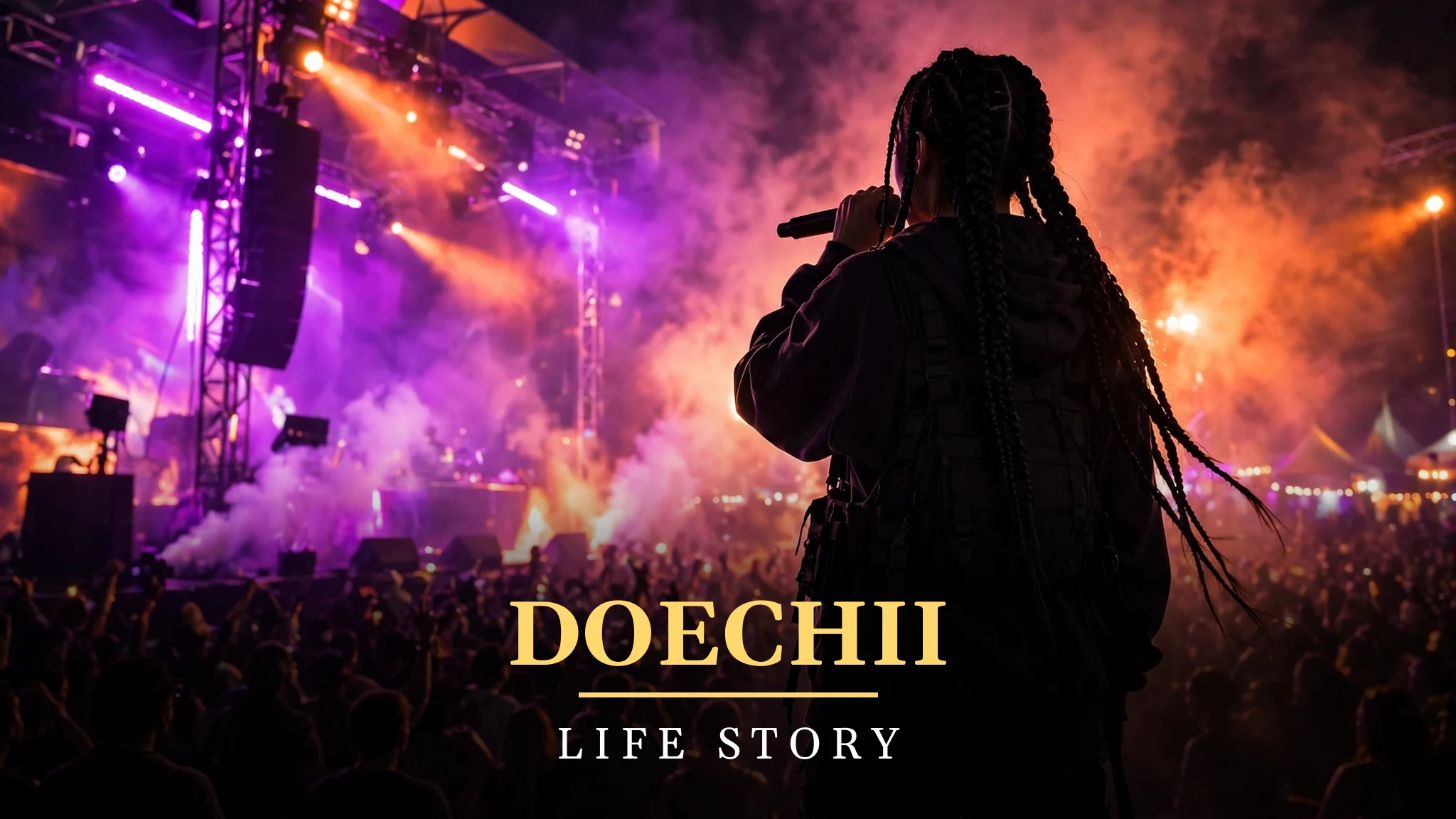
On stage, she is a theatrical performer, and her shows are built around movement, costume changes and storytelling. She has toured as a headliner and as an opener, and her live performances have been praised for their energy and their precision. The stage is where the different parts of her talent come together: the rapper, the singer, the dancer, the actor, and the result is a show that feels more like a play than a concert. It is a long way from the Tampa choir, but the girl who sang in that choir is still there, at the centre of the stage, singing like she means it.
Where She Stands Now
As of 2026, Doechii is a Grammy-winning rapper with a debut album that is already considered a classic, a global hit in Anxiety, and a career that is still accelerating. She is one of the most talked-about artists in rap, and one of the most respected, and the respect is not just for the award but for the work behind it: the mixtapes, the viral moment, the label years, the album, all of it adding up to a career that was built, step by step, from a bedroom in Tampa to a stage in Los Angeles. The alligator in her album title is a creature that survives by being patient, and Doechii has survived the same way: by waiting, by working, and by striking when the moment was right.
She continues to record and tour, and the next album will be one of the most anticipated in rap, because the question it has to answer is the hardest one in music: how do you follow a Grammy-winning debut? Her answer, if her career so far is any guide, will be to make the record she wants to make, in the way she wants to make it, and to let the audience catch up. The girl from Tampa who wrote in notebooks is now writing the story of her generation, and the story is still being written.
The Stage, the Screen and the Fashion World
Doechii’s rise has not been confined to records and charts, because her talent has always been visual as well as musical, and the world beyond rap noticed quickly. Her music videos, from the bedroom-made clip for Yucky Blucky Fruitcake to the elaborate, theatrical videos for the Alligator Bites Never Heal era, are short films rather than performance clips, full of costume changes, bold colours and staging that borrows from theatre and dance. She directs the eye the way she directs a verse, with confidence and surprise, and the videos have become as much a part of her art as the songs themselves. The fashion world, which is always looking for a performer who treats clothes as a language, found in her a natural: she has appeared in campaigns, on magazine covers, and on red carpets where her outfits are discussed as seriously as her music.
Her live performances carry the same theatrical energy. On stage she moves between singing, rapping and dancing, she changes costume and character, and she treats a concert as a piece of theatre rather than a recital. Fans who have seen her headline shows talk about the same thing, the sense that they are watching a performer who has thought about every detail, from the lighting to the set list, and who is enjoying herself while she does it. The stage is also where her background in school choir and school theatre shows: she knows how to project, how to hold a room, how to make a large venue feel intimate, and those are skills that cannot be learned in a recording studio.
She has also begun to appear in film and television, lending her voice and her presence to projects that fit her sensibility, and the acting side of her talent, which she showed in the character work of Denial Is a River, is likely to grow. The through-line in all of it, the videos, the stage, the fashion, the screen, is the same as it was in the Tampa notebooks: a performer who would rather be interesting than safe, and who treats every medium as a new room to play in. The Grammy was a recognition of the music, but the career that surrounds the music is just as impressive, and it is still expanding.
The community she has built around her work is the final piece of the picture. Her fans, who call themselves by the names she has given them and who follow her from platform to platform, are not passive listeners, they are participants, making dances, making art, making memes, and carrying her songs into places she has never been. She talks to them directly, she credits them, and she has used her platform to speak about mental health, about being a young Black woman in rap, and about the importance of staying true to yourself. The relationship is not marketing, it is a conversation, and it is one reason her audience has stayed loyal through the long wait for the album and the slow climb that followed it.
My Take:
Doechii is the rapper I am most excited about in 2026, and the reason is not the Grammy, it is the mixtapes. The Grammy is a wonderful thing, and it is deserved, but the mixtapes, the viral song, the Swamp Sessions, the years of work in Tampa that nobody saw, are the reason the Grammy happened, and they are the reason I trust her to make a second great album. A career built on a viral moment alone is fragile; a career built on years of writing in notebooks is not, and Doechii’s career is the second kind. She was ready long before anyone noticed, and the noticing was the last step, not the first.
Yucky Blucky Fruitcake is the song I keep coming back to, because it is so strange and so brave. Most artists, given a first chance at attention, would play it safe, would make a song that sounded like the radio, would try to fit in. Doechii made a song that sounded like nothing on the radio, a song with a nursery-rhyme cadence and a video made in a bedroom, and the internet loved it precisely because it was strange. The song is a lesson in the value of being yourself: the weirder the song, the more it stood out, and the more it stood out, the more people wanted to know who made it. I think every young artist should listen to that song and learn from it, because it proves that the audience is smarter than the industry thinks, and that it rewards originality.
The TDE signing matters more than it looks, because TDE is a label that takes craft seriously, and Doechii is an artist who takes craft seriously. The label behind Kendrick Lamar and SZA does not sign novelty acts, and the fact that they made her the first female rapper on their roster tells you what they heard in her: a writer, a performer, a person who could carry an album. The signing also gave her something she had never had, a team, and the team gave her room to make the records she wanted, which is the best thing a label can do for an artist like her. Persuasive and What It Is are the proof that the partnership worked: mainstream hits that still sound like Doechii.
Alligator Bites Never Heal is the album that will define her, and I think it deserves to be spoken about alongside the great debut albums in rap. It is long, it is ambitious, it is funny and sad and angry and tender, and it does something very few debut albums do: it tells you who the artist is, where she comes from, and what she cares about, in nineteen tracks that never repeat themselves. Denial Is a River is the centrepiece, a song that does the work of a memoir in a single verse, and Nissan Altima is the counterweight, a song that reminds you she can still make you laugh. The album’s slow success, the way it grew over months rather than exploding in a week, is the best kind of success, because it means people found it, loved it, and told their friends, and that is how classics are made.
The Grammy speech is the moment that made me a fan for life, and I do not mean the award, I mean the speech. She stood on the Grammy stage, a Black woman from Tampa who had made an album about alligators and anxiety, and she spoke directly to young Black girls, telling them that they could do it, that they did not have to change, that their weirdness was their strength. It was not a canned acceptance speech, it was a message, and it went viral because it was true. I have watched it several times, and every time I am struck by the same thing: she was not thanking the industry, she was talking to the audience, and that is the difference between a star and a leader.
Anxiety is a strange hit, and I mean that as a compliment. It is a song she first posted on YouTube in 2019, a song about a feeling that everyone has but nobody wants to talk about, and it became a global hit six years later, because the world finally caught up with it. The song’s success proves something important about her catalogue: it has depths that the charts have not yet explored, and there are more hits in there waiting to be found. It also proves something about her as a writer: she was writing about mental health in 2019, before it was fashionable, and she was writing about it honestly, which is why the song still feels true in 2025. The hit did not change her, it revealed her, to an audience that had missed the first version.
Her voice is the thing that sets her apart, and I do not think it gets enough credit. She can rap, she can sing, she can whisper, she can shout, she can play a character, and she can do all of it in a single song without ever losing the thread. Listen to Denial Is a River, where she moves between voices the way other rappers move between flows, and you hear a performer who understands that a voice is not just a sound, it is a tool for storytelling. The versatility is not showing off, it is serving the song, and that discipline is what makes her great: she uses every voice she has, but only when the song needs it.
The visual side of her work is equally important, and I think it is underrated. Her videos are not performance clips, they are short films, full of colour, costume, and theatrical imagination, and they show an artist who thinks in images as well as in words. The style, the bold colours, the strange costumes, the playful staging, is not a costume, it is the music made visible, and it is why her work stands out in a feed full of artists who all look the same. She learned to make videos in a bedroom, with no budget, and the lesson stayed with her: a good idea is worth more than a big budget, and a strange idea is worth more than a safe one.
Tampa is the secret ingredient in her music, and I think it matters more than people realise. She is not from New York or Los Angeles or Atlanta, she is from a city with no rap industry, no scene, no obvious path, and the fact that she built a career from there, without a local machine behind her, tells you how much of the work was hers alone. The alligator, the swamp, the Florida heat, these are not decorations in her songs, they are the place she comes from, and the place gives her music a flavour that no other rapper has. She did not leave Tampa behind when she got famous, she brought it with her, and the music is better for it.
The Swamp Sessions are my favourite part of her catalogue, because they are the purest version of her talent: a rapper, a beat, a camera, and nothing else. No features, no production tricks, no label notes, just Doechii rapping like her life depends on it, and the sessions prove that she can hold her own against anyone in the genre. I think every rapper should have to do a freestyle series like that, because it strips away the marketing and leaves the skill, and Doechii’s skill is formidable. The sessions also built her credibility in the rap world, which matters, because a Grammy is one thing and the respect of other rappers is another, and she has both.
If I were introducing someone to Doechii, I would start with Yucky Blucky Fruitcake, then Alligator Bites Never Heal, then Anxiety, because that sequence shows the arc: the viral song, the album, the hit, each one building on the last. And I would tell them to watch the videos, because the visuals are half the art, and to listen to Denial Is a River with headphones, because the song rewards close listening. Doechii is a rapper, a singer, a writer, an actor, and a visual artist, and the combination is rare, and the career is just beginning.
There is a final thing I want to say, and it is about the speech. When she told young Black girls that they could do it, she was not just accepting an award, she was opening a door, and the girls who heard her will walk through it. That is the real measure of a career, not the awards or the chart positions, but the doors it opens for the people who come next. Doechii has opened a door, and she did it by being herself, by writing in notebooks in Tampa, by making a strange song in a bedroom, by refusing to change. The door is open, and the next generation is already walking through it.
The visual side of her work is what I want to celebrate, because it is the part that gets lost when we talk about Grammys and charts. Her videos are not afterthoughts, they are art, and they show a performer who thinks in images as well as in words. The bedroom video for Yucky Blucky Fruitcake, the bold, theatrical clips for the album, the fashion shoots, all of it is one continuous project: a visual world to match the musical one. I think young artists should study her videos the way they study her verses, because the lesson is the same in both: a good idea, executed with confidence, is worth more than a big budget, and a strange idea is worth more than a safe one.
Her live show is the other thing I keep thinking about, because it is where all the parts of her talent come together. The rapper, the singer, the dancer, the actor, the comedian, they are all on stage at the same time, and the result is a performance that feels like a play, a concert and a party at once. I have watched clips of her shows and been struck by the joy in them: she is clearly having fun, and the fun is infectious, and the audience, which is often young and often seeing her for the first time, leaves feeling like they have been part of something. That joy is not a performance, it is the real thing, and it is why her fans stay.
The fashion world deserves a mention too, because it shows how her influence is spreading beyond music. She is not a rapper who wears clothes, she is a performer who uses clothes as part of the art, and the fashion industry, which is famously hard to impress, has been impressed. The magazine covers, the campaigns, the red carpet moments, they are not distractions from the music, they are extensions of it, and they show an artist who understands that a career is built in many rooms, not just one.
And finally, the fans. I have watched her audience grow from a handful of people on TikTok to a global fanbase, and what strikes me is the loyalty: the fans who waited for the album, who learned the words to Denial Is a River, who made the dances for Anxiety, who showed up for the Swamp Sessions, are not casual listeners, they are a community. She built that community by talking to them honestly, by being herself, by refusing to pretend, and the community has repaid her with the kind of loyalty that cannot be bought. The Grammy belongs to her, but the community belongs to all of them, and it is the community that will carry her to the next album and the one after that.
What I admire most about Doechii is the performance, because she is not just a rapper, she is a theatre of one. The videos, the alter egos, the costumes, the way a song like Denial Is a River is staged like a sitcom, all of it shows an artist who thinks in scenes, not just in verses, and the scenes, which are funny, strange, and deeply personal, are the reason her work sticks in the mind long after the song has ended. I think about her Tampa beginnings, about the swamp sessions she filmed with friends, about the way she built a world before anyone in the industry was watching, and I am struck by the patience: she did not rush to be famous, she built a language, a look, and a voice, and the voice, which is the point, is still hers, whether she is rapping, singing, or acting, and the acting, which is the mark of a performer who understands that a song is also a show, is the reason she won a Grammy for a debut mixtape, and the reason she will be here for a long time.
Frequently Asked Questions
Where is Doechii from and what is her real name?
Doechii’s real name is Jaylah Ji’mya Hickmon. She was born on 14 August 1998 in Tampa, Florida, where she grew up. The stage name Doechii comes from a nickname she had at school.
How did Doechii become famous?
She first went viral in 2020 with the song Yucky Blucky Fruitcake, which spread on TikTok. She then signed with Top Dawg Entertainment and Capitol Records in March 2022, becoming the first female rapper on the TDE roster, and released the singles Persuasive and What It Is (Block Boy).
What album won Doechii a Grammy?
Her debut studio album Alligator Bites Never Heal, released on 30 August 2024, won Best Rap Album at the 67th Grammy Awards in February 2025. She became only the third woman to win the award, after Lauryn Hill and Cardi B.
What is Denial Is a River about?
Denial Is a River is the centrepiece of Alligator Bites Never Heal. It is a long, confessional track in which Doechii tells the story of her life, moving between characters and voices, over a beat that shifts underneath her. Critics praised it as one of the best songs on the album.
What is Doechii’s song Anxiety?
Anxiety is a song Doechii first posted on YouTube in 2019, sampling Gotye’s Somebody That I Used to Know. It was re-released as a single in March 2025 and became a worldwide hit, reaching the top ten of the Billboard Hot 100. The song is about living with anxiety.
What are the Swamp Sessions?
The Swamp Sessions are a series of freestyles and short videos Doechii released, rapping over classic beats with a camera and nothing else. They showed her raw rapping skill and built her credibility in the rap world while she worked on her debut album.
What does the alligator in her album title mean?
The title Alligator Bites Never Heal refers to the alligator, a creature of the Florida swamps where Doechii grew up in Tampa. The album is a love letter to her home and to the person she was before fame, and the alligator became the album’s central image.


