Dorra Zarrouk: The Life Story Behind Tunisia's Elegant Actress
In this post
Dorra Zarrouk is one of the most elegant actresses in the Arab world, a Tunisian star whose calm beauty, clear voice, and careful choice of roles have made her a familiar face in Egyptian cinema and television. She was born in Tunis, she studied law, and she became an actress almost by chance, first in Tunisia and then in Egypt, where her roles in films such as “Al Maslaha” and “Tisbah Ala Khair” made her a household name. Her performances are known for their grace, their intelligence, and a quiet strength that makes her stand out on screen.
What makes Dorra’s story special is the unusual path she took. Most actresses start young, in a drama school, with a clear plan, but Dorra started as a law student, a young woman preparing for a serious, ordinary career, and she found acting later, through a love of theatre and a willingness to try something new. She is a woman who has lived in two worlds, Tunisia and Egypt, and who has carried the best of each into her work, with an elegance that is both Tunisian and Egyptian at once.
Her life has had moments of great success, on screen and on the red carpet, and moments when she had to prove herself again, but her star has remained, and her name is still one of the most loved in Arab cinema. This is the story of how a law student from Tunis became Dorra Zarrouk, the elegant actress of the Arab world.
A Girl From Tunis Who Studied Law
Dorra Zarrouk was born on 13 January 1980 in Tunis, the capital of Tunisia, a city on the Mediterranean coast where the old medina meets the modern suburbs, and where culture, education, and family are valued deeply. She grew up in that world, in a family that encouraged her to study, to read, and to think, and she learned to love learning as much as she loved art. Tunis in the 1980s was a city full of life, with schools, theatres, and a strong sense of community, and a child growing up there could hear many kinds of stories, in Arabic and in French, in the streets and at home.
As a girl she was drawn to the arts, to theatre, to film, and to the stories that filled Tunisian homes, but she was also a serious student, and she chose to study law at university, a subject that seemed safe, respectable, and full of promise. Law is a field that requires reading, thinking, and speaking clearly, and those skills, learned in a law faculty, would later help her as an actress, when she had to understand a character, to speak a line with meaning, and to hold an audience with her presence. She did not grow up thinking about acting as a career, but she grew up with a love of stories, and that love would lead her to the stage.
School was a normal part of her early life, and she balanced her studies with her interest in theatre, taking part in school plays and in amateur productions, where she learned how to perform in front of an audience, how to become a character, and how to make a story feel real. Those small performances were her first stage, and they taught her lessons that would stay with her, about how to listen, how to react, and how to be present in a scene. She was not a child star. She was a student who loved theatre, and that love grew slowly, year by year.
Tunis itself shaped her in a particular way. The city is a mix of old and new, of Arab, Mediterranean, and French influences, and a girl growing up there learns to move between worlds, to speak French and Arabic, and to feel at home in many places. Dorra absorbed that mix, and it gave her a cosmopolitan air, a calm elegance that would later make her stand out on screen, as an actress who could play a woman from many places, and who could make each role feel real.
By the time she finished her law studies, Dorra knew that her heart was in acting, not in a courtroom, and she began to think about how to make that happen. It was a brave decision, to leave a safe profession for an uncertain art, and it required a kind of courage that many people never find. She found it, and she took her first steps as an actress, in Tunisia, in small roles that would lead to bigger ones, and to a career that would take her far from Tunis.
First Roles in Tunisia and the Love of Theatre
Dorra Zarrouk began her acting career in Tunisia, in theatre and in television, where she took small roles that taught her the craft of performance, and where she learned how a set works, how a camera sees an actress, and how to build a character from a script. Those early roles were not famous, and they did not make her a star, but they gave her experience, a professional foundation, and a understanding of the work that would serve her for the rest of her career. She was a young actress in a small industry, and she had to work hard to be noticed, but she did it with patience and with a quiet determination.
Theatre was a key part of her early life, and it taught her lessons that film and television cannot teach, about how to perform live, in front of an audience, without a second take, and about how to hold a stage with nothing but her voice and her presence. She loved theatre, and it gave her a love of language, of dialogue, and of the moment when an actor and an audience share a story together. That love of theatre stayed with her, even when she became a film star, and it is audible in her performances, in the clarity of her speech and in the care she takes with every line.
Her early work in Tunisian television also brought her to the attention of audiences in her home country, who recognised a new talent, a young woman with a calm beauty and a clear, intelligent presence, and who began to follow her career. She was not a loud star. She was a quiet one, and her quietness was part of her appeal, because it made her performances feel honest and real, rather than showy or forced. That honesty is a rare quality in an actress, and it is one of the reasons her fans love her so deeply.
During these years she also learned about the business of acting, about how to choose a role, how to work with a director, and how to build a career in a small industry where opportunities are few and competition is fierce. She learned that an actress needs more than talent. She needs patience, good judgement, and a willingness to wait for the right role, rather than taking every offer that comes. Dorra learned those lessons, and she kept working, even when the road was slow, because she believed in her art and in her future.
By the time she left Tunisia for Egypt, Dorra had grown from a law student into an actress, with training, with experience, and with a clear sense of who she was on screen. She was ready for the next step, a step that would take her to Cairo, the centre of Arab cinema, where her face, her voice, and her talent would make her a star.
Egypt, Al Maslaha, and the Breakthrough on Film
Dorra Zarrouk’s breakthrough in Egypt came with her work in Egyptian cinema, and one of the key films was “Al Maslaha”, released in 2012, a drama that brought her to the attention of Egyptian audiences and that showed off her talent as a film actress. The film was a success, and Dorra’s performance in it, as a woman caught in a complex story of love, family, and crime, was praised for its elegance, its intelligence, and its emotional depth. It was a role that required her to be both strong and vulnerable, and she played it with a calm confidence that made audiences want to watch her again.
The success of “Al Maslaha” was not an accident. It came after years of work in Tunisia, of theatre and television, and of learning her craft, and it showed that Dorra was ready for a leading role in Egyptian cinema. She had a face that the camera loved, a voice that was warm and clear, and a presence that made her stand out, and those qualities, combined with her training, made her a natural film actress. The film gave her a platform, and she used it to build a career in Egypt that would last for many years.
Her work in Egypt also marked a move to a new country, to Cairo, the centre of Arab film, where the biggest movies are made, and where an actress who succeeds can become famous across the whole Arab world. Dorra moved, she adapted, and she built a new life, with roles in films and in television series that took her to audiences in Egypt, in the Gulf, and in North Africa. She was no longer a Tunisian actress trying to make it in Egypt. She was a star in Egypt, with a name that was known in every home.
The film world in Egypt is competitive, with many talented actresses, and Dorra had to prove herself again and again, with each new role, each new film, and each new performance. She did it by choosing her roles carefully, by working with good directors, and by bringing her intelligence and her elegance to every character she played. That care is visible in the quality of her work, in the roles she chose, and in the reputation she built as a reliable, talented actress.
By the end of this period, Dorra was recognised as one of the leading actresses in Egyptian cinema, a Tunisian star who had become a star in Cairo, and whose name was known to millions of viewers. She had also shown that a career can start late, in a foreign country, and still reach the highest levels, if the actress is willing to work, to learn, and to stay true to herself.
Tisbah Ala Khair and the Star of Egyptian Cinema
One of the most important moments in Dorra Zarrouk’s career came with the film “Tisbah Ala Khair”, which means “good night”, released in 2017, a drama that became a hit in Egypt and that made her a leading lady of Egyptian cinema. The film’s story, about love, family, and the choices people make, gave Dorra a role that showed off her full range as an actress, with moments of joy, of sadness, and of quiet strength, and her performance was praised by critics and by audiences alike. It was a film that proved she could carry a movie on her own, and that her name on a poster was enough to bring viewers to a cinema.
The success of “Tisbah Ala Khair” brought Dorra to a new level of fame, with interviews, photo shoots, and appearances that took her to festivals and to red carpets across the Arab world. She was no longer only a film actress. She was a star, with a public image that was elegant, intelligent, and calm, and with a fan base that followed her from film to film. That change brought new pressures, with the need to stay visible, to choose good roles, and to live up to the expectations of a public that had just discovered her, but Dorra handled it by staying close to her work and to her values.
Her work in the years around “Tisbah Ala Khair” also included television series, where she played leading roles in Ramadan dramas and in other popular shows, and where she reached audiences who watched television at home, with their families, every night. Television is a different medium from film, with a different pace and a different kind of performance, and Dorra’s ability to move between the two is a sign of a trained, professional actress, one who understands the craft and who can adapt to any format. Her television work, while less famous than her films, is an important part of her career, and it shows a woman who is interested in more than one kind of acting.
The film also showed her range, her ability to play a romantic lead, a dramatic role, and a character with depth and complexity, and it proved that her training in law and in theatre had given her a craft that could be applied to any kind of story. She was not a one-role actress. She was a performer who could adapt, who could learn, and who could grow, and that adaptability is the reason her career has lasted for so many years.
By the end of this period, Dorra was recognised as one of the leading actresses in the Arab world, a Tunisian star who had become a star in Egypt, and whose name was known to millions of viewers. She had also shown that a career built on law, on theatre, and on a move to Cairo could reach the highest levels, and that a woman who starts late can still become a leader in her field.
Television, Ramadan, and a Face Families Know
Dorra Zarrouk’s work in television, especially in Ramadan series, made her a familiar face to millions of Arab families, who watched her every night during the holy month, and who came to know her as a part of their evenings together. Ramadan series are the biggest television events in the Arab world, watched by families who gather after breaking their fast, and a leading role in a successful Ramadan series can make an actress a part of a family’s memory. Dorra played such roles, with a calm, elegant presence that viewers loved, and her performances became a part of the ritual of Ramadan, a sign that the evening had come and that it was time to watch together.
Her television work also showed her versatility, with roles in dramas, in comedies, and in stories about family, love, and society, and each role added a new piece to the picture of who she was as an actress. She did not play the same character again and again. She chose different roles, different stories, and different kinds of women, and that variety kept her work fresh and kept her fans engaged. A television actress who can play many kinds of women is a valuable one, and Dorra proved that she could, with a range that few actresses can match.
The fame that came with television also brought her to new audiences, in the Gulf, in the Levant, and in North Africa, where viewers who had not seen her films discovered her through a series, and where they began to follow her career. That wider fame is a sign of how far she had come, from a law student in Tunis to a star whose face was known in every Arab home, and it is a testament to the quality of her work, to the care she took with every role, and to the elegance she brought to the screen.
Her work on television also kept her connection with her fans alive, even when she was not making a film, and it reminded everyone why her acting mattered, even when the headlines were about other stars. She was a reliable, talented actress, and her presence on screen was a guarantee of quality, a sign that the series was worth watching. That reputation, built over many years, is one of the most valuable things an actress can have, and Dorra earned it, role by role, year by year.
The Elegant Star and the Life Beyond the Screen
Dorra Zarrouk is often described as elegant, and that description, while true, can be a burden for an actress, because it can make people think that her success comes from her looks rather than her talent. Dorra has faced that judgement throughout her career, with some critics and viewers assuming that her fame is based on her beauty, and she has met it by working hard, by choosing serious roles, and by proving, again and again, that she is a trained, intelligent actress, not only a beautiful one. That proof, given over many years and many roles, is the best answer to the criticism, and it is one that her fans understand well.
Her personal life, including her marriage in 2020 to the Egyptian architect and designer Hany Saad, has been a subject of public interest, and she has handled it with a calm dignity, keeping her family life largely private, and focusing on her work rather than on controversy. She has not sought attention for its own sake, and she has not made her career about scandal. She has made it about acting, about choosing good roles, and about building a body of work that will last, and that choice is a sign of a mature artist.
The life beyond the screen, with family, with friends, and with a home in Cairo, is a part of her story that she has kept largely to herself, and that privacy is a deliberate choice, a way to protect the people she loves from the spotlight, and to keep her work separate from her home. That separation is hard to maintain in a world of social media and constant attention, but Dorra has maintained it, with a quiet strength that her fans respect. She is a public figure, but she is also a private woman, and that balance is part of what makes her interesting.
Her elegance, both on screen and off, is not only about clothes or makeup. It is about a way of carrying herself, a calm, intelligent presence that makes people listen when she speaks, and that makes her performances feel honest and real. That elegance is a gift, and it is one that Dorra has used well, in her acting and in her life, to build a career that is respected as well as loved.
A Star Who Still Shines
Today Dorra Zarrouk remains one of the most loved actresses in the Arab world, a Tunisian star whose name is known in every home, and whose performances are still watched, still loved, and still remembered. She continues to act, in film and in television, and her fans continue to follow her, because her work is part of their lives, part of their Ramadan, and part of the soundtrack of their families. She has also shown that a career can be built from an unlikely beginning, from law to theatre to stardom, and that a woman who is willing to work and to learn can reach the highest levels, even if she starts late.
Her legacy is still being written, because she is still active, still working, and still making new roles, but its shape is already clear. She opened a door for other Tunisian actresses, she carried the name of Tunisia to Egypt and to the wider Arab world, and she showed that an elegant, intelligent actress, when combined with training, talent, and hard work, can become a lasting star. That example matters, because it tells young actresses that looks alone are not enough, and that the work, the training, and the dedication are what make a star last.
For a young woman in Tunis today, Dorra’s story is a reminder that a career can start in an unexpected place, in a law faculty, on a small stage, or in a television studio, and that it can grow if the person is willing to work, to learn, and to stay true to who she is. That message is hopeful, and it is one that Dorra’s life makes real, in a way that no speech or slogan could.
My Take:
I think Dorra Zarrouk’s story is one of the most interesting in this whole set, because it begins in a law faculty, not on a stage. She was a law student first, a young woman preparing for a serious, ordinary career, and she became an actress later, through a love of theatre and a willingness to try something new. I admire that kind of reinvention, because it takes courage to leave a safe profession behind and to start again with an uncertain art, especially when the new art is as competitive as acting. Many people would have stayed with law, because it was safe and respectable, but Dorra did not. She followed her heart, she took small roles in Tunisia, and she built a career from that unlikely beginning, and that courage is the heart of her story.
What I like most about her is the elegance she brings to the screen, a calm, intelligent presence that makes her stand out without shouting. She does not overact, she does not try to be the loudest person in the room, and she does not rely on drama for its own sake. She plays a character with a quiet dignity, with a look, a pause, and a voice that carries the feeling, and that restraint is a sign of a trained actress, one who understands that less can be more. I think about her roles in “Al Maslaha” and “Tisbah Ala Khair”, and I see a woman who can hold a scene with very little, who can make an audience feel love, loss, and hope, simply by being present. That is a rare gift, and it is the reason her fans love her so deeply.
Her move to Egypt interests me deeply, because it shows what it means to be a foreigner in a new country, learning a new industry, a new audience, and a new kind of fame, all at once. Dorra did that, and she did it well, becoming a star in Egyptian cinema, a world that is competitive and demanding, and where a Tunisian actress has to work harder than others to be noticed. I think about how lonely those first years in Cairo must have been, far from Tunis, far from family, and how much strength it took to keep going when the roles were small and the future was uncertain. She kept going, and that persistence is a lesson for anyone who has ever started again in a new place, that a new beginning is possible, even when it is hard, and that hard work can turn a small role into a big career.
The film “Tisbah Ala Khair” is the part of her career I think about most, because it was a leading role that proved she could carry a movie on her own, and that her name on a poster was enough to bring viewers to a cinema. The film’s story, about love and the choices people make, gave her a role that showed off her full range, with moments of joy, of sadness, and of quiet strength, and her performance was praised by critics and by audiences alike. I think about how much pressure there must have been, to carry a film, to be the face that audiences came to see, and I admire the way she handled it, with a calm confidence that made the film work. That is the mark of a leading lady, not only talent, but the ability to carry a story on your shoulders, and Dorra did that.
Her work in television, especially in Ramadan series, also matters to me, because Ramadan series are a special part of Arab life, watched by families together, every night, during the holy month, and a leading role in a successful Ramadan series can make an actress a part of a family’s memory. Dorra became that, a face that families saw together, a voice that they heard together, and a character that they talked about together, and that kind of fame is different from the fame of a film star. It is a shared fame, a fame that belongs to a whole family, and it is a beautiful thing for an actress to achieve. I think about the families who watched her in Ramadan, and I wonder what they felt, seeing a Tunisian actress, elegant and calm, playing a woman they recognised, and I think they felt proud, and happy, and connected to her story.
I have to be honest about the elegant label, because it is both a gift and a burden. Dorra is elegant, and that elegance has helped her career, but it has also made some people think that her success comes from her looks rather than her talent. I think that judgement is unfair, because Dorra is a trained, intelligent actress, with years of work in theatre and television, and with a body of work that proves her talent, again and again. She has earned her fame through work, not only through her beauty, and I think her fans understand that, even if some critics do not. A beautiful face can open a door, but only talent can keep it open, and Dorra has kept it open for many years.
I also think about her law studies, and about how the skills she learned in a law faculty have helped her as an actress. Law requires reading, thinking, and speaking clearly, and those skills are exactly what an actress needs, to understand a character, to speak a line with meaning, and to hold an audience with her presence. I think that is a beautiful connection, that a serious, academic training can become the foundation for an artistic career, and that a person who studies law can become a great actress, because the two fields both require a love of language and a understanding of people. Dorra’s life shows that a career does not have to be a straight line. It can turn, it can change, and it can still lead to success.
If I compare her to other actresses in this set, I think she is the most graceful, the one whose performances feel most like a quiet conversation rather than a loud show. That grace is not easy to achieve, and it comes from a combination of training, of intelligence, and of a natural calm that cannot be learned. I think that grace is what makes her stand out, in a world of loud, dramatic performances, and it is the reason her fans return to her films and series again and again, because they know that a Dorra Zarrouk performance will be honest, elegant, and true.
In the end, I think Dorra Zarrouk’s story is about a woman who refused to be defined by a single career, a single country, or a single image. She was a law student, then an actress, then a star, and she was Tunisian and Egyptian, all at once, and she made a life out of that mix, with a calm, elegant presence that makes her stand out on screen. Her roles in “Al Maslaha” and “Tisbah Ala Khair” are still watched today, and they remind viewers of a time when Arab cinema was enriched by a voice from Tunisia. I hope she keeps acting, and I hope her work keeps reaching new audiences, because the world needs more actresses like her, graceful, honest, and unafraid to start again.
I will keep watching her work, and I will keep thinking about the girl from Tunis who studied law and who became a star of Egyptian cinema instead. Her journey is a reminder that a life can change direction, that a dream can be replaced by a better one, and that a person who is willing to learn can find a new home in a new art. That is a hopeful message, and it is one that Dorra’s life makes real, in a way that no speech or slogan could. I am grateful for her performances, and I think many viewers are too.
I want to end by thinking about the young actresses today who look at Dorra and see a path. They see a woman who started late, who studied law, and who became a star, and they see that it is possible to build a career on training, on hard work, and on a calm, honest presence. That example matters, because it shows that success does not have to come early, and it does not have to come easily. It can come late, and it can come through work, and it can last, if the actress is willing to keep working and to keep learning. Dorra is proof of that, and her story will encourage young actresses for many years.
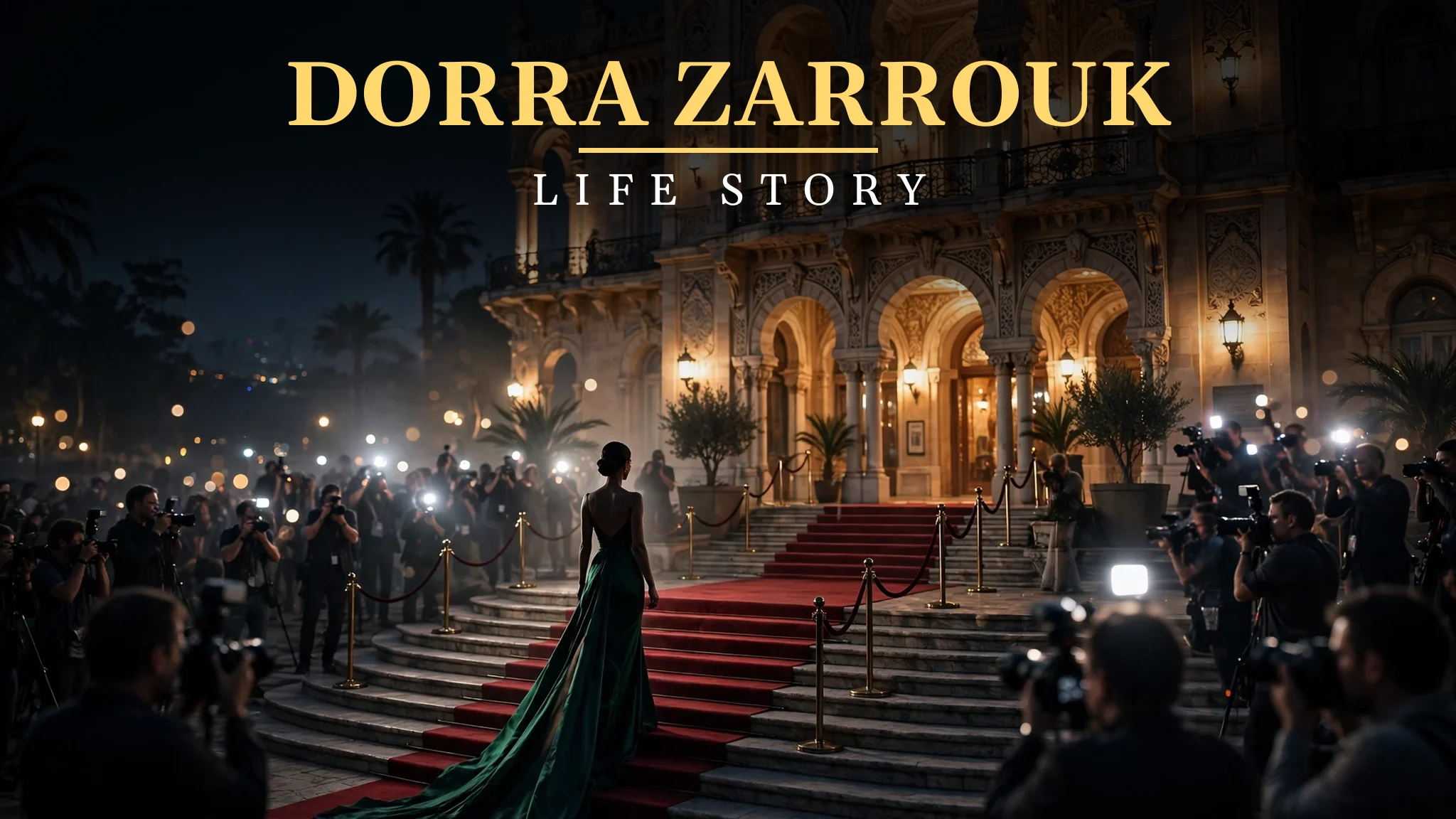
I also think about the red carpet image, the woman in the emerald gown walking up the steps of a grand palace, surrounded by photographers, and I think about how far she has come from a law faculty in Tunis. That image is a symbol of her journey, from a student to a star, and it is a beautiful one, because it shows that a life can be transformed by courage, by talent, and by a willingness to try. I hope she keeps walking up those steps, and I hope her work keeps bringing joy to audiences, because that is the best thing an actress can do, to make people feel, to make them think, and to make them remember. Dorra’s acting does that, and I am grateful for it.
I also think about the theatre where she began, and about how a live stage teaches an actress lessons that no film set can teach. Dorra learned theatre in Tunisia, performing in front of a live audience, without a second take, and that experience gave her a presence, a clarity, and a courage that are audible in her film performances. Theatre is a hard school, and it is one that many film stars never attend, but Dorra did, and it shows, in the way she speaks a line, in the way she listens to another actor, and in the way she holds a scene. I hope young actresses today learn theatre as she did, because it will make them better, in film and in television, for the rest of their lives.
Finally, I want to say that her story gives me hope for anyone who has ever had to change direction, from law to acting, from Tunisia to Egypt, or from one dream to another. Dorra changed direction more than once, and each time she built something new, with work, with patience, and with a quiet confidence. That hope is important, because it tells us that a life can change, and that a new beginning is possible, even when it seems late, even when it seems hard. I hope her work keeps encouraging those who need a new beginning, and I hope Dorra keeps acting, because the world needs more actresses like her, graceful, honest, and true.
I also think about the way her performances will age, and about whether a young viewer ten years from now will still be moved by a Dorra Zarrouk film. I believe they will, because her best work is not built on a fashion that fades. It is built on a graceful presence, an honest performance, and a feeling of intelligence that does not go out of date, and those things travel well across time. A good performance, given truly, will mean as much to a young viewer in ten years as it does today, because the feeling behind it does not change. That is the test of an actress, and Dorra’s best work passes it.
One last thought stays with me, about the city of Tunis itself, with its medina, its schools, and its theatres, and about how an actress can carry a whole city in her presence. Dorra carries Tunis with her, in her elegance and in her pride, and when viewers in other countries watch her films, they see a little of that city too. That is a beautiful thing for an actress to do, to make a place visible, and I hope she keeps doing it, role after role, for many years to come.
Frequently Asked Questions
When was Dorra Zarrouk born?
Dorra Zarrouk was born on 13 January 1980 in Tunis, Tunisia. She grew up in Tunis, where she studied law before becoming an actress.
Did Dorra Zarrouk study law?
Yes, she studied law at university in Tunis before turning to acting. Her legal studies gave her skills in reading, thinking and speaking clearly that later helped her as an actress.
How did Dorra Zarrouk become famous?
She became famous in Egypt through films such as “Al Maslaha” in 2012 and “Tisbah Ala Khair” in 2017, after beginning her career in theatre and television in Tunisia.
What is Tisbah Ala Khair?
“Tisbah Ala Khair” is an Egyptian film from 2017, whose title means “good night”. Dorra Zarrouk played a leading role in the drama, which became a hit and established her as a leading lady of Egyptian cinema.
What is Al Maslaha?
“Al Maslaha” is an Egyptian film from 2012 in which Dorra Zarrouk played an important role. The film helped introduce her to Egyptian audiences and to build her career in Cairo.
Is Dorra Zarrouk still acting?
Yes, she remains active as an actress in film and television in Egypt and Tunisia, and she continues to appear in Ramadan series and other popular dramas.


