Duan Yihong: The Life Story Behind China's Intense Star
In this post
Duan Yihong does not look like a typical film star, and that is exactly why he is one of the most respected actors in China. His face is lined and serious. His eyes look tired in a way that suggests he has seen difficult things. When he plays a soldier, you believe he has carried a heavy pack through the rain. When he plays a detective, you believe he has stayed up all night looking at a case file. He does not act like a hero from a poster. He acts like a real man doing a hard job, and Chinese audiences have learned to trust that feeling.
He was born in 1973 in Yining, a city in Xinjiang in the far north-west of China. Yining is a long way from Beijing, close to the border with Kazakhstan, and life there is shaped by mountains, cold winters, and a mix of peoples and cultures. Duan Yihong grew up in that far corner of the country, and he carried its toughness with him when he left. He studied at the Central Academy of Drama in Beijing, and for years he was known as a theatre actor and a television actor who did serious, unglamorous work. Then came Soldiers Sortie, the television drama that made him famous across the whole country, and after that came a run of film roles that showed he could be one of the finest actors of his generation.
This is the story of a man who took the long road. He did not become a star by being handsome in the usual way. He became a star by being real, by being intense, and by refusing to play a part he did not believe in. It is a story about a boy from the edge of China who made his way to the centre of its film world, and who stayed true to the hard, honest style he learned at the start.
A Childhood on the Edge of China
Yining, where Duan Yihong was born on 16 May 1973, sits in the Ili Valley in Xinjiang, near the border with Kazakhstan. It is a city of wide skies, cold winters, and a mix of Han Chinese, Uyghur, Kazakh, and other peoples. A child growing up there learns early that China is a big place, and that life is not the same everywhere. The food is different. The music is different. The faces on the street are different. Duan Yihong grew up inside that mix, and it gave him a way of seeing people that stayed with him for the rest of his life.
His family was ordinary, and his childhood was not filled with theatre or film. Like many boys in Xinjiang, he spent his time outdoors, playing in the streets, going to school, and learning to live with the cold. He was not a showy child. He was serious, watchful, and stubborn. People who knew him as a boy remember a young man who did not talk much, but who meant what he said when he did talk. That stubbornness would later become one of his greatest strengths as an actor, because it let him hold on to a character even when the work was hard.
As a teenager, he began to think about acting. It was not an obvious dream for a boy from Yining. The drama schools were thousands of kilometres away, in Beijing and Shanghai, and the entrance exams were hard. But Duan Yihong had a quality that drama schools value: a face that tells a story without words. His face is not smooth or pretty. It is a face with lines, with a strong jaw, and with eyes that look as if they have been thinking about something for a long time. That kind of face is useful for an actor, because it can show pain, anger, and loyalty without any extra effort.
He worked hard to prepare for the exams, and he was accepted into the Central Academy of Drama in Beijing. The move from Yining to Beijing was enormous. He left a small city near the border and arrived in a capital of millions of people, with a different climate, a different pace of life, and a different way of speaking. Many young people would have tried to hide where they came from. Duan Yihong did not. He kept his Xinjiang toughness, and he used it. In a school full of polished students from big cities, he stood out because he was real, and because he had lived a life that was different from theirs.
The Hard Training Years in Beijing
The Central Academy of Drama is a demanding school. Students rise early, they train their voices, they train their bodies, and they spend long hours in rehearsal. The teachers are strict, and they expect their students to take the work seriously. Duan Yihong took it seriously. He was not the most talented student in every class, and he knew it. What he had was a willingness to work harder than anyone else, and a refusal to give up on a scene until it felt true.
Theatre was the heart of his training. On stage, there is no camera to save you. If you forget a line, the audience sees it. If you are not honest, the people in the back row can tell. Duan Yihong learned to act on stage first, and that training stayed with him when he moved to television and film. He learned to use his whole body, not only his face. He learned to breathe properly, to stand properly, and to let silence do some of the work. He also learned to listen to the other actors, which sounds simple but is one of the hardest things in acting.
After graduation, he did not become famous quickly. He worked in theatre, and he took small roles in television. He played soldiers, policemen, and ordinary men. The pay was not high, and the attention was not great. But he was building something. Each small role taught him how to be believable in a different kind of life. He learned how a soldier stands, how a policeman talks, how a tired worker walks home at the end of a long day. He collected these details the way other people collect photographs, and he kept them for later.
Those early years were also a test of his character. Many of his classmates left acting when the work did not come fast enough. Some went into business. Some went back to their home towns. Duan Yihong stayed. He stayed because he believed that acting was not a quick way to get rich. It was a craft, and a craft takes time to learn. He was willing to wait, and he was willing to work in the shadows while he waited. That patience would pay off, but it would take a long time.
Soldiers Sortie and the Nation Watches
The turning point came in 2006, with the television drama Soldiers Sortie. The series told the story of a young soldier named Xu Sanduo, a simple and stubborn young man who joins the army and slowly becomes a good soldier through hard work and loyalty. Duan Yihong played Yuan Lang, a tough and clever officer who leads a special forces unit. Yuan Lang is not a kind man in the usual sense. He is hard, demanding, and sometimes cruel. But he is also fair, and he pushes his soldiers because he believes they can be better than they think.
The drama became one of the most loved television series in modern China. Millions of people watched it, and they talked about it in schools, in offices, and in army barracks. Young men wanted to join the army after watching it. Parents wanted their sons to learn the lessons of Xu Sanduo and Yuan Lang. Duan Yihong’s performance was central to that success. He played Yuan Lang with a cold intensity that made the character feel real. When he gave an order, you believed it would be obeyed. When he looked at a soldier, you could see him judging the man’s character in a single glance.
What made the role so powerful was that Duan Yihong did not try to make Yuan Lang likeable. He made him believable. Yuan Lang is the kind of officer who is hard to love but easy to respect. He demands everything from his men, and he demands even more from himself. Duan Yihong understood that, and he played the part without softening it. Audiences respected him for that honesty. They did not need to like Yuan Lang. They needed to believe him, and they did.
Soldiers Sortie changed Duan Yihong’s life. He was in his early thirties, and suddenly he was a well-known actor. Directors who had once overlooked him now wanted him for their films. He had shown that he could carry a major role in a major production, and that he could do it in a way that felt completely real. The years of waiting were over, but the work was only just beginning.
The Dead End and the Best Actor Prizes
After Soldiers Sortie, Duan Yihong moved into film in a serious way. He chose parts that were dark, difficult, and real. He did not want to play handsome heroes in light comedies. He wanted to play men who were struggling, men who had made mistakes, men who were trying to survive in a hard world. One of the most important of these films was The Dead End, released in 2015. In the film, he played a detective chasing a group of criminals, and his performance was praised for its depth and its darkness.
The Dead End won him the Best Actor award at the Shanghai International Film Festival. That prize mattered, because it was a sign that the film world had recognised what television audiences already knew: Duan Yihong was one of the finest actors of his generation. He did not celebrate the award with a big show. He accepted it quietly, in the same way he did his work, and then he went back to the next project. That quietness is part of who he is. He does not seem to act for prizes. He acts because the work itself matters to him.
Another major film was The Looming Storm, released in 2017. In it, he played a factory security guard who becomes obsessed with catching a serial killer. The film is slow, dark, and full of rain and fog. Duan Yihong’s character is a man who is losing control of his life, and who tries to hold on to his purpose by solving a crime that nobody else cares about. His performance won him the Best Actor award at the Tokyo International Film Festival. Once again, the prize came for a role that was the opposite of glamorous. He played a tired, lonely man in a forgotten town, and he made that man unforgettable.
These films showed the full range of his talent. He could play a soldier, a detective, a security guard, and a man falling apart, and each time he made the character feel like a real person. He did not use the same tricks twice. He found something different in each man, a different way of walking, a different way of speaking, a different way of looking at the world. That is the mark of a great actor. He does not bring the same performance to every film. He builds a new person each time, from the ground up.
A Private Man in a Loud Industry
Duan Yihong is known in the Chinese film world as a private man. He does not give many interviews. He does not appear on variety shows to make people laugh. He does not share his personal life on social media. He goes to work, he does the work well, and then he goes home. In an industry that rewards noise, his silence is unusual, and it is part of what makes him respected. People know that when he speaks, he means it, because he does not speak often.
He is married, and he keeps his family life away from the cameras. Little is known in public about his wife and his home, and that is how he wants it to be. He has said in the few interviews he has given that acting is his work, not his whole life, and that he wants to keep something for himself. That attitude is rare among famous actors, and it is easy to admire. Fame can eat a person’s whole life if they let it. Duan Yihong has drawn a line, and he has held it.
That privacy has also shaped the way he chooses his roles. He does not take a part because it will make him more famous. He takes a part because the script is good, because the character is real, and because the director is serious. That means he sometimes turns down work that would pay well but would not challenge him. It also means that his film list is shorter than that of some actors his age, but stronger. Every film on his list feels like a choice, not an accident.
His colleagues speak of him as a serious and disciplined worker. He arrives on set prepared. He knows his lines. He knows what his character wants in each scene. He does not waste time. He also treats the crew with respect, and he does not act like a star. That reputation matters in the film world, because directors want to work with actors who make the job easier, not harder. Duan Yihong makes the job easier by being ready, and he makes the film better by being honest.
The Hard Roles Nobody Else Wants
One of the things that sets Duan Yihong apart is his willingness to take the hard roles that other actors avoid. He has played men who are poor, men who are violent, men who are broken, and men who are not likeable. These are not the roles that win fans or sell posters. They are the roles that test an actor, and Duan Yihong seems to seek them out. He has said, in effect, that a good actor should not be afraid of an ugly character, because real life is full of ugly moments, and an actor’s job is to show life as it is, not as we wish it were.
That choice has a cost. Playing dark and troubled men, film after film, is hard on a person’s mind and body. An actor who lives inside a troubled character for months can carry some of that trouble home with him. Duan Yihong has not spoken much about that cost, but it is easy to imagine. He works in a way that demands a great deal from him. He does not play a detective by pretending. He tries to think like a detective, to feel the weight of the case, and to carry that weight through every scene. That kind of acting is powerful, but it is not easy, and it is not something every actor can do.
He has also faced the problem that comes with being so good at dark roles: directors want him to play the same kind of man again and again. He has fought against that by looking for variety inside the darkness. A soldier is not the same as a detective. A security guard is not the same as a criminal. He finds the small differences, and he builds each character from those differences. It is slow work, and it does not always pay off at the box office, but it has built him a reputation that few actors can match.
In recent years, he has continued to work in both film and television, taking parts in major productions and in smaller, more personal films. He has played in war dramas, in crime stories, and in films about ordinary people in difficult times. His name is now a sign of quality. When audiences see Duan Yihong in a cast list, they expect the film to be serious and well acted. That expectation is a heavy one, but he has carried it for many years without letting it break him.
What His Career Leaves Behind
Duan Yihong’s career is still going, and it is too early to write a final judgement. But it is already clear what he stands for. He stands for the idea that acting is a craft, not a shortcut to fame. He stands for the idea that a face does not need to be pretty to be powerful. He stands for the idea that a man from the far edge of China can make his way to the centre of its film world by working harder and more honestly than anyone else.
His best roles will be remembered for a long time. Yuan Lang in Soldiers Sortie will be remembered as one of the great television characters of modern China. His detective in The Dead End will be remembered as a man who carried the weight of a terrible crime on his shoulders. His security guard in The Looming Storm will be remembered as a man who lost himself while trying to do the right thing. These are not light memories. They are heavy ones, and they stay with the viewer because they feel true.
For young actors, he is an example of a different path. He did not become famous young. He did not become famous by being handsome. He became famous by being good, and by being patient, and by refusing to pretend. That path is slower, and it is harder, but it leads to a longer and more respected career. Duan Yihong’s story says to young actors that they do not need to chase every trend. They need to learn their craft, choose their roles with care, and trust that honest work will be recognised in the end. It is a hard message, but it is an honest one, and his life is the proof that it is true.
The Theatre Roots That Never Left Him
Before he was a film star, Duan Yihong was a theatre actor, and the theatre never left him. He trained on stage, he learned his craft in front of a live audience, and he carried the habits of the stage into every film he made afterwards. On stage, there is no second take. If you forget a line, the audience sees it. If you are not honest, the people in the back row can tell. That pressure teaches an actor to be ready, to be focused, and to be true. Duan Yihong learned those lessons early, and he has kept them for his whole career.
Theatre also teaches an actor to use their whole body. On a film set, the camera can come close, and a small movement of the face can say a great deal. On stage, the actor must be seen from far away, and they must use their voice, their posture, and their movements to tell the story. Duan Yihong learned to do that, and it shows in his film work. He stands like a man who knows how to fill a room. He walks like a man who has somewhere to go. He speaks like a man who expects to be heard, even in a large hall. Those habits come from the stage, and they give his film performances a physical weight that many film actors do not have.
He has also kept a love of the stage, even after becoming famous in film and television. He returns to theatre when he can, because it reminds him of why he became an actor in the first place. On stage, there is no fame, no camera, and no editing to save you. There is only the actor, the other actors, and the audience, in one room, for a few hours. That directness is what Duan Yihong loves, and it is what keeps his acting honest. A film actor can hide behind a good edit. A stage actor cannot hide at all. Duan Yihong does not want to hide, and that is why the theatre still matters to him.
That theatre training also explains why he is so disciplined on a film set. He arrives prepared, he knows his lines, and he does not waste time. On stage, wasting time is not an option. The show must go on, and the audience is waiting. He has carried that discipline into film, where it makes him a pleasure to work with, and where it helps him to deliver a strong performance, take after take, even when the shoot is long and tiring. Directors value that discipline, and they keep calling him back, because they know he will be ready, every time, without exception.
My Take:
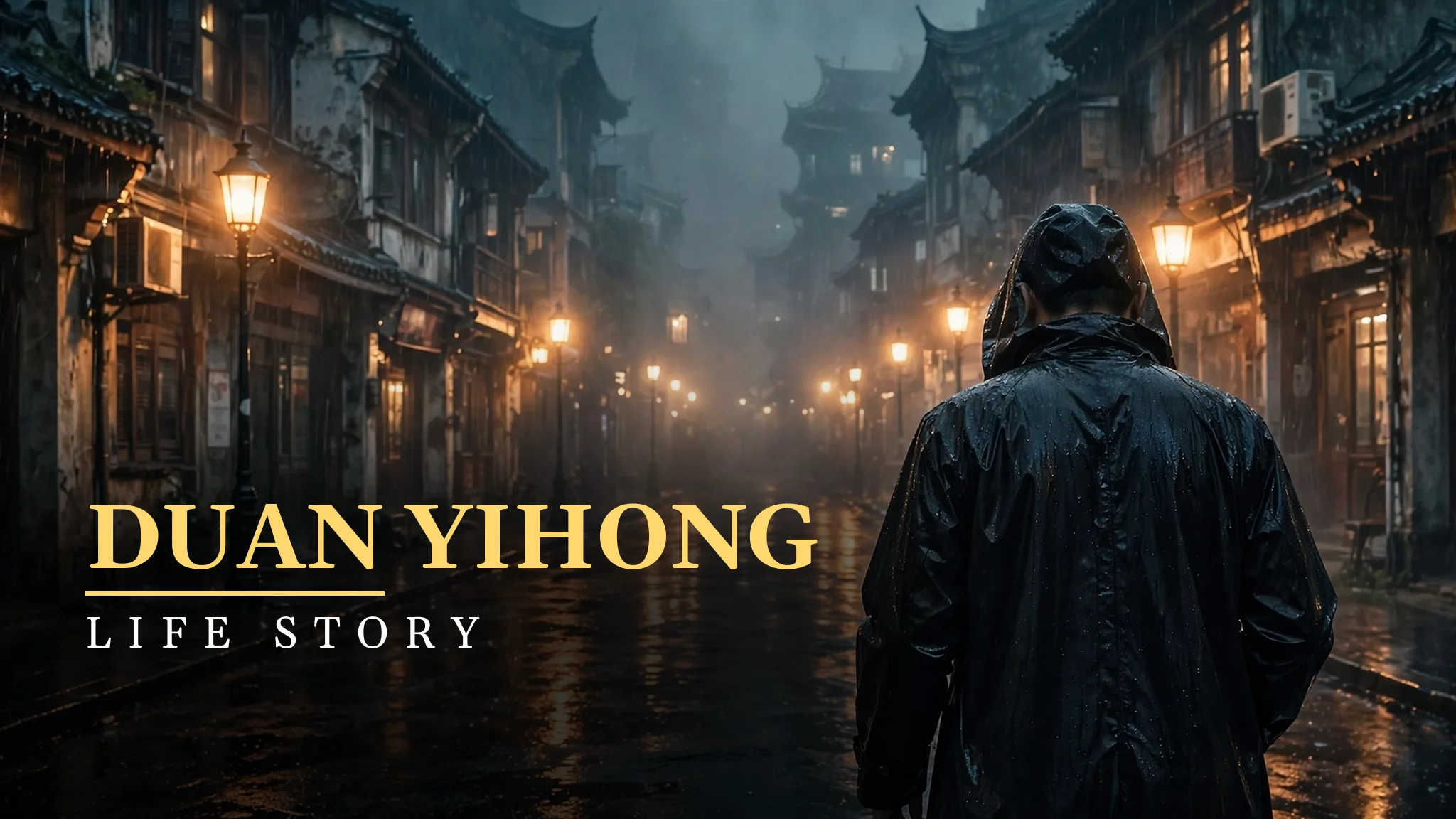
I keep coming back to one image when I think about Duan Yihong: a man standing in the rain, in a wet coat, looking down a street that nobody else wants to walk down. That image is from his cover photograph, but it could be from any of his films. He is the actor who walks down the street that others avoid. He plays the men who are left behind, the men who are tired, the men who are not loved by the crowd. I admire that more than I can say, because it is easy to play a hero. It is hard to play a man who is failing and still make the audience care about him. Duan Yihong does that again and again, and I think it is the most difficult thing an actor can do.
What I respect most about him is that he did not try to change his face to fit the film world. His face is not the smooth, pretty face that casting directors usually look for. It is lined, serious, and a little bit rough. A lot of actors would have tried to hide that. They would have taken lighter roles, smiled more, and tried to look younger. Duan Yihong did the opposite. He made his face his greatest tool. He let the camera see the lines, the tired eyes, and the hard jaw, and he trusted the audience to understand what those lines meant. I think there is a lesson in that for all of us. We spend so much time trying to hide the parts of ourselves that do not fit the fashion of the moment. We cover up our rough edges. We pretend to be smoother than we are. Duan Yihong shows that the rough edges can be the most interesting thing about a person, if we have the courage to let them show.
I also think about where he came from, and what that means. Yining is far from Beijing, far from the centre, far from the places where decisions are made. A boy from Yining has to travel a long way, in every sense, to become an actor. He has to leave his home, learn a new way of life, and prove himself to people who have never been to his town. Duan Yihong did that without forgetting his home. He carried the toughness of Xinjiang with him, and he used it in his work. I find that moving, because many people who leave a small place feel that they have to become a different person to succeed. They hide their accent. They hide their past. Duan Yihong did not hide his. He turned it into his strength, and I think that is a brave thing to do.
There is a hard side to his story, and I do not want to pretend it is not there. The hard side is that playing dark, troubled men for years must take something out of a person. An actor who spends months inside the mind of a detective chasing a killer, or a security guard losing his grip on reality, cannot simply switch that off at the end of the day. Some of it stays with him. I worry about that, not only for Duan Yihong, but for all actors who do this kind of work. We praise them for being so real, but we rarely ask what it costs them to be real. I hope he has a life outside acting that gives him rest and peace, a home where he can be himself and not a character. I hope he has people around him who remind him that he is not the men he plays. That matters, because a person who only lives inside dark stories can forget that there is light too.
I want to be honest about something else as well. Duan Yihong’s films are not for everyone. They are slow. They are dark. They do not have the easy laughter of a comedy or the fast action of a blockbuster. Some people will watch The Looming Storm and find it too slow, too grey, too sad. I understand that. Not every film needs to be dark and slow. But I think we need films like his, because life is not always fast and bright. Life has long, grey stretches, and it has moments when a person is alone in the rain, trying to do the right thing, and nobody is watching. Duan Yihong’s films show those moments, and they show them with respect. I think that is valuable, even if it is not always entertaining in the easy sense. Entertainment is important, but so is truth, and his films choose truth.
The lesson I take from him is about choosing the hard thing on purpose. Most of us choose the easy thing when we can. We take the easy job, the easy answer, the easy role. Duan Yihong chooses the hard role, the one that other actors turn down, the one that asks him to show an ugly side of life. I do not think he does it to suffer. I think he does it because he believes that an actor’s job is to show life as it is, not as we wish it were. That belief takes courage, and it is a belief I want to carry into my own life. When I face a hard choice, I want to ask myself what Duan Yihong would do. Would he take the easy path, or would he take the path that is true? I think I know the answer, and I think it would make my life better, even if it made it harder.
I also think his story teaches us to respect the people who work in the background. Duan Yihong spent years in small roles before anyone knew his name. He was the soldier in the back, the policeman with two lines, the man in the crowd. Those years were not wasted. They were the years when he learned his craft. I think about the people in my own life who work in the background, the ones who do the hard jobs without praise, and I wonder if I have thanked them enough. Probably not. Duan Yihong’s story reminds me to look at those people again, and to see the skill in their quiet work. The world runs on people like that, and the film world does too.
Finally, I want to say what his career means to me as a whole. It means that a person does not need to be loud to be powerful. It means that a person does not need to be pretty to be important. It means that a person from the edge of the map can reach the centre, not by changing who he is, but by being more fully who he is. Duan Yihong is intense, serious, private, and stubborn, and those are the very qualities that made him great. He did not succeed in spite of who he is. He succeeded because of who he is. That is a hopeful message for anyone who feels that they do not fit the usual shape of success. You do not need to fit the shape. You need to be honest about your shape, and then work harder than anyone else to make it matter. Duan Yihong did that, and his work will be remembered long after the louder stars have been forgotten.
I also think about the way Duan Yihong’s voice works, because it is such a large part of his intensity. His voice is low, rough, and slow. It does not rise quickly, and it does not sound polished. It sounds like a man who has been working outside, in the cold, and who has not had time to rest. That roughness is not a flaw. It is a strength, because it makes his characters feel real. When he gives an order as Yuan Lang, you believe it, because the voice itself sounds like an order. When he speaks as a detective, you believe him, because the voice sounds like a man who has stayed up all night, thinking about a case. I think many actors try to make their voices beautiful, and they lose something in the process. Duan Yihong has kept his voice rough, and honest, and it is one of the reasons his performances feel so true. A beautiful voice can be a lie. A rough voice, used well, can be the truth.
I want to think, too, about what it means to be from Xinjiang, and how that shapes a person. Xinjiang is far from Beijing, far from the centre, and life there is different. The land is vast, the winters are cold, and the people are a mix of many cultures. A boy from Yining grows up knowing that China is a big place, and that life is not the same everywhere. That knowledge gives a person a wider view of the world. Duan Yihong carries that wider view into his acting. He does not play men from Beijing, or men from Shanghai. He plays men from everywhere, men who could come from any part of China, because he understands that China is large, and that its people are different, and that those differences matter. I think that is a valuable thing, and it is one of the reasons his characters feel so real. They are not generic. They are specific, like the place he came from, and like the life he lived before he became famous.
There is another part of his story that I find important, and it is the way he handles fame, or rather, the way he refuses to handle it. He does not give many interviews. He does not appear on variety shows. He does not share his life online. In a world where famous people are expected to be always visible, always talking, and always selling themselves, Duan Yihong’s silence is almost radical. It says, my work is enough. It says, you do not need to know everything about me to appreciate what I do. I think that is a brave choice, and I think it is a healthy one. Fame can eat a person’s whole life if they let it. Duan Yihong has drawn a line, and he has held it, for many years, without apology. I respect that line, and I think more famous people should draw it. A person needs a private life, a place where they can be themselves, away from the cameras. Without that place, a person loses themselves, and their work suffers too. Duan Yihong has kept his place, and his work is better for it.
I want to be honest about something else as well. Duan Yihong’s films are not easy to watch. They are slow, dark, and sad. They do not have happy endings. They do not make you laugh. Some people will watch them and find them too heavy, too grey, too depressing. I understand that. Not every film needs to be dark. But I think we need films like his, because life is not always bright. Life has dark stretches, and it has moments when a person is alone, tired, and afraid. Duan Yihong’s films show those moments, and they show them with respect. They do not turn pain into entertainment. They show pain as it is, and they let the audience feel it. That is a valuable thing, even if it is not always enjoyable. We need films that entertain us, and we also need films that tell us the truth, even when the truth is hard. Duan Yihong’s films tell the truth, and that is why they matter, even if they are not for everyone.
Finally, I want to return to the image of the man in the rain, walking down an old street, which is the image on his cover. That image fits Duan Yihong perfectly, because it shows a man who is alone, in the rain, in a place that is old and a little bit broken, and who keeps walking anyway. He does not run from the rain. He does not hide from it. He walks through it, with his hood up, and his head down, and he keeps going. That is how he has lived his career. He has walked through the rain of waiting, of small roles, of dark films, and of a fame that came late, and he has kept going, step by step, without complaint. I think that is the image I will carry with me from his story, a man in a wet coat, walking down a rainy street, alone, and unafraid. It is a lonely image, but it is also a strong one, and it is the image of a man who has made his own way, in his own time, and in his own style. That is Duan Yihong, and that is why his story will stay with me.
Frequently Asked Questions
Who is Duan Yihong and why is he respected in Chinese cinema?
Duan Yihong is a Chinese actor born in 1973 in Yining, Xinjiang. He is respected for intense, realistic performances in Soldiers Sortie, The Dead End, and The Looming Storm, and for winning Best Actor awards at the Shanghai and Tokyo film festivals.
Where was Duan Yihong born?
He was born in Yining, a city in the Ili Valley in Xinjiang, in the far north-west of China near the border with Kazakhstan. He later moved to Beijing to study at the Central Academy of Drama.
What role made Duan Yihong famous?
He became famous across China as Yuan Lang, the tough special forces officer in the 2006 television drama Soldiers Sortie. The series was watched by millions and made his cold, demanding performance one of the most talked-about in Chinese television.
Which films won Duan Yihong Best Actor awards?
He won Best Actor at the Shanghai International Film Festival for The Dead End in 2015, and Best Actor at the Tokyo International Film Festival for The Looming Storm in 2017. Both roles were dark, troubled men, far from glamorous hero parts.
Where did Duan Yihong study acting?
He studied at the Central Academy of Drama in Beijing, where he trained in theatre and stage acting. That theatre training shaped his realistic style and his careful, disciplined way of working on film and television sets.
Is Duan Yihong active on social media or variety shows?
He is known as a private man who rarely gives interviews and does not appear often on variety shows. He keeps his family life out of public view and prefers to let his acting work speak for him.
How old is Duan Yihong?
Duan Yihong was born on 16 May 1973, so he was fifty-three years old in 2026. He became widely known in his early thirties and has worked steadily in film and television ever since.


