Duki: The Life Story Behind the Argentine Rap Star
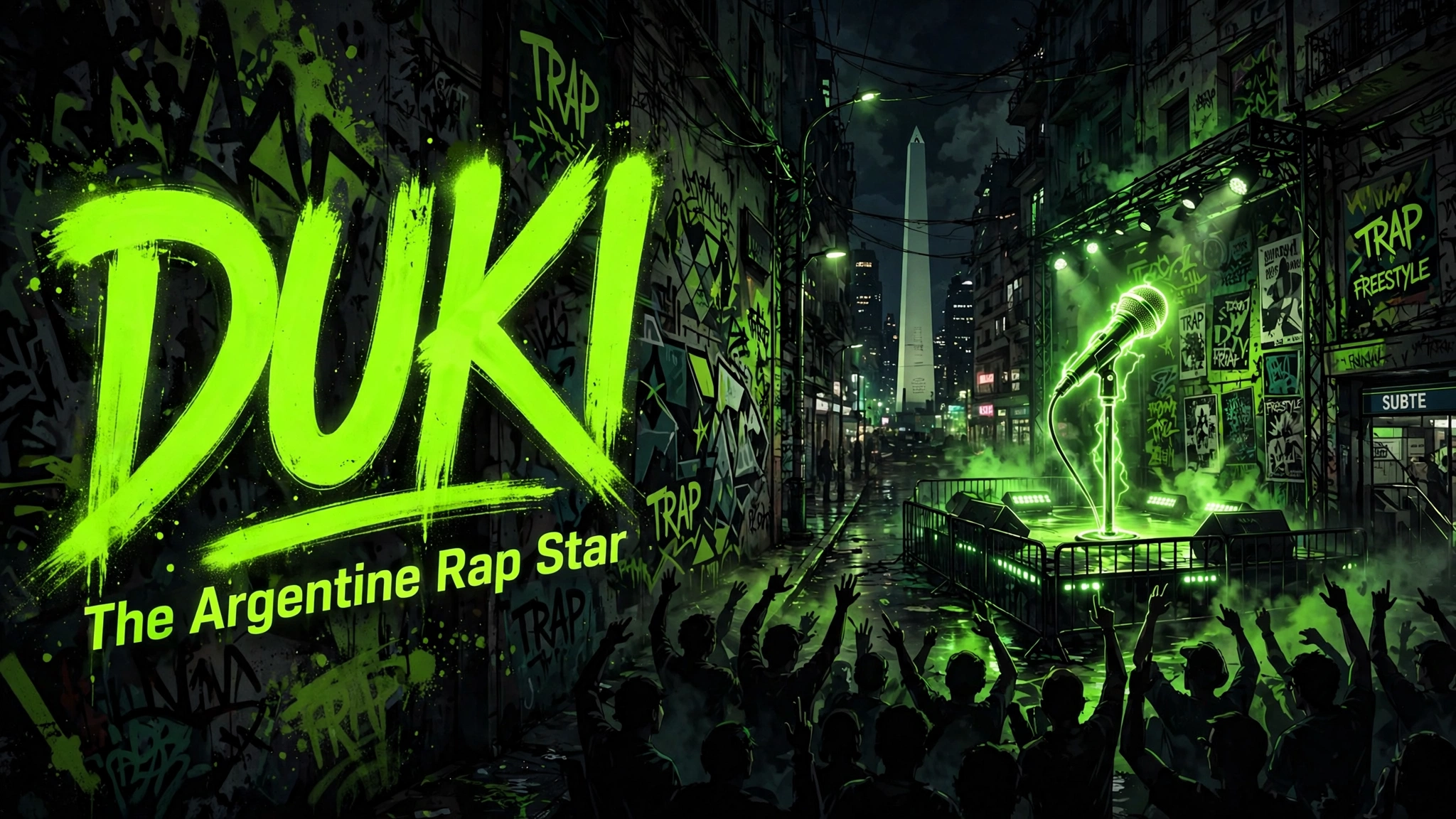
In this post
- Almagro and a Boy Called Mauro
- El Quinto Escalón and the Battle That Made Him
- She Don’t Give a FO, Loca, and the Trap Explosion
- Modo Diablo, Bizarrap, and the Collaborations That Built a Scene
- Goteo and the Anthem of a Generation
- Desde el Fin del Mundo and the Albums That Followed
- River Plate, the Bernabéu, and the Stadiums
- Ameri, the Gardel Awards, and the Leader of Argentine Trap
- My Take:
Duki was born Mauro Ezequiel Lombardo on 24 June 1996 in Buenos Aires, Argentina, and he became the pioneer of Argentine trap, the artist who took freestyle battles from a park in his neighbourhood to stadiums on two continents. He won his fame in 2016 at El Quinto Escalón, a freestyle battle competition in Buenos Aires, and within three years he had released Goteo, a song that became a generational anthem, and Súper Sangre Joven, an album that topped charts across Latin America. He has since sold out the River Plate stadium in Buenos Aires and the Santiago Bernabéu in Madrid, won multiple Gardel Awards, Argentina’s highest music honours, and released Ameri in 2024, an album named after his own name. He did it by being first, by being honest, and by understanding, earlier than anyone else, that Argentine trap was not a copy of American hip-hop. It was a new sound, with its own language, its own rhythm, and its own story to tell. This is how it happened.
What makes his career worth telling in full is that it is not just a music story. It is a story about a generation. Duki grew up in Almagro, a working-class neighbourhood of Buenos Aires, and he became the voice of young Argentines who had grown up with the internet, with economic crisis, with a sense that the old promises did not apply to them. His music speaks to that feeling, directly, without apology, and it has made him one of the most important artists in Latin America. He built his own label, he filled stadiums, he collaborated with Bizarrap, Khea, Cazzu and Emilia Mernes, and he did it all while staying close to the neighbourhood that raised him. This is the story of how a freestyle battle in a Buenos Aires park became a movement, and how a boy called Mauro became Duki.
Read on for the complete journey, from Almagro to El Quinto Escalón, from Goteo to the Bernabéu, and from a local battle to the leadership of Argentine trap.
Almagro and a Boy Called Mauro
Mauro Ezequiel Lombardo was born in Buenos Aires in 1996, and he grew up in Almagro, a neighbourhood in the centre of the city, known for its tango, its cafes, and its working-class pride. It was an ordinary childhood, in an ordinary part of a city that has seen more than its share of economic crisis, and it taught him something important: that you do not wait for permission. You make your own way, with your friends, in your own neighbourhood, on your own terms. He was a shy, watchful boy, and he was drawn to music early, listening to American hip-hop, to Argentine rock, and to the sounds that were coming out of his own city. He began to write rhymes, to practise, to dream of something bigger than Almagro, and he did it the way most teenagers do: in his bedroom, with his friends, with no plan and no money.
The neighbourhood stayed with him. He has spoken about Almagro often, and about how the streets, the people, and the rhythm of the place shaped his music. He listened to American hip-hop and to Argentine rock, and he absorbed both, but the sound he made was neither. It was something new, built from the slang of Buenos Aires, from the humour and the anger of a generation that had grown up with economic crisis, and from the internet, which let a boy in Almagro hear music from anywhere in the world and imagine himself in it. Argentine trap, the sound he would help to create, is not an import. It is a product of Buenos Aires, of its slang, its humour, its anger, and its hope, and Duki’s music carries all of it. He did not go to a music school. He did not have connections in the industry. He had a neighbourhood, a language, and a talent for words, and that was enough. The boy from Almagro would become the most famous rapper in Argentina, and he would do it without ever pretending to be anything other than a boy from Almagro.
El Quinto Escalón and the Battle That Made Him
In 2016, Duki entered El Quinto Escalón, a freestyle battle competition held in a park in Buenos Aires, and he won. The competition was the heart of Argentine hip-hop, a place where young rappers stood in front of a crowd and improvised verses, battling each other with words, with wit, and with speed. It was raw, it was competitive, and it was public, and it was where the best young talent in the city proved themselves. Duki won the battles, and he won the crowd, and the videos of his performances spread across the internet, turning a local rapper into a national name. He was twenty years old, and he had become famous overnight, or so it seemed. In fact, he had been practising for years, writing rhymes in his bedroom, battling his friends, and waiting for a stage. El Quinto Escalón was the stage, and he was ready for it.
The battle scene matters because it explains everything about Duki’s style. Freestyle is not a studio skill. It is a live skill, a test of whether you can think fast, whether you can listen, whether you can turn an opponent’s words against them in front of a crowd that is judging you in real time. The battles at El Quinto Escalón were held in Parque Rivadavia, a public park in Buenos Aires, and the crowds grew week by week, from dozens to hundreds to thousands, until the park became the centre of Argentine hip-hop. The battles were filmed, uploaded to YouTube, and watched by millions, and they created a new kind of fame, a fame that belonged to the crowd, not to a label. Duki was one of the best at it, and the reputation he built in the park followed him into the studio. He was not a rapper who had been manufactured by a label. He was a battler who had earned his name in front of a crowd, and that credibility has stayed with him for his whole career. The videos from El Quinto Escalón are still watched, still shared, and still cited as the moment when Argentine trap was born. Duki did not invent the battle. He won it, and winning it made him the leader of a movement.
She Don’t Give a FO, Loca, and the Trap Explosion
In 2017, Duki released She Don’t Give a FO, a collaboration with Khea, and it became his first major hit. The song is a trap anthem, built around a simple, infectious hook, and it spread across Argentina and Latin America, played in clubs, on the radio, and on every phone in Buenos Aires. It was followed by Loca, a collaboration with Khea and Cazzu, which became another hit, and by a run of singles that established Duki as the leading voice of a new sound. Argentine trap was exploding, and Duki was at the centre of it, alongside Khea, Cazzu, Neo Pistea, and a generation of young artists who were making music in their bedrooms and releasing it on the internet, without waiting for a record label.
The explosion was not an accident. Argentine trap grew out of the freestyle battle scene, out of the economic crisis that had left a generation of young Argentines feeling that the old system had failed them, and out of the internet, which let them release music directly to their fans. YouTube and Spotify were the new radio, and a song recorded in a bedroom could reach a million people before a record label had even heard of the artist. Duki understood that earlier than anyone else. He did not wait for a label. He released his music, he built his audience, and he let the audience decide. The songs were direct, honest, and full of Buenos Aires slang, and they spoke to young people in a way that no mainstream artist had. She Don’t Give a FO was the song that proved it could work, and Loca was the song that proved it was not a fluke. The movement had a leader, and the leader was Duki, and behind him was a whole generation of young artists who had learned, from the battles, that the only permission they needed was their own.
Modo Diablo, Bizarrap, and the Collaborations That Built a Scene
Duki did not build Argentine trap alone. He built it with a group of friends, and the most important of those groups was Modo Diablo, a collective that included Duki, YSY A, and Neo Pistea, three of the most important names in the scene. The name means Devil Mode, and it captured the energy of the moment: young, fearless, and unafraid to be different. The collective released music together, performed together, and pushed each other, and songs like Tumbando el Club and Pininfarina became anthems of the scene. The collaboration was not a business arrangement. It was a friendship, and it was the reason the scene grew so fast. When one of them succeeded, they all succeeded, and the audience could feel that. Argentine trap was not a solo act. It was a movement, and Modo Diablo was its engine.
The collaborations went beyond the collective. Duki worked with Khea and Cazzu on Loca, with Bizarrap on the BZRP Music Sessions #50 in 2022, which became one of the most popular sessions in the series, and with a long list of Latin artists, from Bad Bunny to Emilia Mernes. The Bizarrap session is worth singling out, because it showed Duki returning to his roots. A Bizarrap session is a freestyle, recorded live, with no safety net, and Duki’s session was a reminder that he had not lost the skill that made him famous in the park. He was still fast, still sharp, still able to think on his feet, and the session became one of the most-watched in the series. He also appeared on Además de mí, a remix that brought together some of the biggest names in Argentine trap, and on songs with artists from Spain, Mexico, and the United States. The collaborations were not about chasing fame. They were about building a scene, and the scene is still growing.
Goteo and the Anthem of a Generation
In 2019, Duki released Goteo, and it became the defining song of his career. The title means “dripping”, a reference to jewellery, to style, to the way a person carries themselves, and the song is a trap anthem about confidence, about success, about a boy from Almagro who has made it and who is not going to apologise for it. It became a generational anthem, played everywhere, quoted by everyone, and it remains the song people mention first when his name comes up. The same year he released his debut album, Súper Sangre Joven, which topped charts across Latin America and confirmed that he was not just a singles artist. He was an album artist, a performer, and a star.
Goteo works because it is both specific and universal. It is about Buenos Aires, about Almagro, about a particular way of speaking and dressing, and it is also about a feeling that anyone can understand: the feeling of having nothing, of working for something, and of finally getting it. The song’s success was not just commercial. It was cultural. It gave a generation of young Argentines a song that sounded like them, that spoke their language, that understood their lives. Duki was twenty-three, and he had written an anthem. He followed it with more hits, including a collaboration with Bizarrap, the BZRP Music Sessions #50 in 2022, which became one of the most popular sessions in the series, and he continued to build his catalogue, one song at a time.
Desde el Fin del Mundo and the Albums That Followed
In 2021, Duki released Desde el Fin del Mundo, an album that topped charts across Latin America and showed a more mature, more ambitious artist. The title means “From the End of the World”, a reference to Argentina’s position at the southern tip of the continent, and the album is a statement: that music from the end of the world can reach the whole world. He followed it with more hits, including Malbec, a collaboration with Bizarrap on Desde el Fin del Mundo, a song that pairs Duki’s flow with Bizarrap’s production and that became one of the most popular tracks on the album. The album also included collaborations with some of the biggest names in Latin music, and it showed Duki experimenting with new sounds, with rock, with pop, with reggaeton, without losing the trap foundation that had made him famous. The album was a commercial success, and it confirmed that he was not a one-hit artist. He was a career artist, and he was still growing.
He followed it with Temporada de Reggaetón in 2021, an album that showed his range, and with Antes de Ameri in 2023, a mixtape that served as a prelude to his next album. Antes de Ameri was a statement in itself, a collection of songs that looked back at where he had come from and forward to where he was going, and it kept his audience close while he prepared the album that would carry his own name. In 2024 he released Ameri, an album named after his own name, a deeply personal record that looks back at his career, his neighbourhood, and his journey from Almagro to the world. The album was a critical and commercial success, and it showed an artist who is comfortable with who he is, and who is not afraid to be honest about where he came from. The gap between Súper Sangre Joven in 2019 and Ameri in 2024 is where Duki grew up in public, and Buenos Aires fans watched every step. He was no longer a boy from a battle. He was a man with a catalogue, a label, and a legacy.
River Plate, the Bernabéu, and the Stadiums
Duki’s live career is as important as his recorded one, because it shows the scale of what he built. In December 2022 he played the Estadio Monumental, the home of River Plate in Buenos Aires, one of the biggest stadiums in South America, and he filled it. It was a landmark moment, a trap artist from Almagro headlining the biggest stadium in his own city, in front of tens of thousands of fans who knew every word. He had gone from a park in Buenos Aires to a stadium in Buenos Aires, and the journey had taken six years. The show was a celebration, not just of Duki, but of Argentine trap, of a movement that had started in a park and ended up in a stadium.
In 2024 he went further, selling out the Santiago Bernabéu in Madrid, the home of Real Madrid, one of the most famous stadiums in the world. The show, on 8 June 2024, was the first time an Argentine trap artist had headlined the Bernabéu, and it was a moment that proved his reach went far beyond Argentina. He brought guests, he played the hits, and the crowd, tens of thousands of people, sang every word in Spanish. It was not just a concert. It was a statement, that a sound from a park in Buenos Aires could fill the biggest stadium in Spain, and that the audience would follow it anywhere. The stadiums are not just a measure of success. They are a measure of what Argentine trap became, a movement that started in a park and ended up in the Bernabéu, and Duki was the man who led it there. He built his own label, he controlled his own career, and he did it all while staying close to the neighbourhood that raised him.
Ameri, the Gardel Awards, and the Leader of Argentine Trap
Today, Duki stands as the pioneer of Argentine trap, who took freestyle battles to stadiums, and the recognition has followed. He has won multiple Gardel Awards, Argentina’s highest music honours, including awards for his albums and his songs, and he is recognised as the leader of a movement that has changed Latin music. The Ameri album in 2024 was followed by a tour that took him across Latin America and Europe, playing to crowds that had grown up with his music, and the shows were a reminder of how far the sound had travelled, from a park in Buenos Aires to arenas in Madrid, Mexico City, and Santiago. The awards matter, but the fans matter more, and the fans in Buenos Aires, who filled rooms for him when he was nobody, still fill stadiums for him now. He is known for his distinctive style, his face tattoos, his fashion, and his honesty, and he has become a role model for young Argentines who see in him a proof that it is possible to come from Almagro and reach the world.
He is in a relationship with Emilia Mernes, the Argentine singer, and he has kept his private life relatively private, preferring to let the music speak. He has built a business, a label, and a career that spans two continents, and he has done it by being first, by being honest, and by never forgetting where he came from. He has also become a fashion figure, known for his distinctive style, his face tattoos, and his willingness to be visible, to be different, to refuse to blend in. The boy from Almagro who won a freestyle battle in a park became the man who sold out the Bernabéu, and the journey is not finished. He is still recording, still touring, still leading, and the next chapter is still being written, one song, one show, one stadium at a time. The pioneer of Argentine trap took a local sound to the world, and the world is still listening, and it will keep listening for a very long time to come, in Buenos Aires and everywhere else. and the park in Buenos Aires where it all started is still there, still full of young rappers who believe they can be next, and who have Duki to thank for proving that they can, and for showing them the way from a park to a stadium.
My Take:
What I admire most about Duki is that he was first, and being first is harder than being best. He was born Mauro Ezequiel Lombardo in Buenos Aires in 1996, and he grew up in Almagro, a working-class neighbourhood in the centre of the city. He was a shy, watchful boy who loved music, who wrote rhymes in his bedroom, and who dreamed of something bigger than his neighbourhood. In 2016, at twenty, he entered El Quinto Escalón, a freestyle battle competition in a park in Buenos Aires, and he won. The videos spread across the internet, and he became famous. People called it an overnight success. It was not. It was years of writing, of battling his friends, of waiting for a stage, and when the stage came, he was ready. I think about that a lot, because the battle scene is the most honest test in music. You stand in front of a crowd, you improvise, and the crowd judges you in real time. There is nowhere to hide. Duki won that test, and the reputation he built in the park has stayed with him for his whole career.
The battle scene matters because it explains his style. Freestyle is not a studio skill. It is a live skill, a test of whether you can think fast, whether you can listen, whether you can turn an opponent’s words against them. Duki was one of the best at it, and he carried that skill into the studio. He was not a rapper who had been manufactured by a label. He was a battler who had earned his name in front of a crowd, and that credibility is the reason his fans trust him. When he says something in a song, they believe him, because they saw him prove it in a park, with no production, no autotune, no safety net. Just words, and a crowd, and a boy from Almagro who was faster than everyone else.
She Don’t Give a FO in 2017, with Khea, is the song that turned the battle reputation into a career. It is a trap anthem, built around a simple, infectious hook, and it spread across Argentina and Latin America. It was followed by Loca, with Khea and Cazzu, and by a run of singles that established Duki as the leading voice of a new sound. Argentine trap was exploding, and Duki was at the centre of it, alongside Khea, Cazzu, Neo Pistea, and a generation of young artists who were making music in their bedrooms and releasing it on the internet. I think the explosion was not an accident. It grew out of the freestyle battle scene, out of the economic crisis that had left a generation of young Argentines feeling that the old system had failed them, and out of the internet, which let them release music directly to their fans. Duki understood that earlier than anyone else. He did not wait for a label. He released his music, he built his audience, and he let the audience decide.
Goteo in 2019 is the song I keep coming back to, because it is the one that became an anthem. The title means dripping, a reference to jewellery, to style, to the way a person carries themselves, and the song is about confidence, about success, about a boy from Almagro who has made it and who is not going to apologise for it. It became a generational anthem, played everywhere, quoted by everyone, and it remains the song people mention first when his name comes up. The same year he released Súper Sangre Joven, his debut album, which topped charts across Latin America. What I love about Goteo is that it is both specific and universal. It is about Buenos Aires, about Almagro, about a particular way of speaking and dressing, and it is also about a feeling that anyone can understand: the feeling of having nothing, of working for something, and of finally getting it. That is why it became an anthem. It gave a generation of young Argentines a song that sounded like them, that spoke their language, that understood their lives. Duki was twenty-three, and he had written it, and the song has not left the conversation since. It plays at parties, at football matches, in cars, in the street, and every time it plays, it reminds the room where it came from: a park in Buenos Aires, a boy with a rhyme, and a crowd that believed him.
Desde el Fin del Mundo in 2021 is the album that showed he was still growing. The title means From the End of the World, a reference to Argentina’s position at the southern tip of the continent, and the album is a statement: that music from the end of the world can reach the whole world. It included collaborations with some of the biggest names in Latin music, and it showed Duki experimenting with new sounds, with rock, with pop, with reggaeton, without losing the trap foundation that had made him famous. The album’s title is a joke and a claim at the same time. Argentina is far from the centres of the music industry, far from Los Angeles and New York and Madrid, and Duki is saying that distance does not matter anymore. The internet closed the distance, the battles closed the distance, and the music closed the distance. He followed it with Temporada de Reggaetón in 2021, and with Antes de Ameri in 2023, and in 2024 he released Ameri, an album named after his own name, a deeply personal record that looks back at his career, his neighbourhood, and his journey. I think the album title is the most honest thing he has done. He named it after himself, not out of arrogance, but out of clarity. This is who I am. This is where I come from. This is what I built.
The stadiums are the part of his story that still surprises me, because of how fast it happened. In December 2022 he played the Estadio Monumental, the home of River Plate in Buenos Aires, and he filled it. In 2024 he sold out the Santiago Bernabéu in Madrid, the home of Real Madrid, the first Argentine trap artist to headline it. He had gone from a park in Buenos Aires to the Bernabéu in eight years. I think about what that means, not just for Duki, but for Argentine trap. A sound that started in a park, made by teenagers with no money and no label, ended up in the biggest stadium in Spain, with tens of thousands of people singing every word in Spanish. That is not a music story. That is a story about a generation, about young people who built something out of nothing, and who refused to let anyone tell them it was not real music. It is also a story about Argentina itself. The country has been through economic crisis after economic crisis, and young Argentines have grown up with a sense that the old promises do not apply to them. Duki’s music speaks to that feeling, directly, without apology, and it gives it a voice. When he sings about Almagro, about having nothing, about making it anyway, he is singing about millions of young people who feel the same way, and that is why they fill the stadiums. They are not just listening to a song. They are hearing themselves.
His collaboration with Bizarrap, the BZRP Music Sessions #50 in 2022, is the one I would point to if someone asked me when Argentine trap became global. Bizarrap’s sessions are a platform, and Duki’s session became one of the most popular in the series, a freestyle that showed he had not lost the skill that made him famous. He was still the boy from the park, still fast, still sharp, still able to think on his feet. The session is a reminder that the battle never left him, and that the studio never replaced the park. He is still, at heart, a freestyler, and that is why his fans trust him. He proved it in front of a crowd, and he keeps proving it, session after session, album after album.
There is also the collective, and I think it matters more than most people realise. Modo Diablo, the group he formed with YSY A and Neo Pistea, was not a business arrangement. It was a friendship, and it was the reason the scene grew so fast. Songs like Tumbando el Club and Pininfarina became anthems, and the three of them pushed each other, performed together, and built something that none of them could have built alone. I think about how rare that is in music, where egos usually break a group apart. Modo Diablo held together because the friendship came first, and the music came second, and the audience could feel that. When one of them succeeded, they all succeeded, and that generosity is part of why Argentine trap became a movement rather than a moment.
One more thing, and it is about how he looks. Duki is known for his distinctive style, his face tattoos, his fashion, his jewellery, and I think the style is not decoration. It is identity. A boy from Almagro who wears his success on his face is saying something: I am not going to hide where I come from, and I am not going to apologise for what I have become. The tattoos, the clothes, the drip that Goteo is named after, all of it is a statement, and the statement is that a working-class kid from Buenos Aires can look however he wants, and the world will have to deal with it. I admire that, because it takes courage to be visible, to be different, to refuse to blend in. Duki has never blended in, and he has never tried to. He stands out, and he stands out on purpose.
Finally, I keep thinking about what it means to be the leader of a movement. Duki has won multiple Gardel Awards, Argentina’s highest music honours, and he is recognised as the pioneer of Argentine trap. He built his own label, he controlled his own career, and he did it all while staying close to Almagro. He is in a relationship with Emilia Mernes, the Argentine singer, and the two of them are one of the most talked-about couples in Latin music, though he has kept the details of his private life relatively private, preferring to let the music speak. He is known for his distinctive style, his face tattoos, his fashion, and his honesty. I think the leadership matters because it is not just about music. It is about showing a generation of young Argentines that it is possible to come from a working-class neighbourhood and reach the world, without waiting for permission, without changing who you are, without forgetting where you came from. The boy from Almagro who won a freestyle battle in a park became the man who sold out the Bernabéu, and he did it by being first, by being honest, and by trusting a sound that the world had not yet learned to hear. That is the story I would tell a young artist first, before the awards and before the stadiums. Start where you are, with what you have, in front of whoever will listen, and do not stop, because the park you start in might be the beginning of something much bigger than you can imagine, and the crowd that watches you there might be the first of millions, and the song you write in your bedroom might be the anthem of a generation, and the boy from Almagro might be the one who leads it all, from a park to a stadium to the world, and back home again to Almagro, where it all began and where it still belongs, and where the next Duki is probably writing rhymes in a bedroom right now, waiting for his own park and his own crowd.
Frequently Asked Questions
Where was Duki born?
Duki was born in 1996 in Buenos Aires, Argentina. The place shaped the early life and the work that followed, and Duki has often been described as a proud representative of Argentina on the world stage.
What is Duki best known for?
Duki is best known as a rapper and singer, and for winning freestyle battles at El Quinto Escalón in Buenos Aires. The work that followed turned that breakthrough into a lasting international career, with Desde el Fin del Mundo (2021) among the most recognised projects.
What was Duki’s breakthrough moment?
The breakthrough came through winning freestyle battles at El Quinto Escalón in Buenos Aires. It was the moment when years of preparation met a wide audience, and it changed the scale of every opportunity that followed.
Has Duki won any major awards?
Yes, the career includes multiple Gardel Awards and recognition as the leader of Argentine trap. Beyond formal awards, the lasting recognition has come from audiences and from younger artists who cite Duki as an influence.
What is Duki’s most famous work?
Many fans would point to Desde el Fin del Mundo (2021), the album that topped charts across Latin America. Other landmark projects include She Don’t Give a FO (2017) and Ameri (2024), and each one marked a different stage of the career.
What is Duki’s legacy?
the pioneer of Argentine trap, who took freestyle battles to stadiums. The story continues, and the influence on new generations of artists from Argentina is already clear.