Dwight Howard: The Life Story Behind Basketball's Superman
In this post
- Atlanta: A Christian Home and a Big Dream
- Orlando: The Young Giant Takes Over
- The Superman Cape and the Weight of Fame
- Los Angeles, Houston, and the Long Search for Home
- The Comeback: A Title With the Lakers
- Taiwan, the Hall of Fame, and Life After the NBA
- The Man Off the Court: Fatherhood and Faith
- My Take:
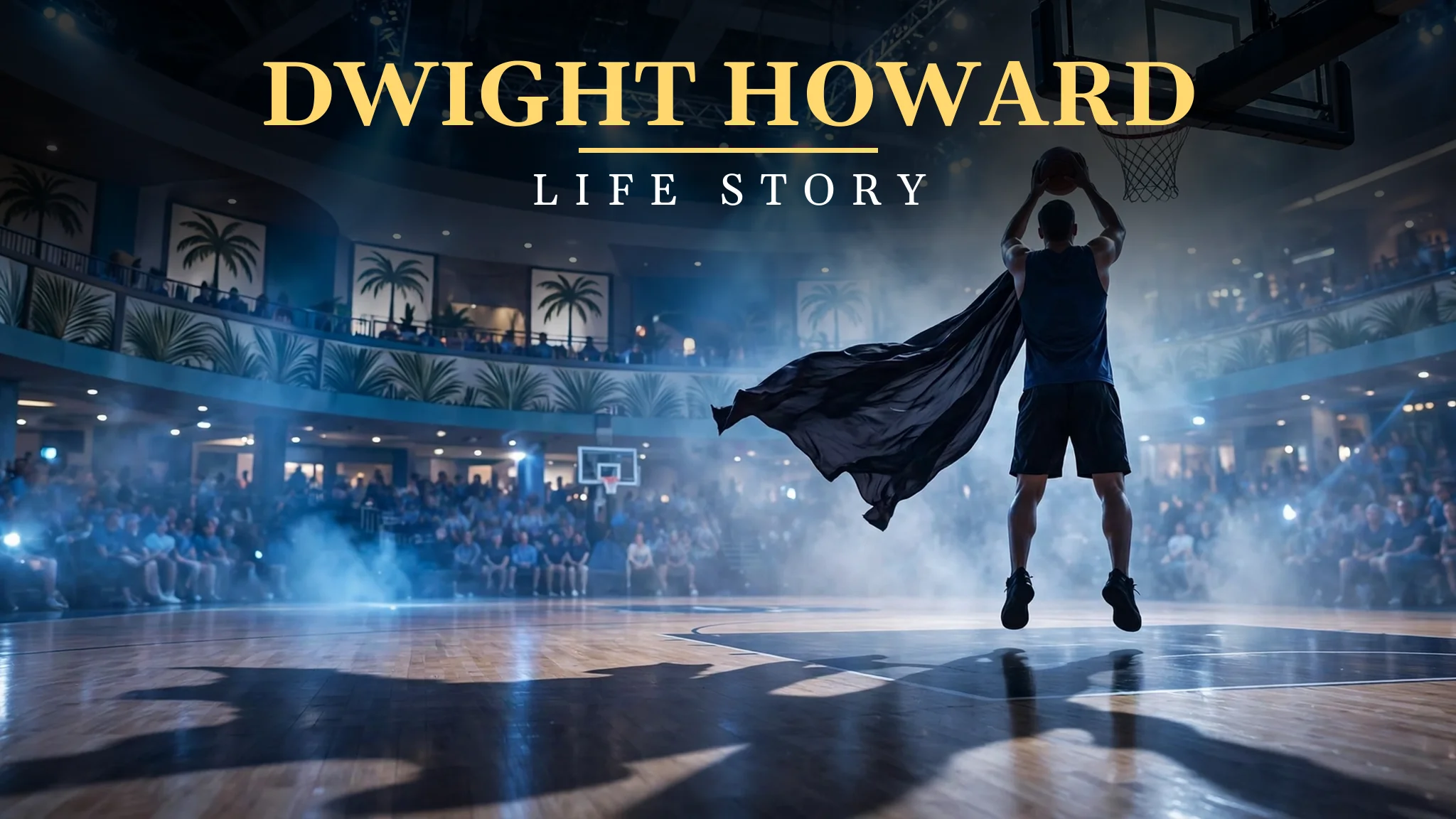
Dwight Howard once flew through the air in a red cape, threw a basketball down through the hoop from a great height, and made the whole basketball world laugh and cheer at the same time. It was the 2008 dunk contest, and the cape said “Superman” on it, and the nickname stuck to him for the rest of his career. He was big, strong, joyful, and impossible to ignore, a player who seemed to have been built in a laboratory for the job of centre: tall, powerful, quick off the floor, and able to block shots that other men could only watch. For a few years, he was the best centre in the world, and the Orlando Magic was his team, and the future looked as bright as the smile he wore everywhere he went.
But the story of Dwight Howard is not only about dunks and capes. It is also about a player who reached the top very young, who was loved by one city and then misunderstood by many others, who moved from team to team searching for a place that felt like home, and who was written off as finished before he found his way back to a championship with the Los Angeles Lakers in 2020. He was a star, then a joke to some people, then a role player, and then a champion again, and each of those chapters taught him something different about basketball and about himself.
This is the story of a boy from Atlanta who was raised in a Christian home, who went straight from high school to the NBA, who became the most feared defender in the league, and who had to learn, slowly and painfully, that talent alone is not enough, and that the way you treat people matters as much as the way you play the game.
Atlanta: A Christian Home and a Big Dream
Dwight David Howard was born on 8 December 1985 in Atlanta, Georgia, and he grew up in a family where faith was the centre of daily life. His father, Dwight Sr., was a Georgia state trooper who had played basketball in college, and his mother, Sheryl, was a woman of deep faith who worked hard to raise her children well. The family attended church regularly, and Dwight grew up hearing that his talents were a gift from God, and that he had a duty to use them well. He was a big child, taller than his classmates from an early age, and he was also a cheerful child, a boy who liked to joke and to make people laugh, a trait that stayed with him all his life.
He attended Southwest Atlanta Christian Academy, a small Christian school, and he played basketball there under coaches who knew him well and who cared about his character as much as his game. He was a dominant player from the start, because he was taller and stronger than almost everyone he played against, but he was also a hard worker, and he spent hours in the gym working on his footwork, his rebounding, and his shot-blocking. In his senior year, he led his school to a state championship, and he was named the best high school player in the country by several organisations. He was, by the time he finished school, the most wanted young big man in America.
He had the chance to go to college, and many of the best programmes in the country wanted him, but Howard made a different choice. He decided to go straight from high school to the NBA, a path that only the most confident young players took, and one that carried a real risk, because the professional game is faster, stronger, and harder than anything a schoolboy has ever faced. His family supported the decision, and his coaches supported it too, because they believed he was ready, and because they believed his body and his work ethic would carry him through. It was a bold choice, and it was a choice that would shape everything that followed.
The 2004 NBA draft was held in June of that year, and the Orlando Magic, a team that had won very few games the season before, held the first overall pick. They selected Dwight Howard, an eighteen-year-old boy from Atlanta, and they gave him the job of rebuilding their team. It was a huge responsibility for a teenager, but Howard took it on with a smile, and with the confidence of a young man who believed that God had given him a gift, and that his job was to use it.
Orlando: The Young Giant Takes Over
Howard arrived in Orlando as a raw but remarkable talent. He was six feet eleven inches tall, he could jump higher than most guards, and he could run the floor like a much smaller player. In his first season, he averaged a double-double, scoring and rebounding in double figures, a rare achievement for an eighteen-year-old, and he was named to the All-Rookie first team. He was still learning the game, and his post moves were basic, and his free-throw shooting was poor, but his energy and his athleticism were already enough to change games. He blocked shots, he grabbed rebounds, and he dunked with a power that made crowds gasp.
Over the next few years, he grew into the best centre in the league. He worked on his body, adding muscle, and he worked on his game, learning how to defend without fouling, how to position himself for rebounds, and how to finish around the basket. By the 2007-08 season, he was an All-Star, and he was leading the league in rebounding and in blocked shots. In 2008, he won the dunk contest at All-Star weekend, wearing the Superman cape and throwing down a dunk that became one of the most famous moments in the history of the event. The crowd loved him, the cameras loved him, and the league loved him, because he was a star who played with joy, and joy is a rare thing in professional sport.
In 2009, Howard led the Magic to the NBA Finals, beating the Cleveland Cavaliers, with LeBron James, in the Eastern Conference finals along the way. It was the high point of his time in Orlando, and it showed the world what he could do when he was at his best. The Magic lost the Finals to the Los Angeles Lakers, a team with Kobe Bryant and Pau Gasol, but Howard had proved that he could carry a team to the biggest stage in the sport. He was 23 years old, and he seemed to have the whole future in front of him.
He also won the Defensive Player of the Year award three times in a row, in 2009, 2010, and 2011, a feat that only a handful of players in history have achieved. He was the anchor of the Magic’s defence, the man who protected the basket, and the man who made it hard for any opponent to score inside. Coaches built their game plans around stopping him, and they still could not stop him. For those three years, Dwight Howard was, by common agreement, the most dominant defensive player in the world, and the best centre in the game.
The Superman Cape and the Weight of Fame
The nickname Superman was a gift and a burden at the same time. It was a gift because it made Howard famous, and because it matched the way he played, flying through the air, blocking shots, and dunking with power that seemed superhuman. It was a burden because it set an expectation that no human being could meet. Superman does not get tired. Superman does not get hurt. Superman does not lose. Howard was not Superman. He was a young man, and he was learning, and he was making mistakes, and the nickname made those mistakes look bigger than they were.
As his fame grew, so did the pressure around him. The Magic wanted him to be the leader of the team, and to carry them to a championship, and Howard wanted that too, but he was still young, and he did not always know how to lead. He was cheerful by nature, and he liked to joke, and some people in the organisation thought he was not serious enough, that he did not take the game as seriously as he should. He was also the subject of trade rumours, and of stories about his relationships with coaches and teammates, and the noise around him grew louder every year.
The 2011-12 season was the hardest of his time in Orlando. He was unhappy with the direction of the team, and he asked to be traded, and then he changed his mind, and then he asked again, and the whole saga played out in public, day after day, in the newspapers and on television. Fans in Orlando, who had loved him for eight years, began to turn against him, and the team began to fall apart. He also suffered a back injury that season, and he needed surgery, and he missed the playoffs. It was a sad and messy ending to a relationship that had once been full of joy, and it taught Howard a hard lesson about how quickly love can turn to anger when a star asks to leave.
In the summer of 2012, the Magic finally traded him to the Los Angeles Lakers, in a big four-team deal that sent him to one of the most famous teams in the world. He was 26 years old, and he was leaving the only professional home he had ever known, and he was going to a team with Kobe Bryant, Steve Nash, and Pau Gasol, a team that was expected to win a championship at once. It was a new beginning, but it was also a new kind of pressure, and Howard was about to learn that the grass is not always greener on the other side.
Los Angeles, Houston, and the Long Search for Home
Howard’s single season with the Lakers, in 2012-13, was a disappointment for almost everyone involved. He was still recovering from back surgery, and he was not at his best, and he did not fit easily with Kobe Bryant, a player whose style and personality were very different from his own. The team struggled with injuries, the coach changed during the season, and the Lakers lost in the first round of the playoffs. Howard was booed by some Lakers fans, and he was criticised by reporters, and when the season ended, he had a choice to make: stay in Los Angeles, or leave. He chose to leave, signing with the Houston Rockets, and the Lakers fans, who had once welcomed him, were happy to see him go.
In Houston, he played alongside James Harden, one of the best scorers in the league, and for a time the partnership worked. The Rockets reached the Western Conference finals in 2015, and Howard played well, but the team never reached the Finals, and the relationship between Howard and Harden grew strained. Howard wanted the ball more, and he wanted a bigger role in the attack, and Harden wanted the ball in his own hands, and the two stars never quite learned how to share the court. After three seasons, Howard left Houston too, and the wandering began in earnest.
Over the next few years, he played for the Atlanta Hawks, the Charlotte Hornets, and the Washington Wizards, and at each stop the story was similar: he played well in stretches, he rebounded and blocked shots, but the team did not win, and the talk about him became more negative. People said he was a bad teammate, that he was not serious, that he was finished as a star. He was traded, he was waived, and he was treated as a problem rather than as a prize. It was a hard fall for a man who had once been the best centre in the world, and it was a fall that tested his faith and his character in a way that success never had.
He also had to face the truth about his own game. The NBA was changing, and the slow, powerful centre who lived near the basket was becoming less important, as teams began to play faster and to shoot more three-pointers. Howard’s free-throw shooting had always been poor, and opponents used a tactic called Hack-a-Shaq against him, fouling him on purpose so that he would have to shoot free throws and miss them. It was an ugly part of the game, and it made coaches think twice about playing him in the final minutes of close games. He worked on his free throws, but he never solved the problem, and the game moved on without waiting for him.
The Comeback: A Title With the Lakers
In the summer of 2019, Howard got a second chance with the Lakers, and this time he took it in a very different way. He signed a small contract, with no guarantee that he would even make the team, and he accepted a role that would have been unthinkable for him a few years earlier: coming off the bench, playing limited minutes, doing the dirty work of rebounding and defending, and letting LeBron James and Anthony Davis be the stars. He did not complain. He worked hard in practice, he encouraged his teammates, and he played with the same energy he had always had, but now he played it in service of the team, not in service of himself.
The 2019-20 season was the season of the bubble, played in Orlando, Florida, with no fans, because of the Covid-19 pandemic, and Howard played an important part in the Lakers’ run to the championship. He defended the other team’s big men, he rebounded, and he gave the team energy off the bench, and in the Western Conference finals against the Denver Nuggets, he started games and played a key role in stopping Nikola Jokic, one of the best centres in the league. When the Lakers beat the Miami Heat in the Finals to win the title, Howard finally had what he had chased for his whole career: a championship ring.
It was a redemption story, and Howard knew it. He had gone from being the best centre in the world, to being a player that teams did not want, to being a champion again, and he had done it by changing himself. He had learned to accept a smaller role, to put the team first, and to be humble, and the reward was the one thing he had never been able to win when he was a star. He cried when the title was won, and he spoke about how much it meant to him, and how grateful he was for the second chance. It was one of the most satisfying endings in recent NBA history, because it was earned not by talent alone, but by growth.
After the championship, Howard played one more season with the Philadelphia 76ers, and then he returned to the Lakers for another season, but his time as an NBA regular was coming to an end. He had played in the league for eighteen seasons, he had been an eight-time All-Star, a three-time Defensive Player of the Year, and a champion, and he had done it all after starting his career as an eighteen-year-old boy from Atlanta. The wandering was over, and the legacy was secure, even if the road to it had been far harder than anyone had expected.
Taiwan, the Hall of Fame, and Life After the NBA
When his NBA career ended, Howard did not stop playing basketball. In 2022, he signed with the Taoyuan Leopards in Taiwan, a move that surprised many people, but one that Howard embraced with his usual joy. He played in front of enthusiastic crowds, he helped to grow the game in a place where it was still developing, and he showed the same energy and the same smile that had made him famous in Orlando. It was a reminder that Howard loved basketball for its own sake, not only for the money or the fame, and that he was happy to play it anywhere, in front of anyone, as long as he could play.
He also became a father to several children, and he has spoken openly about the joys and the difficulties of fatherhood, and about wanting to be a good parent. His personal life has not always been easy, and he has faced criticism and legal disputes in the years since his playing career ended, but he has continued to speak about his faith, and about his desire to grow as a person. He is a man who has always worn his heart on his sleeve, and that openness has sometimes made his life harder, but it has also made him more human to the people who follow him.
In 2025, Howard was inducted into the Basketball Hall of Fame, an honour that recognised his whole career: the eight All-Star selections, the three Defensive Player of the Year awards, the rebounding titles, and the championship. The induction was a moment of pride for him and for his family, and it was a sign that the basketball world had come to see his career in full, not only in the difficult years in the middle, but in the great years at the start and the redemptive year at the end. He stood on the stage in Springfield, Massachusetts, and he thanked the people who had helped him, and he spoke about his journey, and the crowd that had once booed him now cheered him.
Today, Howard is remembered as one of the best defensive centres of his generation, and as a player whose career was a story of rise, fall, and return. He is also remembered as a man who played the game with joy, who made people smile, and who never stopped believing that he could come back. His story is not a simple one, and it is not a perfect one, but it is a human one, and that is why it is worth telling.
The Man Off the Court: Fatherhood and Faith
Away from basketball, Howard has always been an open and emotional man, and his life off the court has been as public as his life on it. He is a father to several children, and he has spoken often about how much his children mean to him, and about how hard he works to be present in their lives even while travelling the world for basketball. He has said that fatherhood changed him, because it taught him that the most important job he will ever have is not on a court, but at home, and that the love of a child is worth more than any award. It is a side of him that fans do not always see, because the cameras follow the dunks, not the quiet moments at home, but it is a real part of who he is.
His faith has also been a constant in his life, from his childhood in a Christian home in Atlanta to his years as a star. He has spoken about praying before games, about reading his Bible, and about believing that his talents were given to him for a purpose. That faith did not make his life easy, and it did not stop him from making mistakes, but it gave him a way to understand those mistakes, and a reason to keep trying to do better. He has said that he wants to be remembered not only as a basketball player, but as a man who tried to live well, and who tried to help others, and that is a goal that goes beyond any game.
My Take:
I have always had a soft spot for Dwight Howard, and I want to be honest about why: he is the player who reminded me that basketball is supposed to be fun. When he put on the Superman cape in 2008 and flew through the air, I laughed, and I cheered, and I felt like a child again, because he was playing the game the way a child plays it, with joy and with imagination. So many players in the modern game are serious all the time, as if smiling were a sign of weakness, and Howard was different. He smiled, he joked, he danced, and he played with a happiness that was contagious. I think the game needs players like that, and I think it is poorer when they are gone.
But I also have to be honest about the other side of his story, because it is the side that teaches the hardest lesson. Howard was a star at 18, the best centre in the world at 23, and by 30 he was being traded from team to team, and people were calling him a problem. That fall did not happen because he lost his talent. It happened because he did not learn, quickly enough, how to be a teammate, how to lead, and how to put the team before himself. He wanted the ball, he wanted the attention, and he wanted the game to be played his way, and when it was not, he became unhappy, and the unhappiness spread to everyone around him. I think that is a lesson for any young person who is talented: talent will open the door for you, but character is what keeps you in the room.
The Orlando ending is the part of his story that saddens me most, because it did not have to end that way. He had a team that loved him, a city that loved him, and a chance to be a legend in one place for his whole career. But the trade saga, the changing of his mind, the public arguments, all of it broke the trust between him and the fans, and trust, once broken, is very hard to rebuild. I do not blame him alone for it, because teams and coaches and reporters all played a part, but I do think he could have handled it better, and I think he knows that now. The saddest part is that the fans in Orlando still loved him, even after all of it, and they still wish it had ended differently.
What I admire most about Howard is what happened after the fall, because that is where his real growth took place. When he came back to the Lakers in 2019, he was a different man. He accepted a small contract. He accepted a bench role. He accepted that LeBron James and Anthony Davis were the stars, and that his job was to help them. He did not complain, and he did not demand the ball, and he played with the same energy he had always had, but now it was in service of the team. That takes humility, and humility is the hardest thing for a former star to learn, because a star is used to being the centre of everything. Howard learned it, and the reward was a championship, and I think that is a beautiful thing. He did not win a title when he was the best player in the world. He won it when he learned to be a helper, and that tells me something important about life.
I also think about his defence, because I believe he is one of the greatest defenders who ever played the game, and I do not think he gets enough credit for it. He won the Defensive Player of the Year award three times in a row, and only a handful of players in history have done that. He changed the way teams attacked the basket, because nobody wanted to go near him. He blocked shots, he altered shots, and he grabbed rebounds that seemed out of reach. Defence is not glamorous, and it does not make the highlight shows, but it wins games, and Howard was a master of it. I think young big men should study his Orlando years, not only for the dunks, but for the way he moved his feet, the way he timed his jumps, and the way he protected the rim.
The free-throw problem is the part of his game that I find most frustrating, because it was the one weakness that opponents could always use against him. He shot free throws poorly for his whole career, and teams fouled him on purpose, and it cost his teams points and momentum in big games. He worked on it, and he tried different techniques, but he never solved it, and I think that is a lesson about the importance of fixing your weaknesses early. If you are a young player and you cannot shoot free throws, work on them every day, because the league will find your weakness and it will use it against you, again and again, until you fix it. Howard never fixed it, and it held him back from being even greater than he was.
I also want to talk about his faith, because it was clearly real to him, and it shaped his life in ways that I respect. He grew up in a Christian home, and he spoke about God often, and he tried to live by his beliefs, even when he fell short. I think that is honest. Faith is not about being perfect. It is about trying, and failing, and trying again, and Howard did that. He was open about his mistakes, and he was open about his desire to grow, and I think that openness is brave, especially in a world where athletes are expected to pretend they have no problems. He did not pretend. He was human, and he let people see it.
When I think about the Hall of Fame induction in 2025, I feel glad for him, because it was a recognition that his career, taken as a whole, was a great one. Eight All-Star selections, three Defensive Player of the Year awards, a championship, and a place among the best centres of his time: that is a career to be proud of. The induction also showed that the basketball world can forgive, and that a player who is written off can come back and be honoured. I think that is a hopeful message, not only for athletes, but for anyone who has made mistakes and wants a second chance. Howard got his second chance, and he used it well, and the Hall of Fame was the proof of it.
If I could speak to a young player who is tall and strong and full of joy, I would tell them to look at Dwight Howard and to learn two things from him. First, keep the joy. Play with a smile. Enjoy the game, because the game is a gift, and the day you stop enjoying it is the day you should stop playing. Second, learn to be a teammate early. Learn to listen, learn to share, and learn to put the team first, because the teams that win are the teams where everyone puts the team first. Howard learned the second lesson late, and it cost him years of his career. Learn it early, and you will save yourself a great deal of pain.
In the end, I think Dwight Howard’s story is about a man who was given everything: size, strength, speed, and a smile that could light up an arena, and who had to learn, the hard way, that everything is not enough. You also need humility, and patience, and the willingness to change. He learned those things, and he won a championship because of them, and he was inducted into the Hall of Fame because of the whole journey, not only the easy part. I will remember the cape, and I will remember the dunks, but I will also remember the man who came back from the fall, who accepted a smaller role, and who helped his team win. That is the Dwight Howard I admire most, and that is the one I hope young players will remember.
I also think his time in Taiwan matters more than people realise, because it showed that he loved the game itself, not only the fame that came with it. He could have retired and lived quietly on his money, but he went to Taiwan and played in front of smaller crowds, and he brought joy to fans who had never seen a player like him up close. That tells me that his love for basketball was real, and that it was never only about the NBA. I respect a player who will play anywhere, for the love of the game, and I think that is a good way to end a career: not with a farewell tour, but with a journey to a new place, to share the game with new people.
And I want to add one final thought about second chances, because Howard’s career is really a story about second chances. He got a second chance with the Lakers, and he used it. He got a second chance with the Hall of Fame, and he used it. He got a second chance in Taiwan, and he used it. Life does not always give second chances, but when it does, the wise person takes them, and Howard took his. I hope that anyone reading this, who feels that they have made a mistake that cannot be undone, will remember Dwight Howard, and will remember that a career, and a life, can be rebuilt, if you are willing to change, and to work, and to accept help. That is the lesson I take from him, and it is a lesson I will carry with me.
I also think about the children who watched Howard play, because for many of them he was the first big man they ever loved, and the first player who made defence look fun. A child who watches a man block a shot and then smile does not only learn about basketball. He learns that hard work can be joyful, and that protecting your team is just as important as scoring. I hope those children remember the smile as much as the dunks, because the smile is what made Howard different from every other great centre of his time, and it is what will keep his memory alive long after the records are broken.
There is one more thing I want to say, and it is about forgiveness, because Howard’s story asks us to forgive a player who made mistakes, and to judge him by his whole life, not only by his worst years. He was not perfect. He made bad decisions, he hurt people who loved him, and he wasted years of his talent. But he also grew, he apologised in his actions if not always in his words, and he came back and won. I think that is enough to earn forgiveness, and I think the Hall of Fame agreed with me when it inducted him in 2025. We should all be judged by our whole story, not only by our worst chapter, and Howard’s whole story is a good one.
Finally, I want to say that I will miss watching Dwight Howard play, because the game is less joyful without him. The league has many great players, but it has few who play with the happiness that he brought to the court. When he is gone from the game entirely, I hope young players will watch his old games and see what I saw: a giant of a man who loved to play, who loved to laugh, and who learned, in the end, that the greatest victory is not the one you win for yourself, but the one you win for your team. That is Dwight Howard, and that is why I will always have a soft spot for Superman.
I also think about the Orlando fans who still wear his old jersey, because they have not forgotten what he gave them. He gave them a Finals run, he gave them three Defensive Player of the Year awards, and he gave them years of joy, and even though the ending was messy, the beginning was beautiful. I hope those fans can remember the whole story, not only the ending, and I hope Howard knows that many of them still love him. A player belongs to a city in a way that is hard to explain, and Orlando will always be a part of him, just as he will always be a part of Orlando.
Frequently Asked Questions
Why was Dwight Howard called Superman?
He earned the nickname after wearing a Superman cape during the 2008 dunk contest, where his powerful dunks matched the superhero image, and fans kept using the name for the rest of his career.
How many times did Dwight Howard win Defensive Player of the Year?
He won the award three times in a row, in 2009, 2010, and 2011, while playing for the Orlando Magic, a feat achieved by only a few players in NBA history.
Which team did Dwight Howard lead to the NBA Finals in 2009?
He led the Orlando Magic to the NBA Finals in 2009, where they lost to the Los Angeles Lakers, after beating the Cleveland Cavaliers in the Eastern Conference finals.
When did Dwight Howard finally win an NBA championship?
He won his first and only NBA championship with the Los Angeles Lakers in 2020, when the Lakers beat the Miami Heat in the finals played in the Orlando bubble.
Why did Dwight Howard leave Orlando?
He asked to be traded after becoming unhappy with the direction of the team, and after a long public saga the Magic traded him to the Los Angeles Lakers in the summer of 2012.
Did Dwight Howard play basketball outside the NBA?
Yes, after his NBA career he played for the Taoyuan Leopards in Taiwan in 2022, and he was inducted into the Basketball Hall of Fame in 2025.


