Édith Piaf: The Life Story Behind the Little Sparrow of Paris
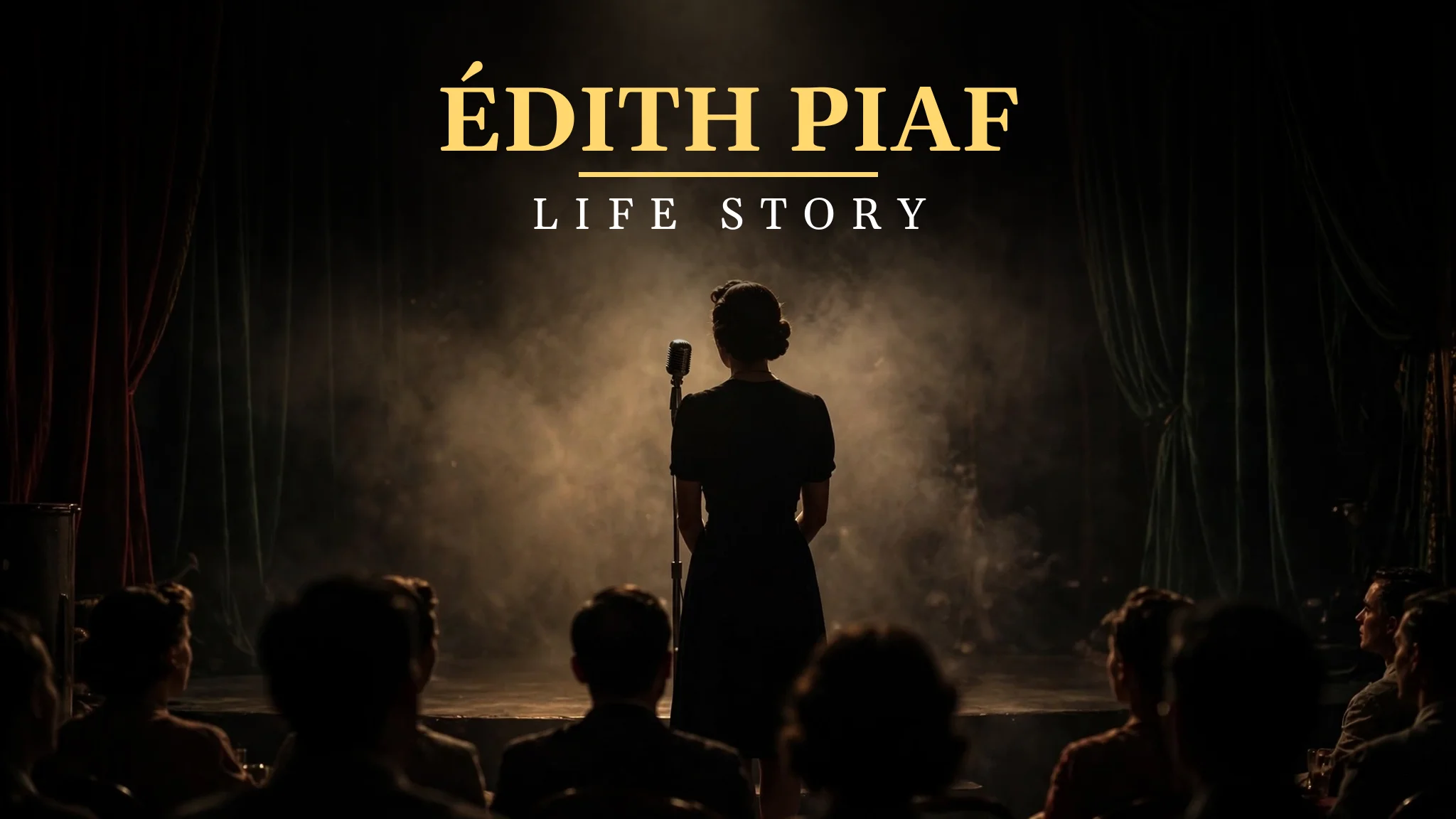
In this post
Édith Piaf was small in height and huge in feeling. When she sang, people in the back row of a hall could hear every word, and they could feel every word too. Her voice was not smooth or sweet in the usual way. It was rough at the edges, full of pain, and full of life. She sang about love that did not last, about streets, about luck, and about starting again. Millions of people who never met her felt that she was singing about their own lives.
She became known as the Little Sparrow, a name that fitted her small frame and her big spirit. Paris gave her that name, and Paris never took it back. She sang in small clubs and then in the greatest halls in the world. She sang in French, and people who did not know a word of French still understood her. Her face, her hands, and her voice told the story even when the words were strange to the listener. That is a rare gift, and it made her one of the most loved singers of the twentieth century.
Her life was not easy, and she never pretended that it was. She was born poor, she lost people she loved, her health broke down again and again, and she still came back to the stage. Each time she returned, the audience waited to see if the voice was still there. It usually was, because the feeling behind it had only grown stronger. This is the story of a girl from the streets of Paris who became the voice of France, and of the price she paid for that voice.
Born on the Streets of Paris
Édith Giovanna Gassion was born in Paris on 19 December 1915, during the First World War. Her father was a circus acrobat, and her mother was a singer who worked in cafes. The family had very little money, and the baby did not have a calm or safe start in life. Her mother left when Édith was still very young, and the child was passed between relatives who did their best in hard times. Those early years left her with a deep sense of being alone, and that feeling stayed in her songs for the rest of her life.
For a time she lived with her grandmother in Normandy, and later she went back to Paris to live with her father. He was a street performer, and he took his young daughter with him when he worked in the open air. She learned to sing for coins thrown by passers-by, and she learned that a crowd can be warm one minute and cold the next. There was no school of music for her, no kind teacher at a piano, and no safe room where she could practise in peace. The street was her classroom, and the people who stopped to listen were her first audience.
She was small and thin, and she had poor eyesight as a child. For a while she was looked after by women in a house in Normandy, and the story of her childhood was later told in many ways, some true and some made bigger by time. What is clear is that she grew up without the comfort that most children take for granted. She did not have a steady home, a steady income, or a mother at her side. She had a voice, a strong will, and a father who knew how to earn a living in front of a crowd.
Paris in those years was a hard place for poor people. The war had left its mark, money was short, and work was not easy to find. Yet the city was also full of music, of cafes, of theatres, and of people who loved a good song. Édith learned the songs of the streets, the sad ballads and the lively tunes that ordinary people sang. She learned to put her whole heart into a few lines, because a street singer has only a moment to make a stranger stop and listen. That lesson never left her, even when she sang in the grandest halls.
Singing for Coins and Finding a Stage
As a teenager, Édith sang on the streets of Paris with her father and later on her own. She stood in squares and near cafes, and she sang for whatever people chose to give her. It was a hard life, and it taught her to be tough. She had to sing in cold weather, in rain, and in front of people who walked past without looking. She also learned to read a crowd, to see when people were moved, and to change her song when the mood of the street changed.
In 1935, when she was nineteen, her life changed. Louis Leplée, who ran a cabaret called Le Gerny’s in Paris, heard her singing in the street and asked her to perform in his club. He gave her the stage name Piaf, which is a Paris slang word for a sparrow. The name was perfect for her small size, and it stayed with her for the rest of her life. In the club she sang for people who sat close, drank, and listened in a way that street crowds never had. She learned to hold a room, to pause, and to let a song breathe.
Leplée was a kind guide at first, and he helped her to dress better, to choose songs, and to sing for a real audience. But the happiness did not last long. In 1936, Leplée was killed, and Édith was questioned by the police because she had known him. She was not charged, but the shock and the newspaper stories hurt her early career. People who had just begun to know her name now saw it in a bad light, and she had to fight to be heard again. She did not give up, and she found new people to work with.
In the years that followed she worked with the songwriter Raymond Asso, who became an important partner in her life and her career. He taught her how to choose songs, how to shape a performance, and how to act on a stage. He also helped her to move from the small cabaret to larger rooms. She recorded her first songs, and her name began to spread beyond Paris. The street singer was becoming a professional artist, and the sparrow was learning to fly further than the streets where she had started.
La Vie en rose and the War Years
The Second World War came when Édith was in her twenties, and Paris lived under German occupation. She kept singing through those years, in clubs and theatres, and her songs gave comfort to people who were afraid and tired. She also toured and performed for prisoners and for soldiers, and her fame grew even in dark times. Music did not stop the war, but it gave people a few minutes of feeling human again, and Édith understood that better than most singers.
In 1946, after the war had ended, she wrote and recorded La Vie en rose, the song that would become her signature for the rest of her life. The song is about seeing life through rose-coloured glasses when you are in love, and about the way love can make ordinary days feel bright. It was simple, warm, and honest, and it travelled around the world. Later, singers in many countries recorded their own versions, and the song became one of the most famous French songs ever written. For Édith, it was more than a hit. It was a song she had helped to create, and it showed that she was not only a singer of other people’s words.
During the war years she had met many people who shaped her life, and she had also learned how to survive in a world that could turn on a person quickly. She was generous with money when she had it, and she helped friends who were in trouble. She was also stubborn, and she did not like being told what to do. Those two sides of her character, the warm heart and the iron will, were both clear by the time the war ended. She was no longer a girl singing for coins. She was a star, and she knew it.
The years after the war brought her to larger stages, to radio, and to records that reached far beyond France. She began to tour, and audiences in other countries discovered her voice. She sang with a small black dress, with almost no movement, and with her hands held tight. The lack of show did not matter, because the voice and the face did the work. People who saw her once never forgot the sight of that small woman standing alone and filling a hall with sound.
Love, Loss, and Hymne à l’amour
Édith loved deeply and often, and her loves shaped her songs. She had many relationships, and she married twice, first to Jacques Pills and later to Théo Sarapo, a much younger singer. She also had a daughter who died very young, a loss that haunted her for the rest of her life. Her songs about love were not made up from books. They came from her own joy and her own grief, and that is why they sounded true to so many listeners.
The greatest love of her life was the boxer Marcel Cerdan, a married man who became her partner in the late 1940s. He was a famous French boxer, strong and kind, and the two of them were happy together. They planned a future, and Édith wrote Hymne à l’amour for him in 1950, a song that speaks of a love that would last even after death. It is one of the most moving love songs ever written in French, and it came from a real and deep feeling.
In October 1949, before the song was recorded, Cerdan died in a plane crash while flying to see her in New York. The news broke her heart, and she was never quite the same again. She sang Hymne à l’amour with a pain that no acting could fake, because the words were about a man she had lost. Audiences wept when they heard it, not because the song was sad in a general way, but because they knew the story behind it. The song became a lasting tribute to Cerdan, and it is still played at funerals and memorials in France.
After Cerdan’s death, Édith’s health and her personal life became more troubled. She had accidents, she drank too much, and she took medicine that harmed her body. Friends tried to help her, and she tried to help herself, but the grief stayed with her. She kept working, because work was the one thing that gave her life order. When she sang, the pain had a place to go, and the audience gave her love in return. That exchange, pain for love, became the centre of her later career.
The Olympia, Milord, and the Final Triumph
In the 1950s, Édith became a regular star at the Olympia in Paris, the famous music hall where the greatest French singers performed. Her concerts there were events, and people queued for tickets. She sang with a small orchestra, and she stood alone in her black dress, with no dancers and no bright show. The audience came for the voice, and they left feeling that they had seen something real. She also toured in America, where she sang at Carnegie Hall in New York and in other great halls, and American audiences loved her even though most of them did not speak French.
In 1959 she recorded Milord, a lively song about a girl singing to a rich man, and it became a huge hit. The song showed a different side of her, playful and sharp, and it proved that she was not only a singer of sad ballads. The next year she recorded Non, je ne regrette rien, a song about refusing to regret the past. The words fitted her life perfectly, and the song became an anthem for people who wanted to look forward instead of back. She sang it with power, and it is still one of her most famous songs today.
Her health was failing by then, and she had to rest between tours. She had operations, she spent time in hospital, and she lost weight. Doctors told her to stop, but she kept returning to the stage, because the stage was where she felt most alive. In 1961 she gave a famous series of concerts at the Olympia that were meant to save the hall from closing, and she sang night after night even though she was ill. The effort was huge, and the audience loved her for it.
In her last years she married Théo Sarapo, who cared for her and sang with her. She recorded her final songs, and she gave her final concerts, with a voice that was weaker but still full of feeling. She died in the south of France on 11 October 1963, at the age of forty-seven. Paris mourned her as if she had been a queen, and thousands of people followed her funeral. She was buried in the Père Lachaise Cemetery, where her grave is still visited by fans from around the world.
Why Her Voice Still Matters
Édith Piaf left behind a body of songs that still define French music for the rest of the world. La Vie en rose, Hymne à l’amour, Milord, and Non, je ne regrette rien are played in films, in cafes, and in concert halls, and new singers still record them. Her style, the small black dress, the bare stage, and the voice that carried everything, became a model for French chanson. She showed that a singer does not need a big show to move a crowd. A true voice and a true story are enough.
Her life also became a story in itself, told in books, in films, and on stage. The film La Vie en rose, released in 2007, brought her story to a new generation, and Marion Cotillard won an Academy Award for playing her. The film showed her childhood, her loves, and her struggles, and it reminded people that behind the famous songs there was a real woman who had lived a hard life. The film was not a perfect record of her life, but it kept her name alive for young people who had never heard her sing.
In France, she is more than a singer. She is a symbol of Paris, of the streets, of love, and of survival. Her name is on streets, her songs are taught in schools, and her grave is a place where people leave flowers and notes. Tourists who visit Paris often look for her, because she is part of the city’s story. She is one of the few singers whose voice can stand for a whole country, and that is a rare honour.
Her legacy is also a lesson about honesty in art. She did not hide her pain, her mistakes, or her loves. She put them into her songs, and people trusted her because of it. She was not perfect, and she never claimed to be. She was real, and that reality is what still moves listeners today, more than sixty years after her death. When a young singer today stands alone on a stage and sings a simple song with all their heart, they are following the path that Édith Piaf made.
The Little Sparrow’s Lasting Place in Paris
Paris remembers Édith Piaf in small ways as well as in big ones. Her songs are heard in the metro, in small bars, and in the homes of people who grew up with her voice. The city that once gave her coins on the street now keeps her memory with care, and her name is spoken with love by people who were not yet born when she died. That is the mark of a singer who became part of a place, not just a star who passed through it.
Her records are still sold, her concerts are still watched on film, and her voice is still used in movies to tell a listener at once that the story is about Paris, about love, or about loss. She did not need to speak English to reach the world, and she did not need to change her style to please other countries. She sang as herself, in her own language, and the world came to her. That is a quiet kind of power, and it is the power that has kept her alive in memory.
The sparrow was small, but her song was large, and it still flies far beyond the streets where it began. When a visitor walks through Paris today and hears La Vie en rose drifting from a small cafe, the city feels whole again, because the song carries the sound of old streets, of lovers at small tables, and of a woman who refused to be forgotten. That is the gift she left behind, a sound that belongs to Paris and also belongs to anyone who has ever loved and lost.
A Voice That Crossed Borders
Édith Piaf toured in many countries, and each tour taught her something new about her audience. In America, people who could not follow the French words still sat in silence while she sang, because they could hear the feeling in her voice. She did not change her songs to suit them, and she did not add English verses to make the meaning clear. She trusted the music to carry the story, and the audience trusted her in return. That trust grew with every concert, and it made her one of the few French singers of her time who could fill halls in New York as easily as she filled them in Paris.
She also worked with musicians and writers from other countries, and she learned songs that had started far from France. Her version of songs from other places never sounded like a copy, because she sang them in her own way, with the same rough warmth that marked all her work. She was not a singer who collected styles for show. She took a song, made it her own, and gave it back to the audience with her own pain and joy inside it. That is why her recordings still sound fresh, even when the bands behind her sound old.
The respect she earned abroad was not only about sales or concert tickets. Other singers looked up to her, and many of them said that hearing Piaf changed the way they thought about singing. They saw that a singer could stand still, wear a plain dress, and hold a hall with nothing but a voice and a true story. That lesson travelled further than any single song, and it is still taught by singing teachers today. A voice that tells the truth does not need to be loud, and a song that comes from a real life does not need to be explained.
My Take:
When I listen to Édith Piaf, I do not first think about technique or about fame. I think about a small woman standing alone on a stage with nothing to hide behind. There was no big band show, no dancers, and no bright costume to save her if the song went wrong. She had her voice, her face, and the truth of the words. That kind of courage moves me more than any loud performance, because it leaves no room to pretend. She sang as if the room was full of people who had also been hurt, and she was right, because most people have been hurt in one way or another.
I admire her because she turned a hard start into art without making it sound like a complaint. She was born poor, she lost her mother early, she sang for coins in the street, and she could have become bitter. Instead, she learned to listen to the street and to the people in it, and she turned what she heard into songs that ordinary people recognised as their own. That is a rare skill. Many singers sing about love as if it were a dream in a book. Piaf sang about love as if it were rent, hunger, a train that left without you, and a man who did not come back. She made the small details matter, and that is why her songs still feel close to real life.
What saddens me most is how much loss she carried and how little rest she ever got. She lost a child when she was very young, she lost Marcel Cerdan in a plane crash, she lost friends, and her own body kept breaking down. Each time, she went back to work, and the audience clapped, and the world called it a triumph. I wonder how often she went home after those triumphs and felt alone. Fame can look like company from the outside, but it is not the same as having someone sit with you when you are afraid at night. I think Piaf knew that difference better than most stars, and I hear it in the way she sings Hymne à l’amour, as if she is holding on to a person who is already gone.
I also think about the way she refused to regret her life, at least in song. Non, je ne regrette rien is a strong song, and it is easy to sing along with it and feel brave. But I do not think it means she truly regretted nothing. I think it means she chose not to live inside regret, because regret would have stopped her from singing. There is a difference between saying you have no regrets and saying you will not let the past own you. Piaf chose the second path, and that choice took strength. She had made mistakes, she had hurt people, and people had hurt her, yet she stood up and sang about starting again. I respect that choice, and I think it is a useful lesson for anyone who has made a mess of something and does not know how to move on.
Her voice itself teaches me something about honesty. It was not a perfect voice. It cracked, it shook, and it could sound rough. In a world that often wants everything smooth and polished, that roughness was a gift. It told the listener that the singer had lived through the song, not just learned it. When I hear La Vie en rose today, I do not hear a perfect singer. I hear a woman who knows what it feels like to be in love and to be afraid of losing it. That feeling is what makes the song last, long after the fashion of its time has gone. A perfect voice can be forgotten. A true voice stays in the ear.
I think about her childhood a lot, because it explains so much and excuses nothing. She did not have a safe home, a steady school, or a mother to guide her. The street taught her to sing, but it also taught her to be hard, to trust few people, and to spend money as soon as it came. Later, when she had money, she was generous, sometimes too generous, and she gave to friends who needed help. I admire that generosity, and I also see the sadness in it. A person who grew up without enough often gives too much when they finally have something, because they remember what it felt like to have nothing. Piaf gave, and she loved, and she kept looking for a home in other people. That search made her songs deep, and it also made her life unstable.
The story of Marcel Cerdan stays with me because it shows how love and loss can live in the same song. She wrote Hymne à l’amour for a living man, and then she had to sing it for a dead one. I cannot imagine what that felt like, to stand on a stage and sing words about loving someone even after death when the person you loved had just died in a crash. She did it anyway, night after night, and the audience wept with her. I think that is one of the bravest things a singer can do. She did not hide the pain. She gave it a tune, and she let other people carry a little of it with her. That is what art is for, in my view. It does not remove pain, but it gives pain a shape that other people can hold.
I also notice how little she needed to impress people. She wore a plain black dress, she stood still, and she let the song do the work. In our time, when singers often need lights, dancers, and screens to hold attention, her way feels almost shocking. She trusted the audience to listen, and she trusted the song to be enough. I think that trust is a lesson for anyone who makes something, whether it is a song, a story, or a small business. If the work is true, you do not need to shout about it. You need to do it well, stand by it, and let people come to it. Piaf did that, and people came, in Paris, in New York, and in every city where her records were played.
There is a harder part of her story that I do not want to smooth over. She drank too much, she took drugs that harmed her, and she pushed her body past its limits. I do not admire those choices, and I do not think they made her art better. They made her life shorter, and they made her last years painful. I think it is important to say that clearly, because young people who love her voice might think that suffering is the price of great art. It is not. Her art was great because she was honest and because she worked hard, not because she harmed herself. The harm took years from her, and it took songs from the world that she never got to sing. I wish she had found a way to rest, to heal, and to live longer.
Her relationship with money and fame also makes me think. She earned a lot, and she spent a lot, and she was never careful in the way a bank manager would want. I do not judge her for that, because she had grown up with nothing and had never been taught how to keep money. But I do see a lesson in it for ordinary people. A gift can earn you a living, but it cannot manage your life for you. You still need rest, care, and people who will tell you the truth when you are hurting yourself. Piaf had friends who tried, and she had a husband in her last years who cared for her, yet the damage was already deep. I think we should admire her voice and learn from her mistakes at the same time. Both are part of her story.
When I think about her place in France, I feel a kind of warmth. She is not just a singer from the past. She is a voice that still plays in cafes, in films, and in the homes of people who were born long after she died. That is a strange and lovely thing. A woman who sang for coins on a cold street now sings for people all over the world, in languages they do not speak, and they still understand her. I think that happens only when a singer tells the truth about being human. Love, loss, hope, and the wish to start again are not French feelings. They are human feelings, and Piaf sang them in a way that crossed every border.
I also think about the film that brought her back to young audiences, and about Marion Cotillard playing her. The film was a success, and it was good that a new generation learned her name. But no film can replace the sound of her own voice. When I want to understand Piaf, I do not watch a film first. I listen to her sing, with the small band behind her, and I hear the street, the cafe, and the hall in one sound. That is where she lives, in the recordings, and that is where any reader of this story should go next. Listen to La Vie en rose, then listen to Hymne à l’amour, then listen to Non, je ne regrette rien, and you will hear three different women in one voice, a woman in love, a woman in grief, and a woman who refuses to give up.
In the end, I think Piaf teaches us that a small person can carry a large truth. She was small in size, she was poor at the start, and she had no power in the world. Yet she stood on a stage and told the truth about love and loss, and millions of people listened. That is a kind of power that does not come from money or from force. It comes from honesty, from work, and from a willingness to stand alone and sing. I would rather be remembered for one true song than for a hundred loud ones, and I believe Piaf would have agreed. Her song is still flying, long after the sparrow has gone, and I am glad it is still in the air.
One more thing I keep coming back to is the way she treated other people when she had money and fame. She helped friends who were struggling, she paid for things they needed, and she did not make a show of it. That generosity came from a childhood where help was rare, and I think it was one of her best qualities. She knew what it felt like to be cold and hungry, and she did not want the people around her to feel that way. Fame gave her a chance to be kind on a larger scale, and she took it, even when her own health was failing and her own money was running low.
I also think about what her life says to a young person who has no money, no connections, and no clear path. Piaf had none of those things when she started, and she still built a life that the whole world remembers. She did it by using the one thing she had, her voice, and by working at it every day in the street, in small clubs, and then in great halls. She did not wait for a perfect chance. She sang for the people in front of her, and the next chance came because she was ready. That is a practical lesson, not a dream. Use what you have, do it in front of real people, and keep going when the first doors close.
In the end, I come back to the image of the sparrow. A sparrow is small, common, and easy to overlook, yet it sings loudly for its size and it survives in cold streets where larger birds would struggle. Piaf was like that. She was small, she came from nothing, and she survived hard winters that would have broken many people. Her song is still in the air because it was never about being grand. It was about being alive, being in love, being hurt, and being willing to sing again the next day. I hope readers of this story hear that, and I hope they remember it when their own lives feel small.
Frequently Asked Questions
Where was Édith Piaf born and when did she die?
Édith Piaf was born in Paris on 19 December 1915, and she died on 11 October 1963 in the south of France at the age of forty-seven. She is buried in the Père Lachaise Cemetery in Paris, where fans still visit her grave and leave flowers.
What does the name Piaf mean and why was she called the Little Sparrow?
Piaf is a Paris slang word for a sparrow, and the stage name was given to her by Louis Leplée when she began singing in his cabaret in 1935. The name fitted her small size and her lively spirit, and it stayed with her for the rest of her life.
What is Édith Piaf’s most famous song?
Her most famous song is La Vie en rose, which she helped to write and recorded in 1946. Other songs that are known around the world are Hymne à l’amour, Milord, and Non, je ne regrette rien, and each one shows a different side of her voice and her life.
Who was Marcel Cerdan and why did Piaf write Hymne à l’amour for him?
Marcel Cerdan was a famous French boxer and the great love of Piaf’s life in the late 1940s. She wrote Hymne à l’amour for him, and after he died in a plane crash in October 1949, the song became a lasting tribute to him and one of her most moving performances.
Did Édith Piaf sing in English or only in French?
She sang almost always in French, and that was part of her power. Audiences in America and other countries loved her even though most of them did not speak French, because her voice, her face, and her feeling told the story of each song.
How did Édith Piaf start her singing career?
She started as a street singer in Paris, singing for coins with her father and then on her own. In 1935 Louis Leplée heard her in the street and asked her to sing in his cabaret, Le Gerny’s, and that chance gave her a stage name and her first real audience.
What film tells the story of Édith Piaf’s life?
The film La Vie en rose, released in 2007, tells her life story from childhood to her final years. Marion Cotillard played Piaf in the film and won an Academy Award for her performance, and the film brought Piaf’s music to many young listeners.


