Eida Al Menhali: The Life Story Behind the UAE's Beloved Singer
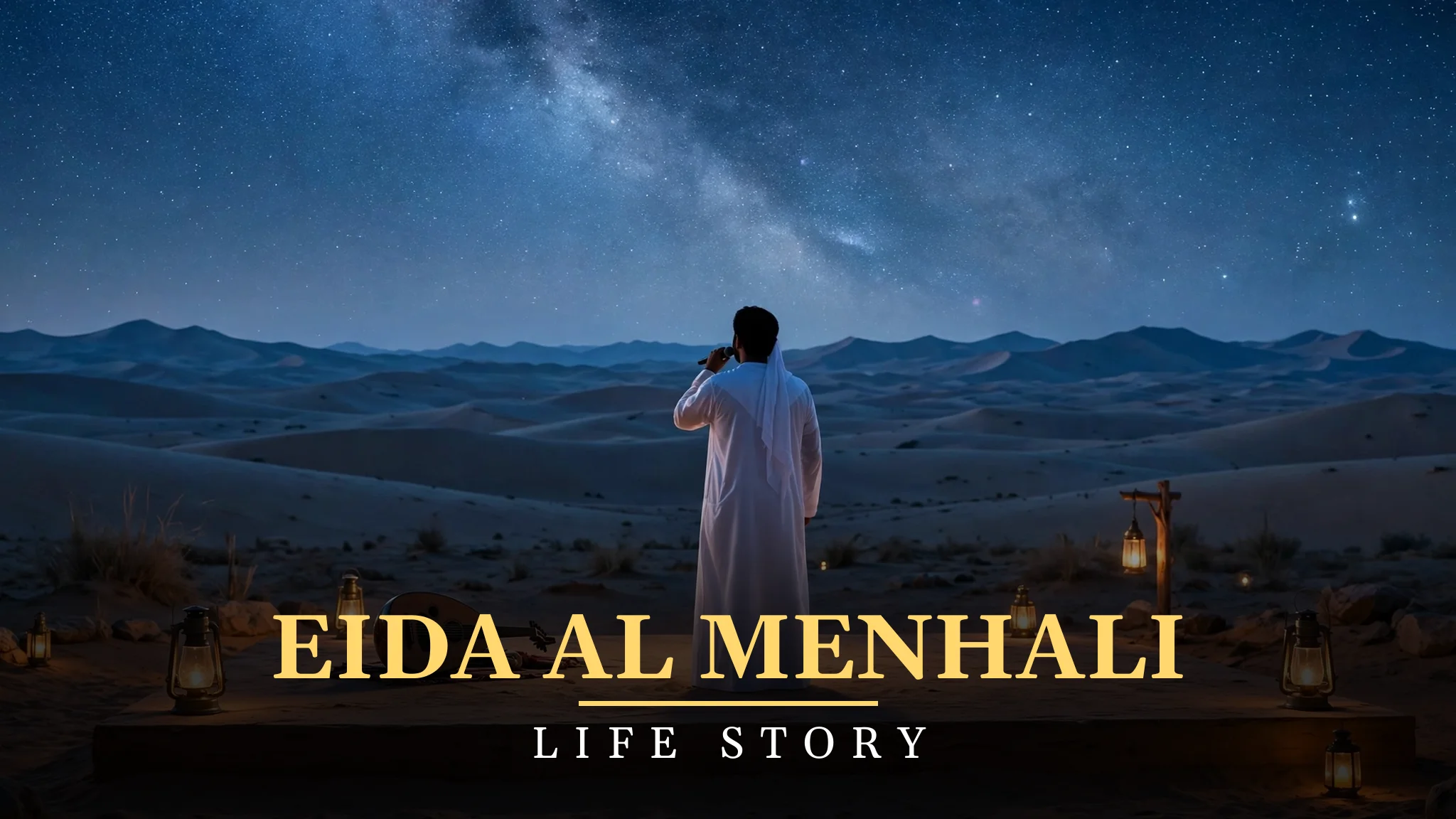
In this post
- A Boy From Abu Dhabi and the Poetry of the Desert
- Al Shallat and Poetry Without Instruments
- Mahma Jara and the Debut Album of 2002
- Motasoa and the Song That Made Him Famous
- Festivals Across the Gulf and the Middle East
- Six Albums, Many Songs, and a Steady Career
- Later Life, New Work, and a Lasting Legacy
- The Corniche, the Nation, and a Voice for the UAE
- My Take:
There is a style of performance in the Arab world that needs no instruments at all. It is called Al Shallat, and it is poetry performed with the voice alone, with rhythm, with feeling, and with the power of words. Eida Al Menhali is one of its great masters. He is an Emirati singer, a composer, and a poet, and he is known for his hit single “Motasoa”, for his debut album “Mahma Jara” in 2002, and for his performances at festivals across the Gulf and the Middle East. His voice is the voice of the UAE, a voice that speaks the poetry of the desert, and that is loved by millions.
He was born in Abu Dhabi, in the United Arab Emirates, and he grew up with the poetry and music of the Emirates. As a boy, he heard the old poems of the desert, the songs of the sea, and the Nabati poetry that is part of Emirati life. He learned to recite poetry, to sing, and to compose, and he became a singer who could perform with a full band, or with no instruments at all, using only his voice. That versatility is his gift, and it is what makes him different from other singers.
What makes his story worth telling is not only his music. It is the way he represents the poetry of the Emirates, a poetry that is old, that is proud, and that is still alive today. He is a poet-singer, a man who writes his own words and sings them, and his life shows how a traditional art can live in the modern world. This is the story of Eida Al Menhali, and of the voice that carries the poetry of the desert.
A Boy From Abu Dhabi and the Poetry of the Desert
Eida Al Menhali was born on 1 January 1977 in Abu Dhabi, the capital of the United Arab Emirates, a city that was growing fast in the 1970s. Abu Dhabi in those years was a city of new towers, new roads, and new opportunities, but it was also a city with a deep tradition, with poetry, with music, and with the culture of the desert. A boy growing up in Abu Dhabi in the 1970s heard the old poems of the Bedouin, the songs of the sea, and the Nabati poetry that is part of Emirati life. Eida grew up in that world, and it shaped his ear. He learned to love words, to love rhythm, and to love the sound of a poem recited well.
His family was not a family of famous singers, and his childhood was simple. He went to school in Abu Dhabi, he played with other children, and he listened to the poetry and music that was part of life in the Emirates. He was drawn to poetry from an early age, and he began to recite verses, to memorise poems, and to write his own. His family noticed that he had a gift for words, that he could remember long poems, and that he could recite them with feeling. They encouraged him, and he practised, learning the old poems by heart.
He was also drawn to singing, and he began to sing the songs he heard around him. His voice was warm and strong, and it suited the poetry he loved. He sang at home, he sang for his family, and he sang at gatherings, where his recitations were welcomed. He was not only a singer. He was a poet, a man who understood words, and who could make them live with his voice. That combination, of poetry and singing, became the centre of his career, and it has stayed at the centre ever since.
When he was old enough, he began to think about singing and poetry as a career. He wanted to be a professional singer and poet, and he knew that he would have to work hard to be heard. He took his voice, his love of Nabati poetry, and his Emirati heritage, and he set out to build a life in music. He did not know then that he would become one of the most popular singers in the UAE, but he was already on the road that would lead him there.
Al Shallat and Poetry Without Instruments
Eida Al Menhali is known for Al Shallat, a style of performance in the Arab world where poetry is performed without musical instruments, using only the voice. In Al Shallat, the poet-singer recites verses with rhythm, with feeling, and with a melody that comes from the voice alone. There is no oud, no drum, and no band. There is only a man, his words, and his voice, and the audience listens in silence. That is a difficult art, because it needs a voice that can hold an audience without any help, and a poet who can make words sing on their own. Eida can do both, and he has done so for his whole career.
He is a composer and a poet as well as a singer, and he writes many of the words he performs. His poetry is Nabati poetry, the traditional poetry of the Arabian Peninsula, written in the dialect of the desert, and it speaks about love, about the land, about honour, and about the life of the Bedouin. His verses are simple, but they are honest, and they have a feeling that people recognise as true. When he performs them, with or without instruments, his audience hears their own lives in his words, and they respond with love.
Al Shallat is an old tradition, and Eida has kept it alive in the modern world. He performs it at festivals, at gatherings, and at concerts, and he shows young audiences that poetry does not need a band to be powerful. A voice alone, with true words, can move a crowd, and Eida’s voice has moved many crowds. He has taught young poets that their words matter, and that they do not need instruments to be heard. That is a lesson in the power of poetry, and it is a lesson that Eida has taught by example.
His work in Al Shallat has also made him a respected figure in Emirati culture. He is not only a pop singer. He is a keeper of a tradition, a man who carries the poetry of his ancestors into the present, and who shows that it is still alive. That role is important, because traditions can easily be forgotten in a modern world. Eida has not let his tradition be forgotten. He has performed it, he has recorded it, and he has made it known to a new generation. That is a service to his culture, and it is a service that will be remembered.
Mahma Jara and the Debut Album of 2002
Eida Al Menhali released his debut album, “Mahma Jara”, in 2002, and it was an important step in his career. The album’s title means “Whatever Happens” in Arabic, and it fitted a young singer who was ready for whatever the future would bring. The songs on the album were a mix of traditional Emirati music and modern Gulf pop, and they were sung with a voice that was warm, strong, and clear. The album showed that Eida was not only a poet who performed Al Shallat. He was a recording artist, with songs of his own, and with a voice that was worth hearing.
The album was recorded with care, and it was produced by people who understood his voice and his audience. He worked with composers and poets who wrote songs that suited him, and he sang them with a feeling that was honest. His fans, who had first heard him perform poetry, bought the album, and they played it at home, in their cars, and at gatherings. The album spread his name further, from Abu Dhabi to the Emirates, and from the Emirates to the Gulf. He was becoming a known singer, and his career was growing.
After his debut, he released six albums in total, and each one added new songs to his repertoire. His albums built his reputation step by step, and each song added new fans. He did not release music in a rush. He took his time, he chose his songs carefully, and he recorded them with care. That patience was part of his character, and it was part of his art. A poet-singer cannot rush. He must wait for the right words, the right melody, and the right moment. Eida waited, and when he sang, people listened.
His albums also showed his versatility, because they included songs with full musical arrangements, and songs that were closer to Al Shallat, with only his voice. That range made his work interesting, and it showed that he was not limited to one style. He could sing with a band, and he could sing alone, and both sounded like him. That is a rare gift, and it is one that has made his albums loved by many different kinds of listeners.
Motasoa and the Song That Made Him Famous
Eida Al Menhali is known for his hit single “Motasoa”, a song that became one of his best-known works, and that made him famous across the Gulf. The song was a romantic song, with a catchy melody, a strong rhythm, and lyrics that spoke about love and longing. It was played on radio stations, it was shared online, and it was heard by people across the Emirates and the Arab world. Audiences loved the song, and they loved the voice that sang it. It was not a complicated song. It was a simple, honest song, and that simplicity was its strength.
The song’s success showed that Eida could make a pop hit as well as perform Al Shallat. He was not only a traditional poet. He was also a modern singer, capable of making a song that would be played on the radio and sung by young people. That versatility was important, because it showed that he could reach many audiences, from the lovers of traditional poetry to the lovers of modern pop. His music was not limited to one world. It belonged to many worlds, and it was loved in all of them.
“Motasoa” also became a signature song for Eida, a song that audiences asked for at his concerts, and that they sang along with him. A signature song is a gift for a singer, because it gives the audience a way to remember him, and it gives the singer a way to connect with them. When Eida sings “Motasoa”, the audience sings with him, and the concert becomes a shared moment. That connection is part of why his concerts are so loved, and why his fans stay loyal to him.
The song’s fame also spread beyond the UAE, to the Gulf, and to other Arab countries, where it was heard by audiences who shared the same love of romantic song. Eida had become a star, not only in Abu Dhabi, but across the region. His hit single had opened doors, and he walked through them with the same humility and the same love of poetry that had defined his career from the start. He did not let fame change him. He stayed a poet-singer, and his songs stayed true to his roots.
Festivals Across the Gulf and the Middle East
Eida Al Menhali has toured extensively across the Persian Gulf and the Middle East, performing at well-known festivals such as the Hala February Festival in Kuwait, the Salalah concerts in Oman, and the Jerash Festival in Jordan. Each festival was a chance to meet a new audience, and each audience taught him something about his own music. In Kuwait, he sang for an audience that loved Gulf music, and they welcomed him. In Oman, he sang for an audience that knew the poetry of the desert, and they understood him. In Jordan, he sang for an audience that loved Arabic song, and they loved his voice. His music crossed those borders easily, because it spoke about feelings that were the same everywhere.
He also headlined at the Mother of the Nation Festival in 2018, at the Abu Dhabi Corniche, a major event in the UAE that celebrates the nation’s heritage and its future. To headline such a festival is a great honour, and it shows that a singer is trusted by his country. Eida was trusted in that way, because his voice represents something important about the UAE: its poetry, its tradition, and its pride in its culture. His performance at the festival was a moment of national pride, and it showed that his work was not only entertainment. It was a part of the cultural life of his nation.
His festival performances have also been praised by local publications, and the Khaleej Times has described him as a hugely popular singer in the UAE. That praise is a recognition of what his audiences have always known: that he is a voice of the Emirates, a poet-singer whose work is loved by millions. His concerts at festivals are not only performances. They are celebrations of Emirati culture, and they bring people together in a shared love of poetry and song.
He has also performed at national celebrations in the UAE, singing at events that mark the country’s history and its future. To sing at a national event is an honour, and it shows that a singer is trusted by his country. Eida has been trusted in that way, again and again, because his voice represents the UAE at its best: its poetry, its tradition, and its modernity. His festival career is not only a personal success. It is a national success, and it has made him a part of the history of his country.
Six Albums, Many Songs, and a Steady Career
Eida Al Menhali has released six albums since his debut in 2002, and that body of work shows a steady, patient career. He did not release music in a rush, and he did not chase every new fashion. He took his time, he chose his songs carefully, and he recorded them with care. Each album added new songs, and each song added new fans. His albums are a record of his growth as a singer and as a poet, from a young man in Abu Dhabi to a mature artist known across the Gulf. That growth is visible in his work, and it is one of the reasons his fans stay loyal to him.
His songs are a mix of romantic songs, patriotic songs, and poems about the desert, about love, and about home. He sings about the UAE with pride, about its land, its sea, and its people, and his patriotic songs are loved at national celebrations. He sings about love with tenderness, about longing with sadness, and about hope with a quiet strength. Those themes are old, but they are also timeless, because people in every generation feel them. Eida sings them in a way that makes them feel new, because his voice gives them a freshness that a younger singer could not have given.
His steady career has also been helped by his versatility. He can sing with a full band, and he can perform Al Shallat with only his voice. He can sing a pop song, and he can recite a poem. That range makes his work interesting, and it shows that he is not limited to one style. He is a complete artist, a singer, a composer, and a poet, and he uses all of those skills in his work. That completeness is his gift, and it is why his albums are loved by many different kinds of listeners.
He has also been a mentor to young poets and singers in the UAE, showing them that traditional poetry can live in the modern world, and that a voice alone can move a crowd. He has taught by example, and his example has inspired a new generation of Emirati artists. He has shown that a singer does not need a big band to be heard. He needs true words, a strong voice, and a heart that believes in what he sings. That is a lesson that will outlive him, and it is one that he has taught with his whole career.
Later Life, New Work, and a Lasting Legacy
In recent years, Eida Al Menhali has continued to perform, to record, and to be honoured as one of the most popular singers in the UAE. He has performed at major festivals, he has released new work, and he has remained one of the most respected names in Emirati music. His concerts in Abu Dhabi and across the Gulf have been large events, and they have shown that his audience is still there, still loyal, and still growing. He has become a living example of the Emirati poet-singer, a man whose name is known to every generation.
His legacy is not only in his records. It is in the Al Shallat tradition he kept alive, in the Nabati poetry he performed, and in the standard he set for Emirati singers. He showed that a singer could be a poet, that a voice alone could move a crowd, and that traditional art could live in the modern world. He showed that a boy from Abu Dhabi could become a star across the Gulf, and that his voice could carry the poetry of the desert to the world. Those are lessons that will outlive him, and they will inspire young artists for a long time.
He is also a reminder that a voice, when it is honest and strong, will always find an audience. He did not become famous because of one song alone. He became famous because he sang, year after year, and because people trusted his voice. That trust is his greatest achievement, and it is the reason his name is still spoken with love in the UAE and across the Gulf.
Today, Eida Al Menhali is still active, still singing, still performing poetry, and still respected as the beloved singer of the UAE. His story is still being written, and his voice is still part of the life of the Emirates. The boy from Abu Dhabi who learned the old poems has become a man whose work has shaped a generation, and whose songs will be remembered long after he has stopped singing. His legacy is secure, because it is built on words that are true, and true words do not fade.
The Corniche, the Nation, and a Voice for the UAE
The Mother of the Nation Festival in 2018, at the Abu Dhabi Corniche, deserves a special place in Eida Al Menhali’s story, because it was a moment when his voice became the voice of his nation. The festival celebrates the UAE, its heritage, its mothers, and its future, and to headline it is a great honour. Eida headlined it, and he performed for a large audience on the Corniche, with the sea behind him and the city around him. It was a fitting stage for a singer from Abu Dhabi, a singer whose music is about the sea, the desert, and the home he loves.
His performance at the festival showed that he is not only a popular singer. He is a national singer, a man whose voice represents the UAE, and who is trusted with its most important celebrations. He sang with pride, with love, and with a voice that carried the poetry of his country to everyone who listened. The audience, made up of Emiratis and visitors, heard his songs and felt the spirit of the Emirates in them. That is a powerful thing for a singer to do, and it is a thing that Eida does well.
The Corniche itself is a symbol of Abu Dhabi, a place where the city meets the sea, and where people gather to walk, to talk, and to celebrate. Eida’s performance there was a meeting of his music and his city, and it showed that his art belongs to the place where he was born. He is a singer of Abu Dhabi, and his voice is the voice of its Corniche, its sea, and its people. That connection between a singer and his city is a beautiful thing, and it is one that will be remembered by everyone who was there.
My Take:
When I think about Eida Al Menhali, the first thing I think about is Al Shallat, and how powerful a voice alone can be. He can stand on a stage with no instruments, with only his words and his voice, and he can hold an audience in silence. That is a remarkable gift, and it is one that few singers possess. Most singers need a band, a backing track, and a stage show to be heard. Eida needs only his voice, and that voice is enough. I admire that, because it shows a confidence in the power of words, and a trust in the audience to listen.
What I admire most about him is that he is a poet as well as a singer. He writes his own words, and he sings them, and that makes his songs personal in a way that other songs cannot be. When he sings a line, he knows why he wrote it, and he sings it with a feeling that comes from inside. I think that is why his songs move people so deeply. They are not borrowed feelings. They are his feelings, shared with his audience, and that sharing is a form of trust. A poet-singer is a complete artist, and Eida is one.
I also think about Abu Dhabi, and about how a city can shape a poet. Abu Dhabi is a modern city, with new towers and new roads, but it is also a city with a deep tradition, with poetry, with music, and with the culture of the desert. Eida’s work has both of those qualities: it is modern, and it is rooted. He did not come from a big music centre like Cairo or Beirut. He came from Abu Dhabi, and he made Abu Dhabi a centre of poetry and song. That is a hopeful story for any young person from a city that is not known for music. It says that you can make your own centre, if you have a voice and you work hard.
His hit single “Motasoa” is one of the songs I think about most, because it shows everything he does well. It is simple, it is honest, and it is sung with a voice that makes you believe every word. He did not make a complicated song to show off. He made a simple song about love, and he sang it with feeling. That simplicity is his strength, and it is why the song became a hit. A song that is simple and true will be remembered, while a song that is complicated and clever will be forgotten. Eida’s songs are remembered, because they are simple and true.
I think about his debut album, “Mahma Jara”, and about what it meant for a young singer to release an album with that title, which means “Whatever Happens”. That title is a statement of courage, a statement that he was ready for whatever the future would bring. He was ready, and he has faced whatever came, with patience and with grace. That is a form of bravery, and it is one that I respect. A singer who is ready for whatever happens is a singer who will not be broken by change, and Eida has not been broken by change.
If I am honest, I also think about the fact that Eida is more famous in the Gulf than in the wider Arab world, and I wonder if that is fair. He is a master of Al Shallat, but that tradition is not as widely known outside the Gulf, and his name is not as widely known as the names of pop stars from Egypt or Lebanon. I think that is a sadness, because a man who has given so much to Emirati culture deserves to be known by everyone, not only by people in the Gulf. But I also think that his fellow poets’ respect is the highest honour a poet-singer can receive, because they know what they are hearing. They know the skill, the hard work, and the mastery, and they honour it.
I think about his festivals, the Hala February Festival, the Salalah concerts, and the Jerash Festival, and about how they show a singer who is loved across the region. He has performed in Kuwait, in Oman, and in Jordan, and his voice has been welcomed in each place. That is a sign of a singer whose art crosses borders, and whose words speak to people in many countries. His poetry is Emirati, but its feelings are universal, and that is why it travels so well. A poem about love, about home, and about the desert can be understood by anyone, no matter where they come from.
What I learn from his life is that words matter, and that a voice alone can be enough. He did not need a big band to be heard. He needed true words, a strong voice, and a heart that believed in what he sang. That is a lesson for any artist, and for any person: you do not need a lot to make something beautiful. You need something true, and you need the courage to share it. Eida understood that, and he lived by it. His life is a reminder that simplicity is not a weakness. It is a strength, and it is a strength that lasts.
I also learn from him that tradition can live in the modern world. Al Shallat is an old tradition, but Eida performs it today, at festivals, on television, and online, and young audiences love it. That shows that tradition is not dead. It is alive, and it can be made new, if it is performed with honesty and with love. Eida has made it new, and he has shown young poets that their tradition is worth keeping. That is a service to his culture, and it is a service that will be remembered.
I think about the Mother of the Nation Festival in 2018, and about what it meant for Eida to headline it. To headline a national festival is a great honour, and it shows that a singer is trusted by his country. Eida was trusted, and he did not let his country down. He performed with pride, with love, and with a voice that represented the UAE at its best. That is a proud moment, and it is one that he should remember with joy. A singer who is trusted with his nation’s story is a singer who has earned the highest honour.
I also think about the desert, and about how it is present in his poetry. The desert teaches patience, it teaches a person to wait, and it teaches a person to listen to silence. Eida’s songs have that patience, that waiting, and that silence in them. They are not rushed, they are not noisy, and they do not try to fill every moment with sound. They leave space for the listener to feel, and that space is part of their beauty. I think that is a gift from the desert, and it is a gift that he has carried with him all his life.
Another thing I respect is that he has stayed close to his roots, even as he became famous. He could have moved to another country, or changed his style to please a foreign audience, but he did not. He stayed an Emirati poet-singer, singing Nabati poetry, performing Al Shallat, and honouring his tradition. That loyalty has made his music stronger, because it comes from a real place, and it speaks to real people. A singer who forgets where he comes from often loses his voice. Eida never forgot, and his voice has stayed strong because of it.
I think about the young poets who listen to him today, and I hope they learn the right lessons. They should learn that words matter, that a voice alone can be enough, and that tradition is worth keeping. Eida’s life is a lesson in all of those things, and it is a lesson that is worth studying. He did not take shortcuts, and he did not cheat. He worked, he wrote, he sang, and he earned his place. That is a powerful example, and it will inspire young poets for a long time.
If I had to choose one word to describe him, I would choose “voice”. He is a voice, a voice of the desert, a voice of the Emirates, and a voice of poetry. He does not need instruments, he does not need a big stage, and he does not need a show. He needs only his voice, and that voice is enough. I hope he keeps singing, and I hope his voice is heard for many more years, because the UAE needs its poet-singer, and it has found him in Eida.
I also think about the future, and about what his legacy will be. His records will remain, his poems will be recited, and his example will be followed by young Emirati poets who want to sing. But his greatest legacy may be the tradition he kept alive, the Al Shallat that he performed with love, and the Nabati poetry that he carried into the modern world. That tradition is still alive because Eida kept it alive, and it will stay alive because he showed young people that it matters.
In the end, I think Eida Al Menhali’s life is a reminder that a single voice, with true words, can move a crowd, can keep a tradition alive, and can shape a culture. He did not need a big band, or a loud stage, or a famous name. He needed a voice, a poem, and a willingness to share it. That was enough, and it was enough for more than twenty years. I hope he keeps singing, and I hope his voice is heard for many more years, because the Emirates needs its beloved singer, and it has found him in Eida.
I also think about the Corniche, and about how it is a symbol of Abu Dhabi, a place where the city meets the sea. Eida’s performance there in 2018 was a meeting of his music and his city, and it showed that his art belongs to the place where he was born. A singer who performs for his own city, on its Corniche, with its sea behind him, is a singer who is home. That feeling of home is in his songs, and it is one of the reasons they move people so deeply. Home is not only a place. It is a feeling, and Eida’s voice carries that feeling.
Another lesson I take from his life is about the value of patience. He did not release music in a rush. He took his time, he chose his songs carefully, and he recorded six albums over many years. That patience is a form of respect: respect for the music, respect for the audience, and respect for himself. In a world where everyone wants everything fast, his patience is a lesson. Good work takes time, and a good song is worth waiting for. Eida understood that, and he lived by it.
I think about the young singers who listen to him today, and I hope they learn the right lessons. They should learn that a voice alone can be enough, that words matter, and that tradition is worth keeping. Eida’s life is a lesson in all of those things, and it is a lesson that is worth studying. He did not take shortcuts, and he did not cheat. He worked, he wrote, he sang, and he earned his place. That is a powerful example, and it will inspire young poets for a long time.
His story also reminds me that a singer can be a keeper of a culture, not only an entertainer. Eida keeps the Al Shallat tradition alive, he keeps Nabati poetry alive, and he keeps the music of the Emirates alive. That is a responsibility, and he has carried it with grace. A culture needs keepers, people who will perform its songs, recite its poems, and teach them to the next generation. Eida is such a keeper, and his work will be remembered as a service to his country.
Finally, I want to say that I hope his poems are taught to children in the UAE, so that they can hear the poetry of their own land in his voice. A country’s poetry is part of its education, and Eida’s poems are a lesson in words, in rhythm, and in feeling. If a child learns one of his poems, that child learns something about the desert, about home, and about what it means to belong to a place. That learning lasts longer than a lesson in a classroom, because a poem stays in the heart. He has given the UAE many such poems, and the best way to thank him is to keep reciting them.
I will remember him as a poet-singer from Abu Dhabi who carried the poetry of the desert onto the stages of the Gulf, not by chasing fame, but by singing with honesty, year after year. His voice is the sound of the Emirates at its most poetic, and it is a sound that has moved millions of people. That is a legacy to be proud of, and it is a story worth telling in full.
Frequently Asked Questions
When and where was Eida Al Menhali born?
Eida Al Menhali was born on 1 January 1977 in Abu Dhabi, in the United Arab Emirates, and he grew up with the Nabati poetry and music of the Emirates.
What is Al Shallat?
Al Shallat is a style of performance in the Arab world where poetry is performed without musical instruments, using only the voice, and Eida Al Menhali is one of its great masters.
What was Eida Al Menhali’s debut album?
His debut album was “Mahma Jara”, released in 2002, and he has released six albums since, as a singer, composer, and poet.
What is Eida Al Menhali’s hit single?
His hit single is “Motasoa”, a romantic song that became one of his best-known works and made him famous across the Gulf.
Where has Eida Al Menhali performed at festivals?
He has performed at the Hala February Festival in Kuwait, the Salalah concerts in Oman, and the Jerash Festival in Jordan, and he headlined the Mother of the Nation Festival in Abu Dhabi in 2018.
Is Eida Al Menhali a poet as well as a singer?
Yes, he is a composer and a poet as well as a singer, and he writes many of the Nabati poems he performs, often without any instruments.
Is Eida Al Menhali still performing today?
Yes, he is still active, performing at festivals and concerts in the UAE and across the Gulf after more than twenty years in music.


