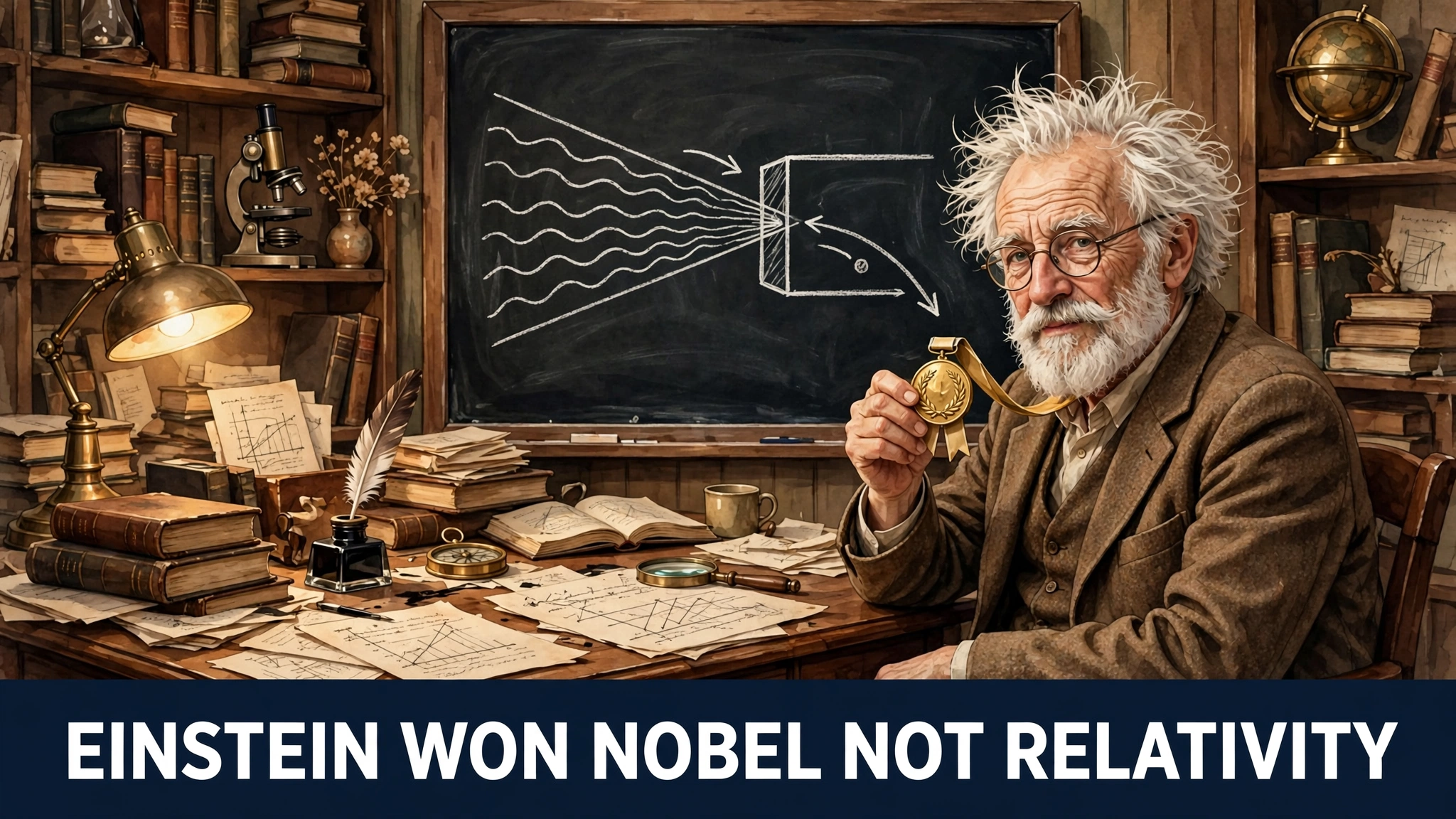
Einstein Won Nobel Not Relativity
In this post
- The Most Famous Scientist In The World, Still Waiting
- The Work They Chose: Light That Knocks Electrons Free
- The Man Who Proved Einstein Right While Doubting Him
- 1921: The Year Stockholm Said “Not Yet”
- An Award Announced While He Was Half A World Away
- The Prize Money Was Already Promised To Someone Else
- Why This Story Still Matters
- Sources
Ask almost anyone why Albert Einstein won the Nobel Prize, and they will answer at once: “For the theory of relativity, of course.” It feels obvious. Relativity made him the most famous scientist on Earth. His face, his wild hair and his little equation became known in every corner of the world.
But the obvious answer is wrong. When the Nobel Prize finally came, it did not mention relativity at all. The world’s most celebrated theory was quietly left off the certificate, and the prize went instead to a smaller, stranger idea about light — one Einstein had written down as a young patent office clerk. This is the full story: the years of waiting, the experimenter who proved Einstein right while trying to prove him wrong, the award announced while Einstein was on the far side of the planet, and the lecture he finally delivered — on relativity anyway.
The Most Famous Scientist In The World, Still Waiting
Einstein published his special theory of relativity in 1905, and the general theory — his new picture of gravity itself — in 1915. Scientists began putting his name forward for the Nobel Prize as early as 1910, and the nominations kept coming, year after year — yet the prize kept going to other people.
Then came November 1919. Two British expeditions had travelled to watch a total eclipse of the Sun, hoping to test one of general relativity’s boldest predictions: that gravity bends light. When the results were announced, they matched Einstein’s calculations. Newspapers around the world carried the story in giant headlines, and almost overnight Einstein became a global celebrity.
So by the early 1920s the situation was almost comic. Einstein was the most famous scientist alive, his theory had passed a spectacular public test — and still, in Stockholm, the Nobel Committee for Physics would not give him the prize for it.
Why not? Because fame is not proof. Relativity was radical — it replaced Newton’s picture of the universe, which had stood for more than two centuries — and parts of it were still being argued about fiercely. The men in Stockholm were cautious by nature, and not ready to stamp the highest honour in science onto a theory they felt was not yet fully settled. The question was whether they could find another part of Einstein’s work that was beyond argument. They could — and it had been sitting in print since 1905.
The Work They Chose: Light That Knocks Electrons Free
In 1905, Einstein was not a professor at all. He worked as a clerk at the Swiss patent office in Bern, examining other people’s inventions, and did his physics in his spare time. That single year he produced a burst of papers that changed science — and one of them explained a puzzle called the photoelectric effect.
The puzzle was this. When light shines on certain metals, it can knock electrons — tiny particles of electricity — loose from the surface. But it behaved in a way that made no sense if light was simply a wave, as most scientists believed. Making the light brighter did not give the electrons more energy. Yet changing the colour of the light did. Blue and violet light worked powerfully; red light, however bright, sometimes did nothing at all.
Einstein’s explanation was daring. Light, he said, does not flow only like water in a river; it also arrives in tiny separate packets of energy — quanta, later called photons. Each packet carries an amount of energy fixed by the light’s frequency, which our eyes read as its colour. One packet can strike one electron and hand over all its energy in a single blow. A packet from blue light carries enough energy to free an electron; a packet from red light does not — and sending a million weak packets makes no difference, because each electron meets only one packet at a time.
It was a beautiful, simple law. But in 1905, nearly everyone thought the packets-of-light idea was far too wild to be true. It needed an experiment to decide. And the man who settled it spent years hoping the answer would go the other way.
The Man Who Proved Einstein Right While Doubting Him
The American physicist Robert A. Millikan was one of the finest experimenters of his age — and he did not believe Einstein’s light packets at all. Still, being a true scientist, he decided to test the prediction with the most careful measurements he could build. He even constructed an elaborate device he called “a machine shop in vacuo” — a little workshop inside a vacuum chamber — so he could slice fresh, clean surfaces off metals without air spoiling them, and then measure exactly how much energy light knocked out of them.
In 1916, Millikan published his results, and they were as clear as anything in physics. The energies of the escaping electrons followed Einstein’s 1905 equation precisely, rising in a perfect straight line as the light’s frequency rose — exactly as the law required. Millikan had set out to test a theory he distrusted, and his own instruments told him the equation was right. The American Physical Society’s history of the work notes the irony: Millikan’s measurements were a triumph even though he long struggled to accept the quantum picture behind them, and the photoelectric work later formed part of his own Nobel Prize in 1923. For Stockholm, this was solid ground at last: the law had been measured on a laboratory bench, to great accuracy, by a sceptic.
1921: The Year Stockholm Said “Not Yet”
Even then, it did not happen smoothly. During the selection process in 1921, the Nobel Committee for Physics decided that none of that year’s nominations met the criteria set out in Alfred Nobel’s will. So, as NobelPrize.org records, the 1921 physics prize was simply not awarded at all. Under the Nobel Foundation’s rules, a prize can be held back and decided the following year — and that rule was used.
A year later, the compromise was ready. Einstein would receive the reserved 1921 prize, and the official words chosen for it were picked with great care. His prize motivation, as it still reads on NobelPrize.org today, honours him “for his services to Theoretical Physics, and especially for his discovery of the law of the photoelectric effect”. Read that sentence again and notice what is missing. Relativity — the theory the whole world associated with his name — is not there.
The feelings behind the careful wording slipped out at the award ceremony on 10 December 1922. Professor Svante Arrhenius, the chairman of the physics committee, opened his presentation speech by admitting that most discussion centred on Einstein’s theory of relativity, and that the theory “has astrophysical implications which are being rigorously examined at the present time.” In polite language, the message was plain: we are honouring you for the other thing.
An Award Announced While He Was Half A World Away
Einstein himself was not even in Europe when the decision was announced in the autumn of 1922. He was travelling in Japan, lecturing and being received like a visiting celebrity, and that is where the news reached him. Nor could he attend the Stockholm ceremony that December — his banquet speech had to be read aloud by the German minister, R. Nadolny, because the laureate was prevented from being there by his journey to the Far East.
He finally delivered his Nobel lecture on 11 July 1923, at a gathering of natural scientists in Gothenburg, Sweden. And here the story takes its most satisfying turn. The prize had been given for the photoelectric effect. The committee had carefully avoided relativity. But the lecture Einstein chose to give — his official Nobel lecture, the one printed and preserved by the Nobel Foundation — was titled “Fundamental ideas and problems of the theory of relativity.”
He had waited more than a decade for the prize. He accepted it gracefully for the work they named. And then, standing in the spotlight at last, he spoke about the work he knew the future would remember.
The Prize Money Was Already Promised To Someone Else
There is one more twist, and it is a human one. Einstein did not keep the prize money — roughly 121,572 Swedish kronor, a large sum at the time. Years before the prize arrived, it had already been assigned to his first wife, Mileva Marić.
Einstein and Mileva, herself a trained physicist, divorced in 1919. As part of their settlement, Einstein had promised her the money from a Nobel Prize he had not yet won. Think about what that means. In 1919, no committee had promised him anything; he had been passed over for years. Yet both of them treated the future prize as a real asset worth writing into a legal agreement. When the money finally came in 1922, it went to Mileva, to support her and their two sons. Einstein’s confidence in his own science had been so complete that he had spent his Nobel Prize three years before receiving it.
Why This Story Still Matters
Relativity was famous, celebrated and almost certainly correct — but the committee wanted laboratory proof that no one could argue with, and for the photoelectric effect that proof existed, delivered by an experimenter who had doubted the idea himself. And the “smaller” work they chose turned out to be anything but small. Einstein’s light packets helped launch quantum physics, and the photoelectric effect now sits inside everyday life: as NobelPrize.org points out, it shapes technologies from burglar alarms to solar panels to the camera in your smartphone.
Einstein, for his part, got everything in the end: the prize, the money question settled as he had promised, and a lecture hall in Gothenburg where he calmly explained relativity to the world. History gave relativity its crown anyway. Stockholm just needed a little more time — and a little more proof — than the newspapers did.
Frequently Asked Questions
Did Einstein win the Nobel Prize for the theory of relativity? No. His 1921 Nobel Prize in Physics honoured his services to theoretical physics and, especially, his discovery of the law of the photoelectric effect. Relativity is not mentioned in the prize motivation.
Why did the Nobel Committee avoid relativity? Because at the time it was still fiercely debated and, in the committee’s view, not fully proven. Its chairman said at the 1922 ceremony that the theory’s astrophysical implications were still being rigorously examined.
Why was the 1921 prize announced in 1922? In 1921 the committee decided that no nomination met the criteria in Alfred Nobel’s will, so the prize was reserved. Under the Nobel Foundation’s statutes it could be decided the next year, and Einstein received the 1921 prize in 1922.
How was the photoelectric effect proven? The American physicist Robert Millikan spent years testing Einstein’s 1905 equation with extremely precise experiments. His results, published in 1916, matched the equation exactly — even though he had doubted Einstein’s idea of light packets.
What did Einstein talk about in his Nobel lecture? Relativity. He delivered the lecture in Gothenburg on 11 July 1923, and its title was “Fundamental ideas and problems of the theory of relativity” — even though the prize itself was for the photoelectric effect.
What happened to Einstein’s prize money? Under his 1919 divorce settlement, it went to his first wife, Mileva Marić, to support her and their two sons. Einstein had promised her the money from a future Nobel Prize before he had actually won it.
Sources
- NobelPrize.org, “Albert Einstein – Facts”: https://www.nobelprize.org/prizes/physics/1921/einstein/facts/
- NobelPrize.org, “The Nobel Prize in Physics 1921” (summary): https://www.nobelprize.org/prizes/physics/1921/summary/
- NobelPrize.org, “Why we should thank Einstein for our smartphone cameras” (the photoelectric effect): https://www.nobelprize.org/stories/photoelectric-effect/
- American Physical Society, Physics, “Centennial Focus: Millikan’s Measurement of Planck’s Constant”: https://physics.aps.org/story/v3/st23
- The picture on this page is an original illustration made for Talha M Blog.