Ella Fitzgerald: The Life Story Behind the First Lady of Song
In this post
Ella Fitzgerald was born on 25 April 1917 in Newport News, Virginia, and she grew up in Yonkers, New York, after her mother moved north looking for work. Her childhood was not easy. Her mother died when Ella was fifteen, and she spent time in an orphanage and a reform school, running away more than once and living on the streets of Harlem. She had no formal musical training and no money, but she had a voice that was clear and true, and she had a determination that carried her through the hardest years of her life.
Her break came in 1934, when she was seventeen and entered an amateur contest at the Apollo Theater in Harlem. She had planned to dance, but she changed her mind at the last moment and sang instead, performing Hoagy Carmichael’s Judy and winning first prize. The bandleader Chick Webb was in the audience, and he hired her as his singer. Within a few years she was the most popular female vocalist in America, and the girl who had once lived on the streets was singing to packed houses.
Fitzgerald’s career lasted more than sixty years, and it took her from the swing bands of the 1930s to the concert halls of the world. She recorded more than two hundred albums, won thirteen Grammy Awards, and became known as the First Lady of Song, a title that stuck because no one else could claim it. Her Songbook recordings of the 1950s and 1960s, in which she sang the works of Cole Porter, George Gershwin, Duke Ellington and others, set the standard for how the American popular song should be sung.
She died on 15 June 1996 in Beverly Hills, California, at the age of 79, after a long illness. By then she had received the Presidential Medal of Freedom and the Kennedy Center Honors, and her voice was recognised around the world as one of the great instruments of the twentieth century. This is her life story, from the streets of Harlem to the concert stage.
Yonkers, Harlem, and the Apollo
Ella Jane Fitzgerald was born on 25 April 1917 in Newport News, Virginia, to William Fitzgerald, a coachman, and Temperance Henry, a laundress. When Ella was still small, her mother moved with her to Yonkers, New York, where Temperance worked in a laundry and Ella attended school. The family was poor, and Ella worked odd jobs as a child, including running numbers for local gamblers. She loved to sing and dance, and she listened to the records of Louis Armstrong and the Boswell Sisters, teaching herself to sing along with them.
In 1932, when Ella was fifteen, her mother died in a car accident, and her life fell apart. She was sent to live with an aunt, but she ran away, and she spent time in the Colored Orphan Asylum in the Bronx and later in a state reform school in Hudson, New York. The reform school was a harsh place, and Ella later said little about it, but she survived it, and when she was released she made her way to Harlem, where she lived with an aunt and worked as a lookout for a numbers operation, a job that kept her close to the music of the neighbourhood.
In November 1934 she entered the amateur night at the Apollo Theater in Harlem, one of the most famous talent contests in America. She had intended to dance, but the Edwards Sisters, a dance act, had just performed, and she changed her mind and sang instead. She chose Judy, a ballad by Hoagy Carmichael, and the audience, which had been noisy, fell quiet and then erupted. She won the twenty-five-dollar prize, and among the people who noticed her was Chick Webb, the drummer and bandleader, who hired her on the spot. The contest had changed her life in a single evening.
Chick Webb and the Swing Years
Chick Webb’s band was one of the most popular swing orchestras in New York, and Fitzgerald became its featured singer at seventeen. Webb was a small man with a hunched back and a huge talent, and he treated Ella like a daughter, protecting her from the rougher side of the music business and teaching her how to work with a band. She recorded her first songs with Webb in 1935, including Love and Kisses, and she learned to sing in front of large crowds, to hold a note over a brass section, and to swing a lyric the way the band swung the beat.
In 1938 Webb and Fitzgerald recorded A-Tisket, A-Tasket, a nursery rhyme set to a swing rhythm, and it became a number one hit, selling more than a million copies. The record made Fitzgerald a star, and she became the most popular female singer in America, with her name on the marquee alongside Webb’s. She also began to write songs, including the lyrics for A-Tisket, A-Tasket, and she showed a talent for comedy and for scat singing that would become her trademark in later years.
Webb died in June 1939, at the age of thirty, of spinal tuberculosis, and Fitzgerald took over the band, renaming it Ella Fitzgerald and Her Famous Orchestra. She led the group for three years, an unusual position for a young woman in the 1930s, and she kept it working through the war years, touring the country and recording steadily. In 1942 she left the band to go solo, and she signed with Decca Records, beginning the next phase of a career that would last another fifty years.
The Webb band played the Savoy Ballroom in Harlem, the most famous dance hall in America, where two bands would compete in battles that drew thousands of dancers. Fitzgerald sang at the Savoy night after night, learning to project over a big band and to hold a crowd that had come to dance, not to listen. The band also toured the country, playing theatres and ballrooms in the South, where the musicians faced segregated hotels and restaurants, and Webb shielded his young singer from the worst of it. Those years on the road were her real education, and they made her one of the most reliable performers in the business.
The Songbooks and the Verve Years
In 1956 Fitzgerald signed with Verve Records, the label founded by Norman Granz, and she began the project that defined her career, the Songbooks. The idea was simple: devote an entire album to the songs of a single great composer, recording them with a full orchestra and giving each song the attention it deserved. The first was the Cole Porter Songbook, recorded in 1956, and it was followed by collections devoted to Rodgers and Hart, Duke Ellington, Irving Berlin, George and Ira Gershwin, Harold Arlen, Jerome Kern and Johnny Mercer.
The Songbooks were a commercial and critical triumph, and they changed the way the American popular song was treated. Before them, the songs of Porter and Gershwin were considered light entertainment. Fitzgerald sang them with the seriousness of a classical singer, finding the emotion in every lyric and the beauty in every melody, and the albums became the standard versions against which all later recordings were measured. They also made her rich and famous, and they gave her a repertoire she could draw on for the rest of her life.
Granz was also important in another way. He insisted that Fitzgerald be treated with respect on tour, refusing to book her into segregated venues and demanding equal treatment for her and her musicians. In 1955, when she was arrested in Houston for singing to a mixed audience, Granz bailed her out and fought the charges. He also arranged her first concerts at Carnegie Hall and her tours of Europe, where she was received as a serious artist. The partnership lasted for decades, and it was one of the most productive in the history of jazz.
The Songbook sessions were recorded with large orchestras, often with arrangements by Nelson Riddle or Buddy Bregman, and Fitzgerald approached them with the care of a classical musician. She would study the lyric for days before a session, marking the places where the feeling changed and deciding how to shape each phrase. The musicians in the studio were struck by how little rehearsal she needed, and by how she could sing a difficult arrangement perfectly on the first take. The albums were expensive to make, and Granz spent lavishly on them, but they sold steadily for decades and repaid the investment many times over.
Scat Singing and the Voice
Fitzgerald’s scat singing, in which she improvised wordless syllables over the melody, was one of the most distinctive sounds in jazz. She had learned it from Louis Armstrong, and she took it further than anyone, using her voice like a trumpet, running through scales, leaping between octaves and matching the band note for note. Her scat solos were not random. They followed the harmony of the song and built to a climax, and audiences who had never heard jazz before could follow them, because they were musical in the way a good story is musical, with a beginning, a middle and an end.
Her voice itself was remarkable for its range and its clarity. She could sing three octaves, from a low contralto to a high soprano, and she could move between them without a break. Her diction was perfect, every word clear even at high speed, and her intonation was so accurate that musicians said she never sang a flat note. She also had a gift for mimicry, imitating the sound of a trumpet, a saxophone and even a whole orchestra, and she used it in her live shows to the delight of audiences.
She was not a dramatic singer in the style of Billie Holiday or Edith Piaf. She did not act out the songs, and she rarely changed the lyrics. Instead she found the feeling in the song as written, trusting the composer and the lyricist, and singing the melody straight. The result was a style that seemed effortless, and it was easy to miss how hard it was. Musicians knew, and they ranked her with the greatest instrumentalists of her time, not just the greatest singers.
Her most famous scat performance came in Berlin in 1960, when she sang Mack the Knife and forgot the words halfway through. Instead of stopping, she improvised new lyrics, imitating Louis Armstrong’s voice and making jokes about the song, and the audience roared. The recording of that night became one of her best-selling live albums, and it won her a Grammy. The moment showed what made her special, a singer who could turn a mistake into a triumph, and who trusted her ear more than her memory.
Marilyn Monroe and the Mocambo
In the 1950s Fitzgerald was one of the most popular singers in America, but she was still barred from some of the best nightclubs because she was Black. The Mocambo, a fashionable club on the Sunset Strip in Los Angeles, was one of them, and its owner refused to book her. Marilyn Monroe, who was a fan, called the owner and promised that if he booked Fitzgerald for a week, she would sit in the front row every night and bring the press with her. The owner agreed, and Fitzgerald played the Mocambo in March 1955 to packed houses and rave reviews.
The engagement changed Fitzgerald’s career. It made her a star in Hollywood, and it opened doors that had been closed to her, including television appearances and bookings at the best clubs in the country. She and Monroe became friends, and Fitzgerald later said that Monroe was a loyal friend who understood what it meant to be underestimated. The story has become one of the most famous in music history, a reminder of how segregation worked in practice and how a single act of friendship could break through it.
Fitzgerald was grateful, but she was also realistic about what the engagement meant. She had been singing for twenty years and had won every award in the business, and it still took a white movie star to get her into a Los Angeles nightclub. She never forgot that, and she spoke about it in interviews for the rest of her life. The Mocambo story is often told as a feel-good tale, but Fitzgerald told it as a story about a system that needed changing, and about the people who were willing to change it.
The Grammys and the Honours
Fitzgerald won thirteen Grammy Awards in her career, more than any other female jazz singer, and she was nominated many more times. Her first Grammys came in 1959, when she won Best Jazz Performance, Soloist, for Ella Fitzgerald Sings the Duke Ellington Songbook, and Best Female Pop Vocal Performance for Ella Fitzgerald Sings the Irving Berlin Songbook. The awards continued through the 1960s and 1970s, and in 1967 she received the Grammy Lifetime Achievement Award, one of the first artists to be so honoured.
The honours outside music were just as impressive. In 1987 President Ronald Reagan awarded her the National Medal of Arts, and in 1992 President George H.W. Bush awarded her the Presidential Medal of Freedom, the highest civilian honour in the United States. She received the Kennedy Center Honors in 1979, and she was given honorary degrees by several universities. France awarded her the Commander of Arts and Letters, and her recordings were inducted into the Grammy Hall of Fame one after another.
She was also one of the first Black women to be treated as a national treasure in America, and the honours reflected a change in the country as much as a recognition of her talent. When she began singing, Black performers were barred from the best hotels and clubs. By the time she died, she had sung for presidents and queens, and her records were in the Library of Congress. The distance she travelled was the distance the country travelled, and she travelled it with grace.
The Later Years and the Health
Fitzgerald worked steadily into her seventies, touring the world and recording new albums, but her health began to fail in the 1980s. She suffered from diabetes, and in 1993 she had both legs amputated below the knee, a consequence of the disease. She continued to perform from a wheelchair for a time, but the touring became too much, and she gave her last concert in 1993. She retreated to her home in Beverly Hills, where she was cared for by her son, Ray Brown Jr., the child of her marriage to the bassist Ray Brown.
Her marriage to Ray Brown had lasted from 1947 to 1953, and it produced her only child, Ray Jr., who was adopted. She had been married once before, briefly, to Benny Kornegay, a shipyard worker, in 1941, a marriage that was annulled within a year. She never married again, and she lived quietly in her later years, listening to music and receiving visitors. Her son managed her affairs, and her friends in the music world visited her regularly, including Quincy Jones and Frank Sinatra.
She died on 15 June 1996 in Beverly Hills, at the age of 79, of complications from diabetes and a stroke. Her funeral was held in Los Angeles, and musicians from around the world sent tributes. She was buried at Inglewood Park Cemetery, and her grave is marked with a simple stone. The Ella Fitzgerald Charitable Foundation, which she established, continues to support music education for children, and her recordings are still in print, selling steadily to new listeners.
Fitzgerald was generous with her money throughout her life, and she gave quietly to charities that helped children and musicians. She established the Ella Fitzgerald Charitable Foundation, which supports music education and medical research, and she donated to the care of other musicians who had fallen on hard times. She rarely spoke about her giving, and friends said she preferred to help without being thanked. The foundation continues her work today, funding music programmes in schools and scholarships for young singers.
The First Lady of Song
The title First Lady of Song was given to Fitzgerald in the 1950s, and it stuck because it was accurate. She was the most accomplished singer of her generation, and the one other singers measured themselves against. Her range, her diction, her swing and her scat singing were all without equal, and she combined them in a way that no one else could match. Singers from Sarah Vaughan to Diana Krall have named her as their model, and jazz musicians ranked her with the great instrumentalists.
Her Songbook recordings remain the standard for the American popular song. They are used in singing schools as examples of how to approach a lyric, and they are the versions that other singers study when they learn a song. The albums have never gone out of print, and they have been reissued in every format, from vinyl to streaming. They are also a record of a moment in American culture, when the songs of Broadway and Hollywood were treated as serious art, and Fitzgerald was the singer who made that case.
Today Fitzgerald is remembered as one of the great voices of the twentieth century, and her influence is heard in every jazz singer who follows her. She took a voice that was trained on the streets of Harlem and turned it into an instrument of extraordinary precision and beauty. She sang for more than sixty years, and she left a body of recordings that will be studied and loved for as long as people sing.
Why Ella Still Matters
Fitzgerald matters because she showed what the human voice could do. She sang with a clarity and a range that no one else matched, and she used those gifts to serve the song, not herself. She did not need drama or volume to move an audience. She needed only a melody and a lyric, and she found the feeling in them with a directness that still startles listeners who hear her for the first time.
She also matters because of the distance she travelled. She began as a homeless teenager in Harlem and ended as a national treasure, honoured by presidents and loved by audiences on every continent. She did it without compromising her art and without bitterness about the obstacles she faced, and she did it with a generosity that everyone who worked with her remembers. Her story is a reminder that talent, given time and care, can overcome almost anything.
For singers, Fitzgerald remains the standard. Her recordings are the first thing a young jazz singer is told to listen to, and the last thing they stop listening to. She proved that a singer could be as creative as any instrumentalist, and that the popular song, treated with respect, could be as serious as any other music. That is a legacy that will not fade, and it is why her name still comes first whenever the great singers are discussed.
My Take:
What I admire about Ella Fitzgerald is that her voice was the purest in jazz, a voice that could sing anything, and make it sound effortless, and that won her thirteen Grammy Awards, more than any other jazz singer. That is a rare thing, because many singers have beautiful voices, but few have a voice that is pure, and Ella’s voice was pure, in the sense that it was flawless, and that it made every song she sang sound beautiful, and that is why she is the First Lady of Song, and why her voice is still studied today, by singers who want to learn how to sing, and who listen to Ella, and who try to understand her genius, and who know they never will, because it was unique, and it was Ella’s.
The Songbooks are the recordings I think about most, because they are the finest recordings of the Great American Songbook ever made, and Ella’s voice is at their heart. She recorded the songs of Cole Porter, of Gershwin, and of Duke Ellington, in albums that are still regarded as classics, and that are still listened to today, by people who love those songs, and who want to hear them sung, in the best possible way, by the best possible singer, and Ella was that singer, a woman whose voice was pure, whose diction was perfect, and whose interpretation was flawless, and that is why the Songbooks are still important today, more than sixty years after they were recorded.
Her scat singing is a part of her story that fascinates me, because she could scat, and make her voice into an instrument, improvising, like a jazz musician, and making it sound like a trumpet, or a saxophone, and she did it with a precision, and a joy, that was infectious, and that is a part of her genius, a genius that was not just about singing a song, but about creating, about improvising, and about making music, in the moment, with a voice that was an instrument, and that was, in every sense, a jazz instrument, and that is why she is remembered, not just as a singer, but as a jazz artist, and as one of the greatest musicians who ever lived.
The Apollo Theatre win is a part of her story that moves me, because she was seventeen years old, living on the streets, and she won a talent contest, at one of the most famous theatres in America, and that win changed her life, and made her a star, and that is a hopeful message, for anyone who feels lost, or who is living on the streets, because it shows that you can find your way, through talent, and through a voice, and that is a lesson worth remembering, for anyone who dreams of being a singer, because Ella was a shy girl, who became a legend, through a voice that was pure, and through a talent that was extraordinary.
The lesson I take from Ella is that purity matters. Her voice was pure, and her life was lived with a purity, and a dignity, that is worth aspiring to, because she was kind, she was generous, and she never forgot where she came from, and that is a lesson for anyone who becomes famous, because fame can change you, but Ella did not let it change her, and she remained herself, always, and that is a rare thing, and it is a part of why she is respected, not just as a singer, but as a woman, and as a human being, and that is a legacy that will never fade.
I also think about her thirteen Grammys, because they are a record that speaks for itself, and they show that she was consistently great, over six decades, in every kind of music, from jazz to pop, and that she was, in every sense, the First Lady of Song, a woman whose voice was the standard, against which all other singers are measured, and that is a legacy that will never be matched, and it is one that I am grateful to have learned about, and to have shared, because it shows that talent, and hard work, can make a voice into a legend, and Ella did that, and she did it better than anyone.
Her friendship with Marilyn Monroe is a part of her story I love, because Marilyn used her fame to help Ella, getting her booked at the Mocambo, a club that did not book Black singers, and that is a beautiful story, and it is a part of Ella’s life that shows the power of friendship, and of standing up for what is right, even when it is not popular, and Marilyn did, and Ella never forgot it, and she was grateful, for the rest of her life, and that is a lesson worth remembering, in a world that often pits women against each other, because Ella and Marilyn were friends, and they helped each other, and that is a beautiful thing.
Finally, I believe Ella Fitzgerald was one of the greatest singers who ever lived, and her recordings are classics that will be listened to for as long as songs are sung. She was the First Lady of Song, she was the purest voice in jazz, and she was a legend, and her story is one of talent, determination, and a life lived with purity. She will always be remembered as the woman with the purest voice in jazz, and as the First Lady of Song.
One more thing I want to say is that her foundation, the Ella Fitzgerald Charitable Foundation, still operates today, and it still helps children, and supports music education, and that is a legacy that will last for generations. She did not just sing. She gave back, and she did it with a generosity that was real, and that made a difference, and that is a gift that will never fade, and that is a part of her story that I am grateful to have learned about, and to have shared, because giving back is something we should all do, and Ella did it, and she did it beautifully.
When I think about Newport News, her birthplace, I think about how far she travelled, from a shy girl in Virginia to the most famous singer in the world, and how much she achieved. She was a girl who lost her mother, who lived on the streets, and who became a legend, and that is a story that inspires anyone who has lost someone, because it shows that you can survive loss, and you can become great, and you can find a new family, in music, and in jazz, and that is a hopeful message, and one that Ella embodied, in every song she sang.
I will end by saying that listening to Ella Fitzgerald sing was a privilege, and I am grateful to have heard her voice. She was pure, she was beautiful, and she was flawless, and those three things together make a great singer. She is the First Lady of Song, she is the purest voice in jazz, and she is Ella Fitzgerald, and she will always be remembered as such, as a legend, and as a voice that will never be forgotten.
There is a final thought I want to leave with, and it is about her famous line, that she did not want to be a star, she wanted to be a singer, a line that has stayed with me, because it is a lesson about humility, about loving music, and about being true to yourself. Ella lived that lesson, in every song, and in every part of her life, and that is the power of her example: it teaches us how to live, and it makes us better people, by showing us that being a singer, and being yourself, is enough, and that is a lesson I will carry with me, always.
And if you have never heard Ella Fitzgerald sing, listen to her, because she is one of the great singers of all time, and her voice is at its heart. Listen to her Songbooks, and to her scat singing, and to her duets with Louis Armstrong, and you will hear a voice that is pure, and that is beautiful, and that is unforgettable. That is the Ella Fitzgerald I will remember: not just the singer, but the woman, who was pure, kind, and great, and who will never be forgotten.
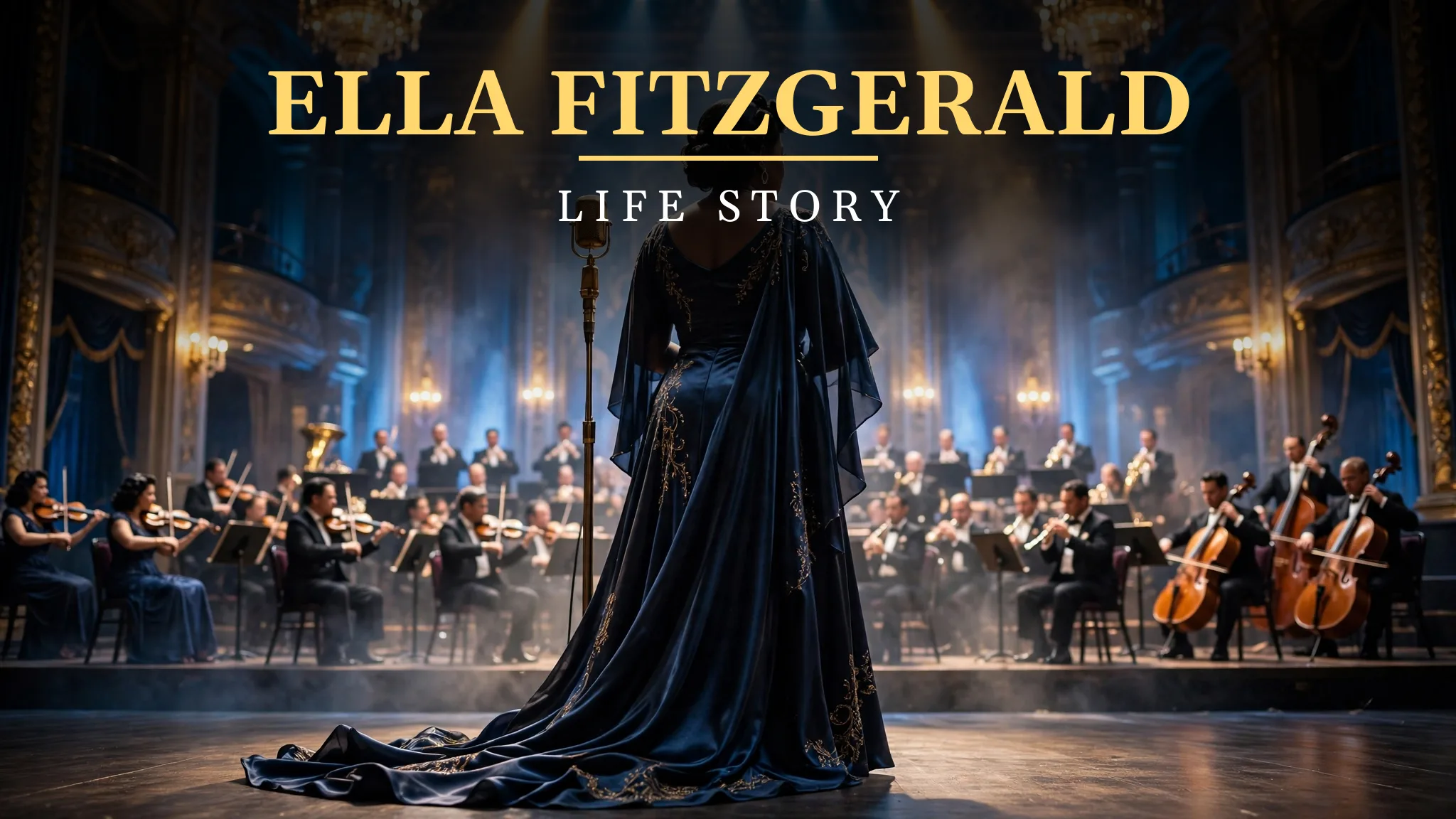
One last memory: the image of her on stage, in a gown, smiling warmly into a microphone, with a voice that is pure, and that fills the room, and that makes an audience feel joy. That image is iconic, and it is beautiful, and it is the image that will define her forever. She was the First Lady of Song, and she was Ella Fitzgerald, and she was the purest voice in jazz.
Her legacy will live on through her recordings, through her foundation, and through the generations of singers she inspired, who heard her voice and wanted to sing the way she sang. That is a fitting legacy for a woman who defined a voice, and who did it with a purity and a talent that will never be forgotten. She is gone, but her voice remains, and her name will be remembered as one of the greats.
Finally, I want to say thank you, Ella Fitzgerald, for the Songbooks, for your scat singing, and for a life lived with a voice that was pure. You were a great singer, and you were a great woman, and the world is a better place because you were in it. Your recordings are still here, your legacy is still here, and your example is still here, and that is a life that mattered, and a life that will never be forgotten.
And one more thing: if you are a singer, sing like Ella, because she is the singer every singer deserves to be, a singer who sings with purity, and who makes an audience feel joy. Sing like Ella, the way Ella Fitzgerald sang, and the world will be a better place for it, because the world needs more singers like her, who sing with purity, with joy, and with humanity.
There is a last lesson in her life that I carry with me, and it is this: be pure, even when it is hard, because purity is a choice, and Ella chose it, every day, in every song, and in every part of her life. That is a lesson worth remembering, and it is one I will carry with me, always, because the world needs more people like Ella Fitzgerald, who are pure, who are kind, and who are true.
One final thought: her thirteen Grammys, won over six decades, are a testament to her longevity, because she was great at 20, at 40, and at 70, and at every age in between, and that is a rare achievement, and it is a reminder that talent does not fade with age, and that a great singer can be great for a lifetime, if she has the talent, the determination, and the purity that Ella possessed.
And if you ever doubt that a voice can change the world, remember Ella Fitzgerald, because she did, with a voice that was pure, and her difference is still felt today, in every jazz singer, in every scat solo, and in every person who loves jazz, and that is a legacy that will last, long after her voice is heard, because her voice is still here, and her influence is still here, and that is a gift that will never fade.
There is one more thing I want to say, and it is about her duets with Louis Armstrong, because they recorded together, and their voices, hers pure, and his gravelly, were a perfect combination, and their duets are classics, and they show two great singers, at their best, singing together, and making music that is joyful, and that is beautiful, and that is a part of her story that shows her as a collaborator, not just as a soloist, and that is a legacy that matters, in its own way, alongside her Songbooks and her Grammys.
Her story also reminds me that a shy girl from Newport News can become a legend, if she has talent, determination, and a voice, and that is a hopeful message for anyone who feels shy, or unsure, or different. Ella was shy, and she was unsure, and she became one of the greatest singers in history, because she embraced who she was, and she used her voice to become great. That is a lesson worth remembering, for every shy person out there, and for every singer who wants to be heard.
I also want to mention her manager, Norman Granz, because he believed in her, and he founded Verve Records, specifically to record her, and he gave her the freedom to record what she wanted, and that is a reminder that a manager who believes in an artist can change their life, and that Ella was lucky to have Granz, and that Granz was lucky to have Ella, and that is a beautiful thing, and it is a part of her story that shows the power of belief, and of a manager who cares, and who does the right thing.
And finally, I think about the fact that she lived to 79, and that she sang for more than sixty years, and that is a reminder that a long career, lived with purity, is a beautiful thing. She was the First Lady of Song until the end, and she was herself until the end, and that is a life worth living, and a life worth remembering, and I am grateful to have learned about it, and to have shared it with you.
Frequently Asked Questions
When was Ella Fitzgerald born?
Ella Fitzgerald was born on 25 April 1917 in Newport News, Virginia, USA. She grew up in Yonkers, New York, lost her mother at 15, and won a talent contest at the Apollo Theatre in Harlem in 1934.
What is Ella Fitzgerald most famous for?
She is most famous for her pure voice, her scat singing, her thirteen Grammy Awards, and her Songbook albums recording the songs of Cole Porter, Gershwin, and Duke Ellington.
How many Grammys did Ella Fitzgerald win?
She won thirteen Grammy Awards, more than any other jazz singer, over a career of more than sixty years, and she received the Presidential Medal of Freedom in 1992.
What are the Ella Fitzgerald Songbooks?
The Songbooks are a series of albums from the 1950s and 1960s in which she recorded the complete songs of great American composers, still regarded as the definitive versions of those songs.
When did Ella Fitzgerald die?
She died on 15 June 1996 in Beverly Hills, California, at the age of 79, of complications from diabetes, after a career that began at the Apollo in 1934.
Did Marilyn Monroe help Ella Fitzgerald?
Yes. In the 1950s Marilyn Monroe persuaded the Mocambo nightclub in Hollywood, which did not book Black singers, to book Ella, promising to sit in the front row every night, and it changed Ella’s career.


