Emel Mathlouthi: The Life Story Behind Tunisia's Voice of Freedom
In this post
- A Girl From Tunis Who Found Her Voice
- Kelmti Horra and a Song Written for Freedom
- The Revolution, the Streets, and a Voice Heard Around the World
- Kelmti Horra the Album and a Career on the World Stage
- Ensen, Everywhere We Looked Was Burning, and a Singer Who Keeps Growing
- Paris, New York, and a Life Between Worlds
- A Voice of Freedom That Belongs to Everyone
- My Take:
Emel Mathlouthi is a singer whose voice became the sound of a revolution, a Tunisian artist who wrote a song called “Kelmti Horra”, which means “my word is free”, and who sang it in the streets during the Tunisian revolution of 2011, when her country was changing forever. She was born in Tunis, she learned to sing and to play guitar as a young woman, and she became known first in Tunisia and then around the world, as a voice of freedom, of dignity, and of hope, with albums such as “Kelmti Horra”, “Ensen”, and “Everywhere We Looked Was Burning”.
What makes Emel’s story special is the way her music and her life became one. She did not write songs about freedom from a distance. She lived the struggle for freedom, she sang in the protests, she was banned from performing in her own country, and she carried her song to the world, where it became an anthem for people who wanted to be free. Her voice is powerful, emotional, and full of a conviction that cannot be faked, and her songs are still sung today by people who dream of a better world.
Her life has had moments of great courage, on the streets of Tunis and on the stages of the world, and moments when she had to start again, in Paris and in New York, but her voice has remained, and her place as the voice of freedom is secure. This is the story of how a young woman from Tunis became Emel Mathlouthi, a singer whose word is free.
A Girl From Tunis Who Found Her Voice
Emel Mathlouthi was born on 11 January 1982 in Tunis, the capital of Tunisia, a city on the Mediterranean coast where the old medina meets the modern suburbs, and where music, poetry, and politics have always been part of daily life. She grew up in that world, in a family that loved music, and she learned to sing the songs she heard at home, from Tunisian folk music to the international rock and folk that filled the radio. Tunis in the 1980s and 1990s was a city full of sound, and a child growing up there could hear many kinds of music in a single day, from the calls of the market to the songs played in cafes.
As a girl she was drawn to music, and she spent time listening to the voices she admired, from Arab singers to Western folk and rock stars, and she began to copy their melodies, first quietly and then with more confidence, as her voice grew stronger and clearer. Her family noticed that she had a gift, and they encouraged her, as families often do when a child shows a talent that cannot be hidden. She was not pushed into a career, but she was given room to grow, and that room mattered, because it allowed her to develop a voice that was powerful, emotional, and full of feeling.
She also learned to play the guitar, an instrument that became her companion, a way to express feelings that were hard to put into words, and a tool that would carry her through the hardest years of her life. The guitar gave her independence, because she could write a song, play it, and sing it, all on her own, without needing a band or a studio. That independence is a key part of her art, and it is the reason her songs feel so personal, so direct, and so honest, as if she were speaking to the listener alone.
School was a normal part of her early life, and she balanced her studies with her love of music, playing at home and with friends, and dreaming of a career that seemed far away. She did not grow up in a music school, and she did not have a teacher who laid out a path for her. She learned by listening, by playing, and by trying, and that self-taught beginning gave her music a freshness that formal training sometimes takes away. She was not trying to be perfect. She was trying to be true, and that truth is audible in every song she has made.
By the time she was a young woman, Emel knew that music was more than a hobby. It was the thing she wanted to do with her life, and she began to think about how to make that happen, in a country where a woman with a guitar, singing about freedom, was still an unusual sight. That search would lead her to a song, to a protest, and to a moment that would change her life and her country forever.
Kelmti Horra and a Song Written for Freedom
Emel Mathlouthi’s most famous song is “Kelmti Horra”, which means “my word is free” in Arabic, a track she wrote in 2007, years before the Tunisian revolution, as a song about the right to speak, to think, and to be free. The song is a powerful, emotional piece, with a melody that is both simple and haunting, and with lyrics that speak about a word that cannot be silenced, about a voice that will not be bought, and about a person who refuses to be afraid. It was a song that came from her own life, from the feeling of living in a country where free speech was limited, and where artists who spoke out could be punished.
The song was banned from radio and television in Tunisia, because its message was seen as dangerous by the government of the time, and Emel was not allowed to perform it in her own country. That ban is a sign of how powerful the song was, because a government does not ban a song that does not matter. It bans a song that speaks the truth, and “Kelmti Horra” spoke the truth about freedom, in a way that every listener understood. Emel kept singing it, in small venues, in private gatherings, and online, where the song spread from person to person, even though it was not played on the radio.
When the Tunisian revolution began in late 2010 and early 2011, with protests in the streets of Tunis and across the country, “Kelmti Horra” became an anthem, a song that protesters sang together, in the squares and in the streets, as they demanded freedom and dignity. Emel herself sang it in the protests, standing with the crowd, her voice carrying the song over the noise of the city, and that image, a young woman with a guitar, singing about freedom in the middle of a revolution, became one of the most famous images of the Arab Spring. The song was no longer only hers. It belonged to a whole people, and it became the sound of their hope.
The revolution changed Tunisia, and it changed Emel’s life, because the song that had been banned was now sung openly, and the singer who had been silenced was now heard around the world. She performed “Kelmti Horra” on stages in many countries, and the song became known far beyond Tunisia, as an anthem for anyone who wanted to be free. That journey, from a banned song to a world anthem, is a remarkable one, and it is the heart of Emel’s story, a proof that a song, sung truly, can change the world, or at least can help the world to change itself.
The Revolution, the Streets, and a Voice Heard Around the World
In January 2011, when the Tunisian revolution reached its peak, Emel Mathlouthi was in the streets of Tunis, singing “Kelmti Horra” with the protesters, and her voice became a symbol of the revolution, a sound that was heard on videos, on television, and on the internet around the world. She was not a politician, and she did not make speeches. She sang, and her singing gave the protesters a voice, a melody, and a feeling of unity, a sense that they were not alone, and that their demand for freedom was shared by millions. That is a powerful role for a singer to play, and Emel played it with courage, standing in the crowd, without protection, and singing a song that the old government had tried to silence.
The revolution succeeded in removing the old government, and Tunisia began a new chapter, with elections, with a new constitution, and with a new sense of hope, but the years that followed were not easy, with political struggles, with economic hardship, and with the challenge of building a democracy in a country that had never had one. Emel’s songs continued to speak to that struggle, with music about freedom, about dignity, and about the hope that a better future was possible, even when the present was difficult. She did not stop singing about freedom after the revolution. She kept singing, because freedom is not a single moment. It is a daily practice, and her songs reminded listeners of that.
Her fame after the revolution took her to stages around the world, where she performed “Kelmti Horra” for audiences who had never been to Tunisia, but who recognised in its message a universal truth, that every person has the right to speak freely, and that no government can silence a word that is true. She performed at festivals, at concerts, and at events that celebrated human rights, and her voice became known to listeners in Europe, in America, and in many other countries, as a voice of freedom that belonged to the whole world, not only to Tunisia.
In 2015 she performed at the Nobel Peace Prize ceremony, an honour that recognised both her music and the Tunisian revolution, and that brought her song to one of the most important stages in the world. The performance was a moment of pride for Tunisia, and for Emel, because it showed that a song written in a small room in Tunis could reach the Nobel stage, and that a singer who had been banned in her own country could be honoured by the world. That journey, from ban to Nobel, is a measure of how far her music had travelled, and of how much it had meant to people who had never met her.
By the end of this period, Emel was recognised as one of the most important singers to come out of the Arab Spring, a voice that had given a revolution its song, and an artist whose work had become a symbol of freedom. She had also shown that a singer can be both an artist and a citizen, and that music can be a form of action, not only a form of entertainment.
Kelmti Horra the Album and a Career on the World Stage
In 2015 Emel Mathlouthi released her debut album, also called “Kelmti Horra”, a record that brought together her songs into a full body of work, and that introduced her to a wider audience in France, in Europe, and in America. The album was a mix of Arabic folk, rock, and electronic sounds, with Emel’s powerful voice at the centre, and it showed a singer who could make a record that was both personal and political, both Tunisian and international. It was praised by critics, and it brought her new fans, people who had heard “Kelmti Horra” during the revolution and who wanted to hear more of her music.
The album’s success was not a sudden explosion of fame. It was a slow, steady growth, as listeners discovered her music, shared it with friends, and came to her concerts, where they found a performer who was warm, powerful, and completely focused on the songs. She did not put on a show in the usual sense. She sang, she played guitar, and she let the music do the work, and that simplicity was part of her appeal. In a world of big productions, Emel’s honest, powerful performances felt like a breath of fresh air, a reminder that music can be a voice, not only a spectacle.
Her later albums, including “Ensen” in 2017 and “Everywhere We Looked Was Burning” in 2019, continued that journey, with songs that explored new sounds, new collaborations, and new themes, from love and loss to the life of a woman living between Tunisia, Paris, and New York. Each album was a step forward, with a more mature sound and a clearer sense of who Emel was as an artist, and each one added to her catalogue, giving her fans new music to love and new reasons to follow her.
She also moved to Paris and later to New York, living in new cities, learning new languages, and building a career that was truly international, with concerts in many countries and with a fan base that stretched across continents. That movement, from Tunis to Paris to New York, is a key part of her story, and it shows a singer who is willing to travel, to learn, and to grow, even when the road is long and the future is uncertain. She carried her Tunisian identity with her, in her songs and in her voice, and she made it a part of the world stage, rather than leaving it behind.
By the end of the 2010s, Emel was recognised as one of the leading voices of her generation, a singer whose music had travelled from a banned song in Tunis to the Nobel stage, and whose voice had become a symbol of freedom for listeners around the world. She had also shown that a singer can be both local and global, both Tunisian and international, and that those two identities can strengthen each other, rather than conflict.
Ensen, Everywhere We Looked Was Burning, and a Singer Who Keeps Growing
Emel Mathlouthi’s album “Ensen”, released in 2017, was a record about humanity, with a title that means “human” in Arabic, and with songs that spoke about love, about loss, and about the shared experience of being human, in a world that is often divided by borders and by fear. The album was a more personal, more reflective work than “Kelmti Horra”, with a sound that mixed folk, rock, and electronic music, and with lyrics in Arabic, French, and English, reflecting her life in Paris and in New York. It was well received, and it showed a singer who was growing, who was willing to explore new themes, and who was not content to repeat the success of a single song.
Her next album, “Everywhere We Looked Was Burning”, released in 2019, was a darker, more experimental record, with a title that speaks of a world on fire, and with songs that dealt with climate, with war, and with the feeling of living in a time of crisis. The album was a bold step, with a sound that was more electronic, more atmospheric, and more ambitious than her earlier work, and it proved that Emel was still willing to take risks, to try new sounds, and to speak about the issues that mattered to her, even when those issues were difficult. It was a record for a world in trouble, and it showed a singer who was not afraid to look at that trouble directly.
These later albums also showed her range as a singer and as a writer, her ability to move between languages and styles, and her willingness to work with musicians from many countries. She had become a world artist, in the best sense, a singer whose music belonged to Tunisia but also to the world, and whose songs could be heard in Paris, in New York, and in Tunis with equal love. That breadth is a rare achievement, and it is one that Emel earned through years of work, of touring, and of staying true to her art.
Her live performances in these years remained the heart of her career, and she continued to sing at concerts and festivals, where audiences came to hear her powerful voice and her acoustic guitar. She was known for the intensity of her shows, for the way she gave everything to a song, and for the feeling that her concerts were not performances but gatherings, where a singer and her listeners shared a moment of music and of hope together. That feeling is hard to create, and Emel created it again and again, night after night, year after year.
By the end of the 2010s, Emel was recognised as one of the most important Tunisian singers of her generation, a woman whose music had travelled from a banned song to the world stage, and whose voice had become a symbol of freedom, of humanity, and of hope. She had also shown that a singer could grow older without losing her relevance, and that a mature artist could make music that was as fresh and as honest as the work of her youth.
Paris, New York, and a Life Between Worlds
Emel Mathlouthi’s life in Paris and in New York is a key part of her story, because it shows a singer who has lived in many worlds, and who has carried the best of each into her work. Paris gave her a home in Europe, a place where she could perform, record, and build a career, and where she could meet musicians from many countries. New York gave her a home in America, a city full of energy, of diversity, and of music, and where she could explore new sounds and new collaborations. Both cities shaped her, and both are audible in her later albums, in the mix of languages, of rhythms, and of ideas.
Living between worlds is not easy, and it comes with loneliness, with the feeling of being far from home, and with the need to start again in a new place. Emel lived that life, and she turned it into music, with songs about exile, about longing, and about the hope of return, songs that speak to every migrant, to every person who has left home and who carries it in their heart. That is a large audience, and it is the reason her music resonates with listeners in many countries, who hear in her voice their own feelings of being between worlds.
Her identity as a Tunisian singer in the world is a central part of her art, and she has never hidden it. She sings in Arabic, she speaks about Tunisia, and she carries her country’s story with her, even when she lives in Paris or in New York. That loyalty to her roots is one of the reasons her Tunisian fans love her so deeply, because they know that her fame did not change her, and that she still sings for them as well as for the wider world. She is a voice for Tunisia, and a voice for the world, at the same time.
A Voice of Freedom That Belongs to Everyone
Emel Mathlouthi’s title, voice of freedom, is not only a compliment. It is a description of the way her music belongs to everyone, to listeners in Tunisia, in Egypt, in France, and in America, who all hear in her voice a singer who sings for freedom, for dignity, and for hope. Her songs are played at protests, at concerts, and in homes across the world, and they have become part of the shared culture of people who dream of a better world. That universality is the mark of a great singer, and it is the reason her music will keep being heard for a long time.
Her legacy is still being written, because she is still active, still singing, and still making music, but its shape is already clear. She gave a revolution its song, she carried the name of Tunisia to the world, and she showed that a singer with a guitar, singing truly, can change the way people see themselves and their country. That example matters, because it tells young singers that music can be more than entertainment. It can be action, it can be hope, and it can be freedom, and that is a gift that goes beyond any single song.
For a young woman in Tunis today, Emel’s story is a reminder that a career in music can start with a guitar and a song, and that it can grow if the singer is willing to work, to learn, and to stay true to who she is, even when the world is dangerous and the road is hard. That message is hopeful, and it is one that Emel’s life makes real, in a way that no speech or slogan could.
My Take:
I think Emel Mathlouthi is one of the most courageous singers I have ever read about, because her courage was not only artistic. It was political, personal, and physical, a courage that took her into the streets of Tunis during a revolution, singing a song that the old government had banned, in front of a crowd, without protection, and with a voice that could not be silenced. That kind of courage is rare, and it is the reason her music still feels alive today. She did not write songs about freedom from a safe distance. She lived the struggle for freedom, she sang in the protests, and she carried her song to the world, where it became an anthem for people who wanted to be free. I admire her for that more than I can say, because it is easy to sing about freedom when it is safe, and it is hard to sing about it when it is dangerous.
What I admire most about her is the song “Kelmti Horra” itself, a simple, powerful piece of music whose title means “my word is free”, and whose lyrics speak about a word that cannot be bought, a voice that will not be silenced, and a person who refuses to be afraid. The song was written in 2007, years before the revolution, and it was banned, because its message was seen as dangerous, and that ban is a sign of how powerful the song was. A government does not ban a song that does not matter. It bans a song that speaks the truth, and “Kelmti Horra” spoke the truth about freedom, in a way that every listener understood. I think about how many people must have heard that song in secret, in private, and felt that it was written for them, and that feeling is the reason a song becomes an anthem, not because it is clever, but because it is true.
Her performance during the revolution, singing in the streets of Tunis with the protesters, is the image I keep returning to, because it is a perfect picture of what music can do. She was not on a stage, with lights and a microphone. She was in a crowd, with a guitar, singing a song that the crowd knew by heart, and her voice carried over the noise of the city, giving the protesters a melody, a feeling of unity, and a sense that they were not alone. That is a powerful role for a singer to play, and Emel played it with a courage that I find deeply moving, because she could have stayed at home, safe, and she chose to be in the street, with her people, singing the song that had been banned.
I also think about the Nobel Peace Prize ceremony in 2015, and about how far her song had travelled, from a banned track in Tunis to a performance on one of the most important stages in the world. That journey, from ban to Nobel, is a measure of how much her music meant to people, and of how a single song, sung truly, can change the way the world sees a country and a people. I think about the pride that Tunisians must have felt, hearing her voice at the Nobel ceremony, and knowing that their revolution, and their singer, were being honoured by the world. That pride is a beautiful thing, and it is a part of Emel’s legacy that will last for a long time.
Her albums, especially “Kelmti Horra” and “Ensen”, interest me because they show a singer who was willing to grow, to explore new sounds, and to speak about new themes, from freedom to humanity, and from love to the feeling of living in a world on fire. “Ensen” means “human”, and it is a record about the shared experience of being human, in a world that is often divided by borders and by fear, and that message, that we are all human, is a simple one, but it is also a powerful one, especially in a time when the world feels divided. Emel’s music reminds listeners of that shared humanity, and that reminder is more important now than ever.
I want to say something about her voice, because it is easy to talk about a singer’s politics and forget the voice that made it possible. Emel’s voice is powerful, emotional, and full of a conviction that cannot be faked, and it does not try to be pretty or polite. It tries to be true, and that truth is what makes her songs work. When she sings “Kelmti Horra”, the listener does not think about technique. The listener feels the freedom in the song, and that feeling is the point. I think that is the highest praise you can give a singer, that her voice makes you forget about the singing and think about the feeling instead, and Emel’s voice does that, again and again.
If I am honest, I do not think every album she made is perfect, and I do not think her music is for everyone. Some listeners will find it too political, too intense, or too far from the pop music they know, and I understand that. Her music requires a listener who is willing to think, to feel, and to care about freedom, and not everyone wants to do that when they listen to a song. I think that is fine. Not every singer needs to please everyone. Emel pleases the listeners who need her, the people who are looking for a voice that speaks about freedom, and those listeners are loyal, because they know that her music is made for them, not for a chart.
I think about the young people in Tunisia today who look at Emel and see a path. They see a woman who wrote a song about freedom, who sang it in the streets, and who became a voice for a whole revolution, and they see that it is possible to use music to change the world, or at least to help the world change itself. That example matters, because it shows that art can be action, that a song can be a protest, and that a singer can be a citizen, not only a performer. Emel is proof of that, and her story will encourage young artists for many years, in Tunisia and beyond.
Her life in Paris and in New York also interests me, because it shows a singer who has lived in many worlds, and who has carried the best of each into her work. Paris gave her a home in Europe, New York gave her a home in America, and Tunis gave her a home in her heart, and she has lived in all three, singing in Arabic, in French, and in English, and making music that belongs to all three. That international life is not easy, and it comes with loneliness, with the feeling of being far from home, and with the need to start again in a new place. Emel lived that life, and she turned it into music, and her music helps other people who live that life to feel less alone.
In the end, I think Emel Mathlouthi’s story is about a word that refused to be silenced, a song that was banned and then became an anthem, and a singer who stood in the street and sang it, even when it was dangerous. Her voice is powerful, her songs are true, and her legacy is a reminder that music can be freedom, that a guitar and a voice can change a country, and that a single song, sung truly, can travel from a small room in Tunis to the Nobel stage, and to the hearts of people around the world. I will keep listening to her songs, and I will keep thinking about the young woman with a guitar who became the voice of freedom, because her story reminds me that art matters, and that a free word is worth singing for.
I hope her music keeps reaching new listeners, and I hope young singers in Tunisia and in the world know her name and understand what she achieved. She was not only a great singer. She was a bridge between a revolution and the world, between a banned song and a Nobel stage, and between a woman’s voice and the freedom of a people. Her life is a reminder that a singer can be more than a performer. She can be a keeper of hope, a voice for the silenced, and a singer whose songs become part of a people’s struggle for freedom. That is a beautiful legacy, and I am grateful for it.
I want to end by thinking about the listener who hears “Kelmti Horra” for the first time today, in a quiet room, on a phone, or in a crowd, and who feels a sudden sense of courage, as if someone were singing directly to them about freedom. That feeling is the heart of her art, and it is the reason her music matters. She does not sing to impress. She sings to free, and that freedom, between a singer and a listener, is the most important thing in music. I hope that freedom keeps growing, and I hope Emel keeps singing, because the world needs more voices like hers, powerful, honest, and free.
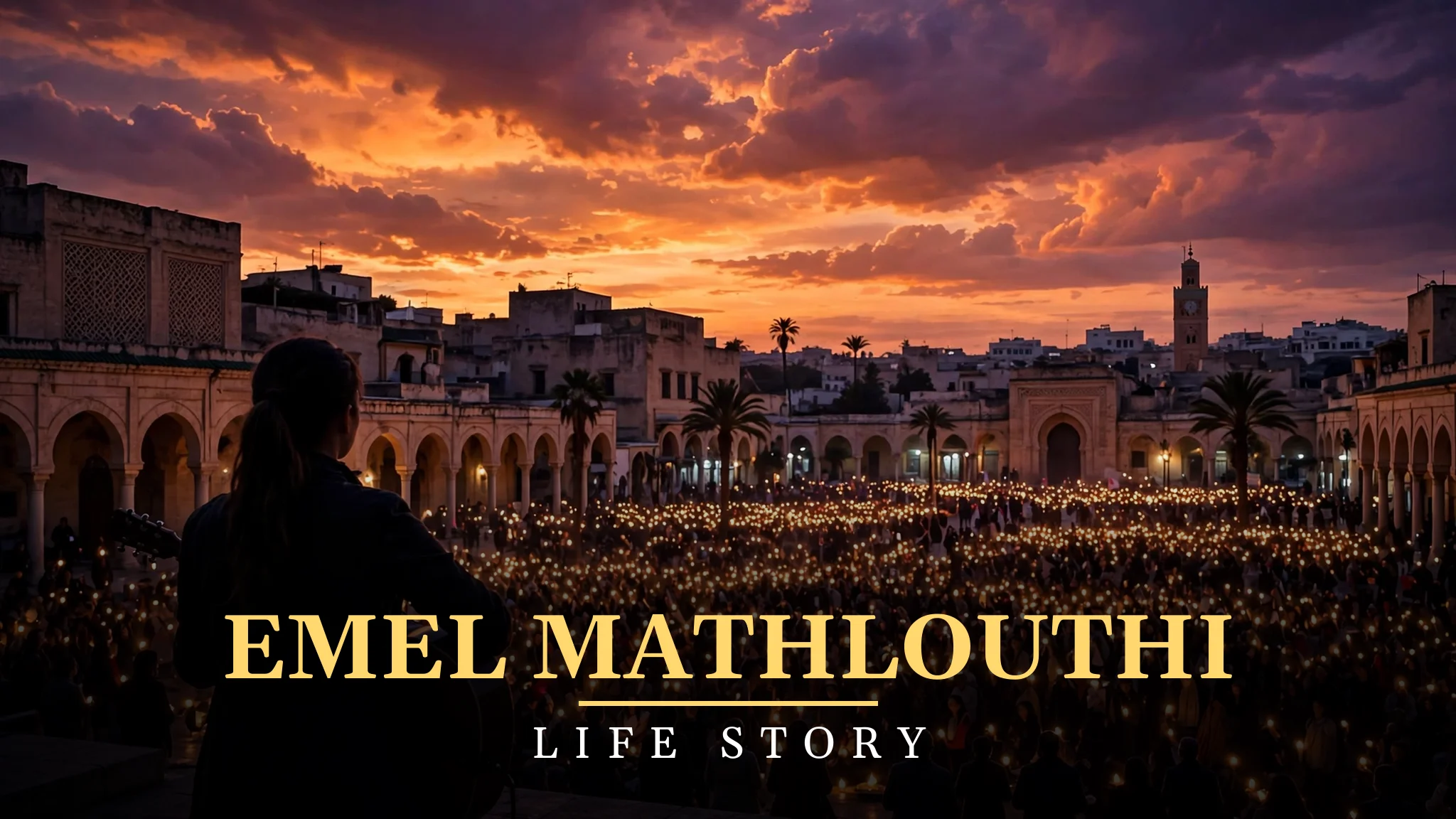
I also think about the candlelit crowd in her cover image, thousands of people holding lights in a square at sunset, and about how that image captures her music, a single voice, a guitar, and a crowd that listens together, in hope. That is a beautiful picture, and it is one that I will carry with me, as a reminder that music can bring people together, even in the darkest times, and that a song, sung truly, can light a whole square, and a whole country, with hope.
I also think about the guitar she has carried since she was young, and about how an instrument can become a home for a person who has left theirs. Emel’s guitar was with her in Tunis, in Paris, and in New York, and it carried her songs across oceans and across a life. That kind of companionship is rare, and it is a reminder that an artist’s tools are not only tools. They are friends, and they carry the artist’s history in their wood and their strings. I think about the guitar in her hands on stage, and I see a woman who is not alone, because she has her music with her, and that music has never left her, even when she was far from Tunis.
Finally, I want to say that her story gives me hope for the future, and for the power of a single song to change a life, a country, and a world. Emel’s “Kelmti Horra” began as a song written in a small room, it was banned, it was sung in the streets, and it became an anthem, and that journey shows that art can be more than entertainment. It can be freedom, it can be hope, and it can be a voice for people who have no other voice. I hope her songs keep encouraging those who need freedom, and I hope Emel keeps singing, because the world needs more voices like hers, powerful, honest, and free.
I also think about the way her songs will age, and about whether a young listener ten years from now will still feel the courage in “Kelmti Horra”. I believe they will, because Emel’s best songs are not built on a fashion that fades. They are built on a powerful voice, a simple melody, and a feeling of freedom that does not go out of date, and those things travel well across time. A song about freedom, sung truly, will mean as much to a young person in ten years as it does today, because the feeling behind it does not change. That is the test of a protest song, and Emel’s best work passes it with ease.
One last thought stays with me, about the city of Tunis itself, with its squares, its streets, and its people who stood up for freedom, and about how a singer can carry a whole revolution in her voice. Emel carries Tunis with her, in her sound and in her courage, and when listeners in other countries hear her songs, they hear a little of that revolution too. That is a powerful thing for a singer to do, to make a moment audible, and I hope she keeps doing it, song after song, for many years to come.
Frequently Asked Questions
When was Emel Mathlouthi born?
Emel Mathlouthi was born on 11 January 1982 in Tunis, Tunisia. She grew up in Tunis, where she learned to sing and to play guitar as a young woman.
What is Kelmti Horra?
“Kelmti Horra” is Emel Mathlouthi’s best-known song, whose title means “my word is free” in Arabic. She wrote it in 2007, it was banned in Tunisia, and it became an anthem of the Tunisian revolution in 2011.
How did Emel Mathlouthi become famous?
She became famous by singing “Kelmti Horra” during the Tunisian revolution in 2011, when protesters adopted the song as their anthem. Her performance in the streets of Tunis was seen around the world.
Did Emel Mathlouthi perform at the Nobel Peace Prize?
Yes, she performed at the Nobel Peace Prize ceremony in 2015, an honour that recognised both her music and the Tunisian revolution. The performance brought her song to one of the world’s most important stages.
What albums has Emel Mathlouthi released?
Her debut album “Kelmti Horra” was released in 2015, followed by “Ensen” in 2017 and “Everywhere We Looked Was Burning” in 2019. Each album explores new sounds and themes, from freedom to humanity.
What languages does Emel Mathlouthi sing in?
She sings mainly in Arabic, as well as in French and English, often mixing languages in her work. That mix reflects her life in Tunisia, Paris and New York.


