Ethel Merman: The Life Story Behind the Broadway's Beloved Star
In this post
- A Queens Childhood and a Voice That Would Not Stay Quiet
- Girl Crazy, Anything Goes, and Broadway Stardom
- Annie Get Your Gun and the Greatest Role
- Gypsy and Mama Rose
- A Loud Life, Four Marriages, and a Lasting Voice
- What Her Life Still Means
- The Voice That Built Broadway
- A Star Who Never Left Broadway
- My Take:
Ethel Merman had a voice that could fill a theatre without a microphone, and she used it to become the queen of Broadway for more than thirty years. When she sang, the sound seemed to come from her whole body, strong and clear and full of confidence, and audiences knew they were hearing something special. She was not a quiet singer, and she was not a subtle one. She was loud, she was bold, and she was unforgettable, and Broadway loved her for it.
She was born in Queens, New York, and she grew up in a working-class family where she learned to be direct, funny, and tough. She worked as a secretary before she became a star, and she sang in clubs at night while she kept her day job. She was not discovered as a teenager, and she did not come from a theatre family. She made herself into a star through hard work, through a remarkable voice, and through a refusal to be anything other than herself.
What makes her story worth telling is how long she stayed at the top, and how many great roles were written for her. She starred in Girl Crazy, in Anything Goes, in Annie Get Your Gun, in Call Me Madam, and in Gypsy, and in each of those shows she gave a performance that became the standard by which other performers were judged. She was the first to sing many of the most famous songs in American musical theatre, and her voice is still the one people think of when they hear those songs. This is the story of a woman who sang her way from a secretary’s desk to the centre of Broadway.
A Queens Childhood and a Voice That Would Not Stay Quiet
Ethel Agnes Zimmermann was born on 16 January 1908 in Astoria, Queens, New York, and she grew up in a working-class neighbourhood where people worked hard and spoke plainly. Her father was a bookkeeper, and her mother was a homemaker, and the family lived a modest and steady life. Ethel was a lively child, with a strong voice and a quick wit, and she liked to sing, to make people laugh, and to be the centre of attention in a friendly way. She was not a shy girl, and she was not a quiet one.
She attended school in Queens, and she later studied at a commercial high school, where she learned typing and shorthand, skills that would help her get a job as a secretary. She was a good student, but she was also drawn to music, and she began to sing in church and in local productions. She had a voice that was naturally loud and clear, and she did not need to be taught how to project it. She seemed to understand, even as a young girl, that a song was meant to be heard, and that she was meant to be the one singing it.
After school, she worked as a secretary during the day, and she sang in nightclubs at night. She was in her early twenties, and she was trying to balance a practical job with a dream of performing. She sang in clubs in New York, she learned how to work a room, and she began to build a reputation as a singer with a powerful voice. She was not a trained opera singer, and she was not a jazz singer. She was a Broadway singer, with a voice that could fill a theatre and a personality that could fill a room.
She was discovered by the composer George Gershwin, who heard her sing and was impressed by her voice and her confidence. He cast her in his musical Girl Crazy in 1930, and her performance in that show changed her life. She sang “I Got Rhythm” with a power and a joy that made audiences stand up and cheer, and she became an overnight star. She was twenty-two years old, and she had gone from a secretary’s desk to the Broadway stage in a single step. It was the beginning of a career that would last for more than fifty years.
Girl Crazy, Anything Goes, and Broadway Stardom
In Girl Crazy in 1930, Ethel Merman played Kate Fothergill, a role that gave her a chance to sing, to act, and to show her comic timing. The show was a success, and her performance was praised by critics and audiences alike. She sang “I Got Rhythm” in a way that became famous, and she established herself as a Broadway star with a voice that was unlike anyone else’s. She was loud, she was clear, and she was confident, and audiences loved her for it.
She followed Girl Crazy with other Broadway shows, including Take a Chance, and in 1934 she starred in Anything Goes, with music by Cole Porter, playing Reno Sweeney, a nightclub singer who helps a young man win the woman he loves. The show was a great success, and her performance was praised for its energy, its humour, and its singing. She sang “I Get a Kick Out of You” and “You’re the Top” with a power that made those songs famous, and she became known as the leading lady of Broadway musicals.
In the years that followed, she starred in a string of hit shows, including Red, Hot and Blue, Stars in Your Eyes, and other productions that were built around her voice and her personality. She was not a traditional leading lady. She was a brassy, funny, and strong woman, and she played characters who were like her: direct, confident, and unafraid to speak their minds. Audiences loved her because she was real, and because she sang with a joy that was infectious.
She also began to appear in films, though her film career was never as successful as her stage career. She appeared in films such as We’re Not Dressing and in other comedies, but the camera did not capture her voice in the same way that a live theatre did. She was a stage performer, and she knew it, and she returned to Broadway again and again, where she felt most at home. She was the queen of Broadway, and she wore that title with pride.
Annie Get Your Gun and the Greatest Role
The greatest role of Ethel Merman’s career came in 1946, when she starred in Annie Get Your Gun, a musical by Irving Berlin about the sharpshooter Annie Oakley. She played Annie, a rough and funny woman from the backwoods who becomes a star in Buffalo Bill’s Wild West Show, and who falls in love with a fellow sharpshooter. The role was perfect for her. Annie is loud, direct, and full of energy, and she sings songs that require a powerful voice and a strong personality. Ethel brought all of that to the part, and she made it her own.
She sang “There’s No Business Like Show Business” with a power that made the song an anthem for the theatre, and she sang “You Can’t Get a Man with a Gun” with humour and wit. The show ran for more than a thousand performances on Broadway, and it became one of the most successful musicals of its time. Ethel’s performance was praised as one of the great performances in Broadway history, and it cemented her reputation as the leading musical star in America.
She toured with the show, and she brought it to audiences across the country who had not seen her on Broadway. She was proud of the work, and she was proud of the role, and she spoke about Annie as one of the best parts she had ever played. She was in her late thirties by then, and she had been a star for more than fifteen years, but this was the role that defined her career. It showed that she could carry a major show, that she could sing the greatest songs in American musical theatre, and that she could do it night after night with the same energy and joy.
She continued to star in Broadway shows after Annie Get Your Gun, including Call Me Madam in 1950, where she played a Washington hostess, and she won a Tony Award for that performance. She was at the height of her powers, and she was the most sought-after musical star in America. Composers wrote songs for her, producers built shows around her, and audiences came to see her because they knew they would hear a voice like no other.
Gypsy and Mama Rose
In 1959, Ethel Merman took on the role that many people regard as her greatest, Mama Rose in Gypsy, a musical about the mother of the stripper Gypsy Rose Lee. Mama Rose is a tough, ambitious, and complicated woman who pushes her daughters to become stars, and who will do anything to make her dream come true. The role is one of the most demanding in musical theatre, requiring a singer who can act, who can be funny and frightening in the same scene, and who can sing some of the most powerful songs ever written for Broadway.
Ethel played Mama Rose with a force that stunned audiences. She sang “Some People”, “Everything’s Coming Up Roses”, and “Rose’s Turn” with a power and a desperation that made the character feel real and terrifying. She did not play Mama Rose as a villain. She played her as a woman who loved her daughters, who wanted the best for them, and who could not let go of her own dreams. Her performance was praised as one of the greatest in Broadway history, and it won her a Tony Award nomination, though she did not win.
Gypsy ran for more than seven hundred performances on Broadway, and it became a classic of American musical theatre. Ethel’s performance was recorded, and it is still listened to today by people who want to hear how Mama Rose should be played. She was fifty-one years old when she took on the role, and she showed that a woman in her fifties could still be the most powerful presence on Broadway. She was not a young star. She was a great star, and Gypsy proved it.
She continued to perform after Gypsy, though she took on fewer new roles. She appeared in films, including It’s a Mad, Mad, Mad, Mad World in 1963, where she played a funny and loud character, and she appeared on television, where her voice and her personality made her a familiar face. She was a legend, and she was treated as one, but she remained a working actress, always ready to sing, always ready to perform.
A Loud Life, Four Marriages, and a Lasting Voice
Ethel Merman’s personal life was as loud and as dramatic as her stage career. She was married four times, and each marriage ended in divorce. She was a strong and independent woman, and she did not find it easy to share her life with a husband who wanted her to be quieter or smaller than she was. She had two children, Ethel Jr. and Robert, and she was a devoted mother, though her career often kept her away from home. She spoke honestly about her marriages, and about the difficulties of balancing a demanding career with a family life.
She was known for her directness, her humour, and her refusal to pretend to be something she was not. She did not hide her opinions, she did not soften her voice, and she did not apologise for being loud. That honesty made her loved by audiences, and it also made her a difficult person to live with at times. She was a woman who knew what she wanted, and who was not afraid to say it, and that strength was part of what made her a great performer.
In her later years, she continued to perform, though she worked less often. She appeared in concerts, she sang at special events, and she remained a beloved figure in the theatre world. She was honoured with awards for her work, and she was admired by younger performers who saw her as a role model. She was the voice of Broadway, and her recordings are still played today by people who want to hear how a musical should be sung.
She died on 15 February 1984 in New York City, at the age of seventy-six, after suffering a brain tumour. Her death was mourned across America, and tributes came from performers, composers, and audiences who had loved her work for decades. She was buried in New York, and her legacy was remembered in the many recordings, films, and stage performances she had left behind. She had been a star for more than fifty years, from Girl Crazy in 1930 to Gypsy in 1959 and beyond, and she had left a mark on Broadway that has never faded.
What Her Life Still Means
Ethel Merman is remembered today as the greatest Broadway belter of all time, and as the original star of some of the most famous musicals in American history. Her voice is still the standard by which other Broadway singers are judged, and her performances in Annie Get Your Gun and Gypsy are still regarded as definitive. She showed that a woman with a loud voice and a strong personality could be a star, and that she did not need to be quiet or delicate to be loved.
Her influence can be seen in the work of musical theatre performers who admire her power, her humour, and her honesty. She showed that a Broadway star could be a working-class woman from Queens, who had been a secretary, and who had made herself into a legend through hard work and talent. She also showed that a career on Broadway could last for decades, if you had the voice and the will to keep going. That lesson is still relevant today, when many performers are told that their careers will be short.
She is remembered for “There’s No Business Like Show Business”, for “I Got Rhythm”, for “Rose’s Turn”, and for many other songs, but she is also remembered for the way she lived: loudly, honestly, and without apology. She was a woman who sang her heart out, and who left the world a little louder and a little braver than she found it.
The Voice That Built Broadway
Ethel Merman’s voice is the most important part of her story, and it is worth thinking about in detail, because it was not a voice that was trained in the usual way, and it was not a voice that sounded like other Broadway singers. She had not studied opera, she had not taken years of formal singing lessons, and she did not sing with a classical technique. She sang with a natural power, with a clear diction, and with a confidence that made her voice fill a theatre without a microphone, even when the theatre held more than a thousand people. That power was a gift, and she used it with a seriousness that made it last for more than fifty years.
Composers wrote songs for her because they knew what her voice could do. Irving Berlin wrote Annie Get Your Gun for her, Cole Porter wrote Anything Goes for her, and Jule Styne and Stephen Sondheim wrote Gypsy for her, and each of those composers understood that her voice needed songs that were strong, direct, and full of energy. They did not write delicate ballads for her. They wrote anthems, songs that required a singer who could be loud, clear, and confident, and who could make an audience feel the power of a song in their chest. She sang those songs with a joy that made them famous, and her recordings of them are still the standard by which other singers are judged.
Her diction was also remarkable. She sang every word clearly, so that even people in the back row of a theatre could understand the lyric, and she did it without losing the emotion of the song. That clarity came from her work as a secretary, where she had learned to type and to speak clearly, and from her work in nightclubs, where she had learned to project her voice over a band. She was a practical singer, and she understood that a song is only as good as its words, and that an audience needs to hear those words to feel the story. That understanding made her performances not only powerful, but also clear and communicative.
She also had a comic timing that made her singing funny as well as powerful. She could sing a line, pause, and let the audience laugh, and then sing the next line with even more energy, and that timing came from her years on stage, where she had learned how to work with an audience, how to read a room, and how to make a joke land. She was not only a singer. She was a comedian, and she used her voice to tell jokes, to make people laugh, and to make them feel happy. That combination of power and humour is rare, and it is one reason her performances are still loved today.
In her later years, her voice changed, as all voices do, but she continued to sing, and she continued to perform, because she loved to sing and because audiences loved to hear her. She recorded albums, she appeared in concerts, and she sang at special events, and she did it with the same energy and joy she had brought to the stage in 1930. Her voice is still there, in those recordings, waiting for anyone who wants to hear what Broadway sounded like at its best, when a single voice could fill a theatre and make a thousand people stand up and cheer.
A Star Who Never Left Broadway
Ethel Merman was a Broadway star in a way that few performers have ever been, because she did not just appear on Broadway. She was Broadway, for more than thirty years, from Girl Crazy in 1930 to Gypsy in 1959 and beyond. Composers wrote shows for her, producers built productions around her, and audiences came to New York specifically to hear her sing. She was not a star who visited Broadway. She lived there, she worked there, and she made it her home. That loyalty to the stage is part of what makes her special, because she could have moved to Hollywood and tried to become a film star, but she stayed where she belonged, where her voice could fill a theatre and where her personality could fill a room.
She also helped to define what a Broadway musical could be, by showing that a musical could be loud, funny, and powerful, and that a woman could be the centre of it, not only a supporting player. Her roles in Annie Get Your Gun and Gypsy are still studied by young performers who want to learn how to play a strong woman on stage, and her recordings are still played in theatre schools, where students listen to how she phrased a line, how she used her voice, and how she made a song feel like a story. She was a teacher as well as a performer, even if she never taught in a classroom, because her work taught generations of singers how to sing with power, with clarity, and with joy.
My Take:
I think Ethel Merman’s story makes me smile, and I think it also makes me think about what it means to be loud in a world that often tells women to be quiet. She was loud, she was bold, and she was proud of it, and Broadway loved her for it. I admire that, because so many women are told to soften their voices, to be smaller, to be more polite. She did the opposite. She sang louder, she spoke her mind, and she became a legend. That takes courage, and it takes a belief in yourself that is rare.
What strikes me first is her voice. I have heard recordings of her singing “There’s No Business Like Show Business”, and I can imagine what it must have felt like to hear that voice live in a theatre, without a microphone, filling every corner of the room. It must have been thrilling, and it must have felt like the whole building was shaking with sound. I think that kind of power is a gift, and she used it wisely. She did not waste it on small songs. She used it on the greatest songs in American musical theatre, and she made them her own.
I love the fact that she started as a secretary. She worked during the day, she sang at night, and she kept her practical job until she was discovered. I think that tells me something important about her character. She was not a dreamer who waited for fame to find her. She was a worker who kept a job, who paid her bills, and who sang when she could. When George Gershwin heard her, she was ready, because she had been practising, performing, and learning. That readiness is a lesson I want to remember: do the work, even when no one is watching, so that you are ready when the chance comes.
Annie Get Your Gun is the show I think about most when I think of her. Annie Oakley is a character who is rough, funny, and strong, and who does not fit the usual idea of a leading lady. Ethel played her with a joy and a confidence that made the role feel real. I think that performance works because Ethel understood Annie. She understood what it means to be a woman who is not delicate, who is not quiet, and who is proud of her strength. She brought that understanding to the role, and it showed in every song.
Gypsy is even more powerful to me, because Mama Rose is a complicated character, a mother who loves her daughters and who also pushes them too hard. Ethel played her with a force that was both frightening and moving. She sang “Rose’s Turn” as if her life depended on it, and in a way, it did. That song is about a woman who realises that she has given everything to her children and has nothing left for herself. I think Ethel understood that feeling, as a mother and as a performer who had given everything to her career. She brought that understanding to the role, and it made her performance unforgettable.
I also think about her personal life, and about her four marriages, and I feel a real sympathy for her. She was a strong woman, and she did not find it easy to live with men who wanted her to be smaller than she was. I do not blame her for those marriages ending. I think they ended because she was true to herself, and because she refused to give up her voice, her career, or her personality for anyone. That is a brave choice, and it is a choice that many women have had to make. She made it, and she lived with the consequences, and she kept singing.
What I learn from her is that being loud is not a flaw. It is a gift, if you use it well. She used her loud voice to sing the greatest songs, to make audiences laugh, and to tell stories that mattered. She did not apologise for her volume, and she did not try to be quieter to please other people. I think that is a lesson for anyone who has been told to tone it down, to be less, to fit in. Be yourself, be loud if you are loud, and find the place where your voice is valued. For Ethel Merman, that place was Broadway, and Broadway was lucky to have her.
I also learn from her that a career can be built on a single great gift, if you work hard to develop it. She had a voice, and she spent fifty years using it, learning new songs, taking on new roles, and growing as a performer. She did not try to be everything. She was a Broadway singer, and she was the best at it, and that was enough. I think we are often told to be good at many things, but her life shows that being truly great at one thing, and doing it with love and dedication, can be a whole life.
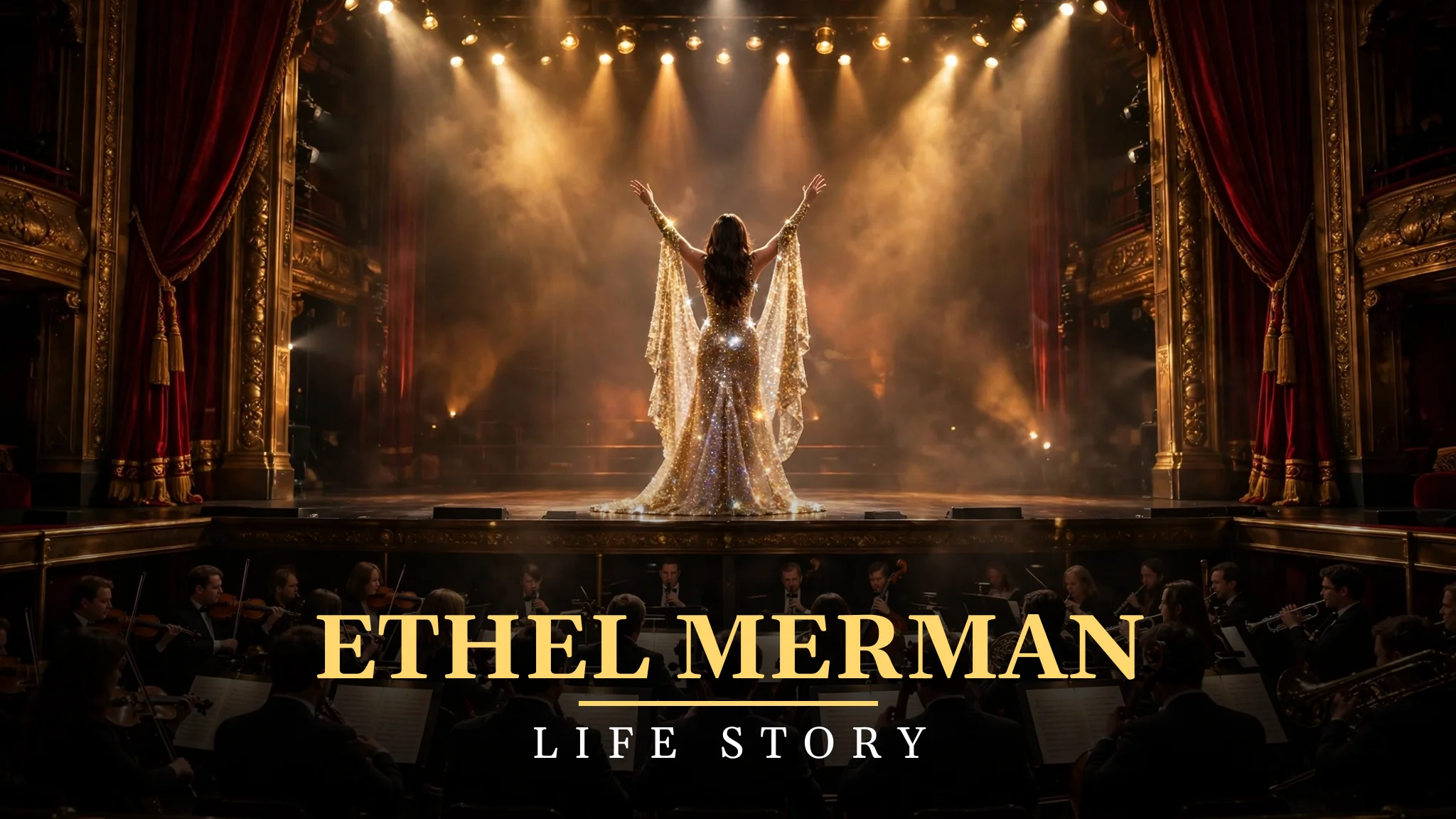
When I think of Ethel Merman now, I think of a woman in a sparkling gold gown, standing centre stage with her arms raised, in a grand theatre with red curtains and an orchestra below her. She is not afraid. She is ready to sing, and she knows that the whole room is listening. That image stays with me, because it captures her confidence, her joy, and her power. She was a star, and she knew it, and she shared that stardom with her audience in a generous way.
I hope readers who meet her for the first time will listen to her recordings, and I hope they will watch Gypsy, and I hope they will hear “There’s No Business Like Show Business” and understand why that song became an anthem. I hope they will see that she was more than a loud voice. She was a great actress, a great singer, and a woman who lived her life without apology. That is why I think her story matters, and that is why I think it will still matter many years from now, when Broadway is still singing her songs.
In the end, I think Ethel Merman teaches us to use the voice we have, loudly and proudly, and to not be afraid of being heard. She sang, she spoke, and she lived loudly, and she left a legacy that is still ringing in theatres today. I will remember her as Annie, as Mama Rose, as Reno Sweeney, and as a woman who showed us that a loud voice, used with love and with honesty, can change the world.
I also think about how Ethel Merman’s story connects to the way we think about women’s voices today, and to how often women are told to be quieter, softer, or more polite. She was none of those things, and she was loved for it. She sang loudly, she spoke directly, and she did not apologise for taking up space, on stage or in life. I think that is a powerful example for any woman who has been told to tone it down. Be loud if you are loud, be strong if you are strong, and find the place where your voice is valued. For her, that place was Broadway, and Broadway was lucky to have her, because her voice made Broadway better, louder, and more joyful.
Another part of her story that stays with me is her work in film, and how the camera did not capture her voice in the same way that a live theatre did. She appeared in films, but her film career was never as successful as her stage career, and I think that tells us something important about the difference between stage and screen. On stage, her voice could fill a theatre, and her personality could fill a room, and audiences could feel her energy in their bodies. On film, that energy was flattened, and her voice was recorded, not live, and it lost some of its power. She understood that, and she returned to the stage again and again, where she felt most alive. That loyalty to the stage is part of what makes her special. She knew where she belonged, and she stayed there.
I also wonder what she would think of musical theatre today, where many singers use microphones, where voices are often amplified, and where the raw power of a voice like hers is rare. I think she would be pleased that musicals are still popular, but I also think she would remind young singers that a microphone is not a substitute for a voice, and that the best singing comes from the body, from the breath, and from the heart, not from technology. She sang without a microphone for most of her career, and she filled theatres with her voice alone. That is a remarkable achievement, and it is one that should be remembered, especially in a time when so much singing is done with help.
When I think of Ethel now, I do not only think of Gypsy or Annie Get Your Gun. I think of a young secretary, typing during the day and singing in clubs at night, waiting for her chance, and being ready when it came. That image stays with me, because it captures her hard work, her patience, and her belief in herself. She was not a star who was discovered as a teenager. She was a worker who made herself into a star, through talent, through practice, and through a refusal to be anything other than herself. That is a life I admire, and a life I am glad to have learned about.
I hope that people who read her story will listen to her recordings, will hear the power in her voice, and will understand that she was more than a loud singer. She was a great actress, a great comedian, and a woman who lived her life loudly and proudly, and who left Broadway a little louder and a little braver than she found it. Her voice is still there, in those recordings, waiting for anyone who wants to hear what a truly great Broadway voice sounds like.
I also think about how Ethel Merman’s Broadway legacy is taught today, and how young performers still listen to her recordings to learn how to sing with power and with clarity. They hear her voice, they hear how she phrased a line, and they try to copy her, not because they want to be her, but because they want to understand what made her great. That kind of influence, passed from one generation to the next through recordings, is a powerful kind of teaching, and it means that her voice is still alive, still instructing, and still inspiring, long after she has gone. I think that is a beautiful thing, and it is one reason her recordings should be preserved and shared with new audiences.
I also want to remember her as a person who was not afraid to be herself, even when being herself meant being loud, direct, and a little bit difficult. She did not try to be sweet, she did not try to be delicate, and she did not apologise for taking up space. She was herself, fully and honestly, and audiences loved her for it. That is a lesson for anyone who has been told to be smaller, to be quieter, or to fit in. Be yourself, be loud if you are loud, and find the place where your voice is valued. She found that place on Broadway, and Broadway was lucky to have her.
I also think about how Ethel Merman’s voice is still heard today, in theatres, in films, and in recordings, and how new generations are still discovering it. Young singers listen to her singing “Rose’s Turn” and they hear a power, a clarity, and a joy that is hard to find in modern musical theatre, where voices are often amplified and where songs are often written for a softer sound. Her voice reminds us what a human voice can do when it is used fully, without fear, and without apology. That reminder is valuable, and it is one reason her recordings should be preserved, shared, and listened to by anyone who loves Broadway.
Frequently Asked Questions
What songs is Ethel Merman most famous for singing?
Ethel Merman is most famous for singing “I Got Rhythm” in Girl Crazy, “There’s No Business Like Show Business” in Annie Get Your Gun, and “Rose’s Turn” and “Everything’s Coming Up Roses” in Gypsy. She was the original singer of many of the most famous songs in American musical theatre, and her powerful voice became the standard for those songs.
What role did Ethel Merman play in Annie Get Your Gun?
She played Annie Oakley, a sharpshooter who becomes a star in Buffalo Bill’s Wild West Show, in the Broadway musical Annie Get Your Gun in 1946. The show ran for more than a thousand performances, and her singing of “There’s No Business Like Show Business” became an anthem for the theatre. It was the role that defined her career.
Why is Ethel Merman’s performance in Gypsy so famous?
In Gypsy in 1959, she played Mama Rose, a tough and ambitious mother who pushes her daughters to become stars. Her performance, especially her singing of “Rose’s Turn”, is regarded as one of the greatest in Broadway history. She brought power, desperation, and love to the role, and she showed that a woman in her fifties could still dominate Broadway.
Did Ethel Merman start her career as a secretary?
Yes, she worked as a secretary during the day and sang in nightclubs at night before she was discovered by George Gershwin. She was cast in Girl Crazy in 1930, and her singing of “I Got Rhythm” made her an overnight star. Her practical start shows that she built her career through hard work, not only through luck.
How many times was Ethel Merman married?
She was married four times, and each marriage ended in divorce. She had two children, Ethel Jr. and Robert, and she was a devoted mother, though her career often kept her away from home. She spoke honestly about the difficulties of balancing a demanding Broadway career with family life.
When did Ethel Merman die?
Ethel Merman was born on 16 January 1908 in Astoria, Queens, New York, and she died on 15 February 1984 in New York City, at the age of seventy-six. She had been a Broadway star for more than fifty years, from Girl Crazy in 1930 to Gypsy in 1959 and beyond, and she is remembered as the queen of Broadway.


