Evanescence: The Life Story Behind Rock's Bring Me to Life Band
In this post
- Little Rock, a Youth Camp, and Two Teenagers
- Evanescence Is Born, and the First Records
- Fallen, Bring Me to Life, and a Global Hit
- Ben Moody Leaves, and the Band Changes
- The Open Door, Evanescence, and a Long Break
- Synthesis, The Bitter Truth, and a Return
- Amy Lee, the Voice, and the Legacy
- Awards, Grammys, and the Records
- The Live Show: Piano, Power, and a Gothic Stage
- Amy Lee’s Other Work: Films, Charity, and New Music
- My Take:
Evanescence are a band built around a voice and a piano, and their story is about a young woman from Arkansas who turned sadness, faith, and classical music into a rock sound that the whole world recognised. Amy Lee sings with a clear, powerful voice, and she plays piano with a classical training that gives the band a depth most rock bands do not have. When Bring Me to Life was released in 2003, it sounded like nothing else on the radio, and it made Evanescence famous overnight.
The band began in Little Rock, Arkansas, when Amy Lee met Ben Moody at a youth camp in the mid-1990s. They were teenagers, they loved music, and they began writing songs together. They were not a typical rock band. They mixed gothic imagery, classical piano, and heavy guitars, and they wrote about loss, faith, and the wish to feel alive again. Their music was dark, but it was also beautiful, and it spoke to listeners who felt different.
Their story is also about change, loss, and survival. The band went through many line-up changes, they lost their co-founder, they took long breaks, and they came back with new music. Amy Lee remained at the centre through every change, and she became one of the most respected singers in rock. This is the story of how a teenage friendship in Arkansas became a global rock band, and how one woman’s voice carried it through every storm.
Little Rock, a Youth Camp, and Two Teenagers
Amy Lee was born in Riverside, California, in 1981, and grew up in Little Rock, Arkansas, where her father worked as a disc jockey and a television station manager. She began playing piano as a child, and she studied classical music seriously. She also sang in choirs, and she loved the sound of a clear, strong voice carrying a melody. She was a quiet, thoughtful girl who found her voice in music.
Ben Moody was also a teenager in Little Rock, and he played guitar and wrote songs. Amy and Ben met at a youth camp in 1994, when Amy was playing piano and singing. Ben heard her voice, and he asked her to work with him. The two teenagers began writing songs together, and they found that their styles fitted. Amy brought melody and piano, and Ben brought guitar and a love of rock.
Little Rock was not a centre for rock music, and the young duo had to work hard to be heard. They played at local venues, they recorded demos, and they built a following among young listeners in Arkansas. Their music was different from the pop and country that were popular in the area, and it stood out because it was dark, emotional, and honest. They were teenagers writing about feelings that many adults did not want to talk about.
The early years were slow, but they were important. Amy learned how to write songs, how to sing with power, and how to play piano in a rock band. Ben learned how to write guitar parts that supported her voice. Together they built a sound that was both classical and heavy, both soft and loud, and that sound would become the heart of Evanescence.
Evanescence Is Born, and the First Records
The duo called themselves Evanescence, a word that means the act of vanishing, like mist fading away. The name fitted their music, which was about loss, fading, and the wish to hold on to something beautiful. They released a demo in 1998, and an EP called Sound Asleep in 1999, and they began to build a name for themselves in the Arkansas music scene.
In 2000, they released a longer demo called Origin, which included early versions of songs that would later become famous. The record was rough, but it showed the band’s sound clearly. Amy’s voice was strong, the piano was central, and the guitars were heavy. The band were still a duo, and they used other musicians for live shows, but the core was Amy and Ben, writing and recording together.
The band signed to Wind-up Records, a small label that believed in their sound, and they began to record their first full album. They worked with producers who understood how to mix classical piano with heavy rock, and they built a record that was both beautiful and powerful. Amy was still young, but she was already a confident songwriter and singer.
The recording was not easy, and the band had to learn how to work in a professional studio. They were used to writing in bedrooms and small rooms, and the studio was a new world. They took time, they worked hard, and they made a record that they believed in. The album would change their lives, and it would change rock music.
Fallen, Bring Me to Life, and a Global Hit
Fallen was released in March 2003, and it became one of the biggest rock albums of the decade. The record included Bring Me to Life, My Immortal, Going Under, and Everybody’s Fool, and it sold more than seventeen million copies around the world. Bring Me to Life, with its mix of Amy Lee’s singing and a male rap vocal, became a huge hit, and it was used in the film Daredevil, which helped bring the band to a wider audience.
My Immortal, a piano ballad about loss, became one of the band’s most loved songs, and it showed Amy Lee’s gift for writing a simple, beautiful melody. The song was played on the radio, at funerals, and at moments of grief, and it became a part of many people’s lives. The album was both heavy and gentle, and that mix made it stand out from other rock records of the time.
Evanescence won two Grammy Awards in 2004, including Best New Artist, and they became one of the most famous bands in the world. They toured the world, playing large venues and festivals, and Amy Lee became a star. She was praised for her voice, her piano playing, and her songwriting, and she became a role model for young women who wanted to make rock music.
The success was exciting, but it was also hard. The band were suddenly famous, they were touring for long periods, and they were under great pressure. Ben Moody, the co-founder, was struggling with the fame and with his relationship with Amy, and the tension between them was growing. The band’s first great success was also the start of a difficult period.
Ben Moody Leaves, and the Band Changes
In October 2003, during a tour in Europe, Ben Moody left the band. The news shocked fans, and the band had to find a new guitarist quickly. Amy Lee became the sole leader of the band, and she had to learn how to lead a group on her own. She was still young, but she was determined to keep the band going, and she believed in the music they had made.
The band continued with new members, including Terry Balsamo on guitar, and they recorded a live album and DVD called Anywhere but Home in 2004. The live record showed that the band could still play with great power, and that Amy Lee’s voice was the heart of the sound. The band toured again, and they played to large crowds who still loved the songs from Fallen.
The line-up changes continued over the years, and the band went through many guitarists, bass players, and drummers. Amy Lee remained the constant, and she became the face and the voice of Evanescence. She wrote the songs, she chose the musicians, and she shaped the sound. The band was no longer a duo. It was Amy Lee’s band, and she carried it with strength and care.
The changes were hard, but they also gave Amy a new freedom. She could write the songs she wanted, she could work with the musicians she trusted, and she could make the records she believed in. The band’s sound remained dark, melodic, and powerful, but it was now shaped by Amy’s vision alone. That vision would guide the band through the next albums.
The Open Door, Evanescence, and a Long Break
In 2006, Evanescence released The Open Door, which included Call Me When You’re Sober, Lithium, and Sweet Sacrifice. The album was a success, and it showed that the band could make a strong record without Ben Moody. The songs were darker, more personal, and more confident, and Amy Lee’s singing was stronger than ever. The album sold well, and the band toured the world again.
In 2011, they released a self-titled album, Evanescence, which included What You Want, My Heart Is Broken, and Lost in Paradise. The record was a return to a heavier rock sound, and it was praised by fans. The band toured again, and they played large shows, but after the tour, they took a long break. Amy Lee became a mother, and she spent time with her family and on other projects.
The break lasted for several years, and many fans wondered if the band would ever return. Amy Lee worked on film music, she released solo work, and she took time to rest. The band’s future was uncertain, but Amy remained committed to Evanescence, and she kept writing songs in her spare time. The break was not an ending. It was a pause, and the band would return when they were ready.
During the break, the band’s music continued to be played on the radio and on streaming services, and new fans found Fallen and The Open Door. Bring Me to Life and My Immortal remained popular, and Amy Lee’s voice remained one of the most recognised in rock. The band’s legacy was secure, even while they were away from the stage.
Synthesis, The Bitter Truth, and a Return
In 2017, Evanescence returned with Synthesis, an album that reworked their old songs with an orchestra and electronic sounds, and included a new song, Imperfection. The record was a bold idea, and it showed Amy Lee’s love of classical music. The band toured with an orchestra, playing in concert halls, and the shows were beautiful and different from their earlier rock tours.
In 2021, they released The Bitter Truth, their first album of new rock songs in ten years. The record included Wasted on You, The Game Is Over, and Use My Voice, and it dealt with loss, anger, and the state of the world. The album was praised by fans and critics, and it showed that the band could still make powerful rock music after a long break. Amy Lee’s voice was as strong as ever.
The band toured the world for The Bitter Truth, playing large shows and festivals, and they co-headlined a tour with Halestorm, another band led by a strong female singer. The tour was a celebration of women in rock, and it was welcomed by fans. The band were older, they were more experienced, and they played with a new sense of purpose.
The return showed that Evanescence were not a band of the past. They were a living band, still writing, still recording, and still touring. Amy Lee had kept the band alive through every change, and the music was still dark, beautiful, and honest. The band had survived, and they were still here.
Amy Lee, the Voice, and the Legacy
Amy Lee is now recognised as one of the great singers in rock music. Her voice is clear, powerful, and emotional, and her piano playing gives the band a classical depth that few rock bands have. She has also worked on film music, she has spoken about mental health, and she has become a role model for young women who want to make music on their own terms.
The band’s influence is wide. Many younger bands learned from Evanescence, and their mix of gothic imagery, classical piano, and heavy rock has become a normal part of modern rock. They showed that a rock band could be led by a woman, could write about sadness and faith, and could be both beautiful and heavy. That lesson has lasted longer than any chart position.
Evanescence have won Grammy Awards, they have sold tens of millions of records, and they have played in almost every major city in the world. Their songs are still played on the radio, still sung by new fans, and still loved by people who grew up with Fallen. Bring Me to Life and My Immortal have become part of the sound of the 2000s.
Today, Evanescence are remembered as a band that turned a teenage friendship in Arkansas into a global rock story. They began with a piano and a voice, they became famous, they lost a co-founder, they took breaks, and they came back. Amy Lee remained at the centre through every change, and her voice carried the band. Their story is about survival, about art, and about the power of a song to help people feel less alone.
Awards, Grammys, and the Records
Fallen has sold more than seventeen million copies around the world, and it is one of the best-selling rock albums of the 2000s. In America alone it sold more than ten million copies, and it stayed on the charts for more than two years. Bring Me to Life, My Immortal, Going Under, and Everybody’s Fool were all hits, and the album made Evanescence famous in almost every country in the world. For a band that began as two teenagers in Little Rock, those numbers were almost impossible to believe.
Evanescence won two Grammy Awards in 2004, for Best New Artist and for Best Hard Rock Performance for Bring Me to Life, and Amy Lee became one of the few women to lead a rock band to such honours. The band were also nominated for other Grammys, and they won awards from MTV, from the American Music Awards, and from music magazines around the world. Those awards recognised a sound that was both heavy and beautiful, and a singer whose voice was unlike any other in rock.
Bring Me to Life has been streamed billions of times, and it is one of the most played rock songs of its era. The song was used in the film Daredevil, and it introduced the band to millions of people who had never heard of them. My Immortal became a favourite at funerals and at moments of farewell, and it showed that the band could write a quiet, beautiful song as well as a loud one. The album’s songs are still played on rock radio every day.
What makes these records special is that the band earned them with a sound that many people said would not work. A gothic rock band, led by a woman who sang like a classical singer and played piano, should not have become a mainstream hit, but they did, because their songs were strong and their singer was extraordinary. The awards and the sales are the proof that an unusual band, made with honesty, can reach the whole world.
The Live Show: Piano, Power, and a Gothic Stage
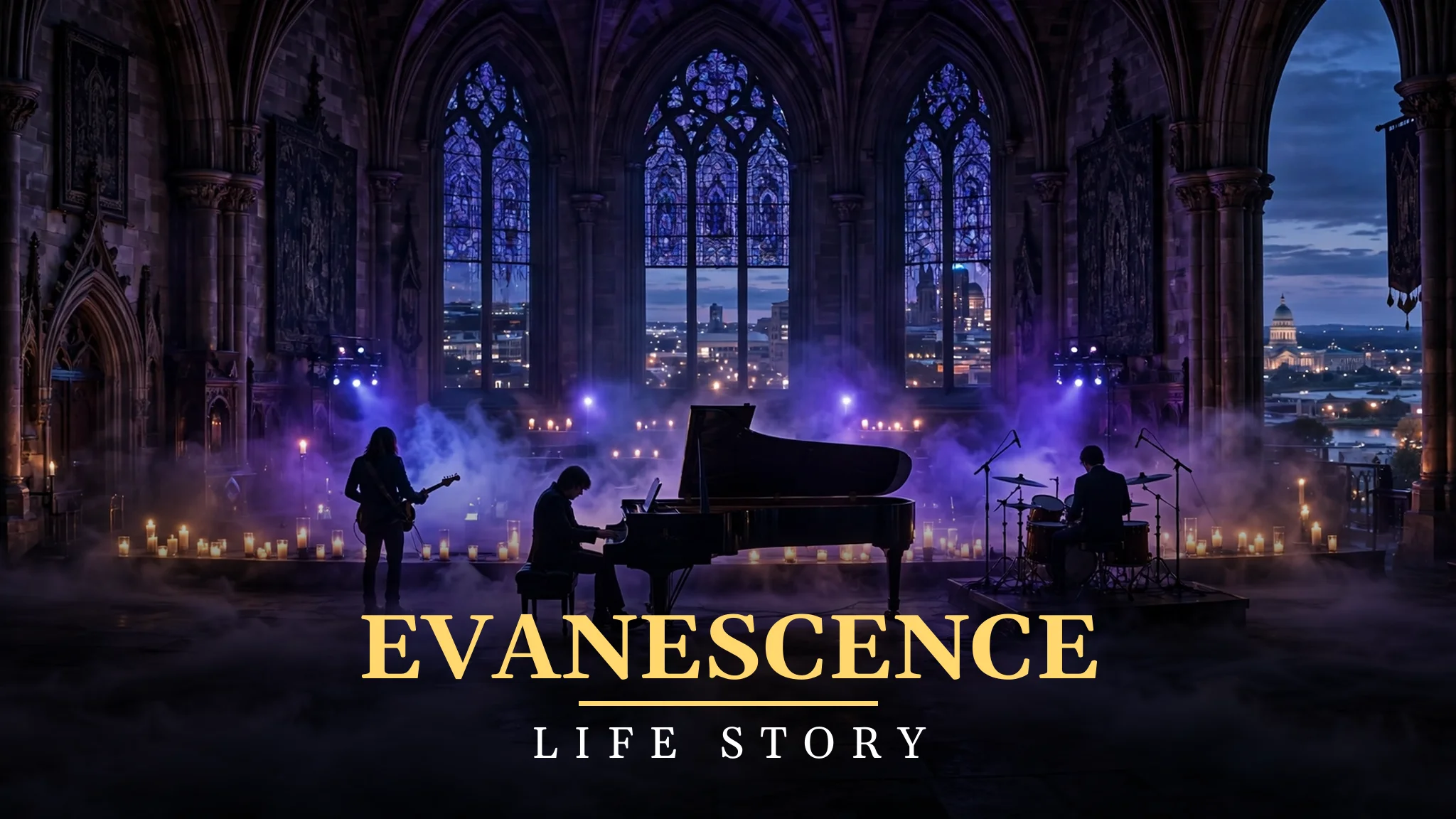
An Evanescence concert is a mix of power and beauty, because Amy Lee sits at a piano and sings softly, and then the band play loud, heavy guitars behind her. The stage is often dark, with candles, with purple light, and with a gothic feeling that fits the music. The crowd sing along to Bring Me to Life, they hold up lights during My Immortal, and they cheer when Lee hits the high notes that few singers can reach.
Amy Lee is the heart of the live show, because her voice is strong, clear, and full of feeling, and she also plays piano while she sings. She wears long dresses, often black, and she moves across the stage with a grace that makes the show feel like theatre. The band behind her play with power and precision, and the contrast between Lee’s beauty and the band’s heaviness is what makes the shows so exciting to watch.
The band have played at festivals all over the world, from Rock on the Range in America to Download in England, and they have headlined arenas and concert halls in many countries. During the Synthesis tour, they played with an orchestra in concert halls, which was very different from their earlier rock tours, and the shows were praised for their beauty. Lee’s love of classical music came to the front, and the old songs sounded new with strings behind them.
After many years, the band still play with the same power they had at the start, and their shows still draw huge crowds. Young fans who were not born when Fallen came out now go to see them, and they sing along to songs that are older than they are. That is the sign of a band whose music has lasted, and whose live shows are still worth seeing.
Amy Lee’s Other Work: Films, Charity, and New Music
Amy Lee is known not only for Evanescence, but for her work on film music, on charity, and on solo projects. She wrote songs for films, including the film War Story, and she worked on music for the television series. Her film work shows her love of classical music and of storytelling, and it is quieter and more delicate than the band’s rock songs. She has said that she loves to write music that tells a story, whether it is for a film or for a rock album.
Lee is also involved in charity work, and she has supported causes that help children, that fight epilepsy, and that support music education. She has spoken openly about her own life, about losing her younger sister when she was a child, and about how that loss shaped her music. Her honesty about grief has helped many fans who have lost someone they love, and it has made her music feel more personal and more real.
Lee has also worked with other musicians, singing on their records and writing songs with them, and she has released solo music that is softer and more personal than Evanescence’s work. She is a singer who loves to try new things, and who is not afraid to sing quietly, to play piano alone, or to work with an orchestra. That curiosity keeps her music fresh, even after thirty years.
All of this other work shows that Amy Lee is not only a rock singer, but a musician who loves many kinds of music. She loves classical music, film music, and rock, and she brings all of them to Evanescence. The band’s sound is richer because of her wide interests, and her fans love her not only for her voice, but for her honesty, her kindness, and her art.
My Take:
I think Evanescence are the band that taught me that sadness can be beautiful. When I hear My Immortal, I hear a piano, a voice, and a feeling of loss that is both quiet and deep. Amy Lee does not shout about sadness. She sings it softly, and the softness makes it stronger. I think that is a rare gift, and it is why the song still moves people more than twenty years after it was released.
I admire Amy Lee more than almost any other singer in rock, because she has carried a band through every change without losing herself. She began as a teenager in Arkansas, she became famous, she lost her co-founder, she went through many line-up changes, and she is still here, still singing, still writing. That takes great strength, and it takes a clear sense of who you are. I respect that more than any award.
Bring Me to Life is the song that first made me notice the band, and it still excites me. The mix of piano, heavy guitar, and Amy’s voice is powerful, and the song feels like waking up from a long sleep. I think the song works because it is about the wish to feel alive again, and that is a feeling many people know. When life feels numb, a song like this can remind you that feeling is still possible.
I am struck by how young Amy Lee was when she became famous. She was only twenty-one when Fallen was released, and she was suddenly a star. That is a hard age to become famous, and I think she handled it with great care. She did not lose herself in fame, she did not stop writing, and she kept her focus on the music. I think that is a sign of a strong person, and a sign of a real artist.
The departure of Ben Moody saddens me, because he was the co-founder, and the two teenagers had built the band together. I understand why he left, and I understand why Amy had to go on alone, but I still feel sad about the loss of that partnership. The band’s early songs were written by two people, and the later songs were written by one. Both are good, but the early partnership had a special feeling that could not be repeated.
I like the way Amy Lee mixes classical music with rock. She studied piano seriously, and that training shows in her songs. The piano is not an afterthought in Evanescence. It is the heart of the music, and it gives the band a depth that most rock bands do not have. I think that mix is a good lesson for young musicians. You do not have to choose between classical and rock. You can love both, and you can make something new from both.
Synthesis is the album I find most interesting, because it was a bold idea. Amy took old rock songs and reworked them with an orchestra, and she played in concert halls instead of rock clubs. That takes courage, because it could have failed. Instead, it showed a new side of the band, and it proved that the songs were strong enough to work in a completely different setting. I admire a band that is willing to take a risk like that.
I also think about the role of faith and loss in the band’s music. Amy Lee grew up in a religious family, and she has spoken about loss, including the death of her younger sister when Amy was a child. That loss is in the music, in the sadness, and in the search for meaning. I think the band’s songs are honest about grief, and that honesty helps listeners who have lost someone. A song that says, I miss you, and I am still here, is a powerful thing.
What I find less easy is the way the band went through so many line-up changes. It must have been hard for Amy to keep finding new musicians, and hard for fans to keep up with who was in the band. I understand that changes happen, but I wish the band had found a stable line-up sooner. The music is strong, but the constant changes made the story harder to follow, and I think the band lost some momentum because of it.
When I compare Evanescence with other bands led by women, I see a band that was both commercial and artistic. They sold millions of records, they won Grammy Awards, and they also made music that was dark, personal, and different. Many bands choose one or the other. Evanescence did both, and they did it without losing their identity. That is a rare achievement, and it deserves respect.
For a young reader, I would say the lesson is to trust your own voice, even when it is different. Amy Lee’s voice is not like other rock singers, and her piano is not like other rock instruments. She could have tried to sound like everyone else, but she did not. She trusted her own sound, and the world came to her. If you have a voice that is different, do not hide it. Use it, and let people hear it.
I also think the band teaches us about survival. They lost a co-founder, they took long breaks, they changed members many times, and they are still here. Survival in music is not about never falling. It is about getting up again, and again, and again. Amy Lee has done that, and the band is still playing, still recording, and still loved. That is a hopeful message for anyone who has been through a hard time.
I keep coming back to the idea that Evanescence’s music is for people who feel different. The songs are dark, they are emotional, and they do not pretend that life is always happy. For a listener who feels alone, a song like My Immortal can feel like a friend. I think that is the highest praise for a band. They did not only make hits. They made songs that helped people feel less alone.
In the end, I think Evanescence leave us with a simple truth. A voice, a piano, and a true word can be enough. Their songs are still beautiful, still dark, and still loved, and they will be for a long time. When I hear Amy Lee sing now, I hear all the years, all the changes, and all the strength it took to keep going. That is a story worth remembering, and a voice worth listening to.
I will keep listening to them, and I will keep thinking about the teenage girl in Little Rock who played piano and sang, and who became one of the great voices in rock. That is a rare and happy story, and I am glad it is still going on.
When I hear Bring Me to Life, I feel the same rush I felt the first time, because the song starts with a piano, then the guitars crash in, and Amy Lee’s voice rises above them. The words are about waking up, about feeling alive again after a long sleep, and the music matches that feeling. I think it is one of the great rock songs, because it is both heavy and beautiful, and because it is sung by a voice that sounds like no other in rock.
My Immortal is the song I would play for a friend who has lost someone they love, because it is a piano ballad about missing a person who is gone. Amy Lee sings it softly, with only a piano behind her, and the song is sad, beautiful, and honest about grief. I have heard it played at funerals and at moments of farewell, and it always does the same job: it tells people that their sadness is real, and that they are not alone.
I admire Amy Lee more than almost any other singer of her time, because she is both a rock singer and a classical musician. She plays piano, she sings with a voice that can be soft and powerful, and she writes songs that are both heavy and delicate. She led a band in a world that was mostly men, and she did it without changing who she was. She wore long dresses, she sang her own songs, and she became a star on her own terms.
The story of the band’s beginning moves me, because Amy Lee and Ben Moody met as teenagers at a youth camp, and they began writing songs together in a small town in Arkansas. They were not in New York or Los Angeles. They were in Little Rock, writing songs in a bedroom, and dreaming of something bigger. That is a hopeful story for any young musician in a small town. You do not need to be in a big city to make great music.
I think about Ben Moody leaving the band in 2003, and how hard that must have been for Amy Lee. He was her co-founder, her friend, and her songwriting partner, and he left during a tour in Europe. Lee became the sole leader of the band, and she kept going. That takes great strength, because it is hard to lead a band alone, especially when you are young and famous. I respect her for carrying on, and for making the band her own.
The song I would play for a teenager who has never heard the band is Going Under, because it is loud, fast, and full of the feeling of drowning in your own emotions. The words are about sinking, about struggling, and about wanting to breathe again. If a young listener likes that song, they will find the rest of the band’s music, and they will understand why so many people still love them.
I am struck by how the band’s music helped so many young people who felt different. Evanescence’s songs are about sadness, about loss, and about feeling like an outsider, and they say those things with beauty and with power. Many fans say the band’s music helped them through hard times, because it told them that their feelings were real, and that they were not alone. That is a legacy that matters more than any award.
If I could ask Amy Lee one question, I would ask how she writes a song like My Immortal, which is so simple and so sad that it feels like it has always existed. I wonder if the song came quickly, or if she worked on it for a long time. I think she would say that the best songs feel as if they arrive whole, and that the job of the writer is to listen and to write down what they hear.
I sometimes compare Evanescence with other rock bands of their time, and I think they were more beautiful and more theatrical than most. Many rock bands were loud and angry, but Evanescence were also gothic, classical, and poetic. They wore long dresses, they played piano, and they sang about mist, about loss, and about waking up. That beauty is rare in rock, and it is why their songs still feel special.
The concert I would most like to see is an Evanescence show with an orchestra, the way they played on the Synthesis tour, because the old songs sounded new with strings behind them. I can imagine Amy Lee at the piano, the orchestra playing softly, and the crowd listening in silence. A show like that, with a singer that good and music that beautiful, must have felt like a dream.
For a young reader, I would say the lesson is to be yourself, even if you are different. Amy Lee wore long black dresses, she sang like a classical singer, and she played piano in a rock band, and she became a star. You do not need to copy other people. You need to be honest about who you are, and to make art that is true. If you do that, the right people will find you.
In the end, I think Evanescence matter because they made rock music that was both heavy and beautiful. Their songs are about loss, about waking up, and about carrying on, and they are sung with a voice that is unlike any other. When I hear them now, I hear a band that began in a small town and became one of the great rock acts of their time. That is a story worth remembering, and a band worth listening to.
Frequently Asked Questions
How did Evanescence form in Little Rock?
Evanescence formed in Little Rock, Arkansas, in 1995, when Amy Lee met Ben Moody at a youth camp. Lee was playing piano and singing, and Moody asked her to work with him. They began writing songs together as teenagers, and they called themselves Evanescence, a word that means fading away like mist.
What made Fallen such a huge album in 2003?
Fallen, released in March 2003, included Bring Me to Life, My Immortal, Going Under, and Everybody’s Fool, and it sold more than seventeen million copies around the world. Bring Me to Life was used in the film Daredevil, and the album won two Grammy Awards, including Best New Artist.
Why did Ben Moody leave Evanescence?
Ben Moody, the co-founder and guitarist, left the band in October 2003 during a tour in Europe. The reasons were tension with Amy Lee and the pressure of fame. Amy Lee became the sole leader of the band, and she continued with new members. The band never recorded a new album with Moody after Fallen.
What is My Immortal about, and why do fans love it?
My Immortal is a piano ballad from Fallen about loss and missing someone who is gone. Amy Lee sings it softly, with piano as the main instrument, and the song has become one of the band’s most loved songs. Fans love it because it is honest about grief and it is played at moments of farewell.
What is Synthesis, and why is it different?
Synthesis, released in 2017, reworked Evanescence’s old songs with an orchestra and electronic sounds, and it included a new song, Imperfection. The band toured with an orchestra in concert halls, which was very different from their earlier rock tours. The album showed Amy Lee’s love of classical music.
Are Evanescence still making music today?
Yes, Evanescence released The Bitter Truth in 2021, their first album of new rock songs in ten years, and they continue to tour the world. Amy Lee remains the leader and singer of the band. Their songs from Fallen are still played on the radio and on streaming services.


