F1 2027 Season Preview: Teams, Drivers and What to Watch
In this post
- The New 2027 Rules: Smaller Cars, Bigger Electric Power
- Red Bull, McLaren, Ferrari and Mercedes: The Big Four
- Audi, Cadillac and the New Faces on the Grid
- The Calendar: Twenty-Four Races, Three Continents
- Sprint Races, Tyres and Strategy in 2027
- Drivers to Watch Beyond the Title Fight
- What Will Decide the Championship
- The Rookie Class and the Driver Market
- How the New Cars Should Change the Racing
- Money, Sponsors and the Business of F1
- What the first race will tell us
- My Take:
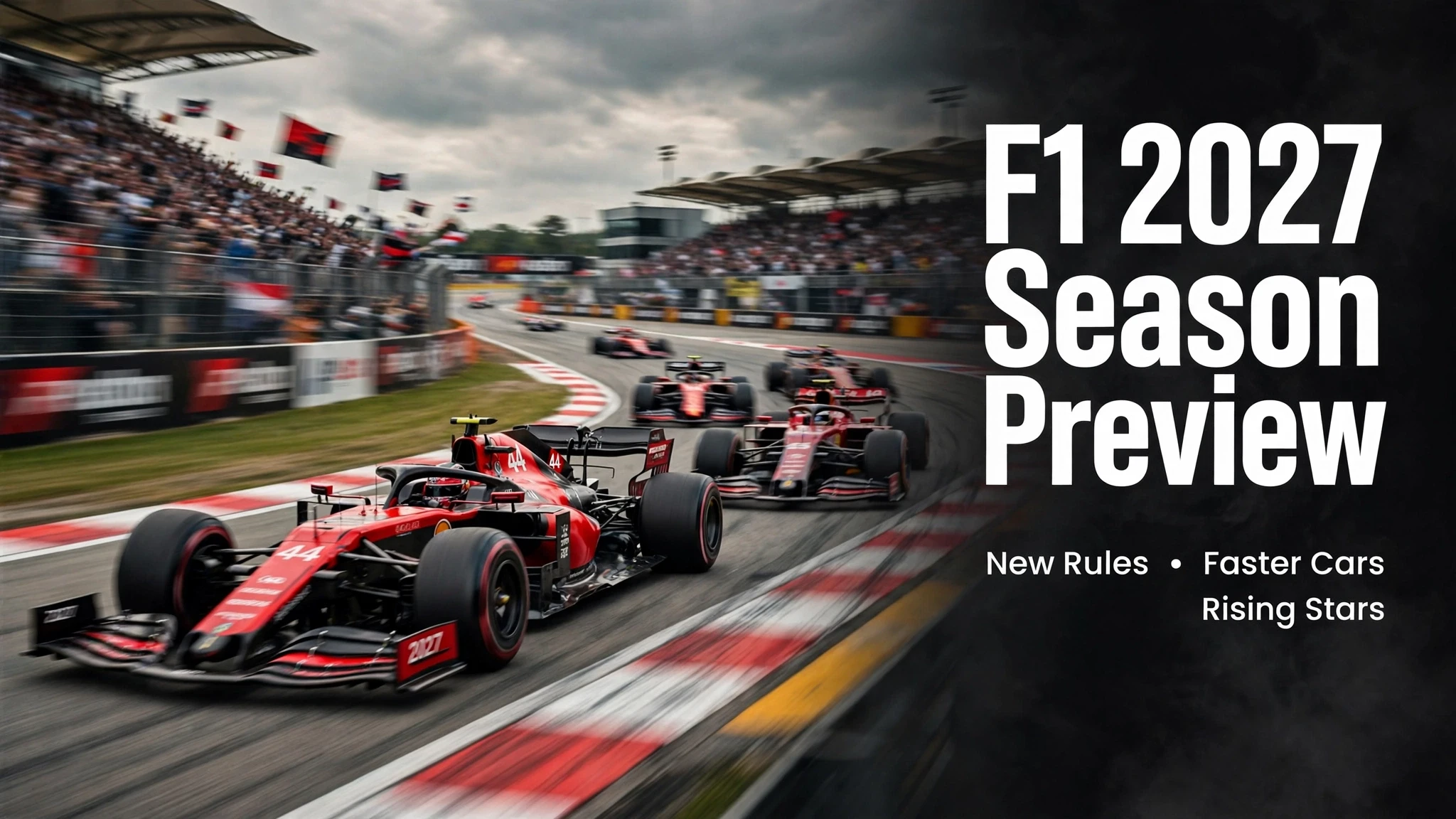
Formula 1 arrives in 2027 with the biggest rule change in a generation, and that single fact makes this season harder to predict than any in recent memory. The cars are smaller and lighter, the engines use a new split between combustion power and electric power, active aerodynamics move the wings on straights and in corners, and the fuel is fully sustainable. Teams that dominated under the old rules have no guarantee that their advantage survives, because a new rulebook rewards different ideas, and history shows that the teams who read a new rulebook fastest usually win the first year. Red Bull, McLaren, Ferrari and Mercedes all arrive with questions to answer, while Audi, which enters as a full works team, and the new Cadillac entry add fresh names to the grid. The calendar is expected to run to twenty-four races, from the traditional opener in Australia through the night race in Singapore, the street circuits in Monaco and Las Vegas, and the finale in Abu Dhabi. This preview explains the new cars, the teams and drivers to watch, the circuits that will decide the championship, and the storylines that will matter long after the first lights go out.
The New 2027 Rules: Smaller Cars, Bigger Electric Power
The 2027 regulations cut the size and weight of the cars, with a narrower chassis, a shorter wheelbase and a minimum weight around thirty kilograms lower than the previous generation, which should make the cars more nimble on street circuits and easier to follow in corners. The power unit keeps a 1.6-litre turbocharged V6, but the electric part grows to roughly half of the total power, with the MGU-K delivering around 350 kilowatts, and the complicated MGU-H, which recovered energy from the turbo, is removed. That change simplifies the engine and makes it cheaper to build, which is one reason new manufacturers were willing to join, but it also changes how drivers manage energy, because the battery now matters far more on every lap. Drivers will have a boost button, often called manual override, which gives extra electric power on straights, and the cars will use active aerodynamics, with front and rear wings that open on straights to reduce drag and close in corners to restore grip.
Red Bull, McLaren, Ferrari and Mercedes: The Big Four
McLaren arrives as the team to beat after winning the constructors’ championship in 2024 and 2025 with Lando Norris and Oscar Piastri, and their strength is the depth of their operation: a wind tunnel that works, a car that is kind to its tyres, and two drivers who push each other without breaking the team. Norris, who won his first drivers’ title in 2025, is now the reference point for the grid, while Piastri, who has won multiple races and beaten his team-mate on his day, will expect equal treatment and a real chance at the title. Red Bull, after years of dominance with Max Verstappen, face a new question: their star driver remains the fastest man on the grid on his day, but the team lost key technical staff, and their second seat has been a revolving door, so the constructors’ fight depends on whether the new car suits Verstappen and whether his team-mate can score regularly.
Audi, Cadillac and the New Faces on the Grid
Audi’s arrival as a full works team, taking over the Sauber operation, is the biggest new story of 2027, because a major car manufacturer entering Formula 1 with its own engine changes the balance of power. Audi have hired experienced staff, built a new power unit in Germany, and signed a driver line-up built around experience, but history warns that new manufacturers usually need two or three years to win, and the first season is often about learning rather than winning. Cadillac, backed by General Motors, joins as the eleventh team, which expands the grid to twenty-two cars, and they will use Ferrari engines at first while they build their own power unit for later seasons. Their entry adds two more seats for drivers, which matters for young talent, and it adds an American team to a sport that has grown rapidly in the United States, with three races in Miami, Austin and Las Vegas.
The Calendar: Twenty-Four Races, Three Continents
The 2027 calendar is expected to keep the familiar shape of recent seasons, with twenty-four races across five continents, starting in Australia in March and ending in Abu Dhabi in December. The early season runs through Asia and the Middle East, with Japan’s Suzuka, a favourite of drivers for its fast, flowing corners, and the night races in Bahrain and Saudi Arabia, where the Jeddah street circuit is the fastest street track on the calendar. Europe brings the classics: Monaco, where overtaking is almost impossible and qualifying decides the race; Silverstone, the home of British motorsport; Spa in Belgium, with the famous Eau Rouge corner; and Monza, the fastest circuit, where cars reach more than three hundred and fifty kilometres per hour on the straights. The flyaway races in Singapore, Austin, Mexico, Brazil and Las Vegas close the season, and the championship is often decided in that stretch, when the pressure is highest and the smallest mistake can cost a title.
Sprint Races, Tyres and Strategy in 2027
Sprint weekends, where a short race on Saturday sets part of the weekend’s story, are expected to continue in 2027, with six sprint events on the calendar, and they matter because they give extra points and extra chances for a surprise. A sprint is about one hundred kilometres, roughly a third of a normal race, with no mandatory pit stop, so the start and the first lap decide most of the result, and a driver who qualifies well can bank points before the main race even begins. Tyres remain the hidden story of every race: Pirelli supplies three compounds per weekend, soft, medium and hard, and the choice of when to stop, how many stops to make, and which compound to use can win or lose a race. The new lighter cars should be kinder to tyres, but the active aerodynamics and the extra electric power change how the tyres are loaded, so the teams that understand the new tyres fastest will have an advantage. Strategy is also shaped by the safety car, which can wipe out a lead in seconds, and by the weather, which at Spa, Silverstone and Interlagos can change in minutes.
Drivers to Watch Beyond the Title Fight
Beyond the title contenders, several drivers will shape the season in quieter ways. Charles Leclerc at Ferrari remains one of the fastest qualifiers on the grid, and if Ferrari give him a car that is kind to its tyres, he can win races even when he is not the championship favourite. Lewis Hamilton, who moved to Ferrari in 2025 and chased a record eighth title, brings experience that no other driver can match, and his battle with his younger team-mate is one of the most interesting dynamics in the sport. George Russell at Mercedes has grown into a team leader, and his qualifying speed and racecraft make him a threat at circuits that reward precision. Among the younger drivers, Andrea Kimi Antonelli at Mercedes and Oliver Bearman at Haas represent the next generation, and their progress will be watched closely, because Formula 1 is always looking for its next star. The midfield, with Alpine, Williams, Racing Bulls and Haas, will fight for the smaller points, and a single podium for one of those teams can define their season.
What Will Decide the Championship
The 2027 championship will be decided by three things: who understands the new rules fastest, who develops their car fastest through the season, and who makes the fewest mistakes when the pressure is highest. In a year of new rules, the first races often produce surprises, because one team has found a clever interpretation of the regulations that others have missed, and the advantage can be worth half a second per lap, which is a lifetime in Formula 1. Development matters because the rules allow teams to upgrade their cars through the season, and the team with the best wind tunnel and the best correlation between the tunnel and the track will pull ahead by the summer. Reliability matters too, because the new power units are unproven, and a retirement in a race you were leading can cost twenty-five points that no amount of speed can recover. Finally, the drivers matter: the champion will be the one who scores on bad days, who qualifies well when the car is not perfect, and who keeps their nerve in the final races, when the title is on the line and every point counts.
The Rookie Class and the Driver Market
The 2027 driver market is shaped by the new rules, because teams want drivers who can adapt quickly, give clear feedback, and help develop a new car, and that favours experienced drivers as well as young talent. Andrea Kimi Antonelli, who joined Mercedes as a teenager, is the most watched young driver on the grid, because Mercedes chose him to replace Lewis Hamilton, and his speed in qualifying has already shown why they trusted him. Oliver Bearman, who scored points on his debut for Ferrari as a substitute, now races for Haas, where he has the chance to lead a team and prove he deserves a top seat. Isack Hadjar, Gabriel Bortoleto and other rookies from recent seasons are fighting to keep their places, because Formula 1 has only twenty-two seats and the competition for them is fierce. A rookie who performs well in 2027, when everyone is learning a new car, can earn a long career, while a driver who struggles may lose their seat by the summer break.
How the New Cars Should Change the Racing
The 2027 cars are smaller, narrower and lighter than the cars they replace, and that change alone should make the racing closer, because a smaller car loses less grip when it follows another car through a corner. The old cars were wide and heavy, and they struggled in dirty air, which is the disturbed air behind a leading car, so overtaking was difficult on many circuits and drivers often had to wait for a pit stop or a mistake. The new cars use active aerodynamics, with wings that open on the straights to cut drag and close in the corners to restore grip, and the manual override boost gives the chasing driver extra electric power when they are close enough to attack.
The proof will come in the first races, at Bahrain and Saudi Arabia, where overtaking is possible, and at Monaco, where it is almost impossible whatever the rules say. If the new cars race well, the season will be remembered as a turning point, and the teams that understand the new aerodynamics fastest will have an advantage that no amount of money can buy. If they do not race well, the rules will be changed again, because Formula 1 has never been afraid to change its mind, and the sport has always been willing to admit when an idea has not worked.
Money, Sponsors and the Business of F1
Formula 1 is also a business, and the 2027 season arrives with the sport more valuable than ever, with new sponsors, new races, and a growing audience in the United States and Asia. The cost cap, which limits how much teams can spend on developing their cars, is designed to close the gap between the richest teams and the smallest, and it has worked to some extent, because teams such as McLaren and Aston Martin have been able to compete with Ferrari and Mercedes. The new engine rules, which are simpler and cheaper, attracted Audi and Cadillac, and their arrival proves that the sport is healthy. The calendar, with twenty-four races, is the longest in history, and it puts pressure on the teams, who travel for most of the year, and on the drivers, who must stay fit and focused for ten months. The business of Formula 1 matters to fans, because a healthy sport produces better racing, and 2027 looks like a healthy year.
What the first race will tell us
The first race in Australia will tell us more than any test, because testing is secretive, teams hide their true speed, and no one knows who is fastest until the cars race for real. In testing, teams run different fuel loads, different tyres, and different programmes, so the times are misleading, and the only reliable guide is the race itself. At Albert Park, a street circuit in Melbourne, the cars will qualify, race, and reveal their strengths and weaknesses, and the team that wins the first race will not necessarily win the championship, but they will have the confidence that comes from leading. The first race will also show which drivers have adapted to the new cars, which teams have reliability problems, and which clever ideas, a new wing, a new suspension, or a new way of using the electric power, actually work. I will be watching the first qualifying session more than the race, because qualifying, with every car on low fuel and soft tyres, is the purest test of speed, and it will tell us who has done the best job over the winter.
My Take:
I think 2027 is the most exciting season Formula 1 has offered in years, and I say that because new rules are the only thing that can truly reset a sport. When the rules stay the same, the richest team with the best wind tunnel wins, and the rest of the grid fights for the leftovers. When the rules change, a clever engineer in a smaller team can find an idea that no one else has seen, and that idea can win races. I have watched seasons where the championship was decided by March, and they were boring, however fast the cars were. A season where no one knows who is fastest until the first race is a gift, and 2027 looks like that season, because the cars are new, the engines are new, and the teams are guessing as much as they are knowing. I would rather watch a season of guesses than a season of certainties, and I think most fans feel the same.
My strongest feeling is about Max Verstappen, because he is the driver I would least want to bet against, even in a year of new rules. He has won four world titles, he has beaten team-mates who were supposed to challenge him, and he has a habit of winning races in cars that are not the fastest, which is the mark of a great driver. People talk about his aggression, and it is real, but they talk less about his tyre management, his ability to read a race, and his calm under pressure, which are the things that win championships. I think the new rules will suit him, because a smaller, lighter car with more electric power will reward a driver who can adapt quickly, and Verstappen adapts faster than anyone. If Red Bull give him a car that is within a tenth of the best, he will win the title, and I would not be surprised if he wins it in a car that is not the best, because that is what great drivers do.
I also believe McLaren are the team to beat, and I believe that for a reason that has nothing to do with speed. They have two drivers who are both fast enough to win, they have a team that works together, and they have a car that is kind to its tyres, which matters more than most people realise. Tyre management is the hidden skill of modern Formula 1, because a driver who can keep his tyres alive for ten laps longer than his rival can win a race without being faster. Norris and Piastri both understand that, and their team understands it too, which is why they won the constructors’ title twice. The danger for McLaren is that two fast drivers can become a problem, because they will fight each other, and a fight between team-mates can cost a championship. I think McLaren can manage it, because they have done it before, but it will be the hardest part of their season, harder than building a fast car.
Another thing I care about is Audi, because a new manufacturer entering Formula 1 is a test of whether the sport is healthy. Audi would not have joined if the rules were too expensive or too complicated, and their arrival proves that the new engine rules worked as intended. I do not expect Audi to win in 2027, because new teams rarely do, but I expect them to learn, to hire well, and to be competitive by 2028 or 2029, and that is how a healthy sport should work. I also think Cadillac’s entry matters, because an American team with American backing will bring new fans, new sponsors, and new attention, and Formula 1 needs that if it wants to grow in the United States. The sport is at its best when new teams join, new drivers arrive, and new ideas are tested, and 2027 has all three, which is why I am more hopeful about this season than I have been in years.
Finally, I think the fans are the real winners in 2027, because a season of new rules is a season of surprises, and surprises are what make sport worth watching. I remember the 2009 season, when Brawn, a team that had almost closed, won the title with a clever diffuser, and it was the most exciting season I had ever seen, because no one saw it coming. I hope 2027 gives us something like that, a team or a driver that no one expected, winning races and changing the story. I also hope the racing is close, because close racing is what brings new fans, and new fans are what keep the sport alive. I will be watching the first race in Australia with the same excitement I felt as a child, waiting for the lights to go out, and I think that feeling, of not knowing what will happen, is the best feeling in sport.
I also think the cost cap is the best thing that has happened to Formula 1 in years, because it stops the richest team from simply buying the championship. Before the cap, a team with unlimited money could outspend everyone else, hire the best engineers, build the best wind tunnel, and win for a decade, and that made the sport predictable. With the cap, a clever team with a good idea can beat a rich team with a bad idea, and that is how sport should work. I know the cap is not perfect, and teams find ways around it, but it has closed the gap, and the proof is that McLaren, a team that was struggling a few years ago, won the constructors’ title twice. I hope the cap stays, and I hope it is enforced fairly, because a fair sport is a better sport, and a better sport is one where the winner is the team that did the best job, not the team that spent the most money.
There is one more thing I care about, and it is the way Formula 1 treats its fans, because the sport has become more expensive to watch, with races behind paywalls, tickets that cost hundreds of dollars, and merchandise that is priced for the wealthy. I understand that the sport needs money, and I understand that the teams need sponsors, but I worry that the fans who made the sport popular, the ones who watched on free television, who saved for a ticket, and who loved the sport when it was not fashionable, are being priced out. I hope the sport remembers them, because without fans, there is no Formula 1, and a sport that forgets its fans will one day find that it has no one left to watch. I will be watching in 2027, as I always have, and I hope the racing is worth the price, because the fans deserve a great season.
Frequently Asked Questions
When does the F1 2027 season start?
The season is expected to begin in March 2027, with the Australian Grand Prix in Melbourne traditionally opening the calendar, and to run to twenty-four races ending in Abu Dhabi in December.
What are the big rule changes for F1 2027?
The cars become smaller, narrower and lighter, the electric part of the power unit grows to about half the total power, the MGU-H is removed, and active aerodynamics allow the wings to open on straights and close in corners.
Who is favourite to win the F1 2027 title?
McLaren arrive as the team to beat after back-to-back constructors’ titles, with Lando Norris the defending drivers’ champion, but Max Verstappen at Red Bull remains the driver most rivals fear, and the new rules make predictions uncertain.
Which new teams join F1 in 2027?
Audi joins as a full works team, taking over Sauber, and Cadillac joins as the eleventh team on the grid, expanding the field to twenty-two cars.
How many races are in the F1 2027 calendar?
The calendar is expected to feature twenty-four races, including sprint weekends, classic circuits such as Monaco, Silverstone and Spa, and night races in Singapore and Las Vegas.
What is the manual override boost in F1 2027?
Manual override is a driver-controlled boost that gives extra electric power on straights, replacing the old DRS system and giving drivers a new tool for overtaking.