F4: The Life Story Behind Taiwan's Famous Boys
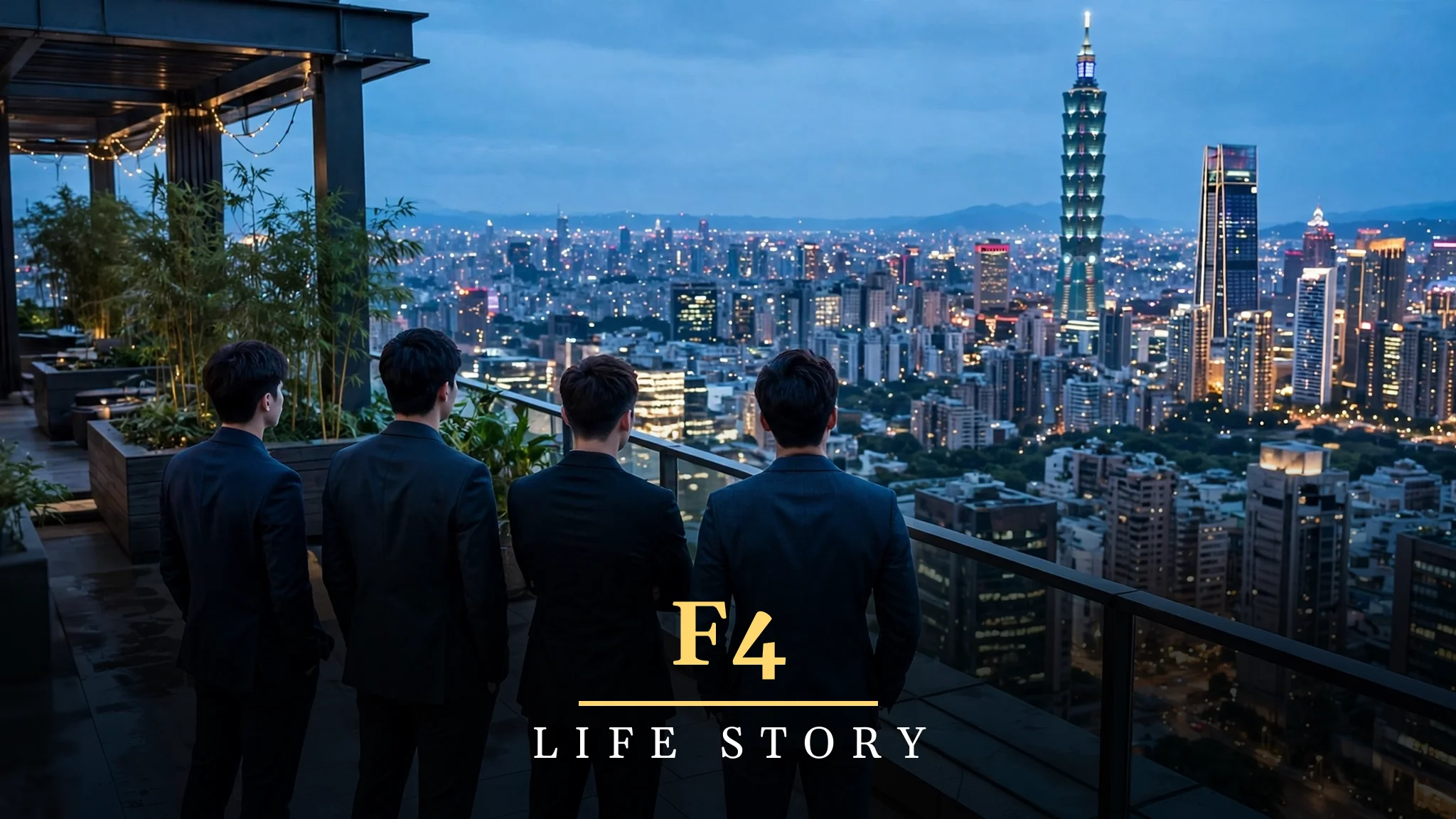
In this post
- Meteor Garden and Four Strangers
- Meteor Rain and Becoming a Real Band
- Fame Across Asia and the Pressure It Brought
- Solo Careers and Growing Apart
- Reunions, Legacy, and the Boys Who Never Left
- A Drama That Changed Taiwanese Television
- The Boys Who Became Men in Public
- Meteor Rain: A Song That Outlived the Group
- The Music That Travelled With the Drama
- My Take:
F4 is a name that can make a whole generation smile. For people who grew up in Asia in the early 2000s, those two letters mean a television drama, four handsome young men, and a time when a song could be heard on every street. F4 was not a band that formed in a rehearsal room. It was a band that was born on television, in a drama called Meteor Garden, and it became one of the biggest boy bands in Asia almost overnight.
The four members are Jerry Yan, Vic Chou, Vanness Wu, and Ken Chu. In Meteor Garden they played four rich, handsome schoolboys who were known as F4, short for Flower Four. The drama was a huge hit, and the four actors became stars. A record company saw the chance to turn them into a real band, and they released music together, toured Asia, and filled stadiums. It was a fairy tale, and like many fairy tales, it did not last forever in its first form. But the name F4 has never gone away.
Their story is about how television can create a star, how four strangers can become a group, and how fame that comes very fast can be both a gift and a burden. It is also a story about friendship, about growing up in public, and about a reunion that fans waited years to see. This is the story of Taiwan’s most famous boys.
Meteor Garden and Four Strangers
F4 began with a television drama. Meteor Garden, which aired in Taiwan in 2001, was based on a Japanese manga called Boys Over Flowers. The story was about a poor, brave girl named Shan Cai, played by Barbie Hsu, who goes to an elite school and stands up to four rich, handsome boys known as F4. The four boys were Dao Ming Si, played by Jerry Yan, Hua Ze Lei, played by Vic Chou, Mei Zuo, played by Vanness Wu, and Xi Men, played by Ken Chu. The drama was a sensation.
Before Meteor Garden, none of the four men was a major star. Jerry Yan was a model, Vic Chou was a young actor with little experience, Vanness Wu was a singer and dancer, and Ken Chu was also new to acting. They were cast because they looked right for the parts, and because they had a presence on screen that the producers liked. They were not chosen as a band. They were chosen as actors, and they had to learn to act together, to trust each other, and to make the story believable.
The drama’s success was enormous. It was watched by millions of people in Taiwan, and then it spread to China, Hong Kong, Southeast Asia, and other parts of Asia. Young people copied the hairstyles, the clothes, and the attitudes of the four boys. The song Meteor Rain, which the group later released, became an anthem, and the four actors became household names. For Jerry, Vic, Vanness, and Ken, life changed in a matter of weeks. They went from being unknown young men to being stars who could not walk down a street without being recognised.
The success also brought pressure. The four men had to learn to live with fame, with fans, with the press, and with each other. They were not friends before the drama. They were colleagues, and they had to become a group quickly, under the eyes of the whole of Asia. That is a hard thing to do, and it is one of the reasons their story is so interesting. They were not a band that grew up together. They were four strangers who were thrown together by a television show, and they had to find a way to work as a team.
Meteor Rain and Becoming a Real Band
After the success of Meteor Garden, the four actors were turned into a real music group called F4. Their first album, Meteor Rain, was released in 2001, and it was a huge success. The title song, Meteor Rain, was a soft, romantic ballad that became one of the most famous Mandarin songs of its time. It was played at weddings, on the radio, and in karaoke bars across Asia, and it is still one of the songs most associated with the group.
The album showed that the four men could sing as well as act, even though none of them had started as a singer in a band. Jerry Yan’s voice was warm and emotional, Vic Chou’s voice was soft and gentle, Vanness Wu brought energy and dance, and Ken Chu added a steady, calm presence. Together, they made a sound that was romantic and youthful, and it fitted the image fans had of them from the drama. They were not a rock band. They were a pop group, and their music was made for young people in love.
F4 toured Asia in the years that followed, performing in Taiwan, China, Hong Kong, Singapore, Malaysia, and other countries. Their concerts were huge events, with thousands of fans, mostly young women, screaming, waving lights, and singing along. The four members learned to perform live, to dance, and to talk to a crowd, and they did it with the same charm they had shown on television. A F4 concert was a celebration of youth, romance, and the dream of a perfect love, and fans loved it.
The group also released more albums, including Fantasy 4ever in 2002 and Waiting for You in 2007, and they continued to act in dramas and films. Each member also began to build a solo career, with Jerry Yan and Vic Chou becoming leading actors, Vanness Wu working in music and television, and Ken Chu acting and singing. That solo work was natural, because each man had his own talents and his own dreams, but it also meant that the group spent less time together as the years passed.
By the mid-2000s, F4 was still famous, but the four members were growing up, and they were moving in different directions. The group did not break up in a fight. They simply began to work more on their own, and less as a group. That slow change is common for a band that was formed by a television show rather than by friendship, and it is a part of the F4 story that fans have learned to accept.
Fame Across Asia and the Pressure It Brought
The fame that F4 enjoyed in the early 2000s was on a scale that few Taiwanese stars had ever known. They were not only famous in Taiwan. They were famous in China, where their dramas and songs were watched by hundreds of millions of people, and they were famous in Southeast Asia, where young people copied their style. They were invited to perform in many countries, they appeared on magazine covers, and they were treated like royalty wherever they went. For four young men who had been unknown only a short time before, it was an overwhelming experience.
That fame brought money, attention, and opportunity, but it also brought pressure. The four members were watched constantly, their love lives were discussed in the press, and every move they made was reported. They had little privacy, and they had to learn to live with that. Jerry Yan, in particular, was known for being shy and private, and the sudden fame was hard for him. Vic Chou was also quiet, and he found the attention difficult. Vanness Wu was more outgoing, but even he felt the weight of being a star. Ken Chu was the calmest of the four, but he too had to adjust to a life in the public eye.
The group also faced the challenge of living up to their image. In Meteor Garden, they played rich, perfect, handsome boys, and fans expected them to be like that in real life. In real life they were ordinary young men, with worries, with bad days, and with their own personalities. The gap between the image and the reality was hard to live with, and it is one of the reasons the group found fame both exciting and exhausting. They were loved for characters they had played, and they had to find a way to be themselves while still giving fans what they wanted.
Despite the pressure, the four members stayed professional, and they continued to work together when they could. They performed at special events, they appeared together in public, and they spoke about each other with respect. They did not fight in public, and they did not blame each other for the pressures of fame. That professionalism is a credit to them, and it is one of the reasons fans still respect them today.
The Asian fame of F4 also helped Taiwanese entertainment reach a wider audience. Before F4, Taiwanese dramas were popular in Taiwan, but they were not as well known in other parts of Asia. After Meteor Garden, Taiwanese dramas became a major export, and other Taiwanese stars benefited from the doors that F4 had opened. In that sense, F4 did more than make themselves famous. They helped put Taiwan on the map for a whole generation of viewers.
Solo Careers and Growing Apart
As the 2000s went on, each member of F4 built a solo career that was successful in its own right. Jerry Yan became one of Taiwan’s most popular actors, starring in dramas that were watched across Asia. Vic Chou also became a leading actor, known for his serious, thoughtful performances in dramas like Mars and Black and White. Vanness Wu worked in music, television, and film, in Taiwan, China, and the United States, and he became known for his dancing and his international outlook. Ken Chu acted in dramas and released solo music, and he built a quieter, steadier career.
Those solo careers were a sign of success, but they also meant that the group spent less time together. A solo actor who is filming a drama for months cannot also be on tour with a band, and a singer who is recording an album cannot also be rehearsing with three other men. The four members drifted apart naturally, not because they disliked each other, but because their lives took them in different directions. Fans noticed, and they missed seeing the four of them together, but they also supported each member’s solo work.
The group did reunite from time to time, for special concerts and events, and those reunions were always joyful. When the four men appeared on stage together, the crowd would cheer louder than for any solo performance, because they were seeing a piece of their youth again. The reunions reminded everyone of what F4 had meant, and they showed that the four men still respected each other and still enjoyed performing together, even if they did not do it often.
In 2013, the group performed together at a major event in China, and the performance was watched by millions of people. It was a reminder that F4 had not been forgotten, and that their songs still meant a lot to fans who had grown up with them. The four men were older now, in their thirties, and they looked different, but when they sang Meteor Rain together, the audience sang along as if no time had passed. That is the power of a song that belongs to a generation.
The solo years also gave each member a chance to grow as a person. They were no longer only the boys from Meteor Garden. They were men with their own careers, their own families, and their own lives. Jerry Yan learned to handle fame with more calm, Vic Chou became a respected actor, Vanness Wu became a father and a businessman, and Ken Chu built a life that was quieter but no less full. That growth is a natural part of life, and it is a part of the F4 story that fans have watched with pride.
Reunions, Legacy, and the Boys Who Never Left
F4 has never officially broken up, and that is an important part of their story. They have not released a new album together for many years, and they do not perform together regularly, but they have never said that the group is over. They have always left the door open for a reunion, and fans have always hoped for one. That hope is a testament to how much the group meant to people, and how much it still means.
In recent years, there have been talks of reunions, and the four members have appeared together at events, including a notable reunion that delighted fans across Asia. Each time they appear together, the reaction is the same: joy, nostalgia, and a flood of memories. Fans who were teenagers in 2001 are now adults, with jobs and families, and seeing F4 together again takes them back to a simpler time. That nostalgia is powerful, and it is one of the reasons the group will never be forgotten.
The legacy of F4 is clear. They were one of the first Taiwanese boy bands to become famous across all of Asia, they helped make Taiwanese dramas popular around the world, and they showed that a television show could create a music group. They also showed that four young men, thrown together by chance, could become a group that people loved for decades. Their songs, especially Meteor Rain, are still played today, and their dramas are still watched by new viewers who discover them for the first time.
Today, the four members are in their forties, and they live very different lives. Jerry Yan is still acting, Vic Chou is still a respected actor, Vanness Wu is working in music and business, and Ken Chu is living a quieter life. They are no longer the boys of Meteor Garden, but they are still F4 in the hearts of their fans. That is a legacy that few groups achieve, and it is one that will last for many years to come.
A Drama That Changed Taiwanese Television
Meteor Garden did more than make four young men famous. It changed Taiwanese television, and that change is worth understanding. Before Meteor Garden, Taiwanese dramas were popular in Taiwan, but they were not as well known in other parts of Asia. After Meteor Garden, Taiwanese dramas became a major export, watched by millions of people in China, Hong Kong, Southeast Asia, and beyond. The drama showed that a Taiwanese story, told with Taiwanese actors, could reach a whole continent, and that opened doors for many other Taiwanese stars and dramas that came after it.
The drama worked because its story was simple and universal. A poor girl stands up to four rich boys, she refuses to be bullied, and she falls in love with one of them. That story is easy to understand in any country, because every country has rich and poor people, and every young person has felt like an outsider at some point. The drama did not need a complicated plot. It needed honest feelings, and it had them. Audiences in different countries, with different languages and different cultures, all understood Shan Cai’s courage, and they all wanted her to succeed.
Meteor Garden also changed the way boy bands were made. Before F4, most boy bands were formed by record companies, with members chosen for their singing and dancing. F4 was formed by a television drama, with members chosen for their acting and their looks, and then turned into a band. That was a new idea, and it worked, because the audience already loved the characters, and they wanted to hear the actors sing as well as act. Other companies copied the idea, and television dramas became a new way to launch music groups across Asia.
The drama’s success also showed the power of a good adaptation. Meteor Garden was based on a Japanese manga, Boys Over Flowers, and it took a Japanese story and made it Taiwanese, with Taiwanese actors, Taiwanese settings, and Taiwanese humour. That adaptation worked because the core story was universal, and the Taiwanese version made it feel fresh. It is a reminder that a good story can travel across borders, if it is told with honesty and with local flavour. F4 was the result of that travelling story, and their fame is a testament to its power.
In the end, Meteor Garden is not only a drama. It is a turning point in Asian television, a moment when Taiwanese entertainment reached a new audience, and when four young men became stars. F4 was born from that moment, and their story cannot be understood without it. The drama gave them fame, it gave them a group, and it gave them a legacy that has lasted for more than twenty years.
The Boys Who Became Men in Public
The four members of F4 grew up in public, and that is a hard way to grow up. They were in their early twenties when Meteor Garden made them famous, and they had to become men while millions of people were watching. They made mistakes, they learned, and they changed, all in front of an audience. Jerry Yan learned to handle his shyness, Vic Chou learned to become a serious actor, Vanness Wu learned to work internationally, and Ken Chu learned to build a quieter life. Each of them grew in a different way, but they all grew, and that growth is a big part of their story.
Growing up in public also means that fans watch you change, and they feel like they are growing up with you. A fan who was a teenager in 2001 is now an adult, and they have watched F4 become adults too. That shared growth creates a bond that is hard to break, because it is tied to a shared life. When F4 reunites, fans do not only see four men singing an old song. They see their own youth, their own growth, and their own lives reflected back at them. That is why reunions are so emotional, and why they matter so much to fans who have followed the group for more than twenty years.
Meteor Rain: A Song That Outlived the Group
Meteor Rain is a song that has outlived the group that made it, and that is a rare thing for a boy band song. It was released in 2001, and it is still played today, at weddings, in karaoke bars, and at F4 reunions. It is a soft, romantic ballad, and it captures the feeling of young love in a way that is simple and honest. When fans hear it, they do not only hear a song. They hear their own youth, their own first love, and their own teenage years. That memory is powerful, and it is why the song has lasted for more than twenty years, even though the group has not released a new album together for many years.
The song also shows what F4 did best: they sang about romance in a way that felt sincere, not fake. Jerry Yan’s voice was warm and emotional, Vic Chou’s voice was soft and gentle, and together they made a sound that was romantic and youthful. A lot of boy band songs fade quickly, because they are tied to a moment in time. Meteor Rain has not faded, because it is tied to a feeling that everyone understands, the feeling of falling in love for the first time. That feeling does not go out of fashion, and neither does the song.
The Music That Travelled With the Drama
Meteor Garden made F4 famous as actors, but the music made them famous as singers too. Their first album, Meteor Rain, came out in 2001, and its title song became one of the best known Mandarin songs of that time. The song was gentle and sad, and it fitted the drama perfectly. When people heard it, they thought of Dao Ming Si and Shan Cai, of rain, of first love, and of a story that had made them cry. The album sold well across Asia, and the group began to perform live in places where the drama had been a hit, including Hong Kong, Singapore, Malaysia, and the Philippines. For four young men who had never planned to sing together, the speed of it all must have been frightening.
The songs worked because they were simple and honest. They were not trying to be clever. They were about missing someone, about waiting, about loving someone who does not love you back, and about hoping for a second chance. Those feelings are the same in every country, and that is why the music crossed borders so easily. Fans who did not speak Mandarin learned the words anyway, and they sang along at concerts with tears in their eyes. The group did not release many albums, and their time as a working band was short, but the songs did not disappear. They stayed on the radio, they stayed at karaoke, and they stayed in the memories of the people who had been young in 2001.
Live shows were a different challenge from the drama. On television the four men had scripts, directors, and many takes. On stage they had only their voices, their dancing, and the crowd. Some of their early concerts were rough, and critics said so openly. Yet the crowds did not seem to mind. They came to see the four boys from Meteor Garden in person, and to hear the songs they loved. Over time the performances improved, and the group learned to work as a unit. The music may not have been the strongest part of F4, but it was the part that let fans carry the drama with them after the last episode ended.
My Take:
I think F4 is a group that tells us a lot about how fame works, and how fast it can come. One day, four young men were unknown actors. The next day, after a television drama, they were stars across Asia. That kind of fame is exciting, but it is also frightening, because it comes before you are ready for it. They had not spent years building a career slowly. They had been given fame in a few weeks, and they had to learn to live with it while everyone was watching. I think they handled it better than most people would have, and I respect them for that.
What I find most interesting about F4 is that they were not a real band in the usual sense. They were actors who became a band because a television show made them famous. That is a strange way to form a group, and it explains a lot about why they later drifted apart. A band that forms because four friends love music together has a strong bond. A band that forms because four actors played brothers on television has a different kind of bond, one that is real but also a little fragile. They were colleagues first, and friends second, and that order matters. It does not mean their friendship was false. It means it had to be built after the fame, not before it, and that is harder.
I also think about Meteor Garden, and why it was so popular. The story is a fairy tale: a poor girl stands up to four rich boys, and one of them falls in love with her. That story is simple, romantic, and easy to understand, and it speaks to a feeling that many young people have: the feeling of being an outsider in a world of rich, powerful people. Shan Cai was brave, and the four boys were handsome, and the audience wanted to see them together. F4 was the dream, and the drama made that dream feel real for a few months. I think that is why fans loved them so much. They were not only watching a show. They were living a dream.
Their song Meteor Rain is another part of their story that I love, because it is a song that has outlived the group. A lot of boy band songs fade quickly, because they are tied to a moment in time. Meteor Rain has not faded. It is still played at weddings, still sung in karaoke bars, and still remembered by people who were teenagers in 2001. That is because it is a good song, simple and romantic, and because it is tied to a memory that many people share. When you hear it, you do not only hear a song. You hear your own youth, and that is a powerful thing.
I also think about the pressure they faced, and how hard it must have been to be watched all the time. Jerry Yan is a shy man, and sudden fame must have been very hard for him. Vic Chou is also quiet, and he has spoken about finding fame difficult. Vanness Wu and Ken Chu handled it in their own ways, but none of them had an easy time. I think we should remember that when we talk about stars. Fame looks glamorous from the outside, but from the inside it can be lonely, tiring, and frightening. F4 lived that, and they survived it, and that survival deserves respect.
Their solo careers are another thing I admire, because each man found his own path after the group. Jerry Yan became a leading actor, Vic Chou became a serious actor, Vanness Wu became an international performer, and Ken Chu built a quieter life. They did not all try to do the same thing. They each did what suited them, and that is a wise way to live. A group can give you a start, but it cannot give you a whole life. You have to find your own work, your own interests, and your own happiness, and the four members of F4 did that in different ways. I think that is a good example for anyone who has been part of a team and then had to stand alone.
The reunions are the part of their story that makes me happiest, because they show that the four men still care for each other. When they appear on stage together after years apart, they smile, they laugh, and they sing together as if no time has passed. That is not acting. That is the feeling of old colleagues who share a history that no one else shares. They were young together, they were famous together, and they grew up together in public. That shared history is a bond, even if they do not see each other every day. I hope they reunite more often, because their fans deserve it, and because they deserve to enjoy the music they made together.
If I were talking to a young person who wants to be famous, I would tell them to look at F4 and learn a lesson about fast fame. Fast fame is exciting, but it is also fragile, because it can disappear as quickly as it came. Slow fame, built over years of hard work, is more lasting, because it is built on skill and on a real connection with fans. F4 had fast fame, and they were lucky to have talent and professionalism to back it up. Not everyone is so lucky. If you want a long career, you need more than a hit drama. You need skill, patience, and a willingness to keep working after the first rush of fame fades.
In the end, I see F4 as a group that belongs to a time, and to a generation. They were the boys of the early 2000s, and they will always be remembered as such. But they are also more than that. They are four men who handled sudden fame with dignity, who built solo careers, and who stayed friends enough to reunite when their fans needed them. That is a good story, and it is one that will be told for many years. When I hear Meteor Rain, I think of a time when four young men looked out over Asia and saw a whole continent singing their song back to them. That is a moment few people ever experience, and they earned it, even if they did not expect it.
I also think about the individual members, and how different they are from each other. Jerry Yan is shy and private, Vic Chou is quiet and serious, Vanness Wu is outgoing and international, and Ken Chu is calm and steady. Those four personalities should not have worked together, and yet they did, because they respected each other’s differences. A group does not need four identical people. It needs four different people who can work together, and F4 had that, even if they did not plan it. Their differences made them interesting, and they made fans love each member for a different reason.
Their fans are another part of the story that I think about, because F4 fans have stayed loyal for more than twenty years. Fans who were teenagers in 2001 are now adults, with jobs and families, and they still remember F4 with love. When the group reunites, those fans come back, they sing along, and they cry with joy. That loyalty is not something a group can buy. It has to be earned, and F4 earned it by being part of their fans’ youth. A song, a drama, and a group that belong to your teenage years stay with you for life, because they are tied to a time when life felt new and exciting. F4 belongs to that time for millions of people.
I also think about the pressure of being a teen idol, and how hard it is to grow up in public. The four members of F4 were in their early twenties when they became famous, and they had to grow up while everyone was watching. They made mistakes, they learned, and they became men in front of millions of people. That is a hard way to grow up, and I respect them for surviving it with dignity. They did not fight in public, they did not blame each other, and they did not turn their fame into a spectacle. They handled it professionally, and that professionalism is a credit to them.
Finally, I think F4’s story is a reminder that fame can come from unexpected places. Four actors, chosen for a television drama, became one of Asia’s biggest boy bands, not because they planned to be a band, but because a story captured the hearts of millions of people. That is a strange and wonderful thing, and it is one that shows how powerful a good story can be. A good story can make stars, can change lives, and can be remembered for decades. Meteor Garden was a good story, F4 was a good group, and their combination created a moment in Asian entertainment that will not be forgotten.
I also think about the way F4 handled the pressure of being teen idols, because that pressure is intense. They were watched constantly, their love lives were discussed in the press, and every move they made was reported. They had little privacy, and they had to learn to live with that. They handled it by staying professional, by not fighting in public, and by focusing on their work. That professionalism is a credit to them, and it is one of the reasons fans still respect them today. A lot of teen idols lose themselves under that pressure. F4 did not, and that survival deserves respect.
Finally, I think F4’s story is a reminder that a good story can change lives. Meteor Garden was a good story, F4 was a good group, and their combination created a moment in Asian entertainment that will not be forgotten. When I hear Meteor Rain, I think of a time when four young men looked out over Asia and saw a whole continent singing their song back to them. That is a moment few people ever experience, and they earned it, even if they did not expect it. I hope they reunite again, because their fans deserve it, and because they deserve to enjoy the music they made together.
I also think about the way F4’s fame helped Taiwanese entertainment reach a wider audience, because that impact goes beyond the group itself. Before F4, Taiwanese dramas were popular in Taiwan, but they were not as well known in other parts of Asia. After Meteor Garden, Taiwanese dramas became a major export, and other Taiwanese stars benefited from the doors that F4 had opened. In that sense, F4 did more than make themselves famous. They helped put Taiwan on the map for a whole generation of viewers, and that is a legacy that matters. A group that opens doors for others is a group that has done something valuable, and F4 did that.
Something I keep thinking about is what Meteor Garden meant to viewers outside Taiwan. For many people in Southeast Asia, it was the first Taiwanese drama they ever watched, and it opened a door. They began to watch more Taiwanese shows, to listen to Mandarin songs, and to learn about a place they had never visited. F4 did not plan to be cultural ambassadors, but that is what they became. A television drama did what no advertising campaign could do. It made millions of young people care about Taiwan, and it did so through a love story.
I also think about the price of that sudden fame. Four strangers were put together, made famous in a matter of weeks, and then expected to be a band, to tour, to record, and to stay close. That is a lot to ask of young men in their early twenties. It is no surprise that they grew apart and went their own ways. What surprises me, in a good way, is that they never turned bitter in public. They speak of each other with respect, and when they do meet again on stage, the crowd reacts as if no time has passed. The lesson I take from F4 is that a single good story, told with heart, can change lives, including the lives of the people who told it. I also hope the four members know how much their work meant to people who grew up with them. A song, a drama, and a group that belong to your teenage years stay with you for life, because they are tied to a time when life felt new and exciting. F4 belongs to that time for millions of people, and that is a gift that few groups ever give.
Frequently Asked Questions
How was F4 formed?
F4 was formed from the cast of the 2001 Taiwanese drama Meteor Garden, based on the Japanese manga Boys Over Flowers. The four actors, Jerry Yan, Vic Chou, Vanness Wu, and Ken Chu, played the F4 boys in the drama and were then turned into a real music group.
Who are the members of F4?
The members are Jerry Yan, Vic Chou, Vanness Wu, and Ken Chu. In Meteor Garden they played Dao Ming Si, Hua Ze Lei, Mei Zuo, and Xi Men, four rich schoolboys known as Flower Four.
What is F4’s most famous song?
Meteor Rain, released in 2001, is their most famous song, a romantic ballad that became a huge hit across Asia. It is still played at weddings and in karaoke bars today.
Did F4 break up?
F4 never officially announced a breakup, but the members began focusing on solo acting and music careers in the mid-2000s. They still reunite for special performances and events, and fans continue to hope for more reunions.
What made Meteor Garden so popular?
Meteor Garden told a simple, romantic story about a poor girl who stands up to four rich boys, and it was watched by millions across Asia. It helped make Taiwanese dramas popular around the world and made the four actors into stars.
Are the members of F4 still working today?
Yes, Jerry Yan and Vic Chou are still leading actors, Vanness Wu works in music, television, and business, and Ken Chu continues to act and sing. They are all in their forties and have built successful solo careers.


