Fares Karam: The Life Story Behind Lebanon's Dabke Star
In this post
- A Boy From Jezzine Where the Dabke Never Stops
- Studio El Fan and the Gold Medal
- Shefta, El Tannoura, and the Songs That Made Weddings Dance
- Weddings, Festivals, and the King of Celebration
- The Private Man Behind the Dabke
- Weddings: The Singer Who Leads the Dabke Line
- The Green Hills of Jezzine: How Home Shapes His Songs
- The Dabke Star in His Later Years
- My Take:
Fares Karam is the singer who makes Lebanon dance. His music is dabke, the traditional line dance of the Levant, with its drums, its stomping feet, and its joy, and his voice is the one that leads the dance. When his songs play at a wedding, people do not sit and listen. They stand, they join hands, and they dance, and the whole room moves together. For more than twenty-five years, Fares Karam has been the king of that dance, and his name is linked with celebration itself.
He was born in Jezzine, a town in the mountains of southern Lebanon, known for its waterfalls, its pine trees, and its proud people. He grew up there, with the sounds of dabke around him, at weddings, at festivals, and in the streets. He was a young man who loved to sing, and he sang with a voice that was strong, rough, and full of life. He did not come from a famous family, and he did not have a clear road to stardom. He had a voice, and he had a love for dabke, and he took those things to a television contest that changed his life.
This is the story of that dabke star, from a mountain town in the south of Lebanon to a contest stage in Beirut, from a gold medal to a career that made weddings dance, and from a young singer to a man whose voice is heard at celebrations across the Arab world. It is a story about dance, about joy, and about a singer who turned a village dance into a life.
A Boy From Jezzine Where the Dabke Never Stops
Fares Karam was born on 25 June 1973 in Jezzine, a town in the Jezzine District of South Lebanon. Jezzine is a beautiful place in the mountains, known for its waterfalls, its pine forests, and its people who take pride in their home. Growing up there in the 1970s meant growing up in a Lebanon that was beautiful and troubled at the same time, a country of music and of war, of celebration and of loss. Fares’ childhood was shaped by both sides of that Lebanon.
His family was a Lebanese family from Jezzine, and his early years were spent at home, at school, and in the sounds of Lebanese folk music. He heard dabke at weddings, at festivals, and at family gatherings, and he heard the drums, the flutes, and the voices that led the dance. He was drawn to that music, and he sang along, learning how his voice sounded and how it felt to lead a song. He was not a child star, and he did not perform on big stages as a boy. He was a young man who loved to sing, and who kept that love alive while life went on around him.
Dabke is not only music. It is a dance, a tradition, and a way for a community to come together. A line of dancers holds hands, they stamp their feet, and they move as one, led by a singer who calls out the steps. Fares learned that tradition by watching, by joining the line, and by singing. He understood that a dabke singer is not only a voice. He is a leader, a man who must keep the dance going, who must read the crowd, and who must make everyone feel part of the celebration. That understanding would become the heart of his career.
School mattered, but music kept calling him. He listened to the singers who were popular in Lebanon, and he tried to understand what made a song last. He noticed that the songs people remembered were the ones with a clear rhythm, with words that said something true, and with a voice that sounded alive. That lesson stayed with him, and it shaped the way he later chose his songs.
As a teenager, he began to sing in public, at weddings and at local events, and people noticed that his voice had a special quality. It was strong, it was rough, and it carried a feeling of joy. He was not a singer who whispered. He sang with his whole body, with his whole heart, and the room danced. That strength would become his trademark, and it would take him to a television contest that would change his life.
Studio El Fan and the Gold Medal
Fares Karam’s first big step came in 1996, when he took part in Studio El Fan, the Lebanese talent show, and he won the gold medal in his category. The show introduced him to audiences across Lebanon, and it gave him a start in the music world. He was twenty-three years old, he was strong, and his voice was unlike the voices that were popular at the time. He sang dabke, he sang with power, and he sang with a joy that made the audience want to dance. The judges and the audience saw something real, and they remembered him.
The win gave him a recording contract, and it gave him a name. People in Lebanon began to know who Fares Karam was, and they waited to hear what he would do next. He did not rush. He worked on his first songs, he learned how a studio works, and he began to build the sound that would become his own. A first album after a contest win is a hard thing, because the audience expects much, and the singer must prove that the win was not luck. Fares took that challenge seriously.
His first songs arrived in the late 1990s, and they sounded like Jezzine itself: bright, joyful, and full of the mountains. The drums led, the rhythms made people dance, and his voice sat at the centre of every track, high and playful. Listeners in Lebanon heard those songs on the radio, and they recognised something real in them, a singer who was not copying Cairo or the Gulf, but singing his own home. The records found their audience slowly, first in the south, then in Beirut, then across the Arab world, carried by people who played them at weddings and in their cars.
Learning to perform was the next lesson, and Fares learned it on stage, night after night. A dabke singer must learn to lead a line, to keep the energy high, and to make a crowd feel like one body. He learned to open with a strong beat, to call the steps, and to close with a dance that brought the whole hall to its feet. He moved across the stage, he laughed with the crowd, and he made a large hall feel like a village wedding. That skill cannot be taught in a studio. It is learned in front of people, and Fares learned it well.
The years after Studio El Fan were years of learning. He made more records, he sang at weddings and in concert halls, and his name travelled, first across Lebanon, then across the Arab world. He was building a life, song by song, and he was learning that a dabke singer must earn belief. His listeners had to feel that when he sang about Jezzine, about love, about celebration, he meant it, and Fares earned that feeling by singing with honesty, year after year.
Shefta, El Tannoura, and the Songs That Made Weddings Dance
The songs that made Fares Karam a star are now classics of Lebanese music. Shefta, a song about seeing a loved one, became one of his best-known hits, and it showed his gift for a melody that is both joyful and romantic. The song was played on the radio, at weddings, and at parties, and it made his name known to people across the Arab world. It was a song that people could dance to, and a song they could sing along to, and that combination made it last.
El Tannoura, another of his defining songs, became a favourite, and it is still one of the songs most linked with his name. The tannoura is a traditional dance, with a spinning skirt, and the song captures the joy of that dance. Fares sang it with energy, and his audience danced to it, in lines, in circles, and in joy. The song’s success showed that he had found his true subject. He was not only a singer of love songs. He was a singer of celebration, and his songs made people move.
Ya Reit, which means I wish, added to his list of favourites, and it became a song played at weddings and in homes across the Arab world. The song’s simple words and strong rhythm made it easy to love, and Fares’ voice carried it without force. He did not need to shout his feelings. He sang them with joy, and the joy made them stronger. That is a rare skill, and it is one of the reasons his songs last.
More songs came, and each one taught him something new. El Saraha and Neswanji joined Shefta on the radio, and his name became the one people mentioned when they talked about Lebanese celebration. His records sold steadily, his halls filled, and his voice became the sound of a wedding in the south. He carried that voice with him, to the halls of Beirut, to the festivals of the Gulf, to the stages of Cairo, and to the Arab communities of Paris and Montreal, where families who had left Lebanon came to hear a sound that reminded them of home, dancing to his songs as if they were their own.
The end of the 1990s and the first years of the new century were when his name settled into Arab folk music for good, and they showed him what a long career asks of a singer. A singer has to keep making records, has to keep standing on stage, and has to keep the belief of listeners who hear a new voice every week. Fares did all of that, and he did it without bending his sound to fit a fashion. He stayed a dabke singer, and his listeners stayed with him because they knew what his voice meant.
Weddings, Festivals, and the King of Celebration
A Fares Karam night usually starts the same way: the drums begin, the lights come up, and a line of dancers forms before he has sung a single word. That is the power of dabke, and Fares knows how to use it. His concerts in Beirut, in Cairo, and in Amman have the same shape, a hall full of people who have come to dance, not only to listen, and by the second song the whole room is on its feet. He does not need to ask the crowd to join in. The drums ask, and the crowd answers.
The Gulf was a different lesson. In Dubai and in Doha, the halls were larger, the crowds were mixed, and many in the audience had never danced a dabke in their lives. Fares taught them, calling the steps, slowing the rhythm, and letting the line grow until strangers were holding hands. That is a gift beyond singing, and it is why his Gulf concerts are remembered. He did not only perform for those crowds. He made them part of the show, and they left feeling Lebanese for a night, even if they had been born far away.
He also became a regular at weddings, where his songs were the ones that made the dance floor fill. A wedding in Lebanon without dabke is not a wedding, and Fares Karam’s songs were the ones that led the dabke. His voice, strong and joyful, called the dancers to the floor, and the line formed, hands joined, feet stomping, and the whole room moved together. That is a special kind of fame, a fame that is lived at the happiest moments of people’s lives, and Fares earned it song by song.
He performed at the great festivals of Lebanon, where he sang in ancient settings and in modern halls, and his voice filled those spaces with Lebanese music. Those nights became part of his legend, and audiences who were there still talk about them. He was not a singer who needed large sets or bright lights. His presence was enough, and his voice and his drums filled the space.
His songs travelled, too, to the Gulf, where they were loved, and to North Africa, where listeners were drawn to his joy. He sang in the Lebanese dialect, and he did not soften it to suit other audiences. That choice could have held him back, but it did the opposite. It gave him a sound that was clearly Lebanese, not a copy of music from anywhere else, and listeners outside Lebanon were drawn to it. His dialect became his mark, and his fans learned to love it.
Television made him a familiar face, and his warm personality made him a favourite. He appeared on music shows, he talked in interviews, and he laughed loudly, without hiding what he thought. Speaking his mind won him admiration, and it also brought him trouble at times, because a man who says what he thinks is not always welcomed. Fares did not soften himself to please his critics. He stayed as he was, and his listeners stayed with him because of it.
The Private Man Behind the Dabke
Fares Karam’s private life has been a subject of public interest, but he has tried to keep it as private as he can. He married later in life, and he has spoken about his family with warmth, while keeping much of his private life away from the public eye. He has tried to balance a demanding career with the quiet needs of family life, and he has made choices that protected his home. That balance is hard for any touring singer, and it requires choices about when to travel and when to stay home.
Hard years came, as they come to every singer who works for decades. Not every song became a hit, not every record was received the same way, and the public’s taste moved on. A dabke singer can find that younger listeners want faster, more modern sounds, and that the radio plays fewer traditional songs. Fares answered by keeping his sound and adding small new touches, by working with younger producers, and by believing that the listeners who loved him would stay. That belief was rewarded, and his listeners stayed.
A long career asks a lot of a body, and Fares has felt that. Touring, late nights, and the need to sing at his best every time can wear a voice down, and he has learned to look after himself, to rest when he needs to, and to protect the voice that feeds his family. Looking after a voice is not exciting work, but it is the reason a singer can keep working for many years instead of burning out in a few. Fares has looked after his, and his voice still sounds strong.
Through the hard years, his family and his belief in his music kept him steady. He did not disappear, and he did not complain in public. He kept working, kept recording, and kept performing, and his listeners respected that steadiness. A singer who lasts through hard years wins a different kind of love from his fans, a love built on trust rather than excitement, and Fares won that love over time.
He has also been known for his generosity, for helping other singers and for supporting young artists from Jezzine and from the south of Lebanon. A star who remembers where he comes from does not forget the young people who are starting where he started, and Fares has tried to help them. That generosity is part of why he is loved, not only respected.
Weddings: The Singer Who Leads the Dabke Line
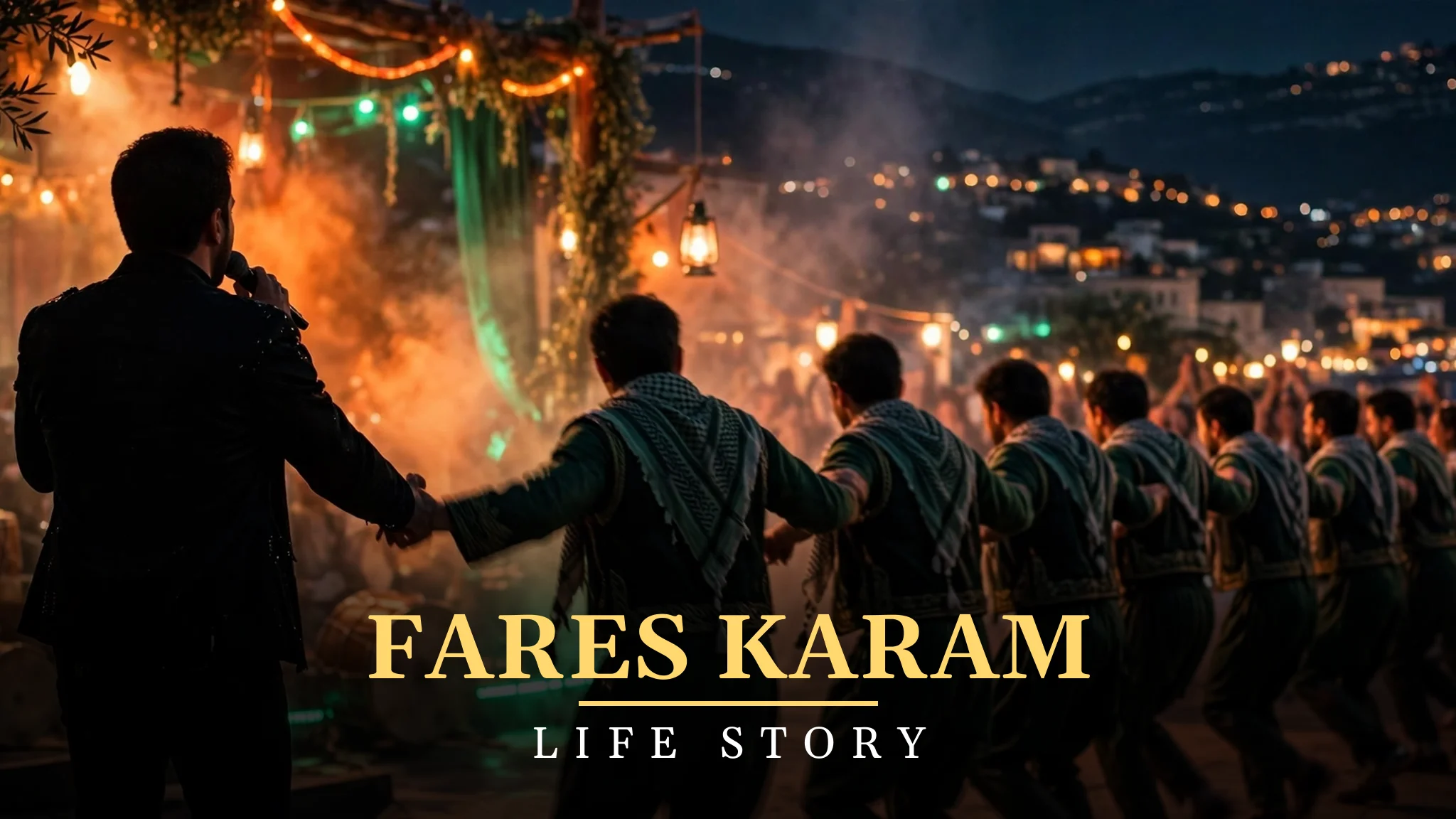
A Lebanese wedding without dabke is hard to imagine, and a dabke without a singer to lead it is hard to imagine too. Fares Karam is that singer. At weddings across Lebanon and the Arab world, when his voice begins, the line forms. Men and women join hands, the leader of the line, the lawweeh, raises his beads, and the feet begin to stamp in time. Fares stands at the front of that joy, calling out the steps, singing the verses, and keeping the energy high until the whole hall is moving as one.
The wedding singer has a special job. He is not only an entertainer. He is part of the family’s happiest night, and his songs become part of the family’s memory. A couple who dances their first dabke to Shefta will remember that song for the rest of their lives, and they will play it for their children. Fares knows that, and he sings with a care that matches the occasion. He does not rush a wedding song, and he does not treat it as just another show. He treats it as a celebration that belongs to the family, and he is honoured to be part of it.
The zaffe, the wedding procession, is another moment where his music is heard. Drums, flutes, and voices lead the bride and groom into the hall, and the crowd follows, clapping and singing. Fares’ songs fit that moment perfectly, because they are built for movement, for drums, and for joy. A wedding singer who understands the zaffe understands Lebanon itself, because the zaffe is one of the oldest traditions in the country, and Fares carries it with pride.
He has sung at thousands of weddings, in Lebanon, in the Gulf, in Europe, and in America, wherever Lebanese families live. Each wedding is different, each family has its own story, but the dabke is the same, and Fares is the voice that leads it. That is a special kind of fame, a fame that is lived at the happiest moments of people’s lives, not only heard on the radio. A singer who is part of a wedding is part of a family, and Fares has become part of many families.
The wedding work also taught him how to read a crowd. A wedding crowd is not a concert crowd. It is made up of grandparents, children, cousins, and friends, and the singer must please them all. Fares learned to do that, to sing a slow song for the elders and a fast one for the young, to keep the line moving and the hall happy. That reading is a skill that cannot be taught in a studio. It is learned at weddings, night after night, and Fares learned it well.
The Green Hills of Jezzine: How Home Shapes His Songs
Jezzine is not only the town where Fares Karam was born. It is the sound of his music, the green hills, the waterfalls, the pine forests, and the mountain air that his songs carry with them. When he sings, his listeners hear a place, not only a voice, and that is why his songs feel different from the pop of Beirut. They are rooted, they are warm, and they smell of the mountains. A singer who carries his home in his voice has a gift that cannot be copied, and Fares carries Jezzine wherever he goes.
The town is known for its cutlery, its waterfalls, and its festivals, and Fares has spoken about it with pride all his life. He returns there, he walks its streets, and he meets the people who knew him as a boy. Those visits matter to him, because they remind him where he came from, and they remind his listeners that a star can still belong to a small town. A singer who forgets his town loses something, and Fares has not forgotten his.
His songs are full of the images of the south: the mountains, the green hills, the weddings in village squares, and the joy of a community dancing together. Those images are not decorations. They are the heart of his music, and they are why his listeners in the Gulf and in Europe feel close to Lebanon when they hear him. He does not sing about a place he has left behind. He sings about a place he still loves, and that love is in every note.
Young singers from the south look at him and see that they do not have to leave their town to be heard. They can sing about their own hills, their own weddings, and their own joy, and they can be loved for it. That is a lesson Fares teaches without saying a word, simply by being himself, a boy from Jezzine who became a star and never stopped loving the green hills that raised him.
The Dabke Star in His Later Years
Fares Karam is now in his fifties, and the drums have not slowed down. When Shefta starts at a wedding, the hall still rises, and Fares still leads the line with the same joy he had at twenty-five. His voice has grown a little deeper with age, and that depth suits the songs, because a dabke singer who has lived a little sings with more feeling. He still records, still performs, and still travels to the Gulf and to Europe, and his audience, now three generations wide, still dances when he sings.
The weddings have changed around him. The brides he sings for now are the daughters of the brides he sang for in the 1990s, and that is a strange and beautiful thing. A family invites him twice, once for the mother and once for the daughter, and both times the hall dances. That is a kind of trust that no chart can measure, and Fares has earned it by being there, year after year, whenever a family celebrates. He is not a singer who appears and disappears. He is a singer who stays.
His newer songs sit beside the old ones, and the crowd accepts both, because a joyful rhythm does not age. He has worked with younger producers, he has tried new sounds, and he has kept the dabke at the centre, because that is what his audience loves. A tradition can grow without losing itself, and Fares shows how: take the old drums, add a new touch, and keep the joy. That is his method, and it has kept him on stage for more than twenty-five years.
What he will be remembered for is not one song. It is the feeling of a hall dancing together, hands joined, feet stamping, and a voice calling the steps. Young singers from the south of Lebanon look at him and see that they do not have to leave their tradition to be heard. They can sing dabke, they can be joyful, and they can be loved for it. That is a legacy, and it is still growing, every time a wedding hall rises to dance.
My Take:
I think Fares Karam is a singer who proves that joy is a serious art. I have heard many singers who try to be deep and serious, and I respect them, but Fares is different. He is joyful, he is energetic, and his songs make people want to dance. That is not a small thing. In a world that is often sad, a singer who can make a room dance is doing important work, and Fares has done that work for more than twenty-five years. I admire him for it.
What I admire most about him is that he kept dabke at the centre of his career. Dabke is a traditional dance, a line of people holding hands, stamping their feet, moving as one. It could easily have been forgotten, or pushed aside by newer sounds. Fares kept it alive, and he made it modern, and he made it loved by young people as well as old. That is a generous act, because it carries a tradition forward, and it shows younger listeners that their own music has value. I think that is one of the best things he did.
I also think about Jezzine, and about what it means to be from a mountain town and to become a star. A boy from a quiet place, who sang at weddings, became a singer whose voice was heard across the Arab world. That is a hopeful story, and it tells young people that where you start does not decide where you finish. He started with a voice and a love for dabke, and he built a career from that, and I find that hopeful. It tells me that a dream, worked at with patience, can take you further than you imagine.
His win on Studio El Fan in 1996 makes me think about contests, and about how a single win can change a life. He was twenty-three, he won a gold medal, and he used that win to build a career. Many contest winners fade, because they think the win is enough. Fares did not think that. He worked, he recorded, he performed, and he kept his audience. I respect that work, because it shows that a contest is only a door, and what matters is what you do after you walk through it.
I want to be honest about something I find less strong in his career. His style has stayed very close to dabke, and his albums can sound alike to a listener who hears them all at once. The rhythms stay familiar, the themes stay close to love and celebration, and the sound does not change much from one album to the next. I understand why he did it, because his audience loves that sound, and changing it would be a risk. But I also think a few more quiet songs, a few songs that stepped outside the dance world, would have shown us another side of him. A singer who only sings for dancing can become a joyful voice in a narrow room, and I would have liked to hear him step into a quieter room now and then.
That said, I do not think the repetition is a fault in the way some critics might say. Dabke is a wide world, and Fares finds different corners of it in each song. One song is about seeing a loved one, another is about a traditional dance, another is about a wish. Those are different feelings, and he sings them differently, even if the style stays close. I think a listener who pays attention will hear the differences, and I think his fans do pay attention, because they dance to his songs at weddings, and they know which song is which.
His privacy makes me think about the value of keeping a part of your life for yourself. He married later in life, and he has kept much of his family life private. In a world where many famous people share everything, I find that restraint admirable. It tells me that he knows the difference between his work and his home, and that he protects his home. A singer can give his voice to the public, but he does not have to give his family to the public, and Fares seems to understand that line clearly.
I also think about weddings, and about what it means to be the singer whose songs are played at the happiest moments of people’s lives. When a couple dances their first dabke to a Fares Karam song, that song becomes part of their memory, part of their family story. That is a special kind of fame, a fame that is lived, not only heard. I think Fares understands that, and I think it is why he sings with such joy. He knows his songs will be part of people’s happiest days, and he takes that responsibility seriously.
When I compare him with other Lebanese singers, I see that his strength is not poetry or power. Other singers are known for classical songs, for strong folk voices, for gentle ballads. Fares is known for joy, for dance, and for a stage that feels alive. I think that is a harder strength to build, because joy can be dismissed as simple, but real joy, worked at with discipline, is an art, and Fares has worked at it for years. His audience can feel that work, and they respect it.
I think about the younger singers from the south of Lebanon who watch him and think, if he can do it, I can do it too. That is a powerful message, and it is one of the best things about his career. He did not only make songs. He made a path for singers from Jezzine, from the south, from the villages, who want to sing dabke and to be themselves. I hope he knows how many young singers he has helped by being himself, and I hope he keeps being himself, because the world needs more voices like his.
If I had to choose one song to explain Fares Karam to someone who had never heard Lebanese music, I would choose Shefta, because it holds everything he does best in one place. It is joyful, it is romantic, and it is sung with a voice that makes the listener want to dance. I would tell that person to listen to it loudly, to feel the drums, and to notice how the song makes them smile. That smile is the point of his music, and Fares understands it.
In the end, I think Fares Karam’s story teaches a simple lesson that I want to remember. You do not have to be serious to be respected. You can be joyful, you can dance, you can sing dabke, and the world will listen. Fares did that, and his songs are still played at weddings, still danced to, and still loved across the Arab world. A career built on joy and dance, sung with a voice like his, is a career that earns its place, and I am glad his place is secure.
Weddings are the image I cannot get out of my mind when I think about Fares Karam. A hall full of people, hands joined, feet stamping, and one voice leading them all. That picture tells me what his career is about. He is not a singer for a quiet room. He is a singer for a celebration, for the happiest night of a family’s life, and his songs become part of that family’s memory. A couple who dances to Shefta on their wedding night will remember that song for the rest of their lives, and they will play it for their children. That is a special kind of fame, and Fares earned it.
The dabke line is another thing I think about. A line of dancers holding hands, moving as one, led by a singer who calls the steps, is a picture of community. It says that no one dances alone, that joy is shared, and that a village, a family, a country can move together. Fares leads that line, and he does it with a joy that makes everyone want to join. I think that is a beautiful thing, and I think it is why his music matters beyond entertainment. It holds people together, literally, hand in hand, and that is a rare gift.
Jezzine is a small town, and I think about what it means to carry a small town onto the world’s stages. A boy from a quiet place, who sang at weddings, became a singer whose voice was heard in Dubai, in Cairo, and in Paris. That journey tells young people that where you start does not decide where you finish. He started with a voice and a love for dabke, and he built a career from that, and I find that hopeful. It tells me that a dream, worked at with patience, can take you further than you imagine.
His privacy is another thing I respect. He married later in life, and he has kept much of his family life to himself. In a world where many famous people share everything, I find that restraint admirable. It tells me that he knows the difference between his work and his home, and that he protects his home. A singer can give his voice to the public, but he does not have to give his family to the public, and Fares seems to understand that line clearly.
If a young singer asked me what to learn from Fares Karam, I would say three things. First, keep your tradition alive, because it is the source of your sound. Second, sing for people’s happiest moments, because those moments are remembered. Third, be joyful, because joy is a serious art, and it takes work to make a room dance. Fares did all three, and his career is the proof that they work. He is still here, still singing, still dancing, and that is a lesson worth remembering.
His weddings are something I think about often, because they show what a singer’s voice means at its most human. A wedding is the happiest night in a family’s life, and Fares’s voice is there, leading the dabke, making the hall rise to dance. That is a beautiful thing, and it is a test no chart can give. A singer whose voice is chosen for a family’s happiest night is a singer who has become part of that family’s life, and Fares has, thousands of times over. I think that is why his audience is so loyal, because his voice is not only on their radios. It is in their memories, in their weddings, in their happiest nights.
I also think about Jezzine, and about what it means to carry a small town onto the world’s stages. A boy from the mountains, who sang at home, became a man whose voice is heard at weddings across the Arab world. That journey shows young people that a beginning does not decide an ending. He began with a voice and a love for dabke, and he made a life from that, and I find that hopeful. It reminds me that a dream, held on to with patience, can carry a person further than they ever guessed.
His joy is something I think about often, because it is not a simple joy. Fares sings with a happiness that has been worked at, that has been practised, and that has been kept alive for more than twenty-five years. That is a rare kind of joy, and it is one that young singers should learn from. You do not have to be the most serious voice in the room. You can be the happiest, and you can be loved for it, and Fares is. I admire that, and I think his audience feels it, because they have danced to his songs at their weddings, at their parties, and in their cars, for decades, and they still dance.
I also think about the dabke line, and about what it means to hold hands and move as one. A line of people dancing together is a picture of community, and Fares leads that line. He calls the steps, he sings the verses, and the hall follows him. That is a beautiful thing, and it is why his music matters beyond entertainment. It holds people together, literally, hand in hand, and that is a rare gift for a singer to give. I am glad he kept giving it, because Lebanon’s weddings need his voice, and his audience needs to hear it, year after year.
Frequently Asked Questions
Where was Fares Karam born?
Fares Karam was born on 25 June 1973 in Jezzine, a town in the Jezzine District of South Lebanon. Jezzine is known for its waterfalls and pine forests, and he has spoken of his home town with pride.
How did Fares Karam become famous?
He became famous by winning the gold medal on Studio El Fan, the Lebanese talent show, in 1996. The win gave him a recording contract and introduced him to audiences across Lebanon and the Arab world.
What is dabke, the dance Fares Karam sings for?
Dabke is a traditional line dance of Lebanon and the Levant, where dancers hold hands, stamp their feet, and move together to drums and folk music. Fares Karam is known as a dabke star because his songs lead that dance at weddings and festivals.
What are Fares Karam’s most famous songs?
His most famous songs include Shefta, El Tannoura, Ya Reit, El Saraha, and Neswanji. Shefta is the song most often linked with his name, and it is still danced to at weddings.
Why is Fares Karam called a dabke star?
He earned the title because his career is built on dabke music, and his concerts and wedding performances are known for the dance lines that fill the hall. His voice leads the dance, and his audience follows.
Is Fares Karam still performing?
Yes, he continues to perform and release music, and his older songs are still played widely in Lebanon and across the Arab world. His concerts still draw audiences who come to dance to his songs.


