Fat Freddy's Drop: The Life Story Behind the Dub Stars
In this post
Most bands hurry. They hurry to sign, hurry to record, hurry to chart, and then they hurry to repeat whatever worked. Fat Freddy’s Drop did the opposite. They formed in Wellington in the late 1990s, spent years playing long nights in bars and clubs, and released their first album only when they were ready, in 2005. That album went to number one in New Zealand, and it did so without a major record company behind it, which no independent album in the country’s history had ever done. The band had taken the slow road, and the slow road had taken them to the top.
The sound they made was slow too, in the best sense. Dub, reggae, soul and jazz, mixed together and stretched out across songs that could run for ten minutes without ever feeling long. Deep bass you could feel in your chest, horns that rose and fell like weather, keyboards shimmering in the spaces between, and a voice, Dallas Tamaira’s, that sounded like warm light. Seven musicians made that sound, and they made it together, in the same room, playing off each other the way jazz players do. It was music built for dancing slowly, for long nights, for crowds that did not want the evening to end.
More than twenty-five years later, they are still going, still independent, still playing sets that last for hours, and still carrying Wellington with them wherever they travel. Their story is about patience, about friendship, and about a simple idea that the music business keeps forgetting: if the music is good enough, and you play it for people night after night, the audience will find you.
A Band That Refused to Hurry
Wellington is a windy city at the bottom of New Zealand’s North Island, with a harbour, steep hills, and a habit of blowing people’s hats off. In the late 1990s it also had a music scene that suited a band like Fat Freddy’s Drop perfectly: small bars and clubs where reggae, dub and soul were loved, where a band could play a long set without anyone asking them to hurry up, and where musicians from different backgrounds mixed freely. The band grew out of that scene, a group of players who loved the same records and wanted to make something of their own.
Two figures stood at the centre. Dallas Tamaira, known to everyone as Joe Dukie, was the singer, and his voice was the band’s calling card: smooth, soulful, and warm, the kind of voice that makes a lyric sound like a confidence shared between friends. Chris Faiumu, known as Mu, played drums and held the vision for the group, the person who understood how the pieces fitted together and where the sound was heading. Around them gathered the rest of the band, until there were seven members in all, with horns, keyboards, guitar, bass and drums, a small orchestra by rock standards, and a big, full sound to match.
The name was a joke, and like all good band names, it was also a description. Fat Freddy’s Drop sounds big and warm and slightly mischievous, and that was the band: a large group making generous music, with a sense of humour and no interest in looking cool. They were not a pop band chasing a hit. They were a dub and reggae band, playing music that came from Jamaica, with deep bass, echo, and space, and they mixed it with soul and jazz until it became something of their own. Their music was not fast. It moved slowly and deeply, and it made people dance in a slow, happy way, swaying rather than jumping, which suited Wellington’s long nights perfectly.
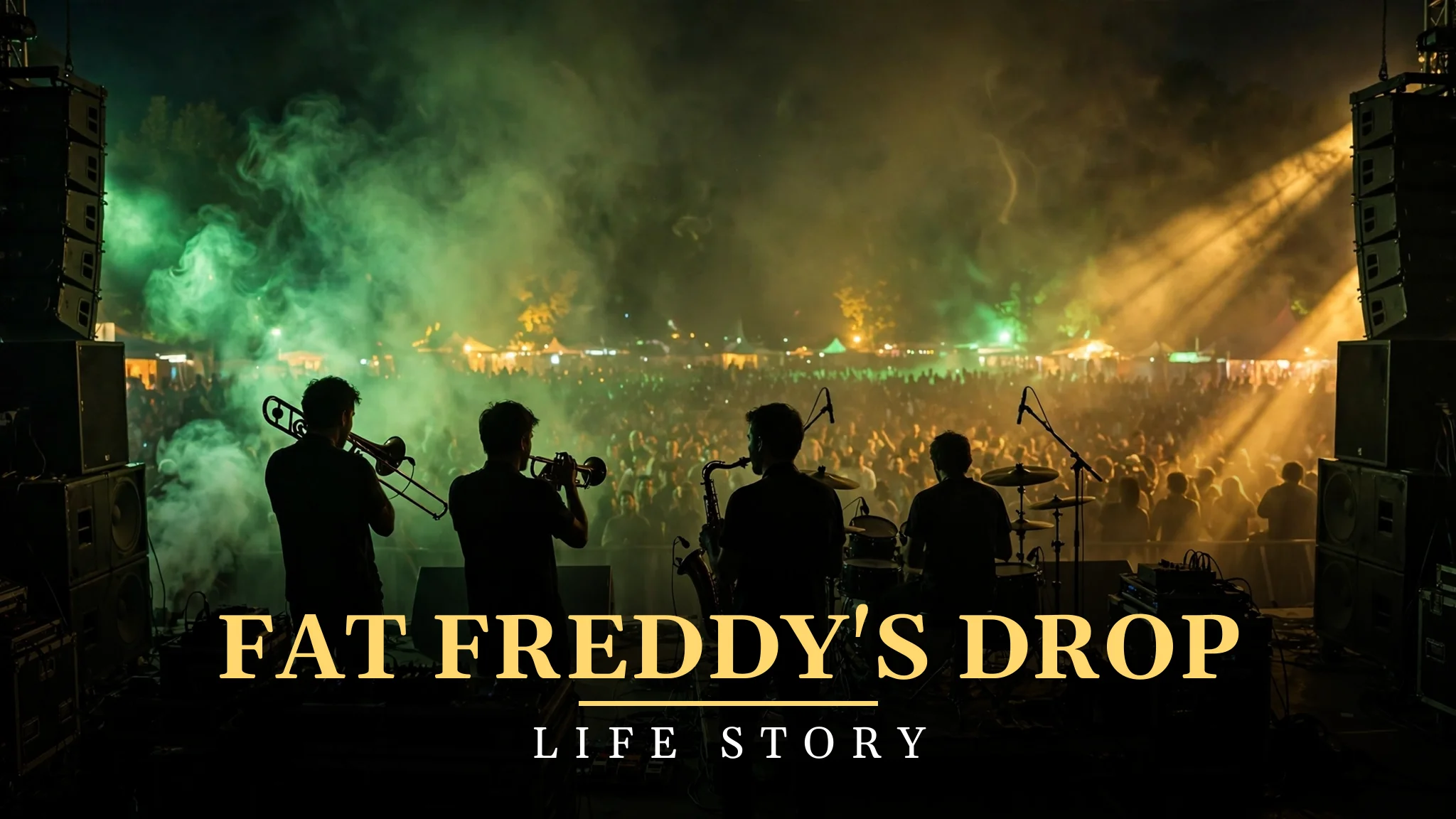
Those early years were spent on stage, not in studios. The band played Wellington’s bars and clubs, played festivals, and learned their craft in front of real audiences. Their shows became known for their length. They would play for hours, jamming, letting the music grow and change as the night went on, and staying until the crowd was happy. That is a demanding way to learn, because a band that jams has nowhere to hide. Every musician has to listen, every musician has to respond, and the audience can hear instantly when the connection is real. Fat Freddy’s Drop learned to keep that connection alive for a whole evening, and it became the foundation of everything they did afterwards.
Seven People, One Deep Sound
To understand Fat Freddy’s Drop, it helps to understand dub, the Jamaican style at the heart of their music. Dub takes a reggae song and strips it down to its bones: the bass and the drums stay, the other instruments drop in and out, and echo and space do as much work as the notes themselves. It is music built around what is left out as much as what is played, and it gives a band room to breathe. Fat Freddy’s Drop took that idea and filled the spaces with soul singing, jazz horns, and long, patient jams, until the result sounded like nothing else in New Zealand.
The seven-piece line-up was essential to that sound. The horns could play like a jazz band, bright and bold, and then fall silent while the bass took over. The keyboards could shimmer quietly in the background, adding colour without taking the lead. The guitar could flicker in and out of the mix, and the drums, under Mu’s direction, could hold the whole thing together with a steady, unhurried pulse. And above it all, Joe Dukie’s voice carried the melody, smooth and unforced, never shouting, never straining, simply telling the song the way it needed to be told.
Playing in a group that size demands a particular kind of discipline. Seven musicians cannot all play at full volume at the same time without turning the music into noise. They have to take turns, listen to each other, and leave space, and Fat Freddy’s Drop became masters of that restraint. A song might begin with almost nothing, just bass and a whisper of keyboard, and then slowly gather instruments until the whole band is playing at once. That slow build is one of the great pleasures of their music. It rewards patience, and it makes the loud moments feel earned rather than merely loud.
It also explains why their records sound the way they do. They were not assembled track by track in a studio, with each part recorded separately and stitched together. They were played, by people in a room, listening to each other, and the records kept that feeling. You can hear the band breathing together, and you can hear the space between the notes, which is exactly what dub is supposed to give you.
The Night the Whole Country Noticed
By the early 2000s, Fat Freddy’s Drop had a strong reputation in New Zealand. They had released singles, played festivals, and built a loyal audience through their live shows. People who had seen them wanted the records, and people who had the records wanted to see them play. But nobody, not even the band, expected what happened in 2005, when their first album, Based on a True Story, was released.
The album went to number one in New Zealand, and in doing so it made history. It was the first independently released album ever to reach number one in the country, a record that had been held by the major labels since charts began. The band had done it without signing to a big company, without changing their sound, and without hurrying. They had made their own record, sold it themselves, and let their audience carry it to the top. It stayed on the charts for a long time, it sold in large numbers, and it won Album of the Year at the New Zealand Music Awards, which confirmed what the charts had already said: this was not a fluke. It was the arrival of a major band.
The songs on the album explain why. Wandering Eye is a warm, rolling track with a melody that feels like it has always existed. Roady is a travelling song, full of movement and good humour, and Cay’s Crays is stranger and more playful, a track that shows the band’s willingness to follow an idea wherever it leads. Together, the songs added up to a record that sounded like a long, warm night in Wellington, and New Zealanders recognised their own country in it. The album was not trying to sound American or British. It sounded like home, and home bought it in large numbers.
Success brought the wider world to the band’s door. They toured Australia, toured Europe, and played festivals in many countries, where audiences who had never heard of Wellington fell in love with the music anyway. Dub and reggae are international languages, and Fat Freddy’s Drop spoke them fluently, with a New Zealand accent that made the songs distinctive rather than strange. The band was no longer just a Wellington secret. It was a group with a worldwide following, built the slow way, one show at a time, and all the stronger for it.
Wandering Eye and the Songs That Travelled
Wandering Eye deserves a closer look, because it is the song that carried Fat Freddy’s Drop further than any other. It begins gently, with the band easing into the groove, and then Joe Dukie’s voice enters, smooth and conversational, telling a story about looking around, about restlessness, about the feeling of wanting to be somewhere else. The horns lift the chorus, the bass holds the floor steady, and the whole song moves with the unhurried confidence of a band that knows exactly what it is doing. It is a song that works at a festival, in a car, or in a quiet room, and that versatility is why it has lasted.
Roady is a different kind of song, a travelling song about life on the road, and it captures the humour and the weariness of touring in equal measure. Cay’s Crays is odder still, a playful track built around a strange idea, and it shows the band’s willingness to be funny without being silly. The three songs together show the range of Based on a True Story: it could be warm, it could be funny, and it could be strange, and all of those moods fitted inside the same deep, spacious sound.
What the songs shared was a quality that is hard to name but easy to feel. They sounded honest. They did not try to impress the listener with speed or volume or cleverness. They simply played, and let the groove do the work, and the listener could relax into the music the way you relax into a warm bath. That honesty is what made the album sell without a major label’s marketing machine. People heard it, they told their friends, and their friends told their friends, until the whole country was listening.
The album’s title, Based on a True Story, was a quiet joke, and a true one. The songs were based on the band’s real life: the nights in Wellington bars, the long drives between towns, the friendships inside the group, and the city they loved. There was nothing invented about it. The record was a document of a band that had spent years playing together, and the audience could hear the truth in it.
Boondigga, Blackbird: The Middle Records
The hardest album for any band is the second one, and Fat Freddy’s Drop handled theirs with the same patience they brought to everything else. Dr Boondigga and the Big BW arrived in 2009, four years after the debut, and it had a bigger, more polished sound, with the soul and dub elements pushed further forward. The Camel, a long and joyful track, became a favourite at live shows, where the band could stretch it out and let the audience dance for ten minutes or more. The album went to number one in New Zealand, just like the first, and it proved that the band could do it again without repeating themselves.
Blackbird followed in 2013, and it was a darker, more soulful record, with songs about love, loss and hope. The title track, Blackbird, is a beautiful and gentle song, and the album as a whole showed a band that was still growing, still experimenting, and still writing songs that mattered to them. It also went to number one in New Zealand, which meant the band had now topped the charts with three albums in a row, all released independently, all made on their own terms. Very few bands anywhere in the world have done that, and none of them did it by hurrying.
During these years, the band toured the world constantly, playing festivals in Europe, Australia and beyond. Their live shows became famous for their length and their energy, with the band playing for hours, jamming, and letting the music grow as the night went on. Audiences loved them because the shows felt generous. The band was not watching the clock. They were playing until the music was done, and the crowd could feel the difference between a band that wants to be there and a band that wants to go home.
The band’s independence held through all of this. They kept making their own records, selling them themselves, and building their audience through live shows. They did not sign to a major label, and they did not change their sound to fit the fashion of the moment. That stubbornness was not arrogance. It was the knowledge, earned in 2005, that their way worked, and that there was no reason to abandon it.
Bays: An Album Named After Home
In 2015, the band released their fourth album, Bays, named after the bays of Wellington, the inlets and beaches that curve around the city’s harbour. The title was a tribute to home, and the music carried that tribute in every track: warm, deep songs with dub, soul and reggae mixed together, recorded by a band that had been playing together for nearly twenty years. The album went to number one in New Zealand, the fourth in a row, and it showed that the band was still at the top of its game.
Naming an album after the bays of Wellington was a statement. The band could have named it after anything, but they chose the place that had made them, the water and the hills and the wind that shaped their sound. Their music had always carried Wellington in it: the space in the songs, like the space between the hills and the sea; the slowness, like a harbour on a calm day; and the warmth, like a crowded bar on a cold, windy night. Bays made that connection explicit, and New Zealanders loved them for it.
Special Edition Part 1 followed in 2019, a collection that showed the band’s range: long jams, soulful ballads, and dub tracks, all played with the same patience and warmth. The band toured it around the world, playing festivals and concert halls, and the audiences were a mix of people who had loved them for years and new fans who had discovered the music for the first time. That mix is a sign of a healthy band. The old fans stay, and the new ones keep arriving.
Through these years, the line-up changed, as line-ups do over two decades. Members came and went, and the band had to learn how to be a slightly different group. But the heart stayed the same. Joe Dukie’s voice was still at the centre, Mu’s vision was still guiding the band, and the music was still warm and deep. The band had learned how to change without losing itself, and that is a skill that very few long-running groups ever master.
Three Hours on Stage, No Clock Watching
The live shows are the heart of the Fat Freddy’s Drop story, and they are some of the best live shows in the world. A typical set lasts two or three hours, with the music growing and changing as the night goes on. The band jams, the horns play, the keyboards shimmer, and Joe Dukie sings with a voice that is smooth and soulful. The crowd dances, and the band plays until the crowd is happy. It is a shared experience, a night where the band and the audience become one, and it is why their fans love them so much.
They have played at festivals around the world, including Glastonbury in Britain, one of the biggest festivals on earth, and many others in Europe, Australia and New Zealand. Their festival shows are famous for their energy, with thousands of people dancing to the music and the band playing long into the night. They are a band made for festivals, because their music is warm, deep and joyful, and it makes people want to dance, even people who have never heard a dub record in their lives.
What the shows reveal, more than anything, is generosity. Many bands play a short set and leave. Fat Freddy’s Drop stays, plays, and gives the audience everything it has. That is a rare thing in the music business, and audiences know it. They know that a Fat Freddy’s Drop show is not just a concert. It is an experience, a night they will remember, and they return to the next one because they want that feeling again.
The live work also built the band’s worldwide audience, in the slowest and most honest way possible. People who saw them at a festival told their friends, and their friends came to the next show, and the audience grew. There was no shortcut, no viral moment, no sudden explosion. There was simply a band playing, night after night, year after year, until the world caught up with them. It is the best way to become famous, because the fame is built on something real, and it does not disappear when fashion changes.
Wairunga and the Long Game
The band’s later work included new music and new tours, and in 2025 they released Wairunga, another album, and kept playing live shows around the world. They had been going for more than twenty-five years by then, and they were still making music that mattered, still playing to crowds who danced for hours, and still doing it on their own terms. That is a remarkable achievement, and it is a testament to the power of their songs and to the strength of the friendships inside the band.
They have also become mentors to younger musicians in New Zealand. Young bands look up to them as an example of how to be independent, how to build a career through live shows, and how to stay faithful to your own music. Fat Freddy’s Drop showed them that you do not need a major record company to succeed, and that you do not need to change your sound to fit the fashion of the moment. You need to make good music, play it live, and let the audience find you. That is a legacy that goes beyond their own records, and it is one of the most important parts of their story.
Their influence on New Zealand music has grown with the years. They are regarded as one of the most important bands in the country’s history, and their albums are studied by young musicians who want to learn how to make dub and reggae music. They opened a door for other independent bands, and they showed that a group from Wellington could make music the whole world loves. That door is still open, and younger bands are still walking through it.
The music will last because it is about things that do not change. Love, hope, joy, and the feeling of dancing with friends on a warm night are the same for every generation, and their songs speak to those things in a clear and honest way. A young person hearing Wandering Eye for the first time today can feel what a young person felt when they heard it in 2005, and that is the mark of a great song. Fat Freddy’s Drop made music that will outlive them, and that is the best thing any band can hope for. They did it slowly, they did it together, and they did it from Wellington, a windy city at the bottom of the world, which turned out to be exactly the right place to start.
My Take:
When I think about Fat Freddy’s Drop, the first thing I feel is warmth, because their story is a story about music that is made to be felt, not just heard. Their songs are slow and deep, with reggae, dub, soul, and jazz mixed together, and they make me want to dance in a slow and happy way. I have heard a lot of music that is fast and loud, and it can be exciting, but it does not always make me feel something deep. Fat Freddy’s Drop’s music makes me feel something deep, because it is warm, it is honest, and it is made with love. That is a rare gift, and I admire it very much.
I admire their independence, because they did something that very few bands have done. They made a number one album without a big record company, they sold it themselves, and they built their audience through live shows. That takes a kind of courage that I admire, because it is easier to sign to a big company and let them do the work. Fat Freddy’s Drop did the work themselves, and they proved that a band can succeed on its own terms. I think that is inspiring, because it shows that you do not need permission from a big company to make great music. You need good songs, hard work, and the patience to build an audience one show at a time.
What I love most about their story is the way they play live. Their shows are long, often for two or three hours, and they jam, they let the music grow, and they play until the crowd is happy. That is a beautiful thing, because it shows that they care more about the audience than about the clock. Many bands play a short set and go home, but Fat Freddy’s Drop stays and plays, and that is why their fans love them. I think that is a lesson for anyone who performs. You should give the audience everything you have, because they came to see you, and they deserve your best.
I think about their first album, Based on a True Story, often, because it is a remarkable record. It was the first independently released album to go to number one in New Zealand, and it did it without a big record company, without a big marketing campaign, and without changing the band’s sound. That is a wonderful thing, and it shows that good music will find its audience, even without the help of a big company. The album is still loved today, and its songs, like “Wandering Eye” and “Roady”, are still played on the radio. That is the mark of a great album, and it is why the band is still loved.
There is something I find sad in their story, though it is a small sadness. It is that dub and reggae music do not always get the attention they deserve. The world loves pop music, rock music, and hip-hop, but dub is a quieter style, and it can be overlooked. I think Fat Freddy’s Drop has been overlooked at times, especially outside New Zealand, and that is unfair. Their music is as good as any pop music, and in some ways it is better, because it is deeper and warmer. Yet I also believe their followers cherish them all the more for standing outside pop, a triumph that outlasts any chart placing.
I also think about the way the band has stayed together for more than twenty-five years, and I admire that very much. A band is a group of people, and people change, and it is hard to keep a band together for a long time. But Fat Freddy’s Drop has done it, through changes in their line-up, through changes in the music business, and through the ups and downs of a long career. That convinces me their friendship is genuine, and that they truly enjoy creating together. That seems lovely to me, and it holds a lesson for everyone. A good friendship is worth more than a hit song, and it lasts longer too.
If I were to tell a young band what to learn from Fat Freddy’s Drop, I would say this. Begin by creating the music you adore, rather than the music you imagine will bring fame, since a beloved song always sounds richer than one you doubt. Second, play live, and play long, because a live show is where a band truly meets its audience, and a good live show can change a life. Third, be independent, because you do not need a big company to succeed, and doing it yourself will make you stronger. Fourth, be patient, because a career is built over years, not over one night. Fat Freddy’s Drop did all of these things, and their career shows what happens when a band trusts its music and its heart.
I think their song “Wandering Eye” is a beautiful part of their story, because it is a song about love and about looking, and it has a melody that is both sad and hopeful. It is a song that makes me feel calm, and it makes me want to dance slowly. That is a wonderful thing for a song to do. A pop song can make you happy for a summer, but a dub song can make you feel calm for a lifetime, and that is a gift.
When I finish thinking about their story, I feel calm, and I think that is the right feeling. Their music is calm, their life is calm, and their story is calm, but it is not boring. It is the calm of a band that knows who it is, that knows what it loves, and that does not need to shout to be heard. Fat Freddy’s Drop is a band from Wellington that played dub music in a small city, and that became a legend. That is a story worth telling, and it is a story worth remembering.
I also think about the way their songs are played at parties and festivals, and it makes me happy. “Wandering Eye” is played at barbecues, “Roady” is played on long drives, and “The Camel” is played at festivals, and each time they play, people dance. That is because their songs have a quality that fits the happiest moments of life, a warmth and a groove that makes a moment feel joyful. I think that is a wonderful thing for a song to do, to be part of a person’s happiness, and Fat Freddy’s Drop’s songs do that, and they do it without trying. They are simply warm, and warmth lasts.
There is another part of their story that I admire, and it is the way Dallas Tamaira sings. His voice is smooth and soulful, and it carries the band’s music with a gentleness that is rare in dub and reggae. When he sings, you can hear the feeling behind the words, and you can feel the emotion inside them. That is an uncommon talent, and it explains why their songs lodge so firmly in memory. A singer who can make a slow song feel exciting is a singer who understands music deeply, and Dallas does. His voice is the heart of the band, and it is the reason their music feels so human.
I think about their independence often, because it is a brave thing to make your own records and sell them yourself. Fat Freddy’s Drop did not wait for a big record company to discover them. They made Based on a True Story themselves, and it went to number one. That is a remarkable achievement, and it shows that a band does not need permission from a big company to succeed. They need good songs, hard work, and the patience to build an audience one show at a time. I think that is inspiring, and it is a lesson for any young band that thinks it needs a big company to be heard.
I also respect how the group has navigated the business side of music. They watched labels rise and fall, watched radio transform, and watched the business travel from compact discs to streaming, all while continuing their work. That requires a calm resolve I admire, since surrender comes easily when everything around you shifts. Fat Freddy’s Drop did not give up. They continued composing, continued taping new material, and continued discovering listeners eager for their sound. That is guidance for anybody labouring in a world that keeps shifting. Change itself is beyond your command, but your craft is yours to govern, and fine work will eventually reach its audience.
There is a small sadness I feel when I think about how dub music is sometimes overlooked. The world loves pop music, and it loves rock music, but dub is a quieter style, and it can be ignored. I think Fat Freddy’s Drop has been overlooked at times, especially outside New Zealand, and that is unfair. Their music is as good as any music in the world, and in some ways it is better, because it is deeper and warmer. Yet I also believe their followers cherish them all the more for standing outside pop, a triumph that outlasts any chart placing.
I think about the word warm, because it is a word that describes their whole career. Their music is warm, their shows are warm, and their friendship is warm. Warmth is not a loud word, and it is not a word that the music business uses very often. But it is a word that matters, because a band that is warm will be loved by its audience, and that love will last. Fat Freddy’s Drop has earned that love, and they have kept it.
If I had to compress their history into a single lesson, it would be this. A career is not a single moment. It is a life made of instants, grand and modest alike, and the modest ones count just as much. The big moment was Based on a True Story going to number one, but the small moments were the long nights in Wellington bars, the jams that went on for hours, and the shows played to small crowds who really listened. Those modest instants constructed the career, and they made the grand moment achievable. That strikes me as a lovely truth, and one I intend to carry with me.
I also feel thankful for the uncomplicated joy their records bring. There are songs that make you think, and there are songs that make you feel, and Fat Freddy’s Drop’s songs do both, but they also do something simpler, which is to make you want to dance slowly. When I hear “Wandering Eye”, I feel calm, and I feel like moving gently, even if I am sitting still. That is a gift, and it is a gift that Fat Freddy’s Drop has given to millions of people. A band that can make people dance slowly is a band that has done something wonderful, and they have done it for a very long time.
In the end, I think Fat Freddy’s Drop’s story is a story about patience and warmth. It is about a band from Wellington that played dub music in a small city, and that became a legend by being honest, by working hard, and by making music that made people feel good. They did not need to be loud to be heard. They needed only to be warm, to be patient, and to play the truth about their home. That is a tale that will encourage groups for decades ahead, and I am pleased to have shared it.
One more image stays with me from this band, and it is the simplest one. I picture a Wellington bar on a windy night, the windows rattling, seven musicians on a small stage, and Joe Dukie leaning into the microphone while the bass rolls through the floorboards. Nobody in that room is in a hurry. The song stretches, the horns rise, and the crowd sways instead of jumping. That picture explains the whole band to me. They built a career out of unhurried nights, and the world eventually came to them.
Frequently Asked Questions
Who are Fat Freddy’s Drop and why are they famous?
Fat Freddy’s Drop is a band from Wellington, New Zealand, known for their mix of dub, reggae, soul, and jazz. They became famous with their first album, Based on a True Story, released in 2005, which was the first independently released album to go to number one in New Zealand. They are known for their long live shows, their warm sound, and songs such as “Wandering Eye” and “Roady”.
What is the album Based on a True Story and why is it important?
Based on a True Story is Fat Freddy’s Drop’s first album, released in 2005. It went to number one in New Zealand and became the first independently released album to reach number one in the country’s history. The album included “Wandering Eye”, “Roady”, and “Cay’s Crays”, and it won Album of the Year at the New Zealand Music Awards. It proved that a band could succeed without a big record company.
When was Fat Freddy’s Drop formed and where are they from?
Fat Freddy’s Drop was formed in Wellington, New Zealand, in the late 1990s. The band came together from a group of musicians who loved reggae, dub, and soul music, and who played in the city’s bars and clubs. The singer is Dallas Tamaira, known as Joe Dukie, and the band’s leader is Chris Faiumu, known as Mu.
What are Fat Freddy’s Drop’s most famous albums and songs?
Their most famous albums are Based on a True Story from 2005, Dr Boondigga and the Big BW from 2009, Blackbird from 2013, Bays from 2015, and Special Edition Part 1 from 2019. Their best-known songs include “Wandering Eye”, “Roady”, “The Camel”, and “Blackbird”. Each album shows a different stage in the band’s life.
What kind of music does Fat Freddy’s Drop play?
Fat Freddy’s Drop plays a mix of dub, reggae, soul, and jazz, with deep bass, horns, keyboards, and a smooth soulful voice. Their songs are often long, with the band jamming and letting the music grow. Their live shows are famous for their length, often lasting two or three hours, with the band playing until the crowd is happy.
Have Fat Freddy’s Drop played at festivals around the world?
Yes, Fat Freddy’s Drop has played at festivals around the world, including Glastonbury in Britain, one of the biggest festivals in the world, and many others in Europe, Australia, and New Zealand. Their festival shows are famous for their energy, with thousands of people dancing to their music, and with the band playing long into the night.
Is Fat Freddy’s Drop still making music today?
Yes, Fat Freddy’s Drop continues to make music and perform live. They released the album Wairunga in 2025, and they still play concerts in New Zealand, Australia, Europe, and other countries. They remain one of New Zealand’s most loved and respected bands, and their music is still played on the radio around the world.


