Fernandel: The Life Story Behind France's Beloved Comic Actor
In this post
- A Child of the Music Hall in Marseille
- From the Stage to the Screen
- Don Camillo: A Priest the World Loved
- A Hundred Films and a Life of Work
- The Final Years and a Farewell
- The Man Who Laughed at Himself
- Marseille, the South, and a National Treasure
- La Vache et le prisonnier: Laughter in a Time of War
- Topaze: The Honest Man in a Corrupt World
- My Take:
Fernandel had a face that no one could forget, and a laugh that filled a cinema. He was tall and thin, with a long face, a wide smile, and teeth that seemed to take up half his face when he grinned. He knew that his looks were unusual, and instead of hiding them, he made them the centre of his comedy. He played simple men from the south of France, men who were honest, stubborn, and full of life, and audiences loved him for it. For more than forty years, he was one of the most popular actors in France, and his films were seen by millions of people.
He was born in Marseille, the son of a music hall singer, and he grew up backstage, among singers, comics, and musicians. He learned to perform before he learned to do anything else, and he spent his whole life on stage and on screen. He made more than a hundred films, and he became famous far beyond France, above all for playing Don Camillo, the fighting priest of a small Italian village. That role made him known around the world, and it is still the role people think of first when they hear his name.
His story is a story of hard work, of a man who never stopped, and of a face that became a national treasure. He was not a handsome leading man, and he did not try to be one. He was a comic, a singer, and a storyteller, and he gave France laughter through war, through hard times, and through years of change. He died in 1971, but his films are still shown, and his laugh is still heard, in France and far beyond.
A Child of the Music Hall in Marseille
Fernandel was born Fernand Joseph Désiré Contandin on 8 May 1903 in Marseille, in the south of France. His father, Denis Contandin, was a singer in the music halls, and his mother, Désirée Bédouin, was also from a family of performers. Fernand grew up in the world of the stage: in dressing rooms, in small theatres, and in the cafés where singers and comics met after the show. He learned the sounds of the music hall before he learned the lessons of school, and he knew from an early age that he wanted to perform.
As a boy, he sang in the chorus, he acted in small parts, and he watched the great comics of the time. He learned how to time a joke, how to use his long face, and how to make an audience laugh with a single look. He was not a child who sat quietly in a corner. He was a child who wanted to be on stage, and his parents, who knew the life, let him try. He took the stage name Fernandel, a small, affectionate form of his first name, and it stayed with him for the rest of his life.
He began to perform in earnest as a young man, singing comic songs in the music halls of Marseille and then Paris. His songs were funny, cheeky, and full of the accent and the spirit of the south. He sang about everyday life, about love, about work, and about the small troubles of ordinary people. He had a high, clear voice, and he knew how to use it for comedy. Audiences laughed at his songs, and they remembered his face. He was building a name, night after night, in the hard school of the music hall.
The music hall was a tough place. If the audience did not like you, they told you at once. Fernandel learned to win them over, and he learned to keep them. He was not afraid of looking foolish, and he was not afraid of his own face. He used his long jaw, his wide smile, and his big teeth as tools, and he turned what some might have called a strange face into a famous one. That courage, to laugh at himself before anyone else could, was the start of everything.
From the Stage to the Screen
Fernandel’s first films came in the early 1930s, when French cinema was learning to talk. Sound films needed actors who could speak, sing, and make people laugh, and Fernandel could do all three. He appeared in a series of comic films, and he quickly became popular. He played men from the south, men who were honest and a little naive, men who got into trouble and got out of it by luck and by charm. His accent, his face, and his timing made him different from every other actor in France.
In the 1930s, he starred in films such as Angèle and Regain, working with the great director Marcel Pagnol, who loved the south of France and its people. Pagnol saw in Fernandel a true son of Provence, and he gave him roles that mixed comedy with real feeling. Fernandel also starred in Topaze in 1951, based on the play by Pagnol, playing a simple schoolteacher who is drawn into a world of corruption. The film showed that he could play more than a comic. He could play a good man in a bad world, and make the audience care about him.
He also became known for his singing in films. He sang comic songs, he sang tender songs, and he used his voice as part of his acting. He was a complete performer: he could sing, he could act, and he could make people laugh with a single look. Directors liked him because he was reliable, because he knew his lines, and because he understood the audience. He worked hard, film after film, and he built a career that few actors could match.
By the end of the 1940s, Fernandel was one of the biggest stars in France. He had made dozens of films, and his name on a poster was enough to bring people into the cinema. He was not a star who lived in Paris and forgot his roots. He stayed a man of Marseille, a man of the south, and his films carried the sun, the accent, and the humour of Provence into cinemas across France. He was a national figure, and he was still working as hard as he had in the music halls.
Don Camillo: A Priest the World Loved
Fernandel’s most famous role came in 1952, when he played Don Camillo in Le Petit Monde de Don Camillo, based on the books by the Italian writer Giovannino Guareschi. Don Camillo was a priest in a small village in Italy, a big, strong, stubborn man who fought constantly with Peppone, the communist mayor of the village. The two men argued, they fought, and they also respected each other, and in the end they were friends. Fernandel played the priest with warmth, anger, and humour, and he made the character beloved around the world.
The film was a huge success, not only in France and Italy, but in many other countries. People who had never seen a French film knew Don Camillo. Fernandel returned to the role again and again: in Le Retour de Don Camillo, in La Grande Bagarre de Don Camillo, in Don Camillo Monseigneur, and in Don Camillo en Russie. Each film brought new adventures, new fights with Peppone, and new moments of kindness and faith. The priest became a part of Fernandel, and Fernandel became a part of the priest.
What made Don Camillo work was the balance in Fernandel’s performance. The priest was a man of God, but he was also a man of flesh and blood. He lost his temper, he played tricks, he fought with his fists, and then he prayed for forgiveness. He talked to Christ on the cross in his church, and he listened to the answers with a humble heart. Fernandel played all of that without making it silly. He made the priest funny and serious at the same time, and audiences believed in him.
The Don Camillo films also made Fernandel an international star. He was known in Italy, in Germany, in America, and in many other countries. He had started as a music hall singer in Marseille, and he had become a world star by playing a village priest. It was a strange journey, but it was a true one. The role suited him because it was about a simple man with strong beliefs, a man who fought for his village, and a man who loved people even when they drove him mad. That was Fernandel, and that was Don Camillo, and the two became one in the minds of millions.
A Hundred Films and a Life of Work
Fernandel made more than a hundred films in his career, and he worked in almost every kind of film: comedies, dramas, adventure films, and films for children. He played Ali Baba in Ali Baba et les quarante voleurs in 1954, a big, colourful adventure that delighted audiences. He played a prisoner of war in La Vache et le prisonnier in 1959, a moving and funny film about a man who escapes from a German camp with a cow. The film was a great success, and it showed once again that Fernandel could mix laughter with real feeling.
He was a tireless worker. He made several films a year, he toured with his songs, and he appeared on stage and on radio. He did not take long holidays, and he did not rest on his fame. He believed that an actor should work, and that the audience deserved his best every time. He was known for being professional, for knowing his lines, and for treating the crew with respect. Young actors who worked with him said that he was kind, patient, and always ready to help.
He was also a family man. He married Henriette Manse in 1925, and they stayed together for the rest of his life. They had three children, and his son Franck Fernandel also became a singer and actor. Fernandel kept his family close, and he did not live a wild life in Paris. He worked, he went home, and he lived simply. He was a star, but he was also a husband and a father, and he took those roles seriously.
In the 1960s, he continued to make films, and he continued to be popular, even as French cinema changed around him. New directors, new actors, and new styles came along, but Fernandel stayed true to his own style. He did not try to be modern, and he did not try to be young. He played the men he had always played: honest men from the south, with a big heart and a quick laugh. Audiences stayed loyal to him, because he stayed loyal to them.
The Final Years and a Farewell
In his last years, Fernandel was still working, but his health was failing. He had been a heavy smoker for much of his life, and he developed lung cancer. He kept his illness quiet, and he kept working as long as he could. He was making a new Don Camillo film when he became too ill to continue, and the film was never finished. It was a sad end to a long career, but it was also a fitting one: he died doing the work he loved, playing the character he loved most.
He died on 26 February 1971 in Paris, at the age of sixty-seven. His death was mourned across France and Italy, and tributes came from actors, directors, and ordinary people who had grown up with his films. He was buried in Paris, and his funeral was attended by many of the people who had worked with him over forty years. France had lost one of its most loved stars, and Italy had lost its Don Camillo.
His legacy is a large one. His films are still shown on French television, and Don Camillo is still known around the world. His songs are still sung, and his face is still recognised by people who were not yet born when he died. He left behind a body of work that is rare in its size and its warmth: more than a hundred films, dozens of songs, and a character, Don Camillo, who has become a part of world culture.
For the people of Marseille, he remains a son of their city, a boy from the music hall who became a star and never forgot where he came from. For the people of France, he remains a symbol of laughter, of the south, and of a simpler time. For the world, he remains Don Camillo, the priest who fought, prayed, and laughed, and who taught us that faith and humour can live in the same heart.
The Man Who Laughed at Himself
Fernandel’s greatest gift was his ability to laugh at himself. He had a long face, a wide smile, and big teeth, and he knew that people noticed. Instead of hiding his face, he made it the centre of his comedy. He pulled funny faces, he grinned, he looked surprised, and he let the audience laugh at his looks. That takes courage, because most people want to be seen as handsome, and they hide what makes them different. Fernandel did the opposite. He showed what made him different, and he turned it into fame. He taught France that a strange face can be a beautiful face, if it is full of laughter.
He also laughed at his own characters. His men were often foolish, often stubborn, and often wrong, and Fernandel played them with a warmth that made the audience love them. He did not play clever men who always won. He played simple men who tried their best, who made mistakes, and who kept going. That honesty made his comedy feel real, and it made audiences trust him. They knew that he was not laughing at them. He was laughing with them, and at himself, and that made all the difference.
His humour was never cruel. He did not mock the poor, he did not mock the weak, and he did not mock people for their beliefs. He mocked pride, he mocked stubbornness, and he mocked himself. That is a kind kind of comedy, and it is a rare one. Many comics become cruel as they get older, because cruelty gets a quick laugh. Fernandel stayed kind, and his kindness is why his films are still loved today. He made people laugh, and he made them feel better, and that is the best kind of comedy there is.
Marseille, the South, and a National Treasure
Fernandel was a son of Marseille, and he never forgot it. He was born in the great port city, he grew up in the music halls, and he carried the sun, the accent, and the humour of the south with him for his whole life. His films are full of Provence: the light, the sea, the villages, and the people. He played men from the south, and he played them with love, not with mockery. He showed France that the south was not a joke. It was a home, with its own wisdom, its own humour, and its own way of life.
He became a national treasure in France, and a beloved figure in Italy as well, because of Don Camillo. The priest he played was Italian, but the humour was French, and the heart was universal. People in many countries loved Don Camillo, because they recognised the village, the priest, and the mayor, and they recognised the fights and the friendships of small places everywhere. Fernandel had taken a local story, from a small Italian village, and made it into a world story, and that is a great achievement for an actor.
In Marseille today, his name is still spoken with pride. He is a son of the city, a boy from the music hall who became a star and never forgot where he came from. His face is still recognised, his films are still shown, and his laugh is still heard. He is a part of the city, just as the city was a part of him. He gave Marseille to the world, and the world loved it, and that is a legacy that few actors can match.
La Vache et le prisonnier: Laughter in a Time of War
In 1959, Fernandel starred in La Vache et le prisonnier, a film about a French prisoner of war who escapes from a German camp during the Second World War, taking a cow with him as his cover. The film was both funny and moving, and it became one of the most loved French films of its time. Fernandel played the prisoner with warmth, with humour, and with a quiet courage that made audiences love him. He walked across Germany with a cow, he hid from soldiers, he shared his food, and he kept going, mile after mile, toward freedom. The film was a story about survival, about friendship between a man and an animal, and about the will to live.
The cow in the film was not only a joke. She was a companion, a friend, and a reason to keep going. Fernandel treated her with tenderness, and the audience felt that tenderness. The film showed that even in a time of war, even in a prison camp, there is room for laughter, for kindness, and for hope. It was a film that made people laugh, and it also made them think about the war, about the men who were prisoners, and about the long road home. Fernandel gave the film his whole heart, and it became one of his most remembered roles.
La Vache et le prisonnier is still shown in France today, and it is still loved by audiences of all ages. Children love the cow, adults love the humour, and everyone loves Fernandel’s performance. It is a film that proves his range: he could play a priest, a prisoner, a comic, and a hero, and he could make each one feel real. He was an actor who could mix laughter with sadness, and who could make a film about war feel warm. That is a rare gift, and it is one that he gave to France again and again.
Topaze: The Honest Man in a Corrupt World
In 1951, Fernandel starred in Topaze, based on the play by Marcel Pagnol, playing a simple schoolteacher who is drawn into a world of corruption. Topaze is an honest man, a man who believes in doing the right thing, and who is used by corrupt men for their own ends. Fernandel played him with a warmth and a sadness that made audiences care about him deeply. He showed a good man in a bad world, a man who tries to stay honest, and who pays a price for it. The film was a success, and it showed that Fernandel could play more than a comic. He could play a man of principle, and he could make the audience feel his pain.
Topaze is a film about honesty, about the difficulty of staying good in a world that rewards the corrupt, and about the price of integrity. Fernandel played the role with a quiet dignity, and he made the audience root for a man who is too honest for his own good. It is one of his finest performances, and it is a reminder that he was not only a comic. He was a serious actor, capable of great depth, and capable of telling a story about the human heart. The film is still shown today, and it is still loved by audiences who recognise the honest man in a corrupt world.
My Take:
When I think about Fernandel, I think first about his face. It was a long face, with a wide smile and big teeth, and it was not a handsome face in the usual sense. But it was a face that made people happy the moment they saw it. I admire the courage it took to build a career on a face like that. Most actors want to be beautiful, and they hide their flaws. Fernandel did the opposite. He showed his face, he used it, and he made it famous. He laughed at himself before anyone else could laugh at him, and that took away the power of mockery. I think that is a brave way to live, and a wise way to work. If you own what makes you different, no one can use it against you.
I admire his work ethic, because he made more than a hundred films, and he never stopped. He worked through the 1930s, through the war, through the 1950s and 1960s, and he was still working when he fell ill. That is not a career built on one lucky film. It is a career built on showing up, day after day, year after year, and giving the audience your best. I think about the young actors today who want fame quickly, who want one film to make them stars, and I wish they knew Fernandel’s story. He did not become a star in one night. He became a star by working for forty years, and by never letting the audience down.
What moves me most is Don Camillo, because the character is about two things that do not often go together: faith and humour. Don Camillo is a priest, but he is also a fighter. He prays, and he also loses his temper. He talks to Christ, and he also plays tricks on the mayor. Fernandel played all of that without making the priest look silly, and without making faith look foolish. He showed that a man of God can also be a man of flesh and blood, with anger, with laughter, and with love. I think that is a true picture of faith, and a kind one. Faith is not about being perfect. It is about trying, failing, and trying again, and Don Camillo tries again and again.
I think about the friendship between Don Camillo and Peppone, the priest and the communist mayor, and I see a lesson for our own time. The two men disagree about almost everything. They argue, they fight, and they try to outwit each other. But they also respect each other, and when the village is in trouble, they stand together. That is a powerful idea: that people who disagree can still be friends, can still help each other, and can still love the same place. In a world where people argue on screens and refuse to speak to each other, Don Camillo and Peppone remind me that disagreement does not have to mean hatred. Fernandel and his co-star made that idea live, and it is still needed today.
There is a sadness in his story too, and I do not want to hide it. He died of lung cancer at sixty-seven, after a life of heavy smoking. He was still working on a new Don Camillo film when he became too ill to go on, and the film was never finished. That is a painful ending, because it feels unfinished. I think about the film that was never made, and about the years he might have had, and I feel the loss. But I also think that he died doing what he loved, playing the character he loved most, and there is a kind of dignity in that. He did not retire and fade away. He worked until he could work no more, and that is a good way for an artist to end.
I also think about his roots in Marseille, and about the music hall where he grew up. He was a child of performers, and he learned his trade by watching, by trying, and by failing in front of real audiences. That is a hard school, but it is a good one. It teaches you to respect the audience, to listen to them, and to give them your best. Fernandel never forgot that lesson. He treated his audience with respect, and they repaid him with love. I think about the performers today who seem to look down on their audiences, who think they are too clever for the people who watch them. Fernandel was never like that. He loved his audience, and his audience knew it.
When I compare Fernandel with other comics, I see a man who was both local and universal. He was a man of Marseille, with the accent and the humour of the south, and yet the whole world understood him. Don Camillo was an Italian priest, played by a French actor, loved in Germany, in America, and in many other countries. That is a rare thing: to be so true to your own place that the whole world recognises you. It tells me that you do not have to hide where you come from to be loved by the world. You have to be true to it, and the world will come to you.
For a young reader, I think the lesson of Fernandel’s life is to use what you have, even if it seems strange. He had a long face, a wide smile, and a voice that could make people laugh. He used all of it. He did not wish for a different face. He did not wish for a different voice. He took what life gave him, and he made it into a career, a fortune, and a legacy. We all have something that makes us different, something we might wish to hide. Fernandel shows us that the thing we hide might be the very thing that makes us loved. Do not hide it. Use it, own it, and let the world see it.
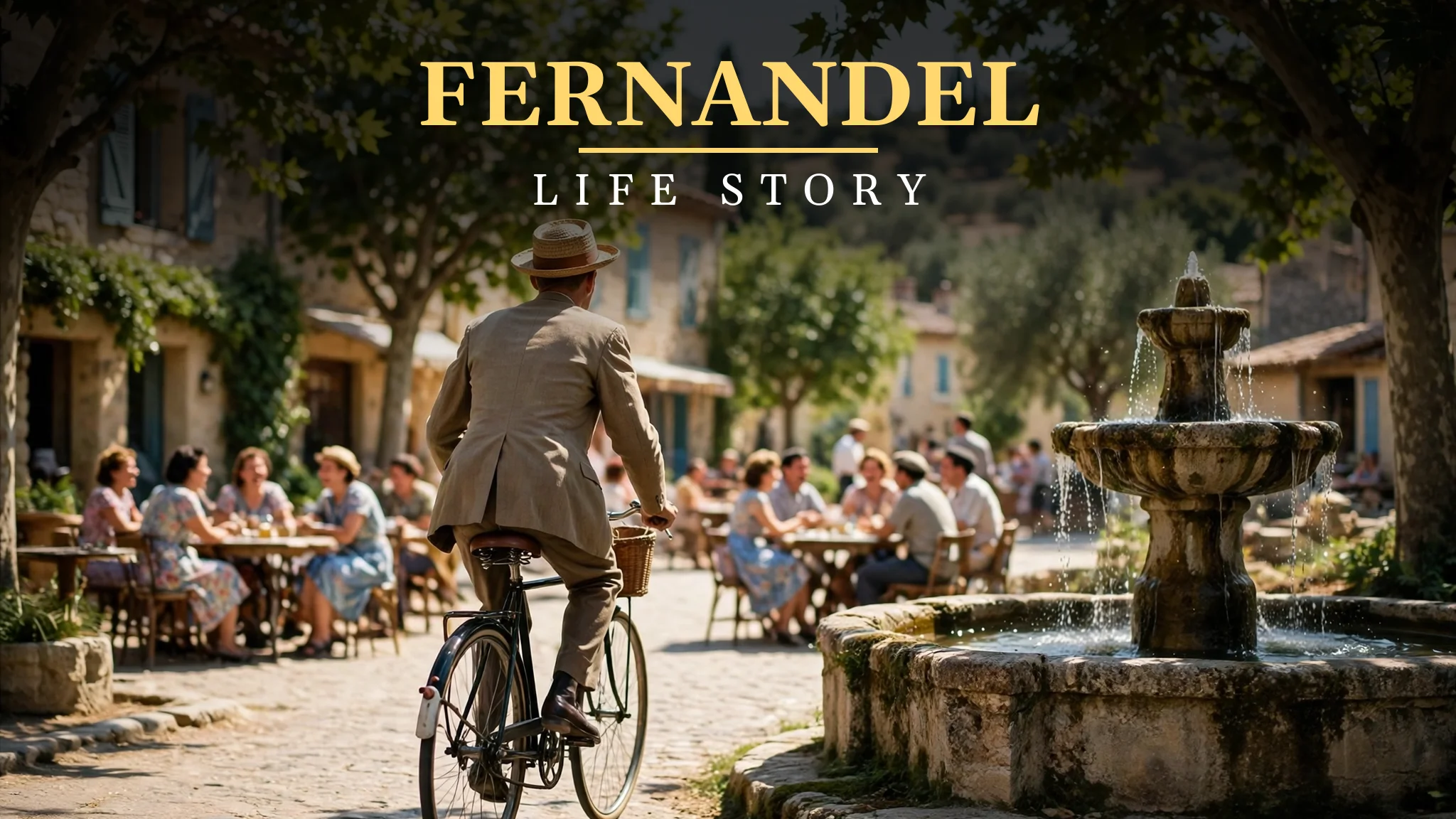
I keep thinking about the bicycle in the village square, the fountain, the café tables, and the sunny day. It is a picture of the south of France, of a simple life, and of a man riding through it with a smile. That is Fernandel’s world, and it is a world of sun, of laughter, and of people sitting together. He gave that world to the cinema, and he gave it to the whole world. In the end, I think that is his gift: he took the laughter of Marseille, and he shared it with everyone. That laughter is still there, in his films, in his songs, and in the memory of Don Camillo. It has not faded, and I do not think it ever will.
I also think about his work ethic, and about what it means to make more than a hundred films. That is not a career built on luck. It is a career built on showing up, day after day, year after year, and giving the audience your best. I think about the young actors today who want fame quickly, who want one film to make them stars, and I wish they knew Fernandel’s story. He did not become a star in one night. He became a star by working for forty years, and by never letting the audience down. He worked through the war, through hard times, and through changes in cinema, and he kept going. That is a lesson in patience, and it is a lesson I want to remember.
I think about the Don Camillo films, and about the friendship between the priest and the mayor, Peppone. They disagree about almost everything, they argue, they fight, and they try to outwit each other. But they also respect each other, and when the village is in trouble, they stand together. That is a powerful idea, and it is one that the world needs today. People who disagree do not have to hate each other. They can argue, they can laugh, and they can still be friends. Fernandel and his co-star made that idea live on screen, and it is still needed. I think about the arguments in my own life, and about the people I disagree with, and I remember Don Camillo and Peppone. They show me that disagreement does not have to mean hatred, and that respect can survive any argument.
I also think about his family, and about the way he kept his life simple. He was married for forty-six years, he raised three children, and he lived quietly, away from scandal. He was a star, but he was also a husband and a father, and he took those roles seriously. I think about the stars today who live loud lives, who chase attention, and who forget their families. Fernandel did not forget. He worked, he went home, and he lived with the people he loved. That is a good way to live, and it is a way that keeps a person honest. Fame is a loud thing, but family is a quiet thing, and Fernandel chose the quiet thing, even when the loud thing was calling him.
There is a sadness in his story that I cannot ignore, and it is the film that was never finished. He was making a new Don Camillo film when he became too ill to continue, and the film was never made. I think about that unfinished film, and about the story that was never told, and I feel the loss. It is a reminder that life does not always give us a clean ending, and that some stories are left unfinished. But I also think that Fernandel’s story is not unfinished. He made more than a hundred films, he sang dozens of songs, and he left behind a character, Don Camillo, who will never be forgotten. That is a finished story, in the best sense: a life that was full, even if it ended too soon.
Finally, I think about his face, and about what it teaches us. He had a face that was not handsome in the usual sense, and he made it famous. He did not wish for a different face. He used the face he had, and he made the world love it. I think about the people who wish they looked different, who hide their faces, and who feel ashamed of what makes them different. Fernandel shows them that the thing that makes you different might be the very thing that makes you loved. Do not hide it. Use it, own it, and let the world see it. He did, and the world loved him for it, and that is a lesson that will last as long as his films.
I also think about La Vache et le prisonnier, and about the man who walks across Germany with a cow. It is a funny idea, but it is also a moving one, because the cow is his friend, his cover, and his reason to keep going. Fernandel plays the prisoner with a tenderness that makes the audience care about both the man and the cow. I think about the friendships in my own life, and about the companions who help us through hard times, even when they are not human. A dog, a cow, a friend: they all give us a reason to keep walking. Fernandel shows that in this film, and he does it with humour and with heart. It is a film about survival, and about the small kindnesses that keep us alive.
I think about his son Franck, and about the family he built. Fernandel was a father, a husband, and a star, and he kept those parts of his life together. He did not let fame break his family. He worked, he went home, and he loved his children. I think about the fathers who work hard, who come home tired, and who still find time for their children. Fernandel was one of them, and his son followed him into show business, singing and acting, because he had seen his father do it with love. That is a legacy that is just as important as any film: a son who follows his father, not because he has to, but because he wants to.
Finally, I think about the village square, the fountain, the café tables, and the man on a bicycle in the sun. It is a picture of the south of France, of a simple life, and of a man riding through it with a smile. That is Fernandel’s world, and it is a world of sun, of laughter, and of people sitting together. He gave that world to the cinema, and he gave it to the whole world. He took the laughter of Marseille, and he shared it with everyone, and that laughter is still there, in his films, in his songs, and in the memory of Don Camillo. It has not faded, and I do not think it ever will.
I also think about Topaze, and about the honest schoolteacher who is used by corrupt men. Fernandel plays him with a warmth and a sadness that make the audience care deeply. I think about the honest people in the world, who try to do the right thing, and who are often taken advantage of. Topaze is one of them, and Fernandel makes us root for him, even when we know he will be hurt. That is a powerful story, and it is one that matters today as much as it did in 1951. Honesty is not always rewarded, but it is always worth it, and Fernandel shows that in Topaze, with a performance that is both funny and deeply moving.
Frequently Asked Questions
What was Fernandel’s real name, and where was he born?
Fernandel was born Fernand Joseph Désiré Contandin on 8 May 1903 in Marseille, in the south of France. His father was a music hall singer, and Fernand grew up backstage in the world of the stage, taking the name Fernandel as a young performer.
How did Fernandel become famous?
He became famous first as a comic singer in the music halls of Marseille and Paris, and then as a film actor in the 1930s, when sound films needed performers who could speak, sing, and make people laugh. His long face, warm accent, and perfect timing made him one of France’s most popular stars.
What is Don Camillo, and why is it his most famous role?
Don Camillo is a fighting priest in a small Italian village, played by Fernandel from 1952 in Le Petit Monde de Don Camillo and in several sequels. The priest argues constantly with Peppone, the communist mayor, yet the two men respect each other, and the films became loved around the world.
How many films did Fernandel make?
He made more than a hundred films in a career of over forty years, including Ali Baba et les quarante voleurs, La Vache et le prisonnier, Topaze, and the Don Camillo series. He also sang on stage and on radio, and he worked steadily from the early 1930s until his final illness.
Who was Fernandel married to?
He was married to Henriette Manse from 1925 until his death in 1971, and they had three children together. His son Franck Fernandel also became a singer and actor, and Fernandel kept his family close throughout his long career.
When and how did Fernandel die?
He died in Paris on 26 February 1971, at the age of sixty-seven, after suffering from lung cancer. He was working on a new Don Camillo film when he became too ill to continue, and the film was never finished.


