Francis Cabrel: The Life Story Behind France's Gentle Folk Singer
In this post
Francis Cabrel is the gentle voice of the French countryside. He sang about small towns, about wheat fields, about love, and about the simple life, and he did it with a guitar, a soft voice, and words that were clear and warm. He did not need a big show, a glittering stage, or dancers. He needed a guitar, a song, and an audience that wanted to listen, and with those three things he became one of the most loved singers in France.
He was born in Agen, in the south-west of France, he grew up in a small town, and he became famous in the late 1970s with songs that spoke about love, about the land, and about the people who live there. He wrote Petite Marie, Je l’aime à mourir, L’Encre de tes yeux, and La Corrida, and each of those songs is still played today, in homes, in cars, and on the radio, whenever people want to hear a song about love, about the countryside, and about life.
He is still alive, still singing, and still living in the south-west, in a small town where he can walk, play guitar, and write songs, away from the noise of Paris. He has kept his audience for more than forty years, because his songs are honest, warm, and full of heart, and because he has never changed his style to follow fashion. He is a singer of the land, and his songs are the sound of France outside the big city.
A Boy from Agen in the South-West
Francis Cabrel was born in Agen, in the Lot-et-Garonne region of south-west France, on 12 November 1953. His father was a worker in a cake factory, and his mother was a cashier in a shop, so the boy grew up in a modest home, with little money, but with a lot of love. He went to school in Agen, he played with friends in the streets, and he learned to love the countryside, the fields, the rivers, and the small towns of the south-west, a love that stayed in his songs for the rest of his life.
He was a shy and thoughtful boy, and he did not like to be the centre of attention. He liked to listen to music on the radio, he liked to read, and he liked to be alone with his thoughts. He heard Bob Dylan, he heard French chanson, and he began to play the guitar, learning to strum, to sing, and to write small songs about his own life. He was not a child who performed for the family. He was a child who listened, and who kept his feelings inside until he found a way to express them in music.
He left school early, and he worked in small jobs, in a shop, in a factory, and in other places, while he played guitar in the evenings. He was not a good student, but he was a good observer, and he noticed the small details of life that other people missed, the market, the fields, the cafe, and the people who lived in them. That habit of noticing became the heart of his songwriting, and it is why his songs feel so close to real life, because they are about the life he knew, in the south-west of France.
He began to sing in small clubs and in cafes, where his soft voice and his honest words began to attract attention. He was not loud, and he did not try to be a star. He simply sang, in a clear and warm voice, and people who heard him knew at once that he was different. He was not trying to copy anyone. He was trying to say something true about love, about the land, and about the people who live there, and that truth is what made his songs last.
Petite Marie and the First Fame
In 1977, Francis Cabrel recorded Petite Marie, a song about a young woman, about love, and about the tenderness of a first love, and it became a huge hit in France. The song was simple, with a gentle melody and honest words, and it made his name known all over the country. He sang it with a soft voice, with a guitar, and with a band that played folk, and the audience loved it, because it spoke about a feeling that everyone knows, the joy of loving someone young, and the hope that love will last. It was a perfect first hit, because it showed his gift for writing about love in a simple and direct way.
He followed it with other songs, and he became a star of French folk, touring France, playing in large halls, and appearing on television. He was young, he was handsome, and he had a voice that was clear and warm, and young people loved him, especially young women, who bought his records in large numbers. He was becoming a pop star, and he was enjoying it, but he was also working hard, because he knew that a first hit is not enough, and that a singer needs to keep writing, keep singing, and keep growing, if he wants to last.
He recorded Les Murs de poussière in 1977, his first album, and it showed that he was not only a singer of love songs. He was a songwriter who could write about the land, about the people who work it, and about the small towns of France, with a respect that was rare in pop music. He wrote about the dust, about the walls, and about the life of ordinary people, and he did it with a tenderness that made his songs feel like a letter home. That album was the start of a career that would last for more than forty years.
He did not move to Paris, and he did not chase the noise of show business. He stayed in the south-west, in Astaffort, a small town near Agen, where he could live quietly, walk in the fields, and write songs, away from the cameras. That choice was unusual for a star, but it was typical of the man he was, a man who loved the land, who loved a quiet life, and who believed that a singer should live where his songs come from, not in a big city far from his roots.
Je l’aime à mourir and the Great Love Songs
In 1979, Francis Cabrel recorded Je l’aime à mourir, a song about loving someone to death, about a love that is so strong that it feels like it could kill you, and it became one of his greatest hits. The song is tender, romantic, and full of feeling, and it is still played today, at weddings, at anniversaries, and on the radio, whenever people want to hear a song about love. He sang it with a soft voice, with a guitar, and with a band that played with care, and the audience loved it, because it spoke about a love that is simple, honest, and true. It is a song that has become a classic of French pop.
He recorded L’Encre de tes yeux in 1980, a song about the ink of your eyes, about writing love in the eyes of a person you love, and it became another hit. The song is poetic, warm, and full of images, and it showed that Cabrel could write about love with a beauty that was rare in pop music. He did not use simple words. He used images, of ink, of eyes, of writing, and he made them into a song that felt like a poem, and that is why his work is still praised by people who love the French language.
He also recorded Sarbacane in 1989, a song about a blowpipe, about a child who plays, and about the joy of youth, and it became a favourite at his concerts. He wrote about love, about children, and about the small joys of life, and he did it with a humour that made people smile even when the subject was serious. He was a songwriter who understood the heart, and who could put its feelings into words that people recognised as their own. His songs were not grand, but they were true, and that truth is why they are still played today.
He toured France, Europe, and other countries, and his concerts were full, with lights, with a band, and with a crowd that sang every word. He was a star, but he was also a man who worked hard, who rehearsed, and who gave his best every night. He did not take his fame for granted, and he did not treat his audience as if they were only fans. He treated them as friends, and he thanked them, night after night, for coming to hear him sing.
La Corrida and a Song About a Bull
In 1988, Francis Cabrel recorded La Corrida, a song about a bullfight, told from the point of view of the bull, and it became one of his most famous songs. The song is dramatic, sad, and full of feeling, and it speaks about a bull who knows he will die, who looks at the crowd, and who asks why he must suffer for their entertainment. It is a song about cruelty, about the pain of an animal, and about the human love of a spectacle, and it touched millions of people, because it made them think about a tradition that they had never questioned. Cabrel did not preach. He told a story, from the bull’s point of view, and he let the listener decide what to feel.
The song became a hit, and it is still played today, whenever people talk about bullfighting, about animals, and about the right to live without suffering. It showed that Cabrel could write about a serious subject with poetry, with drama, and with a heart, and that he was not afraid to take a side. He was a singer who believed in kindness, and he used his songs to defend the weak, whether they were people or animals, and that is a legacy that goes beyond music, a legacy of a man who used his voice for good.
He also wrote about the environment, about the land, and about the need to protect it, and he did it with songs that were gentle, not loud. He did not shout about the planet. He sang about a field, about a river, and about a tree, and he made the listener love those things, and want to protect them. That is a kind way to teach, to make people love the world, and then to let them decide to care for it. Cabrel did that, and his songs are still a part of the conversation about nature in France.
He continued to record in the 1990s, and his album Samedi soir sur la Terre, released in 1994, became one of the best-selling albums in French history, with songs including Je t’aimais, je t’aime et je t’aimerai, a song about loving in the past, in the present, and in the future. The song became a classic, and it is still played at weddings, because it speaks about a love that lasts, through time, through change, and through life. It is a song that has become a part of French life, and it is one of the reasons Cabrel is still loved today.
Astaffort, the Festival, and a Home in the South-West
Francis Cabrel lives in Astaffort, a small town in the south-west of France, near Agen, where he has lived for most of his life. He chose not to settle in the capital, and he avoided the rush of the entertainment world. He stayed in the south-west, where he could walk in the fields, play guitar, and write songs, away from the cameras. That choice was unusual for a star, but it was typical of the man he was, a man who loved the land, who loved a quiet life, and who believed that a singer should live where his songs come from.
He founded the Rencontres d’Astaffort, a festival and a school for young songwriters, where he helps new artists to write, to sing, and to find their own voice. He gives his time, his advice, and his encouragement, and he does it without making a show of it. He believes that a great songwriter should help the next generation, and he has done so, for many years, with a generosity that is rare in show business. Young singers who have been to Astaffort speak about him with love, and they say that he taught them to write honestly, to sing simply, and to trust their own feelings.
He is married to Mariette, and they have daughters, and he has tried to give his family a normal life, even though he is famous. He takes his daughters to school, he plays guitar with them, and he keeps his home as quiet as he can, away from the noise of show business. He is a star, but he is also a father, and he tries to be a good one, even when his work takes him away for long periods. He is a man who values home, and his songs about family and about love come from that value.
He has also been involved in charity work, helping children, helping people who are sick, and speaking out for causes he believes in. He is a star who believes that fame should be used for something useful, and he has done so, giving money, giving time, and giving his voice to help others. He is not a loud campaigner, but he is steady, and people listen to him because they trust his sincerity, and because they know that his songs come from a kind heart.
The Later Years and a Voice That Lasts
In the 2000s and 2010s, Francis Cabrel continued to record and to tour, and his concerts were full, with audiences who had grown up with him and with young listeners who had discovered him through their parents. He was a star who had lasted for more than thirty years, and he had done it by working, by changing, and by respecting his audience, and that is a rare achievement in show business. He did not try to stay young forever. He sang about growing older, about time passing, and about the changes that come with age, and his fans loved him for that honesty.
He recorded new albums, including Des roses et des orties in 2008, and he toured France, playing in large halls and in festivals, where his songs were sung by crowds who knew every word. He was a singer who had become a legend, and he did not need to chase hits. He simply sang, with a guitar, with a band, and with a voice that was still clear and warm, and his audience came to hear him, because they loved his songs and because they loved the man who sang them.
He has received honours in France, and he has been praised by other singers, who say that he is one of the greatest songwriters in French history. He has not chased honours, and he has not used them to promote himself. He has simply worked, written, and sung, and he has let his songs speak for him. That modesty is part of his character, and it is why he is so respected in France, not only as a singer, but as a man who has lived his life with honesty and with grace.
He is still alive, still singing, and still living in Astaffort, where he can walk, play guitar, and write songs, away from the noise of Paris. He is an old man now, but his voice is still warm, his guitar is still in his hands, and his songs are still in the air, in the schools, in the cars, and in the homes of France. He is a singer of the land, and his songs are the sound of France outside the big city, and they will keep singing for a long time.
Why Cabrel Still Matters
Francis Cabrel matters because he gave France songs about the countryside, about love, and about the simple life, and those songs are part of the life of the country. Petite Marie, Je l’aime à mourir, L’Encre de tes yeux, and La Corrida are played in homes, in cars, and on the radio, and new singers still record them. He is a singer, a guitarist, and a man of the land, and he has kept his audience for more than forty years, because his songs are honest, warm, and full of heart. That is a legacy that few singers ever earn.
He also matters because he showed that a singer can live outside Paris, in a small town, and still be a star, and that a quiet life can be a great life. He did not need the noise of the capital to be famous. He needed a guitar, a song, and an audience that wanted to listen, and he found all three in the south-west, where he still lives today. That is a lesson for anyone who dreams of fame, that you do not have to go to a big city to be great. You can be great where you are, if you work hard and if you sing true.
His work for young songwriters at Astaffort also matters, because it shows that a great artist should help the next generation, and that a song is not only for the singer, but for the future. He has taught young writers to write honestly, to sing simply, and to trust their own feelings, and those writers will carry his lessons forward, into new songs, new concerts, and new lives. That is a legacy that goes beyond his own records, a legacy of teaching, of giving, and of love.
A Singer of the Land
Cabrel is a singer of the land, and that is the best way to remember him. He sang about wheat fields, about small towns, about rivers, and about the people who live there, and he did it with a guitar, a soft voice, and words that were clear and warm. He did not sing about the city, about fame, or about luxury. He sang about the life he knew, in the south-west of France, and that life is the life of many people in France, who live outside Paris, who work the land, and who love their homes. His songs gave those people a voice, and that is a rare and beautiful gift.
His guitar is still in his hands, his voice is still warm, and his songs are still in the air, in the schools, in the cars, and in the homes of France. He is a singer who has lasted, because he has worked, because he has changed, and because he has respected the people who came to hear him sing. He is a part of French culture, and his songs are part of the life of the country, and they will keep singing, as long as people love, as long as people live in small towns, and as long as people sing about the land they love.
When a listener today hears Je l’aime à mourir, they hear a man who sang about love with tenderness, and they hear a voice that still carries that tenderness, even after many years. That is a gift that Cabrel left behind, a song that will last as long as people love, and as long as people sing about love with all their heart. He is a singer, and his voice is still singing.
My Take:
When I think about Francis Cabrel, I think first about the countryside. He sang about wheat fields, about small towns, about rivers, and about the people who live there, and he did it with a guitar, a soft voice, and words that were clear and warm. I admire that, because it takes a special kind of honesty to sing about a simple life, and to make that life feel important. Most pop stars sing about the city, about fame, and about luxury, but Cabrel sang about the land, and he made the land feel like the centre of the world. That is a lesson I carry with me, that a great subject does not have to be grand. It can be a field, a river, or a small town, and if you look at it with care, it can become poetry.
I admire his song Je l’aime à mourir, because it is about loving someone to death, about a love that is so strong that it feels like it could kill you, and it is a song that is tender, romantic, and full of feeling. He sang it with a soft voice, with a guitar, and with a band that played with care, and the audience loved it, because it spoke about a love that is simple, honest, and true. I think many people have felt that kind of love, a love that is so large that it feels dangerous, and Cabrel gave that feeling a tune. That is a gift, to take a strong feeling and to make it into a song that millions of people can sing together.
What moves me most is his song La Corrida, because it is about a bullfight, told from the point of view of the bull, and it is a song that makes people think. He did not preach, and he did not shout. He told a story, from the bull’s point of view, and he let the listener decide what to feel. That is a brave way to write a song, to take a side without forcing it, and to let the story do the work. I think that is a kind way to teach, to make people feel the pain of an animal, and to let them decide for themselves if a tradition is right or wrong. Cabrel did that, and his song is still played today, whenever people talk about bullfighting, about animals, and about kindness.
I also think about his life in Astaffort, and about the way he stayed in the south-west, even when he became famous. He did not move to Paris, and he did not chase the noise of show business. He stayed where his songs come from, in a small town, with fields, with rivers, and with people he knew, and that choice is a lesson for anyone who dreams of fame. You do not have to go to a big city to be great. You can be great where you are, if you work hard and if you sing true. Cabrel proved that, and his life is a proof that a quiet life can be a great life.
His work for young songwriters at Astaffort also impresses me, because it shows that a great artist should help the next generation. He founded the Rencontres d’Astaffort, a festival and a school for young writers, and he gives his time, his advice, and his encouragement, without making a show of it. He believes that a song is not only for the singer, but for the future, and he has taught young writers to write honestly, to sing simply, and to trust their own feelings. That is a generous act, and it is a part of his legacy that deserves to be remembered alongside his songs.
I think about his song Petite Marie, and about the young woman who is loved, and about the tenderness of a first love. That song was his first hit, and it is still played today, because it speaks about a feeling that everyone knows, the joy of loving someone young, and the hope that love will last. He wrote it when he was young, and he sang it with a soft voice, and the audience loved it, because it was honest and because it was warm. I think that is a lesson for any songwriter, to write about your own life, with your own words, and to trust that the audience will hear the truth.
His song L’Encre de tes yeux also stays with me, because it is about the ink of your eyes, about writing love in the eyes of a person you love, and it is a poetic song, full of images, that shows his gift for words. He did not use simple words. He used images, of ink, of eyes, of writing, and he made them into a song that felt like a poem. That is a rare gift, to make a pop song feel like poetry, and Cabrel had it, and he used it with care, in every song he wrote, from Petite Marie to La Corrida to Je t’aimais, je t’aime et je t’aimerai.
I also admire the way he has grown older as a singer, and the way his songs have grown deeper with him. He recorded Samedi soir sur la Terre in 1994, an album that became one of the best-selling albums in French history, with songs about love that lasts, through time, through change, and through life. He was no longer only the young singer of Petite Marie. He was a man who had lived, who had loved, and who had learned, and his songs reflected that learning, with a depth that his audience respected. That is a beautiful way to age, to accept the years and to find new things to say.
There is a sadness in his story too, and it is the sadness of a man who has lived in public for more than forty years, and who has had to share his private life with the world. He has had relationships, he has had family problems, and he has had to deal with the press, and that is hard for anyone. I do not judge him for his personal life, because a life in public is hard, and he has handled it with dignity. But I do see a lesson in it, that fame does not make family life easy, and that a star needs to protect his home, even when the world wants to know everything.
I think about his family, and about the way he has tried to give his daughters a normal life, even though he is famous. He is married to Mariette, and they have daughters, and he has spoken about being a father with warmth. He is a man who values home, and his songs about family and about love come from that value. I respect that, because a star who puts his family first, even when his work takes him away, is a man who understands what matters, and Cabrel does.
His love of nature also makes me think about the world we live in, and about the need to protect it. He sang about fields, about rivers, and about trees, and he made the listener love those things, and want to protect them. He did not shout about the planet. He sang about a field, and he made it beautiful, and that beauty is a kind of teaching, to love the world, and then to care for it. I think that is a useful lesson for today, when the world needs people who love nature, not only people who talk about it.
When I hear Je t’aimais, je t’aime et je t’aimerai today, I hear a song about loving in the past, in the present, and in the future, and I understand why it became a classic. It is a song about a love that lasts, through time, through change, and through life, and it is a simple song that carries a large feeling. That is a gift, to make a simple song that brings joy, and Cabrel had that gift. He did not need a complicated song to be great. He needed a true song, and he wrote it, and his audience sang it back, night after night, for many years.
I also think about the way he has kept his audience for more than forty years, and about how he has done it by working, by changing, and by respecting the people who came to hear him sing. He did not chase fashion, he did not seek scandal, and he did not change his style to please the moment. He sang his own songs, in his own way, and the audience came to him, year after year, decade after decade. That is a lesson for anyone who wants a long career, to be yourself, to work hard, and to care about the people who listen to you.
In the end, I think Cabrel teaches us that a gentle voice can be a strong voice, and that a simple song can be a great song. He did not shout, he did not dance wildly, and he did not try to be loud. He sang softly, with a guitar, about love, about the land, and about life, and he did it with honesty, with warmth, and with a heart that was open to the world. I hope readers listen to his songs, from Petite Marie to Je l’aime à mourir to La Corrida, and hear the journey in them, from a young man in Agen to a legend who has sung for forty years.
I hope young singers learn from him, not only how to play guitar, but how to write honestly, how to live simply, and how to respect an audience. He showed that you do not need to be loud to be loved, that you do not need to be perfect to be great, and that you do not need to go to a big city to be a star. You need to be yourself, to work hard, and to care about the people who come to hear you, and if you do that, your voice will last, as his has lasted, in France and beyond.
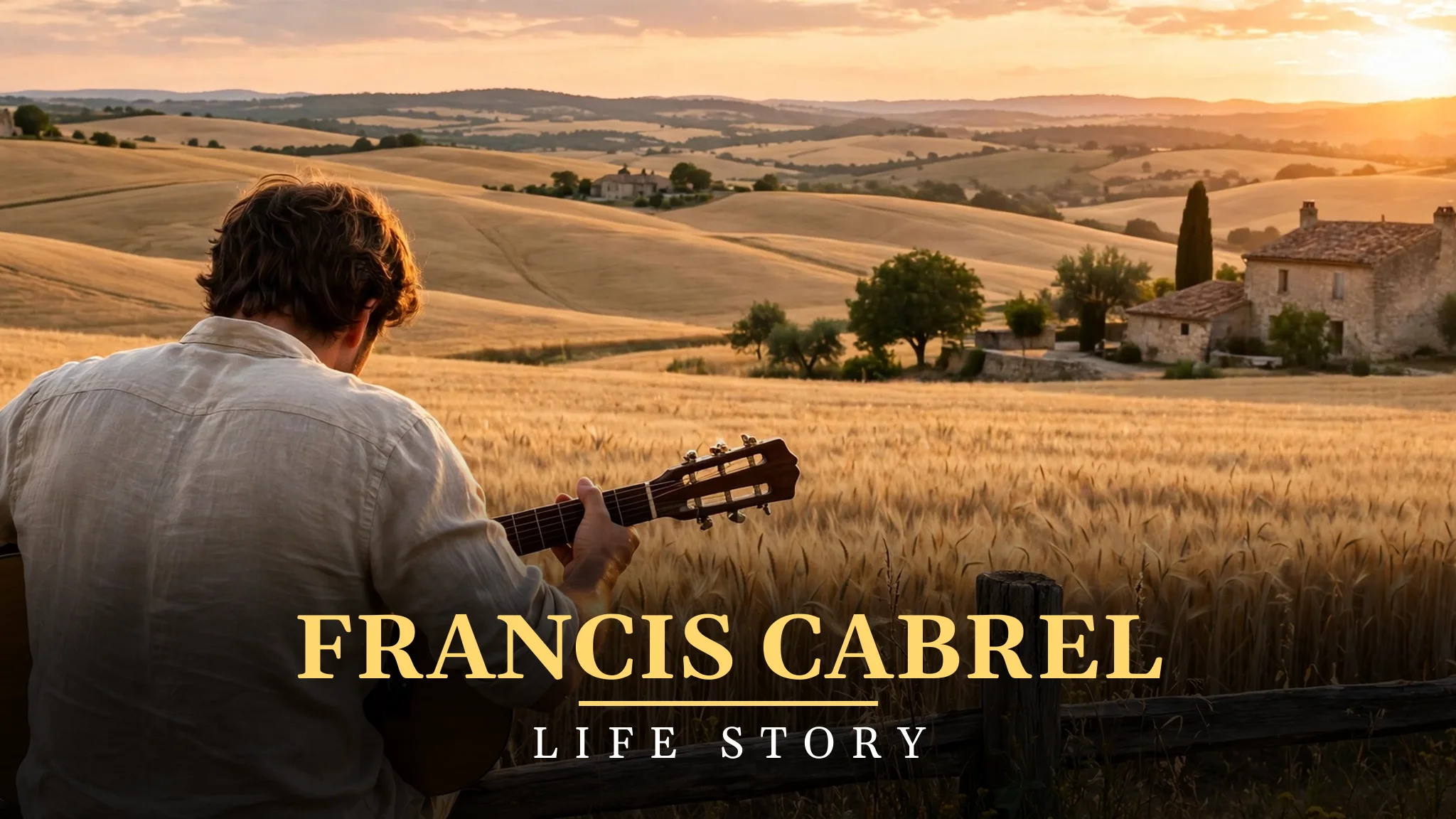
Finally, I think about the image of a man with a guitar, standing at a wooden fence, looking over golden wheat fields at sunset, with a stone farmhouse in the distance. That image is Cabrel, a singer of the land, a man who loves the countryside, and a man who sings about it with a warm heart. I hope that image stays with readers, and I hope they remember that a great artist can be gentle, kind, and true, and that a soft voice can be the strongest voice in the room, if it sings the truth.
I also think about the way he has kept his voice warm for more than forty years, and about how he has taken care of it, by singing softly, by resting, and by playing guitar with care. A voice is a fragile thing, and many singers lose it by shouting, by working too hard, or by chasing fame, but Cabrel has kept his, because he has treated it with respect. That is a lesson for any singer, to care for your voice, to rest it, and to use it wisely, so that it will last, as his has lasted, in the schools, in the cars, and in the homes of France.
His songs about children also stay with me, especially Sarbacane, a song about a child who plays with a blowpipe, and about the joy of youth. That song is playful, warm, and full of the freedom of childhood, and it shows that Cabrel could write about children with a tenderness that was rare in pop music. He did not write about children as small adults. He wrote about them as children, with games, with laughter, and with a sense of wonder, and that respect for childhood is a beautiful part of his work.
Finally, I think Cabrel shows us that a life can be lived at a calm pace, even in show business. He did not rush, he did not chase every trend, and he did not try to be famous every day. He worked when he wanted to, he rested when he needed to, and he kept his private life private. That calm is a lesson for anyone who feels rushed by the world. You do not have to run to be great. You can walk, you can look at the fields, and you can sing when you have something to say, and the world will wait for you, as it waited for Cabrel.
Frequently Asked Questions
When was Francis Cabrel born and is he still alive?
Francis Cabrel was born in Agen, France, on 12 November 1953, and he is still alive, still singing, and still living in Astaffort, in the south-west of France. He has been a star for more than forty years, since his first hit in 1977.
What is Francis Cabrel’s most famous song?
His most famous songs include Petite Marie from 1977, Je l’aime à mourir from 1979, L’Encre de tes yeux from 1980, La Corrida from 1988, and Je t’aimais, je t’aime et je t’aimerai from 1994. Each one is a classic of French folk pop.
What is La Corrida about?
La Corrida, recorded in 1988, is a song about a bullfight, told from the point of view of the bull. The bull knows he will die, looks at the crowd, and asks why he must suffer for their entertainment, and the song makes listeners think about cruelty and kindness.
Where does Francis Cabrel live and why is Astaffort important?
He lives in Astaffort, a small town near Agen in the south-west of France, where he has lived for most of his life. He founded the Rencontres d’Astaffort, a festival and school for young songwriters, where he helps new artists to write and to sing.
Did Francis Cabrel move to Paris to become famous?
No, he stayed in the south-west, even after he became famous, because he loved the land, the fields, and a quiet life. He believed that a singer should live where his songs come from, and he has kept that belief for more than forty years.
What is Samedi soir sur la Terre?
Samedi soir sur la Terre, released in 1994, is one of the best-selling albums in French history, with songs including Je t’aimais, je t’aime et je t’aimerai, a song about loving in the past, in the present, and in the future. It is still one of Cabrel’s greatest works.
Who influenced Francis Cabrel’s music?
He was influenced by Bob Dylan and by French chanson, and by the folk music of the south-west of France. He learned to play guitar, to write songs, and to sing in a soft and warm voice, and he made a style that was entirely his own.


