Francis Ngannou: The Life Story Behind MMA's Hardest Hitter
In this post
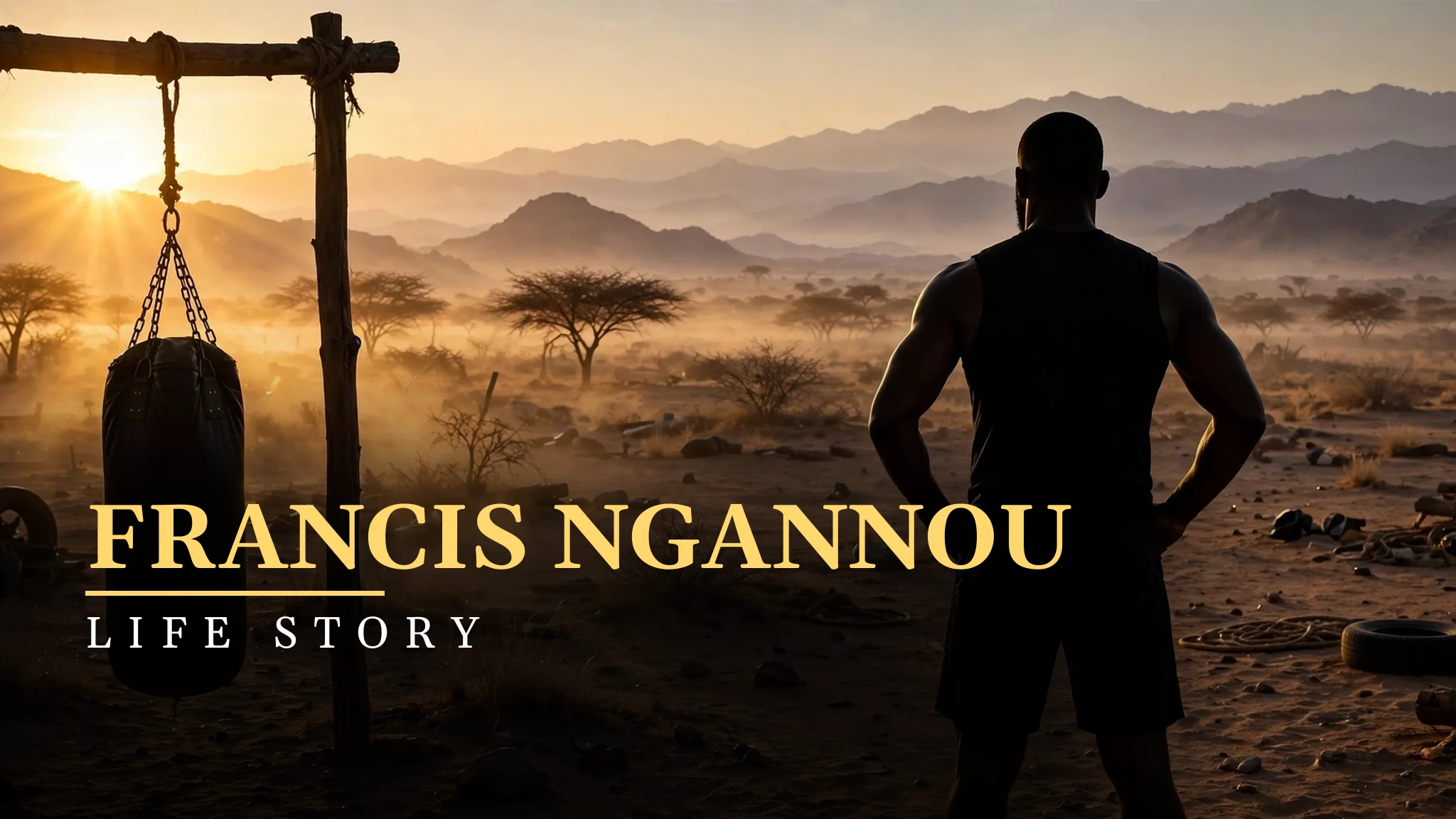
Francis Ngannou hits harder than any man who has ever fought in the UFC. That is not a boast. It is a measurement. Scientists tested his punch, and they found that it carried more force than any punch they had measured before, more than a heavyweight boxer, more than anyone. When Francis lands cleanly, fights end. Men fall, crowds gasp, and the cage goes quiet for a moment, because everyone watching has just seen something that should not be possible. He is a giant of a man, six feet four inches tall, with hands like hammers, and he came from a place where no one expected a champion to come from: a small village in Cameroon, where he worked in sand mines as a boy, where he had no shoes, and where he dreamed of becoming a boxer, even though he had never seen a boxing match.
His journey to the top is one of the most remarkable in the history of sport. He left Cameroon as a young man, he crossed the Sahara Desert, he was jailed in Morocco, he crossed the sea to Spain in a boat, and he arrived in Paris with nothing, homeless, sleeping in a car park, and training in a gym that took him in because they saw something in him. Within a few years, he was in the UFC. Within six years, he was the heavyweight champion of the world. He defended his title, he left the UFC over a contract dispute, and he fought Tyson Fury, the heavyweight boxing champion, in a fight that shocked the world because Francis, a man who had never boxed professionally, knocked Fury down and came close to winning. His story is about power, about hunger, and about a journey that few people could survive, let alone triumph in.
It is also a story marked by loss. In April 2024, Francis’s young son, Kobe, died, a tragedy that no parent should have to face, and one that Francis has spoken about with a grief that is hard to read. That loss is part of his story now, and it is part of why he fights, and why he keeps going. This is the story of a man who came from nothing, who crossed a desert and a sea to find a better life, and who became the hardest hitter in the history of MMA.
Batie, Sand Mines, and a Childhood Without Shoes
Francis Zavier Ngannou was born on 5 September 1986 in Batie, a village in the West Region of Cameroon, a country in Central Africa, where life was hard and where poverty was a daily reality. He grew up in a family that struggled to make ends meet, and his parents separated when he was young. Francis lived with his mother and his siblings, and later with his grandmother, and he learned early that he had to work to survive. As a boy, he worked in the sand mines near Batie, digging sand with his hands, carrying heavy loads, and earning a small amount of money that helped his family. He has spoken about working in the mines from the age of ten, about the heat, the dust, and the exhaustion, and about how the work made him strong in a way that no gym ever could. He did not have shoes, he did not have proper clothes, and he did not have the things that most children take for granted. What he had was strength, and a dream.
That dream was boxing. Francis had heard about boxing, about Muhammad Ali, about Mike Tyson, and he wanted to become a boxer, even though he had never seen a fight, even though there was no boxing gym in Batie, and even though his family thought the dream was foolish. He ran, he did push-ups, he lifted heavy things, and he imagined himself in a ring, in front of a crowd, fighting for a title. It was a dream that seemed impossible, and for many years it was impossible, because Francis had no money, no training, and no way to leave Cameroon. But he did not give up. He worked in the mines, he saved what little he could, and he waited for a chance to leave. When he was twenty-six years old, in 2012, he finally left, with a small amount of money, a bag, and a dream that had survived for more than a decade.
The journey from Cameroon to Europe was long, dangerous, and almost impossible. Francis travelled through Nigeria, through Niger, and across the Sahara Desert, a journey that took weeks and that nearly killed him. He was jailed in Morocco, he was turned back, and he tried again. He crossed the Mediterranean Sea from Morocco to Spain in a small boat, a crossing that many people do not survive, and he arrived in Spain with nothing. He made his way to Paris, France, where he had heard there were boxing gyms, and where he hoped to find a trainer who would take him on. He arrived in Paris homeless, with no money, no place to stay, and no one to help him. He slept in a car park, he ate what he could find, and he looked for a gym. That is where his story changes, because in Paris, he found a gym, and the gym found him.
Paris, Homelessness, and the Gym That Saved Him
When Francis Ngannou arrived in Paris in 2013, he was homeless, hungry, and alone in a city where he did not speak the language and where he knew no one. He found a boxing gym, the MMA Factory, run by a coach named Fernand Lopez, and he asked if he could train there. Lopez saw something in Francis: a huge, strong young man, with a natural power that could not be taught, and with a hunger that was obvious in his eyes. Lopez took him in, he gave him a place to train, he gave him food, and he gave him a chance. Francis trained every day, he learned MMA, he learned wrestling, and he learned how to use his power in a cage. He also worked, cleaning the gym, doing odd jobs, and earning a small amount of money while he trained. It was a hard life, but it was better than the life he had left behind, and Francis was grateful for every day of it.
His early MMA career in France was fast and brutal. He won his first fights by knockout, showing a power that shocked everyone who saw him. He fought in small promotions in France and in Switzerland, and he won fight after fight, mostly in the first round. In 2015, after only a handful of professional fights, he signed with the UFC, the biggest MMA promotion in the world. He was twenty-nine years old, he had been in Paris for only two years, and he was about to fight on the biggest stage in the sport. It was a remarkable rise, from a car park in Paris to the UFC in two years, and it showed what Francis could do when he was given a chance. He did not waste it. He took it, and he ran with it.
Francis made his UFC debut in December 2015, against Luis Henrique, a Brazilian fighter, and he won by knockout in the second round. He won his next fights, beating Curtis Blaydes, Bojan Mihajlovic, and Anthony Hamilton, all by knockout, and he became known as the most dangerous puncher in the heavyweight division. His power was so great that opponents were afraid to stand with him, and his fights became events that fans looked forward to, because they knew that at any moment, a single punch could end the night. Francis was not a technical fighter, in the way that some heavyweights are. He was a power fighter, a man who relied on his strength, his size, and his ability to land a punch that no one could take. That power, combined with his story, made him a star.
The Stipe Losses and Learning to Fight
Francis Ngannou’s first title fight came in January 2018, against Stipe Miocic, the UFC heavyweight champion and one of the greatest heavyweights of all time, at UFC 220 in Boston. Miocic was a skilled wrestler, a former firefighter, and a champion who had defended his title twice. Francis was the challenger, the younger man, and the favourite in the eyes of many fans, because of his power. The fight did not go as Francis had hoped. Miocic took him down, controlled him on the ground, and won a clear decision after five rounds. Francis was exhausted by the end, his power had faded, and he had learned a hard lesson: power alone is not enough. You need cardio, you need wrestling defence, and you need to be able to fight for five rounds, not only for one.
He lost again in his next fight, in July 2018, against Derrick Lewis, in a fight that was slow, boring, and widely criticised as one of the worst heavyweight fights in UFC history. Francis threw very few punches, Lewis threw very few punches, and the crowd booed. Francis lost on points, and his career seemed to be in trouble. He had gone from being the most feared puncher in the sport to being a fighter who had lost two fights in a row, and who had looked lost in the cage. Many people wrote him off, and many said that his power had been exposed, and that he would never become champion. Francis did not listen. He went back to the gym, he worked on his wrestling, he worked on his cardio, and he learned from his defeats.
He came back in November 2018, beating Curtis Blaydes in a rematch, knocking him out in forty-five seconds, and he won his next fights, beating Cain Velasquez in February 2019, knocking him out in twenty-six seconds, and beating Junior dos Santos in June 2019, knocking him out in the first round. He beat Jairzinho Rozenstruik in May 2020, knocking him out in twenty seconds. Each win was a knockout, each win was fast, and each win showed that Francis had learned from his losses. He was still a power puncher, but he was now a smarter fighter, a fighter who knew how to pace himself, how to defend a takedown, and how to wait for the right moment to land his punch. He had earned a second chance at the title, and this time, he was ready.
The Title Win and the Gane Defence
Francis Ngannou fought Stipe Miocic for the heavyweight title for a second time in March 2021, at UFC 260 in Las Vegas, and this time the result was different. Francis fought a patient, disciplined fight, defending Miocic’s takedowns, landing punches, and, in the second round, knocking Miocic out with a punch that ended the fight. He became the UFC heavyweight champion, and he did it in a way that showed how much he had grown. He was not the wild, reckless fighter of 2018. He was a champion, a man who had learned from defeat, and who had come back stronger. The win was a triumph, not only for Francis, but for Cameroon, for Africa, and for everyone who had followed his journey from the sand mines to the top of the world.
He defended his title in January 2022, against Ciryl Gane, a French fighter who was unbeaten and who was seen as the next great heavyweight, at UFC 270 in California. Gane was a skilled striker, a former kickboxer, and a fighter who was expected to test Francis. The fight was close, and Francis, who had injured his knee before the fight, surprised everyone by wrestling Gane, taking him down, and controlling him on the ground. He won a unanimous decision, defending his title and proving that he was more than a puncher. He was a complete fighter, and he was the heavyweight champion of the world. The win was a masterclass in adaptation, and it showed that Francis had become a champion in every sense of the word.
After the Gane fight, Francis’s relationship with the UFC broke down. He had been unhappy with his contract, with his pay, and with the way the UFC treated its fighters, and he refused to sign a new deal. He underwent knee surgery, he recovered, and in January 2023, the UFC announced that Francis had left the promotion, and that he had been stripped of his heavyweight title. It was a bold decision, and it was a risky one, because Francis was giving up the biggest platform in MMA, and he was betting on himself to succeed outside the UFC. He signed with the PFL, a rival promotion, and he turned his attention to boxing, a sport he had dreamed of since he was a boy in Batie.
Boxing Fury, Joshua, and the PFL
Francis Ngannou’s first boxing match came in October 2023, against Tyson Fury, the WBC heavyweight boxing champion and one of the greatest boxers of his generation, in Riyadh, Saudi Arabia. Fury was the favourite, and most people expected him to win easily, because Francis had never boxed professionally before. The fight shocked the world. Francis knocked Fury down in the third round, with a left hook, and he fought a competitive, brave fight for ten rounds. Fury won a controversial split decision, but many people watching thought Francis had done enough to win, or at least to earn a draw. The performance made Francis a star in boxing, and it showed that his power, his toughness, and his heart could carry him into a new sport, against the very best. It was a remarkable achievement for a man who had dreamed of boxing as a boy in Cameroon, and who had never had the chance to learn the sport properly.
He fought again in boxing in March 2024, against Anthony Joshua, another former heavyweight boxing champion, in Riyadh, and this time the result was different. Joshua, who was faster, more skilled, and more experienced as a boxer, knocked Francis out in the second round, landing a right hand that ended the fight. It was a painful defeat, and it showed the limits of Francis’s boxing. He was a great MMA fighter, and he was a powerful puncher, but he was not a professional boxer, and against a boxer as good as Joshua, that difference mattered. Francis took the loss with grace, congratulating Joshua, and saying that he had learned from the experience. He returned to MMA later in 2024, fighting for the PFL in October, and beating Renan Ferreira by knockout in the first round, winning the PFL heavyweight title and showing that he was still one of the best heavyweights in MMA.
Loss, Grief, and a Father’s Strength
In April 2024, Francis Ngannou’s young son, Kobe, died. Francis announced the loss on social media, and the MMA world, and the world beyond it, responded with an outpouring of sympathy and support. The death of a child is a tragedy that no parent should have to face, and Francis has spoken about it with a grief that is hard to read, and with an honesty that is brave. He has said that he does not know how to cope with the loss, that he thinks about his son every day, and that he is trying to find a way to go on. That is all that can be said, and it is enough. The loss is a part of his story now, and it is a part that deserves respect, not speculation, and not sensational detail. Francis is a father who lost his son, and he is grieving, as any father would.
His grief has shaped his life since April 2024, and it has shaped the way people see him. He is no longer only a fighter, or a champion, or the hardest hitter in MMA. He is a man who has suffered a terrible loss, and who is trying to live with it. He has continued to fight, he has continued to work, and he has continued to be a father to his other children, and that takes a strength that goes beyond anything he has shown in the cage. The cage is a place where a man can be strong for a few minutes, or for a few rounds. Grief is a place where a man has to be strong every day, for the rest of his life. Francis is learning to do that, and he is doing it in public, with a dignity that is admirable.
What Francis Ngannou Means
Francis Ngannou means a great deal to Cameroon, to Africa, and to the world. He is a man who came from a village where he worked in sand mines, who crossed a desert and a sea, who was homeless in Paris, and who became the heavyweight champion of the world. His journey is one of the most remarkable in the history of sport, and it shows what is possible when a person refuses to give up, even when the odds are against them. He is a hero in Cameroon, where his face is known to everyone, and where his story is told to children as an example of what hard work and determination can achieve. He is also a hero in Africa as a whole, where he is seen as a symbol of what African athletes can do, when they are given a chance.
His power, his story, and his character have made him one of the most loved fighters in MMA, and one of the most respected. He is not a trash-talker, he is not a showman, and he is not a man who seeks attention for its own sake. He is a quiet, humble, hard-working man, who speaks softly and hits hard, and who has never forgotten where he came from. He has used his fame to help his community in Cameroon, to build gyms, to support young people, and to give back to the place that made him. That is a legacy that goes beyond fighting, and it is one that will last long after his career is over. Francis Ngannou is the hardest hitter in MMA history, and he is also one of its greatest stories.
The PFL Return and a New Title
Francis Ngannou returned to MMA in October 2024, fighting for the PFL in Riyadh, Saudi Arabia, against Renan Ferreira, a Brazilian heavyweight who was the PFL champion. Francis had been away from MMA for almost three years, he had boxed twice, and he had suffered the loss of his son, and many people wondered whether he could still fight at the highest level. He answered them in the first round, taking Ferreira down and knocking him out with punches on the ground, winning the PFL heavyweight title. It was a powerful performance, and it showed that Francis, even after everything he had been through, was still one of the best heavyweights in the world. The win was not only about a title. It was about coming back, about proving that he could still fight, and about honouring his son by continuing to live and to work.
My Take:
I have thought about Francis Ngannou’s story many times, and I still find it hard to believe. A boy who worked in sand mines from the age of ten, who had no shoes, who dreamed of boxing even though he had never seen a fight, who crossed the Sahara Desert, who was jailed, who crossed the sea in a boat, who arrived in Paris homeless, and who became the heavyweight champion of the world. That is not a story. That is a miracle, and it is a miracle that Francis made happen through hard work, through determination, and through a refusal to give up. I think about the sand mines, and I think about how hot it must have been, how dusty, how exhausting, and I think about a boy who did that work every day, and who still dreamed of something better. That dream kept him alive, and it carried him across a desert and a sea, to a new life. I admire that more than I admire any punch he has ever thrown.
I also think about the power, because Francis’s power is not normal. Scientists measured his punch, and they found that it was the hardest they had ever measured, harder than any heavyweight boxer, harder than anyone. When Francis lands cleanly, fights end, and men fall, and the crowd goes quiet. That power is a gift, and it is a gift that Francis earned through years of hard work in the mines, carrying heavy loads, digging sand, and building strength in a way that no gym could teach. I think that is a lesson. Strength does not only come from a gym. It comes from life, from hard work, from doing difficult things every day, and Francis’s strength came from a childhood that was harder than most of us can imagine. He did not become strong in spite of his childhood. He became strong because of it, and that is a powerful thought.
The journey from Cameroon to Paris is the part of his story that I think about most, because it is a journey that many people have made, and that many people have not survived. Francis crossed the Sahara, he was jailed in Morocco, he crossed the sea to Spain, and he arrived in Paris with nothing. He slept in a car park, he ate what he could find, and he looked for a gym. That is a journey that takes a courage I cannot imagine. To leave your home, to cross a desert, to risk your life in a boat, all for a dream that seems impossible, is an act of faith. Francis had that faith, and he kept it, even when he was homeless, even when he was hungry, and even when he had no one to help him. I think that faith is the most important part of his story, and it is the part that should inspire anyone who has ever felt lost, or hopeless, or far from home. Francis was lost, and he was far from home, and he found his way, because he never stopped believing.
I also think about Fernand Lopez, the coach who took Francis in, and about the importance of a single act of kindness. Lopez saw a huge, strong young man, homeless in Paris, and he gave him a place to train, food to eat, and a chance. That single act changed Francis’s life, and it changed the history of MMA. Without Lopez, Francis might still be homeless, or he might have given up and gone home. With Lopez, he became a champion. I think that is a lesson for all of us. A single act of kindness, a single chance given to someone who needs it, can change a life, and can change the world. We should all be more like Fernand Lopez, and we should all look for the Francis Ngannous in our own lives, the people who need a chance, and give it to them.
The losses to Stipe Miocic and Derrick Lewis in 2018 are a part of Francis’s story that I think deserves attention, because they show that he could learn from defeat. He lost to Miocic because he was exhausted, because he had no cardio, and because he relied only on his power. He lost to Lewis because he was afraid to throw punches, because he had lost confidence. Many fighters would have given up after two losses like that. Francis did not. He went back to the gym, he worked on his wrestling, he worked on his cardio, and he came back stronger. He beat Blaydes, he beat Velasquez, he beat dos Santos, and he beat Miocic in the rematch to win the title. That is the mark of a great champion. It is not about never losing. It is about what you do after you lose, and Francis showed that he could learn, adapt, and return better than before. I think that is a lesson for anyone who has ever failed. Failure is not the end. It is a teacher, and if you listen to it, you can come back stronger.
The Fury fight in October 2023 is one of my favourite moments in combat sports, because it was so unexpected and so brave. Francis had never boxed professionally, and he fought Tyson Fury, the heavyweight boxing champion, in Riyadh, in front of the whole world. He knocked Fury down in the third round, and he fought a competitive fight for ten rounds. Fury won a controversial decision, but many people thought Francis had done enough to win. That performance showed the world what Francis could do, and it showed that his power, his toughness, and his heart could carry him into a new sport, against the very best. I think that fight is a perfect example of what Francis is: a man who is not afraid to take a risk, who is not afraid to fail, and who is willing to test himself against the best, even when the odds are against him. That courage is rare, and it is inspiring.
I also have to say something about the loss of his son, Kobe, in April 2024, because it is a part of Francis’s story that cannot be ignored, and that deserves to be treated with respect. The death of a child is the worst thing that can happen to a parent, and Francis has spoken about it with a grief that is hard to read. He has said that he does not know how to cope, that he thinks about his son every day, and that he is trying to find a way to go on. I do not have words for that kind of loss, and I do not think anyone does. What I can say is that Francis’s strength, the strength that made him a champion, is now being tested in a way that no fight could ever test it, and that he is facing that test with a dignity that is admirable. I hope that he finds peace, and that he finds a way to live with his grief, and that his other children give him a reason to keep going. That is all I can hope for, and it is enough.
If I had to choose one word to describe Francis Ngannou, it would be journey. His life has been a journey, from Batie to Paris, from the sand mines to the UFC, from homelessness to a championship, from MMA to boxing, and from triumph to grief. It is a journey that few people could survive, and that even fewer could triumph in, and Francis has done both. He is a man who crossed a desert and a sea, who became the hardest hitter in the world, and who is now learning to live with a loss that no parent should have to face. That is a story that deserves to be told, and it is a story that deserves to be remembered. Francis Ngannou is not only a fighter. He is a survivor, a champion, and a father, and his story is one of the most remarkable in the history of sport.
I also think about Cameroon, and about what Francis means to his country. He is a hero there, a man who came from a small village and became a world champion, and who never forgot where he came from. He has used his fame to help his community, to build gyms, and to support young people, and he has shown that success does not have to mean leaving home behind. It can mean bringing success home, and sharing it with the people who need it most. I think that is a beautiful part of his story, and it is one that should inspire athletes everywhere. When you succeed, do not forget where you came from. Go back, help your people, and make a difference. Francis does that, and he does it with a humility that is rare among famous athletes.
Finally, I want to say something to anyone who reads Francis’s story and feels inspired by it. Do not try to be Francis Ngannou. Try to be like him in the ways that matter: work hard, never give up, believe in your dream even when it seems impossible, and remember where you came from. Francis’s story is not only about fighting. It is about a boy who worked in sand mines and dreamed of boxing, a young man who crossed a desert and a sea, and a champion who became the hardest hitter in the world. If you can carry that spirit, that determination, and that humility into your own life, you will have a life to be proud of, whether you ever win a title or not. Francis won titles, and he won them brilliantly, but the titles are not the most important part of his story. The most important part is the journey, and the man who made it. I also think about the Joshua fight in March 2024, because it shows the limits of Francis’s boxing, and it teaches a lesson about knowing your sport. Joshua was a professional boxer, with years of experience, and he knocked Francis out in the second round. It was a painful loss, but it was also an honest one. Francis was a great MMA fighter, but he was not a professional boxer, and against a boxer as good as Joshua, that difference mattered. I respect Francis for taking the fight, because it took courage to step into a boxing ring against Joshua, but I also think it shows that even the hardest hitter in MMA cannot beat the best boxer in the world at his own game. That is not a criticism. It is a fact, and it is a reminder that every sport has its own skills, and that greatness in one sport does not guarantee greatness in another.
There is also a lesson in Francis’s story about contracts and about standing up for yourself. He left the UFC because he was unhappy with his pay, with his contract, and with the way fighters were treated, and he refused to sign a new deal, even though it meant giving up his title. That was a bold decision, and it was a risky one, because he was giving up the biggest platform in MMA. But he believed that fighters deserved better, and he was willing to bet on himself to prove it. He signed with the PFL, he fought Fury and Joshua in boxing, and he made more money than he would have made in the UFC. That is a powerful example, and it shows that a fighter who believes in himself can change the business, not only by winning fights, but by standing up for what he believes is right. I admire that, and I think other fighters will learn from it.
Finally, I want to say something about Africa, and about what Francis means to his continent. He is a hero in Cameroon, and in Africa as a whole, because he came from a small village, he crossed a desert and a sea, and he became a world champion. He shows young Africans that they can achieve great things, even when the odds are against them, and even when they come from a place that the world often overlooks. That is a powerful message, and it is one that Francis carries with him wherever he goes. He is not only a fighter. He is a symbol of what Africa can do, and that is a legacy that will last long after his fighting days are over.
Frequently Asked Questions
How did Francis Ngannou get to Europe from Cameroon?
He left Cameroon in 2012, travelled through Nigeria and Niger, crossed the Sahara Desert, was jailed in Morocco, and crossed the Mediterranean Sea to Spain in a boat. He then made his way to Paris, where he arrived homeless in 2013 and found a gym that took him in.
Why is Francis Ngannou known as the hardest hitter in MMA?
His punch was measured as the hardest ever recorded in the UFC, with more force than any heavyweight boxer tested. He has knocked out many of his opponents in the first round, including Stipe Miocic, Cain Velasquez, and Junior dos Santos.
How did Francis Ngannou win the UFC heavyweight title?
He beat Stipe Miocic by knockout in the second round at UFC 260 in March 2021, in a rematch of their 2018 fight. He had lost the first fight on points, but he came back, improved his wrestling and cardio, and won the title.
What happened when Francis Ngannou fought Tyson Fury?
He fought Fury in a boxing match in Riyadh in October 2023, knocked Fury down in the third round, and lost a controversial split decision after ten rounds. Many people watching thought Francis had done enough to win, and the performance made him a star in boxing.
Why did Francis Ngannou leave the UFC?
He was unhappy with his contract, his pay, and the way the UFC treated its fighters, and he refused to sign a new deal after defending his title against Ciryl Gane in January 2022. The UFC stripped him of his title in January 2023, and he signed with the PFL.
What happened to Francis Ngannou’s son?
His young son, Kobe, died in April 2024. Francis announced the loss publicly and has spoken about his grief with honesty, and the tragedy has shaped his life since that time.


