Franz Kafka: The Life Story Behind the Metamorphosis Author
In this post
- Prague, a Fancy Goods Shop and a Difficult Father
- Law, the Insurance Office and the Nights That Belonged to Writing
- Friends, Love and the Engagements That Never Led to Marriage
- The Metamorphosis and the Short Stories That Found Readers
- The Trial, The Castle and the Books He Never Finished
- Illness, Dora Diamant and the Last Year in Berlin
- Max Brod, the Burning That Never Happened and the Afterlife of the Books
- My Take:
Franz Kafka is one of the strangest cases in all of literature. He is now read in schools and universities in almost every country, his name has become an ordinary word in English, and his books are counted among the most important of the twentieth century. Yet during his life, almost nobody outside a small circle of friends in Prague knew who he was. He worked in an office, he went home to his parents’ flat, he wrote at night, and he published only a few short pieces. He asked his friend to burn his unpublished work after his death. The friend did the opposite. That single act of disobedience is why we know Kafka at all.
The word that carries his name, Kafkaesque, is now used for any situation that feels absurd, unfair and impossible to escape: a man arrested for a crime he does not understand, a man turned into an insect overnight, a man who waits for years outside a door that was meant for him alone. Those images come from his stories, but they also come from his life. Kafka felt trapped by his family, by his job, by his body and by the city he lived in, and he turned that feeling into fiction so clear and so strange that readers a hundred years later still recognise it at once.
This is not a story of fame arriving in time to be enjoyed. It is a story of a quiet, anxious man who wrote because he had to, who doubted almost everything he wrote, and who died at forty, believing that his best work should be destroyed. The fact that it was saved, and that it changed literature, is one of the great accidents of cultural history, and it makes Kafka’s life both sad and strangely hopeful.
Prague, a Fancy Goods Shop and a Difficult Father
Franz Kafka was born on 3 July 1883 in Prague, which was then part of the Austro-Hungarian Empire and is now the capital of the Czech Republic. He was the eldest child of Hermann Kafka, a Jewish merchant who ran a fancy goods shop, and Julie Kafka, who came from a wealthier family and worked in the shop as well. Franz grew up in a German-speaking Jewish family in a city where Czech was the language of most people around him, and that in-between position, German at home, Czech in the streets, Jewish in a largely Christian city, shaped his sense of never quite belonging anywhere.
His father was a large, loud, confident man who had built his business from nothing, and Franz, who was thin, shy and sensitive, felt small beside him all his life. Hermann Kafka was not, by most accounts, a cruel man in the simple sense, but he was demanding, impatient and quick to judge, and Franz spent his childhood trying to win approval he rarely felt he had earned. He later wrote a long letter to his father, the famous Letter to His Father, which was never sent in his lifetime, in which he tried to explain how that fear had shaped him. Whether the letter is a fair portrait of Hermann or a portrait of Franz’s own anxiety is still argued about, but there is no doubt that the father-son relationship was the central wound of Kafka’s life.
Franz had younger sisters, Gabriele, Valerie and Ottilie, and he was close to them, especially to Ottilie, the youngest, who shared his love of books and his feeling of being an outsider in the family. Two younger brothers died in infancy, and their deaths cast a shadow over the household. The family moved flats several times in Prague, always near the Old Town Square, always close to the shop, and Franz’s world was small: the flat, the shop, the school, and the streets between them. He was a good student, but not a happy one, and he learned early to keep his inner life private.
At school, he studied at a German gymnasium, where the teaching was strict and the atmosphere was formal. He read widely, he was interested in literature and in ideas, and he began to write in his teens, though he showed his work to almost nobody. He also suffered from poor health, from headaches and from a sense of physical weakness that made him feel, even as a young man, that his body was not quite on his side. That feeling would grow stronger with time, and it would become one of the great themes of his fiction: a body that betrays you, a mind that cannot control it, a life that feels like it is happening to someone else.
When he left school, he went to university in Prague, first studying chemistry for a short time, then law, which was a practical choice, a degree that would lead to a job. He did not love law, but he finished it, and he earned his doctorate in 1906. He was, by then, a young man with a degree, a difficult father, a small circle of friends, and a growing pile of notebooks that nobody had read. The next step was work, and work would take up most of his days for the rest of his short life.
Law, the Insurance Office and the Nights That Belonged to Writing
After university, Kafka worked briefly in a law office and then, in 1908, took a job at the Workers’ Accident Insurance Institute in Prague, a state office that dealt with claims from workers who had been injured in factories and on building sites. It was not a glamorous job, and it was not a job he had dreamed of, but it was steady, it paid a salary, and it left his evenings free. He stayed there for most of his working life, and he was, by all accounts, good at it. He wrote reports, he visited factories, he saw at first hand how machines could crush a hand or take a life, and he learned how a large organisation could treat a single person as a file number rather than a human being.
That experience went straight into his fiction. The Trial, his great unfinished novel, is about a man, Josef K., who is arrested one morning for a crime that is never named, and who spends the rest of the book trying to find out what he is accused of, moving through offices, corridors, courtrooms and waiting rooms that never lead to an answer. The Castle is about a land surveyor, known only as K., who tries to reach a castle that governs a village, and who is kept waiting, misled and delayed by officials who never quite say no and never quite say yes. Readers have always seen in those books the insurance office, the law courts, the empire itself: a world of rules that nobody can explain, and of power that cannot be faced directly because it has no face.
Kafka’s working day ended in the early afternoon, and he would go home, sleep for a few hours, and then write at night, often until the early hours of the morning. That rhythm, work by day, writing by night, was both a gift and a burden. It gave him a structure, but it also left him tired, and he often felt that his writing was stealing time from his health, and his health was stealing time from his writing. He wrote in his diary about that struggle, about the feeling that he was two people, the clerk and the writer, and that neither one was quite winning.
He did publish during his life, though only a little. A collection of short pieces, Contemplation, appeared in 1912, and The Metamorphosis was published in 1915. The story opens with one of the most famous first sentences in literature: a travelling salesman named Gregor Samsa wakes one morning to find that he has been turned into a large insect. Kafka never explains how or why, and that refusal to explain is the point. The story follows Gregor as his family, first shocked, then disgusted, then tired, slowly stops treating him as a person at all. It is a story about illness, about shame, about being a burden, and about how quickly love can turn into impatience when a person changes.
Kafka’s friends knew he was writing, and a few of them, above all Max Brod, a writer and editor who became his closest friend, encouraged him to publish more. Brod saw the quality of the work, and he saw that Kafka’s doubt about it was not a true measure of its worth. Without Brod, Kafka might have published even less, and without Brod’s later decision to ignore Kafka’s instructions, we might have lost the novels altogether. It is one of the ironies of Kafka’s life that his greatest literary act, in a way, was not his own. It was his friend’s refusal to obey him.
Friends, Love and the Engagements That Never Led to Marriage
Kafka’s personal life was as tangled as his fiction, and it was shaped by the same fear: the fear of being trapped, and the fear of being alone. He fell in love several times, and he became engaged twice to the same woman, Felice Bauer, a Berlin businesswoman he met in 1912. They wrote to each other for years, hundreds of letters, in which Kafka poured out his thoughts, his fears and his love, and in which he also, again and again, pulled back. He wanted marriage, and he feared it. He wanted a home of his own, away from his parents, and he feared that marriage would take away the solitude he needed to write.
The engagement to Felice was broken off, renewed, and broken off again, and the letters remain one of the great records of a man who could not decide what he wanted most: love or freedom, a family or a desk. He later became engaged to Julie Wohryzek, and that engagement also ended. He had a deep and important relationship with Milena Jesenska, a Czech writer and translator who translated his work into Czech, and their letters are among the most moving he ever wrote. In the last year of his life, he lived with Dora Diamant, a young woman from a Hasidic family, in Berlin and then in Vienna, and that relationship, brief as it was, gave him a happiness he had rarely known.
It would be wrong to present Kafka as a man who could not love. He loved deeply, and he was loved in return. What he could not do, for most of his life, was to make the ordinary arrangements of adult life, a flat, a marriage, children, a settled routine, without feeling that something essential in him would be lost. He wrote about that feeling with terrible clarity, and his letters show a man who understood his own problem and could not solve it. That self-knowledge is part of what makes his work so painful to read: he saw the trap, and he saw that he had built much of it himself.
His friendships were, in many ways, easier for him than his romances. Max Brod was the centre of that world, a generous, talkative, confident man who was almost the opposite of Kafka, and who loved him without reservation. Brod organised Kafka’s life in small ways, introduced him to publishers, read his manuscripts, and kept him connected to the literary world of Prague. There were other friends too, writers, artists and thinkers who met in cafes and in each other’s flats, and who talked about books, about politics, about the future of the empire that was about to collapse in the First World War. Kafka listened more than he spoke, but when he spoke, people remembered it.
The war itself touched his life in indirect ways. He was not sent to the front, partly because of his job at the insurance institute, which was considered important, and partly because of his health. He watched the empire fall apart, he watched Prague change, and he watched his sisters marry and build lives of their own. He stayed, for the most part, in the flat with his parents, writing at night, working by day, and growing more ill, more tired, and more certain that time was running out.
The Metamorphosis and the Short Stories That Found Readers
The Metamorphosis, published in 1915, is the work that most readers meet first, and it is a good place to start, because it contains, in a short space, almost everything Kafka wrote about. Gregor Samsa is a travelling salesman who supports his family, who works hard, who has no life of his own, and who wakes one morning transformed. His family, at first, tries to care for him, but they are frightened, they are ashamed, and they are tired. His sister, Grete, who is kind at first, grows impatient. His father throws apples at him, wounding him. In the end, Gregor dies alone in his room, and his family, relieved, goes out for a walk in the spring sunshine. It is a bleak ending, and it is also, in Kafka’s hands, a strangely tender one, because Gregor, even as an insect, still thinks of his family, still wants to help them, still hopes to be loved.
The story is often read as a story about illness, and there is truth in that reading. Kafka was himself ill, and he knew what it was to be a burden, to need care, to feel that your body has made you strange to the people who love you. It is also a story about work, about a man who has given his life to a job and has nothing left for himself, and about a family that loves a provider more than it loves a person. Readers have found many meanings in it, and that is part of its power. Kafka did not explain his stories, and he did not want them explained. He wanted them to be felt, and they are.
His other short works from these years include In the Penal Colony, about a terrible machine that writes a sentence on a man’s body, and A Hunger Artist, about a man who starves himself for public entertainment and is forgotten when the public loses interest. Both stories are short, both are strange, and both are about men who are trapped by a system they cannot understand and cannot escape. The Hunger Artist, written near the end of his life, is often read as Kafka writing about himself: an artist who does something nobody else can do, and who discovers that nobody cares anymore.
Kafka also wrote The Judgment, a short story about a son who tells his father he is engaged, and whose father, in a sudden turn, condemns him to death by drowning, and the son obeys, running to the river and jumping in. The story was written in a single night in 1912, and Kafka was proud of it, though he was also frightened by it. It shows, more clearly than anything else he wrote, the power of the father in his imagination, a power that could not be argued with, only obeyed. It is not a realistic story, and it is not meant to be. It is a nightmare made into words, and it is a nightmare that many readers recognise, even if their own fathers were nothing like Hermann Kafka.
During these years, Kafka’s health was getting worse. He suffered from insomnia, from headaches, from a cough that would not go away. In 1917, he was diagnosed with tuberculosis, the disease that would kill him. He took leave from work, he went to sanatoriums, he tried to rest, but the disease did not go away. He kept writing when he could, and he kept hoping, in a quiet way, that he would get better. He did not. The last years of his life were a slow decline, marked by periods of hope and periods of fear, and by a growing sense that his work would not be finished.
The Trial, The Castle and the Books He Never Finished
The Trial and The Castle are Kafka’s two great unfinished novels, and they are unfinished in a way that feels, to many readers, like part of their meaning. The Trial tells the story of Josef K., a bank clerk who is arrested on his thirtieth birthday, though no one will tell him what he is charged with. He spends a year trying to understand his case, hiring a lawyer, visiting court offices in attics, talking to painters and priests, and getting nowhere. In the end, two men come for him, take him to a quarry, and kill him, and his last words are, in effect, that he dies like a dog. It is a terrifying book, not because it is violent, but because it is calm. The world of The Trial is polite, bureaucratic and utterly indifferent, and Josef K. is destroyed not by anger but by procedure.
The Castle is, if anything, stranger. A man called K. arrives in a village in winter, claiming to be a land surveyor summoned by the Castle, the great building on the hill that governs the village. He tries to reach the Castle, he tries to speak to its officials, he tries to find a place to live and work, and he is always delayed, always misled, always told to wait. The novel breaks off in the middle of a sentence, and we will never know how Kafka intended it to end. That incompleteness has not stopped readers from loving it. In a way, it is the perfect ending for a book about waiting: the waiting never ends, because the book itself never ends.
Kafka wrote these novels in the years after his diagnosis, when he knew he was ill, and he wrote them quickly, in bursts, often at night, often in notebooks that he did not show to anyone. He was not writing for publication in the ordinary sense. He was writing because the stories were in him, and because writing was the only way he could make sense of a world that felt increasingly senseless. He doubted the work, he rewrote it, he left gaps and contradictions, and he never finished either book. It is possible that he would have finished them if he had lived longer. It is also possible that he would have kept revising them forever, never satisfied, never willing to let them go.
He also wrote a large number of diary entries, letters and fragments, in which he recorded his thoughts about writing, about his family, about his health, and about the small details of daily life in Prague. Those diaries, published after his death, are now read as literature in their own right, because they show a mind of extraordinary honesty and clarity, a man who could see his own faults and name them, and who could also see the beauty in a walk, in a conversation, in a moment of quiet. They are, in many ways, the most human of all his writings, because they are not trying to be stories. They are trying to be true.
The question of why Kafka did not finish his novels is still debated, and there is no single answer. Part of it was illness. Part of it was doubt. Part of it was the sheer difficulty of the task he had set himself: to write about a world that cannot be understood, in a form that demands understanding. He left the books unfinished, and his friend Max Brod, after his death, put them together as best he could, edited them, and published them. That editing has been questioned by scholars, who argue that Brod changed the order of chapters and made choices Kafka might not have made. Yet without Brod, there would be no books at all, and that fact has to be weighed against any criticism of his editing.
Illness, Dora Diamant and the Last Year in Berlin
In 1917, Kafka’s tuberculosis was diagnosed, and his life changed. He left his job for long periods, he went to stay with his sister Ottilie in the countryside, he went to sanatoriums in Austria and in Germany, and he tried the treatments of the time, which were mostly rest, fresh air and good food. None of them worked for long. He was a thin man, he ate little, he slept badly, and his body, which had always felt weak to him, now had a name for its weakness. He wrote about his illness with the same clarity he brought to everything else, noting the cough, the fever, the pain, and the fear that he would die before his work was done.
In 1923, in the last year of his life, he met Dora Diamant, a young woman who had come to Berlin from Poland, and he fell in love with her in a way that was different from his earlier loves. He moved to Berlin with her, away from his parents, away from Prague, and for a few months he lived a life that was, by his standards, almost normal. He wrote, he walked, he talked with Dora, and he was happy in a quiet, unshowy way. It was the first time he had lived away from his family as an adult, and it mattered to him enormously, even though his health was failing and he knew it.
Berlin in 1923 was a city in crisis, with inflation so high that money lost its value in a day, and with political violence in the streets. Kafka and Dora lived simply, they had little money, and they relied on help from his family and from friends. It was not an easy life, but it was his own, and that made it precious to him. He wrote some of his last stories in Berlin, including A Hunger Artist and Josephine the Singer, or the Mouse Folk, a strange, sad story about a singer whose art is both loved and doubted by her people. The story is often read as Kafka’s farewell to art itself, a meditation on what it means to be an artist when nobody is listening.
In the spring of 1924, his illness grew worse. He could no longer eat, his throat was so sore that speaking and swallowing were painful, and he was moved to a sanatorium near Vienna, in Kierling, where Dora stayed with him. He died there on 3 June 1924, at the age of forty. He was buried in Prague, in the Jewish cemetery, and his death was noted by few people outside his circle. He had published only a small amount of work, he had no children, he had no house of his own, and he had asked that his unpublished manuscripts be burned.
It is hard to overstate how small Kafka’s life looks from the outside, and how large it became after his death. He was a clerk in Prague, a son in a flat, a patient in a sanatorium, and he left behind a few books that changed the way the world thinks about power, about guilt, about the body, and about the strangeness of ordinary life. That transformation, from obscurity to fame, from a private notebook to a word in every language, is one of the most remarkable stories in literature, and it began with a friend who refused to follow an instruction.
Max Brod, the Burning That Never Happened and the Afterlife of the Books
When Kafka died, he left a note for Max Brod, asking him to burn everything he had not published: the diaries, the letters, the manuscripts of The Trial and The Castle, the fragments and the notes. It was a clear instruction, written by a man who knew he was dying, and Brod, who loved him, chose to disobey it. Brod later wrote that he had told Kafka, while he was alive, that he would not burn the work, and that Kafka had known it. Whether that is true or not, the fact remains: Brod saved the books, edited them, and published them, first in German, then in other languages, and the world slowly began to understand what it had been given.
The Trial was published in 1925, a year after Kafka’s death. The Castle followed in 1926. The diaries and letters appeared over the following decades, and by the middle of the twentieth century, Kafka was recognised as one of the great writers of his time. His work was translated into English, French, Spanish, Japanese and dozens of other languages, and his name became a byword for the absurdity of modern life. Writers, filmmakers, philosophers and ordinary readers found in his books a language for feelings they had not been able to name: the feeling of being judged without knowing why, of waiting for a permission that never comes, of waking up changed and finding that nobody will help you.
The story of Brod’s disobedience is still argued about. Some people say he betrayed his friend, that a dying man’s wish should be respected, and that Kafka, who doubted his work, had the right to decide its fate. Others say that Brod saved a treasure for humanity, and that Kafka’s doubt was not a true judgment of his work but a symptom of his illness and his anxiety. There is no easy answer, and the debate itself is part of Kafka’s legacy. It asks a question that has no simple solution: who owns a work of art, the person who made it, or the world that needs it?
What is certain is that Kafka’s sisters, who might have kept his memory alive in a different way, died in the Holocaust, in the camps, and that much of his family was destroyed in the war that followed his death by only a few years. Brod himself fled Prague in 1939, taking Kafka’s manuscripts with him to Palestine, and the papers survived the war because he carried them. It is a strange, sad coda to Kafka’s life that his work survived because a friend carried it in a suitcase, while his family did not survive at all.
Today, Prague celebrates Kafka in a way he would have found bewildering. There are statues, museums, cafes and shops bearing his name, and tourists walk the streets he walked, looking for the house where he was born, the office where he worked, and the cemetery where he is buried. He would probably have been embarrassed by all of it, and he would probably have doubted that it was deserved. Yet the attention is real, and it is a measure of how deeply his work has entered the world’s imagination. A clerk who wrote at night, in a flat in Prague, is now one of the most famous writers who ever lived, and his fame rests on work he wanted destroyed. That paradox is, in the end, the most Kafkaesque thing of all.
My Take:
I find Kafka hard to write about without feeling a little guilty, because he did not want to be famous in this way, and he did not want his private notebooks read by strangers. I am one of those strangers, and I have read them, and I have learned from them, and I am grateful for them, even though I know that gratitude is complicated. If Max Brod had obeyed him, I would never have read The Trial, and the world would be poorer for it, but Kafka’s wish would have been honoured. I do not know how to resolve that, and I think it is honest to say so, rather than to pretend that the question has an easy answer.
What I admire most about Kafka is not his strangeness, though his strangeness is real. It is his honesty. He wrote about fear, about shame, about the feeling of being a burden, about the feeling of being judged, in a way that is so clear and so unflinching that it is almost painful to read. Most writers soften those feelings, or turn them into a joke, or give them a happy ending. Kafka did not. He let the feeling stand, he followed it to its end, and he trusted the reader to stay with him. That trust is rare, and it is why his work still feels modern, a hundred years after it was written.
I also think about his working life, because it is the part of his story that most people like me can understand. He was not a writer who lived in a garret and wrote all day. He was a man with a job, a man who went to an office, who wrote reports, who visited factories, who came home tired, and who wrote at night because he could not not write. That is the life of many writers, and of many artists, and Kafka shows that a job does not have to kill your art, though it can make it harder. He used his job, he learned from it, he turned the insurance office into literature, and he proved that ordinary work can be material for great art, if you pay close enough attention.
There is a sadness in his love life that I do not want to turn into a simple story about a man who could not commit. He could love, and he did love, and the letters he wrote to Felice, to Milena and to Dora show a man who was tender, funny, thoughtful and deeply attentive. What he could not do was to make a home in the ordinary sense, and I think that was not only a personal failing but a consequence of his health, his family and his time. He was ill, he was poor, he lived with his parents, and the world he lived in was about to fall apart. It is easy to judge him from a comfortable distance. It is harder, and fairer, to see how much he was up against, and how much love he managed to give anyway.
The Metamorphosis is the book I return to most, and every time I read it, I notice something different. The first time, I thought it was about a man turned into a bug. The second time, I thought it was about illness. The third time, I thought it was about a family that stops loving a person when he stops being useful. Now I think it is about all of those things, and about something else too: the way we all fear, at some level, that if we change, if we get sick, if we lose our job, if we stop being the person people expect us to be, we will be left alone in a room, with the door closed. That fear is universal, and Kafka named it before most of us had words for it. That is why the story lasts.
I do not think Kafka is an easy writer to love, and I do not think he wanted to be easy. His books do not comfort you, they do not explain themselves, and they do not end well. Josef K. dies, Gregor dies, K. never reaches the Castle. If you want a story with a happy ending, Kafka is not the writer for you. But if you want a writer who will tell you the truth about how power works, about how a large organisation can crush a small person without ever raising its voice, about how guilt can live in you even when you have done nothing wrong, then Kafka is essential. He is not a writer for a good mood. He is a writer for a clear mood, for a moment when you want to see the world as it is, not as you wish it were.
His relationship with his father is the part of his work that I find most painful, because it is the part that feels most personal. I have known people who lived their whole lives trying to please a parent who could not be pleased, and I have seen how that effort can shape a person, making them careful, anxious, brilliant and tired, all at once. Kafka turned that effort into literature, and he did it without simple blame. His father was not a monster in his writing, and Kafka himself was not a pure victim. Both men were human, both were flawed, and both were trapped in a relationship neither one knew how to fix. That complexity is what makes the Letter to His Father so hard to read, and so hard to put down.
I think about Max Brod a lot, and I think the world owes him a debt that is hard to repay. He was not a perfect editor, and scholars are right to point out the changes he made, the chapters he reordered, the choices he made without Kafka’s permission. But without him, there would be nothing to argue about. There would be no Trial, no Castle, no diaries, no Kafka as we know him. I think Brod understood something that Kafka, in his doubt, could not see: that the work was bigger than the man who made it, and that it belonged, in some sense, to the future. That is a brave thing for a friend to decide, and it is a decision that changed literature. I am glad he made it, and I am also glad that we still argue about whether he should have.
The last year of his life, with Dora Diamant in Berlin, moves me more than almost anything else in his story, because it shows that even Kafka, who had spent his life feeling trapped, could find a brief, real happiness. He lived away from his parents, he wrote, he walked, he was loved, and he was, for a few months, a man with a home of his own. It did not last, and his illness took him soon after, but the fact that it happened at all matters. It tells me that it is never too late to find a different life, even when you are ill, even when you are poor, even when the world around you is falling apart. That is a small, stubborn hope, and it is the kind of hope Kafka rarely offered his characters, which makes it all the more precious when it appears in his own life.
If I were to recommend Kafka to a new reader, I would not start with The Trial. I would start with The Metamorphosis, because it is short, because it is clear, and because it shows, in a single story, what Kafka could do. Then I would read A Hunger Artist, because it is even shorter, and because it is, in a way, Kafka’s farewell. Then, if the reader is ready, I would read The Trial, slowly, without rushing, and I would accept that it does not end neatly, because life does not end neatly either. That is not a cheerful reading list, but it is an honest one, and honesty is what Kafka offers, more than any other writer I know.
In the end, I think Kafka’s life teaches a strange lesson about success. He did not succeed in his lifetime, by any ordinary measure. He was not rich, he was not famous, he did not marry, he did not have children, he did not finish his great books, and he died at forty, believing his work should be burned. By every measure that the world usually uses, his life was a failure. And yet, a hundred years later, his name is a word, his books are read everywhere, and his vision of the world has become part of how we think. That does not make his suffering worthwhile, and I do not want to say that it does. But it does suggest that the measures we use for a life are often wrong, and that a quiet, private, doubt-filled life can leave a mark that loud, public lives never do. Kafka wrote at night, in a flat in Prague, and the world is still listening.
I also think about Kafka’s diaries, and about how honest they are, because a diary is a place where a person does not perform, where he writes for himself, and Kafka’s diaries show a man who was, in private, as clear, as funny, and as sad as he was in his stories. He wrote about his headaches, about his sleepless nights, about his father, about his work, about a walk, about a woman he loved, and he wrote about them with a precision that makes the reader feel as if they are sitting beside him, in Prague, at night, listening. That honesty is rare, and it is why his diaries are now read as literature, not only as notes. They show that Kafka was not only a writer of strange stories, but a man who paid attention to his own life, and who, in paying attention, made his life into art, even when he did not intend to.
There is a question I am often asked about Kafka, and it is a question I ask myself: would he have wanted us to read him? He asked Brod to burn his work, and Brod did not, and we are, all of us, beneficiaries of that disobedience, and also, in a sense, trespassers in a private life. I do not have a clean answer to that, and I think it is honest to live with the question, rather than to pretend it is solved. What I do know is that his work has helped people, that readers who feel trapped, who feel judged, who feel like Gregor Samsa, have found, in Kafka, a language for their feeling, and a sense that they are not alone. That help, that comfort, that recognition, is, I think, worth the trespass, though I say that with a heavy heart, knowing that Kafka himself might not agree.
I think about Prague today, and about how Kafka is celebrated there, with statues, with museums, with cafes, and I wonder what he would think of it. He was a shy man, a private man, a man who did not like attention, and he would, I suspect, have been embarrassed by a statue, by a museum, by tourists taking photographs outside the house where he was born. He would also, I suspect, have been a little pleased, in a quiet way, that his work had lasted, that people still read it, that a clerk from Prague had become a writer whose name is a word in many languages. That mixture, embarrassment and pleasure, is, I think, very Kafka, a man who doubted himself and who, in the end, was right to doubt, and also wrong to doubt, because his work was better than he thought, and it deserved to live.
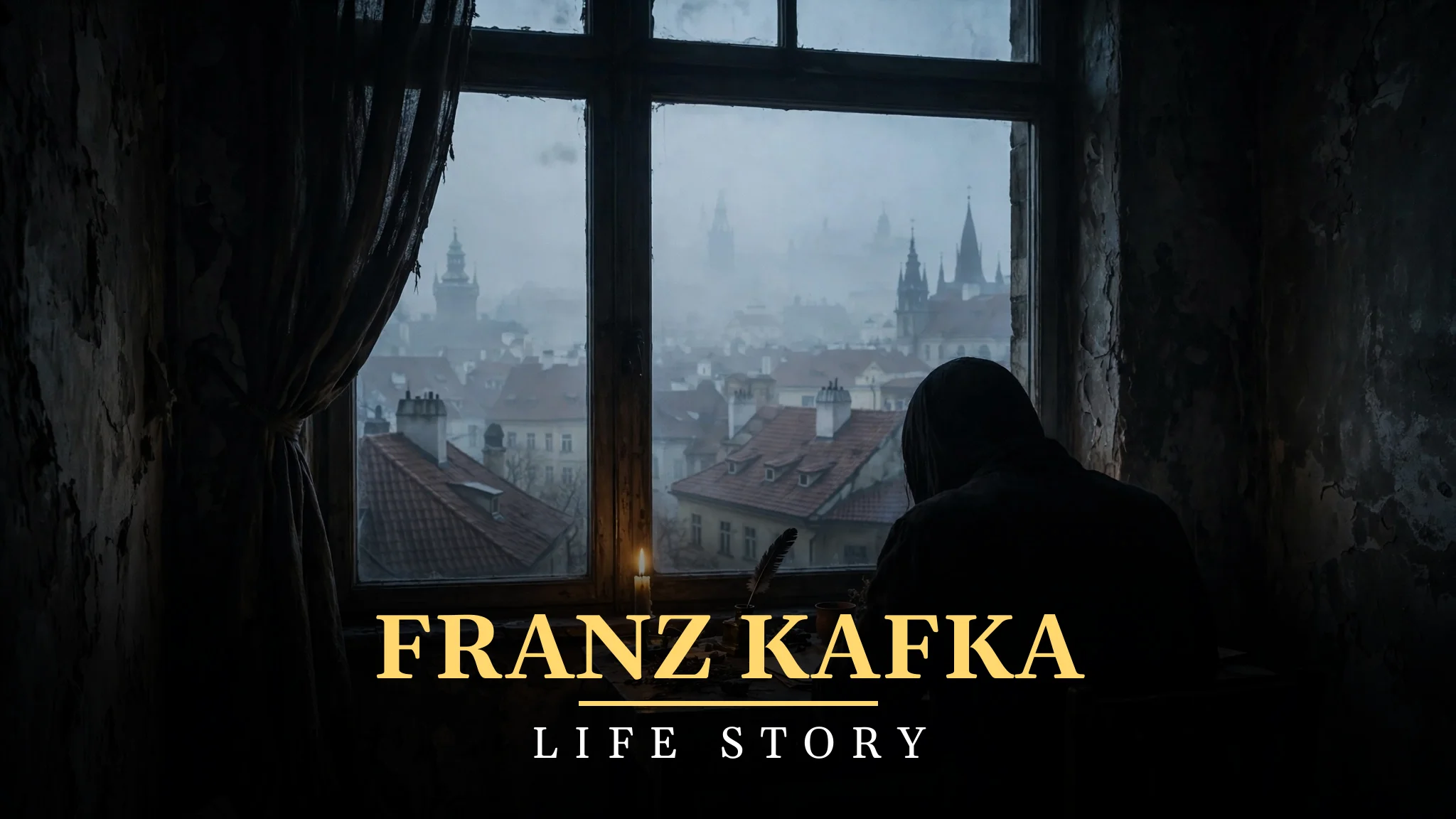
In the end, I return to a simple image: a man at a desk, at night, in Prague, writing by candlelight, while the city sleeps, while his parents sleep in the next room, while the insurance office waits for him in the morning. That image is, for me, the heart of Kafka, a man who wrote because he had to, who wrote in the only time he had, at night, and who, in those nights, made something that would outlive him, outlive his father, outlive his sisters, outlive the empire he lived in, and outlive, in a sense, all of us who read him today. That is not a small achievement. It is a large one, and it was made, quietly, at night, by a man who did not think it mattered, and who was wrong about that, as he was wrong about many things, and right about the most important thing: that writing, done honestly, matters, even if nobody reads it in your lifetime.
Frequently Asked Questions
Why did Franz Kafka ask Max Brod to burn his unpublished work?
Kafka doubted his writing and felt that much of it was unfinished, and he left a note asking Brod to destroy the unpublished manuscripts after his death. Brod, who believed the work was important, chose not to follow that instruction and published The Trial and The Castle instead.
What is The Metamorphosis about in simple words?
It is a short story in which a travelling salesman named Gregor Samsa wakes up one morning changed into a large insect, and it follows how his family slowly stops treating him as a person. It is widely read as a story about illness, shame, being a burden, and how love can fade when a person changes.
Did Franz Kafka have a normal job while he was writing?
Yes, he worked for most of his adult life at the Workers’ Accident Insurance Institute in Prague, dealing with claims from injured workers. He wrote at night after work, and his experience of offices, rules and official power shaped The Trial and The Castle.
Was Franz Kafka married or did he have children?
He was never married and had no children, though he was engaged twice to Felice Bauer, was later engaged to Julie Wohryzek, and had important relationships with Milena Jesenska and, in his last year, Dora Diamant, with whom he lived in Berlin.
What illness did Franz Kafka suffer from and when did he die?
He was diagnosed with tuberculosis in 1917, and his health declined over the following years despite stays in sanatoriums. He died on 3 June 1924 in a sanatorium at Kierling, near Vienna, at the age of forty.
What does the word Kafkaesque mean?
It means a situation that feels absurd, confusing and impossible to escape, like being arrested for a crime nobody will name or waiting for permission from officials who never give a clear answer. The word comes from the world of Kafka’s novels, especially The Trial and The Castle.


