Frédéric Chopin: The Life Story Behind the Piano Poet
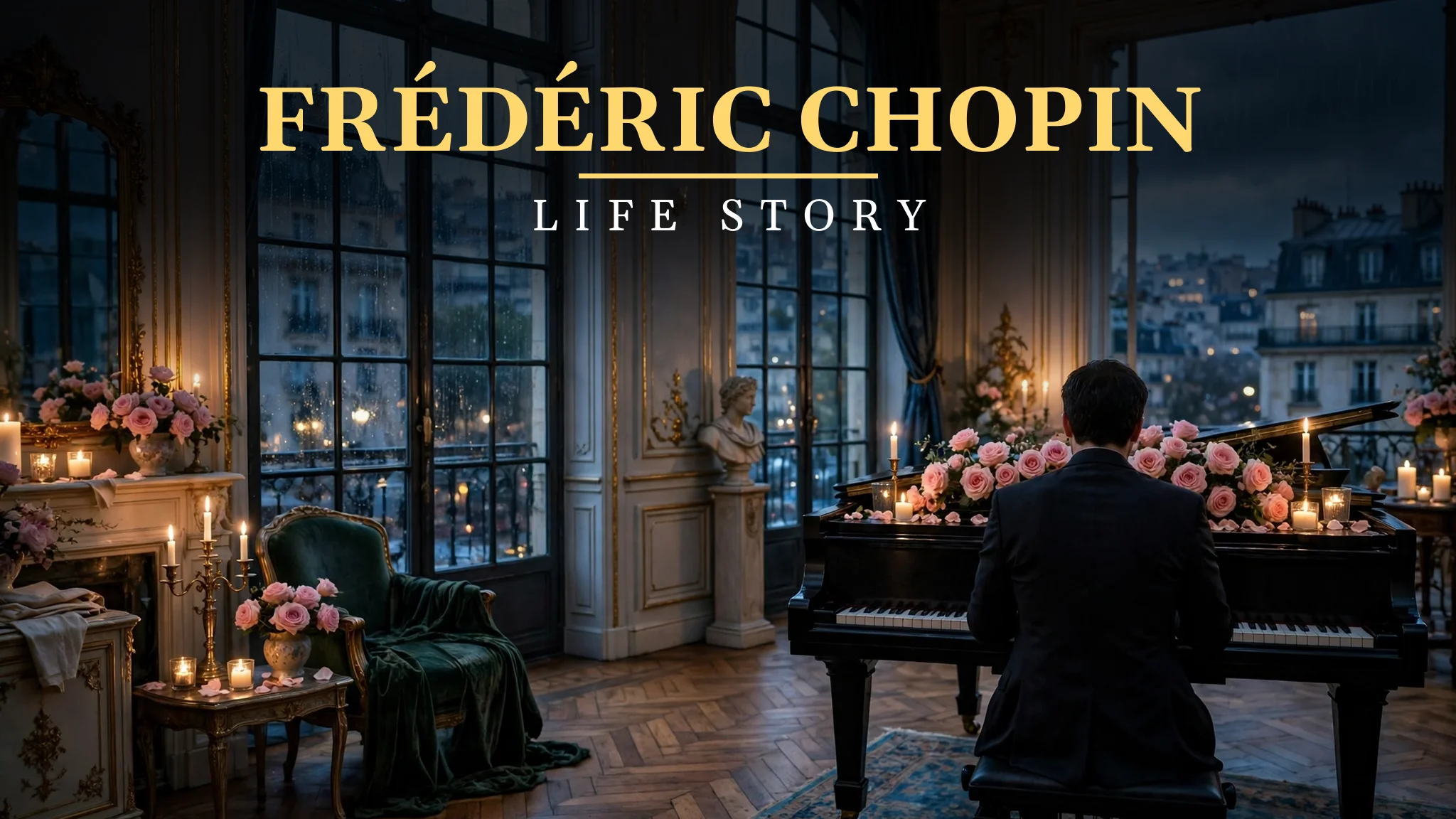
In this post
Frédéric Chopin wrote music for one instrument, the piano, and he wrote it so well that no one has matched him since. He did not write symphonies, he did not write operas, and he wrote only a few songs. He wrote for the piano, and for the piano alone, and he made that one instrument sound like a voice, like an orchestra, and like a whole world. His nocturnes are quiet and beautiful, his polonaises are proud and Polish, his mazurkas are dances from his homeland, and his ballades are stories told without words. People who have never been to a concert know his music, because it is played in films, in advertisements, and in homes, and because it speaks directly to the heart.
He was born in Poland, near Warsaw, in 1810, the son of a French father and a Polish mother, and he was a child prodigy who played the piano in public at eight and composed at seven. He left Poland at twenty, never to return, and he lived in Paris, where he became famous as a pianist and a teacher, playing in salons for small audiences, not in large concert halls. He was shy, he was ill for most of his life, and he was in love with the writer George Sand, a woman who wore men’s clothes and who smoked cigars, and who was one of the most famous people in Paris. Their relationship lasted nine years, and it ended badly, and Chopin died in Paris in 1849, at thirty-nine, leaving behind music that is still played every day.
His life is a story of exile, of illness, and of a love for a homeland he could not return to. He wrote polonaises and mazurkas that sound like Poland, even though he was living in Paris, and he wrote them with a longing that is easy to hear. He was not a loud composer, and he was not a public figure. He was a quiet man who played the piano softly, who taught students in his apartment, and who wrote music that is still, more than a century and a half later, the most loved piano music in the world.
A Prodigy in Żelazowa Wola and Warsaw
Frédéric François Chopin was born on 1 March 1810 in Żelazowa Wola, a village near Warsaw, in the Duchy of Warsaw, which is now Poland. His father, Nicolas Chopin, was a Frenchman who had come to Poland as a tutor, and who became a teacher of French at a school in Warsaw. His mother, Justyna Krzyżanowska, was Polish, from a family of some standing, and she played the piano and sang. Frédéric was the second of four children, and he grew up in Warsaw, in a house that was full of music, books, and visitors, including musicians, writers, and aristocrats who came to hear the young prodigy play.
He began to play the piano at the age of four or five, taught by his mother and by his sister Ludwika, and he soon showed a remarkable talent. At seven he composed his first pieces, polonaises in G minor and B-flat major, and at eight he played in public for the first time, in Warsaw, to great praise. He was compared to Mozart, who had also been a child prodigy, and he was called a second Mozart, a title that he did not like, because he wanted to be himself, not a copy of another composer. He studied at the Warsaw Conservatory, under Józef Elsner, a composer and teacher who recognised his talent and who encouraged him to write in his own style, drawing on Polish folk music, on the dances of his homeland, and on the operas he heard in Warsaw.
Warsaw in the 1820s was a city under Russian rule, after Poland had been partitioned by Russia, Prussia, and Austria, and Chopin grew up in a country that was not free. That fact shaped his music, and it shaped his life, because he loved Poland, and he felt the pain of its occupation, and he expressed that pain in his polonaises, which are proud, martial dances, and in his mazurkas, which are dances from the Polish countryside. He also fell in love for the first time in Warsaw, with a young singer named Konstancja Gładkowska, though the love was not returned in the way he hoped, and he wrote music that reflected his feelings, in a way that was private and personal.
In 1829, at nineteen, he gave concerts in Vienna, where he was praised, and in 1830 he left Warsaw for Vienna, planning to tour Europe, and then to return home. He did not know that he would never return. In November 1830, while he was in Vienna, an uprising broke out in Warsaw against Russian rule, the November Uprising, and Chopin wanted to return to fight, but his friends persuaded him not to, telling him that he could serve Poland better with his music than with a gun. He went to Paris instead, in 1831, and he stayed there for the rest of his life, an exile, writing music for a homeland he could not see again. The uprising was crushed by Russia in 1831, and Poland remained under foreign rule for many years, and Chopin never saw Warsaw again.
Paris, Salons, and a Quiet Fame
Paris in 1831 was the centre of music, art, and literature in Europe, and Chopin arrived there as a young man of twenty-one, with a letter of introduction, with some money, and with a reputation as a prodigy. He gave a concert in Paris in February 1832, and he was praised by the audience, which included the composer Robert Schumann, who wrote that Chopin was a genius, and the pianist Franz Liszt, who became his friend and rival. He decided to stay in Paris, and he made his living not by playing in large concert halls, but by playing in salons, small gatherings in the homes of wealthy Parisians, where he played the piano for a few dozen people, in an intimate, quiet way that suited his style. He did not like large halls, because his playing was soft, delicate, and nuanced, and it was lost in a big room. In a salon, with a small audience, his playing could be heard, and felt, in a way that a large concert could never match.
He also became a teacher, giving piano lessons to the daughters of wealthy families, and to young musicians who wanted to learn from him. He charged high fees, and he was a demanding teacher, insisting on good technique, on a beautiful sound, and on a deep understanding of the music. His students loved him, even when he was strict, because they knew that he was teaching them something real, not only how to play notes, but how to make music that speaks. He wrote his music in Paris, in his apartment, often at night, and he worked slowly, revising a piece many times, crossing out notes, changing a phrase, until it was perfect. He was not a fast composer like Mozart. He was a slow, careful composer, who polished each piece until it shone.
He lived in Paris for eighteen years, from 1831 to 1849, and he became a French citizen, though he never forgot that he was Polish, and he never stopped writing Polish dances. He was friends with many of the great artists of Paris, including the painter Eugène Delacroix, who painted his portrait, and the writer George Sand, who would become his partner. He was also friends with Liszt, with the composer Hector Berlioz, and with other musicians who lived in Paris. He was not a social man, and he preferred small gatherings to large parties, but he was respected, and he was loved, by the people who knew him. His health was poor, and he suffered from tuberculosis, or from a similar lung disease, which made him weak, and which forced him to rest often, and to spend winters in warmer places, including Mallorca, where he went with George Sand in 1838.
George Sand, Mallorca, and Nine Years Together
In 1836 Chopin met George Sand, whose real name was Amantine Lucile Aurore Dupin, a famous French writer who wore men’s clothes, smoked cigars, and lived a life that shocked Paris. She was six years older than Chopin, she had two children, and she was divorced, and she was one of the most talked-about women in France. Chopin was shy, and he was not at first attracted to her, but she pursued him, and in 1838 they began a relationship that would last nine years, until 1847. They lived together, though not married, in Paris and in the countryside, at her house in Nohant, in central France, where Chopin wrote some of his best music, in a quiet, rural setting that suited him.
In the winter of 1838 to 1839, they went to Mallorca, an island in the Mediterranean, hoping that the warm climate would help Chopin’s health. The trip was a disaster. The weather was cold and rainy, the locals were suspicious of the unmarried couple, and Chopin became very ill, coughing blood, and writing music in a cell in a monastery at Valldemossa, where they stayed. He wrote the famous Raindrop Prelude there, a piece that is said to imitate the sound of rain on a roof, though Chopin himself did not give it that name. The trip to Mallorca is one of the most famous episodes in his life, and it shows both his love for Sand, who nursed him through his illness, and the difficulty of their life together, with illness, with cold, and with the gossip of strangers.
Back in France, they lived at Nohant, where Chopin composed in the summer, and in Paris in the winter, where he taught and played. Sand took care of him, she managed the household, and she gave him the space to work, but the relationship was not easy. Sand was strong, outspoken, and busy with her own writing, and Chopin was shy, ill, and demanding, and they quarrelled, especially about her children, and about money. In 1847, after a quarrel about her daughter Solange, they separated, and Chopin was devastated. He had lost the woman he loved, and he had lost the home at Nohant, and he was alone, ill, and in debt. The separation is a sad part of his story, and it is one that has been told many times, often taking sides, but the truth is that both of them were difficult, and both of them suffered, and the end of their relationship was a loss for both.
After the separation, Chopin’s health got worse, and he gave a last concert in Paris in 1848, and then went to London and Scotland, where he gave concerts and taught, hoping to earn money, and hoping that the change of air would help his health. It did not help, and he returned to Paris, ill, weak, and in debt, and he died on 17 October 1849 in Paris, at the age of thirty-nine, in his apartment, with his sister Ludwika, who had come from Poland to be with him, and with friends around him. He was buried in Père Lachaise Cemetery in Paris, and his heart, according to his wishes, was taken to Poland, to the Church of the Holy Cross in Warsaw, where it is still kept today, in a pillar, as a symbol of his love for his homeland.
Nocturnes, Polonaises, and the Piano Alone
Chopin wrote almost entirely for the piano, and his works include nocturnes, short, beautiful pieces that sound like a song sung at night; polonaises, proud dances in triple time, that sound like Poland; mazurkas, dances from the Polish countryside, that are full of rhythm and longing; waltzes, which are elegant and sad at the same time; ballades, which are long, dramatic pieces that tell a story without words; scherzos, which are fast and brilliant; and études, studies that are also concert pieces, written to teach pianists technique, but which are also beautiful music in their own right. He also wrote two piano concertos, a few chamber works, and a small number of songs, but the piano was his world, and he explored it more deeply than any other composer.
His nocturnes, twenty-one in all, are among his most loved works, with melodies that are simple, beautiful, and full of feeling. His polonaises, including the famous Heroic Polonaise in A-flat major, are proud and powerful, and they are played at Polish national celebrations. His mazurkas, more than fifty of them, are the most Polish of his works, with rhythms that come from folk dances, and with a longing that is easy to hear. His ballades, four in all, are long, narrative pieces, inspired by Polish poetry, and they are among the most difficult and most rewarding pieces in the piano repertoire. His music is not loud, and it is not grand in the way Beethoven’s symphonies are grand. It is intimate, it is personal, and it speaks directly to the listener, as if Chopin were playing in a small room, for one person, and telling them a secret.
He was a great pianist himself, and his playing was famous for its delicacy, its beauty, and its rubato, a way of stretching and pulling the tempo, like a singer breathing, that makes the music feel alive. He did not play loudly, and he did not play for large audiences, but those who heard him in a salon said that his playing was unlike anything they had ever heard, and that it made the piano sound like a voice. He taught his students to play in the same way, with a singing tone, with a beautiful sound, and with a deep feeling for the music. His teaching, and his music, have influenced every pianist who has come after him, and his works are still the core of the piano repertoire, played by students, by professionals, and by amateurs, in every country in the world.
Exile, Longing, and the Heart in Warsaw
Chopin never returned to Poland after he left in 1830, and that exile shaped his music in a way that is easy to hear. His polonaises and mazurkas are not only dances. They are memories of a homeland, written by a man who could not go home, and who wrote about home in the only way he could, through music. He wrote to his friends in Poland, he read Polish newspapers, and he followed the news of the uprising and its failure, and he felt the pain of a country that was not free. His music carries that pain, not in a loud, angry way, but in a quiet, longing way, that is more moving because it is quiet. To listen to a Chopin mazurka is to hear a man thinking about home, about the fields, about the dances, and about the people he left behind.
His heart, which was taken to Warsaw after his death, is a symbol of that longing. He asked that his heart be buried in Poland, even though his body would be buried in Paris, and his sister Ludwika carried it back to Warsaw, where it was placed in the Church of the Holy Cross. The heart is still there today, in a pillar, and it is visited by Poles who see it as a relic of a great artist, and as a symbol of a man who loved his country, even in exile. That story, of a heart in Warsaw and a body in Paris, is a fitting end to a life that was lived between two countries, and that belonged to both.
Why Chopin Still Plays in Every Home
Chopin’s music is played today by pianists of every age, in every country, because it is beautiful, because it is pianistic, and because it speaks to the heart. His nocturnes are played at weddings, at funerals, and in homes, his polonaises are played at Polish celebrations, and his études are played by students who want to learn the piano. His music has been used in films, in advertisements, and in popular culture, and it is known by people who have never been to a concert, because it is so melodic, so clear, and so full of feeling. He wrote for one instrument, and he wrote for it perfectly, and that is why his music has lasted, and why it will keep lasting, as long as there are pianos, and people who love to hear them.
The Last Concerts and a Farewell in London
After his separation from George Sand in 1847, Chopin gave a last concert in Paris in February 1848, and then travelled to London and Scotland, where he gave concerts, taught students, and visited the homes of wealthy patrons, including the family of Jane Stirling, a Scottish student who became his friend and supporter. He was ill, he was weak, and he was homesick, and the trip to Britain was hard, with cold weather, with long journeys, and with the strain of performing when he could barely breathe. He gave his last public performance in London in November 1848, at a concert for Polish refugees, a fitting end, to play for his countrymen, in exile, in a foreign city, and to raise money for people who, like him, had lost their home. He returned to Paris in November 1848, ill, in debt, and alone, and he died less than a year later, in October 1849, at thirty-nine, leaving behind music that is still played, in London, in Paris, and in Warsaw, every day.
His sister Ludwika came from Poland to be with him in his last months, and she was with him when he died, and she carried his heart back to Warsaw, as he had asked. That journey, of a sister carrying her brother’s heart across Europe, is a sad and beautiful story, and it shows the love of a family, and the loyalty of a sister, who travelled far to be with her brother, and to honour his last wish. Chopin’s life ended in Paris, but his heart went home, and that split, between a body in Paris and a heart in Warsaw, is the final symbol of a life lived in exile, and of a man who never forgot where he came from. He was also a man who loved his sister Ludwika, and who wrote to her often, from Paris, telling her about his life, about his music, and about his longing for Poland. Those letters, which survive, are a record of a brother’s love, and of a man who, even in exile, in fame, and in illness, thought about his family, and about home. He was not a lonely genius, cut off from his family. He was a brother, a son, and a friend, who wrote letters, who missed home, and who kept in touch, even when the distance was great. That humanity is part of his story, and it is one I want to remember, alongside his music. He was also a man who loved to play the piano for himself, late at night, when no one was listening, playing the music he loved, not the music he was paid to play. That private playing, for no audience, is a reminder that music is not only work, but also a pleasure, and that a great pianist can still enjoy playing alone, in a quiet room, for the simple joy of sound.
My Take:
I think Chopin is the composer I feel most tenderly toward, because his music is so intimate, and his life was so sad, and the two together make a story that stays with me. He wrote for one instrument, the piano, and he wrote for it as if it were a voice, telling secrets, and I listen to his nocturnes and I feel as if he is playing in a small room, for me alone, and telling me something he cannot say in words. That intimacy is rare in music, and it is why I love him. He does not shout, he does not try to impress a large hall, and he does not write for an orchestra. He writes for a piano, and for a listener, and that is enough.
What I admire most is his loyalty to Poland. He left Warsaw at twenty, he never returned, and he spent eighteen years in Paris, but he never stopped being Polish, and he never stopped writing Polish dances. His polonaises and mazurkas are not only music. They are memories, and they are acts of love for a homeland that was not free. I think about my own homeland, and about the people who live far from home, and I understand that longing. To write about home, when you cannot go home, is a brave act, and Chopin did it, again and again, in every mazurka, in every polonaise, until his death. That loyalty is something I respect deeply, because it is easy to forget where you come from, and hard to remember, especially when you are famous in a foreign city.
His illness is another part of his story that moves me, because he was ill for most of his adult life, and he kept composing, and kept teaching, even when he was weak, even when he coughed blood, and even when he knew that he would not live long. He was thirty-nine when he died, and he had been ill for years, and yet he wrote some of his greatest music in those years, in Nohant, in Paris, and in Mallorca, in a cold monastery cell, with rain on the roof. That is a story of work done in pain, and I find it inspiring, because it tells me that illness does not have to stop work, and that a person can make beautiful things even when their body is failing. I think about that when I feel tired, or ill, or discouraged, and I remember Chopin, writing a prelude in a cold cell, and I feel a little stronger.
I have mixed feelings about George Sand, and about their relationship, and I want to be honest about that. She was a strong, famous writer, she wore men’s clothes, she smoked cigars, and she lived a life that shocked Paris, and she loved Chopin, and she took care of him, and she gave him a home at Nohant where he could compose. That is a great deal, and I respect her for it. But she was also difficult, she quarrelled with him, and their separation, in 1847, hurt him deeply, and may have hastened his death. I do not think we should blame her for his death, or blame him for the separation. They were two difficult, talented people, who loved each other, and who could not live together, and that is a sad, human story, not a story of a villain and a victim. I think we should remember both of them with respect, and with sadness, for a love that lasted nine years, and that ended in pain.
The trip to Mallorca is the episode I think about most, because it shows both the love and the difficulty of their life together. They went to a warm island, hoping for health, and they found cold, rain, and suspicion, and Chopin became very ill, and he wrote music in a monastery cell, with Sand nursing him. That image, of a sick man writing a prelude in a cold cell, while rain falls on the roof, is one of the most moving in music, and it has stayed with me. I think about how often we go somewhere hoping for a cure, and find a different kind of hardship, and how we still have to work, and to live, even in that hardship. Chopin did, and the Raindrop Prelude is the proof.
I also think about his teaching, and about how he earned his living by teaching piano to wealthy students in Paris. He was a demanding teacher, and he charged high fees, and he was respected, but teaching is hard work, and it takes time away from composing. I respect him for doing it, because it shows that he was a practical man, who needed to earn a living, and who did so by sharing his knowledge. He did not wait for a patron to support him. He taught, he played in salons, and he wrote music, and he made a life in Paris, as an exile, with his own hands. That is a practical lesson, and it is one I want to remember: talent is not enough, you also need to work, and to earn, and to live.
I do not think every Chopin piece is perfect, and I do not think his work is all equal. Some of his waltzes feel light, as if he wrote them for a salon, not for eternity, and some of his early pieces feel like the work of a talented young man, not yet the master he would become. I say that because I think it is important to be honest, even about a composer I love. His best work, the nocturnes, the ballades, the polonaises, and the mazurkas, is so strong that it does not need every piece to be a masterpiece. The peaks are high enough, and the beauty in those peaks is enough to carry his name.
What I take from his life is a lesson about exile and about home. He left Poland, he never returned, and he wrote about home for eighteen years, in Paris, in a language that everyone could understand, the language of music. That is a lesson for anyone who lives far from home, or who has lost a home, that home does not disappear when you leave it. It lives in you, in your memory, and in your work, and you can carry it with you, wherever you go. Chopin’s heart is in Warsaw, and his body is in Paris, and that split, between two countries, is the story of his life, and it is also the story of many people today, who live between two homes, and who love both.
If I could ask Chopin one question, I would ask him what he thought about when he played the piano in a salon, for a small audience, in the evening, with candles lit, and with the sound of his music filling a small room. I think he would say that he thought about Poland, about the fields, about the dances, and about the people he left behind, and that the piano was his way of going home, even when he could not go home in person. That is a beautiful answer, and it is one I want to keep. Music is a way of going home, and Chopin went home every time he played, even in Paris, even in Mallorca, even in a cold cell, with rain on the roof.
In the end, I think Chopin teaches me that a quiet life can produce great art, and that one instrument, played well, can be enough to change the world. He did not write symphonies, he did not write operas, and he did not try to be loud. He wrote for the piano, and he wrote with a delicacy, a beauty, and a longing that no one has matched. He was born in Poland, he died in Paris, and his heart is in Warsaw, and his music is everywhere, in homes, in concert halls, and in the hearts of people who have never been to Poland, but who feel, when they hear his nocturnes, that they have been there. That is a great achievement, and it came from a man who was shy, who was ill, and who was in exile, and who wrote music that is still, more than a century and a half later, the most loved piano music in the world.
I also think about his last concert in London, for Polish refugees, and about how fitting it was, to play for his countrymen, in exile, in a foreign city, and to raise money for people who, like him, had lost their home. That concert, in November 1848, was his last public performance, and he was ill, and weak, and he played anyway, because he believed that music could help, even when he could not help himself. I find that moving, because it shows a man who, even in his last months, thought about others, about refugees, and about his homeland, and who used his talent to help them, even when he was dying. That generosity, in the face of illness, is a lesson I want to remember.
There is a lesson in his sister Ludwika’s journey, carrying his heart back to Warsaw, that I want to keep. She travelled from Poland to Paris, to be with her brother when he died, and then she carried his heart back, across Europe, to be buried in the Church of the Holy Cross, as he had asked. That is a journey of love, and of loyalty, and it shows that family matters, even when a person is famous, even when they live far away. Ludwika was not a famous musician, but she was a sister who loved her brother, and who honoured his last wish, and her journey is part of his story, and it deserves to be remembered, alongside his music.
I think about the Raindrop Prelude, and about how it was written in a cold monastery cell in Mallorca, with rain on the roof, and how it is now one of the most played pieces in the world. That prelude, with its repeated note, like a drop of rain, is a simple piece, and it is beautiful, and it was written in a hard time, in a cold place, by a sick man, who was far from home. I listen to it and I hear the rain, and I hear Chopin, thinking about home, and about the rain on a roof in Mallorca, and about the rain on a roof in Poland, and I feel a connection to a man who lived more than a century and a half ago, and who wrote a piece about rain that still sounds like rain today. That is the power of music, to make a moment last, and to make a cold cell in Mallorca feel like home.
Finally, I want to say something about his piano, and about how he wrote for one instrument, and how that instrument was his voice. He did not need an orchestra, or a choir, or a large hall. He needed a piano, and a small room, and a listener, and that was enough. I think about how often we think we need more, more instruments, more people, more fame, to make something important, and Chopin proves that we do not. One piano, played well, with feeling, can be enough to change the world, or at least to change a listener’s day. That is a hopeful message, for anyone who works alone, with one tool, and who wonders if it is enough. Chopin says it is enough, if you play it with love, and with longing, and with a heart that is in Warsaw, even when your body is in Paris.
I also think about his letters to Ludwika, and about how they show a man who missed home, and who loved his family, even in exile. He wrote to her from Paris, telling her about his life, and about his music, and those letters are a record of a brother’s love, and of a man who was not only a composer, but also a son, and a brother, who thought about home, every day, for eighteen years. That humanity is part of his story, and it is one I want to remember, alongside his nocturnes, and his polonaises, because it shows that even a great artist is a person, with a family, and with a home that he misses.
I also think about his piano, and about how it was his only instrument, and how he knew it so well that he could make it sound like a voice, like an orchestra, and like a whole world, with only ten fingers, and eighty-eight keys. That knowledge, of one instrument, learned over a lifetime, is a lesson in depth, not breadth, and it tells me that I do not need to know everything. I need to know one thing well, and to love it, and to work at it, every day, until it becomes a part of me, as the piano became a part of Chopin.
Frequently Asked Questions
When was Frédéric Chopin born?
Chopin was born on 1 March 1810 in Żelazowa Wola, near Warsaw, Poland. His father was French and his mother was Polish, and he was a child prodigy who played in public at eight.
Why did Chopin leave Poland and never return?
Chopin left Warsaw in 1830 for a tour, and while he was in Vienna the November Uprising broke out in Poland. He went to Paris in 1831 instead of returning, and the uprising was crushed, so he lived in exile in Paris for the rest of his life.
Who was George Sand?
George Sand was a famous French writer, whose real name was Amantine Lucile Aurore Dupin, who was Chopin’s partner for nine years, from 1838 to 1847. They lived together in Paris and at her house in Nohant, and travelled to Mallorca in 1838.
What are Chopin’s most famous works?
His best-known works include the Nocturnes, the Polonaises including the Heroic Polonaise, the Mazurkas, the Ballades, the Waltzes, and the Études, all written for piano. He wrote almost entirely for the piano alone.
How did Frédéric Chopin die?
Chopin died on 17 October 1849 in Paris, at the age of thirty-nine, after a long illness, widely believed to have been tuberculosis. He was buried in Père Lachaise Cemetery, and his heart was taken to Warsaw.
Where is Chopin’s heart?
Chopin’s heart was taken to Poland after his death by his sister Ludwika, and it is kept in the Church of the Holy Cross in Warsaw, as he had wished, while his body is buried in Paris.


