Fujii Kaze: The Life Story Behind Japan's Piano Star
In this post
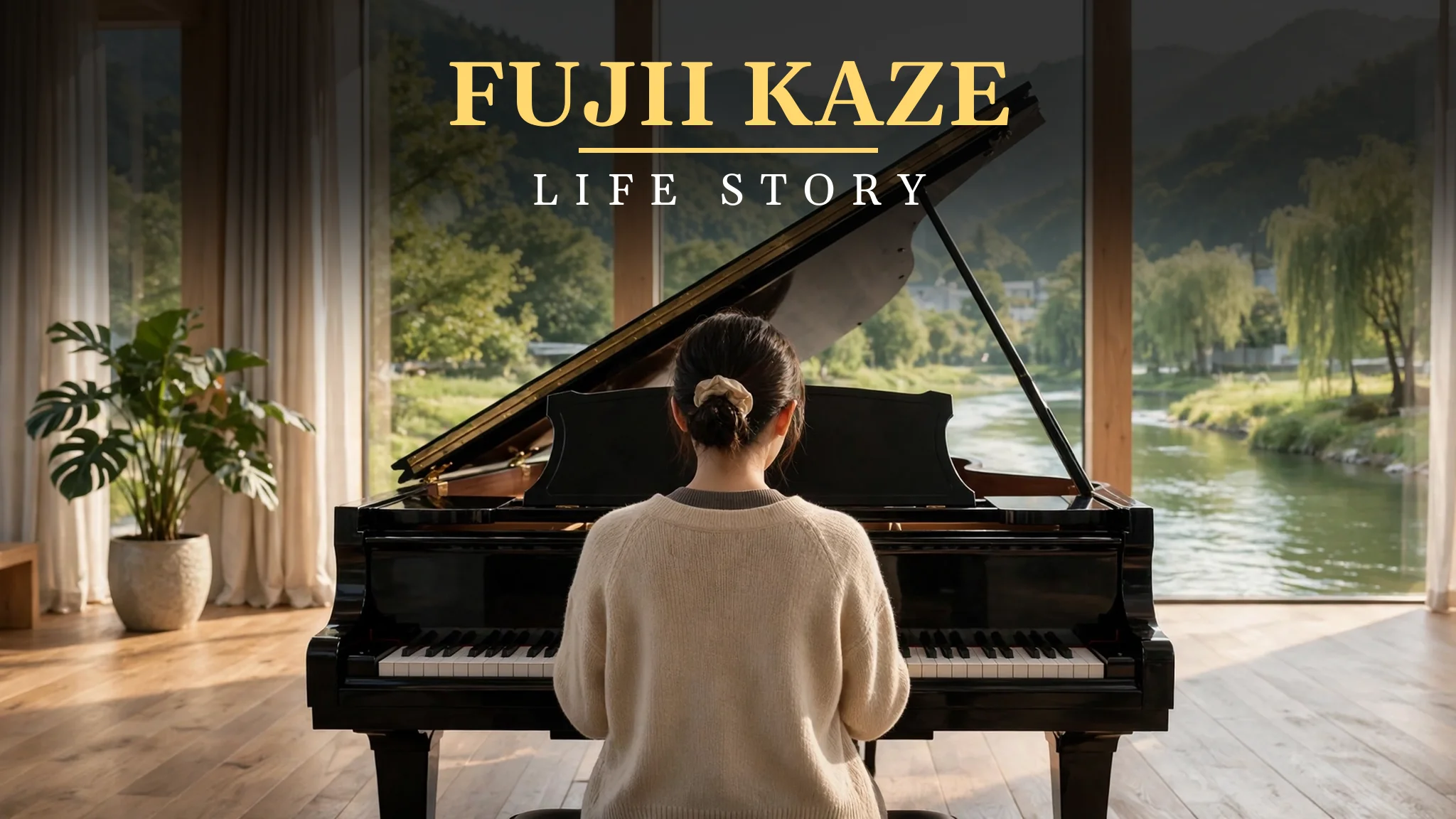
Fujii Kaze is the most free-spirited singer in Japan. He plays the piano like a jazz musician, he sings like a soul singer, and he talks like a boy from the countryside who never lost his accent. He became famous not through a television contest or a big agency, but through YouTube, where he posted videos of himself playing the piano and singing covers of songs he loved. Those videos were watched by millions of people, and they led to a debut album, a viral hit, and concerts in stadiums. His story is a story about the internet, about talent, and about staying true to yourself when the whole world is watching.
Kaze was born in the town of Satosho, in Okayama, on 14 June 1997. Okayama is a prefecture in the west of Japan, known for its sunshine, its fruit, and its quiet towns. He grew up there in a family that loved music, and he learned to play the piano when he was a small child. His father played music too, and the house was full of sound. By the time he was twelve, he was posting videos of himself playing the piano on YouTube, and people around the world were beginning to notice him. He was not a child star in the usual sense. He was a boy in a small town, playing songs he loved, and sharing them with the world.
His debut album, Help Ever Hurt Never, came out in May 2020, and it was a success. His song Shinunoga E-Wa, which means I Would Rather Die, became a viral hit around the world in 2022, with people in many countries singing it in Japanese. His second album, Love All Serve All, came out in 2022, and it confirmed his place as one of the most important young singers in Japan. This is the story of how a boy from a small town in Okayama became a global star, one piano video at a time.
A Boy in Okayama Learns the Piano
Satosho is a small town in Okayama, far from the bright lights of Tokyo. Kaze grew up there, in a house where music was always playing. His father was a musician, and he taught his children to play. Kaze learned the piano when he was very young, and he took to it naturally. He had a good ear, he could pick out a melody after hearing it once, and he loved to play. He played classical music, he played jazz, and he played pop songs, and he played them all with a feeling that was unusual for a child.
He also learned to play by ear, which means he could hear a song and play it without reading the music. That skill is rare, and it gave him a freedom that other young musicians did not have. He could hear a song on the radio, sit down at the piano, and play it. He did that with songs in English, in Japanese, and in many styles, and each time he played, he made the song his own. That ability to make a song his own would become the centre of his career.
When he was twelve years old, in 2010, he began to post videos of himself playing the piano on YouTube. The videos were simple. He sat at the piano in his home, and he played covers of songs he loved, from Western pop to Japanese classics. He sang as well, in a voice that was soft and clear. The videos were watched by people in Japan and around the world, and they began to share them. A boy in a small town in Okayama was suddenly being watched by millions of people, and he had done it without an agency, without a record label, and without leaving his home.
He continued to post videos through his teenage years, and each one showed him growing as a musician. He played more complex songs, he sang with more confidence, and he developed a style that was his own. He was not copying anyone. He was taking songs he loved and playing them in a way that only he could. That originality was the reason people kept watching, and it was the reason his videos were shared so widely. He was a boy who loved music, and his love was visible in every video.
YouTube, Covers, and a Growing Audience
The YouTube years were the foundation of Kaze’s career. He posted covers of songs by artists from around the world, and he played them on the piano with a skill that surprised people. He covered songs in English, even though English was not his first language, and he sang them with feeling. He covered Japanese songs, and he played them with a jazz feeling that made them sound new. Each video was a lesson in music, and each one added to his following.
His audience grew slowly at first, and then faster. People shared his videos on social media, they left comments, and they asked him to play more songs. He listened to them, and he played the songs they asked for. That connection, between a young musician and his audience, was direct and real. There was no agency between them, no marketing campaign, and no television show. There was only a boy, a piano, and a camera, and that simplicity was part of the charm.
He also began to write his own songs during these years. He wrote in Japanese, and he wrote about love, about life, and about the small things he noticed in his town. His songs were simple and honest, and they showed a mind that thought deeply about the world. He was not writing to be famous. He was writing because he had something to say, and because the piano gave him a way to say it. Those early songs would become the foundation of his debut album.
By the time he was in his late teens, he was well known on YouTube, and the music industry in Tokyo was beginning to notice him. He was offered a record deal, and he moved to Tokyo to begin his professional career. It was a big step, from a small town in Okayama to the capital, but he took it with the same calm he had shown in his videos. He was not in a hurry to become a star. He was in a hurry to make good music, and he trusted that the rest would follow.
Help Ever Hurt Never and the Debut
Kaze’s debut album, Help Ever Hurt Never, was released in May 2020, when he was twenty-two years old. The title came from a phrase he had heard, and it reflected his philosophy of life: help others always, and never hurt anyone. The album was a mix of pop, jazz, soul, and R and B, with songs that were catchy, clever, and full of feeling. It included the single Nan-Nan, a bright and funny song, and other tracks that showed his range as a singer and as a pianist.
The album was a success. It reached the top of the charts in Japan, and it was praised by critics who loved its originality. Kaze’s voice was soft and clear, his piano playing was superb, and his songs were unlike anything else in Japanese pop. He was not following a trend. He was making music that was his own, and the audience responded to it. The debut proved that a boy from YouTube could become a real star, and that his talent was not only for covers. He could write his own songs, and those songs were good.
He began to perform live, in concerts and at festivals, and his live shows became known for their warmth and their energy. He played the piano, he sang, and he talked to the audience in his Okayama dialect, with a humour and an honesty that made people love him. He did not act like a star. He acted like a young man from the countryside who was happy to be there, and that happiness was infectious. His fans loved him for it, and they came back to his concerts again and again.
The debut also brought him attention from the media. He appeared on television, he was interviewed in magazines, and he became known as one of the most interesting young singers in Japan. He handled that attention calmly, and he did not let it change him. He still spoke in his dialect, he still played the piano, and he still made music that was true to himself. That refusal to change was part of his charm, and it was part of why his fans stayed loyal.
Shinunoga E-Wa and the Viral Moment
In 2022, Kaze’s song Shinunoga E-Wa became a viral hit around the world. The song had been released on his debut album in 2020, but in 2022 it was discovered by users on TikTok and on other social media, and it spread quickly. People in many countries, including Thailand, Indonesia, and America, began to sing it, to dance to it, and to share videos of themselves performing it. The song was in Japanese, but that did not stop people from loving it. Its melody was beautiful, its feeling was clear, and its title, which means I Would Rather Die, was dramatic and memorable.
The viral moment changed Kaze’s career. He was suddenly known around the world, not only in Japan. His music was streamed millions of times, his videos were watched by new audiences, and he was invited to perform in other countries. He had become a global star, and he had done it without a big international campaign. The internet had done it for him, just as it had done when he was a boy posting piano covers on YouTube. It was a full circle, from a small town to the world, through a screen.
His second album, Love All Serve All, was released in March 2022, at the same time as the viral moment. The album was a success, and it included the hit songs Matsuri, a joyful song about a festival, and Kirari, a bright song used in a car advertisement. The album’s title reflected his philosophy, that love is about serving others, and that music is a way of serving the world. The album was praised for its warmth, its originality, and its sense of joy. It confirmed that Kaze was not a one-hit singer. He was an artist with a vision, and that vision was growing.
He performed in large venues in Japan, including stadium concerts, and he toured in other countries. His concerts were known for their joy, their energy, and their sense of community. He played the piano, he sang, and he connected with the audience in a way that felt personal, even in a stadium full of thousands of people. That ability to make a large venue feel small is rare, and it is one of the reasons his concerts are so loved.
The Free Spirit and the Philosophy
Kaze is known for his free spirit. He speaks in his Okayama dialect, he dresses simply, and he talks about his beliefs with honesty. He has spoken about being a vegetarian, about caring for animals, and about living in a way that does not hurt others. His philosophy, help ever, hurt never, is not only the title of his album. It is the way he tries to live, and it is the way he makes music. His songs are about love, about kindness, and about the small joys of life, and they reflect that philosophy.
He is also known for his humour. He jokes on stage, he makes funny faces, and he does not take himself too seriously. That humour is part of his charm, and it makes his concerts feel like a gathering of friends rather than a formal show. He is a star who does not act like a star, and that is why people love him. He is a young man from Okayama who happens to be famous, and he has not forgotten where he came from.
His music reflects that free spirit. He mixes jazz, soul, pop, and R and B, and he does it in a way that is his own. He does not follow trends, and he does not try to sound like other singers. He sounds like himself, and that self is a mix of many influences, from the piano in his home to the songs he heard on YouTube to the dialect he speaks. That originality is the reason his music stands out, and it is the reason his fans stay loyal.
He has also become a symbol of a new kind of Japanese star, one who comes from the internet, who is honest about his beliefs, and who does not hide his roots. He is not a product of an agency. He is a person who made himself, through talent, through hard work, and through the internet. That story is inspiring to young people in Japan and around the world, because it shows that a boy from a small town can reach the world, as long as he is true to himself.
What Comes Next for Fujii Kaze
Kaze is still only in his twenties, and his career is still at the beginning of what it could become. He has already achieved things that many singers never achieve: a hit debut album, a viral song heard around the world, a second album that confirmed his talent, and concerts in stadiums. Yet the most interesting part of his story may be what happens next, as he grows as an artist and as a person.
He has already shown that he can write songs in many styles, that he can perform in many places, and that he can connect with audiences in many countries. The next step could be more international touring, more collaborations with artists from other countries, or new albums that explore new sounds. He has the talent to do all of those things, and he has the audience to support him. The world is watching, and it is waiting to see what he will do next.
He has also shown that he is not in a hurry. He releases music when he is ready, he performs when he wants to, and he does not chase fame for its own sake. That patience is unusual in a young star, and it is a sign that he is thinking about a long career, not a short one. He is building his work slowly, album by album, concert by concert, and that slow building is the way to a career that lasts.
For now, he is a young star from Okayama who plays the piano, sings with a soft and clear voice, and lives by a simple philosophy: help ever, hurt never. That philosophy, and that voice, have taken him from a small town to the world, and they will take him further still. The boy who posted piano covers on YouTube has become a global star, and his story is still being written, one song at a time.
The Piano, the Voice, and the Sound
Kaze’s piano playing is the centre of his music. He plays with a jazz feeling, with chords that are rich and surprising, and with a rhythm that swings. He learned to play by ear as a child, and that skill gave him a freedom that other pianists do not have. He can hear a song and play it, he can improvise, and he can change a melody in the middle of a performance. That freedom is visible in his concerts, where he often plays the piano alone, without a band, and the audience listens in silence. It is a rare thing for a pop singer to hold a stadium with only a piano, and Kaze can do it.
His voice is also unusual. It is soft, clear, and gentle, with a warmth that makes a listener feel close to him. He does not sing loudly, and he does not show off. He sings as if he is talking to one person, and that intimacy is part of his charm. In a ballad, his voice is tender and sad. In a fast song, his voice is bright and joyful. In both cases, it is honest, and the audience can hear that honesty. His voice is not the loudest in Japanese pop, but it is one of the most loved, because it feels real.
His sound is a mix of many styles. He takes jazz, soul, pop, and R and B, and he blends them into something that is his own. His songs have catchy melodies, clever lyrics, and arrangements that are rich without being busy. He works with producers, but the sound is always his, because he writes the songs, he plays the piano, and he sings them in his own way. That control over his sound is important, because it means his music is a true reflection of who he is, not a product made by others.
His live performances show all of this together. He sits at the piano, he sings, and he talks to the audience in his dialect. He jokes, he laughs, and he makes the concert feel like a gathering of friends. The audience sings along, they dance, and they feel as if they are part of the music. That connection, between a singer and his audience, is the heart of his career, and it is why his concerts are so loved. He does not perform at his audience. He performs with them, and that difference matters.
The Stadium Concerts and the Global Audience
In 2024, Kaze performed in a huge stadium in Japan, in front of tens of thousands of fans, in a concert that showed how far he had come from his small-town piano videos. The stadium was full, the audience sang along to every song, and the atmosphere was joyful. He played the piano, he sang, and he talked to the crowd in his Okayama dialect, just as he had done in small venues years before. The scale had changed, but the feeling had not. He was still a young man from Okayama, playing music he loved, for people who loved it too. That is a remarkable thing to achieve, and it is a sign of how deeply his music connects with people.
His concerts outside Japan have also grown. He has performed in Asia, in Europe, and in America, in front of audiences who may not speak Japanese but who love his music. His songs, with their beautiful melodies and his clear voice, do not need translation. A listener in Bangkok or in London can feel the joy of Matsuri, the sadness of Shinunoga E-Wa, and the warmth of Kirari, without understanding every word. That universality is rare, and it is the reason his audience is global. He is a Japanese singer, but his music belongs to the world.
His live shows are known for their warmth. He does not perform with a large group of dancers or with elaborate stage effects. He performs with a band, with a piano, and with his voice, and he connects with the audience through humour and honesty. He jokes, he laughs, and he makes mistakes on stage and laughs at them. That honesty makes his concerts feel personal, even in a stadium. Fans who attend his concerts often say that it felt like a gathering of friends, not a formal show, and that feeling is the reason they come back.
The global audience has also changed his music. He has heard his songs sung by fans in many countries, he has seen videos of people dancing to his music in places he has never visited, and he has learned that his songs can travel further than he ever imagined. That knowledge has given him confidence, and it has encouraged him to keep making music that is true to himself. He does not need to change his sound to please the world. The world has come to him, because his sound is already universal.
My Take:
When I think about Fujii Kaze, I think about a boy in a small town, sitting at a piano, playing songs he loved, and sharing them with the world through a camera. That image stays with me, because it is the beginning of his story, and it is also the heart of it. He did not become famous by winning a contest or by joining an agency. He became famous by loving music, by playing it well, and by sharing it honestly. That is a hopeful story, and it is one that I think many young people need to hear, especially in a time when fame often feels like something that only happens to other people.
What I admire most about him is his freedom. He speaks in his Okayama dialect, even on national television. He dresses simply. He talks about his beliefs, about helping others and not hurting anyone, and he lives by those beliefs. He does not try to be a polished, perfect pop star. He tries to be himself, and that self is a young man from the countryside who loves the piano. I think that takes courage, because the music industry often asks young stars to change who they are. Kaze did not change. He stayed himself, and the world came to him. That is a powerful lesson, and it is one I wish more young artists would learn.
His YouTube years are the part of his story that I find most inspiring. He was twelve when he started posting videos, and he kept posting them through his teenage years. He did not know whether anyone would watch. He posted them because he loved music, and because he wanted to share it. That love, shared honestly, found an audience. I think about that, and I am struck by how simple it is. You do not need a big budget or a famous name to start. You need a talent, a camera, and the courage to share what you love. Kaze had all three, and he used them. That is a lesson for anyone who wants to create something, in any field.
Shinunoga E-Wa going viral is a moment that makes me smile, because it happened in such an unexpected way. The song had been out for two years, and then people on TikTok discovered it, and it spread around the world. People in Thailand, in Indonesia, in America, were singing a song in Japanese, a song with a dramatic title, and they loved it. That is the power of the internet, and it is the power of a good melody. A song does not need to be in your language to move you. It needs to be honest, and it needs to be beautiful. Shinunoga E-Wa is both, and the world heard it.
I also think about his philosophy, help ever, hurt never, because it is a simple idea that is hard to live by. He tries to live it, in his diet, in his music, and in the way he treats people. I respect that, because it is easy to say kind words and hard to live by them. Kaze seems to live by them, and his music reflects that. His songs are about love, about kindness, and about the small joys of life. They are not angry or bitter. They are warm, and that warmth is a choice. In a world that is often angry, choosing warmth is a brave thing to do.
There is a sadness in his story too, and it is the sadness of leaving home. He grew up in a small town, and he had to leave it to become a star. That is a loss, even when the career is a success. He still speaks in his dialect, and he still talks about Okayama, and I think that is his way of keeping home with him. I find that moving, because it shows that fame does not have to mean forgetting where you came from. You can carry your home with you, in your voice, in your accent, and in your music. Kaze does that, and it makes his work feel real.
If I compare him with other young singers, I think his greatest strength is originality. No one else sounds like him. His mix of jazz piano, soul singing, and Okayama dialect is unique, and it is the reason his music stands out. The pop world is full of singers who sound like each other, who follow the same trends, and who make the same kind of music. Kaze does not follow trends. He makes music that is his own, and he trusts that the audience will find it. That trust has paid off, and it will keep paying off, because originality is the one thing that cannot be copied.
There is a lesson in his story for anyone who is young and talented. Start where you are, with what you have. Share what you love, even if you do not know who will watch. Be yourself, even if yourself is different from what the industry expects. And be patient, because a song can take two years to find its audience, and a career can take a decade to build. Kaze started at twelve, he debuted at twenty-two, and he went viral at twenty-four. That is a long road, and he walked it by being patient and by being himself.
In the end, what I take from Fujii Kaze is the image of a boy at a piano, in a small town, playing a song he loves, and sharing it with the world. He is still that boy, even though he now plays in stadiums. He still loves the piano, he still sings with a soft and clear voice, and he still lives by a simple idea: help ever, hurt never. That is a story of talent, of patience, and of honesty, and it is a story I will always admire.
I also think about his father, and about the house full of music where Kaze grew up. His father played music, his children learned to play, and the home was a place where songs were always in the air. That kind of home shapes a child. It teaches them that music is not only a job or a hobby. It is a way of life, a way of talking, and a way of understanding the world. Kaze learned that lesson early, and he has carried it with him ever since. His music feels like home, because it came from a home full of music, and that warmth is part of why people love it.
His dialect is another thing I think about. He speaks in his Okayama dialect, even on national television, even in stadiums, even when the whole country is listening. That is a brave choice, because the entertainment industry often asks young stars to speak in standard Tokyo Japanese. Kaze did not change. He kept his accent, and he made it part of his charm. I think that takes courage, and I think it sends a message to young people from small towns. You do not need to hide where you come from. You can carry it with you, in your voice, and the world will love you for it. His dialect is not a weakness. It is a strength, and it is one of the reasons his fans feel close to him.
I also think about the internet, and about how it changed his life twice. The first time was when he was twelve, posting piano covers on YouTube, and building an audience one video at a time. The second time was in 2022, when Shinunoga E-Wa went viral on TikTok, and his music reached people in countries he had never visited. Both times, the internet did what no agency could do. It connected a boy from a small town with the whole world, directly, without anyone in between. That is a powerful story, and it is one that young musicians everywhere should hear. The tools are available to everyone now. What matters is what you do with them, and Kaze did something wonderful with them.
There is also the question of his philosophy, help ever, hurt never, and of how he lives by it. He has spoken about being a vegetarian, about caring for animals, and about living in a way that does not hurt others. I respect that, because it is easy to say kind words and hard to live by them. Kaze seems to live by them, and his music reflects that. His songs are about love, about kindness, and about the small joys of life. They are not angry or bitter. They are warm, and that warmth is a choice. In a world that is often angry, choosing warmth is a brave thing to do, and I admire him for doing it.
Finally, I think about his future, and about what he will do next. He is still in his twenties, and his best work may still be ahead of him. He has already written songs that the world loves, he has performed in stadiums, and he has built a global audience. Yet he is not in a hurry. He releases music when he is ready, he performs when he wants to, and he does not chase fame for its own sake. That patience is unusual in a young star, and it is a sign that he is thinking about a long career, not a short one. I look forward to seeing what he does next, and I believe it will be bright, honest, and full of the same warmth that has made his music so loved.
I also think about his childhood piano, because it is the root of everything he does. He grew up in a house in Okayama where music was part of daily life, and he learned to play the piano as a small boy. He did not learn it in a formal and strict way. He learned it by playing, by listening, and by loving the sound. When he was a teenager, he began to post videos of himself playing piano covers on YouTube, and people around the world began to watch. I think about those early videos, a boy in his room playing songs he loved, and I find them moving, because they show a musician who started with nothing but a piano and a camera. He did not need a big studio. He needed only a song and the courage to share it. That courage is the same courage he shows today on a stadium stage.
His debut album, Help Ever Hurt Never, deserves its own thought, because its title is also his philosophy. Released in 2020, the album brought together songs he had written over years, and it showed a singer who could write about love, about kindness, and about the small moments of life. The title comes from words he lives by, to help always and to hurt never, and those words are not only a title. They are a way of living. He has talked openly about eating no meat, about kindness to animals, and about keeping his daily life gentle. I respect that, because it is easy to write kind words in a song and hard to live by them every day. Those words show up in the way he performs, and listeners can hear them in his songs. His songs are not angry. They are warm, and that warmth is a choice he makes again and again.
I also think about Kirari, because it is the song that showed his playful side. Used in a well known car advertisement in Japan, it became a hit, and its bright and joyful sound made people smile. The song is about a small light, a sparkle, and it feels like sunshine. I think about how different it is from Shinunoga E Wa, which is a sad and beautiful song about love and death. Kaze can write both kinds of song, the bright and the sad, and he can make both feel true. That range is rare in a young singer. Most young singers find one feeling and stay with it. Kaze moves between feelings, and he does it with ease. That tells me that he is not only a pop star. He is a songwriter who understands life in all its colours, and who can turn each colour into music.
Another thing I think about is his global audience, because it grew in a way that no one planned. When Shinunoga E Wa went viral on TikTok in 2022, people in Thailand, in Indonesia, and in other countries began to listen to his music, even though they did not speak Japanese. They loved the melody, they loved his voice, and they learned the words. He began to perform in other countries, and his concerts abroad were full of fans who sang along in Japanese. I think that is a beautiful thing. Music does not need a shared language. It needs a shared feeling, and Kaze’s music has that feeling. He is a boy from a small town in Okayama who now sings to the world, and he does it without changing who he is. He still plays the piano, he still writes his own songs, and he still lives by his simple philosophy. That steadiness, in the middle of global fame, is the most impressive part of his story.
I also think about the piano, and about what it means to him. He learned to play as a small child, in a house full of music, and the piano has been his companion ever since. It is the instrument he uses to write songs, to practise, and to perform, and it is the instrument that connects him to his home. When he sits at the piano, he is not only performing. He is returning to the place where he started, to the boy in Okayama who loved music. That connection is visible in his concerts, where he often plays the piano alone, without a band, and the audience listens in silence. It is a rare thing for a pop singer to hold a stadium with only a piano, and Kaze can do it, because the piano is part of who he is.
His fans around the world are another thing I think about. They sing his songs in Japanese, even when they do not speak the language, because the melodies are beautiful and the feelings are clear. That is a sign of how universal his music is. A song does not need to be in your language to move you. It needs to be honest, and it needs to be beautiful. Kaze’s songs are both, and that is why they have travelled so far. He is a Japanese singer, but his music belongs to the world, and the world has welcomed it with open arms.
Frequently Asked Questions
When was Fujii Kaze born?
Fujii Kaze was born on 14 June 1997 in Satosho, Okayama, Japan. He learned to play the piano as a small child, and he began posting videos of himself playing piano covers on YouTube when he was twelve years old.
What is Shinunoga E-Wa and why did it go viral?
Shinunoga E-Wa, which means I Would Rather Die, is a song from Kaze’s debut album. It became a viral hit around the world in 2022, when users on TikTok and other social media began singing and dancing to it, even though the song is in Japanese.
What was Fujii Kaze’s debut album?
His debut album was Help Ever Hurt Never, released in May 2020, when he was twenty-two. The title reflects his philosophy of helping others always and never hurting anyone, and the album was a success in Japan.
What is Love All Serve All?
Love All Serve All is Kaze’s second album, released in March 2022. It includes the hit songs Matsuri and Kirari, and its title reflects his belief that love is about serving others.
How did Fujii Kaze become famous?
He became famous through YouTube, where he posted videos of himself playing the piano and singing covers from the age of twelve. Those videos built him an audience, and they led to a record deal and a professional career.
Why is Fujii Kaze known for his Okayama dialect?
He grew up in Okayama, and he speaks in the local dialect, even on national television and in his concerts. His dialect is part of his charm, and it shows that he has not forgotten where he came from.


