Garth Brooks: The Life Story Behind Country's Biggest Star
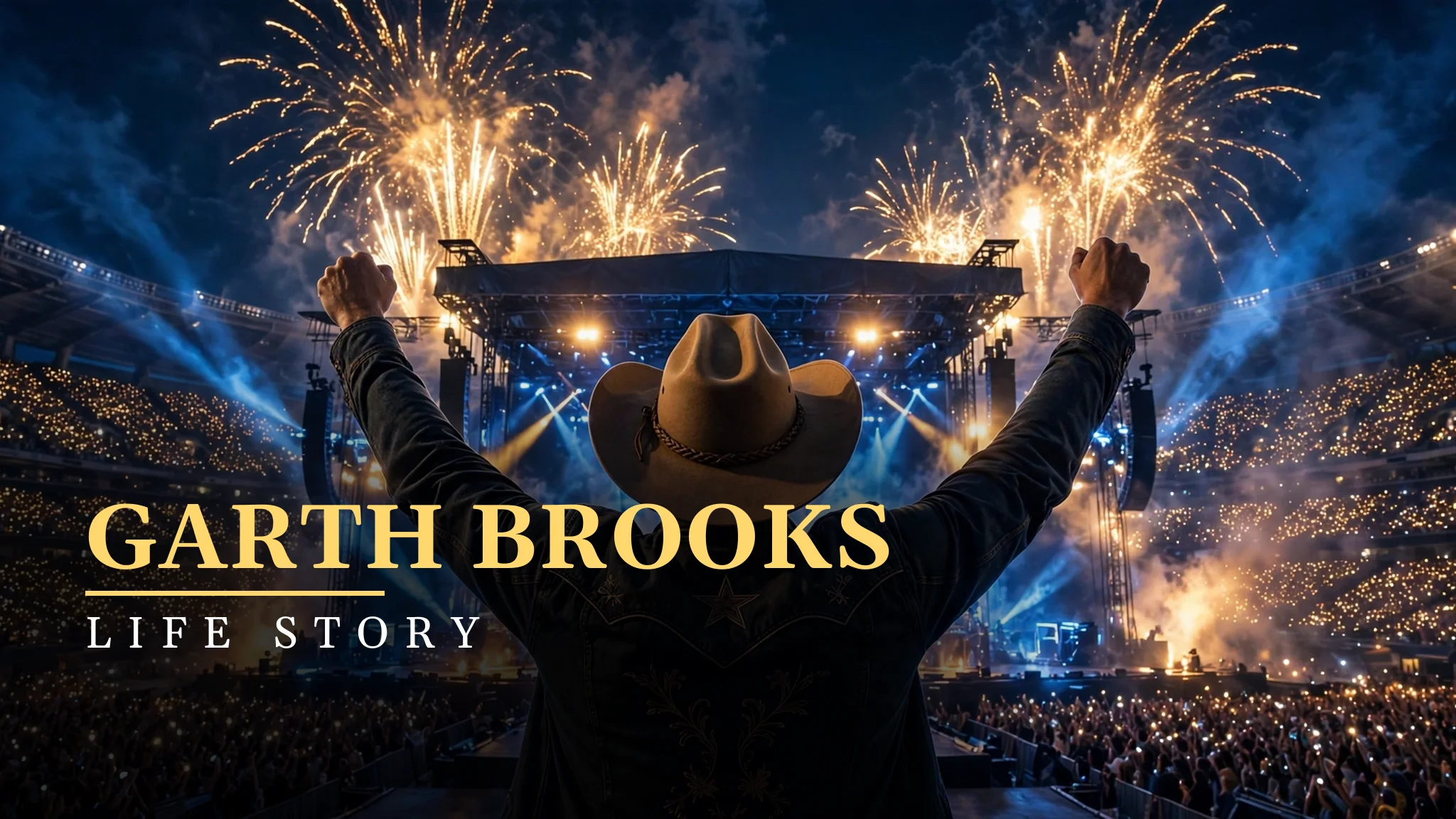
In this post
Garth Brooks is the biggest selling solo artist in American music history, a country singer who filled stadiums like a rock star and changed what a country concert could be. His songs, Friends in Low Places, The Dance, and The Thunder Rolls, are sung in bars and at weddings and on long drives across America, and his live shows are famous for their energy, their noise, and the way he gives everything he has to the crowd. He did not just sing country music. He made it bigger, louder, and more alive than it had ever been before.
What makes his story so interesting is that he walked away from all of it at the height of his fame, to raise his three daughters, and then he came back years later to find that the fans were still waiting. He is a man of big feelings and big choices, and his life has had triumph, risk, and a long quiet period in the middle that says as much about him as the stadium tours do. He grew up in Oklahoma, he studied at university, and he fought hard to get to Nashville, where he was turned away more than once before he finally broke through.
This is the story of a boy from Tulsa who became the king of country music, who retired to be a father, and who returned to the stage to prove that the music had never left him. It is a story about ambition, about family, and about what happens when a star decides that home matters more than fame.
Growing Up in Oklahoma
Troyal Garth Brooks was born on 7 February 1962 in Tulsa, Oklahoma, and he grew up in the town of Yukon, a small place where life was simple and family came first. His father, Troyal Brooks, worked in the oil business, and his mother, Colleen, had been a country singer herself, recording for a major label in the 1950s. Music was always in the house, and Garth grew up hearing his mother sing, and hearing the records she loved, from country to rock to pop.
He was the youngest of six children, and the house was busy, loud, and full of love. He played sports at school, he was good at running and at throwing the javelin, and he learned how to compete and how to work hard. He also learned how to perform, singing in school shows and playing guitar with friends. He was not a quiet child. He had energy, he had a big voice, and he liked being in front of people, and that love of the stage never left him.
After school he went to Oklahoma State University in Stillwater, where he studied advertising and played in bars at night with a small band. The bars were smoky, the crowds were small, and the pay was little, but he learned how to hold a room, how to read a crowd, and how to make a song feel alive. He dreamed of Nashville, the home of country music, and he knew that one day he would have to go there and try his luck, even if it meant leaving everything he knew behind.
He finished university and tried Nashville for the first time in the mid-1980s, but the trip did not go well. He played for a few people, he was told that his music was not quite right, and he went home to Oklahoma, discouraged but not beaten. He worked, he kept singing, and he kept writing, and he waited for the right moment to try again. That patience, and that refusal to give up after a first failure, would matter a great deal in the years that followed.
At Oklahoma State University, Garth was a good athlete, and he competed in the javelin, a sport that taught him discipline, focus, and the value of practice. He was not the biggest or the strongest athlete, but he worked hard, and he learned how to compete, and how to lose, and how to try again. Those lessons stayed with him when he became a singer, because the music business, like sport, rewards those who work hard, and who refuse to give up, even when the road is long.
He also worked closely with the charity Habitat for Humanity, helping to build houses for families in need, and he started a foundation called Teammates for Kids, which helps children who are facing hard times, with health, and with hope. He has said that giving back is not a choice, but a duty, for a man who has been given so much, and he has lived by that belief, year after year, without making a big show of it. His fans know about his charity work, and they respect him for it, because it shows that he is not just a star. He is a man who cares, and who uses his fame to help others, in the way that he knows how.
The Road to Nashville and the First Album
In 1987 Garth went back to Nashville, this time with more experience and more determination. He worked in a boot store, he played in bars, and he met people in the music business who began to notice his voice and his energy. He was not a smooth, polished singer like many of the stars of the time. He was loud, he was physical, and he sang with a feeling that made people stop and listen. He was also a good songwriter, and his songs had a direct, honest quality that fans would soon love.
He was signed by Capitol Records in 1988, and his first album, Garth Brooks, was released in 1989. The album had a slow start, but it grew, and it produced hit songs such as Much Too Young (To Feel This Damn Old), If Tomorrow Never Comes, and The Dance, a song about love and loss that became one of his most loved recordings. The Dance was not a fast, fun song. It was a slow, thoughtful song about the pain of loving someone and losing them, and it showed that Garth could sing a quiet song as well as a loud one.
The album sold well, and it won him new fans, but it was only the beginning. He toured constantly, playing small halls and then bigger ones, and he built a reputation as a live performer who gave everything on stage. He ran, he jumped, he climbed, and he sang until he was out of breath, and the crowds loved it, because they had never seen a country singer perform with that kind of energy before. He was not just singing songs. He was putting on a show.
By the end of 1989, Garth Brooks was no longer a new name in Nashville. He was a rising star, and the music business was watching him closely. He had a voice, he had songs, and he had a live show that people talked about long after the concert ended. The next album would make him a superstar, and it would change country music in a way that nobody had expected.
His first trip to Nashville came in the mid-1980s, when he drove to the city with a friend, played for a few people, and was told that his music was not quite right. He went home to Oklahoma, discouraged, but not beaten, and he worked, and he kept singing, and he kept writing, and he waited for the right moment to try again. That first failure taught him something important: that a no is not the end, and that a singer who believes in himself will find another way, if he is patient enough to wait for it.
Friends in Low Places and the Biggest Years
In 1990 Garth released his second album, No Fences, and it became one of the biggest country albums of all time. The first single from the album was Friends in Low Places, a song about a man who shows up at a fancy party in the wrong clothes and decides he would rather be with his friends in a bar. The song was funny, it was proud, and it was something that millions of ordinary people understood at once. It became his signature song, and it is still sung in bars across America today.
The album also had The Thunder Rolls, a dark and powerful song about a cheating husband and a wife who decides to fight back, and Unanswered Prayers, a gentle song about looking back on a lost love and being grateful that it did not work out. No Fences sold in huge numbers, and it stayed on the charts for years. It was followed by Ropin’ the Wind in 1991, which became the first country album to enter the main American album chart at number one, a sign that country music had become bigger than anyone had thought possible.
Garth’s concerts also became legendary. He played in stadiums that had once been reserved for rock bands, and he filled them with fans who sang every word. He wore a headset microphone so he could run around the stage, he smashed guitars, he climbed on speakers, and he treated every show like it was the most important night of his life. Some people in Nashville thought he was too loud, too wild, and too much like a rock star, but the fans did not care. They loved him, and they bought his records in numbers that no country singer had ever seen before.
Through the early 1990s he was the biggest star in country music, and one of the biggest stars in all of American music. He won awards, he sold millions of albums, and he became a household name. He also used his fame to help others, working with Habitat for Humanity to build houses for families in need, and starting a foundation to help children. He was a superstar, but he was also a man from Oklahoma who remembered where he came from, and who wanted to give something back.
The Dance, one of his most loved songs, was written by Tony Arata, and it tells the story of a man who looks back on a love that ended, and who says that the pain was worth the joy. Garth sang it with a tenderness that surprised people who only knew him as a loud stadium star, and it became a song that is still played at funerals, and at weddings, and in the hearts of people who have loved and lost. It showed that he could sing a quiet song, as well as a loud one, and that his voice had a depth that went beyond the show.
Chris Gaines, Risks, and a Surprising Turn
In 1999 Garth made one of the strangest and boldest choices of his career. He created a fictional rock star called Chris Gaines, with a different look, a different voice, and a different kind of music, and he released an album as Gaines, called Garth Brooks in… The Life of Chris Gaines. The album was meant to be the soundtrack to a film about the fictional singer, but the film was never made, and the album confused many of his country fans, who did not know what to make of it.
The Chris Gaines album was not a failure in every way. It had a hit song, Lost in You, and it showed that Garth could sing pop and rock as well as country. But it was a risk, and it was a risk that did not pay off in the way he had hoped. His country fans were confused, and some of them felt that he had left them behind. The music business, which had always loved his success, was not sure what to do with a country star who wanted to be someone else entirely.
Looking back, the Chris Gaines project tells us something important about Garth. He is not a man who is happy doing the same thing forever. He likes to try new things, even when they are risky, and even when they might fail. He had already achieved more than any other country singer, and he could have kept making the same kind of record for the rest of his life. Instead, he tried something different, and he learned from it, even if the lesson was a hard one.
The late 1990s were also a time of change in his personal life. His marriage to his first wife, Sandy Mahl, with whom he had three daughters, was coming to an end, and the pressures of fame, touring, and family life were pulling him in different directions. He was still a huge star, but he was also a man who was beginning to think about what mattered most to him, and that thinking would lead to the biggest decision of his life.
In 1997 he played a free concert in Central Park in New York City, in front of hundreds of thousands of people, one of the largest crowds for a single concert in American history. The show was a celebration, and it proved that country music could fill the biggest spaces in the world, and that Garth Brooks was not just a country star. He was a star, full stop, and his music belonged to everyone, not just to country fans. It was a night he has never forgotten, and neither have the fans who were there.
Retirement to Raise His Daughters
In 2001 Garth Brooks did something that almost no superstar had ever done. He retired from touring and recording, at the height of his fame, to raise his three daughters, Taylor, August, and Allie, in Oklahoma. He had shared custody of the girls after his divorce, and he wanted to be a full-time father, to take them to school, to help with homework, and to be there for the ordinary days of their childhood. He believed that his daughters needed him more than his fans did, and he acted on that belief.
The retirement lasted for more than a decade, and during that time he lived a quiet life in Oklahoma, away from the spotlight. He played a few special shows, he recorded a little, and he appeared on television from time to time, but he did not tour, and he did not chase the charts. For a man who had been the biggest star in country music, it was a remarkable choice, and it earned him respect from people who understood how hard it is to walk away from fame and money.
He also found love again during those years. He married the country singer Trisha Yearwood in 2005, and the two of them built a life together in Oklahoma, with music, family, and a shared love of cooking and home. Trisha understood the music business, and she understood Garth, and their marriage gave him a partner who could share both the quiet years and the loud ones that were still to come.
His daughters grew up, and as they became adults, Garth began to think about music again. He had never stopped loving it, and he had never stopped writing, but he had kept his promise to his girls, and now that promise was complete. He was ready to return, and he knew that the fans, who had waited for so long, would be there to welcome him back. He was right.
He also released an album called Sevens in 1997, and a live album called Double Live in 1998, which became one of the best-selling live albums of all time. The live album captured the energy of his shows, the noise, the joy, and the way he gave everything he had to the crowd, night after night. It was a record of a star at the height of his powers, and it is still loved by fans who were not there, but who wish they had been.
The Comeback and the Stadium Years
In 2014 Garth Brooks returned to the stage with a new album, Man Against Machine, and a world tour that sold out arenas and stadiums across America and beyond. The fans had not forgotten him. They came in huge numbers, they sang every word, and they treated his return like a homecoming. He was older, he was a father, and he was a husband, but on stage he was the same Garth, running, jumping, and giving everything he had to the crowd, as if no time had passed at all.
The comeback tour lasted for years, and it became one of the biggest tours in music history, with hundreds of shows and millions of fans. He played in stadiums, in arenas, and in small towns, and he kept the ticket prices low, because he wanted ordinary fans to be able to afford to come. He also released new music, he worked with Trisha Yearwood, and he proved that a country singer in his fifties could still fill the biggest rooms in the world.
He also embraced new ways of reaching fans, including a deal with a major retailer to sell his music, and later, his own online store. He was slow to join streaming services, because he wanted to protect the value of his albums, but he eventually found ways to make his music available to a new generation of listeners, who discovered his songs for the first time and wondered why they had never heard them before.
The comeback years showed that Garth’s story was not finished. He had walked away, he had raised his family, and he had come back to find that the music was still there, and the fans were still there, and the songs still mattered. It was a second act that few stars ever get, and he made the most of it, with the same energy and the same heart that had made him a star in the first place.
The Legacy of Country’s Biggest Star
Garth Brooks will be remembered as the best-selling solo artist in American music history, a country singer who sold more albums than almost anyone, and who changed what a country concert could be. He took country music out of small halls and into stadiums, and he showed that a country singer could be as big as any rock star in the world. His records, his tours, and his songs have become a central part of the story of American music.
His legacy is also in the way he balanced fame and family. He walked away from the biggest career in country music to raise his daughters, and he came back when they were grown, and that choice has inspired other artists to think about what matters most. He showed that you can be a superstar and a father at the same time, but not always at the same moment, and that sometimes you have to choose, and the right choice is not always the one that makes you more famous.
He will also be remembered for his generosity, for his work with Habitat for Humanity, for his foundation for children, and for the way he treats his fans. He keeps ticket prices low, he plays long shows, and he signs autographs until the last fan has gone home. He understands that his success belongs to the people who bought his records and came to his shows, and he has never forgotten that.
Garth Brooks started as a boy from Oklahoma with a guitar and a dream, and he became the biggest star country music has ever seen. He did it with songs that told the truth, with shows that gave everything, and with a heart that stayed loyal to his family and his fans. That is a legacy that will last, and it is why his name will be remembered long after the last stadium has gone quiet.
My Take:
When I think about Garth Brooks, the first thing I feel is the energy of his live shows, because I have never seen a country singer perform with that kind of fire. He runs, he jumps, he climbs, and he sings until he is out of breath, and the crowd sings with him, and for a few hours the whole stadium feels like one big family. I think that is a gift, and it is a gift that comes from hard work, not from luck. He learned his craft in small bars in Oklahoma, and he carried that same hunger onto the biggest stages in the world.
I admire him most for the way he retired to raise his daughters. That is a decision that most famous people would never make, because fame is addictive, and money is addictive, and walking away feels like losing. Garth walked away, and he stayed away for more than ten years, and he took his girls to school, and he cooked dinner, and he lived an ordinary life. I think that takes more courage than playing a stadium, because a stadium gives you applause, and an ordinary life gives you nothing but the quiet knowledge that you did the right thing. He did the right thing, and I respect him for it.
What moves me about his music is the way his songs tell the truth about ordinary people. Friends in Low Places is not a song about rich people or fancy parties. It is a song about a man who does not fit in, who goes to a bar with his friends, and who is proud of who he is. The Dance is about love and loss, and about how the pain of losing someone is worth the joy of having loved them. These are songs that speak to real lives, and that is why they last. They are not clever tricks. They are honest stories, sung by a man who believes them.
I also think about the Chris Gaines project, because it is easy to laugh at it now, but it took real courage to try it. Garth had everything, and he risked it all to be someone else, to make a different kind of music, and to tell a different kind of story. It did not work, and his fans were confused, but I admire the fact that he tried. Too many stars play it safe for their whole careers, making the same record again and again, because they are afraid to fail. Garth was not afraid to fail, and that is a rare and valuable quality.
There is a sad part to his story too, and it is the way his first marriage ended. He was married to Sandy Mahl, and they had three daughters, and the pressures of fame, of touring, of being away from home for months at a time, pulled them apart. I do not think it was anyone’s fault, because fame is hard on a family, and a life on the road is hard on a marriage. I think the divorce hurt him, and I think it is part of the reason he retired, because he wanted to be there for his girls, and he wanted to make up for the time he had lost. That is a human story, and it makes him feel real.
I keep coming back to his comeback, because it is one of the great second acts in music. He came back after fourteen years away, and the fans were still there, and the songs were still there, and the stadiums were still full. That does not happen by accident. It happens because the music was good, because the fans were loyal, and because Garth had treated people well. He kept ticket prices low, he played long shows, and he thanked the fans at every turn. I think that is how you build a career that lasts. You treat people well, and they remember.
If I have a criticism, it is that some of his music, especially in the later years, feels a little safe to me, as if he is giving the fans what they want instead of surprising them. I understand why he does it, because the fans come to hear the old songs, and they want to sing along, but I miss the risk of the early years, when he was trying new things and pushing country music in new directions. I hope he keeps taking risks, because he is at his best when he is brave, not when he is careful.
Another thing I notice is how much he has given back. He has built houses with Habitat for Humanity, he has started a foundation for children, and he has played benefits for people in need. He does not talk about it much, and he does not make a big show of it, but he does it, year after year. I think that is the right way to be famous. You use your fame to help people, and you do it quietly, and you do it because it is right, not because it will make you look good.
For a young reader, I think the lesson of Garth’s life is that hard work matters, and that family matters more. He worked hard in bars, he worked hard on tour, and he worked hard in the studio, and that work made him a star. But when he had to choose between being a star and being a father, he chose to be a father, and that choice did not end his career. It made his career better, because when he came back, he was a man who knew what mattered, and the fans could feel it. That is a lesson worth learning.
I also think his story teaches us about second chances. He failed in Nashville the first time, and he went home, and he tried again. He failed with Chris Gaines, and he learned from it, and he moved on. He left the music business, and he came back, and he succeeded again. Life is not one chance. It is many chances, and the people who succeed are the ones who keep trying, even after they have failed. Garth kept trying, and that is why he is where he is.
One more thing stays with me, and it is the way he treats his fans. He does not act like a star who is above the people who love his music. He acts like a man who is grateful, and who knows that without the fans, there is no career, no stadium, no song. He signs autographs, he talks to people, he keeps prices low, and he plays until the last song is done. I think that gratitude is a kind of humility, and it is a rare thing in a world where many famous people forget where they came from.
In the end, I believe Garth Brooks teaches us that a big life is not just about big stages and big sales. It is about big choices, made with a clear heart, and about the people you love, and the people who love you back. He chose his daughters over fame, and he chose his fans over money, and he chose to keep singing, even when it would have been easier to stop. When I hear Friends in Low Places today, I do not just hear a party song. I hear a man who knows who he is, who knows where he came from, and who is proud of it, and I think that is why people will keep singing along for a long time to come.
I think about his mother sometimes, and about the fact that she was a singer too, and that she gave up her own career to raise her children. Garth grew up in a house where music was loved, and where family came first, and I think that shaped everything he did. He became a star, but he never forgot the lesson of his childhood, that family is the most important thing, and that music is a gift to share, not a prize to keep. That is a beautiful inheritance, and he has used it well.
I also want to say that his voice, for all the energy of his shows, is at its best in the quiet songs. The Dance is a song that stops me every time I hear it, because it is about the hardest thing in life, which is loving someone and knowing that you might lose them, and loving them anyway. Garth sings it with a tenderness that surprises people who only know him as a loud stadium star, and it reminds me that a great singer can be both loud and soft, both strong and gentle, and that the best artists are the ones who can do both.
Finally, I want to say that Garth’s story is a reminder that fame is not the end of the story. He was famous, he walked away, and he came back, and the story kept going. That is a hopeful thing, because it means that no choice is final, and no door is closed forever. You can leave, and you can return, and you can start again, and the people who love you will still be there. I think that is a lesson that goes far beyond music, and it is one that I will carry with me.
When I look at the whole of his life, from Yukon, Oklahoma, to the biggest stadiums in the world, from No Fences to Man Against Machine, from retirement to comeback, I see a man who has lived a big life, with big feelings, big choices, and big songs. He is not perfect, and his story has its sad parts, but it is a full life, and it is a life that was lived with heart. I think the world is better because Garth Brooks sang, and I think his songs will keep playing, in bars and in cars and in stadiums, for many years to come.
One last thought stays with me, and it is about the fans singing Friends in Low Places at the end of a long night, with their arms around each other, and their voices raised, and their worries forgotten for a few minutes. That is what music is for, and that is what Garth gave them. He gave them a song to sing together, and a night to remember, and a reason to be proud of who they are. That is a gift, and it is a gift that will last.
I also think about his friendship with Trisha Yearwood, and the way they have built a life together, with music, with cooking, and with a shared love of home. They sing together, they cook together, and they laugh together, and their marriage feels like a partnership, not a performance. I think that is a beautiful thing, and it is a reminder that a good marriage is not about being perfect. It is about sharing a life, and enjoying the ordinary days, as well as the extraordinary ones.
One more thing I admire is the way he has kept ticket prices low, even when he could have charged much more. He has said that he wants ordinary fans to be able to afford to come to his shows, and that a concert should not be a luxury, but a joy that everyone can share. I think that is a rare and generous attitude, in a world where many stars charge more and more, and it tells me that Garth has not forgotten where he came from, and who his fans are.
I also think about the Central Park concert in 1997, when hundreds of thousands of people came to see him play for free, in the heart of New York City, and the whole park sang along, and the whole city felt like one big family. It was a night that proved country music belonged to everyone, not just to country fans, and that Garth Brooks was not just a country star. He was a star, full stop, and his music belonged to the world. I think that is a beautiful thing, and it is a reminder that good music has no borders, and no limits, and that it can bring people together, even in the biggest city in the world.
Frequently Asked Questions
Where did Garth Brooks grow up?
Garth was born in Tulsa, Oklahoma, in 1962, and he grew up in the town of Yukon, where his father worked in the oil business and his mother, a former country singer, filled the house with music. He played sports at school, sang in shows, and later studied at Oklahoma State University while playing in bars at night.
What was Garth Brooks’ first big hit?
His first album, released in 1989, produced hits such as If Tomorrow Never Comes and The Dance, a slow song about love and loss. His real breakthrough came with his second album, No Fences, in 1990, and its first single, Friends in Low Places, which became his signature song.
Why is Friends in Low Places so popular?
Friends in Low Places tells the story of a man who shows up at a fancy party in the wrong clothes and decides he would rather be with his friends in a bar. Its humour, pride, and simple truth made it a song that ordinary people felt was written about them, and it is still sung in bars across America.
Who was Chris Gaines?
Chris Gaines was a fictional rock star that Garth created in 1999, with a different look and a different sound, and he released an album as Gaines called Garth Brooks in… The Life of Chris Gaines. The album had a hit song, Lost in You, but it confused many of his country fans, and the film it was meant to support was never made.
Why did Garth Brooks retire in 2001?
Garth retired from touring and recording in 2001 to raise his three daughters, Taylor, August, and Allie, in Oklahoma, after his divorce from their mother, Sandy Mahl. He wanted to be a full-time father, taking them to school and being there for their childhood, and he stayed away from the road for more than a decade.
When did Garth Brooks come back to music?
Garth returned in 2014 with a new album, Man Against Machine, and a world tour that sold out stadiums and arenas across America and beyond. He married the singer Trisha Yearwood in 2005, and his comeback proved that his fans had waited for him, and that his songs still mattered.


