Gary Oldman: The Life Story Behind the Chameleon
In this post
- A Working-Class Boyhood in New Cross
- Sid and Nancy and the Explosion of Talent
- Dracula, Léon, and the Great Villains
- Sirius Black, Commissioner Gordon, and the Blockbuster Years
- Tinker Tailor Soldier Spy and the First Oscar Nomination
- Darkest Hour and the Oscar for Churchill
- Slow Horses, Mank, and the Later Career
- What Gary Oldman Teaches About Acting
- My Take:
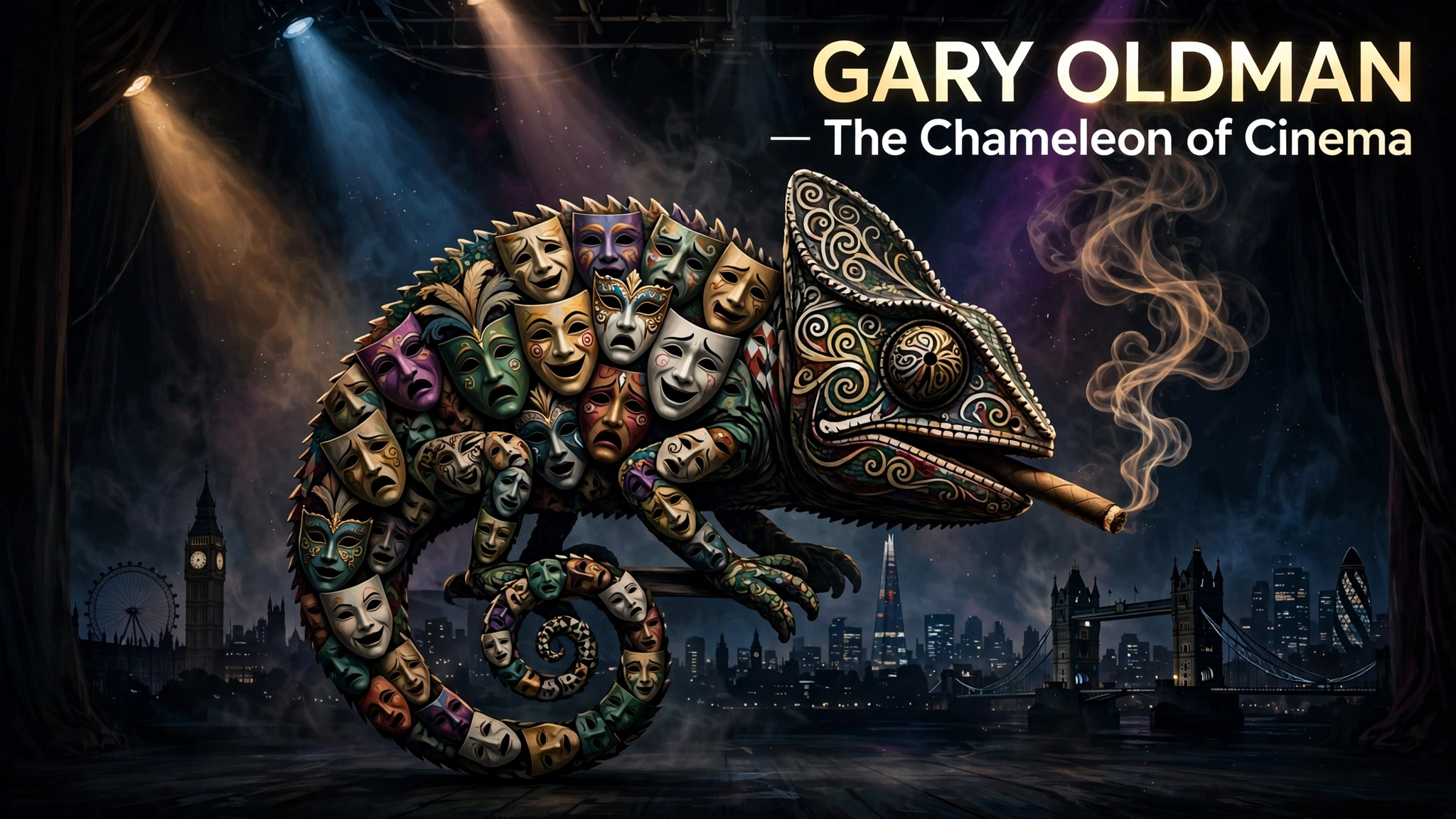
Gary Oldman is the actor who can become anyone, and he has proved it by playing some of the most different characters in cinema history, from a punk rocker to a vampire to a prime minister. When he played Sid Vicious in “Sid and Nancy” in 1986, audiences were stunned by his transformation, by his energy, and by his willingness to disappear into a role. Then came Dracula, a corrupt cop in “Léon”, Sirius Black in “Harry Potter”, Commissioner Gordon in “The Dark Knight”, and Winston Churchill in “Darkest Hour”, a performance that won him the Academy Award for Best Actor. He is a working-class boy from New Cross, south London, who was rejected by RADA and who became one of the greatest actors of his generation anyway. His story is about transformation, about resilience, and about a man who treats every role as a new life to live. It is one of the great acting stories of modern cinema.
Long before the fame, there was simply a child in New Cross, London, learning, watching, and dreaming. His father, Leonard, was a welder who left the family when Gary was young, and his mother, Kathleen, raised him and his sister, Laila, in south London. He has spoken about how difficult those years were, and how his mother’s strength shaped him. He attended West Greenwich School in London, and he later studied at the Rose Bruford College of Speech and Drama, after being rejected by RADA, a rejection that only made him more determined. Those early years explain more of the later career than most people realise.
This post follows the whole arc, from the first steps to Sid and Nancy, and then through the years when Gary Oldman had to decide what kind of performer to become. It covers the breakthrough, the hard stretches, the choices that paid off, and the life away from the spotlight, because a life story is only honest when it keeps every part in view.
A Working-Class Boyhood in New Cross
Gary Oldman was born in New Cross, in south London, in 1958, the son of a welder father and a mother who raised him and his sister after his father left the family. He grew up in a working-class household, where money was tight and life was hard, and he has spoken about how those years shaped him. He attended West Greenwich School, and he was a lively, restless boy, more interested in music and in performing than in studying. He discovered acting as a teenager, through school plays and through youth theatre, and he decided to pursue it as a career. He applied to RADA, the Royal Academy of Dramatic Art, and was rejected, a setback that could have ended his dream. Instead, it made him more determined, and he studied at Rose Bruford College, where he trained as an actor. New Cross gave him his accent, his toughness, and his identity, and he has carried all three throughout his career. He has never forgotten where he came from, and he has spoken about how his background gave him the hunger to succeed.
In 1965, Childhood in New Cross became a test of whether Gary Oldman could grow in New Cross, London without losing what made Gary Oldman interesting. Oldman grew up in working-class south London, raised by his mother after his father left. The response to Childhood in New Cross showed that Gary Oldman could carry a big moment in New Cross, London without forcing it. Careers like that of Gary Oldman are built on steps like Childhood in New Cross, taken seriously in New Cross, London and finished properly.
In 1975, Gary Oldman took on Rejected by RADA, and Gary Oldman knew the job in New Cross, London would ask for more than talent alone. He was turned down by the famous drama school, a rejection that only made him more determined. Rejected by RADA is the kind of job that makes the next opportunity easier for Gary Oldman to win, because the evidence from 1975 is right there. It is a useful reminder that the career of Gary Oldman was built as much in the small jobs as in the famous ones like Rejected by RADA.
The year 1976 brought Rose Bruford College, and Gary Oldman approached it in New Cross, London as a chance for Gary Oldman to be seen differently. He trained at Rose Bruford, learning the craft that would make him one of the great actors. Looking back from New Cross, London, it is easy to see why Rose Bruford College stayed in the mind of Gary Oldman’s audience long after 1976. Moments like Rose Bruford College show why patience matters more for Gary Oldman than sudden noise, and New Cross, London noticed that patience.
Looking back, Childhood in New Cross was one of the steps that made later triumphs possible for Gary Oldman, because it proved the base in New Cross, London was strong.
Sid and Nancy and the Explosion of Talent
In 1986, Gary Oldman played Sid Vicious in “Sid and Nancy”, Alex Cox’s film about the Sex Pistols bassist and his girlfriend, and the performance made him a star. He played Sid with a raw, chaotic energy, capturing the punk’s charisma, his self-destruction, and his tragedy. The film was a critical success, and Oldman’s performance was praised as one of the finest of the year. He followed it with “Prick Up Your Ears” in 1987, in which he played the playwright Joe Orton, another transformative performance that showed his range. He was not a conventional leading man, and he did not look like one, yet directors saw in him a chameleon, an actor who could become anyone. The early years were a period of intense work, of playing characters who were difficult, dangerous, and unforgettable. He has spoken about how those roles taught him the importance of research, of preparation, and of total commitment. Sid Vicious was the beginning, and it announced the arrival of one of the great actors of his generation.
In 1986, Sid and Nancy became a test of whether Gary Oldman could grow in New Cross, London without losing what made Gary Oldman interesting. His portrayal of Sid Vicious became a landmark performance, and it made him a star. Sid and Nancy is the kind of job that makes the next opportunity easier for Gary Oldman to win, because the evidence from 1986 is right there. The lesson of Sid and Nancy is simple for Gary Oldman: do the hard job well in New Cross, London, and the next door opens by itself.
In 1987, Gary Oldman took on Prick Up Your Ears, and Gary Oldman knew the job in New Cross, London would ask for more than talent alone. He played Joe Orton, showing his ability to transform into real, complex people. For audiences in New Cross, London, Prick Up Your Ears became the piece they mention first when they explain why they admire Gary Oldman. Such work builds trust for Gary Oldman, and trust is the currency of Prick Up Your Ears that never goes out of fashion in New Cross, London.
Early acclaim landed in 1987, and for Gary Oldman it was less a reward in New Cross, London than a fresh responsibility for Gary Oldman. His performances established him as one of the most talented young actors in Britain. Early acclaim rewards a second look, because the care Gary Oldman put into it in 1987 only becomes clear over time. The lesson of Early acclaim is simple for Gary Oldman: do the hard job well in New Cross, London, and the next door opens by itself.
The importance of Sid and Nancy is easy to overlook if you only read the headlines from 1986. The true change for Gary Oldman was in the doors it opened afterwards in New Cross, London.
Dracula, Léon, and the Great Villains
Oldman became known as one of cinema’s great villains, playing characters who were terrifying, charismatic, and unforgettable. He played Count Dracula in Francis Ford Coppola’s “Bram Stoker’s Dracula” in 1992, a performance that required him to be both romantic and monstrous. He played the corrupt DEA agent Norman Stansfield in “Léon: The Professional” in 1994, a villain whose love of Beethoven and whose casual cruelty made him one of the most memorable bad guys in film history. He also appeared in “True Romance” in 1993 as Drexl Spivey, a pimp with a dreadlocked, menacing presence, and in “The Fifth Element” in 1997 as the industrialist Zorg. Each villain was different, and each one showed a different side of his talent. He has said that he enjoys playing villains, because they are often the most interesting characters, with the most to explore. The villain years made him a star in Hollywood, and they showed that he could steal any film, even in a supporting role. It was a reputation he would carry for decades.
The story of Bram Stoker’s Dracula in 1992 starts with Gary Oldman taking a gamble in New Cross, London that many around Gary Oldman would have avoided. He played the Count, showing both romance and menace in Coppola’s gothic epic. The job mattered because Bram Stoker’s Dracula stretched what people in New Cross, London believed Gary Oldman could take on next. The lesson of Bram Stoker’s Dracula is simple for Gary Oldman: do the hard job well in New Cross, London, and the next door opens by itself.
1994 paired Gary Oldman with Léon: The Professional, a project in New Cross, London that needed patience, nerve, and long hours from Gary Oldman. His corrupt agent Stansfield became one of cinema’s most memorable villains. Léon: The Professional showed a performer in New Cross, London willing to be judged on the work itself, which is a brave choice for Gary Oldman. It is a useful reminder that the career of Gary Oldman was built as much in the small jobs as in the famous ones like Léon: The Professional.
1993 paired Gary Oldman with True Romance, a project in New Cross, London that needed patience, nerve, and long hours from Gary Oldman. His Drexl Spivey was a small but unforgettable role, showing his gift for transformation. True Romance became a reference point for Gary Oldman, a job from 1993 that later interviews in New Cross, London kept coming back to. Careers like that of Gary Oldman are built on steps like True Romance, taken seriously in New Cross, London and finished properly.
The step of Bram Stoker’s Dracula counts for Gary Oldman because it connected the early promise to the later success in New Cross, London, and without it the story would have a gap.
Sirius Black, Commissioner Gordon, and the Blockbuster Years
In the 2000s, Oldman joined two of the biggest franchises in cinema, playing Sirius Black in the “Harry Potter” films and Commissioner Jim Gordon in Christopher Nolan’s “Dark Knight” trilogy. Sirius Black was a godfather, a rebel, and a tragic figure, and Oldman played him with warmth, wit, and a sense of loss that made him a favourite with fans. Commissioner Gordon was a different kind of role, a decent man in a corrupt city, and Oldman played him with quiet integrity, becoming the moral heart of Nolan’s Batman films. The blockbuster years introduced him to a new generation of fans, who knew him as a hero rather than a villain, and they showed his range, his ability to play good men as convincingly as bad ones. He has spoken about how much he enjoyed those roles, and about how they allowed him to work with great directors and great casts. The franchises made him a global star, and they gave him a stability that the earlier, more chaotic years had not. It was a new chapter, and it suited him.
In 2004, Gary Oldman joined Harry Potter as Sirius Black, a project in New Cross, London whose scale surprised even Gary Oldman and the people making it. He played Harry’s godfather, becoming a beloved figure for a generation of young fans. Audiences in New Cross, London felt the honesty in Harry Potter as Sirius Black, and honesty is the hardest thing for Gary Oldman to fake in this business. There is a reliability in how Gary Oldman handles such moments that directors in New Cross, London learn to count on after Harry Potter as Sirius Black.
The Dark Knight as Gordon landed in 2005, and for Gary Oldman it was less a reward in New Cross, London than a fresh responsibility for Gary Oldman. He played Commissioner Gordon, the moral heart of Nolan’s Batman trilogy. Audiences in New Cross, London felt the honesty in The Dark Knight as Gordon, and honesty is the hardest thing for Gary Oldman to fake in this business. There is a reliability in how Gary Oldman handles such moments that directors in New Cross, London learn to count on after The Dark Knight as Gordon.
Franchise stardom came in 2008, and it turned into a proving ground for Gary Oldman, a test Gary Oldman faced in New Cross, London with everything to prove. His work in two huge franchises made him a global star, known to audiences of all ages. Franchise stardom rewards a second look, because the care Gary Oldman put into it in 2008 only becomes clear over time. The lesson of Franchise stardom is simple for Gary Oldman: do the hard job well in New Cross, London, and the next door opens by itself.
Harry Potter as Sirius Black proved that the foundations of Gary Oldman were solid in New Cross, London, and solid foundations are what let a career survive the hard years.
Tinker Tailor Soldier Spy and the First Oscar Nomination
In 2011, Oldman starred in “Tinker Tailor Soldier Spy”, Tomas Alfredson’s adaptation of John le Carré’s novel, playing George Smiley, a quiet, methodical spy trying to uncover a mole. The performance was a masterclass in understatement, with Oldman conveying Smiley’s intelligence and his sadness through stillness and through small gestures. The film was a critical success, and it earned Oldman his first Academy Award nomination, for Best Actor. It was a long-overdue recognition, because he had been one of the finest actors in the world for decades, yet he had never been nominated before. He has spoken about how much the nomination meant to him, and about how Smiley was a role he had wanted to play for years. The film also showed a different side of his talent, a man who could hold an audience without shouting, without transforming, simply by being present. “Tinker Tailor” was a turning point, the moment when the industry finally recognised what audiences had known for years, that Gary Oldman was one of the greats.
2011 paired Gary Oldman with Tinker Tailor Soldier Spy, a project in New Cross, London that needed patience, nerve, and long hours from Gary Oldman. His George Smiley earned him his first Oscar nomination, a long-overdue recognition. Seen from today, Tinker Tailor Soldier Spy marks a point where the career of Gary Oldman quietly changed direction in 2011. It is the kind of step that looks simple for Gary Oldman in hindsight and felt anything but simple in New Cross, London at the time.
For Gary Oldman, Playing George Smiley in 2011 was the moment to show New Cross, London that the earlier success of Gary Oldman was no accident. He conveyed the spy’s intelligence through stillness, a masterclass in understated acting. In the wider arc of the life of Gary Oldman, Playing George Smiley stands as evidence from 2011 that the progress was real, not lucky. The lesson of Playing George Smiley is simple for Gary Oldman: do the hard job well in New Cross, London, and the next door opens by itself.
With Critical acclaim in 2012, Gary Oldman found a project in New Cross, London that matched the ambition Gary Oldman had carried quietly. The film was praised worldwide, and Oldman’s performance was called one of the finest of the year. Critical acclaim confirmed something the closest watchers in New Cross, London already knew, that the talent of Gary Oldman had depth behind it. Moments like Critical acclaim show why patience matters more for Gary Oldman than sudden noise, and New Cross, London noticed that patience.
Its real importance for Gary Oldman lies beyond a single moment in Tinker Tailor Soldier Spy. It shifted how people in New Cross, London spoke about Gary Oldman, and it made the next stage possible.
Darkest Hour and the Oscar for Churchill
In 2017, Gary Oldman played Winston Churchill in “Darkest Hour”, Joe Wright’s film about the prime minister’s first weeks in office during the Second World War, and the performance won him the Academy Award for Best Actor. He disappeared under heavy prosthetics and makeup, and he captured Churchill’s voice, his humour, his stubbornness, and his greatness. The film was a critical and commercial success, and Oldman’s performance was praised as one of the finest in cinema history. He also won a BAFTA and a Golden Globe for the role, completing a clean sweep of the major awards. He has spoken about how much the role meant to him, because Churchill is one of the most important figures in British history, and because playing him required everything he had learned in thirty years of acting. “Darkest Hour” was the culmination of his career, the moment when his talent was recognised at the highest level. It was also a vindication, after decades of being overlooked, that the chameleon from New Cross was, in fact, one of the greatest actors alive.
The story of Darkest Hour in 2017 starts with Gary Oldman taking a gamble in New Cross, London that many around Gary Oldman would have avoided. He played Winston Churchill, winning the Academy Award for Best Actor. Darkest Hour became a reference point for Gary Oldman, a job from 2017 that later interviews in New Cross, London kept coming back to. That mix of effort and calm from Gary Oldman is difficult to imitate, and it is why Darkest Hour still earns discussion in New Cross, London.
For Gary Oldman, Transformation into Churchill in 2017 was the moment to show New Cross, London that the earlier success of Gary Oldman was no accident. Heavy prosthetics and a studied voice made him unrecognisable as the prime minister. What lasted from Transformation into Churchill was not the headline but the craft of Gary Oldman, and craft is what keeps a career alive in New Cross, London. That willingness of Gary Oldman to keep learning is visible in Transformation into Churchill, and it is what keeps the work of Gary Oldman fresh.
Awards sweep landed in 2018, and for Gary Oldman it was less a reward in New Cross, London than a fresh responsibility for Gary Oldman. He won the Oscar, BAFTA, and Golden Globe, a complete recognition of his performance. Audiences in New Cross, London felt the honesty in Awards sweep, and honesty is the hardest thing for Gary Oldman to fake in this business. The quiet discipline of Gary Oldman behind Awards sweep is easy to miss in New Cross, London, and it is the most important part.
The reason Darkest Hour still gets mentioned in New Cross, London is simple: it changed the direction of the story of Gary Oldman for good.
Slow Horses, Mank, and the Later Career
In recent years, Oldman has continued to impress, most notably in “Slow Horses”, the Apple TV+ series in which he plays Jackson Lamb, a dishevelled, brilliant, foul-mouthed spymaster. The role has become one of his most loved, and it has earned him awards and nominations, as well as a new generation of fans. He also appeared in “Mank” in 2020, David Fincher’s film about the screenwriter Herman Mankiewicz, in which he played the title role with wit and sadness. Oldman has spoken about what television gives him, the room to let a character breathe across many hours. He has also been open about his past struggles with alcohol, and about getting sober, and how that decision saved his career and his life. His later career is a story of an actor at the peak of his powers, still taking on challenging roles, still transforming himself, and still surprising audiences. It is a career that shows no sign of slowing down, and that remains one of the most remarkable in modern cinema.
For Gary Oldman, Slow Horses in 2022 was the moment to show New Cross, London that the earlier success of Gary Oldman was no accident. He plays Jackson Lamb, a role that has become one of his most loved and acclaimed. Seen from today, Slow Horses marks a point where the career of Gary Oldman quietly changed direction in 2022. Careers like that of Gary Oldman are built on steps like Slow Horses, taken seriously in New Cross, London and finished properly.
In 2020, Mank became a test of whether Gary Oldman could grow in New Cross, London without losing what made Gary Oldman interesting. His portrayal of Herman Mankiewicz showed his range in a David Fincher drama. Mank is the kind of job that makes the next opportunity easier for Gary Oldman to win, because the evidence from 2020 is right there. The steadiness behind Mank is the part of Gary Oldman that does not show up in headlines from 2020.
With Sobriety and renewal in 1997, Gary Oldman found a project in New Cross, London that matched the ambition Gary Oldman had carried quietly. He has spoken openly about overcoming alcohol addiction, and about how sobriety saved his career. Sobriety and renewal is the kind of job that makes the next opportunity easier for Gary Oldman to win, because the evidence from 1997 is right there. That mix of effort and calm from Gary Oldman is difficult to imitate, and it is why Sobriety and renewal still earns discussion in New Cross, London.
What Slow Horses gave the career of Gary Oldman was range rather than noise, and range is what keeps a performer working for years in New Cross, London.
What Gary Oldman Teaches About Acting
Oldman’s legacy is the proof that acting is transformation, and that the greatest actors are those who disappear into their roles. He began as a working-class boy from New Cross, rejected by RADA, and became one of the greatest actors in the world. He showed that a villain can be fascinating, that a hero can be quiet, and that a prime minister can be human. His influence can be seen in the many actors who followed his model, and in the way the industry now talks about character acting. He has also shown that honesty about personal struggles can be a strength, and that it is possible to rebuild a life and a career. Young actors study Oldman’s career and find the same lesson in it: be ready to transform, be ready to graft, and never stop learning. The boy from New Cross who was told he was not good enough became the chameleon of cinema, and his story is a reminder that great acting is not about fame, it is about truth, and about the courage to become someone else, completely.
2017 gave Gary Oldman Chameleon legacy, and the part demanded a steadiness in New Cross, London that only experience teaches Gary Oldman. His Churchill proved that total transformation is the highest form of acting. The work of Gary Oldman in Chameleon legacy landed because Gary Oldman treated it seriously in 2017, and seriousness is something audiences in New Cross, London can feel. It is one more reason the story of Gary Oldman reads as earned in New Cross, London rather than handed over after Chameleon legacy.
In 2005, Gary Oldman said yes to Villains and heroes, and that yes in New Cross, London carried more weight for Gary Oldman than anyone expected. His range across villains and heroes set a standard few actors have matched. The job mattered because Villains and heroes stretched what people in New Cross, London believed Gary Oldman could take on next. Villains and heroes shows how much of the success of Gary Oldman is preparation meeting a moment that finally arrives in New Cross, London.
Sobriety as strength landed in 2020, and for Gary Oldman it was less a reward in New Cross, London than a fresh responsibility for Gary Oldman. His openness about recovery has helped others, and it shows the man behind the roles. For Gary Oldman, Sobriety as strength was proof that the long hours and the early sacrifices in New Cross, London had not been wasted. That willingness of Gary Oldman to keep learning is visible in Sobriety as strength, and it is what keeps the work of Gary Oldman fresh.
Chameleon legacy mattered for Gary Oldman because it showed growth in public in New Cross, London, and growth in public takes more courage than growth in private.
My Take:
The first thing I think about when I think of Gary Oldman is how invisible he is. That sounds like an insult for an actor, but for him it is the highest compliment I can pay. I have watched Sid and Nancy, Dracula, Léon, Harry Potter, the Batman films, and Darkest Hour, and in every one of them I forgot I was watching the same man. His voice changes, his walk changes, the shape of his face seems to change, and the person on screen is not Gary Oldman pretending to be someone else. It is someone else. Very few actors can do that, and almost none can do it for forty years without ever repeating themselves. The industry has a word for actors like him, character actor, and it is usually a polite way of saying you will never be the star. Oldman took that label and turned it into a career most leading men would envy.
I keep coming back to Sid and Nancy from 1986, because it was his first great performance and it set the pattern for everything after. He played Sid Vicious, the bassist of the Sex Pistols, a man who was famous for being destructive and who died of a heroin overdose at twenty-one. Oldman was twenty-eight, a trained stage actor from Rose Bruford College, and he did not play Sid as a cartoon punk. He played him as a frightened, needy young man who had been handed fame and drugs and had no idea what to do with either. The performance is frightening because it is tender. You can see the boy inside the chaos, and that tenderness makes the ending hurt more, not less. What amazes me is that Oldman lost a great deal of weight for the role and lived inside that self-destruction for months, and then he walked away from it and played Joe Orton in Prick Up Your Ears the very next year, a completely different person, a witty gay playwright murdered by his lover. Two roles, two men, nothing in common except the actor. That range, shown that early, should have made him a star immediately. It made him respected instead, which is a different thing, and in the long run it was better.
The villains are what most people remember, and I understand why. His Count Dracula in 1992 is operatic and strange, an old man and a young lover and a monster in the same body, and Francis Ford Coppola gave him the room to be theatrical in a way modern films rarely allow. His corrupt detective Norman Stansfield in Léon in 1994 is something else entirely, a man who listens to classical music while murdering a family, and the performance is so controlled and so cheerful that it is genuinely disturbing. Then there is Drexl in True Romance, a pimp with gold teeth and dreadlocks, a small role that people quote thirty years later. And Zorg in The Fifth Element, a villain who is funny and vain and doomed. What strikes me is that none of these villains are the same. Dracula is romantic, Stansfield is bureaucratic evil, Drexl is street-level menace, Zorg is corporate absurdity. Oldman does not have a villain template. He builds each one from scratch, and he gives each one a private logic, a reason the man thinks he is right. That is why they stay with you. A villain who knows he is a villain is boring. A villain who believes he is the hero of his own story is terrifying, and Oldman understands that better than any actor of his generation.
But the villains are only half the story, and the other half is quieter and, to me, more impressive. His Sirius Black in the Harry Potter films is a man who spent twelve years in prison for a crime he did not commit, and Oldman plays him with a gentleness that makes Harry’s love for him completely believable. There is a scene in Prisoner of Azkaban where Sirius looks at Harry and you can see twelve years of lost time in his face, and Oldman does it with almost no dialogue. His Commissioner Gordon in the Batman films is the moral centre of Christopher Nolan’s trilogy, an honest cop in a corrupt city, and Oldman plays him without any showiness at all. He is simply decent, tired, and brave, and the films would not work without him. I think these roles tell you more about Oldman than the villains do, because anyone can be loud. Being quiet on screen, and still holding the audience, is much harder. He does it by trusting the writing and trusting the audience, and that trust is the mark of a stage-trained actor who learned his craft in theatres where you cannot hide behind editing.
The long wait for recognition is the part of his story that makes me angry on his behalf. He was one of the most respected actors in the world for decades, and the Academy did not nominate him until 2011, for Tinker Tailor Soldier Spy, when he was fifty-three years old. He played George Smiley, John le Carré’s quiet spymaster, a man who thinks more than he speaks, and the performance is a masterpiece of stillness. He lost that Oscar to Jean Dujardin for The Artist, and nobody was surprised, because the Academy has always preferred showy performances to quiet ones. Six years later he won for Darkest Hour, playing Winston Churchill in 2017, and the win was deserved, but it was also a strange kind of justice. He won for a performance in which he was buried under prosthetics and a fat suit, playing a famous man, doing a voice. It was a great performance, and his transformation was extraordinary, but it was not his most subtle work. Smiley was. The Academy gave him the award for the loud role and ignored him for the quiet one, and that tells you more about awards than it does about Oldman. He has said himself that he does not work for awards, and I believe him, because his career proves it. He took the roles that interested him, and the awards caught up eventually, on their own schedule.
His personal life is the part I approach with care, because it is painful and he has spoken about it himself. He grew up in New Cross, south London, the son of a welder who was an alcoholic and left the family when Gary was seven. His mother, Kathleen, raised him and his sister, and he has said that the chaos of his childhood shaped him. He struggled with alcohol himself for years, and he has been open about the fact that drinking nearly destroyed his career and his relationships. He became sober in 1997, and he has stayed sober since. He has been married five times, and he has spoken honestly about the damage his drinking and his work did to those marriages. I do not think a biography should excuse that damage, and Oldman himself does not ask for excuses. What I respect is the honesty. He directed a film in 1997, Nil by Mouth, about a violent alcoholic in south London, and it is one of the most painful films ever made about addiction, because it was drawn from what he had seen at home. He did not make it to win praise. He made it because he needed to put that experience somewhere, and the film is still devastating to watch.
Slow Horses is the role that has defined his later career, and I love it for a simple reason: it lets him be funny. Jackson Lamb, the head of a team of disgraced MI5 agents in the Apple TV series that began in 2022, is flatulent, rude, unkempt, and secretly brilliant, and Oldman plays him with a relish that suggests he is having the time of his life. After decades of playing monsters and heroes and prime ministers, he gets to play a man who farts in meetings and insults everyone and still solves the case. The show is based on Mick Herron’s novels, and it has become one of the most acclaimed series on television. Lamb is also, I think, the closest Oldman has come to playing himself, or at least the version of himself that his friends describe: gruff, funny, impatient with nonsense, and loyal to the people he trusts. There is a freedom in the performance that comes from an actor who no longer needs to prove anything to anyone.
His work as a director deserves more attention than it gets. Nil by Mouth won awards at Cannes and the BAFTAs, and it is a film that no one who sees it forgets. It is not a comfortable film, and it was never going to make money, but it was honest in a way that most films about working-class life are not. Oldman wrote it from memory, from the streets he grew up on, and he directed his actors, including Ray Winstone and Kathy Burke, to performances of terrifying rawness. He has directed little since, and I think that is a loss for cinema. He clearly had a director’s eye and a director’s courage, and the fact that he chose acting instead is understandable, because acting paid better and kept him working, but I still wonder what films he might have made if he had kept directing.
What I take from Gary Oldman’s career, when I step back and look at all of it, is a lesson about patience and about the value of craft over fame. He never had a franchise of his own. He never had a period where he was the biggest star in the world. He had something better, which is a forty-year career in which directors kept calling him because they knew he would make their film better. Christopher Nolan called him. Francis Ford Coppola called him. David Fincher called him for Mank in 2020, where he played Herman Mankiewicz, the alcoholic screenwriter of Citizen Kane, and was nominated for an Oscar again. Gary Oldman is the actor other actors want to work with, and that reputation is earned one performance at a time, over decades, with no shortcuts. He did not chase fame. He chased good work, and fame arrived anyway, late and on his own terms.
If I were telling someone where to start with him, I would not start with Darkest Hour, though it won the Oscar. I would start with Tinker Tailor Soldier Spy, and watch how little he does, and how much that little means. Then I would watch Léon, and see how frightening he can be without raising his voice. Then I would watch the Harry Potter films, and see how gentle he can be. Those three performances, taken together, show you the full range, and they show you why the word versatile is not enough. Versatile suggests someone who can do many things adequately. Oldman does many things brilliantly, and he makes it look easy, which is the most deceptive thing of all. Nothing about it is easy. It is the result of training, of discipline, of sobriety, and of a decision made long ago to serve the story rather than himself.
I also think about the young actors who watch him now and what they can learn, because his career is a better teacher than any acting school brochure. He did not become famous quickly, he did not protect his image, and he did not refuse the small roles. He played a pimp with gold teeth, a corrupt detective, a vampire, a wizard, a policeman, a spy, and a prime minister, and he gave each of them the same seriousness. That is the lesson. There are no small roles, only small performances, and Oldman has never given one. A young actor starting today, looking at a career that might last five years or fifty, could do worse than to study how he chose his work: the interesting script over the big paycheque, the difficult character over the easy hero, and the director he trusted over the project that would make him famous. Fame came anyway, in the end, and it came without him ever asking for it. That is the best kind of fame there is. He was born in London and speaks with a south London accent in real life, but on screen he has been American, Transylvanian, Russian, French, and a dozen kinds of English. He learned accents the way other actors learn lines, as a technical skill to be mastered, and he uses them not as a trick but as a way into character. A voice is a person’s history, and Oldman knows that. When he changes his voice, he changes his history, and the audience believes the new history completely. That is the whole job, really. An actor is someone who can make you believe a different history, and Gary Oldman has been doing it, without ever asking for applause, for almost fifty years. I think that is worth more than any award, even the one he finally won.
Frequently Asked Questions
How did Gary Oldman become famous?
He first became known as Sid Vicious in Sid and Nancy in 1986, after training at Rose Bruford College.
Did Gary Oldman win an Oscar?
Yes. He won the Academy Award for Best Actor for Darkest Hour in 2018, playing Winston Churchill.
Is Gary Oldman in Harry Potter?
Yes. He plays Sirius Black, Harry’s godfather, in the Harry Potter films.
What is Gary Oldman’s most famous role?
Winston Churchill in Darkest Hour is his most acclaimed, though Sid Vicious and Sirius Black are also iconic.
Is Gary Oldman in Slow Horses?
Yes. He plays Jackson Lamb in the Apple TV+ series Slow Horses, one of his most loved recent roles.
Was Gary Oldman rejected by RADA?
Yes. He was turned down by RADA, but he trained at Rose Bruford College and became one of the great actors.


