Gene Tierney: The Life Story Behind Hollywood's Mysterious Beauty
In this post
- A Privileged Childhood in Brooklyn
- Broadway, Hollywood, and a Quick Rise
- Laura and the Face That Launched a Mystery
- Leave Her to Heaven and an Oscar Nomination
- A Daughter’s Illness and a Mother’s Pain
- Mental Illness, Hospitals, and Honest Writing
- Later Years and a Quiet Farewell
- What Beauty Hides
- The Razor’s Edge and a Different Kind of Role
- My Take:
Gene Tierney was one of the most beautiful women in Hollywood, and one of the most mysterious. She had dark hair, pale skin, and eyes that seemed to look straight through the camera, and audiences could not look away. She played Laura, a woman who is thought to be dead, and who returns to life, and she played Ellen in Leave Her to Heaven, a woman who loves so fiercely that her love becomes dangerous. She was perfect for roles that were beautiful, romantic, and a little bit dangerous, because she herself was beautiful, romantic, and a little bit mysterious.
Behind the beauty, there was pain. She lost a child to disability, she suffered from mental illness, she spent time in hospitals, and she faced a Hollywood that did not understand what she was going through. She was a woman who had everything, fame, beauty, money, and love, and who still suffered deeply. Her story is not only about glamour. It is about the cost of glamour, and about a woman who tried to live a normal life in a world that would not let her.
She was born in Brooklyn, she grew up in a wealthy family, she studied acting, she became a star at Twentieth Century-Fox, and she lived to be seventy years old. She wrote about her life with honesty, she spoke about her illness, and she helped others to understand that mental illness is not a shame, but a sickness that needs care. This is the story of a beautiful star who faced dark times, and who kept going.
A Privileged Childhood in Brooklyn
Gene Tierney was born Gene Eliza Tierney on 19 November 1920 in Brooklyn, New York. Her father was a successful insurance broker, and her mother was a former teacher, and the family was wealthy. Gene grew up in a comfortable home, she went to good schools, and she travelled to Europe with her family. She was a pretty girl, with dark hair and a clear complexion, and she was noticed for her beauty from an early age. She was not a poor girl who had to fight for success. She was a rich girl who had to find her own path in a world that expected her to marry well and live quietly.
As a young girl, she was sent to boarding school in Switzerland and in Connecticut, and she learned to speak French, to ride horses, and to be a proper young lady. She was a good student, and she was a lively girl, and she liked to perform in school plays. She was not a shy child. She liked to be noticed, and she liked to act. Her family supported her, even though acting was not a traditional career for a girl from a wealthy family. They saw that she had talent, and they encouraged her to study, to learn, and to work hard.
She came back to New York, she studied acting, and she began to work on Broadway. She appeared in plays in the late 1930s, and she was noticed for her beauty and for her talent. She was still a teenager, and she was already a stage actress, and she was on her way to Hollywood. She was in her late teens, and she was about to become a film star, not because she needed money, but because she wanted to act, and because she was good at it.
The privileged childhood mattered because it gave her a foundation, but it also gave her a burden. She had money, she had education, and she had beauty, but she also had expectations, and she had a family that wanted her to live a certain kind of life. She chose a different life, a life in Hollywood, and she did it with courage. She was not a girl who had to act to survive. She was a girl who chose to act because she loved it, and that choice made her different from many other stars.
Broadway, Hollywood, and a Quick Rise
Gene Tierney began her career on Broadway, where she appeared in plays in the late 1930s. She was beautiful, she was talented, and she was noticed by Hollywood. Twentieth Century-Fox, one of the biggest studios, offered her a contract, and she accepted, moving to California to begin a film career. She was in her late teens, and she was ready to work in films, but she was also young, and she had a lot to learn.
She appeared in films in the early 1940s, and she learned how a film set worked. She learned to hit her mark, to speak her lines clearly, to work with different directors, and to make the most of a role. She was pretty, she was talented, and she was professional, but Hollywood had many pretty and talented young women. She needed a role that would show what she could really do, and she had to wait for it, but not for long. She was a star in the making, and the studio knew it.
Her early films included The Return of Frank James in 1940, and Hudson’s Bay in 1941, and she played romantic heroines with grace and with beauty. She was not yet a great actress, but she was a beautiful one, and audiences liked her. She worked with famous directors, she appeared with famous stars, and she learned her craft, film by film, year by year. She was a working actress, and she was patient, and she was ready for her breakthrough.
She married the fashion designer Oleg Cassini in 1941, and the marriage gave her a daughter, Daria, born in 1943. The marriage was a glamorous one, and the two of them were a famous couple in Hollywood. Cassini was a talented designer, and he dressed Gene beautifully, both on screen and off screen. The marriage would later end in divorce, but it was an important part of her life, and it gave her a daughter she loved deeply, even though Daria faced serious difficulties from birth.
Laura and the Face That Launched a Mystery
In 1944, Gene Tierney starred in Laura, a film directed by Otto Preminger, and co-starring Dana Andrews and Clifton Webb. She played Laura Hunt, a beautiful, successful advertising executive who is thought to have been murdered, and who returns to life, to the surprise of everyone who knew her. The film is a mystery, a romance, and a study of obsession, and Gene played Laura with a cool, elegant beauty that made audiences fall in love with her, even though she is dead for much of the film. Her face, in a portrait that hangs on the wall, becomes the centre of the film, and the detective, played by Dana Andrews, falls in love with the portrait, and then with the real woman.
Laura was a hit, and it is now regarded as one of the greatest films ever made. Gene’s performance in it is one of her best-known, and it made her a star. She was beautiful, she was mysterious, and she was perfect for the role. She did not need to shout, or to make a scene. She needed to be beautiful, to be calm, and to be a little bit distant, and she did it perfectly. The film showed that she could carry a major film, and that she could be a leading lady in Hollywood.
The film also showed that Gene Tierney had a special quality, a kind of cool, distant beauty that made her different from other stars. She was not warm and cheerful, like many actresses of her time. She was cool, elegant, and a little bit mysterious, and audiences loved that. She was the kind of woman that men dreamed about, and that women admired, and she knew it. She used that quality in her acting, and she made it work for her.
Laura is an important part of her story because it shows her at her best. She was beautiful, she was talented, and she was a star. She had come from Broadway to Hollywood, and she had found a role that suited her perfectly. She had earned her place, and she had done it through hard work and talent, not only through beauty. That is a fitting achievement, and it is one that she deserved.
Leave Her to Heaven and an Oscar Nomination
In 1945, Gene Tierney starred in Leave Her to Heaven, a film in Technicolor, in which she played Ellen Berent, a beautiful, passionate, and possessive woman who loves her husband so fiercely that her love becomes dangerous. She is jealous, she is controlling, and she will do anything to keep her husband to herself, even if it means hurting others. Gene played Ellen with a cool, beautiful intensity that shocked audiences, because she was so lovely to look at, and so terrifying in her actions. The film was a hit, and it brought her an Academy Award nomination for Best Actress.
The nomination was a well-deserved honour, and it showed that Hollywood respected her as a serious actress, not only as a beautiful face. She had played a difficult, complex role, and she had done it with skill and with courage. She did not play Ellen as a simple villain. She played her as a real woman, with real feelings, who loved too much, and who could not control her love. That is a difficult thing to do, and Gene did it beautifully.
She also starred in The Ghost and Mrs. Muir in 1947, a romantic fantasy in which she played a widow who falls in love with the ghost of a sea captain, played by Rex Harrison. The film is charming, romantic, and a little bit sad, and Gene played her role with warmth and with grace. It is one of her best-loved films, and it is still watched today by people who like romantic, gentle stories. She was versatile, she was skilled, and she was beautiful, and she made each film better by being in it.
She also starred in The Razor’s Edge in 1946, and in other films that showed her range. She was at the peak of her career, and she was one of the most popular actresses in Hollywood. She had come a long way from Brooklyn, and she had earned her place. She was a star, and she knew it, but she was also a woman who faced private pain, and that pain would soon become a central part of her life.
A Daughter’s Illness and a Mother’s Pain
Gene Tierney’s daughter Daria was born in 1943, and she was born with serious disabilities. Daria was deaf, blind in one eye, and had other health problems, and she needed constant care for the rest of her life. Gene later learned that Daria’s disabilities were likely caused by rubella, or German measles, which Gene had contracted during her pregnancy, after being exposed to the illness at a Hollywood event. The knowledge that her daughter’s suffering might have been caused by a chance meeting, by a fan who was ill, was a heavy burden for Gene to carry, and it caused her deep pain and guilt.
She loved Daria deeply, and she tried to give her the best care possible. She worked with doctors, she learned about Daria’s needs, and she did her best to be a good mother. But the pain of seeing her daughter suffer, and the guilt of feeling responsible, was a constant part of her life. She also had a second daughter, Christina, born in 1948, who was healthy, and who gave Gene joy, but the pain of Daria’s illness never left her.
The stress of Daria’s illness, combined with the pressure of her film career, and the difficulties in her marriage to Oleg Cassini, took a toll on Gene’s mental health. She began to suffer from depression, and from other mental health problems, and she spent time in hospitals, receiving treatment. She was a beautiful, famous star, and she was also a woman in pain, who needed help, and who was brave enough to seek it. That is a difficult thing to do, especially in Hollywood in the 1940s and 1950s, when mental illness was not talked about openly, and when people were ashamed of it.
Her marriage to Cassini ended in divorce in 1952, after eleven years. The marriage had faced many difficulties, including Daria’s illness, and the pressure of two public lives in one home. Gene was sad, but she kept going, and she kept loving her daughters. She later married Howard Lee, a Texas oilman, in 1960, and the marriage lasted until his death in 1981. Lee was a supportive husband, and he helped Gene to find stability in her later years. She was a wife, a mother, and a star, and she tried to balance all three, even when it was hard.
Mental Illness, Hospitals, and Honest Writing
In the 1950s, Gene Tierney’s mental health problems became more serious. She suffered from depression, she had breakdowns, and she spent time in psychiatric hospitals, receiving treatment that included, at the time, shock therapy and other methods that are now seen as harsh. She was a famous star, and she was also a patient, and she faced her illness with a courage that few people knew about at the time. She did not hide from it, and she did not pretend that it had not happened. She sought help, and she kept trying to get better.
She worked less in films in the 1950s, because her illness made it difficult to work, and because the studio system was changing. She appeared in a few films, including The Left Hand of God in 1955, and she gave good performances, but she was no longer the young, beautiful star of Laura. She was a woman in her thirties, facing illness, and trying to live a normal life. That is a hard thing to do, and she did it with grace.
In 1979, she published her autobiography, Self-Portrait, in which she wrote honestly about her life, her career, her daughter’s illness, and her own mental health problems. The book was brave, because it talked openly about subjects that many people were afraid to mention, including mental illness, and the guilt of a mother whose child was born with disabilities. She wrote with honesty and with dignity, and she helped many people to understand that mental illness is not a shame, but a sickness that needs care, and that a mother can love her child deeply, even when that child is ill.
Her writing matters because it shows that Gene Tierney was more than a beautiful face. She was a thoughtful, honest woman, who was willing to share her pain to help others. She did not need to write the book. She could have lived quietly, and let people remember only her films. She chose to write, and to be honest, and that choice helped many people. That is a legacy worth remembering, and it is a legacy that still matters.
Later Years and a Quiet Farewell
In her later years, Gene Tierney lived a quieter life. She lived in Texas with Howard Lee, and later in California, and she spent time with her family. She was a mother, a grandmother, and a woman who had lived a long life, with joy and with sorrow mixed together. She looked back on her career with pride, and she knew that her work had mattered. She had been a star in Laura, in Leave Her to Heaven, and in The Ghost and Mrs. Muir, and those films are still loved today.
She died on 6 November 1991 in Houston, Texas, at the age of seventy. She had lived a long life, and she had seen Hollywood change many times. She had been a beautiful star, a wife, a mother, and a writer, and she had done all of those things with grace and with honesty. Her death was mourned by her family, by her friends, and by fans who remembered her films. She was buried in Texas, and her life was remembered as a story of beauty, pain, and courage.
Her legacy is tied to Laura, to the portrait on the wall, and to the mysterious beauty that made audiences fall in love with her. She showed the world that a woman could be beautiful and talented, and that she could also be human, with pain, with illness, and with a need for help. Her films are still shown today, and they still give pleasure to people who like the elegant, romantic films of the 1940s. She is remembered as one of the most beautiful stars in Hollywood history, and as a woman who faced dark times with courage.
What Beauty Hides
Gene Tierney’s story shows that beauty can hide pain. She was one of the most beautiful women in Hollywood, and people assumed that her life was perfect, that she had everything, and that she was happy. She was not happy all the time, and her life was not perfect. She faced a daughter’s illness, she faced mental illness, she faced divorce, and she faced the pressure of being a star. Her beauty did not protect her from pain, and it did not make her life easy. That is an important lesson, because we often assume that beautiful, famous people are happy, and we forget that they are human, with the same sorrows as everyone else.
Her story also shows that it is brave to seek help. She spent time in hospitals, she received treatment, and she wrote about her illness openly. That was brave, especially in a time when mental illness was not talked about, and when people were ashamed of it. She helped to break that shame, and she helped others to seek help. That is a legacy that matters more than any film, because it can save lives, and it can help people to feel less alone.
In the end, Gene Tierney was more than a beautiful face. She was a woman who worked hard, loved her daughters, faced illness with courage, and wrote honestly about her life. That is a story worth telling, and it is a story that still matters today.
The Razor’s Edge and a Different Kind of Role
Gene Tierney also starred in The Razor’s Edge in 1946, based on the novel by W. Somerset Maugham, in which she played Isabel Bradley, a beautiful, selfish woman who wants a rich, comfortable life, and who loses the man she loves because she cannot understand his search for meaning. She played Isabel with a cool, elegant selfishness that made audiences dislike her, and also understand her. The film was a hit, and it showed that Gene could play a woman who was not likable, who was flawed, and who was real. She was not only a romantic heroine. She was an actress who could play difficult, complex women, and who could make them feel true, even when they were not easy to love.
My Take:
When I think about Gene Tierney, I think first about beauty, and about how beauty can be both a gift and a burden. She was one of the most beautiful women in Hollywood, and her beauty opened doors for her. It made her a star, it made audiences fall in love with her, and it gave her a career that many women dreamed of. But beauty also made people assume that her life was perfect, that she had no problems, and that she was happy all the time. She was not happy all the time, and her life was not perfect. She faced pain, illness, and loss, like everyone else, and her beauty did not protect her from any of it. That is a lesson I want to remember, because we often judge people by how they look, and we forget to ask how they feel.
I admire her honesty most of all. She wrote Self-Portrait, her autobiography, in 1979, and she wrote honestly about her daughter’s illness, about her own mental health problems, and about the pain she had faced. That was brave, because mental illness was not talked about openly in those days, and many people were ashamed of it. She was not ashamed. She wrote about it, she spoke about it, and she helped others to understand that mental illness is a sickness, not a shame, and that it needs care. That honesty is a beautiful thing, and it is a thing I admire deeply, because it takes courage to be honest about pain, especially when you are famous, and when people expect you to be perfect.
What makes me sad about her story is the illness of her daughter Daria. Daria was born with serious disabilities, and Gene later learned that those disabilities were likely caused by rubella, which she had contracted during her pregnancy. The guilt of feeling responsible for her daughter’s suffering must have been a heavy burden, and it must have caused Gene deep pain. I feel sad for Daria, who faced a difficult life, and I feel sad for Gene, who loved her daughter deeply, and who had to live with that guilt. I do not want to judge Gene, because she did not know that she was ill, and she did not mean to harm her daughter. I do know that it was a painful situation, and that she did her best to care for Daria, and to love her. That love matters, and it is the most important part of that story.
I also feel sad about her mental illness, and about the treatment she received. She spent time in hospitals, she received shock therapy and other treatments that are now seen as harsh, and she suffered deeply. I feel sad that she had to go through that, and I admire the way she kept trying to get better, and the way she kept going, even when it was hard. Mental illness is a real illness, and it needs care, and Gene’s story shows that even a beautiful, famous star can suffer from it, and can need help. That is a lesson that still matters today, when many people still feel ashamed to seek help for mental health problems.
I think about her work in Laura, and I smile when I remember it. She played Laura Hunt, a beautiful woman who is thought to be dead, and who returns to life, and she played her with a cool, elegant beauty that made audiences fall in love with her. The film is a mystery, a romance, and a study of obsession, and Gene is at its centre, in a portrait on the wall, and then in real life. I think about the detective who falls in love with the portrait, and then with the real woman, and I think about how that story captures the power of beauty, and the danger of loving an image, not a person. That is a thoughtful film, and Gene’s performance in it is one of her best.
I think about her work in Leave Her to Heaven, and I admire it too. She played Ellen Berent, a woman who loves so fiercely that her love becomes dangerous, and she played her with a cool, beautiful intensity that shocked audiences. She was lovely to look at, and terrifying in her actions, and that contrast made the film work. I think about the people who watched that film and saw Ellen, and who thought about love, about jealousy, and about how love can become too much. That is a powerful story, and Gene told it beautifully.
Her work in The Ghost and Mrs. Muir is the part of her story that makes me feel happy. She played a widow who falls in love with the ghost of a sea captain, and she played her with warmth and with grace. The film is charming, romantic, and a little bit sad, and it is still loved today. I think about the people who watch that film and feel comforted, and who believe in love, even after loss. That is a gift, and it is a gift that Gene gave through her acting.
If I could ask her one question, I would ask her how she kept going when life was so hard. She faced a daughter’s illness, she faced mental illness, she faced divorce, and she faced the pressure of being a star, but she kept working, kept loving her daughters, and kept writing honestly about her life. I think she would say that she kept going because she loved her daughters, because she loved acting, and because she believed that life was worth living, even when it was painful. That is good advice, and it is advice that comes from a life lived with courage.
In the end, I feel both admiration and sadness when I think about Gene Tierney. Admiration for her beauty, her talent, her honesty, and her courage in facing illness. Sadness for the pain she suffered, for her daughter’s illness, and for a life that, like all lives, had its share of sorrow. Both feelings are true, and both belong in her story. She was not only a beautiful star on screen. She was a woman who worked hard, loved her daughters, and faced dark times with courage. That is the Gene Tierney I want to remember.
I also learn from her that beauty does not mean happiness, and that fame does not mean a perfect life. She had beauty, she had fame, and she had money, but she still faced pain, illness, and loss. That is a lesson for all of us, because we often envy famous people, and we think their lives are perfect. Gene shows us that they are human, with the same sorrows as everyone else, and that we should be kind to them, and to each other, because we do not know what pain a person is carrying behind a beautiful face.
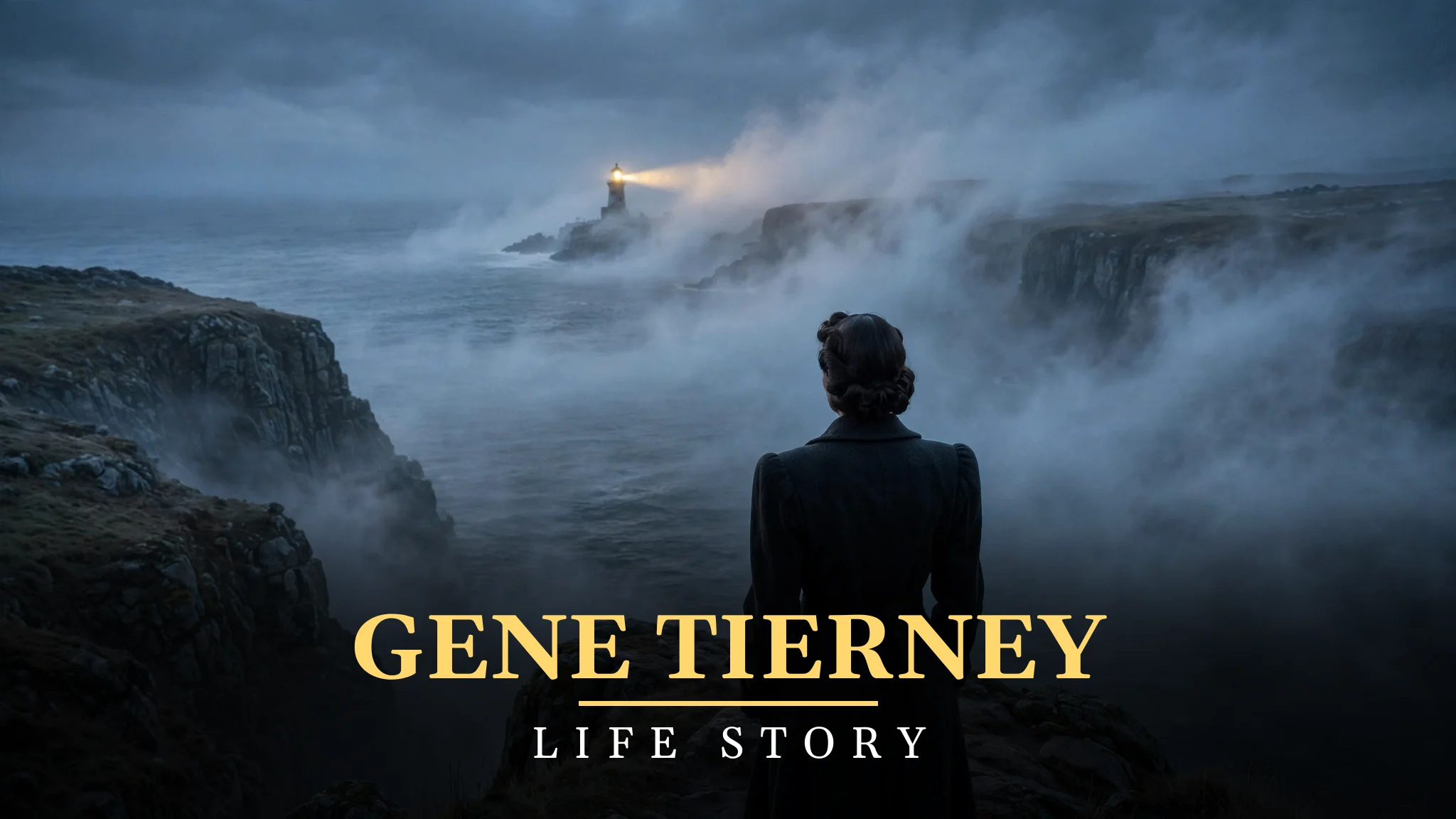
I think her legacy is a good one, and I think it is worth remembering. She showed the world that a woman could be beautiful and talented, and that she could also be honest about pain, and about mental illness. Her films are still shown today, and they still give pleasure to people who like elegant, romantic films. Her book is still read today, and it still helps people to understand mental illness. That is a life worth celebrating, and it is a life worth telling. When I think of Gene Tierney, I think of a woman on a misty cliff, looking toward a lighthouse, beautiful, mysterious, and brave, and I smile, because that image is beautiful, and it will last.
I also think about the young women today who are beautiful, who are talented, and who face mental health problems, and who feel ashamed to seek help. Gene Tierney proves that it is brave to seek help, and that it is honest to talk about pain. She proves that beauty and pain can live in the same person, and that a person can be both beautiful and in need of care. That is a message of hope, and it is a message that still matters. I hope that young women who read about Gene Tierney will feel that hope, and will seek help when they need it, as she did.
I keep thinking about the portrait in Laura, because that portrait captures everything I admire and everything that makes me sad about Gene. The detective falls in love with a portrait, with an image, and then he meets the real woman, and he has to learn to love a person, not a picture. That is a thoughtful story, and it is a story that tells us a lot about how we love famous people. We fall in love with an image, with a photograph, with a film, and we forget that there is a real person behind it, with pain, with illness, and with a need for help. Gene was that real person, and her story reminds us to look past the portrait, and to see the human being.
I also think about her autobiography, Self-Portrait, and about how brave it was to write it. She wrote honestly about her daughter’s illness, about her own mental health problems, and about the pain she had faced. That was brave, because mental illness was not talked about openly in those days, and many people were ashamed of it. She was not ashamed. She wrote about it, she spoke about it, and she helped others to understand that mental illness is a sickness, not a shame, and that it needs care. That honesty is a beautiful thing, and it is a thing I admire deeply, because it takes courage to be honest about pain, especially when you are famous.
There is another part of her story that stays with me, and it is her love for her daughters, Daria and Christina. She loved Daria deeply, even though Daria faced serious difficulties from birth, and she tried to give her the best care possible. She loved Christina, who was healthy, and who gave her joy. She was a mother who tried her best, even when life was hard, even when she was ill herself, and even when she felt guilt. That love matters, and it is the most important part of her story as a mother. She did not give up on her daughters, and she did not give up on herself, and that is a quiet kind of strength that deserves respect.
I wonder what she would say to a young woman today who is beautiful, who is talented, and who faces mental health problems, and who feels ashamed to seek help. I think she would smile, and she would say, seek help, be honest, and remember that you are more than a beautiful face. I think she would tell that young woman to talk to a doctor, to talk to a friend, and to remember that mental illness is a sickness, not a shame. That is good advice, and it is advice that comes from a life lived with courage, beauty, and honesty.
I also think about the way she played Lucy Muir in The Ghost and Mrs. Muir, because that role shows a warmer, gentler side of Gene. She played a widow who falls in love with the ghost of a sea captain, and she played her with warmth, with grace, and with a quiet humour that made audiences love her. The film is charming, romantic, and a little bit sad, and it is still loved today. I think about the people who watch that film and feel comforted, and who believe in love, even after loss. That is a gift, and it is a gift that Gene gave through her acting, and it is a gift that still matters today, when many people need comfort, and need to believe in love.
Finally, I think about her as a woman who was beautiful, talented, and honest, and who faced dark times with courage. She was not perfect, and her life was not perfect, but she faced it with grace, and she wrote about it with honesty. That is a legacy worth remembering, and it is a legacy that still matters, because it shows that beauty and pain can live in the same person, and that a person can be both beautiful and in need of care. Gene shows us that it is brave to seek help, and that it is honest to talk about pain, and that is a message of hope for anyone who faces mental illness today.
Frequently Asked Questions
What is Gene Tierney best known for?
She is best known as Laura Hunt in Laura from 1944, as Ellen Berent in Leave Her to Heaven from 1945, and as Lucy Muir in The Ghost and Mrs. Muir from 1947.
Did Gene Tierney win an Academy Award?
No, she was nominated for Best Actress for Leave Her to Heaven in 1945, but she never won an Oscar, although Laura and her other films are now regarded as classics.
What happened to Gene Tierney’s daughter Daria?
Daria was born in 1943 with serious disabilities, including deafness and blindness in one eye, likely caused by rubella Gene contracted during pregnancy, and she needed care for the rest of her life.
Did Gene Tierney write about her mental illness?
Yes, in her autobiography Self-Portrait, published in 1979, she wrote honestly about her depression, her time in hospitals, and her daughter’s illness, helping to reduce the shame around mental illness.
Who was Gene Tierney married to?
She was married to the fashion designer Oleg Cassini from 1941 to 1952, with whom she had two daughters, and later to Howard Lee from 1960 until his death in 1981.
When did Gene Tierney die?
She died on 6 November 1991 in Houston, Texas, at the age of seventy, after a long life as a film star, wife, mother, and writer.


