Ginger Rogers: The Life Story Behind Hollywood's Dancing Star
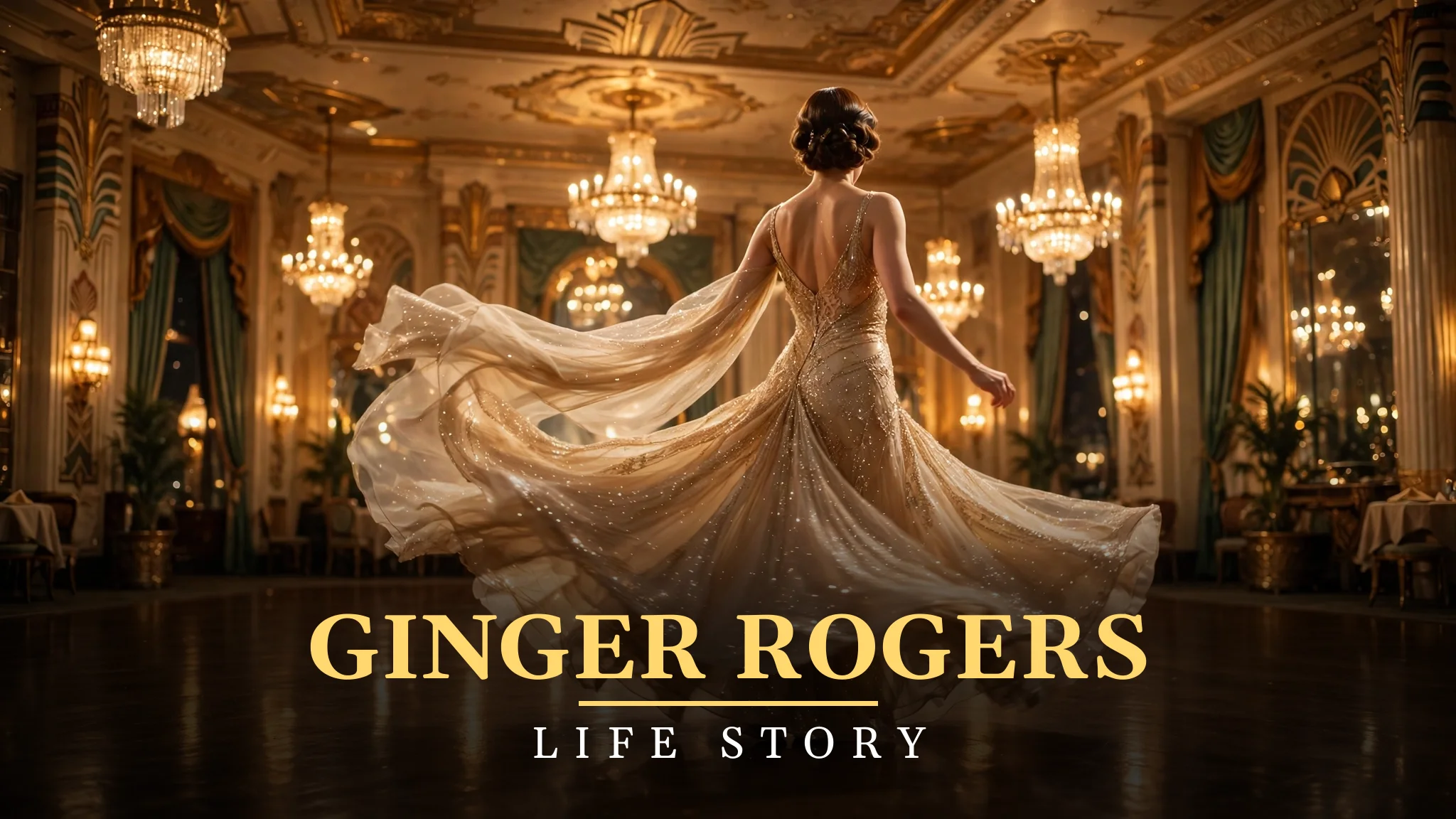
In this post
Ginger Rogers could dance, she could sing, she could act, and she could make all three look easy. That was her gift, and it was also the reason some people took her lightly. When a performer makes hard work look smooth, the audience forgets how much practice went into it, and Ginger Rogers spent her whole life practising. She was one half of the most famous dancing pair in film history, yet she was never only a partner. She was a star in her own right, an Academy Award winner, and a woman who worked on stage and screen for more than sixty years.
She was born Virginia Katherine McMath, and she grew up in the American Midwest, far from the bright lights of Broadway and Hollywood. Her mother raised her largely on her own, and the two of them were close for the whole of Ginger’s life. Her mother believed in her talent, pushed her to practise, and travelled with her when she was still a girl. That closeness gave Ginger a firm base, and it also gave her a sense of discipline. She learned early that talent was not enough, and that a performer had to work every day, learn new steps, and keep going even when she was tired or afraid.
Her story is the story of American entertainment in the twentieth century. She began in vaudeville, the travelling stage shows that toured the country, and she moved to Broadway, where she was still a teenager when she found success. Then she moved to Hollywood, where she made musicals that are still loved today. She danced with Fred Astaire in ten films, and their partnership changed the way dance looked on screen. After that, she proved herself as a serious actress, winning an Oscar for a drama, and she kept working on stage until she was in her seventies. This is the story of a girl from Missouri who learned to dance her way into history.
A Girl From Missouri With Dancing Feet
Virginia Katherine McMath was born on 16 July 1911 in Independence, Missouri. Her father, William McMath, and her mother, Lela, separated when Virginia was still a baby, and her mother took her to live with her own parents in Kansas City. Lela was a strong and lively woman who worked as a newspaper writer and later in theatre, and she was determined that her daughter would have a better life than the one she had known. Virginia was a bright and active child, and she began to dance almost as soon as she could walk. Her mother saw the talent, and she encouraged it, even when money was tight and the future was uncertain.
As a small girl she was called Ginger, a nickname that came from her baby cousin who could not say Virginia properly. The name stuck, and it suited her. She was quick, light on her feet, and full of energy, and she loved to perform for anyone who would watch. Her mother took her to dance lessons, and she practised at home, in the street, and anywhere she could find space. She was not a child who had to be pushed to work. She wanted to dance, and she wanted to be good at it. That hunger to improve stayed with her for the rest of her life.
When she was still a teenager, she entered a dance contest in Texas and won. The prize was a chance to tour with a vaudeville show, and her mother agreed to let her go. Vaudeville was hard work. The performers travelled from town to town, they slept in cheap hotels, they performed several times a day, and they had to win over audiences who were quick to lose interest. Ginger learned how to hold a stage, how to recover when something went wrong, and how to keep smiling when she was tired. Those lessons were worth more than any school, and they made her tough.
By the time she was seventeen, she had already spent years on the road, and she had learned the business of show business from the inside. She knew how to read an audience, how to change a routine when it was not working, and how to take care of herself on tour. Her mother was with her for much of this time, and the two of them made a strong team. Ginger was the performer, and her mother was the manager, the friend, and the protector. That partnership would last for decades, and it gave Ginger a sense of safety in a world that could be hard on young women.
Broadway Lights and a First Taste of Fame
In nineteen twenty nine, Ginger Rogers went to New York to try her luck on Broadway. She was eighteen years old, and New York was the centre of American theatre. The competition was fierce, and many young dancers came to the city and went home again without work. Ginger was different. She had years of stage experience behind her, she could dance, she could sing, and she had a bright and natural way on stage that audiences liked. She was soon cast in the musical Girl Crazy, which opened in nineteen thirty, and the show was a success. It was in Girl Crazy that she first worked with a young dancer named Fred Astaire, though neither of them knew at the time how important that meeting would become.
Broadway taught her a new kind of discipline. A stage show had to be the same every night, and yet it had to feel fresh every night too. She learned to save her energy, to protect her voice, and to work with a company of other performers. She also learned that New York audiences were honest. If they liked you, they told you with applause. If they did not, they told you with silence. Ginger liked that honesty, and she worked hard to earn the applause. She was still young, but she was already a professional, and she behaved like one.
Hollywood was watching Broadway for new talent, and Ginger was soon noticed by film studios. She signed a contract and moved to California, where she began to appear in films. Her first films were light comedies and musicals, and she learned how different film work was from stage work. On a film set, a scene could be shot many times, the camera could be close to her face, and the dance had to be planned for the lens rather than for the back row of a theatre. She adapted quickly, as she always did, and she began to build a name for herself in Hollywood.
In nineteen thirty three, she appeared in 42nd Street, a musical about a Broadway show, and the film was a hit. The same year she was cast in Flying Down to Rio, a light musical that paired her with Fred Astaire for the first time on screen. Their dance together in that film was a small part of the story, but audiences noticed it, and the studio noticed it too. The two of them had a natural ease together, and their dancing looked like a conversation. No one planned it as a great partnership, but the audience had already decided. They wanted to see Ginger Rogers and Fred Astaire dance together again.
Dancing With Fred Astaire: Top Hat, Swing Time, and Magic
The partnership between Ginger Rogers and Fred Astaire became one of the most loved in film history. They made ten films together in the nineteen thirties, and each one gave audiences a new set of dances to remember. The Gay Divorcee came in nineteen thirty four, Top Hat in nineteen thirty five, Follow the Fleet in nineteen thirty six, Swing Time in nineteen thirty six, Shall We Dance in nineteen thirty seven, Carefree in nineteen thirty eight, and The Story of Vernon and Irene Castle in nineteen thirty nine. The films were light comedies with songs and dances, and they gave people a happy escape during the hard years of the Great Depression.
Their dancing was special because it was different from other screen dancing. Astaire was tall, elegant, and precise, and Rogers was quick, graceful, and full of charm. She matched him step for step, and she did it in long dresses and high heels, which made the work even harder. A line often linked to her says that she did everything Astaire did, backwards and in high heels, and while the exact words have been argued over, the meaning is true. She was his equal as a dancer, and she brought warmth and humour to the films that he could not bring on his own. He was the perfect dancer, and she was the perfect partner, because she made the dancing feel like a love story.
The work behind those films was very hard. The dances were rehearsed for weeks, and every step had to be exact. Astaire was known for wanting many takes until a dance was perfect, and Rogers worked through the long hours without complaint. She learned the routines, she practised until her feet hurt, and she smiled for the camera as if the dance were easy. That was her skill. She made the hardest work look light, and audiences loved her for it. She also learned to sing, to act in the comedy scenes, and to carry a film when Astaire was not on screen.
Top Hat is still the film many people name first when they talk about the pair, with its songs, its white tie and tails, and its famous dance scenes. Swing Time is loved for its music and for the feeling between the two stars. The Story of Vernon and Irene Castle was different, a sadder and more serious film about real dancers, and it showed that Rogers could play a real person with a real heart. By the end of the nineteen thirties, the partnership had run its course, and both stars wanted to try other things. But the films remained, and they are still watched today by people who were not born when they were made. That is the mark of work that truly lasts.
Proving She Could Act: Kitty Foyle and the Oscar
Ginger Rogers did not want to be remembered only as a dancer. She wanted to be an actress, and she worked hard to prove that she could play serious parts. In nineteen thirty nine she starred in Bachelor Mother, a comedy in which she played a shop girl who is mistaken for the mother of an abandoned baby. The film was a hit, and it showed that she could carry a film on her own, without Astaire beside her. Audiences liked her warmth, her timing, and her ability to make a funny scene feel real. The film was a turning point, because it proved that she was a star in her own right.
The next year, in nineteen forty, she starred in Kitty Foyle, a drama about a working class woman in Philadelphia who has to choose between two men and two different lives. The part was serious and demanding, and Rogers played it with honesty and depth. She showed a woman who was proud, who worked hard, and who wanted more from life than the world was ready to give her. Her performance won her the Academy Award for Best Actress, the highest honour in film. It was a moment of great pride for her and for her mother, who had worked so hard to help her reach that point.
The Oscar changed how Hollywood saw her. She was no longer only the dancing partner. She was a dramatic actress, and she was given more serious roles. She starred in Roxie Hart in nineteen forty two, a comedy drama about a woman who becomes famous after a murder trial, and she played the part with wit and energy. She worked steadily through the nineteen forties, in films that mixed comedy, drama, and romance, and she was one of the most popular stars in America. She was also one of the hardest working, and she took her work very seriously.
Her personal life during these years was less settled than her career. She was married five times, to Jack Pepper, Lew Ayres, Jack Briggs, Jacques Bergerac, and William Marshall, and none of the marriages lasted. She wanted love and a home, but her work kept her busy, and the men she married often found it hard to live with a woman who was more famous than they were. She never had children, and that was a sadness for her, though she rarely spoke about it in public. She kept her private feelings private, and she let her work speak for her. That was her way, and it was a dignified way.
Later Films, the Stage, and a Life in the Theatre
In the nineteen fifties, Ginger Rogers continued to work in films, but the big musical days were passing. She appeared in comedies and dramas, and she played mothers and older women with the same care she had given to her younger parts. She was graceful about growing older on screen, and she did not try to pretend she was still twenty. She chose parts that suited her age, and she played them well. She also worked on television, appearing in shows and specials, and she stayed in touch with the audience that had loved her since the nineteen thirties.
The stage called her back, and she returned to it with joy. She appeared in plays on Broadway and on tour, and she found that the theatre still felt like home. She starred in Hello, Dolly! on stage, playing the part that had been made famous by others, and audiences loved her in it. She toured with the show, and she worked hard, as she always had, learning new lines, new songs, and new dances. The stage gave her something that film could not give her. It gave her the audience in front of her, the applause at the end of the night, and the feeling of a live performance that could never be repeated in exactly the same way.
She also wrote about her life. Her autobiography, published in nineteen ninety one, told the story of her career in her own words, and it showed a woman who was proud of her work, grateful for her mother, and honest about the hard parts of her life. She wrote about the long rehearsals, the difficult marriages, and the joy of dancing, and she did it with the same plain and direct style that had marked her acting. The book was a reminder that she was not only a performer. She was a thoughtful woman who had lived a long and full life, and who had something to say about it.
In her later years she lived in California, and she stayed close to her friends and to the memory of her mother, who had died in nineteen seventy seven. She was a Christian Scientist, and her faith was important to her. She lived quietly, she looked after her health, and she kept in touch with the world of film and theatre. She was honoured by the film industry in many ways, and she was loved by audiences who remembered her dances with Astaire and her Oscar winning performance. She had become a living link to the golden age of Hollywood, and she carried that honour with grace.
A Long Goodbye and a Legacy in Dance
Ginger Rogers died on 25 April nineteen ninety five at her home in Rancho Mirage, California, at the age of eighty three. She had died of a heart attack, and her death was mourned around the world. Tributes came from actors, dancers, and fans, and many of them spoke about the same thing. She had been a dancer who made hard work look easy, an actress who could make people laugh and cry, and a woman who had worked for more than sixty years without ever losing her love of performing. She was buried near her mother, and her life was remembered as one of the great careers in American entertainment.
Her legacy lives on in the films she made with Fred Astaire. Those films are still shown on television, they are still studied by dancers, and they are still loved by people who have never seen a film from the nineteen thirties before. Young dancers watch her and learn how to move with grace, how to smile while working hard, and how to make a dance look like a story. She taught a generation of performers that a woman could be a dancer and an actress, that she could be funny and serious, and that she could be a star without losing her dignity.
She also left a lesson about hard work. She was not born rich, she was not born in Hollywood, and she did not have an easy path. She won a dance contest as a teenager, she toured in vaudeville, she worked on Broadway, and she rehearsed for weeks to make a dance look perfect. She won an Oscar because she worked for it, and she kept working on stage into her seventies because she loved the work. That is a life to admire, and it is a life that still has something to teach anyone who wants to make a living from their talent.
She was also a star who understood the value of a good song. The music in her films with Astaire came from some of the best songwriters of the time, and she sang those songs with a light and clear voice that suited the mood of each film. She was not a great singer in the way of a concert star, and she never claimed to be one, but she sang with feeling, and she made the songs part of the story. When she sang and danced at the same time, the audience felt as if they were watching a person who was happy, and that happiness was catching. It was part of her charm, and it was part of why the films worked so well.
Her life also shows how much the world of entertainment changed during her lifetime. She began in vaudeville, when performers travelled by train and played in small theatres, and she ended her career on television and in books, when films could be watched at home. She saw the coming of sound in films, the rise of colour, the growth of television, and the change from big studio contracts to a freer kind of work. She adapted to each change, and she did it without losing her love of performing. That ability to adapt is rare, and it is one of the reasons her career lasted so long.
My Take:
When I think about Ginger Rogers, the first thing I feel is respect for her work ethic. She was not a person who waited for luck to find her. She won a dance contest as a girl, she toured in vaudeville when she was still a teenager, she learned her craft on the road, and she kept learning for the rest of her life. I think that is the most important thing about her. Talent is a gift, but work is a choice, and she chose work again and again. She rehearsed for weeks for a dance that would last three minutes on screen, and she did it without complaint. That kind of discipline is rare, and it is the reason her films still look fresh today.
I also think about how easy she made it all look, and how that ease worked against her. When a dancer moves with grace, the audience thinks it is natural, and they forget the hours of practice. When an actress makes a comedy scene look simple, the audience thinks she is just being herself, and they forget the skill. Ginger Rogers suffered from that for much of her career. People called her Fred Astaire’s partner, as if she were only there to follow his lead, and they forgot that she was doing the same steps, in heels, in a long dress, and with a smile. I think that is unfair, and I think we should correct it every time we talk about her. She was not a follower. She was an equal, and the films are better because of her.
Her Oscar for Kitty Foyle matters to me because it proves that she was more than a dancer. She wanted to be taken seriously as an actress, and she earned that respect with a hard and honest performance. Kitty Foyle is a working class woman, a woman who has to make hard choices, and Rogers played her with a warmth that came from her own life. She knew what it was like to work hard, to want more, and to be judged by people who had more money than she did. She brought that knowledge to the part, and the audience felt it. I admire her for not staying in the safe place. She could have kept making musicals for ever, and she would have been loved for it. She chose to try something harder, and she won the highest prize for it.
I think her relationship with her mother is one of the most touching parts of her story. Lela Rogers believed in her daughter, travelled with her, managed her career, and stayed close to her for her whole life. That kind of support is a gift, and Ginger knew it. She often spoke of her mother with love and gratitude, and she wrote about her in her book. I think that closeness gave her a strength that many child stars never had. She was not alone in a strange world. She had her mother beside her, and that made the hard years bearable. It also taught her how to be loyal, and how to value the people who help you when you are young.
What makes me sad about her story is her personal life. Five marriages, and none of them lasted, is a sad record for a woman who wanted love. I do not think she was difficult, and I do not think she was unlucky in a simple way. I think she was a woman whose work came first, and whose fame made a normal marriage very hard. The men she married had to live in her shadow, and that is a hard place to live. She also never had children, and I think that was a quiet sadness for her, even if she did not talk about it much. She gave her life to her work, and her work gave her fame, but fame is not a family, and a career is not a home. I feel for her in that, and I think we should remember it with kindness, not with gossip.
I also think about the line that is often linked to her, about doing everything backwards and in high heels. I like that line because it is true in spirit, even if the exact words are debated. It tells us something about how women in Hollywood were judged. A man could be praised for his skill, and a woman had to show the same skill while looking beautiful, wearing a dress, and smiling. Ginger Rogers did that, and she did it so well that people forgot how hard it was. I think her life is a reminder to look twice at the work of women who make hard things look easy. The ease is not a sign that the work was easy. It is a sign that the worker was very good.
There is a lesson in her dancing that I think applies to life. She and Astaire made dancing look like a conversation, like two people who understood each other without words. That takes trust, and it takes practice, and it takes a willingness to listen to the other person. She listened to Astaire, and he listened to her, and the result was something beautiful. I think that is a good model for any partnership, in work or in life. You do not have to be the loudest person in the room. You have to be the person who listens, who practises, and who shows up on time. Ginger Rogers showed up, and she listened, and she danced.
I respect the way she returned to the stage in her later years. Many film stars would have retired and lived on their old fame. She went back to the theatre, she learned new shows, she toured, and she played Hello, Dolly! with the same energy she had shown as a girl. That tells me that she loved performing for its own sake, not only for the money or the fame. She loved the audience, she loved the work, and she loved the feeling of a live show. I find that moving, because it shows that her talent was not a trick. It was a part of who she was, and she kept it alive until she was old.
Her book, published when she was eighty, also impresses me. She told her own story in her own words, and she did it honestly. She did not pretend that her life was perfect, and she did not blame other people for her troubles. She wrote about her mother, her work, her marriages, and her faith, and she did it with a plain and direct style. I think that is a brave thing to do at eighty, to look back and tell the truth. Many stars would rather let other people write about them. She wrote about herself, and that gives her story a voice that no one else could give it.
If I compare her with other stars of her time, what stands out is her range. She could dance, she could sing, she could act in comedy, she could act in drama, and she could perform on stage and on screen. Very few performers can do all of those things well. She did, and she did them for more than sixty years. That range is her real legacy, more than any single film. She was not a one trick star. She was a complete performer, and she kept learning new tricks until the end. I think young performers today could learn a lot from that. Do not be only one thing. Learn to do many things well, and keep learning.
For a young reader, I think the lesson is simple. Work hard, practise every day, and do not be afraid to try something new. Ginger Rogers started as a dancer, she became a Broadway star, she became a film star, she became an Oscar winner, and she became a stage star again in her seventies. Each step took courage, and each step took work. She did not stay in the safe place. She moved, she learned, and she grew. That is a good way to live, and it is a good way to build a career. You do not have to be the best on the first day. You have to be willing to practise, to listen, and to keep going.
I also think her story teaches us to value the people who help us when we are young. Her mother gave her everything, her time, her money, her belief, and her love. Ginger never forgot that, and she honoured her mother in her life and in her book. We all have people who helped us when we were young, and we should remember them. A career is never built alone. It is built with the help of family, friends, teachers, and partners, and Ginger Rogers knew that. She was grateful, and gratitude is a fine quality in a star.
In the end, I think Ginger Rogers deserves to be remembered as a great artist in her own right, not only as Fred Astaire’s partner. She was a dancer, a singer, an actress, and a stage star, and she was one of the hardest working women in Hollywood. She won an Oscar, she made films that are still loved, and she kept performing until she was old. She had a hard personal life, and she faced it with dignity. She had a close and loving mother, and she honoured that love. She had a gift, and she used it well. That is a life to admire, and it is a life that still shines, like the ballroom in Top Hat, bright and full of music, long after the dance has ended.
One more thought stays with me. When I watch her dance, I see joy. She is smiling, she is moving with ease, and she looks as if she is having the time of her life. That joy is real, and it is contagious. It makes the audience happy, and it makes them want to dance too. I think that joy was her true gift. She could have been bitter about the hard work, about the failed marriages, about being called only a partner. She chose joy instead, and she shared it with millions of people. That is a generous way to live, and it is the reason people still love her today. She danced, and the world danced with her, and that is a beautiful thing to leave behind.
When I look at old photographs of Ginger Rogers, I see a woman who is smiling, and I think that smile was not an act. She loved to dance, she loved to perform, and she loved the applause, and that love shows in every film she made. It is easy to forget, when we talk about hard work and long rehearsals, that she also had fun. She had fun on the dance floor, she had fun on stage, and she had fun with the audience. That fun is part of her gift, and it is part of why people still watch her films today. They do not only admire her skill. They share her joy, and that is a wonderful thing to give to the world.
I also think her story is a reminder that a woman can be many things at once. She was a dancer, a singer, an actress, a writer, and a daughter who loved her mother. She did not have to choose one of those things and give up the others. She did them all, in her own time, and she did them well. That is a good example for anyone who feels pushed into a single box. You can be more than one thing, and you can grow into new things as you get older. Ginger Rogers proved that, and she proved it with a career that lasted more than sixty years.
I also think about how much she gave to the world of dance, and how dancers still learn from her today. Young dancers watch her films with Astaire, they study her steps, and they try to copy her grace. She taught them that a dancer must be strong, must practise, and must smile while working hard. That is a lesson that will last as long as people dance, and it is a legacy that no award can match. She was a teacher as well as a star, even if she never stood in a classroom, because her films are her classroom, and dancers are still her students.
Frequently Asked Questions
When was Ginger Rogers born and when did she die?
Ginger Rogers was born Virginia Katherine McMath on 16 July 1911 in Independence, Missouri, and she died on 25 April 1995 at her home in Rancho Mirage, California, at the age of eighty three. Her career lasted more than sixty years, from vaudeville as a teenager to stage work in her seventies.
How many films did Ginger Rogers make with Fred Astaire?
She made ten films with Fred Astaire in the nineteen thirties, including Flying Down to Rio, The Gay Divorcee, Top Hat, Follow the Fleet, Swing Time, Shall We Dance, Carefree, and The Story of Vernon and Irene Castle. Their partnership is still seen as one of the great dance pairings in film history.
What film won Ginger Rogers an Oscar?
She won the Academy Award for Best Actress for Kitty Foyle in nineteen forty, playing a working class woman in Philadelphia who must choose between two men and two different lives. It was her only Oscar win, and it proved she could carry a serious drama on her own.
Was Ginger Rogers only a dancer?
No, she was also a singer and an actress, and she worked on Broadway, in films, on television, and on stage. She starred in comedies such as Bachelor Mother and Roxie Hart, dramas such as Kitty Foyle, and stage shows including Hello, Dolly!, and she wrote an autobiography in nineteen ninety one.
How did Ginger Rogers start her career?
She began dancing as a child in Kansas City, won a dance contest as a teenager, and toured in vaudeville shows with her mother. She then moved to Broadway, where she appeared in Girl Crazy in nineteen thirty, before signing a film contract in Hollywood.
Was Ginger Rogers married?
She was married five times, to Jack Pepper, Lew Ayres, Jack Briggs, Jacques Bergerac, and William Marshall, and none of the marriages lasted. She had no children, and she stayed close to her mother, Lela Rogers, for her whole life.
What did Ginger Rogers do in her later years?
In her later years she returned to the stage, toured in plays and musicals, and published her autobiography in nineteen ninety one. She lived quietly in California, stayed in touch with the film world, and died at home in nineteen ninety five at eighty three.


