Girl in Red: The Life Story Behind Norway's Indie Star
In this post
- A Childhood in Horten by the Sea
- A Guitar, a Computer and a Bedroom Studio
- We Fell in Love in October and a Song for Autumn
- If I Could Make It Go Quiet and the First Album
- I’m Doing It Again Baby and a Bolder Sound
- A Voice for Young Queer People
- The Bedroom That Became a Stage
- Songs That Became Anthems for a Generation
- My Take:
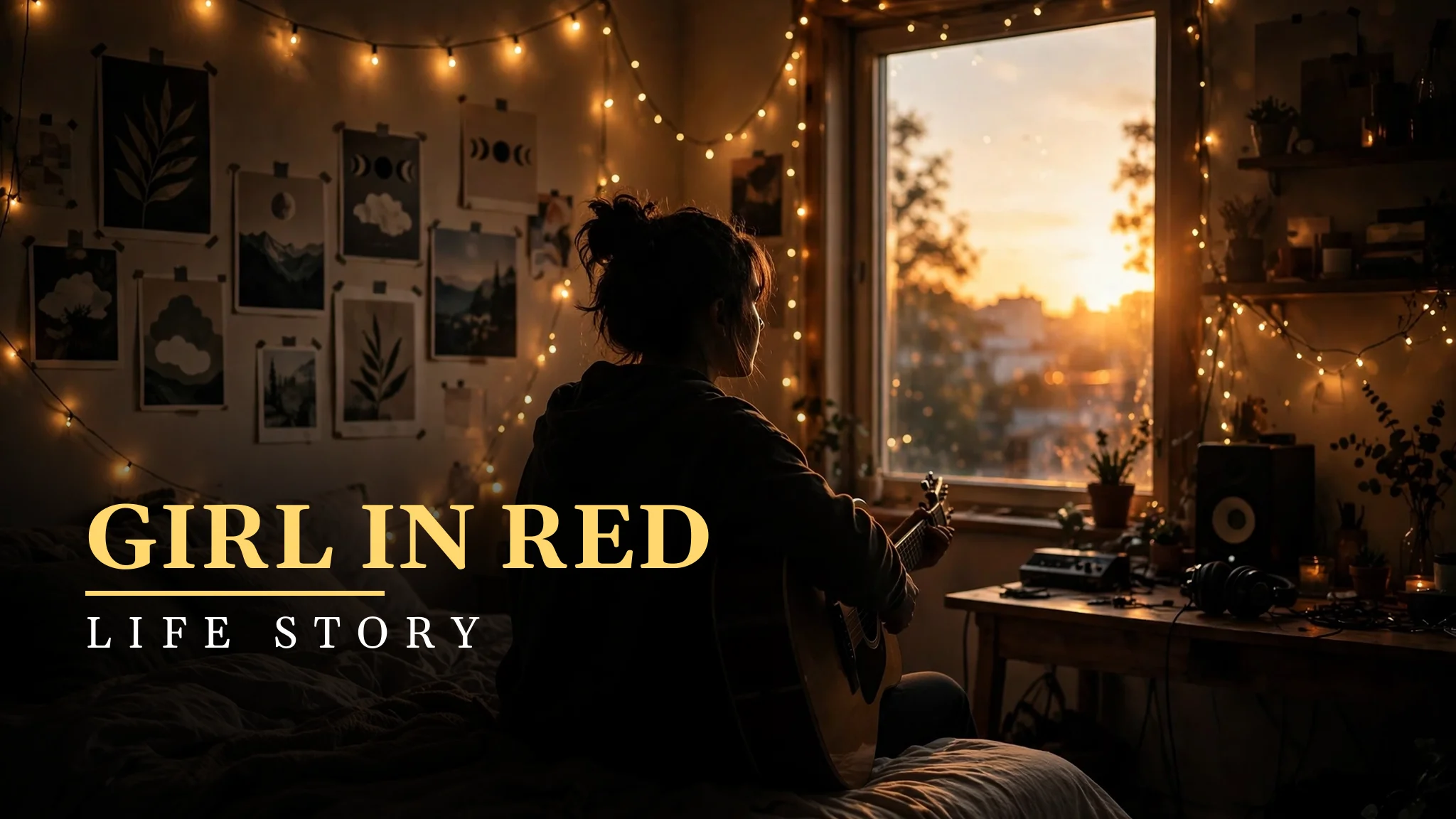
Girl in Red is the name Marie Ulven chose for herself when she started making music in her bedroom in Norway. It is a simple name, and it fits her music, which is simple, honest, and direct. She did not start in a big studio with a team of producers. She started alone, with a guitar, a computer, and a feeling she needed to express. She recorded songs in her bedroom, she put them online, and people all over the world found them and felt that she was singing about their lives too.
She was born Marie Ulven Ringheim in Horten, a small town on the coast of Norway, and she grew up in a family where music was always present. Her mother was a teacher, her father worked in the church, and her grandfather played the guitar. Marie learned to play the piano and the guitar, and she sang in a choir. But she was also a teenager who felt different, who was trying to understand who she was, and who found it hard to say some things out loud. Music became the place where she could say them.
What makes her story matter is not just the songs. It is the honesty. She was one of the first young singers to write openly, in simple words, about loving another girl, about the confusion and the joy of that love, and about the pain of feeling alone. For many young people, hearing her songs was the first time they felt understood. This is the story of a girl from a small Norwegian town who turned her bedroom into a studio and her feelings into songs that travelled the world.
A Childhood in Horten by the Sea
Marie Ulven Ringheim was born on 16 February 1999 in Horten, Norway. Horten is a small coastal town in the south of Norway, known for its harbour, its naval history, and its quiet streets. Marie grew up there with her family, and her childhood was full of music, school, and the sea. Her parents were both involved in the local community, and her home was a place where music was played and sung. Her grandfather, who played the guitar, was an important figure in her early life, and she often listened to him play.
As a child, Marie was curious and creative. She liked to draw, she liked to write, and she liked to make up stories. She learned to play the piano, and then she learned the guitar, and she sang in the local choir. She was a good student, but she was also a dreamer, and she often felt that she was different from the other children around her. She did not always fit in, and she sometimes felt lonely, even when she was with other people. That feeling of being different stayed with her, and it later became the heart of her music.
When she was a teenager, she began to write songs of her own. She wrote about her feelings, about her friends, about the things that made her happy and the things that made her sad. She did not show these songs to many people at first. They were private, and they were about things she found hard to talk about. She played them in her bedroom, on her guitar, and she recorded them on her computer. She was not trying to become famous. She was trying to understand herself, and music was the tool she used to do it.
Her family supported her, but they did not push her. They let her explore music in her own way, and they gave her the space to be herself. That support was important, because Marie was going through a difficult time as a teenager, trying to understand her own feelings and her own identity. She needed a safe place to be herself, and her bedroom, with her guitar and her computer, became that place. It was there, in that small room, that Girl in Red was born.
A Guitar, a Computer and a Bedroom Studio
Marie started making music as Girl in Red in 2016, when she was seventeen years old. She chose the name because she often wore red, and because it felt like a character she could step into, a version of herself who was brave enough to say the things Marie found hard to say. She recorded her songs in her bedroom, using a simple microphone and a computer program, and she played all the instruments herself. She did not have a studio, she did not have a producer, and she did not have a record company. She had a guitar, a computer, and a feeling.
Her first songs were simple and raw. They were about love, about desire, about the confusion of being a teenager, and about the pain of feeling alone. She sang them in a soft, honest voice, and she did not try to make them sound perfect. The recordings were rough, but they were real, and people who heard them felt that realness at once. She put her songs on SoundCloud, a website where young musicians share their music, and people began to listen. They shared her songs with their friends, and her audience grew, slowly at first, and then faster and faster.
One of her early songs was I Wanna Be Your Girlfriend, which she released in 2017. The song was about wanting to be with a girl, about the feeling of falling in love with another girl, and about the fear and the hope that came with that feeling. It was a simple song, with a guitar and a voice, and it became an anthem for many young queer people around the world. They heard it and felt that someone understood them, that someone was singing about their life in a way that no one had before. The song was shared millions of times, and it made Girl in Red famous in a way she had never expected.
She continued to release songs from her bedroom, and each one was more honest than the last. She wrote about summer love, about heartbreak, about anxiety, and about the feeling of being young and lost. She did not hide anything. She sang about her life as it was, and her fans loved her for it. She was not a pop star in the normal sense. She was a girl in a bedroom, singing to the world, and the world was listening.
We Fell in Love in October and a Song for Autumn
In 2018, Girl in Red released a song called We Fell in Love in October. The song was about falling in love in the autumn, about the feeling of a new love in the cold months, and about the warmth that love brings when the world is getting darker. It was a beautiful song, simple and sad and hopeful all at the same time, and it became one of her most famous songs. It was played millions of times, it was used in videos and films, and it became a song that people returned to every autumn, year after year.
The song showed how much Marie had grown as a writer. She was no longer just writing about her own feelings in a private way. She was writing songs that captured a moment, a season, a feeling that many people shared. She wrote about October, about the leaves falling, about the cold air, and about the warmth of being with someone you love. It was a song that felt both personal and universal, and it was the kind of song that stays with you long after you have heard it.
In the same year, she released other songs, including Girls, which was about the experience of being a girl who loves girls, and about the way the world sees that love. The song was bold and honest, and it became another anthem for her fans. She also released a collection of her early songs, and she began to play live shows, first in Norway, and then in other countries. She was still young, and she was still learning how to perform, but her fans loved her because she was real, and because she sang her songs as if she meant every word.
By the end of 2018, Girl in Red was no longer a secret. She was a name that people knew, a singer who had built an audience without a record company, without a big marketing campaign, and without changing who she was. She had done it with a guitar, a computer, and a bedroom, and that was a remarkable thing. She had shown that a young person could make music that mattered, without waiting for permission from anyone.
If I Could Make It Go Quiet and the First Album
Girl in Red’s first album, If I Could Make It Go Quiet, was released in April 2021. The album was named after a feeling she had often described, the wish that the noise in her head would stop, that the anxiety and the doubt would go quiet for a while. It was a deeply personal album, about mental health, about love, about heartbreak, and about the struggle to be at peace with yourself. It included songs like Serotonin, which was about anxiety and depression, and Midnight Love, which was about a love that only happened at night.
The album was a success, and it reached the top of the charts in Norway and did well in other countries. Critics praised it for its honesty, for its writing, and for the way Marie sang about difficult subjects in a direct and simple way. They said she was one of the most important new voices in indie music, and they were right. She was not writing songs to please everyone. She was writing songs to tell the truth, and the truth was sometimes painful, but it was also beautiful.
After the album, she toured the world. She played in Europe, in America, in Britain, and in many other places. Her concerts were known for their energy, for the way her fans sang along to every word, and for the feeling of community in the room. She was no longer a girl in a bedroom. She was a performer on a big stage, but she still sang as if she was talking to each person in the audience individually. She still wore simple clothes, she still played her guitar, and she still talked to the crowd about her life.
During this time, she also became more open about her own mental health. She talked about her anxiety, about her depression, and about the therapy that had helped her. She did not hide her struggles. She talked about them in interviews and in her songs, and she told her fans that it was all right to ask for help. Many young people who listened to her felt less alone because of that, and they wrote to her to say so. She answered them with kindness, and she built a community that felt like a family.
I’m Doing It Again Baby and a Bolder Sound
Girl in Red’s second album, I’m Doing It Again Baby!, was released in April 2024. The album was bolder and more fun than her first album, with songs that were louder, more playful, and more confident. It included songs like Too Much, which was about feeling too much and wanting too much, and You Need Me Now, which featured the singer Sabrina Carpenter. The album showed a new side of Marie, a side that was more confident, more free, and more willing to have fun.
The album was a success, and it did well in the charts in Norway and in other countries. Critics said it was a big step forward, and fans loved the energy of the new songs. She toured again, playing at festivals and in large venues, and her concerts became bigger and more joyful. She was no longer just the girl in the bedroom. She was a star, but she was still herself, still honest, still funny, and still willing to talk about the things that mattered to her.
She also began to work with other artists, and she wrote songs for other people. She collaborated with other singers, she appeared on their songs, and she kept exploring new sounds. She did not stay in one place. She kept moving, kept learning, and kept growing, but she never lost the core of who she was. She was still Marie from Horten, still the girl who wrote songs in her bedroom, still the person who believed that music should be honest above all else.
In the years that followed, she continued to release new music, and she continued to perform. She played at festivals around the world, she appeared on television, and she became one of the best-known indie artists from Norway. She had come a long way from her bedroom in Horten, but she had not forgotten where she started, and she often talked about it in interviews, saying that the bedroom was where she learned to be herself.
A Voice for Young Queer People
Girl in Red’s influence goes far beyond her songs. She has become a voice for young queer people around the world, because she was one of the first young singers to write openly about loving another girl, in simple words, without shame and without hiding. Before her, many young queer people felt alone, because they did not hear their lives in pop music. Girl in Red changed that. She sang about her life, and her fans heard their own lives in her songs.
She has also become a symbol of a new kind of fame. She did not become famous through a television show, or through a record company, or through a big marketing campaign. She became famous by putting her songs online, by being honest, and by letting people find her. She showed that a young person with a guitar and a computer could reach the whole world, without waiting for permission. That is an inspiring story, and it has given hope to many young musicians who are starting out in their bedrooms today.
Her fans love her because she is real. She talks to them on social media, she answers their messages, and she treats them like friends. She does not hide behind a perfect image. She shows her flaws, her doubts, and her humour, and her fans love her for it. She has built a community of people who feel like they know her, and who feel that she knows them too. That community is one of the most loyal in music, and it is a big part of her success.
She has also used her platform to speak about mental health, about the importance of asking for help, and about the need to be kind to yourself. She has talked about her own struggles, and she has told her fans that it is all right to feel sad, to feel anxious, and to feel lost. That honesty has helped many young people, and it is one of the reasons her music matters so much. She is not just a singer. She is a friend to people she has never met, and that is a beautiful kind of fame.
The Bedroom That Became a Stage
Marie Ulven’s story is, in the end, a story about a bedroom. It was a small room in Horten, with a bed, a guitar, a computer, and a girl who had something to say. That room became a studio, and the studio became a stage, and the stage became a world. She did not need a big studio, or a big team, or a big budget. She needed honesty, and she had that in abundance. She wrote songs that were true, she sang them in a voice that was true, and the world heard the truth in them.
She has also changed the way people think about Norwegian music. Before her, Norway was known for a few famous artists, but Girl in Red showed that a young singer from a small town could make music that was heard all over the world, without changing who she was. She opened doors for other young artists, and she showed that music from a small country could be big, bold, and important. She is proud of her home, and she often talks about Norway, about its nature, and about the people who shaped her.
As she moves into her late twenties, Girl in Red is still a young artist with a long career ahead of her. She has already achieved a lot, but she has not stopped growing. She is still writing, still performing, and still learning. Her story is not finished, and her fans wait with hope for whatever she does next. She is a singer, a writer, and a voice for a generation, and her story is one of the most inspiring in modern music. The girl in red is still singing, and the world is still listening.
Songs That Became Anthems for a Generation
Girl in Red’s songs have a strange power to travel. A song she recorded in her bedroom in Horten can be heard years later in a classroom in America, in a car in Japan, in a small room in Brazil, and in each place it means something new to the person who hears it. I Wanna Be Your Girlfriend is the best example of this. She wrote it as a teenager, about wanting to be with a girl, about the fear and the hope that came with that feeling, and it became an anthem for young queer people around the world. They made videos with it, they sang it, they cried to it, and they wrote about how it described exactly how they felt. Marie did not plan for this to happen. She had simply written a true song, and the truth in it waited until the world was ready to hear it.
Other songs travelled in different ways. We Fell in Love in October became a song for autumn, a song that people return to every year when the leaves fall and the air turns cold. It is about falling in love in October, about the warmth of being with someone you love when the world is getting darker, and it is a song that feels both personal and universal. Girls became a song about the experience of being a girl who loves girls, about the way the world sees that love, and about the pride of being who you are. Serotonin became a song about anxiety, about the feeling of a brain that will not go quiet, and about the wish for peace. Each song had its own life, and each song found its own people.
Her songs also travelled through films and television, and through social media, where young people shared them with each other. They were used in videos, in films, in advertisements, and in many other places, and each time they brought a little of Marie’s world into a new place. She did not chase these chances. They came to her because her music was different, and because people who make films and shows want a sound that is unlike anything else. She did not rewrite her songs to fit a new country, she did not sing them in a different style, and she did not try to make them sound more normal. She sang them as she wrote them, in her own voice, with her own words, and the world came to her.
What is most remarkable is that her songs travel without her changing them, and without her changing herself. She is still the girl from Horten who writes in her bedroom, still the person who believes that music should be honest above all else, and still the singer who talks to her fans like friends. That is a rare kind of success, and it is one that many artists dream of but few achieve. Marie achieved it by staying true to the girl who wrote songs in her bedroom, and by trusting that the world would understand her if she was honest. Her songs are anthems now, not because she tried to write anthems, but because she wrote the truth, and the truth became an anthem.
My Take:
When I listen to Girl in Red, I feel like I am sitting in a bedroom with a friend. Her music does not sound like it was made in a big studio. It sounds like it was made in a small room, with a guitar, by a person who is telling me the truth. That is a special feeling, and it is why I admire her. She did not wait for permission to make music. She did not wait for a record company, or a producer, or a manager. She just started, in her bedroom, with what she had, and she made something beautiful. I think that is a lesson for all of us. You do not need perfect tools to start. You just need to start.
I admire her honesty most of all. She writes about loving another girl, about the confusion and the joy of that, in simple words, without hiding. That takes courage, especially when you are young, and especially when the world does not always understand. I know how hard it is to say something true when you are afraid of what people will think. Marie said it, and she sang it, and she put it online for the whole world to hear. That is brave, and it is also generous, because her honesty helped other people to be honest too. Many young people heard her songs and felt, for the first time, that they were not alone. That is a gift that goes beyond music.
What moves me most is the way her songs make people feel understood. I have read messages from her fans, and they say the same thing again and again: her music saved them, her music helped them, her music made them feel less alone. That is not a small thing. That is a big thing. When you are young and you feel different, and you do not hear your life in the songs on the radio, you can feel invisible. Girl in Red made those young people visible. She sang their lives, and she told them that their lives mattered. I think that is the best thing a singer can do.
I also think about her song We Fell in Love in October, and how it captures a feeling so perfectly. It is about autumn, about falling in love when the world is getting colder, about the warmth of being with someone you love. I have felt that. Most people have felt that. It is a simple feeling, but it is also a deep one, and Marie writes about it in a way that makes me feel it all over again. That is what a good songwriter does. She takes a small moment and makes it feel big, and she makes you remember your own small moments too.
I love the way she talks about mental health. She does not hide her anxiety, her depression, or her struggles. She talks about them in her songs and in her interviews, and she tells her fans that it is all right to ask for help. That is important, because many young people are afraid to ask for help. They think it makes them weak. Marie shows them that it does not make them weak. It makes them brave. She went to therapy, she talked about it, and she kept going. I respect that, because it is easy to pretend you are fine. It is hard to say, I am not fine, and I need help. She said it, and she kept saying it, and that helped other people to say it too.
There is something else I admire, and that is her sense of humour. When I watch her interviews, I see a woman who laughs easily, who makes jokes, and who does not take herself too seriously. That is a rare quality. She can sing a sad song and then tell a funny story, and both feel true. She is not a perfect pop star. She is a real person, with flaws and jokes and doubts, and she shows all of that. I think that is why her fans love her so much. They do not love a perfect image. They love a real person.
I also think about the way she built her career without a record company at first. She put her songs online, she let people find them, and she built an audience one person at a time. That is a new kind of fame, and it is a kind that gives power to the artist, not to the company. She showed that you do not need a big machine behind you to reach the world. You need good songs, honesty, and patience. That is an inspiring story for any young person who wants to make music, or art, or anything else. You can start where you are, with what you have, and you can build something real.
If I have a worry, it is that the world will ask too much of her. She is a sensitive person, and she has been open about her struggles. Fame can be hard, and it can make those struggles worse. I hope she keeps taking care of herself, I hope she keeps going to therapy when she needs it, and I hope she keeps saying no when she needs to say no. She has already shown that she knows how to protect herself, by staying close to her family, by living simply, and by being honest about her limits. I hope she keeps doing that, because the world needs her voice, and it needs her to be well.
I think about her fans, too. They are young people, mostly, and they love her because she is honest. They see themselves in her songs. They hear their own feelings in her voice. She gives them a song to sing when they feel angry, a song to sing when they feel sad, and a song to sing when they feel free. That is a powerful thing. She is not just a singer. She is a friend to people she has never met, and that is a beautiful kind of fame. I hope she knows how much she means to them.
For a young reader, I think the lesson from Girl in Red is simple: be honest about who you are, even when it is hard. Do not hide your feelings. Do not pretend to be someone else. Start where you are, with what you have, and make something true. Marie did that in her bedroom in Horten, and she became a star. But even if you do not become a star, the lesson is the same. Your truth matters, your feelings matter, and you have the right to be yourself. That is what Girl in Red teaches me, and it is a lesson I want to carry with me.
I also learn from her that softness is not weakness. Her songs are soft and gentle, but they are also strong. They stand up for love, for honesty, and for the right to be yourself. She does it without shouting, without anger, and without hate. She does it with love, and love is a kind of strength that lasts longer than anger. I want to remember that when I feel angry or afraid. I want to ask myself, what would Marie do? She would write a song, she would breathe, she would be honest, and she would keep going.
In the end, I think Girl in Red is a reminder that a small room can hold a big voice. A bedroom in Horten is not a big studio in Los Angeles. It is a small room with a bed and a guitar, but it gave the world a singer who is now known everywhere. That tells me that talent can come from anywhere, and that you do not need a big stage to start. You just need to be yourself, work hard, and sing your truth. Marie did that, and I am glad she did. Her story gives me hope, and I think it gives hope to many other young people too.
I also think about the way she uses social media. She does not use it to show off, or to sell a perfect image. She uses it to talk to her fans, to share her life, to be funny, and to be honest. She posts about her music, about her cats, about her feelings, and about the things that make her laugh. That honesty is rare in a world where many stars use social media only to promote themselves. Marie uses it to connect, and her fans feel that connection. They write to her, and she answers, and they feel like they know her. That is a kind of fame that is built on trust, not on distance, and I think it is the best kind of fame.
There is another side to her that I want to mention, and that is her patience with herself. She has talked about going to therapy, about learning to live with her anxiety, and about the slow work of getting better. That work is not glamorous, and it does not happen overnight. It happens in small steps, over many years, with setbacks and with progress. Marie has been open about that, and she has told her fans that it is all right to take time, to ask for help, and to not be perfect. That is a message that many young people need to hear, because they are told every day to be perfect, to be happy, to be successful, and to do it all now. Marie says, take your time, be kind to yourself, and ask for help. I think that is a wiser message, and I am grateful for it.
I also think about her second album, I’m Doing It Again Baby!, and how it shows a new side of her. It is bolder, it is more fun, it is louder, and it is full of joy. She is no longer just the sad girl in the bedroom. She is a woman who is having fun, who is dancing, who is collaborating with other artists, and who is enjoying her success. That growth matters, because it shows that she is not stuck in one place. She is growing, she is changing, and she is allowing herself to be happy. I love that, because it tells her fans that it is all right to be happy, to have fun, and to celebrate yourself. Sadness is not the only honest feeling. Joy is honest too, and Marie is learning to sing about joy as well as sadness.
I think about the young musicians who are starting out now, in their bedrooms, with a guitar and a computer, just as Marie did. They look at her story and they think, maybe I can do it too. Maybe I can record a song, put it online, and find people who understand me. That hope is a gift that Marie has given to a whole generation of young artists. She did not just make music. She showed a path, a way to start with almost nothing and to build something real. That path is not easy, and it does not work for everyone, but it is real, and Marie proved it. I hope those young musicians keep trying, and I hope they remember that Marie started exactly where they are now.
I also want to say something about her name, Girl in Red. It is a simple name, and it is a bold one. Red is the colour of love, of passion, of courage, and of standing out. Marie chose that name when she was seventeen, and she has grown into it. She is bold, she is passionate, and she stands out, not because she tries to, but because she is herself. I think that is a beautiful thing, to choose a name as a teenager and to grow into it as a woman. It tells me that she knew who she was, even then, and that she has stayed true to that person.
One more thought stays with me. I think about the colour red, and how it stands out, how it is bold and bright and impossible to ignore. Marie chose the name Girl in Red, and it fits her, because she stands out. She is bold, she is bright, and she is impossible to ignore. But she is also warm, like the colour red, like a fire in a cold room. I hope she keeps burning bright, keeps singing, and keeps being herself. The world needs more voices like hers, voices that are honest, warm, and brave.
Frequently Asked Questions
Where was Girl in Red born and how old is she?
Marie Ulven Ringheim, known as Girl in Red, was born on 16 February 1999 in Horten, Norway, which makes her 27 years old in 2026. She grew up in Horten, learned piano and guitar, and started making music in her bedroom as a teenager.
What is Girl in Red’s most famous song?
Her most famous songs are I Wanna Be Your Girlfriend and We Fell in Love in October. The first became an anthem for young queer listeners, while the second, released in 2018, is a song about falling in love in autumn that people return to every year.
What was Girl in Red’s first album?
Her first album was If I Could Make It Go Quiet, released in April 2021. It is about mental health, love, and heartbreak, and it includes Serotonin and Midnight Love. The album reached the top of the charts in Norway.
What is Girl in Red’s second album called?
Her second album is I’m Doing It Again Baby!, released in April 2024. It is bolder and more playful than her first album, with songs like Too Much and You Need Me Now, which features Sabrina Carpenter.
Why is Girl in Red important to young queer people?
Girl in Red was one of the first young singers to write openly, in simple words, about loving another girl. Many young queer listeners heard their own lives in her songs for the first time, and they felt less alone because of her honesty.
How did Girl in Red become famous?
She became famous by recording songs in her bedroom, putting them on SoundCloud, and letting people find them online. She built her audience one listener at a time, without a record company at first, through honest songs shared directly with the world.
What does Girl in Red say about mental health?
She talks openly about her anxiety and depression, and about the therapy that helped her. She tells her fans it is all right to ask for help, and her album If I Could Make It Go Quiet is named after her wish for the noise in her head to go quiet.


