Glass Animals: The Life Story Behind the Heat Waves Band
In this post
- Four Friends in Oxford
- Zaba and a Jungle of Sound
- How to Be a Human Being and Stories of Strangers
- A Crash, a Pause, and Dreamland
- Heat Waves and the Longest Climb
- I Love You So F***ing Much and the Next Chapter
- What the Band Taught the World About Listening
- Dreamland on Stage and the Colours of a Live Show
- My Take:
Glass Animals make music that sounds like a warm night in a strange place, full of colour, soft beats and stories about people you have never met. Their songs are playful and dreamy at first, but if you listen to the words, you find loneliness, longing and hope hiding under the bright surface. That mix of joy and sadness is what made them one of the most loved British bands of their generation, and it is also what kept people listening long after the first hit faded.
The band comes from Oxford, England, and it is made up of four friends: Dave Bayley, who sings and writes most of the songs, Joe Seaward on drums, Ed Irwin-Singer on bass, and Drew MacFarlane on guitar. They formed in 2010, and their early music was already different from most indie bands of the time. Instead of loud guitars, they used soft electronic sounds, tropical rhythms and Bayley’s gentle voice to build songs that felt like small worlds. Each album opened a new world, and each world had its own characters, colours and stories.
Their journey took a long time. The first album, Zaba, arrived in 2014 and won them a loyal following. The second, How to Be a Human Being, came in 2016 and told stories about strangers Bayley had met. The third, Dreamland, arrived in 2020 and included Heat Waves, a song that started quietly and then, slowly, became one of the biggest songs in the world. It reached the top of the charts in the United States after a climb that lasted many months, and it showed that a song can still grow the old way, person by person, long after its release.
Four Friends in Oxford
Dave Bayley grew up in the United States and in England, and his early life moved between two countries. He spent part of his childhood in Texas, in the United States, before his family moved to England, and that mix of places stayed in his music. He learned to play instruments, he listened to many kinds of music, and he began to write songs that mixed the sounds of American hip hop with British indie music. Oxford, the university city where the band formed, gave him a place where those ideas could grow.
Joe Seaward, Ed Irwin-Singer and Drew MacFarlane were friends who shared Bayley’s love of music, and the four of them began to play together while they were young. Oxford has a long history of bands, and the city’s small venues gave them a place to try their songs in front of real audiences. They practised in bedrooms and small rooms, working out how to make electronic sounds feel warm and human. They did not want their music to sound cold or mechanical. They wanted it to sound like a group of friends playing together in a room.
The band’s name, Glass Animals, came from the way they saw themselves. Glass is fragile and clear, and animals are wild and alive, and the name held both ideas at once. It also suited their songs, which often describe people as if they were animals: strange, beautiful and hard to understand. Bayley began to write lyrics that told short stories about people, and the other members built music around those stories, using drums, bass and guitar to give each one its own feeling.
In 2010 the band became serious about their work. They recorded early songs, they played shows in Oxford and London, and they began to build a small following. The music industry was changing, and a young band could share songs online and reach listeners far beyond their home city. Glass Animals did that carefully, releasing music that sounded finished and thoughtful even in its early form. People who heard them noticed the difference. This was not a band in a hurry. It was a band building something piece by piece.
Zaba and a Jungle of Sound
The band’s first album, Zaba, was released in 2014, and it sounded like nothing else on the radio at the time. The music was soft, tropical and strange, with sounds that seemed to come from a jungle at night. Bayley’s voice floated over the beats, and the lyrics told stories about wild animals, strange lovers and people lost in their own thoughts. Songs like Gooey, Pools and Hazey became favourites with fans, and the album won the band a loyal audience around the world.
Zaba was made with the producer Paul Epworth, who had worked with many famous artists, and the partnership helped the band turn their bedroom ideas into a full record. Epworth understood that their sound needed space and that the quiet parts of a song were as important as the loud parts. The band recorded carefully, trying different sounds and keeping only the ones that made the songs feel more alive. The result was an album that felt like a single place, a humid and colourful world that the listener could step into and stay in for a while.
Touring for Zaba took the band to many countries for the first time. They played in America, in Europe and in Australia, and they learned how to bring their soft, detailed sound to a live stage. A band that uses many small electronic sounds must work hard to make a concert feel alive, and Glass Animals learned to do it by playing with energy and by letting Bayley move around the stage. The shows were warm and joyful, and the audiences grew with each tour. People who had only heard the album online now saw four friends who clearly loved playing together.
The album did not make them famous overnight, but it gave them something better: a foundation. They had a record they were proud of, a growing audience, and a clear sense of who they were. Many bands lose their way after a first album, because they try to copy what worked or to chase a bigger hit. Glass Animals kept their sound and their stories, and they began to think about what the next world should be.
How to Be a Human Being and Stories of Strangers
For their second album, Bayley tried something new. He began to collect stories from strangers he met while touring. He would talk to people on the road, in hotels, in taxis and in crowds, and he would write down the things they told him. Those small stories became the heart of How to Be a Human Being, released in 2016. Each song on the album tells the story of a different person, and each song has its own sound, as if the band had made a short film for every character.
The album included Life Itself, Youth, Season 2 Episode 3 and Pork Soda, songs that showed the band growing bolder and more playful. The music was brighter than Zaba in places, with sharper beats and funnier words, but the feeling underneath was often sad. The characters in the songs were lonely, confused or looking for love, and Bayley sang about them with kindness rather than judgement. The album was praised by critics, and it showed that the band could do more than make one kind of record. They could tell many kinds of stories and still sound like themselves.
Making the album also changed the way the band worked. They recorded in a studio in London, and they spent time trying new instruments and new sounds. MacFarlane’s guitar became more important, Seaward’s drums became sharper, and Irwin-Singer’s bass gave the songs a warm bottom end. The band worked as a team, with each member adding something that the others could not. That teamwork became part of their sound. A Glass Animals song is not one person’s idea. It is four people listening to each other and building something together.
The tour for the second album was bigger than the first, and the band played at festivals around the world. They were becoming known as a live band as well as a studio band, and their shows were full of colour, movement and joy. Bayley danced on stage, the crowd sang along, and the songs about strangers became songs that brought strangers together. It was a happy time, and it set the stage for the biggest change in the band’s life, a change that came from a sad event on the road.
A Crash, a Pause, and Dreamland
In 2018, while the band were touring, their drummer Joe Seaward was hit by a car while cycling in Dublin, and he was badly hurt. He broke bones and suffered a serious head injury, and for a time it was not clear how fully he would recover. The band stopped touring at once. The music did not matter for a while. What mattered was their friend, and whether he would be well again. Bayley, Irwin-Singer and MacFarlane waited, visited, and helped in whatever way they could.
Seaward’s recovery was slow and hard, and it changed the band. They had always been close friends, but the crash made that friendship feel more precious. When Seaward began to play drums again, it was a quiet victory, won one small step at a time. The band did not rush him, and they did not try to replace him. They waited until he was ready, and when he was ready, they began to make music again together. That patience became part of the next album, which was about memory, childhood and the people who shape a life.
Dreamland was released in 2020, and it was the band’s most personal record. Bayley wrote about his own childhood, about growing up between America and England, about his mother, and about the friends who had stayed with him. The album included Your Love (Déjà Vu), Tokyo Drifting, and Heat Waves, a song about missing someone who has gone away. The music was brighter and more direct than before, with sounds from the pop music Bayley had loved as a teenager, but the words were honest and sad in a way that felt new for the band.
The album arrived during the pandemic, when live music had stopped and people were spending long months at home. Many listeners found Dreamland at that time, and the songs about memory and missing people spoke to them in a direct way. Heat Waves, in particular, began to grow. It was not an instant hit. It spread slowly, through playlists, through videos, through friends sharing it with friends, until it became one of the most played songs in the world.
Heat Waves and the Longest Climb
Heat Waves is a song about a person who has lost someone they love, and who keeps thinking about them in the heat of summer. The music is soft and warm, with a gentle beat and a melody that stays in the mind, but the words are about grief and longing. That mix made the song easy to love and hard to forget. People used it in videos about lost love, about friends who had moved away, and about memories that would not fade, and each new use carried the song to more listeners.
The song’s rise was slow and remarkable. It was released in 2020, and it took many months to reach the top of the charts. In the United States, it reached number one on the Billboard Hot 100 in 2022, after one of the longest climbs in the history of that chart. The band watched it happen from home, without the usual tours and television shows that help a song grow. The song grew because people kept sharing it, and because it said something true about missing someone that many people felt in their own lives.
Success on that scale changed the band’s life. They were now known far beyond their old audience, and their older songs began to find new listeners too. They played bigger shows, they appeared on big television programmes, and they became one of the most streamed British bands in the world. But the success did not change the way they made music. Bayley kept writing stories, the band kept working as a team, and Seaward kept playing drums with the same joy he had shown before the crash.
The band also used their new fame with care. They did not rush out a new album to copy Heat Waves. They toured Dreamland properly, they played the songs people loved, and they took time to think about what should come next. That patience was a risk, because the music world moves fast, but it was also a sign of confidence. They knew that a band is more than one song, and they wanted their next record to be as honest as the one that had brought them to the world.
I Love You So F***ing Much and the Next Chapter
The band’s fourth album, I Love You So F***ing Much, was released in 2024, and it showed a band that had grown up in public. The title itself was direct and funny, and the songs were about love in all its forms: romantic love, friendship, family love, and the love that stays even when a relationship ends. The music was big and bright, made for large stages, but the words were still personal. Bayley wrote about the strange feeling of being loved by millions of strangers while still missing the simple closeness of home.
The album included songs like Creatures in Heaven, A Tear in Space (Airlock) and Wonderful Nothing, and it was made with the band’s live shows in mind. They wanted songs that would work in a big room, with a crowd singing along, and they built the record around that feeling. The tour that followed took them to arenas and festivals around the world, and the shows were joyful and colourful, with the band playing as if they were still four friends in a small room in Oxford.
The title of the album also told a story about the band’s relationship with their audience. After Heat Waves, millions of people had told them, in their own way, that they loved the band’s music. The album answered that love back, in plain and funny words. It was a thank you, and it was also a statement: the band were still here, still making music together, and still finding new things to say about love.
In the years since, Glass Animals have kept touring and kept writing. They have become one of the most successful British bands of their time, but they still sound like the band that made Zaba in a small studio: curious, kind and full of stories. Their journey from Oxford to the top of the American charts was not fast, and it was not easy, but it was built on friendship, patience and songs that told the truth about people.
What the Band Taught the World About Listening
Glass Animals never tried to be the loudest band in the room. They tried to be the most interesting, and that choice shaped everything they did. Their songs ask the listener to pay attention to the words, to the small sounds, and to the people in the stories. A listener who rushes past the songs will miss the best parts. A listener who slows down will find a whole world in each album, with characters, jokes, sadness and hope all mixed together.
The band’s story also shows how much a group of friends can do when they stay together. Bayley, Seaward, Irwin-Singer and MacFarlane have been through success, through a serious accident, through a pandemic and through the strange pressure of a worldwide hit, and they have stayed together through all of it. That is not common in music, where bands often split when life gets hard. Their friendship is the quiet centre of their story, and it is the reason their music still sounds warm and human after more than ten years.
Their influence can be heard in younger bands who mix electronic sounds with live instruments and who write songs about ordinary people. Glass Animals showed that a band could be both clever and kind, both strange and popular, and that a song about missing someone could become a worldwide hit without losing its feeling. They did not change who they were to become famous. They waited until the world caught up with who they already were.
Looking back, the story of Glass Animals is a story of slow growth. They started in Oxford, they made a strange and beautiful first album, they told stories about strangers, they faced a frightening accident, and they made a record about memory that contained a song the whole world came to love. It is a story about friendship, about patience, and about the power of a simple song to travel further than anyone expects.
Dreamland on Stage and the Colours of a Live Show
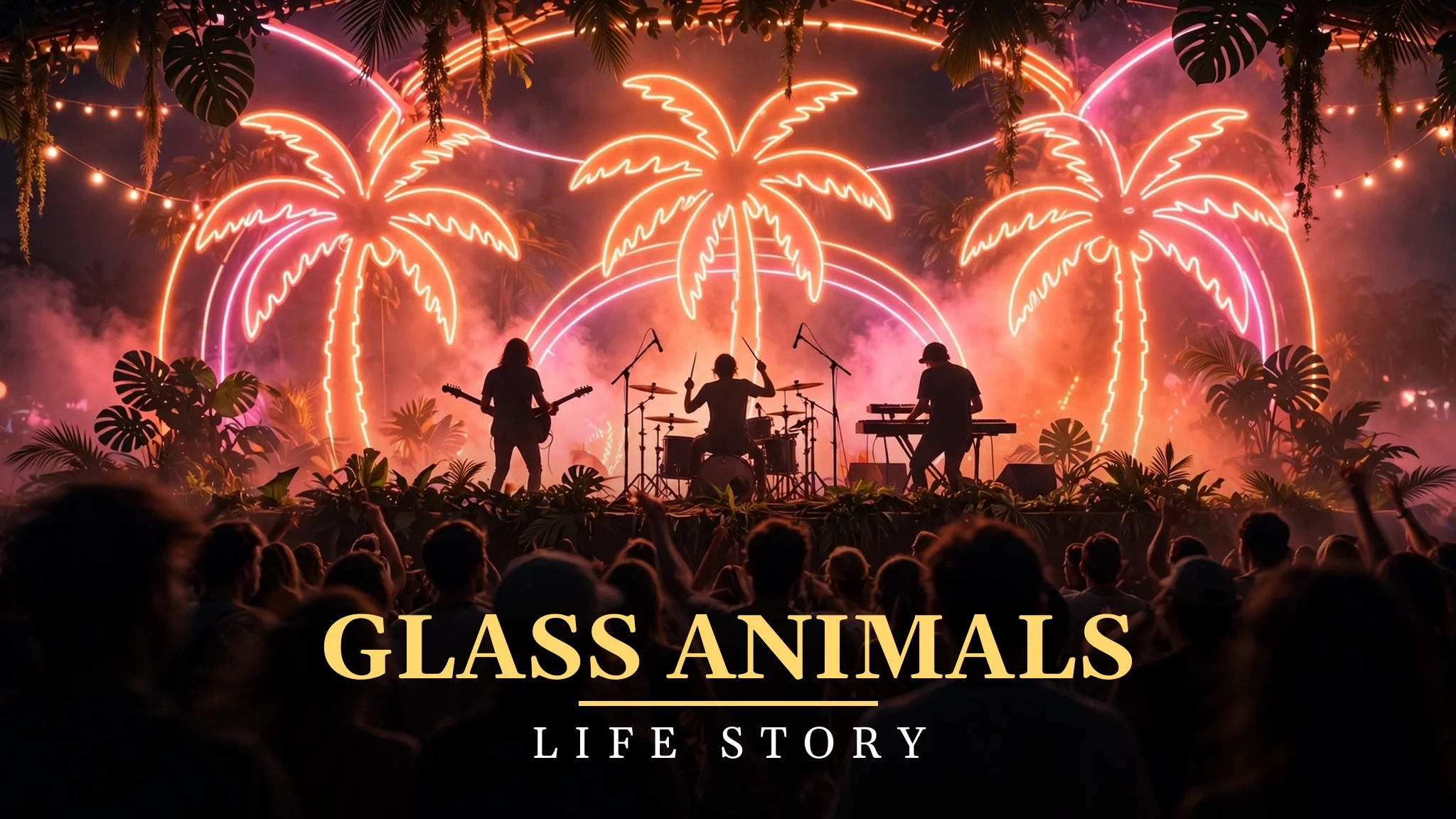
A Glass Animals concert is a bright and joyful place, and it is the best way to understand what the band are really about. On stage, Dave Bayley dances, the band play with energy, and the crowd sings along to songs about loneliness and love. The shows are full of colour: warm lights, tropical images, and a feeling of summer, even when the concert is in winter. That colour is not a trick. It is the sound of the band’s albums, made visible, and it turns a concert hall into the strange and beautiful world that the songs describe.
The band learned how to play live over many years, from small clubs in Oxford to arenas around the world. In the early days, their sound was soft and detailed, and it was hard to make it work on a big stage. They solved that problem by playing with more energy, by letting Bayley move around the stage, and by trusting the crowd to sing along. The songs that had been made in a studio, with many small sounds, became bigger on stage, with the drums louder, the bass deeper, and the vocals stronger. The audience could feel the difference, and they responded with joy.
The Dreamland tour, which followed the album of the same name, was the biggest of the band’s career. They played to crowds who had waited through a pandemic, who had listened to Heat Waves at home, and who were glad to be back in a room full of strangers. The shows felt like a reunion, and the band played with a joy that came from being back on stage. When Heat Waves began, the whole room sang along, and the song that had grown slowly online now filled a large hall with thousands of voices. It was a moment that the band had waited for, and it was worth the wait.
There is also a practical side to their live shows that is easy to miss. A band that uses many electronic sounds must work hard to make a concert feel alive, and Glass Animals do that by playing live instruments, by changing the songs a little each night, and by talking to the crowd. Bayley tells stories between songs, he jokes, he dances, and he makes the audience feel like part of the band. That closeness is the reason their shows are loved. A concert is not a performance to watch from a distance. It is a party to join, and the band are the hosts.
What I find most interesting about their live shows is how they mix joy and sadness in the same set. A song like Heat Waves, about missing someone, is played with a bright and danceable beat, and the crowd dances to it with a smile, even though the words are sad. That mix is the heart of Glass Animals: a band that can make a sad song feel joyful, and a joyful song feel sad, often at the same time. It is a rare skill, and it is the reason their concerts feel like more than just a party. They feel like a shared feeling, a night where strangers come together to dance and to remember at the same time.
The band’s later tours, after I Love You So F***ing Much, showed that lesson even more clearly. By then they were playing to arenas, with bigger lights, bigger stages, and bigger crowds, but the feeling was the same: four friends, playing together, singing about love, and making a room full of strangers feel like a family. That is a remarkable achievement, and it is the reason their live shows are talked about with such warmth by the people who have seen them.
My Take:
When I listen to Glass Animals, the first thing I feel is warmth. Their music sounds like sunlight through leaves, like a summer evening when the air is soft and the world feels kind. But underneath that warmth, there is always a sadder feeling, and I think that mix is what makes them special. Many bands choose to be either happy or sad. Glass Animals choose to be both at the same time, the way real life is both at the same time. A person can dance to Heat Waves and still feel the ache of missing someone, and that is honest. I admire music that does not lie about how feelings work.
I think the heart of their story is the friendship between the four members, and the way that friendship survived a terrible accident. When Joe Seaward was hit by a car in Dublin in 2018, the band could have carried on with another drummer, or they could have split up while they waited. They did neither. They stopped, they waited, and they helped their friend recover. That decision tells me more about them than any chart position ever could. A band is easy to love when things are going well. It is much harder to love when a friend is hurt and the future is uncertain. Glass Animals chose the harder path, and the music they made afterwards, Dreamland, carries that choice in every song.
I also admire Dave Bayley’s way of writing songs. He does not write about himself all the time, the way many songwriters do. He writes about strangers, about people he met on the road, about characters with strange lives and small hopes. That takes curiosity, and it takes kindness. To write a good song about a stranger, you must first listen to that stranger, and you must believe that their life matters. Bayley does that, and the result is an album like How to Be a Human Being, which feels like a book of short stories set to music. I think that is a rare gift. It turns a pop album into something that teaches you how to pay attention to other people.
There is a sadness in their story that I keep thinking about, and it is the sadness inside Heat Waves itself. The song became a worldwide hit, and people danced to it at parties and weddings, but the words are about loss. I wonder how many of the millions of people who loved the song ever really heard what it was saying. That is not the band’s fault. It is the way popular music works: a beautiful melody can carry sad words to places where the sadness is not fully heard. But I also think the band understood that. They wrote a song that could be both a party song and a song about grief, and they let listeners take from it what they needed. That is a generous way to write.
I find the slow rise of Heat Waves deeply encouraging. In a world where songs are expected to become hits in a week or disappear, Heat Waves took almost two years to reach the top of the American chart. It grew because people shared it, because they used it in their own videos, because they played it for friends. No big trick made it happen. It happened the slow way, person by person, and that is the oldest way music has ever spread. I think young musicians should remember that. A song does not need to explode in a day to matter. It can grow slowly, like a plant, and still reach further than a song that burns bright and fades fast.
Another thing I notice is how the band handled fame when it finally arrived. They did not change their sound to copy Heat Waves. They did not rush out ten songs that sounded the same. They toured, they took their time, and they made a new album about love in all its forms. That takes confidence, because the music industry always wants an artist to repeat the last hit. Glass Animals refused, and I respect that refusal. It shows that they care more about the work than about the numbers, and in the long run, that care is what keeps an audience loyal.
I also think about the way their music mixes sounds from different places. Bayley grew up between America and England, and the band’s songs carry both places: American hip hop beats, British indie guitars, tropical rhythms, electronic sounds. That mix could have sounded messy, but it sounds natural, because it is the sound of a person who has lived in more than one world. I think many listeners who have also lived between countries or cultures hear themselves in that mix. The band does not belong to one place, and that is a strength. It makes their music feel open to everyone.
If I have a criticism, it is only that their albums can sometimes feel like puzzles that take a long time to solve. The first time I heard Zaba, I did not understand it at all. It took several listens before the songs opened up for me. That is not a real fault, because the best music often takes time, but I do think some listeners give up too early and miss the reward. The band could make their songs a little easier to enter without losing their strangeness. But I also know that if they made the music simpler, it would not be Glass Animals anymore. The strangeness is the point, and I would not want them to lose it.
I think about their live shows, too, and how joyful they are. Bayley dances, the band plays with energy, and the crowd sings along to songs about loneliness and love. There is something hopeful in that picture: thousands of strangers, singing together about feeling alone, and feeling less alone because they are singing together. That is what a good concert does. It turns private sadness into shared joy, and Glass Animals do that better than most bands I know. I would love to stand in one of those crowds, to hear Heat Waves played live, and to feel that shared feeling in the room.
When I compare Glass Animals with other bands of their time, what stands out is their patience. They did not become famous quickly. They made one album, then another, then another, and each one taught them something new. They waited for their drummer to recover. They waited for their hit song to grow. They waited for the right time to make the next record. Patience is not a fashionable quality in music, but it is the quality that built their career. I think that is the clearest lesson in their story: slow work, done with care, can still win.
For a young reader, I think the lesson is about listening. Bayley listened to strangers, and those strangers gave him an album. The band listened to each other, and that listening kept them together through hard times. Their fans listened closely to the songs, and that close listening turned a slow song into a worldwide hit. Listening is not passive. It is an active choice, and it creates things. A person who listens well will always have stories to tell, friends to keep, and work that matters. Glass Animals prove that in every album they make.
I also take a personal lesson from Joe Seaward’s recovery. He was badly hurt, and he had to learn to play drums again, one step at a time. That kind of recovery takes courage that most of us never have to find. But it also shows that a setback does not have to be the end of a story. Seaward came back, the band came back, and the music they made after the crash was some of the best of their lives. I find that hopeful. It tells me that even when something breaks, it can be mended, and the mended thing can be stronger than it was before.
In the end, I think Glass Animals matter because they make music that is both strange and kind. They write about odd people, they use odd sounds, and they never lose the feeling that every person in their songs deserves to be understood. That kindness is rare in popular music, where so many songs are about winning, about being the best, about leaving others behind. Glass Animals write about staying, about remembering, about missing, and about loving people even when they are gone. That is a softer kind of strength, and I think it is the kind the world needs more of.
One more thought stays with me, and it is about the title of their fourth album, I Love You So F***ing Much. It is funny, it is rude, and it is completely sincere. After everything the band had been through, after the crash, after the pandemic, after the long climb of Heat Waves, they chose to say the simplest thing of all: we love you, very much. I think that is a good place for a band to arrive. Fame fades, charts change, and songs come and go, but love, said plainly, stays. I will keep listening to them, not because they are the biggest band in the world, but because they are one of the kindest, and kindness in music is worth more than noise.
I also think about what I would say to a friend who had never heard Glass Animals. I would not start with Heat Waves, because that song is so famous that it can hide the rest of the band. I would start with Gooey, from Zaba, a soft and strange song that shows the band’s early sound, and then I would play Life Itself, and then Heat Waves, and I would let the friend hear how the band grew. That is the best way to meet this band: slowly, one world at a time, the way the band themselves made their career.
There is another lesson in their story that I keep coming back to, and it is about the value of a strange idea. Glass Animals write songs about strangers, about animals, about dreams, about people who are hard to understand. Those are strange ideas for pop songs, and a record company could have told them to write simpler songs. Instead, they kept the strange ideas, and those ideas became the very things people loved. That tells me that a person does not need to be normal to be loved. They need to be honest about what makes them strange, and the right people will find them.
I also wonder what their next album will sound like, and I find that I do not mind not knowing. Some bands make me want to guess, to predict, to follow every rumour. Glass Animals make me want to wait. I trust that when the record comes, it will be colourful, it will be kind, and it will sound like them. That trust is a rare thing to feel about a band, and it is the result of more than fifteen years of good work. A band that has never let me down earns the right to be waited for.
When I think about Dave Bayley’s writing, I think about how it has changed over the years. On the first album he wrote about animals and jungles, as if he were hiding behind a story. On Dreamland he wrote about his own childhood, about his mother, about his friends, and the songs felt more personal. That change is not about technique. It is about courage, and courage grows slowly, through years of writing, through years of facing hard things, through years of learning that your own life is worth writing about. I find that growth hopeful, because it shows that a writer, like a person, can become braver with time.
I also think about the listeners who found this band during hard times. Many people discovered Glass Animals during the pandemic, when they were at home, when the world felt uncertain, and the band’s songs about memory and missing people matched that feeling. Those listeners did not find the band at a party. They found them in a quiet room, and the songs stayed with them when the world opened up again. That is a special kind of success: not a hit that everyone hears at once, but a song that finds the right person at the right time, and stays.
If I could ask the band one question, I would ask them how they keep their friendship strong after so many years on the road. I would ask them what they do when they disagree about a song, and how they decide when a record is finished. I suspect the answer would be simple: they listen, they wait, and they trust each other. That simplicity is the heart of their story, and it is the reason their music still sounds warm. A band that listens to itself will always sound honest, and honesty is the rarest sound in popular music.
In the end, what I carry from Glass Animals is a feeling of warmth. Their music does not shout, it does not beg, and it does not try to be everything at once. It is a colourful, kind sound, made by four friends who listen to each other, and it reaches people all over the world. That is enough, and it is more than enough. It is a reminder that kind work, done with care, can still be heard, even in the noisiest of times.
Frequently Asked Questions
Who are the members of Glass Animals?
Glass Animals are Dave Bayley, who sings and writes most of the songs, Joe Seaward on drums, Ed Irwin-Singer on bass, and Drew MacFarlane on guitar. The four friends formed the band in Oxford in 2010 and have stayed together through all their albums and tours.
What happened to Glass Animals drummer Joe Seaward?
In 2018, while the band were touring, Joe Seaward was hit by a car while cycling in Dublin and suffered serious injuries, including broken bones and a head injury. The band stopped touring while he recovered, and he later returned to playing drums with the group.
Why did Heat Waves take so long to become a hit?
Heat Waves was released in 2020 on the album Dreamland and grew slowly through playlists, videos and people sharing it with friends. It reached number one in the United States in 2022 after one of the longest climbs in the history of the Billboard Hot 100 chart.
What is How to Be a Human Being about?
How to Be a Human Being, released in 2016, is built around stories Dave Bayley collected from strangers he met while touring. Each song tells the story of a different person, with its own sound and mood, from Life Itself to Pork Soda.
What albums has Glass Animals released?
Their studio albums are Zaba from 2014, How to Be a Human Being from 2016, Dreamland from 2020, and I Love You So F***ing Much from 2024. Each album has its own world of stories, sounds and characters.
Where is Glass Animals from?
The band formed in Oxford, England, in 2010. Dave Bayley spent part of his childhood in Texas in the United States before moving to England, and that mix of American and British life can be heard in the band’s music.
What does the name Glass Animals mean?
The name brings together two ideas: glass, which is fragile and clear, and animals, which are wild and alive. It suits the band’s songs, which often describe people as strange, beautiful and hard to understand, like animals in a story.


