Guan Xiaotong: The Life Story Behind China's Rising Star
In this post
- Born Into a Family of Performers in Beijing
- A Child Star on Television Screens Across China
- To Be a Better Man and a Prize for a Teenager
- Top Scores at the Beijing Film Academy
- Love in the Public Eye
- The Hard Change From Child Star to Adult
- A Young Woman Still Rising
- Variety Shows and the Lighter Side of Fame
- My Take:
Guan Xiaotong has been famous for so long that it is easy to forget she is still young. She was a child actress before she was ten years old, a television star before she was twenty, and a household name across China before she had finished school. People in China call her the nation’s daughter, because they watched her grow up on their television screens, from a little girl in a historical drama to a young woman in a modern love story. She grew up in public, and she grew up well, with a top score in her film school exams, a string of popular dramas, and a career that is still rising.
She was born in 1997 in Beijing, into a family of performers. Her grandfather was a famous Peking opera artist, and her parents were actors. She was on a film set before she could read, and she was acting before most children learn to tie their shoes. That early start gave her a great deal, and it also cost her a great deal. She had fame, and she had skill, but she also had the pressure of being watched by millions of people while she was still a child. Her story is about how she handled that pressure, how she studied, how she changed from a child star to an adult actress, and how she kept going when the change was hard.
This is the story of a girl who was born into the theatre, who grew up on television, and who is still finding her way as a young woman in a demanding industry. It is a story about family, about talent, about school, and about the difficult business of growing up when everyone is watching. It is also a story about a young woman who has already achieved a great deal, and who has many years ahead of her to achieve even more.
Born Into a Family of Performers in Beijing
Beijing is the capital of China, and it is the centre of its film, television, and theatre worlds. Guan Xiaotong was born there on 17 September 1997, into a family that had been part of that world for generations. Her grandfather, Guan Xuezeng, was a well-known Peking opera artist, a man respected across China for his skill in a traditional art form. Her father was an actor, and her mother was also connected to the performing arts. Guan Xiaotong grew up in a home where performance was not a strange dream. It was the family business, talked about at dinner, practised in the living room, and lived every day.
She was a lively child, and she was not afraid of the camera. She appeared in her first film role when she was only four years old, in the film Nuan, a quiet story about a man returning to his home village. She was too young to understand what acting meant, but she understood that the camera liked her, and that the adults on the set liked working with her. She kept appearing in small roles, playing daughters and young girls, and she learned the rhythms of a film set before she learned to read properly.
As a child, she also appeared in The Promise, a large fantasy film directed by Chen Kaige, playing the young version of the heroine. It was a big production, with a large cast and a large budget, and she was a small part of it. But even in a small part, people noticed her. She had a natural presence, a way of standing in front of the camera that made her easy to watch. She was not only the granddaughter of a famous artist. She was a talented child in her own right, and directors began to call her back for more roles.
Growing up in a performing family had advantages and disadvantages. The advantage was that she understood the work from the start. She knew that acting was not only glamour. It was long hours, hard work, and waiting. The disadvantage was that people would always say she only got her roles because of her family. She would spend her whole career answering that question, proving again and again that she had talent of her own. She answered it by working hard, by studying, and by taking on roles that were difficult, not only roles that were easy.
A Child Star on Television Screens Across China
As she grew older, Guan Xiaotong became one of the most familiar child actresses on Chinese television. She appeared in many dramas, playing daughters, students, and young girls in historical stories. Chinese audiences watched her grow up, year by year, from a small child to a teenager. They felt that they knew her, because they had seen her on their screens for so long. That feeling is why people call her the nation’s daughter. She was not only an actress. She was a girl who belonged, in a small way, to every family that watched television.
Her childhood was busy. She went to school, she studied, and she worked on film sets at the same time. It was a hard balance to keep, and her parents worked to protect her. They made sure she did her schoolwork, that she had time to be a child, and that acting did not take over her whole life. That protection mattered, because many child stars lose their childhood to work. Guan Xiaotong kept hers, at least in part, because her family kept her grounded in school and in home life.
She appeared in many popular dramas as a teenager, building a long list of credits before she was twenty. She played in historical dramas, in modern dramas, and in films, learning a different kind of acting in each one. She was a professional, even as a teenager, known for arriving on time, knowing her lines, and working well with other actors. That professionalism was learned young, and it stayed with her.
By the time she was a teenager, she was already a star, with fans, with attention, and with the pressure that comes with both. She handled it with a cheerfulness that audiences liked. She was known as a bright, lively girl, with a good sense of humour, and with a willingness to laugh at herself. That cheerfulness helped her to survive the pressure of growing up in public, and it made her popular with viewers who saw her as a daughter, a sister, and a friend.
To Be a Better Man and a Prize for a Teenager
The turning point in Guan Xiaotong’s career as a young adult came in 2016, with the television drama To Be a Better Man. The series told the story of a chef and the people around him, in modern Beijing, and Guan Xiaotong played Peng Jiahe, a young woman who is strong, stubborn, and full of life. She was nineteen years old, and she played the part with a confidence that surprised many people. She was no longer a child actress. She was a young woman, playing a young woman, and she did it well.
Her performance won her the Best Supporting Actress award at the Magnolia Awards, one of the most important television awards in China. She was one of the youngest winners ever, and the award was a sign that the industry had recognised her as a serious actress, not only as a former child star. She stood on the stage, accepted the prize, and thanked the people who had helped her. It was a proud moment, for her and for her family, and it marked the start of her adult career.
To Be a Better Man was also popular with audiences. It was watched by millions, and Guan Xiaotong’s character became one of the most talked-about in the drama. People liked Peng Jiahe because she was strong and honest, because she said what she thought, and because she did not pretend to be perfect. Guan Xiaotong played her with that same honesty, and audiences recognised it. She had found a role that fitted the young woman she was becoming, and she had made the most of it.
After the award, she was offered more leading roles, in television dramas about modern life, about love, and about young people trying to build a future. She became one of the most sought-after young actresses in China, and her name was known to everyone who watched television. She was no longer only the nation’s daughter. She was a star in her own right, with an award to prove it, and with a career that was moving forward at full speed.
Top Scores at the Beijing Film Academy
In 2016, the same year as To Be a Better Man, Guan Xiaotong took the entrance exams for the Beijing Film Academy. The exams are famous in China for being hard, and for the huge number of young people who take them. Guan Xiaotong did not only pass. She scored the highest marks in the acting exam, a result that was reported across the country. It was a remarkable achievement, and it silenced many of the people who had said she only got her roles because of her family. No family name can answer an exam for you. Guan Xiaotong answered it herself, and she answered it better than anyone else that year.
Her time at the Beijing Film Academy was important for another reason. It gave her a chance to study acting properly, after years of learning on the job. She had been acting since she was four, but she had never studied the theory behind it. At film school, she learned about the history of acting, about different methods, and about how to build a character from the ground up. She took her studies seriously, and she was known as a good student, not only as a famous one. Her teachers praised her discipline, and her classmates respected her work.
Studying at film school while also being a famous actress is not easy. Guan Xiaotong had to balance classes with film shoots, exams with public appearances, and student life with stardom. She did it with the same cheerfulness that had marked her childhood. She went to class, she did her homework, and she kept working. She graduated as a trained actress, with a degree and with a top exam score, and with a career that was already well established. That combination of study and work is rare, and it is one of the reasons her story is respected.
The top score also mattered because it showed the public that she was serious about her craft. A child star can be seen as someone who got lucky, who was in the right place at the right time. A student who scores the highest marks in a national exam cannot be dismissed so easily. Guan Xiaotong had proved, in the most public way possible, that she had talent, that she had worked hard, and that she deserved her place. It was a turning point, not only in her career, but in the way people thought about her.
Love in the Public Eye
Guan Xiaotong’s personal life has been much discussed in China, especially her relationship with Lu Han, one of the most popular young singers and actors in the country. They made their relationship public in 2017, when Guan Xiaotong was twenty years old. It was a bold decision, because Lu Han had millions of fans, and many of those fans were unhappy to learn that he had a girlfriend. Guan Xiaotong faced a great deal of attention, and a great deal of criticism, from people she had never met.
She handled it with a calm that surprised many people. She did not hide the relationship. She did not apologise for it. She continued to work, to study, and to live her life, and she let the talk go on without her. That calm was a sign of maturity, and it was a sign that she had grown up in public and learned how to survive it. She understood that fame brings attention to every part of a person’s life, and that the only answer is to live honestly and to keep working.
The relationship has lasted for many years, and it has become one of the most talked-about in Chinese entertainment. Whether it lasts or not, it has already taught Guan Xiaotong something important: that a famous person’s private life is never truly private, and that the best way to handle that is with honesty and with dignity. She has shown both, and she has done it while still in her twenties, an age when many people would have been overwhelmed by the attention.
Her family has also remained close to her. Her parents and her grandfather’s legacy have shaped her life, and she has spoken about them with pride. She has said that her grandfather’s work in Peking opera taught her about discipline, about respect for the art, and about the importance of hard work. Those lessons have stayed with her, and they show in the way she works. She is not a star who takes her fame for granted. She is a worker, from a family of workers, and she treats her career as a craft to be learned, not as a prize to be enjoyed.
The Hard Change From Child Star to Adult
The hardest part of Guan Xiaotong’s career has been the change from a child star to an adult actress. It is a change that many child stars fail to make. The audience remembers them as children, and they do not want to see them as adults. The roles that made them famous as children do not suit them as adults, and the new roles are harder to find. Guan Xiaotong has faced that change, and she has found it difficult, as many people expected her to.
She has taken leading roles in modern dramas, in historical dramas, and in films, playing young women in love, young women at work, and young women trying to find their place in the world. Some of those dramas have been popular, and some have been criticised. Some viewers have said that her acting has not grown as fast as she has, and that she still plays the same kind of character she played as a teenager. She has heard those criticisms, and she has kept working, looking for roles that will let her show a new side of herself.
That search is still going on. She is twenty-nine years old, and she has many years ahead of her. She has the talent, the training, and the experience to become a great adult actress, if she finds the right roles. She needs a script that asks her to be more than a cheerful young woman, a script that asks her to show pain, to show doubt, and to show the complexity of adult life. If she finds that script, and if she gives it everything she has, she could surprise the people who doubt her. I believe she can, because she has surprised people before, with her exam scores, with her award, and with her ability to grow up in public without losing herself.
Her career is a reminder that growing up is hard for everyone, and it is harder when millions of people are watching. Guan Xiaotong has grown up in front of China, and she has done it with a grace that deserves respect. She has made mistakes, as all young people do, and she has learned from them in public, which is harder than learning from them in private. She is still learning, and she is still growing, and that is exactly as it should be for a woman of twenty-nine.
A Young Woman Still Rising
Guan Xiaotong’s story is still being written, and that is part of what makes it interesting. She is not a finished star, with a career behind her. She is a young woman in the middle of her career, with a great deal already achieved and a great deal still to do. She has been a child actress, a top student, an award winner, and a leading lady. She has done all of that before the age of thirty, and she has done it while growing up in front of millions of people.
What will she do next? She may find the great adult role that defines her career. She may become a producer, or a director, or a teacher, using the knowledge she has gained since she was four years old. She may do all of those things, in time. Whatever she does, she will do it with the experience of a person who has spent her whole life in the performing arts, and with the discipline of a student who scored the highest marks in her exams.
For young people who watch her, she is an example of a different kind of success. She did not become famous by accident. She was born into a performing family, but she worked hard, she studied hard, and she earned her place. She shows that family can open a door, but only hard work can keep you in the room. She also shows that growing up in public is possible, if you keep your family close, if you study, and if you do not let fame change who you are. Guan Xiaotong has done that, and she is still doing it, one role at a time, as she rises from a child star to a woman with a career of her own.
Variety Shows and the Lighter Side of Fame
Guan Xiaotong is not only a dramatic actress. She is also a familiar face on Chinese variety shows, where she shows a lighter, funnier side of herself. She has appeared as a regular on Ace vs Ace, a popular variety show where stars play games, perform, and make audiences laugh. On that show, she is known for being quick, funny, and willing to laugh at herself. She dances, she sings, and she plays along with the jokes, even when the jokes are about her. Audiences love that, because it shows a side of her that her dramas do not show: a young woman who is fun, relaxed, and not afraid to be silly.
Variety shows are a different kind of work from acting. They ask a performer to be themselves, in front of a live audience, without a script, and without the safety of a character to hide behind. Guan Xiaotong has handled that with the same cheerfulness she brings to her acting. She is not afraid to look foolish, and she is not afraid to lose a game. That willingness to be silly is a strength, because it shows confidence. A person who is afraid of looking foolish will never be truly relaxed. Guan Xiaotong is relaxed, and audiences can feel it, and they love her for it.
Her work on variety shows has also made her known to a wider audience, including young people who do not watch her dramas, but who watch variety shows for fun. She has become a familiar face in many homes, not only as an actress, but as a personality, a young woman who is fun to watch, and who seems like a friend. That familiarity has helped her career, because it means that when she does appear in a drama, people already know her, and they are curious to see what she will do next.
But variety shows also bring a risk. A performer who appears on variety shows too often can be seen as a variety star, not as a serious actress. Guan Xiaotong has tried to balance the two, taking variety work when it suits her, and taking dramatic roles when they matter more. She has kept her acting career at the centre of her life, and variety shows at the edges, as a way to show her personality, not as a replacement for her craft. That balance is hard to hold, and she has held it as well as she could, with a cheerfulness that makes it look easy, even when it is not.
My Take:
I think Guan Xiaotong’s story is really a story about growing up, and about how hard it is to grow up when everyone is watching. She was four years old when she first stood in front of a camera. She was a star before she was ten. She was a household name before she had finished school. Most of us grow up in private, making our mistakes where only our family can see them. Guan Xiaotong grew up in public, making her mistakes where millions of people could see them, and comment on them, and judge them. I think that takes a kind of strength that is easy to overlook, because she makes it look easy. She smiles, she works, and she keeps going. But it is not easy. It is very hard, and I respect her for doing it as well as she has.
What I admire most about her is the exam result. She scored the highest marks in the acting exam at the Beijing Film Academy. I keep coming back to that, because it is a fact that cannot be argued with. People can say that she got her roles because of her family. They can say that she is only famous because she started young. But no one can say that her family took an exam for her. She took it herself, and she scored higher than everyone else that year. That is proof, in the clearest possible form, that she has talent, and that she worked hard. I think that matters, not only for her, but for every young person who is told that their success came from luck or from family. Hard work can be proved, and Guan Xiaotong proved it, in a room full of strangers, with a pen in her hand, and no one to help her.
I also think about the name people give her, the nation’s daughter, and what that name means. It is a loving name, but it is also a heavy one. A nation’s daughter belongs to everyone, and everyone feels free to comment on her life. They comment on her acting, on her clothes, on her boyfriend, on her weight, on everything. That is a lot for a young woman to carry. I think about how I would feel if millions of strangers felt that they owned a part of my life. I would feel trapped. Guan Xiaotong does not act trapped. She acts free, and she acts cheerful, and she keeps working. I do not know if she truly feels free, or if she has simply learned to hide the weight. Either way, I respect her for carrying it, and I hope she has people around her who remind her that she belongs to herself first, and to the nation second.
There is a sad part to her story, and I want to name it honestly. The sad part is that she has never had a normal life, not really. She was working when other children were playing. She was famous when other teenagers were anonymous. She was judged by millions when other young women were judged only by their friends. That is a loss, even if it brought her fame and money. A normal childhood is a precious thing, and she gave up a part of hers for her career. I do not think she regrets it, and I do not think she should. But I think we should recognise what it cost her, and we should not pretend that fame is free. It is not free. It costs privacy, it costs rest, and it costs the simple pleasure of being unknown. Guan Xiaotong paid that price, and she paid it young, and I think we owe her a little bit of kindness for it.
I want to be honest about her acting as well, because I do not want this to be only praise. Some of her recent dramas have not been as strong as To Be a Better Man. Some viewers have said that she plays the same kind of character too often, a cheerful, stubborn young woman, and that she has not yet shown the depth that a great actress needs. I think there is some truth in that, but I also think it is unfair to judge a woman of twenty-nine as if her career were already over. She is still young. She is still learning. She has the training, the experience, and the talent to grow, and I believe she will grow, if she finds the right roles. I hope she finds them, because I think she has more to show us than we have seen so far. I hope she takes a risk, plays a character who is not cheerful, who is not likeable, who is difficult and sad, and shows the world what she can do when she is not smiling.
The lesson I take from Guan Xiaotong is about the value of study. She was already famous when she took her film school exams, and she could have skipped them. She could have said, I am already a star, I do not need school. She did not say that. She studied, she took the exams, and she scored the highest marks. That tells me something important about her character. She believes that talent is not enough, and that fame is not enough. She believes that you must learn your craft properly, even when you are already successful. I think that is a lesson for all of us. It is easy to stop learning when we have achieved something. It is harder to keep learning, to go back to school, to admit that we still have things to learn. Guan Xiaotong did that, and she is better for it. I hope young people who read her story understand that. Success is not a reason to stop learning. It is a reason to learn more, because the more you know, the further you can go.
Finally, I want to say that her story makes me think about family, and about what a family can give a child. Her grandfather was a Peking opera artist. Her parents were actors. She grew up in a home where performance was respected, where hard work was expected, and where art was a way of life. That family gave her a great deal: a start, a knowledge of the work, and a sense of discipline. But it also gave her a burden, the burden of living up to a famous name. Guan Xiaotong has carried that burden with grace, and she has made the name her own. She is no longer only the granddaughter of Guan Xuezeng. She is Guan Xiaotong, an actress, a student, an award winner, and a young woman with a future of her own. That is a fine thing to have achieved by the age of twenty-nine, and I look forward to seeing what she does next.
I also think about the way Guan Xiaotong laughs, because it is such a large part of who she is in public. She laughs loudly, freely, and without worrying about how she looks. On variety shows, she laughs at jokes, at herself, and at the games she plays, and that laughter is infectious. It makes the audience laugh with her, and it makes them feel that she is a real person, not a star performing a role. I think that laughter is a gift, and it is one that many famous people lose as they grow older. They become serious, careful, and afraid to look foolish. Guan Xiaotong has not lost her laughter. She still laughs like a young woman who is enjoying her life, and I admire that, because joy is not a weakness. It is a strength, and it is one that she shares generously with her audience. A person who can laugh at themselves is a person who is comfortable in their own skin, and Guan Xiaotong seems comfortable, even after growing up in public, which is a remarkable thing.
I want to think, too, about what it means to be called the nation’s daughter, and how that name can be both a blessing and a burden. It is a blessing because it means that millions of people love you, that they feel you belong to them, and that they have watched you grow up with affection. It is a burden because it means that millions of people feel free to comment on your life, to judge your choices, and to expect you to behave in a certain way. A nation’s daughter is expected to be good, polite, and modest, always. She is not allowed to make mistakes, to be angry, or to be herself, fully. Guan Xiaotong has lived with that expectation for many years, and she has handled it with grace, but I wonder what it costs her. I wonder if she ever wishes she could be anonymous, if she ever wishes she could make a mistake without millions of people knowing about it. I hope she has people around her who remind her that she belongs to herself first, and to the nation second, and that it is all right to be imperfect, even when you are the nation’s daughter.
There is another part of her story that I find important, and it is the way she has handled her relationship in public. She and Lu Han made their relationship public when she was twenty, and they have stayed together for many years, in spite of the attention, the criticism, and the pressure. That is not easy. A relationship in the public eye is hard to keep, because everyone has an opinion, and everyone is watching. Guan Xiaotong and Lu Han have kept theirs alive, quietly, without making a show of it, and without letting the public decide its fate. I respect that, because it shows maturity, and it shows that they value each other more than they value public approval. A relationship that survives public scrutiny is a strong one, and I hope theirs continues, for as long as it is right for both of them.
I want to be honest about something else as well. Guan Xiaotong is a talented actress, but she has not yet had the one great dramatic role that would define her as an adult. She has had good roles, and she has done them well, but she has not yet had the role that makes people say, she is one of the best actresses of her generation. I think that role may still come. She is twenty-nine, and she has many years ahead of her. I hope she finds it, because I think she has more to show us than we have seen so far. She needs a script that asks her to be more than cheerful, more than stubborn, more than the nation’s daughter. She needs a script that asks her to be a real woman, with flaws, with pain, and with a life that is not easy. If she finds that script, and if she gives it everything she has, I think she could surprise a lot of people. I do not say this to criticise her. I say it because I believe in her talent, and I want to see all of it.
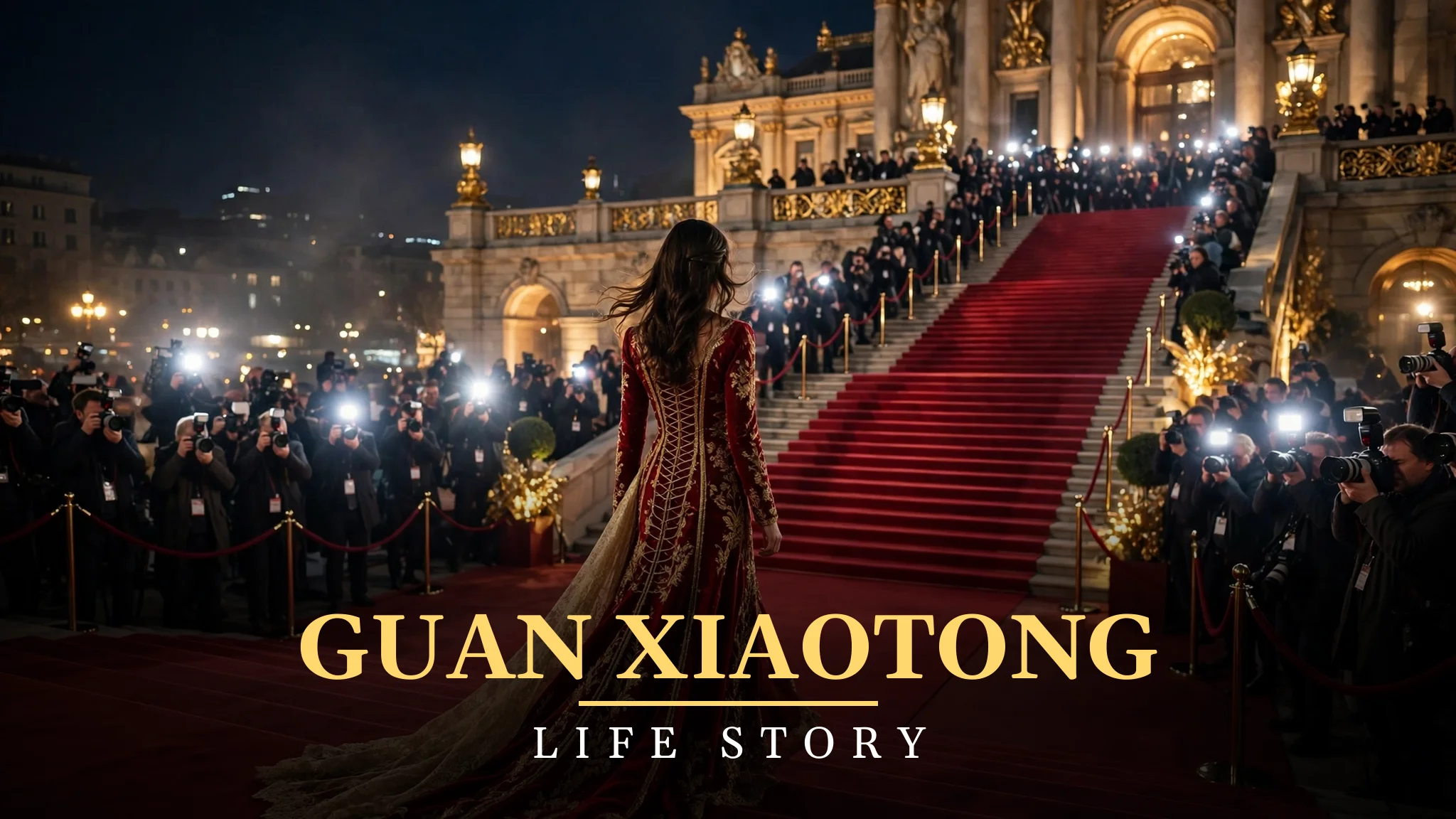
Finally, I want to return to the image of the woman in the red gown, climbing a staircase toward a grand palace, with photographers flashing all around her, which is the image on her cover. That image fits Guan Xiaotong well, because it shows a young woman walking toward a bright, grand place, in a beautiful dress, with the whole world watching her. She is not running. She is walking, steadily, up the stairs, toward the light. That is the story of her life, in a way. She started as a small child on a film set, she climbed the stairs of fame, one step at a time, and she is still climbing, toward whatever comes next. I think that is a beautiful image, and it is a hopeful one. It says that the stairs are long, that the climb is hard, and that the photographers will always be there, but that if you keep walking, you will reach the top. Guan Xiaotong has kept walking, and she is still walking, and I believe she will reach the top, in her own time, and in her own way.
I also want to say something about the way Guan Xiaotong works with other actors, because acting is never a solo art, even when one person is the star. On a set, an actor must listen, respond, and make room for the other performers. Guan Xiaotong has been doing that since she was a child, and she is good at it. She does not try to steal every scene. She shares the scene, she lets other actors shine, and she trusts that the story is bigger than any one person. That generosity is rare, especially among young stars, and it is one of the reasons directors like working with her. A generous actor makes everyone around them better, and the film or drama is better for it. I admire that generosity, because it shows maturity, and it shows that she understands what acting truly is: a team effort, not a solo performance.
Frequently Asked Questions
Who is Guan Xiaotong and why is she called the nation’s daughter?
Guan Xiaotong is a Chinese actress born in 1997 in Beijing. She is called the nation’s daughter because Chinese audiences watched her grow up on television from a small child into a young woman, and they feel that they know her as if she were part of their own family.
What family does Guan Xiaotong come from?
She comes from a family of performers. Her grandfather, Guan Xuezeng, was a famous Peking opera artist, and her parents were actors. She began acting at four years old, appearing in the film Nuan and later in The Promise.
What role won Guan Xiaotong a major award?
She won the Best Supporting Actress award at the Magnolia Awards for playing Peng Jiahe in the 2016 television drama To Be a Better Man. She was nineteen years old and one of the youngest winners of the prize.
How did Guan Xiaotong do in her film school exams?
In 2016, she took the entrance exams for the Beijing Film Academy and scored the highest marks in the acting exam. The result was widely reported and proved her talent beyond her family name and early fame.
Who is Guan Xiaotong in a relationship with?
She has been in a public relationship with singer and actor Lu Han since 2017. The relationship has been much discussed in China, and Guan Xiaotong has handled the attention with calm and dignity.
How old is Guan Xiaotong?
Guan Xiaotong was born on 17 September 1997, so she was twenty-nine years old in 2026. She has been acting since she was four, giving her a career already lasting twenty-five years.
What is Guan Xiaotong’s most famous drama?
To Be a Better Man from 2016 is one of her most famous dramas, and the role of Peng Jiahe won her a Magnolia Award. She has also appeared in many other popular television dramas and films since she was a child.


