Habib Koite: The Life Story Behind Mali's Guitar Master
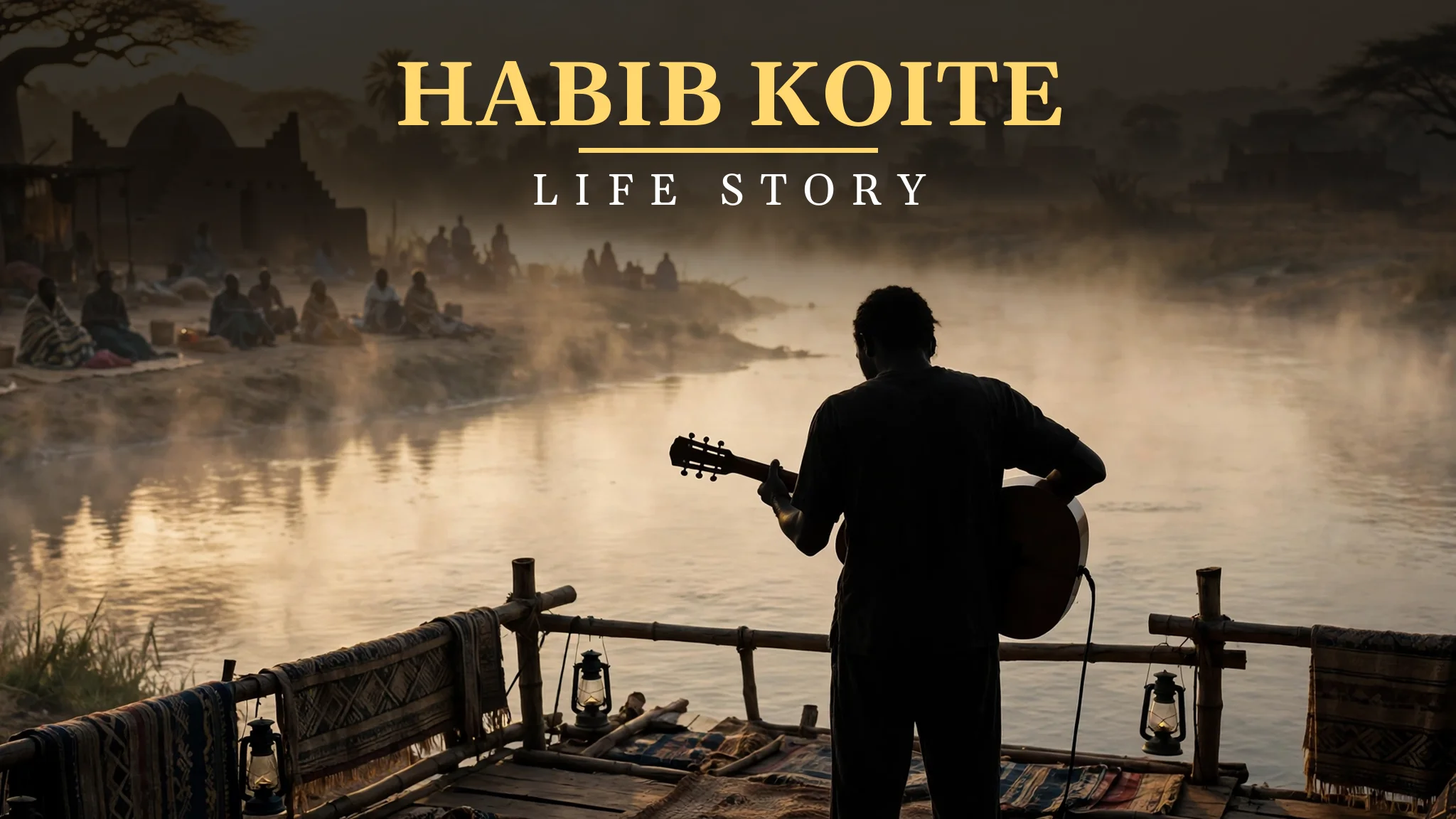
In this post
- Thiès, Kayes, and a Family of Griots
- Bamako, the Institute, and the Birth of Bamada
- Ma Ya and the Guitar the World Heard
- Baro, Afriki, and a Career That Travelled
- The Guitar Style That Carries Mali
- A Master Who Stayed Home
- Brothers in Bamako and the Meeting with the Blues
- Soô, Kharifa, and the Later Records
- My Take:
There is a kind of guitar playing that does not shout. It does not try to impress you with speed, and it does not try to overwhelm you with noise. It speaks quietly, clearly, and with a warmth that makes you want to listen more closely. Habib Koité plays the guitar in that way, and his sound has made him one of the most loved musicians in Mali and one of the most respected guitarists in world music.
He was born on 27 January 1958 in Thiès, Senegal, and he grew up in Kayes, in the west of Mali. He comes from a family of griots, the hereditary musicians and storytellers of West Africa, and music was part of his life from the start. He studied at the National Institute of Arts in Bamako, he formed his band Bamada, and he released the album Ma Ya in 1998, a record that introduced his guitar to the world and that remains one of the great albums of Malian music.
This is the story of that guitar, and of the man who plays it: a musician who took the traditions of his family, the rhythms of Mali, and the sound of the modern guitar, and who made something that belongs to all three. It is a story about patience, about craft, and about a sound that travels quietly and far.
Thiès, Kayes, and a Family of Griots
Habib Koité was born on 27 January 1958 in Thiès, Senegal, and he grew up in Kayes, a town in the west of Mali, near the border with Senegal. Kayes is a hot, dry town on the Senegal River, a place of traders, travellers, and musicians, where the cultures of Mali and Senegal meet. A child growing up there hears many kinds of music, and Habib heard them all. He also heard the music of his own family, because he was born into a griot family, and griot music was the sound of his home.
The griots are the hereditary musicians of West Africa, the people who have carried the history, the stories, and the songs of their peoples for centuries. A griot child grows up hearing the kora, the balafon, and the ngoni, and he learns the songs that tell the history of kings and of families. Habib grew up in that world, and it gave him a deep understanding of Malian music. He did not learn music from a book. He learned it from his family, from the sounds around him, and from the tradition that had been passed down for generations.
As a boy, he was drawn to the guitar, an instrument that was new to Mali but that fitted the music he knew. He learned to play it in his own way, using the rhythms and the melodies of griot music, and he developed a style that was both traditional and modern. His guitar did not sound like a Western guitar. It sounded like a kora, like a ngoni, and like the voice of Mali, played on six strings. That was his gift, and it was a gift that would define his career.
He also learned to sing, and his voice, warm and gentle, became a central part of his music. He sang in Bambara and in other Malian languages, and his songs spoke about love, about life, and about the world around him. He was not a loud singer. He was a singer who spoke quietly and clearly, and whose words carried weight because they were honest. That honesty, in both his guitar and his voice, became the mark of his music.
As a young man, he decided to study music formally, and he enrolled at the National Institute of Arts in Bamako, the capital of Mali. The institute was a school for artists, and it gave Habib a formal education in music, in theory, and in performance. He graduated in 1982, and he left the institute with a deep knowledge of his craft and with a clear idea of what he wanted to do: to make music that was rooted in Mali and that could be heard around the world.
Bamako, the Institute, and the Birth of Bamada
At the National Institute of Arts in Bamako, Habib Koité studied music and learned the formal skills that would support his natural talent. The institute was a place where young artists from across Mali came to learn, and it was a school for the best musicians in the country. Habib studied there in the late 1970s and early 1980s, and he graduated in 1982. The education gave him a foundation, but his real education had already happened in Kayes, in his family, and in the music he had heard since childhood. The institute gave him the tools to use that education, and he used them well.
After graduating, he worked as a musician in Bamako, playing in bands and performing in the city. Bamako in the 1980s was a lively music city, with bands, clubs, and a growing scene, and Habib was part of it. He played with other musicians, he learned the business of music, and he built a reputation as a guitarist of unusual talent. His playing was different from the playing of other guitarists in Bamako, because it was rooted in griot music and in the rhythms of Mali, and it had a warmth and a clarity that set it apart.
In 1988, he formed his own band, Bamada, named after Bamako, the city that had become his home. Bamada was a group of musicians who shared Habib’s vision: to make music that was Malian in its roots and modern in its sound, and to do it with a quality that could be heard anywhere in the world. The band became the vehicle for Habib’s songs, and it has played with him for decades. A band that stays together for that long is a sign of loyalty and of shared purpose, and Bamada is both.
The band’s early years were spent performing in Mali and in West Africa, building a following and refining its sound. Habib’s guitar was at the centre of the music, and his songs were the heart of the band’s repertoire. He wrote about love, about life, and about Mali, and his songs were sung in a way that made them feel personal and universal at the same time. A listener in Bamako heard his own life in them, and a listener in Paris heard a sound that was both exotic and familiar. That is the mark of great music, and Bamada had it from the start.
By the mid-1990s, Habib and Bamada were ready to record the album that would make them famous. They had the songs, they had the sound, and they had the experience. They needed a record that could carry their music to the world, and that record was coming.
Ma Ya and the Guitar the World Heard
In 1998, Habib Koité released Ma Ya, an album that became one of the great records of Malian music and that introduced his guitar to a global audience. The album’s title means it is here, or it has arrived, and the record lived up to its name. Its songs were beautiful, warm, and full of the sound of Mali, and its guitar playing was praised by critics and by other musicians around the world. Ma Ya was not a loud album. It was a quiet, confident record, and its quietness was its strength.
The album included songs that became classics, including I Ka Barra, a song about work and about the dignity of labour, and Cigarette Abana, a song that became one of Habib’s best-known works. Cigarette Abana is a playful song, with a catchy melody and a rhythm that makes you want to move, and it showed that Habib could write a song that was both serious and fun. The album as a whole showed the range of his talent: he could write a gentle love song, a song about work, and a song about life, and all of them sounded like Habib Koité.
Ma Ya was a success in Europe and in America, and it made Habib a star in the world music scene. He was invited to perform at festivals, his concerts drew audiences who had never been to Mali, and his guitar became recognised as one of the great sounds of African music. He was not a singer who relied on volume or on spectacle. He relied on the quality of his playing and on the honesty of his songs, and that quality was enough. A listener who heard Ma Ya understood, without needing to be told, that this was music made by a master.
The album also showed the importance of Bamada. The band’s playing was tight, warm, and supportive, and it gave Habib’s guitar the setting it needed. A great guitarist needs a great band, and Habib had one. The musicians of Bamada understood his sound, they played with him for years, and they made his music fuller and richer. The album was not only Habib’s work. It was the work of a band, and the band’s contribution was essential.
Ma Ya remains Habib’s best-known album, and it is still regarded as a classic of Malian music. It is a record that rewards repeated listening, because its beauty is not in a single hit but in the whole sound: the guitar, the voice, the band, and the feeling of Mali that runs through every song. It is the album that made Habib Koité a name that music lovers around the world recognise, and it is the album that defines his career.
Baro, Afriki, and a Career That Travelled
After Ma Ya, Habib Koité continued to record and to tour, releasing albums that built on its success and that showed his music growing. Baro, released in 2001, was another major album, and it continued the warm, melodic sound of Ma Ya. Its songs were about love, about life, and about Mali, and they were played with the same care and the same quality. The album was a success, and it confirmed that Habib was not a one-album artist. He was a major figure in world music, with a catalogue that was growing and a reputation that was secure.
Afriki, released in 2007, was another important record, and its title, meaning Africa, reflected Habib’s sense of belonging to the whole continent. The album’s songs spoke about Africa, about its people, and about its music, and they were recorded with a sound that was both Malian and pan-African. The record showed that Habib’s vision was not limited to Mali alone. He saw himself as an African musician, and his music carried the sound of the continent as well as the sound of his own country.
He also began to collaborate with musicians from other countries, and those collaborations brought new sounds to his music. In 2012, he released Brothers in Bamako, an album made with the American blues singer Eric Bibb, and the record was a meeting of Malian guitar and American blues. The collaboration was a natural one, because both men played the guitar in a warm, melodic style, and both understood the connection between African music and the blues. The album was praised, and it showed that Habib’s music could meet other traditions without losing its identity.
His later albums, including Soô in 2014 and Kharifa in 2019, continued his work, and they showed that he was still recording, still touring, and still making music of high quality. He performed at festivals around the world, he played in concert halls in Europe and America, and his live shows remained popular with audiences who loved his guitar and his voice. A Habib Koité concert is not a loud event. It is a warm, intimate performance, and the audience leaves feeling that they have heard something beautiful and true.
Through all of this, he remained based in Mali, and he remained a figure in the country’s music scene. He did not move to Paris or London. He stayed in Bamako, he worked with Bamada, and he kept his roots visible. That rootedness is part of his identity, and it is one reason his music has stayed honest. He is a Malian musician who happens to be famous around the world, and that distinction matters to his fans at home.
The Guitar Style That Carries Mali
Habib Koité’s guitar style is one of the most distinctive in African music. He plays with a technique that is influenced by the kora and the ngoni, the traditional instruments of Mali, and his playing has a lightness and a clarity that is rare. He does not play fast, and he does not play loud. He plays with a touch that is gentle and precise, and his notes ring out clearly, one after another, like drops of water. That style is hard to learn, and it is the result of years of practice and of a deep understanding of Malian music.
His style is also a bridge between tradition and modernity. He uses a modern guitar, but he plays it in a traditional way, and the result is a sound that belongs to both worlds. A listener who knows Malian music hears the tradition in his playing, and a listener who knows Western guitar hears the modernity. That is why his music travels so well: it speaks two languages at once, and both are understood. His guitar is a translator, and it translates Mali for the world.
He has also been a teacher, both formally and informally. Young guitarists in Mali look to him as an example, and they learn from his playing, from his songs, and from his career. He showed them that a Malian guitarist could be heard around the world, and that a guitarist did not need to copy Western styles to succeed. He could play in his own way, rooted in his own tradition, and the world would listen. That lesson is one that will last as long as his music does.
His influence is also heard in the work of other African guitarists, who have taken his style and made it their own. That is how music grows: one master creates a style, and the next generation takes it further. Habib’s style is now part of the sound of Malian music, and it will be part of it for a long time. He did not only make great records. He made a way of playing, and that way of playing is his legacy.
A Master Who Stayed Home
Today, Habib Koité is regarded as one of the great guitarists of Africa, and his place in the history of Malian music is secure. He is the master of the Malian guitar, the leader of Bamada, and the singer of Ma Ya, and his name is known to music lovers around the world. He has performed at festivals, in concert halls, and on stages in many countries, and his music has been praised by critics and by other musicians. He has done all of this while staying rooted in Mali, and that rootedness is part of his achievement.
His legacy is not only in his albums. It is in the guitarists he has inspired, in the band he has kept together for decades, and in the sound he has created. Young musicians in Mali still listen to Ma Ya, they still learn his songs, and they still try to play like him. That is the mark of a master: his work becomes a school, and his students carry it forward. Habib’s school is the sound of Mali, played on a guitar, and it will be taught for many years to come.
He remains active, recording, performing, and working with Bamada, and his music remains a part of life in Mali and beyond. The boy from Kayes who learned the guitar in a griot family has become a master, and his mastery is recognised around the world. He did not become famous by being loud. He became famous by being good, by being patient, and by playing a guitar that speaks quietly and clearly. That is a lesson for any artist: quality lasts longer than noise, and a quiet sound, played well, can travel further than a loud one.
Brothers in Bamako and the Meeting with the Blues
In 2012, Habib Koité released Brothers in Bamako, an album made with the American blues singer Eric Bibb, and the record was a meeting of two guitar traditions. Bibb is a bluesman with a warm, melodic style, and Habib is a Malian guitarist with a similar warmth, and the two men found that their playing fitted together naturally. The album’s songs were gentle, reflective, and full of the feeling of two musicians listening to each other. It was not a loud record. It was a quiet conversation between two guitars, and it showed that Malian music and American blues are cousins, separated by an ocean but joined by history. The collaboration was praised, and it introduced Habib’s music to new listeners in America, who heard in his playing a sound that was both foreign and familiar. Brothers in Bamako was also a reminder that music travels best when musicians meet as equals, and Habib and Bibb met as equals, with respect for each other’s traditions.
Soô, Kharifa, and the Later Records
Habib Koité’s later albums, including Soô in 2014 and Kharifa in 2019, show a musician who was still growing, still recording, and still making music of high quality more than twenty years after Ma Ya. Soô, whose title refers to the home, was a warm and reflective record, with songs about family, about Mali, and about the life he knew. Kharifa, released five years later, continued that work, with new songs, new collaborators, and the same clear guitar sound that had always defined him. These records did not try to repeat Ma Ya. They showed a master who was still curious, still listening, and still willing to try new ideas while keeping his identity intact. A musician who can still make a great album after two decades is a musician who has not lost his love for the work, and Habib had not lost his. His later records are proof that a quiet career, built slowly, can last longer than a loud one built quickly.
Kayes, the town where Habib grew up, also deserves a final word, because it gave him something that no school could give: the sound of two cultures meeting. Kayes sits near the border between Mali and Senegal, and its streets carry the music of both countries. A child there hears Malian griot songs and Senegalese rhythms in the same day, and that hearing becomes a part of his ear. Habib’s guitar carries that mix, and it is one reason his music speaks to listeners in both countries. A musician who grows up between two worlds learns to speak to both, and Habib speaks to both with a guitar that is gentle, clear, and unmistakably his own.
His guitar also deserves a last word, because it is the instrument that made his name. It is not a loud guitar, and it is not a fast one, but it is a guitar that speaks clearly, and that clarity is what listeners remember. A guitar that speaks clearly is a guitar that has been played with patience, and Habib played his with patience for a lifetime. That patience is the secret of his sound, and it is the reason his music will be listened to for many years to come.
My Take:
I have a particular fondness for musicians who play quietly, and Habib Koité is one of the best examples I know. In a world where so much music is loud, fast, and desperate to be noticed, his guitar speaks in a low voice, and it asks you to listen closely. I like that. It shows confidence, because a musician who plays quietly is a musician who trusts that his music is good enough to be heard without shouting. Habib trusts his music, and he is right to do so. When I listen to Ma Ya, I do not feel overwhelmed. I feel invited, and that invitation is more powerful than any amount of noise.
What I admire most about his playing is its clarity. Every note is clear, every melody is clean, and every song has a shape that you can follow. That is hard to achieve, and it is the result of years of practice and of a deep understanding of music. Many guitarists play a lot of notes, and the result is a blur. Habib plays fewer notes, and each one matters. I think young guitarists should study that. It is not about how many notes you play. It is about how well you play the notes you choose, and about whether each note has a reason to be there. Habib’s notes all have a reason, and that is why his music is so beautiful.
I also admire the way he stayed rooted in Mali. He could have moved to Paris, he could have become a European star, and he could have forgotten where he came from. He did not do that. He stayed in Bamako, he kept Bamada together, and he kept his music Malian. That rootedness is part of his sound, and it is one reason his music has stayed honest. A musician who forgets his home loses his identity. A musician who stays home keeps it, and Habib kept his. I respect that deeply, because it takes courage to stay when the world is offering you a bigger stage elsewhere. He stayed, and the world came to him.
Ma Ya is the album I return to most often, because it is a record that rewards patience. It is not an album that hits you in the first minute. It is an album that grows on you, song by song, until you realise that you have been listening to something beautiful for an hour. I like that kind of album. It does not try to impress you quickly. It tries to stay with you, and it does. Cigarette Abana is the song I remember first, because it is playful and catchy, but the whole album is strong, and it is the whole album that matters. That is the mark of a great record: it is not only about one hit. It is about a sound, and Ma Ya has a sound that is unmistakable.
I think about his griot background a lot, and about what it means to be born into a family of musicians. A griot child does not choose music. Music chooses him, through his family, through his history, and through the songs he hears from birth. Habib was chosen in that way, and he honoured the choice by becoming a master. He did not abandon the tradition. He carried it forward, on a modern guitar, and he showed that tradition and modernity can live together. That is a lesson for artists everywhere: your tradition is not a burden. It is a gift, and it is the thing that makes your work different from everyone else’s.
I will be honest about something: Habib Koité’s music is not for everyone, and it is not music that will make a crowd dance in the way that Zoblazo or coupé-décalé will. It is quiet, reflective music, and it asks the listener to sit still and to listen. That is not a weakness. It is a strength, because it shows that music can do many things. It can make you dance, and it can make you think, and Habib’s music makes you think. I hope young listeners give it a chance, because it will teach them something about patience, about clarity, and about the beauty of a single guitar played well.
What I learn from his life is that quality lasts. Habib did not become famous overnight. He studied, he practised, he formed a band, and he built his career slowly, album by album. That slow building is the reason his career has lasted for decades. A career built quickly can fall quickly. A career built slowly, on a foundation of real skill, lasts. I think that is a lesson for anyone who wants to do good work, in music or in any other field. Do the work, do it well, and be patient. The audience will find you, if the work is good enough. Habib’s audience found him, and it is still finding him today.
I also think about Bamada, and about the loyalty of a band that has stayed together for decades. A band is a family, and keeping a family together is hard work. Habib kept Bamada together, and the band’s playing shows it. The musicians understand each other, they play as one, and they support Habib’s guitar in a way that only a long-standing band can. That loyalty is a rare thing in music, and it is one I respect. It shows that Habib is not only a great guitarist. He is also a good leader, and a good friend to the musicians who play with him.
In the end, I think Habib Koité’s story is a story about a quiet master. He did not shout, he did not show off, and he did not chase fame. He played his guitar, he sang his songs, and he let the music speak for itself. The world listened, because the music was that good. I hope he keeps playing, because the world still needs quiet masters, and because his guitar still has something to say. That is the legacy of the boy from Kayes who became the guitar master of Mali: a sound that is quiet, clear, and unforgettable.
I also think about the National Institute of Arts in Bamako, and about what a formal education gave him. Habib already knew music from his family, but the institute gave him theory, discipline, and a wider view of his craft. That combination — family knowledge and formal education — is a powerful one, and it is part of why his playing is so complete. He did not rely only on talent. He studied, he practised, and he learned the rules, so that he could use them well. I think young musicians should hear that lesson: talent is a gift, but education makes the gift stronger, and a musician who studies will always have more to offer than one who does not.
His album Kharifa, released in 2019, is another record I think about, because it shows that he was still creating, still recording, and still growing more than twenty years after Ma Ya. A singer who can still make a great album after two decades is a singer who has not lost his curiosity, and Habib had not lost his. He kept trying new ideas, he kept working with new musicians, and he kept his sound fresh. That is a rare quality, and it is one I respect. Many artists stop growing after their first success. Habib kept growing, and his later albums are the proof.
I think about Kayes, his childhood town, and about what it gave him. Kayes is a hot, dry town on the Senegal River, a place where the cultures of Mali and Senegal meet, and a child there hears many kinds of music. Habib heard them all, and his guitar carries that mix. It is Malian, but it is also West African in a wider sense, and it speaks to listeners in Senegal as well as in Mali. That breadth is part of his appeal, and it is one reason his music travels so well. A musician who grows up between two cultures learns to speak to both, and Habib speaks to both with his guitar.
The loyalty of Bamada is another thing I admire. A band that stays together for decades is a family, and keeping a family together is hard work. Habib kept Bamada together, and the band’s playing shows it. The musicians understand each other, they play as one, and they support Habib’s guitar in a way that only a long-standing band can. That loyalty is a rare thing in music, and it is one I respect. It shows that Habib is not only a great guitarist. He is also a good leader, and a good friend to the musicians who play with him.
I also think about the young guitarists in Mali who try to play like Habib, and about what they learn from him. They learn that a guitar can sound like a kora, that a note can be played gently and still be heard, and that a song does not need to be loud to be powerful. Those are valuable lessons, and they are lessons that will shape Malian music for years to come. Habib’s school is the sound of Mali, played on a guitar, and his students are still learning from it. That is a legacy that does not fade, and it is one that he earned with every note he played.
In the end, I keep coming back to the same thought: Habib Koité is a quiet master, and the world needs quiet masters. He did not shout, he did not show off, and he did not chase fame. He played his guitar, he sang his songs, and he let the music speak for itself. The world listened, because the music was that good. I hope he keeps playing, because his guitar still has something to say, and because a quiet sound, played well, can travel further than a loud one. That is the lesson of his life, and it is a lesson I will remember.
I also think about the sound of his guitar in a quiet room, and about how different it is from so much modern music. It does not demand attention. It invites it, and that invitation is more powerful than any demand. A listener who accepts it discovers a world of melody, of rhythm, and of feeling, and that discovery is a reward for patience. I think the modern world needs more music like that, music that asks the listener to slow down and to pay attention. Habib’s guitar does that, and it does it beautifully. I hope young listeners give it a chance, because it will teach them something about listening, and about the value of a sound that is played with care.
There is one more thing I want to say about his family. A griot family is a family where music is not a hobby. It is a heritage, and it is passed from one generation to the next like a name or a piece of land. Habib inherited that heritage, and he honoured it by becoming a master. He did not abandon it, and he did not sell it. He carried it forward, on a modern guitar, and he showed that a heritage can be both old and new. That is a lesson for anyone who comes from a tradition: your heritage is not a burden. It is a gift, and it is the thing that makes your work different from everyone else’s. Habib’s heritage made him a master, and his mastery is his gift to the world.
I also think about the quiet moments in his concerts, when the band softens and his guitar plays alone for a few bars. Those moments are the ones I remember most, because they show what a master he is. A guitarist who can hold a whole hall silent with a few notes is a guitarist who understands music deeply. Habib understands it, and his concerts are full of those moments. I hope audiences keep seeking them out, because in a noisy world, a quiet guitar is a rare and valuable thing, and Habib’s guitar is one of the finest quiet sounds in African music.
Frequently Asked Questions
Where was Habib Koite born?
Habib Koite was born on 27 January 1958 in Thiès, Senegal, and he grew up in Kayes, in the west of Mali. He comes from a griot family of musicians and storytellers.
What is Bamada?
Bamada is Habib Koite’s band, formed in 1988 and named after Bamako, the capital of Mali. The band has played with him for decades and is central to his sound.
Which album made Habib Koite famous?
Ma Ya, released in 1998, was his international breakthrough. It included the songs I Ka Barra and Cigarette Abana and is regarded as a classic of Malian music.
What is Habib Koite’s guitar style?
His guitar style is influenced by the kora and the ngoni, traditional Malian instruments. He plays with a clear, gentle touch, and his sound is both traditional and modern.
Did Habib Koite study music formally?
Yes, he studied at the National Institute of Arts in Bamako and graduated in 1982. His formal education supported the musical training he received in his griot family.
What are Habib Koite’s other well-known albums?
His other albums include Baro from 2001, Afriki from 2007, Brothers in Bamako with Eric Bibb from 2012, Soô from 2014, and Kharifa from 2019.
Is Habib Koite still performing?
Yes, he remains active with Bamada, performing at festivals and concerts around the world and recording new music from his base in Mali.


