Haile Gebrselassie: The Life Story Behind Ethiopia's Running Legend
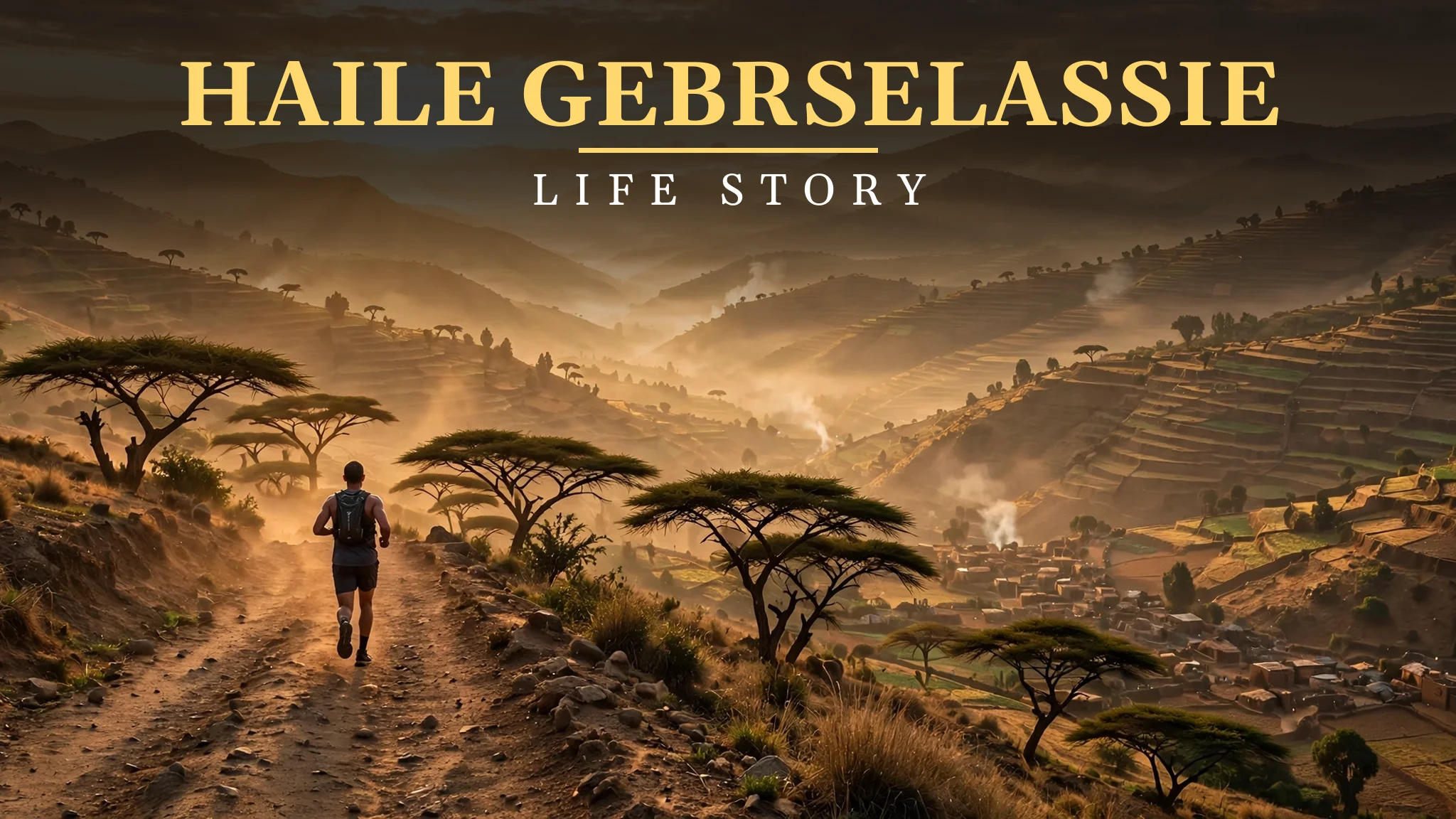
In this post
- Running to School in Asella With Books Under His Arm
- Four World Titles and the Gold in Atlanta
- Sydney 2000: Beating Tergat by Nine Hundredths
- Passing the Crown to Bekele and Moving to the Roads
- Twenty-Seven World Records and a Life of Giving
- The Dubai Marathons and the Long Goodbye
- The Smile, the Books, and the Man From Asella
- My Take:
Haile Gebrselassie is one of the greatest distance runners who has ever lived, and he is also one of the most loved. He won the Olympic gold medal in the 10,000 metres twice, in Atlanta in 1996 and in Sydney in 2000, and he won the world title in the same event four times. He set twenty-seven world records in his career, which is a number that few athletes in any sport have ever matched. He broke the world record in the marathon twice, and he was the first man ever to run a marathon in less than two hours and four minutes. He did all of this with a smile on his face, and that smile became his trademark. He smiled when he won, he smiled when he lost, and he smiled when he ran, because he loved to run. That is the story of Haile Gebrselassie: a boy who ran ten kilometres to school carrying his books, and who became a legend with a smile.
He grew up in Asella, a town in the highlands of Ethiopia, in a family with ten children. He ran to school every day, because there was no bus, and he ran home again in the afternoon, because that was the fastest way to get there. He carried his school books under his arm, and he ran with his left arm bent, holding the books close to his body. That bent left arm became part of his running style for his whole career, and people who watched him run could see it: his left arm stayed bent, as if he were still carrying his books. It was a reminder of where he came from, and it was a sign that his running had grown out of his daily life, not out of a training programme. He did not learn to run in a stadium. He learned to run on the dirt roads of Ethiopia, on his way to school.
He is also a businessman, a leader, and a man who has given back to his country in ways that go far beyond running. He founded the Great Ethiopian Run, which is now the biggest mass running event in Africa, with tens of thousands of people taking part every year. He has built hotels, cinemas, and businesses in Addis Ababa, and he has created jobs for many people. He was the president of the Ethiopian Athletics Federation, and he has worked to help young runners in his country. He is a man who used his fame and his money to build something that lasts, and that is a rare thing. His story is not only about running fast. It is about a boy from Asella who became a king, and who used his kingdom to help others.
Running to School in Asella With Books Under His Arm
Haile Gebrselassie was born on 18 April 1973 in Asella, a town in the Arsi region of Ethiopia, in the highlands where the air is thin and the hills are steep. He was one of ten children, and his family lived a simple life, growing food and keeping animals. He went to school in a village ten kilometres away, and he ran there and back every day, because there was no other way to get there. He carried his school books under his left arm, and he ran with his arm bent, holding the books close. That bent arm stayed with him for his whole career, and it became one of the most famous details in the history of running. When people saw him run, they saw the boy from Asella, still carrying his books, still running to school.
As a child, he was small, cheerful, and full of energy. He helped his family on the farm, he fetched water, and he did his schoolwork with care. He was not the loudest child in the village, but he was the fastest, and the other children knew it. He ran in school races, and he won them. He ran to fetch things for his mother, and he came back quickly. Running was not a sport for him at first. It was a way of life, a way of getting from one place to another, and a way of helping his family. That simple beginning stayed with him, because he never forgot that running was something he did for a reason, not something he did for applause. He loved to run, and he ran with a smile, and that smile never left him.
When he was a teenager, he began to take running more seriously. He joined a training group, and he met coaches who saw his talent. He was small, but he was strong, and he had a natural endurance that came from growing up in the highlands, where the air is thin and the hills are steep. He began to win races at regional level, and then at national level, and coaches began to talk about him as a future star. He was not rushed, and he was not pushed too hard. He was allowed to grow, and he grew into one of the great runners of his generation. He was a boy from Asella, and he was on his way to the world.
The highlands of Ethiopia have produced many great runners, and Haile is one of the finest of them all. He trains in the same region where he grew up, and he has never forgotten his village. He has spoken about how his childhood shaped him, and about how the simple life of a farming family taught him to work hard and to be patient. He is a quiet, humble person, and he does not seek attention. He lets his running speak for him, and his running has spoken very loudly indeed. He is a man who has never forgotten where he came from, and that is one of the reasons he is so loved in Ethiopia and around the world.
Four World Titles and the Gold in Atlanta
Haile’s first great moment came in 1992, when he won the gold medal in both the 5,000 metres and the 10,000 metres at the World Junior Championships in Seoul. He was nineteen years old, and he was already the best young distance runner in the world. The next year, in 1993, he won his first senior world title in the 10,000 metres at the World Championships in Stuttgart. He was twenty years old, and he was now the world champion. It was the first of four world titles in the 10,000 metres, and it announced a new star to the world. He had a smooth stride, a calm mind, and a finishing kick that left his rivals behind. He was not only fast. He was smart, and he knew how to win.
He won the world title again in 1995 in Gothenburg, in 1997 in Athens, and in 1999 in Seville. Four world titles in the 10,000 metres, won over six years, is an achievement that few athletes in history have matched. He also set world records, including the world record in the 10,000 metres in 1995, and the world record in the 5,000 metres in 1998. He was the best distance runner in the world, and he was getting better with every year. He ran with a smile, and he celebrated his wins with joy, and the crowds loved him for it. He was not a serious, unsmiling champion. He was a happy one, and his happiness made people happy too.
The Olympic Games in Atlanta in 1996 brought him his first Olympic gold medal. He won the 10,000 metres in a brilliant race, beating the Kenyan Paul Tergat in a close finish. It was his first Olympic gold, and it was won against one of the greatest distance runners of the era. He celebrated with a smile, and the world began to learn his name. He was twenty-three years old, and he was an Olympic champion. It was the fulfilment of a dream that had begun on the dirt roads of Asella, when he was a boy running to school with his books under his arm. He had come a long way, and he had done it with a smile.
Sydney 2000: Beating Tergat by Nine Hundredths
The Olympic Games in Sydney in 2000 brought Haile his greatest race, and one of the greatest races in the history of the Olympic Games. He was defending his title in the 10,000 metres, and his great rival, Paul Tergat of Kenya, was determined to beat him. The two men ran the final laps side by side, pushing each other to the limit, and the crowd in Sydney roared with every stride. In the final metres, Haile pulled ahead, and he won the gold medal by nine hundredths of a second. It was one of the closest finishes in Olympic history, and it was a victory that showed his heart as much as his legs. He had won his second Olympic gold medal, and he had done it in the most dramatic way possible.
The race in Sydney is remembered for the duel between Haile and Tergat, and for the respect between the two men. They were rivals, but they were also friends, and they admired each other. Tergat was a great runner, and he pushed Haile to be better. Haile was a great runner, and he pushed Tergat to be better. Their rivalry made both men faster, and it made the sport better too. After the race, they embraced, and the crowd applauded both of them. It was a moment of sportsmanship that the Olympic Games are made for, and it is one of the reasons the race is still talked about today.
Sydney was the peak of Haile’s track career, and it was a peak that few athletes ever reach. He had won two Olympic gold medals, four world titles, and many world records, and he had done it all with a smile. He was twenty-seven years old, and he was the greatest distance runner in the world. But the sport was changing, and a new generation was coming. A young Ethiopian named Kenenisa Bekele was rising, and he would soon take Haile’s place at the top. Haile knew it, and he accepted it with grace. He had been the king, and he was ready to pass the crown to the next man, while he moved on to a new challenge: the marathon.
Passing the Crown to Bekele and Moving to the Roads
The Olympic Games in Athens in 2004 marked the end of Haile’s reign on the track. He finished fifth in the 10,000 metres, and the gold medal went to his young compatriot, Kenenisa Bekele. It was a passing of the torch, and Haile handled it with grace. He congratulated Bekele, and he accepted that his time on the track was over. He was thirty-one years old, and he had been at the top for more than a decade. He had won everything there was to win on the track, and he was ready for a new challenge. He decided to move to the marathon, the longest race in athletics, and to start again. It was a brave decision, and it showed that he was not afraid to be a beginner again, even after he had become a legend.
The marathon suited him. He had the endurance, the patience, and the calm mind that the marathon demands, and he began to win races on the roads. He won in Amsterdam, in Berlin, and in Dubai, and he became one of the best marathon runners in the world. He ran with the same smile, and with the same smooth stride, and he finished strongly in every race. The marathon is a race that punishes anyone who starts too fast, and Haile never started too fast. He ran with patience, he waited for the right moment, and he struck when it mattered. It was the same tactic he had used on the track, and it worked on the roads too.
In 2007, at the Berlin Marathon, he broke the world record, running 2 hours, 4 minutes, and 26 seconds. It was the first time the marathon world record had been broken in Berlin in many years, and it was a performance that left experts amazed. A year later, in 2008, he broke it again in Berlin, running 2:03:59. He became the first man ever to run a marathon in less than two hours and four minutes, and he did it with a smile. The two world records in Berlin were the crowning achievement of his marathon career, and they showed that he was not only a great track runner. He was a great marathon runner too, and he was one of the few athletes in history who had been the best in the world over two very different distances.
Twenty-Seven World Records and a Life of Giving
Haile set twenty-seven world records in his career, which is a number that few athletes in any sport have ever matched. He set records in the 5,000 metres, the 10,000 metres, and the marathon, as well as in indoor events and in other distances. He broke records on the track, on the roads, and indoors, and he did it over a period of more than fifteen years. It is a record of consistency and of greatness that is hard to understand. Most athletes set one or two world records in their careers, if they are lucky. Haile set twenty-seven, and he did it with a smile. He was not chasing records for fame or for money. He was chasing them because he loved to run, and because he believed he could always go faster.
He retired from competitive running in 2015, after a career that had lasted more than twenty years. He was forty-two years old, and he had run at the top for longer than most athletes ever manage. He left the sport as a legend, with two Olympic gold medals, four world titles, and twenty-seven world records. He had nothing left to prove, and he had everything to be proud of. But he did not retire to rest. He retired to work, and to build, and to give back to his country in ways that went far beyond running.
He founded the Great Ethiopian Run in 2001, which is now the biggest mass running event in Africa, with tens of thousands of people taking part every year. He has built hotels, cinemas, and businesses in Addis Ababa, and he has created jobs for many people. He was the president of the Ethiopian Athletics Federation from 2016 to 2018, and he worked to help young runners in his country. He has also supported schools, health projects, and community programmes, and he has used his fame and his money to make Ethiopia a better place. He is a man who has never forgotten where he came from, and who has used his success to lift others up. That is a legacy that goes far beyond sport, and it is one that will last for generations.
The Dubai Marathons and the Long Goodbye
Haile’s marathon career was not only about Berlin. He also won the Dubai Marathon three times, in 2008, 2009, and 2010, and he became a familiar and beloved figure in the city. Dubai offered large prizes for fast times, and Haile gave the crowds what they came for: brave running, fast finishes, and his trademark smile. He won in Amsterdam in 2005 as well, and he ran in marathons all over the world, from London to New York, bringing his joy and his class to every race he entered. He was not only a champion. He was an ambassador for his sport, and he carried himself with a dignity that made people love him wherever he went.
The marathon years also showed his generosity. He ran with younger athletes, he encouraged them, and he shared what he knew. He did not treat the marathon as a place to defend his position. He treated it as a place to enjoy running, and to show the world that an older athlete could still compete. He was in his late thirties, and he was still winning marathons, and he was still smiling. That is a rare thing, and it is one of the reasons his marathon career is remembered so fondly. He did not win because he was the youngest or the strongest. He won because he was the wisest, and because he loved to run.
He announced his retirement from competitive running in May 2015, after a career that had lasted more than twenty years. He was forty-two years old, and he had run at the top for longer than most athletes ever manage. He left the sport as a legend, with two Olympic gold medals, four world titles, and twenty-seven world records. He had nothing left to prove, and he had everything to be proud of. But he did not retire to rest. He retired to work, and to build, and to give back to his country in ways that went far beyond running. The goodbye was not an ending. It was a beginning, and it was the start of a new chapter in a life that had already been extraordinary.
The Smile, the Books, and the Man From Asella
Haile Gebrselassie is remembered for many things: the Olympic gold medals, the world titles, the twenty-seven world records, and the marathon world records in Berlin. But he is also remembered for his smile, and for the bent left arm that carried his school books to Asella. Those two details tell the story of his life better than any number. The smile shows that he loved to run, and that he was grateful for the chance to do it. The bent arm shows where he came from, and how his running grew out of his daily life. He did not learn to run in a stadium. He learned to run on the dirt roads of Ethiopia, on his way to school, and he never forgot it.
He is still active in Ethiopian sport and business, and he remains one of the most respected figures in his country. He is a hero in Ethiopia, and he is loved around the world for his humility, his kindness, and his joy. He is a man who has achieved everything in sport, and who has used his success to help others. He is a legend, and he is a gentleman, and those two things do not always go together. In Haile, they do, and that is why his story will be told for a long time. He ran fast, he smiled, and he gave back. That is a life worth remembering.
My Take:
When I think about Haile Gebrselassie, the first thing that comes to my mind is his bent left arm. I picture a small boy in Ethiopia, running ten kilometres to school with his books under his arm, and I picture the same man, years later, running in the Olympic Games with his left arm still bent in the same way. That image stays with me, because it tells the whole story in a single detail. He did not learn to run in a stadium. He learned to run on the dirt roads of Asella, on his way to school, and he carried that beginning with him for his whole career. I think about how many great athletes have a story like that, a small detail from childhood that never leaves them, and I think it is a reminder that where we start shapes who we become. Haile started on a dirt road with books under his arm, and he became a legend. That is a beautiful story, and it is one that gives hope to every child who walks a long way to school.
I also think about his smile, and how rare it is in top-level sport. He smiled when he won, he smiled when he lost, and he smiled when he ran. Most athletes look serious and stressed, even when they win, because the pressure is so great. Haile looked happy, and his happiness made other people happy. I think that is because he truly loved to run, and he never forgot why he started. He started because running was a way of life, and because it made him feel alive. He did not start for money or for fame, and he never let money or fame take away his joy. I think that is a lesson for anyone who does something they love: do not let success ruin it. Keep the joy, keep the smile, and remember why you started. Haile did, and it made him great.
The race in Sydney in 2000, when he beat Paul Tergat by nine hundredths of a second, is one of the great moments in Olympic history, and I think about it often. Two men, running side by side for ten thousand metres, pushing each other to the limit, and the race decided by less than a tenth of a second. It is a perfect image of what sport should be: two great athletes, giving everything, and respecting each other. After the race, they embraced, and the crowd applauded both of them. I think about that embrace, and about what it means. It means that rivalry does not have to be hatred. It can be respect, and it can make both athletes better. Haile and Tergat made each other better, and the sport was better because of them. I wish more rivalries were like that, because the world would be a better place if competitors respected each other the way those two men did.
I think about his twenty-seven world records, and I try to understand what that number means. Most athletes set one or two world records in their careers, if they are lucky. Haile set twenty-seven. That is not a lucky run. That is a lifetime of greatness, spread over more than fifteen years, in many different events, on the track, on the roads, and indoors. It is a number that shows his range, his consistency, and his love for running. He did not set records in one event and then stop. He kept finding new distances, new challenges, and new ways to be the best. I think that is a lesson about not being afraid to try new things. He was a track runner, and he became a marathon runner. He was a 10,000 metres runner, and he became a record-breaker in many events. He did not stay in one place. He kept moving, kept learning, and kept breaking records. That is a life worth studying.
His decision to move to the marathon at thirty-one is another part of his story that I admire. He had won everything on the track, and he could have retired with his medals and his glory. Instead, he started again, in a new event, and he became the best in the world once more. He broke the world record in Berlin twice, and he became the first man to run a marathon in less than two hours and four minutes. I think that takes a special kind of courage, because it is easy to stay where you are comfortable, and it is hard to be a beginner again. Haile was not afraid to be a beginner, and he was not afraid to fail. He tried, he succeeded, and he proved that it is never too late to start again. That is a lesson for anyone who feels that their best years are behind them. They may not be. Haile’s best years in the marathon came after his best years on the track, and that is a reminder that life has more than one chapter.
I also think about the way he passed the crown to Kenenisa Bekele, and how gracefully he did it. In Athens in 2004, Bekele won the gold medal in the 10,000 metres, and Haile finished fifth. It was the end of Haile’s reign, and the start of Bekele’s. Haile did not complain, and he did not make excuses. He congratulated Bekele, and he accepted that his time had come. I think that is a hard thing to do, because it is painful to watch someone else take your place. But Haile did it with grace, and he did it because he understood that sport is bigger than any one person. The crown passes from one champion to the next, and the sport goes on. He understood that, and he accepted it. That is a mature response, and it is one that I admire more than any medal.
The Great Ethiopian Run is another part of his legacy that I think about often. He founded it in 2001, and it is now the biggest mass running event in Africa, with tens of thousands of people taking part every year. It is not a race for elite athletes. It is a race for everyone: for children, for families, for old people, and for anyone who wants to run. I think that is a beautiful thing, because it shows that Haile understands what running is for. It is not only for champions. It is for everyone, and it brings people together. He has given the people of Ethiopia a race to be proud of, and he has given them a reason to run. That is a gift that will last long after his medals are forgotten, because it belongs to the people, not to him.
I think about his businesses, his hotels, and his cinemas in Addis Ababa, and about how he has used his money to create jobs and to build his country. He did not spend his money on luxury for himself. He invested it in Ethiopia, in businesses that employ people and that make life better for others. I think that is the right way to use wealth, and I think it is rare. Many rich athletes spend their money on cars, houses, and parties. Haile spent his on hotels, cinemas, and jobs. That is a different kind of wealth, and it is a better kind. He is a businessman as well as a runner, and he has built something that will last. I respect that, and I think more successful people should learn from him.
I also think about what his story means for Ethiopia, and for Africa. He comes from a small town in the highlands, and he became one of the most famous athletes in the world. He has shown young people in Ethiopia that they can dream big, and that they can achieve great things. He has also shown the world that the greatest runners do not only come from rich countries. They come from villages, from farming families, and from simple lives. That is a powerful message, and it is one that gives hope to millions of children who grow up with very little. Haile is proof that where you start does not decide where you finish, and that a boy who runs to school can become a legend.
I wonder what his daily life is like now, and I think it must be busy. He runs businesses, he works with young athletes, and he supports community projects. He is no longer running at the top, but he is still running, and he is still smiling. I think that is a good way to live after sport: to use what you have learned, to help others, and to keep doing what you love. He has not disappeared, and he has not become bitter. He has stayed active, stayed generous, and stayed joyful. That is a model for every athlete who retires, because retirement can be a hard time. Haile has made it a good time, by giving back and by building.
When I look at his whole career, I see a man who was given a gift and used it with wisdom and with joy. He was born in Asella, he ran to school with books under his arm, and he became the greatest distance runner of his generation. He won two Olympic gold medals, four world titles, and twenty-seven world records. He broke the marathon world record twice, and he founded the biggest running event in Africa. He built businesses, he created jobs, and he helped his country. That is a life worth studying, and it is a life that will inspire people for a long time. He did not only run fast. He ran with meaning, and he showed the world what a boy from Asella can do.
I also think about the Dubai Marathon, and about what it meant to win there three times. Dubai is a city of luxury and wealth, and Haile won there as a man from a small town in Ethiopia, with a smile and a bent left arm. I think that is a beautiful image, because it shows that greatness does not belong to the rich. It belongs to anyone who works hard, and Haile worked harder than anyone. He won in Dubai, he won in Berlin, and he won in Amsterdam, and he did it all with the same joy. He did not change when he became famous. He stayed the same boy from Asella, and that is why people loved him.
I think about his retirement in 2015, and about how he handled it. He was forty-two, and he had run for more than twenty years. He announced his retirement, and he moved on to business, to leadership, and to giving back. He did not cling to the past, and he did not try to keep running when his body told him to stop. He listened, and he moved on, and he built a new life. I think that is a wise way to end a career. Too many athletes hold on for too long, and they end up sad and broken. Haile ended his career with dignity, and he started a new one with purpose. That is a lesson for anyone who has to let go of something they love: let go with grace, and find something new to love.
There is one more thing I want to say about him, and it is about his faith. He is a man of faith, and he has spoken about how his beliefs guide his life. He is humble, he is kind, and he is grateful for what he has been given. I think that faith is part of his strength, because it reminds him that he is not the centre of the world, and that his gifts are meant to be shared. He shares them, through his businesses, through his foundation, and through the Great Ethiopian Run. He is a man who understands that success is not a prize to keep. It is a gift to share, and he shares it generously.
I also think about the children who run the Great Ethiopian Run every year, and about what it means to them. They run in Addis Ababa, in a race that Haile founded, and they dream of being like him. Some of them will become champions, and most of them will not, but all of them will have run, and they will have felt the joy of it. That is a gift, and it is one that Haile has given to tens of thousands of people. He did not only run fast. He gave other people a reason to run, and that is a legacy that will last long after his records are broken.
In the end, I think Haile Gebrselassie will be remembered as one of the greatest distance runners who ever lived, and as the man with the smile and the bent left arm. He will also be remembered as the man who built the Great Ethiopian Run, who created jobs in Addis Ababa, and who gave back to his country. Those are the parts of his story that will last, because medals fade and records fall, but a life lived with joy, generosity, and hard work does not fade. He lived it, he ran it, and he smiled through it all. That is a legacy worth remembering, and it is one that I will carry with me.
Frequently Asked Questions
Why did Haile Gebrselassie run with a bent left arm?
As a boy in Asella, Ethiopia, Gebrselassie ran ten kilometres to school every day carrying his school books under his left arm. He ran with his arm bent to hold the books close to his body, and the bent arm stayed part of his running style for his whole career.
How many Olympic gold medals did Haile Gebrselassie win?
Gebrselassie won two Olympic gold medals in the 10,000 metres, at the Atlanta Games in 1996 and the Sydney Games in 2000. In Sydney he beat his great rival Paul Tergat of Kenya by nine hundredths of a second in one of the closest finishes in Olympic history.
How many world records did Haile Gebrselassie set?
Gebrselassie set twenty-seven world records in his career, in events ranging from the 5,000 metres and the 10,000 metres to the marathon, as well as indoor events. He broke the marathon world record twice in Berlin, in 2007 and 2008, becoming the first man to run a marathon in under two hours and four minutes.
What is the Great Ethiopian Run?
The Great Ethiopian Run is a mass running event that Gebrselassie founded in 2001. It is now the biggest mass running event in Africa, with tens of thousands of people taking part every year in Addis Ababa, and it is open to runners of all ages and abilities.
When did Haile Gebrselassie retire?
Gebrselassie retired from competitive running in 2015, after a career that had lasted more than twenty years. He was forty-two years old, and he left the sport as a legend, with two Olympic gold medals, four world titles in the 10,000 metres, and twenty-seven world records.
What did Haile Gebrselassie do after running?
After retiring, Gebrselassie focused on business and on helping his country. He has built hotels, cinemas, and other businesses in Addis Ababa, creating jobs for many people, and he served as president of the Ethiopian Athletics Federation from 2016 to 2018. He also continues to support the Great Ethiopian Run and young runners in Ethiopia.


