Hakim: The Life Story Behind Egypt's Shaabi Star
In this post
If you have ever been to a wedding in Egypt, you have heard Hakim. If you have ever ridden in a taxi in Cairo late at night, with the driver tapping the wheel and singing along, you have heard Hakim. If you have ever been in a street party, with lights strung across the road and neighbours dancing in front of their doors, you have heard Hakim. He is the singer of the street, the singer of the people, the voice that belongs to ordinary Egyptians in their happiest moments. His music is called shaabi, which means the music of the people, and no singer has carried that name further than Hakim.
He was not born in Cairo. He was born in a small town in the south, in Minya, and he grew up far from the studios and the stages of the capital. He learned to sing the way people in his town learned to sing, at weddings, at family gatherings, and in the streets where music is part of daily life. When he came to Cairo, he did not bring a polished pop sound. He brought the sound of his town, loud, joyful, and full of life, and he made the whole country dance to it. That is his story, and it is a story about how the music of a small town can become the music of a nation.
What makes Hakim worth writing about is not only his songs. It is the way he changed what Egyptian pop could be. Before him, shaabi music was often looked down on by people who loved classical song. It was seen as rough, as music for the street rather than for the concert hall. Hakim took that street music, gave it a big sound, a strong beat, and a singer’s voice that could fill a stadium, and he made it impossible to ignore. He took shaabi from the alley to the arena, and he did it without losing the joy that made it shaabi in the first place.
A Boy From Maghagha Who Sang at Weddings
Hakim was born Abdel Hakim Abdel Samad Kamel on 7 October 1962 in Maghagha, a town in the Minya governorate of Upper Egypt. Minya is a place of fields, of the Nile, and of old towns where life moves at its own pace, and where music is not a luxury but a part of every celebration. A child growing up in Maghagha in the 1960s and 1970s heard music at weddings, at religious festivals, and in the homes of neighbours, and he learned it by listening, by joining in, and by trying to copy the singers he admired. Hakim learned that way, and the wedding was his first school.
In a small town, a wedding is not a small event. It is a whole neighbourhood coming together, with food, with dancing, and with a band that plays late into the night. The singer at a wedding must do a hard job. He must keep people dancing, he must know the songs they love, and he must read the crowd, knowing when to sing a slow song and when to lift the beat. Hakim learned that job young, and he learned it well. A wedding singer who cannot hold a crowd does not get asked back. Hakim was asked back, again and again, and his name began to be known in his town and in the towns around it.
His family was ordinary, and his early life was ordinary too, in the way that life in a small Egyptian town is ordinary. He went to school, he helped at home, and he dreamed of a bigger stage. Many young men in Minya dreamed of Cairo, the great city to the north, where the studios are, where the stars are made, and where a singer can become famous. Hakim dreamed that dream, and he held it close while he sang at weddings and learned his craft. He did not have money or contacts. He had a voice, a strong one, and a knowledge of the songs his people loved.
The music he loved was shaabi, the music of the people, with its simple words, its strong rhythms, and its feeling of joy. Shaabi songs talk about love, about daily life, about the hopes of ordinary people, and they do it in plain words that everyone understands. A shaabi singer does not sing like a classical singer. He sings like a friend, like a neighbour, like a man who knows the life of the street. Hakim sang like that from the start, and that closeness to his listeners became the heart of his career.
The Long Road to Cairo
When Hakim was old enough, he made the move that so many young Egyptians make. He went to Cairo, to try his luck in the city where music is made. Cairo is a hard city for a newcomer. It is big, it is loud, and it is full of singers who want the same thing. A young man from Minya, with no money and no famous name, must work hard to be heard. Hakim worked hard. He sang where he could, he met musicians, he learned how the business worked, and he kept his dream alive through the years when success seemed far away.
Those early Cairo years were a test of patience. A singer can wait for years before a record company listens, and many singers give up and go home. Hakim did not give up. He kept singing, kept performing, and kept building a small name, first in the circles of shaabi music, then in wider circles. He learned the Cairo sound, but he did not lose the Minya sound. He carried both, and that double sound, part street and part city, became his signature. A listener in Cairo heard something familiar and something new at the same time, and that combination drew people in.
He also learned the hard lessons of the music business. A young singer can be promised much and given little. Contracts can be unfair, and money can disappear. Hakim learned to be careful, to work with people he trusted, and to keep his focus on the music. That focus saved him. When the business was hard, the music was still there, and the audience was still there, waiting for a singer who sang their songs with honesty.
By the late 1980s, Hakim was ready. He had the voice, he had the experience, and he had a clear idea of the kind of singer he wanted to be. He wanted to be a shaabi singer, not a copy of a pop star, and he wanted to take shaabi music to a bigger stage than it had ever had. The chance to do that was coming, and when it came, he was ready to take it with both hands.
Nazra and the Breakthrough
Hakim’s breakthrough came with his first album, Nazra, released in the early 1990s. The title means a look, or a glance, and the album gave Egyptian listeners a new sound to love. It had the strong beat of shaabi, the simple words of the street, and a voice that was powerful and warm. The songs were played on the radio, in taxis, and at weddings, and people began to ask who this singer was. The answer was a man from Maghagha, and the country took him to its heart.
A first album is a test, and Nazra passed it. It showed that shaabi music, sung with a big voice and a modern sound, could sell, could fill the radio, and could compete with pop. Hakim had proved something that many people in the music business had doubted. The music of the people could be the music of the whole country, and it did not need to apologise for being rough or simple. It needed only to be sung well, with energy and with love, and Hakim sang it that way.
After Nazra, work came faster. He recorded more albums, he performed more, and his name grew. Each new record added to his standing, and each new song gave his fans something to dance to. He was not a singer who made one hit and then disappeared. He made hit after hit, and he built a catalogue of songs that Egyptians know by heart. A wedding without a Hakim song is hard to imagine, and that is a measure of how deeply his music entered Egyptian life.
He also began to perform live in bigger places. A shaabi singer who had started at small weddings was now singing in large halls, in festivals, and in concerts that drew thousands of people. The move from a wedding in a small town to a concert in a big hall is a great one, and Hakim made it without losing the feeling of the wedding. His concerts still feel like a party, like a street celebration, and that feeling is why his audiences love him. He does not stand far from his people. He sings with them, and they sing with him.
Ah Ya Albi and the Songs of the Street
Among Hakim’s many songs, Ah Ya Albi is one of the best known, a song whose title speaks to the heart, and whose music has the strong, joyful beat that defines his style. When it plays, people move. They clap, they dance, and they sing the words, because the words are plain and the feeling is true. That is the secret of a great shaabi song. It does not need clever poetry. It needs a feeling that everyone knows, and a beat that everyone can follow. Hakim has that secret, and he has used it again and again.
His songs talk about love in the way ordinary people talk about love. They talk about longing, about joy, about the pain of separation, and about the hope of being together, and they do it in words that a taxi driver, a shopkeeper, and a student can all understand. That plainness is not a weakness. It is a strength. A song that only a few people understand will be loved by a few. A song that everyone understands can be loved by a nation, and Hakim’s songs are loved by a nation.
He also sang songs that became part of the sound of Egyptian life in the 1990s and beyond. His music played in the streets, in the markets, and in the homes of people who did not follow pop music closely. A mother cooking in her kitchen, a worker on a building site, a young man driving a microbus, all of them knew his songs. That wide reach is rare, and it is why Hakim matters. He is not a singer for one group. He is a singer for Egypt itself.
His voice is part of that reach. It is strong, it is warm, and it carries over a crowd. A shaabi singer must be heard above the drums, above the clapping, and above the noise of a celebration, and Hakim’s voice can do that. It does not fade. It holds, note after note, song after song, and that holding power is what makes a live performance feel alive. When he sings, the room feels his voice, and the room answers it.
From Egypt to the World Stage
Hakim’s fame did not stay inside Egypt. His music travelled with Egyptians who lived abroad, and it travelled to audiences who had never been to Egypt but who loved the energy of his songs. He performed in the United States and in other countries, and he sang for crowds who did not speak Arabic but who understood the beat, the joy, and the warmth of his performance. A singer who can make a crowd dance in a language they do not speak has a gift that goes beyond words. Hakim has that gift, and he used it to carry shaabi music to the world.
One of the moments that showed his wider reach was his work with Western musicians and his performances at international events. He was not trying to become a Western pop star. He was showing the world what Egyptian street music sounds like, and he was proud of it. That pride matters. A singer who is proud of his own music does not need to copy another country’s sound. He can offer his own sound, and the world can learn to love it. Hakim offered shaabi to the world, and the world listened.
He also became a familiar face on Egyptian television and at national celebrations. When Egypt needed a singer for a big event, for a festival, or for a celebration of its culture, Hakim was often the choice. His music fits those moments, because it is music for the people, and a national celebration is a moment for the people. He sang, the crowd sang with him, and the event felt like a family gathering, only bigger.
Through the 2000s, he kept recording and kept performing, and his name stayed strong. New styles came and went, new singers arrived, and the music business changed, but Hakim’s audience stayed. They stayed because his music was not a fashion. It was a part of their lives, a part of their weddings, their parties, and their daily joy. A fashion fades. A part of life stays, and Hakim’s music stays.
The Hard Years and the Will to Carry On
A career as long as Hakim’s is never free of hard times. The music business in Egypt has gone through difficult years, with piracy, falling sales, and the rise of new sounds that do not always leave room for an older singer. Hakim faced those years, and he faced them by doing what he had always done. He sang, he performed, and he trusted his audience. He did not chase every new trend, and he did not try to become a different singer. He stayed himself, and his audience stayed with him.
There were also personal hard times, as there are in every long life. A singer who travels, who performs late at night, and who lives in the public eye pays a price in rest, in privacy, and in time with family. Hakim has kept much of his private life out of the press, and that privacy is a choice that deserves respect. What the public sees is the singer on stage, full of energy and joy. What it does not see is the work behind that joy, the travel, the rehearsals, and the long nights. That work is real, and it is the price of a long career.
He has also faced the challenge of staying fresh. A singer with many hits can become a singer who only sings old songs, and an audience can grow tired of hearing the same set, year after year. Hakim has met that challenge by keeping his concerts alive, by changing his set, and by singing with the same energy he had when he was young. Energy is not a thing that fades with age if the singer still loves the music. Hakim still loves it, and his audience can feel that love.
The passing of time has also taken friends and fellow musicians, and the Cairo of his early years has changed. The streets, the studios, and the music itself have all moved on. Hakim has moved with them, without losing the sound that made him famous. That is a hard balance to hold, and he has held it for more than thirty years. A singer who can hold it deserves to be called a king, and Hakim is called a king of shaabi for that reason.
What the Shaabi King Means Today
Today, Hakim stands as the great name of shaabi music, the singer who took the music of the street and made it the music of the nation. When young shaabi singers begin their careers, they look to him. When Egyptians want a song for a wedding, they play him. When people abroad want to hear the sound of Egypt, they hear him. His place is secure, not because he had one hit, but because he built a whole world of songs that belong to the people.
His legacy is also a lesson about respect. Shaabi music was once looked down on, and the people who loved it were sometimes looked down on too. Hakim gave that music dignity, and he gave its listeners dignity, by singing it with pride, with skill, and with joy. He showed that the music of ordinary people is not less than the music of the concert hall. It is different, and it is equal, and it deserves to be loved. That lesson will last longer than any single song.
He is still singing, still performing, and still filling halls with the sound of the street. His story is not finished, and his voice, strong and warm, continues to carry the joy of Egypt to everyone who hears it. The boy from Maghagha who sang at weddings became the king of shaabi, and the kingdom he rules is the hearts of ordinary Egyptians. When a new shaabi singer starts out today, he still listens to Hakim’s records to learn how a song should move, how a crowd should be held, and how a simple word can become a whole celebration, and that teaching, passed from one singer to the next, is a living legacy that no chart can measure. His songs also travel in a way that few Egyptian songs do, because a beat that makes people dance needs no translation. A listener in a far country, hearing his drums for the first time, feels the same lift that a listener in Minya feels, and that shared lift is the true power of shaabi. It is music that crosses borders without losing its home, and Hakim is the singer who proved that it could. His concerts abroad, his records played in homes far from Egypt, and his songs sung by Egyptians living in other lands all show the same truth. A song that belongs to the people belongs to the world as well, when it is sung with honesty and with joy. His voice, strong and warm, has carried the sound of an Egyptian wedding to places where no wedding was taking place, and it has made strangers feel, for a few minutes, that they were part of one. That is a rare power, and it is one that Hakim has used with pride, never hiding where he came from, and never forgetting the small town where he first learned to sing.
His nights in Cairo are the heart of his career, because a shaabi singer is judged by the wedding, by the street, and by the crowd that dances until dawn. Hakim has played thousands of such nights, in Cairo, in Minya, and across Egypt, and each one has taught him something new about his audience, about what makes them move, and about what makes them sing along. A singer who learns from every wedding is a singer who never stops growing, and Hakim has never stopped growing, even after thirty years on stage.
My Take:
When I think about Hakim, I smile before I think anything else. That is the effect of his music. It is not music for sitting quietly and thinking. It is music for standing up, for clapping, for dancing, and for feeling happy for a few minutes in a world that is often hard. I think that kind of music is undervalued, and I think Hakim is undervalued too, because people who love serious music sometimes forget that joy is serious as well. A song that makes a tired worker dance, that makes a wedding feel like a celebration, that makes a whole street sing together, has done real work in the world, and Hakim has done that work for more than thirty years.
What I admire most about him is that he never pretended to be something he was not. He came from Maghagha, he sang shaabi, and he stayed shaabi. He did not try to become a classical singer to win respect from people who looked down on street music. He did not try to become a Western pop star to win a different audience. He took the music of his people, he gave it a big sound, and he made the whole country listen. That honesty is rare, and it is powerful. A singer who is honest about his roots gives his listeners permission to be honest about theirs, and that is a gift that goes far beyond music.
I also admire the way he changed the place of shaabi in Egypt. Before Hakim, shaabi was often treated as rough music, as music for the street rather than for the stage. After Hakim, it was impossible to say that, because the street had filled the stadium. He took a sound that was looked down on, and he showed that it could fill a hall, that it could travel abroad, and that it could make people who did not speak Arabic dance. That is not a small achievement. It is a change in how a whole country sees its own culture, and Hakim helped make that change happen, one song at a time.
His voice moves me because it is a working voice. It is not a pretty voice in the polished sense. It is a strong voice, a voice that can be heard above drums and above a crowd, a voice that sounds like a man who has sung at a hundred weddings and who knows how to hold a room. I like that kind of voice, because it feels true. It does not hide behind studio tricks. It stands in front of a crowd and it sings, and the crowd answers. That directness is the heart of shaabi, and Hakim is its best example.
I think about the weddings he sang at when he was young, and about how those weddings taught him everything he needed to know. A wedding singer learns to read a crowd, to know when to lift the beat and when to slow it down, to know which song will make the old people smile and which song will make the young people dance. That knowledge cannot be learned in a school. It can only be learned by singing, night after night, in front of real people who will tell you with their feet whether you are doing well. Hakim learned it, and he carried it to the biggest stages in Egypt, and the biggest stages still feel like a wedding when he sings.
There is a lesson in his life about the people who are often forgotten. The music of the street, the music of taxi drivers, of shopkeepers, of workers, is often ignored by people who think that only classical music matters. Hakim’s career says the opposite. It says that the music of ordinary people matters most, because it is the music that ordinary people live with, dance to, and love. I think that is a lesson for anyone who works in art. Do not look down on the audience. Serve the audience, sing their songs, and they will love you for it. Hakim served his audience, and his audience has loved him for decades.
I also think about his journey from Maghagha to Cairo, and about how hard that journey must have been. A young man from a small town, with no money and no contacts, arriving in a big city full of singers, must have felt small. He did not let that feeling stop him. He worked, he waited, and he kept singing, and in time the city listened. That is a story that many young Egyptians can understand, because many of them have made the same journey, from a village to a city, from a small dream to a bigger one. Hakim’s story tells them that the journey is possible, and that a voice from a small town can become the voice of a nation.
If I am honest, I do not love every song he has made. Some of his songs sound alike, and some of them use the same beat and the same words again and again. That is a weakness in his work, and it is one reason why some people see him as a singer of parties rather than a singer of deep songs. I understand that view, but I do not fully share it. A party singer who can make a whole country dance for thirty years has done something that a deep singer often cannot do. He has given people joy, and joy is not a small thing. I would rather have a singer who gives joy honestly than a singer who pretends to be deep and leaves the listener cold.
I also wish he had taken more risks with his music in some years. He found a sound that worked, and he stayed close to it, and that caution gave him a long career, but it also meant that his music did not change as much as it could have. A singer with his voice and his audience could have tried new sounds, new collaborations, and new kinds of songs, and some of those risks might have given him a second kind of fame. But I respect his choice. He knew what his audience wanted, and he gave it to them, year after year, with energy and with love. That loyalty is a form of respect, and his audience has repaid it with loyalty of their own.
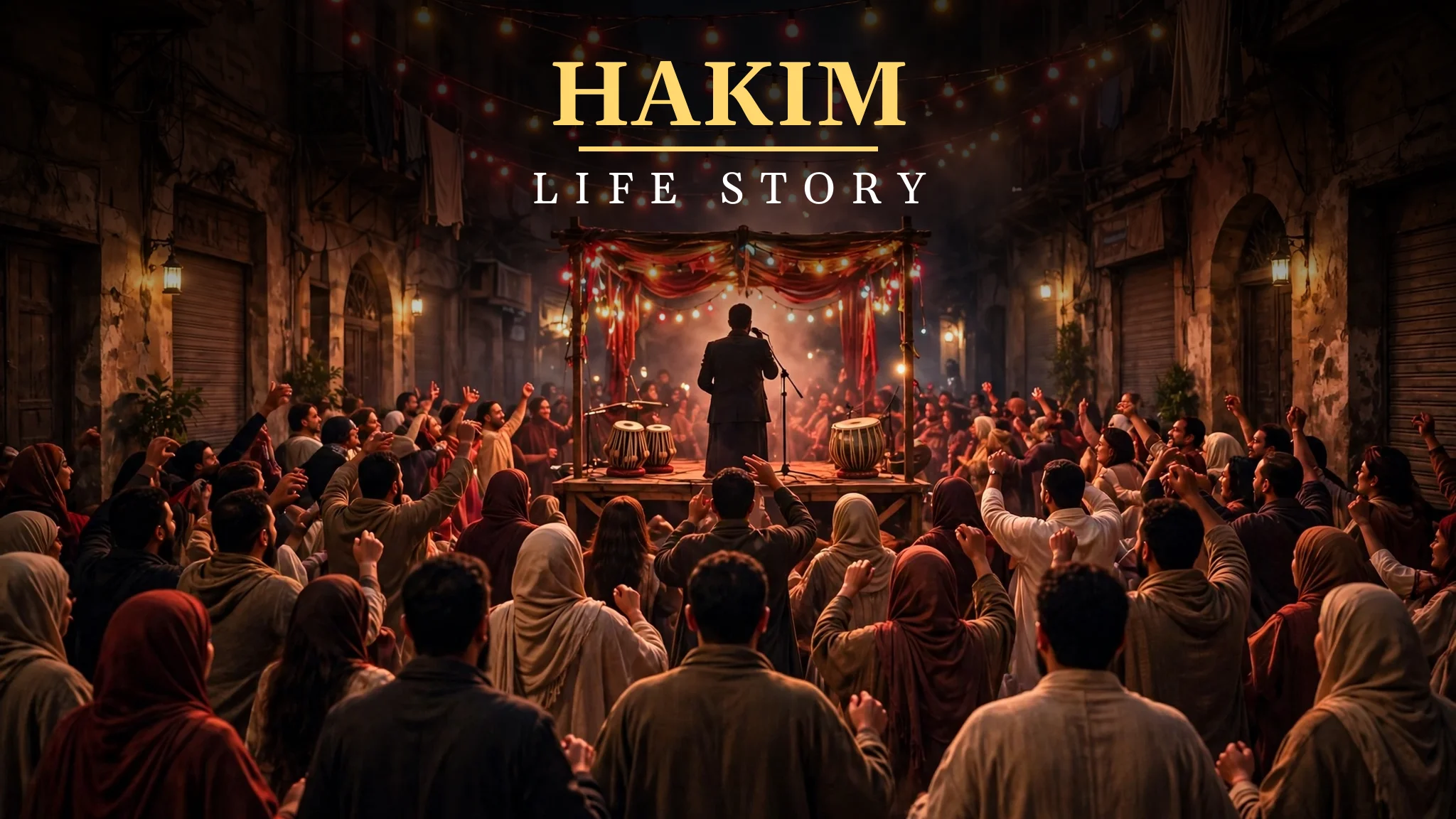
What stays with me is the image of a street at night, with lights strung across the road, with neighbours dancing, and with Hakim’s voice coming from a small stage. That image is Egypt to me, not the Egypt of museums and monuments, but the Egypt of living people, of families, of weddings, and of joy. Hakim’s music belongs to that Egypt, and that Egypt belongs to him. When I hear his name, I think of that street, and I think of the happiness that music can bring to ordinary life.
I also think about his performances abroad, and about what they mean. When Egyptians living far from home hear his voice, they hear home. When people who have never been to Egypt hear his voice, they hear a sound that is new and full of life, and they want to know more. That is how culture travels, not through speeches, but through songs, through a beat, through a voice that makes a stranger want to dance. Hakim has carried Egyptian culture to the world in that way, and he has done it without changing who he is. That is a proud achievement, and it deserves to be remembered.
In the end, I think Hakim’s story is a story about dignity. He gave dignity to shaabi music, dignity to the people who love it, and dignity to the small town he came from. He showed that a singer does not need to be born in Cairo, does not need a classical training, and does not need to pretend to be someone else to become a star. He needs a voice, a love of his people, and the will to keep singing, night after night, year after year. Hakim had all three, and he still has them. That is why he is the king of shaabi, and that is why his songs will still be played at weddings long after he has left the stage.
I will remember him as a singer who made Egypt dance, and who made dancing feel like a serious and beautiful thing. In a world that is often sad, a singer who gives people a reason to dance is doing holy work, even if he does it with drums and a loud beat. Hakim did that work, and he did it with a smile, with energy, and with a love for his people that has never faded. I am grateful for his music, and I think millions of Egyptians are grateful too, every time his song comes on and the whole room begins to move.
There is one more thing I want to say, and it is about the future of shaabi itself. Music changes fast, and young singers now make songs with computers, with new beats, and with sounds from other countries. Some people worry that shaabi will be lost in that change, and that the old sound will fade. I do not worry as much, because Hakim’s career shows that a true sound does not fade. It changes, it grows, and it finds new singers to carry it. The young shaabi singers of today still learn from his records, still sing his songs at weddings, and still feel the beat that he made famous. As long as there are weddings in Egypt, as long as there are streets full of people who want to dance, there will be shaabi, and there will be Hakim’s voice in it. That is a future I am glad to imagine, and it is a future his long career has made possible.
I also think about what it means to be loved by ordinary people. A singer can be loved by critics, by the press, and by the rich, and that love is nice. But a singer who is loved by taxi drivers, by shopkeepers, by mothers cooking in their kitchens, and by young men dancing at a wedding, is loved in a deeper way, because that love is part of daily life. Hakim is loved in that deeper way. His songs are not kept in a museum. They are kept in people’s lives, in their happiest moments, and in their ordinary days. That is the greatest honour a singer can receive, and Hakim has received it, not once, but every day for more than thirty years. I think about a young boy in Minya today, hearing Hakim’s voice for the first time at a wedding, and I think about how that boy might feel the same lift that Hakim felt when he was young. That is how a tradition lives, not in books, but in a song heard at the right moment, and Hakim’s songs are still being heard at the right moment, night after night, across Egypt. I hope that boy grows up to sing, or to dance, or simply to love the music of his people, because a culture that is loved by its children will never die, and Hakim’s music is loved by the children of Egypt as much as by their parents.
I also think about the drums, and about the beat that defines shaabi, a beat that is simple, strong, and full of life. That beat is the heartbeat of Egypt, and Hakim has carried it for more than thirty years, from a small wedding in Maghagha to a large stage in Cairo, and from Cairo to the world. A beat that is loved by millions is a beat that belongs to a nation, and Hakim’s beat belongs to Egypt. I hope it keeps beating, in weddings, in streets, and in homes, for many years to come, because a nation that dances together is a nation that belongs together.
Finally, I want to say that Hakim’s story is a story about respect, about giving respect to the music of ordinary people, and about receiving respect in return. He respected shaabi, he respected his audience, and he respected his roots, and his audience respected him, for more than thirty years, with loyalty that has never faded. That mutual respect is the heart of a lasting career, and it is a heart that beats in Hakim’s story, in every song he sings, and in every crowd that dances to his voice.
Frequently Asked Questions
Where was Hakim born?
Hakim was born Abdel Hakim Abdel Samad Kamel on 7 October 1962 in Maghagha, a town in the Minya governorate of Upper Egypt. He grew up in a small town where weddings and street music shaped his early singing.
What kind of music does Hakim sing?
He sings shaabi, the music of the people in Egypt. It has strong rhythms, plain words about love and daily life, and a joyful sound made for dancing at weddings and street parties.
What was Hakim’s breakthrough album?
His first album, Nazra, released in the early 1990s, was his breakthrough. It brought his shaabi sound to a wide audience across Egypt and showed that street music could fill the radio and the charts.
What is one of Hakim’s best-known songs?
Ah Ya Albi is among his best-known songs, loved for its strong beat and its plain words about the heart. Many of his songs are played at weddings across Egypt.
Has Hakim performed outside Egypt?
Yes, he has performed in the United States and in other countries, singing for Egyptians living abroad and for audiences who did not speak Arabic but loved the energy of his music.
Why is Hakim called the king of shaabi?
He is called that because he took shaabi music from small weddings to large stages, gave it a big sound, and made it loved across Egypt and abroad, while staying true to its street roots for more than thirty years.


