Harvey Keitel: The Life Story Behind Hollywood's Tough Star
In this post
- Brooklyn, the Marines, and a Late Start
- Mean Streets, Scorsese, and the First Breakthrough
- The Duelists, the 1980s, and Working Abroad
- Reservoir Dogs, Pulp Fiction, and a Second Peak
- Bugsy, an Oscar Nomination, and the Later Years
- Smoke, Clockers, and the Quiet Man of Brooklyn
- The Grey Zone, National Treasure, and the Later Years
- The Grand Budapest Hotel, Lansky, and the Elder Statesman
- My Take:
Harvey Keitel is the kind of actor who makes a film feel real. He does not act like a movie star. He acts like a man you might meet on a street in Brooklyn, in a bar, or in a taxi at night. His voice is rough, his manner is direct, and his characters often carry a weight of guilt, loyalty, or anger that feels lived in, not performed. For more than fifty years, directors have turned to him when they needed someone who could be trusted to tell the truth.
He came from Brooklyn, from a working family, and he served in the Marines before he ever thought about acting. He worked as a court stenographer, he studied at the Actors Studio, and he waited patiently for his chance. When it came, through a young director named Martin Scorsese, he took it, and he never let go.
His story runs from the streets of New York to the biggest films of the last half century, from Mean Streets to Taxi Driver, from Reservoir Dogs to The Piano, from the tough men of the city to the quiet fixer who solves problems in the night. It is the story of a working actor who became a legend by never pretending to be anything he was not.
Brooklyn, the Marines, and a Late Start
Harvey Keitel was born on 13 May 1939 in Brooklyn, New York, the son of Jewish immigrants from Eastern Europe. His father ran a small business, and his mother worked hard to keep the family going. He grew up in the Brighton Beach area of Brooklyn, in a neighbourhood full of working people, small shops, and strong families. It was a world where people spoke plainly, where loyalty mattered, and where a man was judged by what he did, not by what he said.
As a boy, he was not a natural performer. He was a street kid, tough and restless, and he did not think about acting at all. After school, he joined the United States Marine Corps at the age of seventeen, and he served in Lebanon during a time of trouble there. The Marines gave him discipline, and they gave him a sense of order that he had not found on the streets. He learned to follow orders, to work as part of a team, and to keep going when things were hard.
When he left the Marines, he worked as a court stenographer in New York, a job that asked him to sit in courtrooms and record every word that was said. It was a strange job for a future actor, but it taught him something important: how real people talk, how they argue, and how they tell the truth and lie. He listened to lawyers, witnesses, and judges, and he learned the rhythm of real speech. That listening would later become one of the strongest parts of his acting.
He did not start acting until he was in his twenties, which is late for an actor. He studied at the Actors Studio in New York, where he learned the method of acting that asked performers to draw on real feelings and real memories. He was a serious student, and he worked hard, because he knew he had started late and that he had to catch up. That late start gave him a hunger that younger actors often lack, and it made him value every part he was given.
Mean Streets, Scorsese, and the First Breakthrough
Keitel’s big break came through Martin Scorsese, a young director who was also from New York and who understood the world Keitel came from. He appeared in Scorsese’s early film Who’s That Knocking at My Door in 1967, and then he played Charlie in Mean Streets in 1973, a film about small-time criminals in Little Italy. Charlie is a man torn between his loyalty to his friends and his desire to live a better life, and Keitel played him with a warmth and a sadness that made the film feel real.
Mean Streets became a landmark film, and it made both Scorsese and Keitel known to the wider world. It also introduced Robert De Niro, who played the wild Johnny Boy, and the film is now seen as one of the great American films of the 1970s. Keitel’s performance was at its centre, and it showed that he could carry a film with quiet, honest acting. He was not a flashy performer. He was a real one, and audiences trusted him.
In the years that followed, he worked with Scorsese again in Alice Doesn’t Live Here Anymore in 1974, and in Taxi Driver in 1976, where he played Sport, a pimp who controls a young prostitute played by Jodie Foster. The role was dark and disturbing, and Keitel played it without softening the character. He showed the cruelty of the man, and he made audiences feel uncomfortable, which was exactly what the film needed. Taxi Driver became one of the most famous films of the decade, and Keitel’s small part in it is still remembered today.
The Scorsese years gave him a base, but they also set a pattern. He was offered many tough, streetwise roles, and he took them, because they suited him. He was a New York actor, and he knew the streets, the bars, and the people who lived there. That knowledge made his performances feel true, and it kept directors coming back to him.
The Duelists, the 1980s, and Working Abroad
Through the late 1970s and 1980s, Keitel worked steadily, often in films made outside Hollywood. He appeared in The Duelists in 1977, a film by Ridley Scott about two officers in Napoleon’s army who fight a long series of duels, and his performance showed that he could play a historical character as well as a modern street man. He also appeared in Fingers in 1978, a film about a piano player who collects debts for his father, a role that showed his ability to play a man torn between art and violence.
He worked in Europe as well, taking parts in Italian and French films, and he built a reputation as an actor who was willing to travel for good work. He was not interested in being a Hollywood star. He was interested in acting, and he went where the interesting scripts were. That willingness to work abroad kept his career alive during years when Hollywood offered him fewer parts.
He also appeared in Thelma and Louise in 1991, playing a kind detective who tries to help the two women at the centre of the film. The role was a change for him, because he played a gentle, understanding man rather than a tough one, and audiences loved him for it. It showed that he could be warm as well as hard, and that his range was wider than many people thought.
The 1980s were not always easy. He took many parts, some good and some forgettable, and he kept working. He did not become a major star in the usual sense, but he became something more durable: an actor whom directors trusted, and whom audiences recognised as a sign that a film was serious. When Harvey Keitel appeared in a film, people knew it would be worth watching.
Reservoir Dogs, Pulp Fiction, and a Second Peak
In the early 1990s, Keitel’s career found a new peak through Quentin Tarantino, a young director who loved the films Keitel had made in the 1970s. He played Mr. White in Reservoir Dogs in 1992, a film about a group of criminals whose robbery goes wrong. He was the calm, loyal centre of the film, a man who tries to hold the group together as it falls apart. His performance was powerful, and it introduced him to a new generation of film lovers.
He also helped to produce the film, and he used his name to get it made. That support mattered, because Tarantino was still unknown, and Keitel’s backing gave the film credibility. It was a generous act, and it showed that Keitel cared about new talent and about good films, not just about his own career. Reservoir Dogs became a cult classic, and it changed the course of American film.
Two years later, he appeared in Pulp Fiction in 1994, playing Winston “The Wolf” Wolfe, a cool, efficient fixer who arrives in the middle of the night to solve a terrible problem. The role lasted only a few scenes, but it became one of the most famous in the film, because Keitel played the Wolf with a calm authority that made the chaos around him seem manageable. People still quote his lines today, and the character has become a legend in popular culture.
In the same period, he played in Bad Lieutenant in 1992, a dark film about a corrupt policeman, and in The Piano in 1993, playing a frontiersman in New Zealand who falls in love with a mute woman played by Holly Hunter. The Piano won the Academy Award for Best Picture, and Keitel’s tender, vulnerable performance showed a side of him that few people had seen. He could be gentle, he could be romantic, and he could be broken, and he played all of those things with honesty.
Bugsy, an Oscar Nomination, and the Later Years
In 1991, Keitel played Mickey Cohen in Bugsy, a film about the gangster Bugsy Siegel, and his performance brought him an Academy Award nomination for Best Supporting Actor. It was the first time he had been nominated for an Oscar, after more than twenty years of work, and it was a recognition of his whole career. He played Cohen as a tough, intelligent man, and he held his own against Warren Beatty, who played the title role.
In the years that followed, he continued to work in films and television, taking roles in movies such as From Dusk till Dawn in 1996, Cop Land in 1997, and The Grey Zone in 2001, a film about the Holocaust that he also helped to produce. He also appeared in the television series Life on Mars, playing a police lieutenant, and he worked in many European films, where he remained a respected figure.
He has also been involved in the Actors Studio, where he studied as a young man, and he later served as its president. He has taught and supported younger actors, and he has kept the traditions of the Studio alive. That work matters to him, because the Studio gave him his start, and he believes in passing on what he learned.
His personal life has been quieter than his screen life. He was in a long relationship with the actress Lorraine Bracco, with whom he has a daughter, Stella. He later married Daphna Kastner in 2001, and they have a son. He has lived in New York and in other places, and he has kept his family life mostly private. He is a man who values loyalty, and that loyalty shows in his long friendships and in his family.
Today, Harvey Keitel stands as one of the great character actors of American film. He has worked with Scorsese, Tarantino, and many other great directors, and he has left a mark on every film he has touched. He is not a star in the usual sense. He is a craftsman, a New Yorker, and a man who has never stopped working.
Smoke, Clockers, and the Quiet Man of Brooklyn
In 1995, Keitel played Auggie Wren in Smoke, a film written by Paul Auster about a cigar shop owner in Brooklyn who photographs the same street corner every morning. Auggie is a quiet, thoughtful man who listens to the stories of his customers, and Keitel played him with a warmth and a patience that surprised many viewers. The film is slow and gentle, and it is built on talk, on small moments, and on the kindness of ordinary people. Keitel’s performance is at its centre, and it shows a side of him that his gangster roles never did.
He also appeared in Clockers in 1995, a film by Spike Lee about the drug trade in Brooklyn, playing a detective who investigates a murder. The role was serious and complex, and it showed that Keitel could work with a director like Lee, whose style was very different from Scorsese’s or Tarantino’s. He was not an actor who only worked with one kind of director. He worked with many, and he adapted to each one.
In 1996, he played Jacob Fuller in From Dusk till Dawn, a film by Robert Rodriguez and Quentin Tarantino, about two criminals who take a family hostage and end up in a bar full of vampires. Jacob is a former preacher who has lost his faith, and Keitel played him with a quiet, weary dignity that made the character feel real, even in a film that is wild and strange. He was the moral centre of the film, and his performance gave it a weight that it would not have had without him.
He also appeared in The Piano in 1993, playing George Baines, and in Bad Lieutenant in 1992, playing a corrupt policeman who is falling apart. Those two roles, made one after the other, show his full range. Baines is gentle and loving. The lieutenant is broken and lost. Keitel played both with the same honesty, and he made both feel like real men. That is why the early 1990s were the peak of his career. He was playing the best roles of his life, and he was playing them with a depth that few actors could match.
The Grey Zone, National Treasure, and the Later Years
In 2001, Keitel produced and starred in The Grey Zone, a film about the Sonderkommando, the Jewish prisoners at Auschwitz who were forced to work in the gas chambers. The film is dark, painful, and important, and Keitel played a prisoner who tries to help a young girl survive. He took on the project because he believed the story needed to be told, and he used his own money and his own name to get it made. It was not a commercial film. It was a film about memory, about horror, and about the human spirit, and Keitel made it because he cared.
He also appeared in National Treasure in 2004, playing an FBI agent who chases a treasure hunter played by Nicolas Cage, and in the sequel in 2007. The films were popular adventures, and Keitel played his part with a calm authority that made them feel more serious than a simple action film. He was a working actor, and he took the parts that came to him, bringing his usual honesty to each one.
In 2008, he starred in the American version of Life on Mars, a television series about a detective who wakes up in 1973, playing Lieutenant Gene Hunt, a tough, old-fashioned policeman. The role was a perfect fit for him, because Hunt is a man from another time, and Keitel played him with a rough, direct manner that made the character feel real. He was in his late sixties, and he was still leading a television series.
He also appeared in Youth in 2015, playing Mick Boyle, a film director who is trying to make one last film, opposite Michael Caine, and in The Irishman in 2019, playing the mob boss Angelo Bruno. He has continued to work in his eighties, taking roles in films and television, and he has remained a respected figure in the film world. He is not a star who faded away. He is a craftsman who kept working, because he loves the work and because the work loves him.
The Grand Budapest Hotel, Lansky, and the Elder Statesman
In 2014, Keitel appeared in The Grand Budapest Hotel, a film by Wes Anderson, playing Ludwig, a prisoner who helps the hero escape. The role was small, only a few scenes, but Keitel played it with a warmth and a humour that made the character memorable. It was a different kind of film from the crime stories he was known for, a bright, funny, and beautifully made picture, and Keitel showed that he could work with a director like Anderson, whose style is very different from Scorsese’s or Tarantino’s. He was not an actor who only worked in one world. He worked in many, and he adapted to each one.
In 2021, he played Meyer Lansky in Lansky, a film about the famous gangster, told through the memories of an old man looking back on his life. The role was a perfect fit for Keitel, because Lansky is a quiet, intelligent criminal, a man who thinks before he acts, and Keitel played him with a calm authority that made the character feel real. He was eighty-two years old, and he was still playing gangsters, still commanding the screen, and still bringing his usual honesty to the part. It was a late-career leading role, and he made the most of it.
He also appeared in The Congress in 2013, a strange and ambitious film about an actress who sells her image to a studio, and in many other films that showed his willingness to take risks. He was not an actor who played it safe. He took on difficult, unusual projects, because he cared about the work, not just about the money. He has worked with young directors, with old directors, and with directors from many countries, and he has earned the respect of all of them.
He has continued to work in his eighties, taking roles in films and television, and he has remained a respected figure in the film world. He is not a star who faded away. He is a craftsman who kept working, because he loves the work and because the work loves him. His career now spans more than fifty years, from Mean Streets to Lansky, and it is one of the longest and most varied in American film.
He also returned to work with Martin Scorsese in The Irishman in 2019, playing Angelo Bruno, the mob boss of Philadelphia, more than forty years after he first worked with Scorsese on Mean Streets. The role was small, only a few scenes, but Keitel played Bruno with a quiet, old-fashioned dignity that made the character feel like a man from another time. It was a fitting reunion, two old friends from New York, working together again at the end of long careers, and it showed that the bond between them had never faded. He was eighty years old, and he was still working with the director who had given him his start, still bringing the same honesty to the screen that he had brought to Charlie in Mean Streets all those years ago.
My Take:
When I think about Harvey Keitel, the first thing I feel is trust. I trust him on screen, because he never lies to the audience. When he plays a criminal, I believe he is a criminal. When he plays a detective, I believe he is a detective. When he plays a man in love, I believe he is in love. That trust is rare, and it is the reason directors have kept hiring him for more than fifty years. He does not act. He tells the truth, and the camera can see it.
I admire where he came from. He was a boy from Brighton Beach, Brooklyn, the son of immigrants, and he joined the Marines at seventeen. He did not grow up in a theatre family. He grew up on the streets, in a working neighbourhood, and he learned life the hard way. Then he worked as a court stenographer, sitting in courtrooms and listening to real people talk. I think that job is more important than people realise. He spent hours listening to how people argue, how they lie, and how they tell the truth, and that listening became the foundation of his acting. He learned to hear people before he learned to play them.
What I find most interesting is his work with Martin Scorsese. Mean Streets is a film about small-time criminals in Little Italy, and Keitel plays Charlie, a man who is torn between his friends and his faith. It is a quiet, sad performance, and it is the heart of the film. He does not shout or show off. He just plays a man who is trying to be good in a world that makes goodness hard. I think that is the real Harvey Keitel. He is a man who understands loyalty, guilt, and the desire to do better, because he has lived with those feelings himself.
I also think about Taxi Driver, because his role there is so dark. He plays Sport, a pimp, and he plays him without any softening. It is an uncomfortable performance to watch, and it should be, because the character is a cruel man. But Keitel does not judge the character. He just plays him as he is, and he lets the audience feel the discomfort. That takes courage, because many actors would want to make the character more likeable. Keitel does not care about being liked. He cares about being true.
The most famous part of his later career, for many people, is the Wolf in Pulp Fiction. He arrives in the middle of the night, in a tuxedo, and he solves a terrible problem with calm, clear instructions. It is only a few minutes of screen time, but people still talk about it today. I love that performance, because it shows his authority. He does not need to raise his voice. He just tells people what to do, and they do it, because they can feel that he knows what he is doing. That is the same authority he brings to all his roles. He is a man who knows his job, and who does it well.
I also think about The Piano, because it shows a side of him that many people forget. He plays George Baines, a frontiersman in New Zealand who falls in love with a mute woman, and he plays the role with a tenderness that is surprising. He is gentle, he is patient, and he is vulnerable, and he shows that a tough man can also be a loving man. That performance is one of my favourites, because it proves that he is not only a street actor. He can play a romantic lead, and he can do it with real feeling.
There is something sad in his story too. He started acting late, in his twenties, and he worked for many years before he became well known. He was in great films, but he was often the supporting actor, not the star. He waited more than twenty years for his first Oscar nomination, for Bugsy, and he has never won one. I think that is unfair, because his work is as good as any actor of his generation. But I also think he does not care about awards in the way some actors do. He cares about the work, and the work has been extraordinary.
I admire the way he helped Quentin Tarantino. He did not just act in Reservoir Dogs. He helped to produce it, and he used his name to get it made when Tarantino was still unknown. That is a generous thing to do, and it shows that he cares about film as an art, not just as a job. He saw a young director with talent, and he helped him. That film changed American cinema, and Keitel was part of making it happen. I respect that deeply.
Another thing I notice is his loyalty to the Actors Studio. He studied there as a young man, and he later became its president. He has taught younger actors, and he has kept the traditions of the Studio alive. That matters, because it shows that he believes in passing on what he learned. He did not just take from the Studio. He gave back, and he continues to give back. That is the mark of a person who understands that a career is not only about yourself.
If I have a criticism, it is that some of his later films have not been as strong as his early work. He has taken many parts, and not all of them have been good films. Some of them feel like he said yes because the work was there, not because the script was special. I understand why. He is a working actor, and he likes to work. But I sometimes wish he had been more careful, because his best work is so good that it makes the weaker films stand out. Still, I do not blame him. He has always been a man who works, and work is work.
I also think about his private life, and how little we know about it. He was with Lorraine Bracco for many years, and they have a daughter together. He later married Daphna Kastner, and they have a son. He keeps his family out of the spotlight, and he rarely talks about his personal life in interviews. I respect that. He is a private man, and his privacy protects his acting. When I watch him, I see the character, not the celebrity, and that is exactly how it should be.
For a young reader, I think the lesson of his life is about starting late and still succeeding. He did not begin acting until he was in his twenties. He was a Marine, he was a stenographer, and he was a working man before he was an actor. That late start did not stop him. It made him stronger, because he brought real life to his acting. A person who has lived a real life has more to draw on than a person who has only ever acted. Keitel’s life proves that it is never too late to start, and that real experience is the best training an actor can have.
I also think his story teaches something about loyalty. He was loyal to Scorsese when Scorsese was young. He was loyal to Tarantino when Tarantino was unknown. He was loyal to the Actors Studio, and he has been loyal to his family and friends. Loyalty is a word that comes up again and again in his films, and it comes up again and again in his life. That is not an accident. He is a loyal man, and his loyalty is the heart of who he is.
When I look at his whole career, I see a man who worked hard, told the truth, and never pretended to be something he was not. He played the criminal, the detective, the fixer, and the lover, and he made each one feel real. He did not chase fame, and he did not chase awards. He chased good work, and good work found him, again and again, for more than fifty years.
In the end, I think Harvey Keitel matters because he shows that acting is a craft, not a trick. He learned his craft in the Marines, in the courtroom, and at the Actors Studio, and he has practised it every day since. He is not the most famous actor of his time, but he is one of the most trusted, and that trust is worth more than fame.
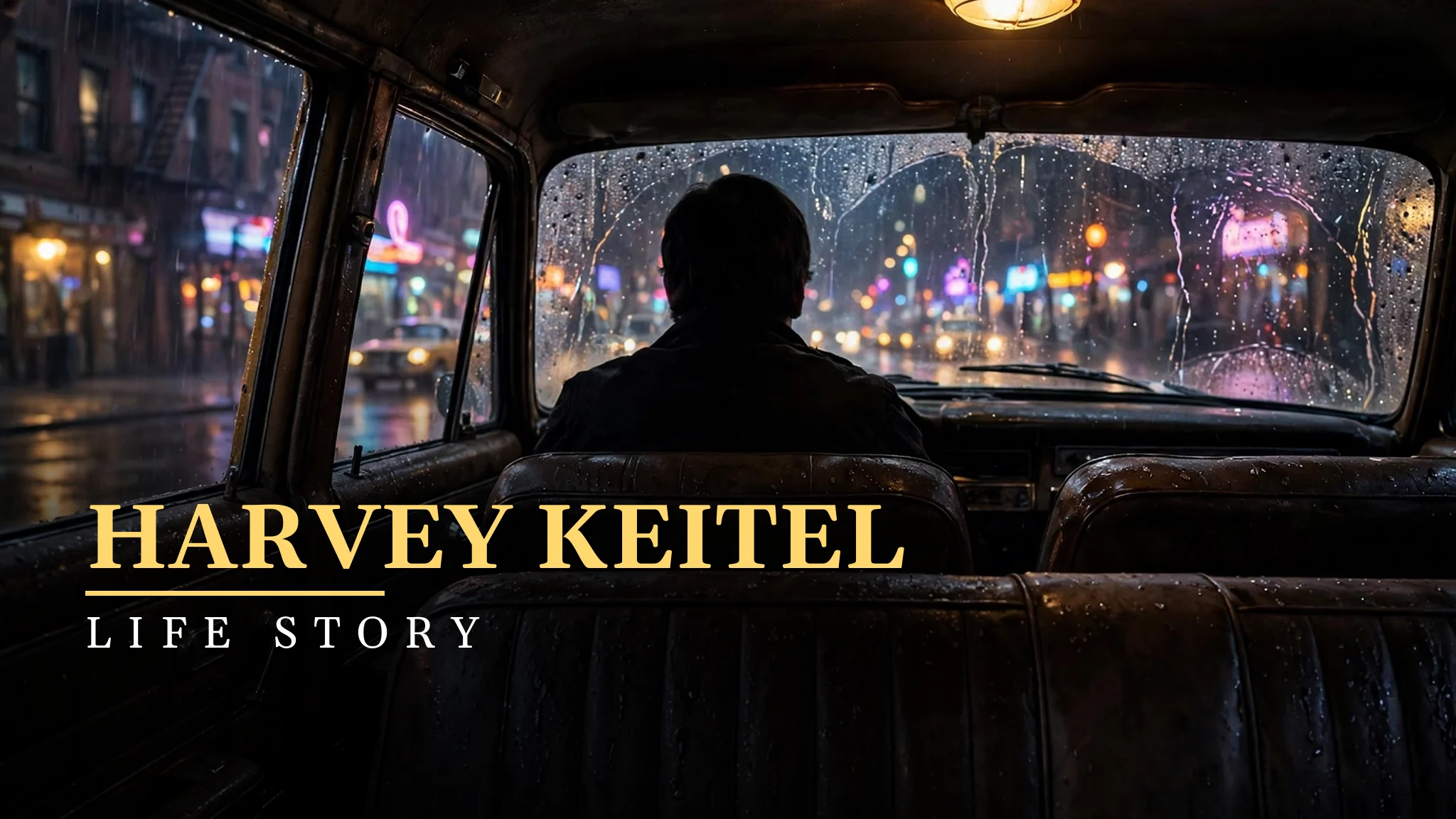
One more thought stays with me. When I picture him, I picture the taxi in the image for this story: the back seat at night, the rain on the windshield, and the driver in silhouette, looking out at the neon city. That is a good picture of his career, because he has always been the man in the driver’s seat, quiet, focused, and taking people where they need to go, through the dark streets of the night.
I also think about Smoke, because it shows a side of Keitel that his gangster roles never did. He plays Auggie Wren, a cigar shop owner who photographs the same street corner every morning, and he plays the part with a warmth and a patience that is deeply moving. The film is slow, it is built on talk, and it is about the kindness of ordinary people. Keitel is the heart of it, because he listens. He listens to his customers, he listens to their stories, and he makes the audience listen too. I think that listening is the key to his acting. He does not just speak. He hears, and that hearing makes his performances feel true.
Another thing I notice is The Grey Zone, the film about Auschwitz that he produced and starred in. He made that film because he believed the story needed to be told, not because it would make money. He used his own name and his own resources to get it made, and he played a prisoner who tries to save a young girl. That is a brave choice, and it shows that he cares about film as an art, not just as a job. He is a man who believes that some stories must be told, even when they are painful, and he is willing to pay the price to tell them.
I think about Youth as well, where he plays Mick Boyle, an old film director trying to make one last film. He is in his seventies in that role, and he plays a man who is facing the end of his career, and the end of his life, with a mix of humour and sadness. It is a beautiful performance, and it feels personal, because Keitel himself is an older artist who is still working, still trying, and still hoping to make something good. I think he understands Mick, because he is Mick, in a way. He is a man who has given his life to his art, and who does not want to stop.
When I look at his whole career, I see a man who helped young directors, who produced films that mattered, who played criminals and saints, and who never stopped working. He was loyal to Scorsese when Scorsese was young, he was loyal to Tarantino when Tarantino was unknown, and he has been loyal to the Actors Studio for his whole life. That loyalty is the heart of who he is. He is not just an actor. He is a man who believes in other people, and who helps them, and that is a rare and beautiful thing.
I also think about his role in Lansky, because it shows that he was still leading films in his eighties. He plays Meyer Lansky, an old gangster looking back on his life, and he plays the part with a calm authority that makes the character feel real. He is not a young criminal anymore. He is an old man who has seen everything, and who is trying to make sense of it. That is a beautiful performance, and it proves that Keitel has not lost anything with age. He has simply grown into a new kind of role, the elder statesman, and he plays it as well as he played everything else.
Another thing I notice is his small role in The Grand Budapest Hotel, where he plays Ludwig, a prisoner who helps the hero escape. It is only a few scenes, but he plays them with a warmth and a humour that makes the character memorable. It shows that he can work with any director, in any kind of film, and make a small part matter. He is not an actor who needs a big role to make an impression. He can do it in a few minutes, because he brings his whole craft to every line. That is the mark of a great actor, and it is why directors keep calling him, even now, in his eighties.
Frequently Asked Questions
Where was Harvey Keitel born and raised?
Harvey Keitel was born on 13 May 1939 in Brooklyn, New York, the son of Jewish immigrants from Eastern Europe, and he grew up in the Brighton Beach area. He joined the Marine Corps at seventeen and later worked as a court stenographer before turning to acting in his twenties.
How did Harvey Keitel meet Martin Scorsese?
He worked with the young Scorsese on Who’s That Knocking at My Door in 1967, and then played Charlie in Mean Streets in 1973, a landmark film about small-time criminals in Little Italy. The film made both men known, and it began a collaboration that shaped Keitel’s early career.
Who is the Wolf in Pulp Fiction?
In Pulp Fiction from 1994, Keitel plays Winston “The Wolf” Wolfe, a cool, efficient fixer who arrives in the middle of the night to solve a terrible problem. The role lasts only a few scenes, but his calm authority made it one of the most famous parts of the film.
Was Harvey Keitel nominated for an Oscar?
Yes, he was nominated for Best Supporting Actor for Bugsy in 1991, playing the gangster Mickey Cohen. It was his first Oscar nomination after more than twenty years of work, and it recognised a long career of strong, honest performances.
What is Harvey Keitel’s role in The Piano?
In The Piano from 1993, he plays George Baines, a frontiersman in New Zealand who falls in love with a mute woman played by Holly Hunter. His tender, vulnerable performance showed a warmer side of him, and the film won the Academy Award for Best Picture.
Did Harvey Keitel help make Reservoir Dogs?
Yes, he starred as Mr. White in Reservoir Dogs in 1992, and he also helped to produce the film, using his name to support the then-unknown Quentin Tarantino. The film became a cult classic and changed the course of American cinema.
What is Harvey Keitel’s connection to the Actors Studio?
He studied at the Actors Studio in New York as a young man, and he later served as its president, teaching and supporting younger actors. The Studio gave him his start, and he has worked to keep its traditions alive throughout his career.


