Hayao Miyazaki: The Life Story Behind Japan's Animation Master
In this post
Hayao Miyazaki is the most loved maker of animated films in the world. Children who have never been to Japan know the name Totoro, and adults who have never watched a cartoon cry at the story of a girl lost in a bathhouse for spirits. His films are gentle and strange at the same time, full of flying machines, forests, witches, and brave girls who do not wait to be rescued. They have won Academy Awards, they have filled cinemas on every continent, and they have changed the way the world thinks about animation. Behind those films is a man who has spent more than sixty years drawing, and who has never really stopped.
Miyazaki was born in Tokyo on 5 January 1941, in the middle of a war. His father ran a company that made parts for aeroplanes, and his mother spent years ill in bed. Those two facts shaped his whole life. The aeroplanes gave him a love of flight that fills every film he has made. His mother’s illness gave him a sense of how strong a woman can be, even when she is weak in body, and the women in his films are strong in exactly that way. He grew up drawing, and he never stopped.
He joined the animation studio Toei in 1963, and he worked his way up from the bottom, drawing frame after frame by hand. In 1985, he helped to found Studio Ghibli, and from that small studio came some of the greatest films ever made. He has retired more than once, and he has come back more than once, because he cannot seem to stop telling stories. This is the story of how a boy born in wartime Tokyo became the master of animation.
A Wartime Childhood and a Love of Flight
Miyazaki was born in Tokyo in 1941, when Japan was at war. His early childhood was marked by air raids, by moving from place to place, and by the fear that filled the city. His family moved to escape the bombing, and the young Miyazaki saw a world that was broken and frightening. That experience stayed with him. His films are full of beautiful worlds, but they are also full of war, of machines that destroy, and of people trying to live well in a damaged world. The war did not only frighten him. It taught him to look carefully at the world, and to ask what is worth protecting.
His father, Katsuji Miyazaki, ran a company called Miyazaki Airplane, which made parts for aeroplanes, including the rudders for the famous Zero fighter plane. The young Hayao grew up around aeroplanes, around the smell of oil and metal, and around the idea that a machine could fly. He loved aeroplanes, and he drew them constantly. That love never left him. His films are full of flying machines, from the gliders of Nausicaa to the seaplanes of Porco Rosso to the wind that lifts the characters of The Wind Rises. Flight, for Miyazaki, is not only a way of moving. It is a way of being free.
His mother, Yoshiko, was ill for many years with a disease of the spine, and she spent long periods in bed. The young Miyazaki watched her carefully, and he learned that a person can be weak in body and strong in spirit at the same time. His mother was clever, outspoken, and full of opinions, and she did not accept the idea that a woman should be quiet and gentle. The heroines of his films carry that spirit. They are brave, they argue, they work hard, and they do not wait for a man to save them. Many people have noticed that his mother is the model for those heroines, and Miyazaki himself has said that she shaped his view of women.
He was a clever boy, and he loved to read. He read manga, the Japanese comics that were becoming popular after the war, and he was inspired by the work of Osamu Tezuka, the great manga artist. He also loved Western books and films. He studied economics at Gakushuin University, not art, because his family expected him to take a sensible path. But drawing was always the real love, and when he left university in 1963, he chose drawing over economics. He joined Toei Animation, the biggest animation studio in Japan, and he began the long climb from the bottom.
Learning the Craft at Toei
Toei Animation in the 1960s was a busy place, making films and television series for a growing audience. Miyazaki joined as an in-between animator, the lowest job in animation, drawing the frames that sit between the key drawings. It is slow, careful work, and it teaches a person how movement really works. He was good at it, and he was also outspoken. He joined the studio’s labour union, he argued with his bosses, and he made it clear that he had opinions about how films should be made. That outspokenness would stay with him for his whole career.
He worked on a series of films and television shows, learning the craft from the inside. He met Isao Takahata, a director who would become his closest colleague and friend, and the two men began to work together. They shared a belief that animation could be more than simple entertainment for children. They believed it could tell serious stories, with real feelings and real ideas, and they wanted to make films that adults would love as much as children. That belief was unusual at the time, and it would take them decades to prove it.
He also met Akemi Ota, a fellow animator, and they married in 1965. They had two sons, Goro and Keisuke, and Miyazaki’s family life became a quiet anchor for his working life. He was a hard worker, often working long hours, and his family sometimes saw little of him. That tension between work and family would follow him for years, and it would later appear in his films, in the stories of fathers who are absent and children who must be brave on their own.
In the 1970s, Miyazaki moved into television, working on series that became loved across Japan. He directed episodes of Lupin III, and he created the series Future Boy Conan in 1978, a story about a boy living after a great war. Conan was a sign of what was to come. It had a brave young hero, a damaged world, and a sense of hope that survived the damage. It was also the first time Miyazaki had real control over a whole series, and he used that control to show what he could do.
By the end of the 1970s, he was ready to make films of his own. He directed The Castle of Cagliostro in 1979, a Lupin III film that was full of energy, chases, and flying machines. It was a success, and it showed that he could carry a film. But his greatest work was still ahead of him, and it would come from a story he had been carrying in his mind for years.
Nausicaa and the Birth of Ghibli
In the early 1980s, Miyazaki began to draw a manga called Nausicaa of the Valley of the Wind, about a young princess living in a world poisoned by war and pollution. The manga was a success, and in 1984 he turned it into a film. Nausicaa was different from anything else in Japanese animation. It had a heroine who was kind and brave, a world that was beautiful and damaged, and a message about caring for nature that was serious without being preachy. The film was a hit, and it proved that Miyazaki’s vision could work on the big screen.
The success of Nausicaa led to the founding of Studio Ghibli in 1985, with Miyazaki, Takahata, and the producer Toshio Suzuki. Ghibli was a small studio, and it was built on a simple idea. The films would be made by hand, with care, and they would tell stories that mattered. The studio’s name came from a word for a hot wind in the Sahara, and Miyazaki chose it because he wanted to blow a new wind through Japanese animation. He did exactly that.
Ghibli’s first films were made in the late 1980s. Laputa: Castle in the Sky came in 1986, a story of a floating island and a girl with a magic crystal. Then, in 1988, came My Neighbor Totoro, the film that would become the studio’s most loved work. Totoro is the story of two young sisters who move to the countryside with their father while their mother is ill in hospital, and who meet a great forest spirit. It is a gentle film, full of wonder and sadness, and it has become one of the most beloved films in the world. The great grey Totoro is now the symbol of the studio itself.
In the same year, Takahata made Grave of the Fireflies, a heartbreaking film about two children in wartime Japan. The two films were released together, and they showed the range of what Ghibli could do. One was gentle and hopeful. The other was sad and honest about war. Together they proved that animation could hold the whole range of human feeling, from joy to grief, and that a small studio in Tokyo could make films as good as any in the world.
Totoro, Kiki, and the Films of Childhood
The years after Totoro were a golden time for Ghibli. In 1989, Miyazaki made Kiki’s Delivery Service, about a young witch who leaves home to find her own way in a seaside town. Kiki is a story about growing up, about leaving home, about losing confidence and finding it again. It spoke to young viewers, and it spoke to adults too, because everyone knows what it feels like to be new in a place and unsure of yourself. The film was a success, and it confirmed that Miyazaki could tell a small, human story as well as a grand adventure.
In 1992, he made Porco Rosso, about a pilot who has been turned into a pig and who flies a seaplane over the Adriatic Sea. It was a stranger film, full of aeroplanes, pirates, and a love of flying that was pure Miyazaki. It was also a film about a man who has given up on the world, and who slowly learns to care again. The film was loved by adults, and it showed that Miyazaki’s films were not only for children. They were for anyone who had ever felt tired of the world and wanted to fly away from it.
In 1997, he made Princess Mononoke, a grand and serious film about a young prince caught between humans who cut down the forest and the gods who protect it. It was a bigger, darker film than anything he had made before, and it was a huge success in Japan. It showed that an animated film could deal with war, with nature, and with the difficult choices that grown-ups face. It also showed that Miyazaki was willing to take risks, to make a film that was not easy or simple, and to trust his audience to follow him.
These films made Ghibli famous around the world. The studio’s films were shown in cinemas in Europe and America, and they won praise from critics who had never taken animation seriously before. Miyazaki became known as a master, and his name was mentioned alongside the great directors of live-action film. He did not seek that fame. He kept working in his small studio, drawing by hand, and telling the stories he wanted to tell. The fame came to him, not the other way round.
Spirited Away and the Oscar
In 2001, Miyazaki made the film that would become his most famous work. Spirited Away is the story of a ten-year-old girl named Chihiro who wanders into a bathhouse for spirits and must work there to free her parents, who have been turned into pigs. It is a strange, beautiful, and frightening film, full of gods, witches, and a boy who is really a river. It is also a story about a girl who learns to be brave, to work hard, and to take responsibility for herself. It became the highest-grossing film in Japanese history, and it won the Academy Award for Best Animated Feature in 2003.
The Oscar was a landmark. No Japanese animated film had ever won it before, and the win put Miyazaki and Ghibli at the centre of world cinema. Miyazaki did not travel to America to accept the award, because he was opposed to the war in Iraq, and he did not want to celebrate while a war was going on. That decision said a great deal about him. He was not interested in fame for its own sake. He was interested in making films that mattered, and in living by his beliefs.
After Spirited Away, he made Howl’s Moving Castle in 2004, based on a book by the British writer Diana Wynne Jones. It was a story about a young woman turned into an old woman by a witch, and a wizard who lives in a moving castle. It was another success, and it was nominated for an Academy Award. Then came Ponyo in 2008, a gentle film about a fish who wants to become a girl, and a boy who loves her. Ponyo was simpler and brighter than his earlier films, and it showed that Miyazaki could still tell a story for very young children with the same care he gave to his grandest works.
In 2013, he made The Wind Rises, a film about Jiro Horikoshi, the man who designed the Zero fighter plane. It was a personal film, full of aeroplanes and dreams, and it was also a film about the sadness of making something beautiful that is used for war. Miyazaki announced that it would be his last film, and he retired. Many people believed him. He had retired before, and he had always come back, but this time the announcement felt final. He was seventy-two, and he had been working for fifty years.
Retirement, Return, and The Boy and the Heron
Miyazaki’s retirement did not last. He kept drawing, he kept thinking, and in 2017 it was announced that he was making a new film. The film took six years to make, and it was released in 2023 as The Boy and the Heron. It was a strange and personal film, about a boy who loses his mother in the war and who follows a heron into a magical world. It was full of images from Miyazaki’s own life, from the war, from his mother, and from his long career. It won the Academy Award for Best Animated Feature in 2024, making him the oldest director ever to win that award.
The return surprised no one who knew him well. Miyazaki has always been a man who cannot stop working. Drawing is not only his job. It is the way he thinks, the way he understands the world, and the way he lives. Retirement, for him, was never really an option, because stopping would have meant losing the thing that makes him who he is. The Boy and the Heron was not only a film. It was a statement that he was still alive, still thinking, and still able to surprise the world.
The film also showed that his style had not changed. It was still made by hand, still full of careful drawings, and still told at a gentle pace. In a world where most animation is made by computer, Miyazaki’s hand-drawn films feel more precious with every year. They are proof that a slow, careful way of working can still produce something that millions of people love. That proof matters, because it gives hope to young artists who want to work by hand in a digital world.
His relationship with his son Goro, who is also a director at Ghibli, has been a difficult and public part of his story. Miyazaki was often absent when his sons were young, because he was working, and Goro has spoken about the pain of that absence. Miyazaki has also spoken about it, with regret. The two men have worked together at Ghibli, and their relationship has improved with time. It is a reminder that even a great artist can fail at home, and that success at work does not always mean success as a father.
Today, Miyazaki is in his eighties, and he is still working. He has said that he may make another film, and no one would be surprised if he did. His studio, Ghibli, is now one of the most loved names in world cinema, and his films are watched by new generations every year. The boy who was born in wartime Tokyo, who loved aeroplanes and drew constantly, has become a master whose work will be watched for as long as people love stories.
What Miyazaki Leaves to the World
The legacy of Hayao Miyazaki is not only a set of films. It is a way of seeing the world. His films teach that nature is precious, that war is wasteful, that girls can be brave, and that kindness is a form of strength. These are simple ideas, but he has spent sixty years making them beautiful, and that beauty has changed the way millions of people think. A child who watches Totoro learns to love a forest. A child who watches Spirited Away learns to be brave. Those lessons last longer than any single film.
His studio, Ghibli, has also left a legacy. It showed that a small studio could make films by hand, with care, and still succeed around the world. It gave work to hundreds of artists, and it inspired a generation of animators in Japan and beyond. The Ghibli Museum in Tokyo, which Miyazaki helped to design, is now a place of pilgrimage for fans from every country. It is a museum that feels like one of his films, full of wonder and small details, and it is a fitting monument to his work.
Miyazaki’s influence reaches far beyond animation. Directors of live-action films admire him. Writers admire his stories. Artists admire his drawings. He has shown that a film can be gentle and serious at the same time, that it can be for children and for adults, and that it can be made slowly and carefully in a world that wants everything fast. That example is more important now than it has ever been, because the pressure to work fast is greater than ever.
He has also left a question for the future. Who will carry on his work when he is gone? His son Goro is a director, and other artists at Ghibli are learning the craft. But Miyazaki is a rare talent, and his combination of drawing skill, storytelling, and moral seriousness may not come again soon. The studio will go on, and new films will be made, but the world will always remember the films that Miyazaki himself made, and it will watch them again and again.
For now, the master is still working, still drawing, and still telling stories. The boy from wartime Tokyo who loved aeroplanes has given the world Totoro, Chihiro, Nausicaa, and Kiki, and he has done it by hand, one drawing at a time. That is a life’s work, and it is one of the greatest lives in the history of film.
My Take:
I find Hayao Miyazaki difficult to write about, because I admire him so much that I worry about sounding like a fan rather than a thinker. So let me be honest about that first. I am a fan. I have watched his films more times than I can count, and they have shaped the way I see the world. But I also want to think clearly about him, about what his life means, and about what is hard or sad in his story as well as what is beautiful. He deserves that kind of honest thinking, because his films are honest, and they ask the same of us.
The first thing I think about is his mother. She was ill for years, and she was strong in spirit even when her body was weak. Miyazaki has said that she shaped his view of women, and I believe him, because the women in his films are unlike the women in almost any other films. They are not waiting to be rescued. They are not pretty decorations. They work, they argue, they get tired, and they keep going. Chihiro works in a bathhouse to save her parents. Nausicaa walks into danger to save her people. Kiki leaves home to find her own way. These are not princesses. They are workers, and they are brave in the way that real women are brave. I think that is Miyazaki’s greatest gift to cinema, and it came from watching his mother in bed, listening to her opinions, and learning that strength does not always look like strength.
I also think about the war. He was born in 1941, and his childhood was marked by bombing and fear. That experience gave him a hatred of war that runs through every film he has made. In Nausicaa, war has poisoned the world. In Princess Mononoke, war destroys the forest. In The Wind Rises, a beautiful aeroplane is used to kill. He does not make war look exciting. He makes it look wasteful and sad, and that is a brave choice in a world where war is often shown as adventure. I respect that choice deeply, because it comes from a real memory, not from a political slogan. He saw what war did to his city, and he has spent his life saying that it should not happen again.
There is also the question of his work habits, and here I want to be honest rather than simply admiring. Miyazaki is famous for working extremely hard, for demanding the same of everyone around him, and for being absent from his family when his sons were young. His son Goro has spoken about that absence, and Miyazaki has spoken about it with regret. I think this is the saddest part of his story. A man who made beautiful films about children and families was not always there for his own children. That does not make his films less beautiful, but it does make his life more complicated. I think we should hold both truths at once. He is a great artist, and he is a man who made real mistakes at home. Both things are true, and neither one cancels the other.
I also admire his refusal to work by computer. In a world where almost all animation is made digitally, Miyazaki still draws by hand, frame by frame, with pencils and paper. That is a slow way to work, and it is an expensive way to work, but it gives his films a warmth that computer animation rarely has. You can feel the hand in his films. You can feel the time that went into each drawing. I think that matters, because it reminds us that slow work can still be good work, and that a human hand can make something a machine cannot. In a time when everything is fast, his slowness is a kind of resistance, and I admire it.
His retirements make me smile, because he has retired so many times and come back so many times. He announced his retirement after The Wind Rises, and then he made The Boy and the Heron. He is now in his eighties, and people still ask whether he will make another film. I think he will keep working until he cannot, because drawing is not his job. It is the way he thinks. A man who has drawn every day for sixty years does not stop because he is tired. He stops when his hand will not move, and even then he may find another way. I find that moving, because it shows that a person’s work can be a part of who they are, not just something they do for money.
Spirited Away is the film I return to most often, and I want to say why. Chihiro is ten years old, and she is not special. She is not a princess, she is not a warrior, and she has no magic powers. She is an ordinary girl who is frightened, and who learns to work hard and to be brave. That is a story that any child can understand, and it is a story that any adult can learn from. Miyazaki’s genius is that he trusted an ordinary girl to carry a great film, and he was right to trust her. I think that is the heart of his work. He believes that ordinary people can be brave, and he makes films that prove it.
I also think about Studio Ghibli, and about what it means that a small studio in Tokyo changed world cinema. Ghibli did not have the money of a Hollywood studio. It did not have the technology. It had a group of artists who cared about their work, and a director who would not compromise. That is a powerful example for anyone who wants to make something good with limited resources. You do not need the biggest budget. You need a clear idea, a group of people who believe in it, and the patience to do it well. Ghibli proved that, and the proof is still on screens around the world.
There is a lesson in Miyazaki’s life for anyone who creates things. Make what you believe in, even if it is slow. Do not follow the fashion of the moment. Trust your audience to understand a serious story. Be honest about war, about nature, and about people. And accept that your work will take time, because the things that last are rarely made quickly. Miyazaki has lived by those rules for sixty years, and the result is a body of work that will be watched for as long as people love stories.
I also want to say something about his age. He is in his eighties, and he has won an Academy Award at an age when most people are long retired. That is a wonderful thing, because it shows that creativity does not have to fade with age. It can grow deeper, richer, and more personal. The Boy and the Heron is a film about loss and memory, and it could only have been made by a man who has lived a long life and thought deeply about it. I hope young artists look at that film and understand that their best work may still be ahead of them, even when they are old.
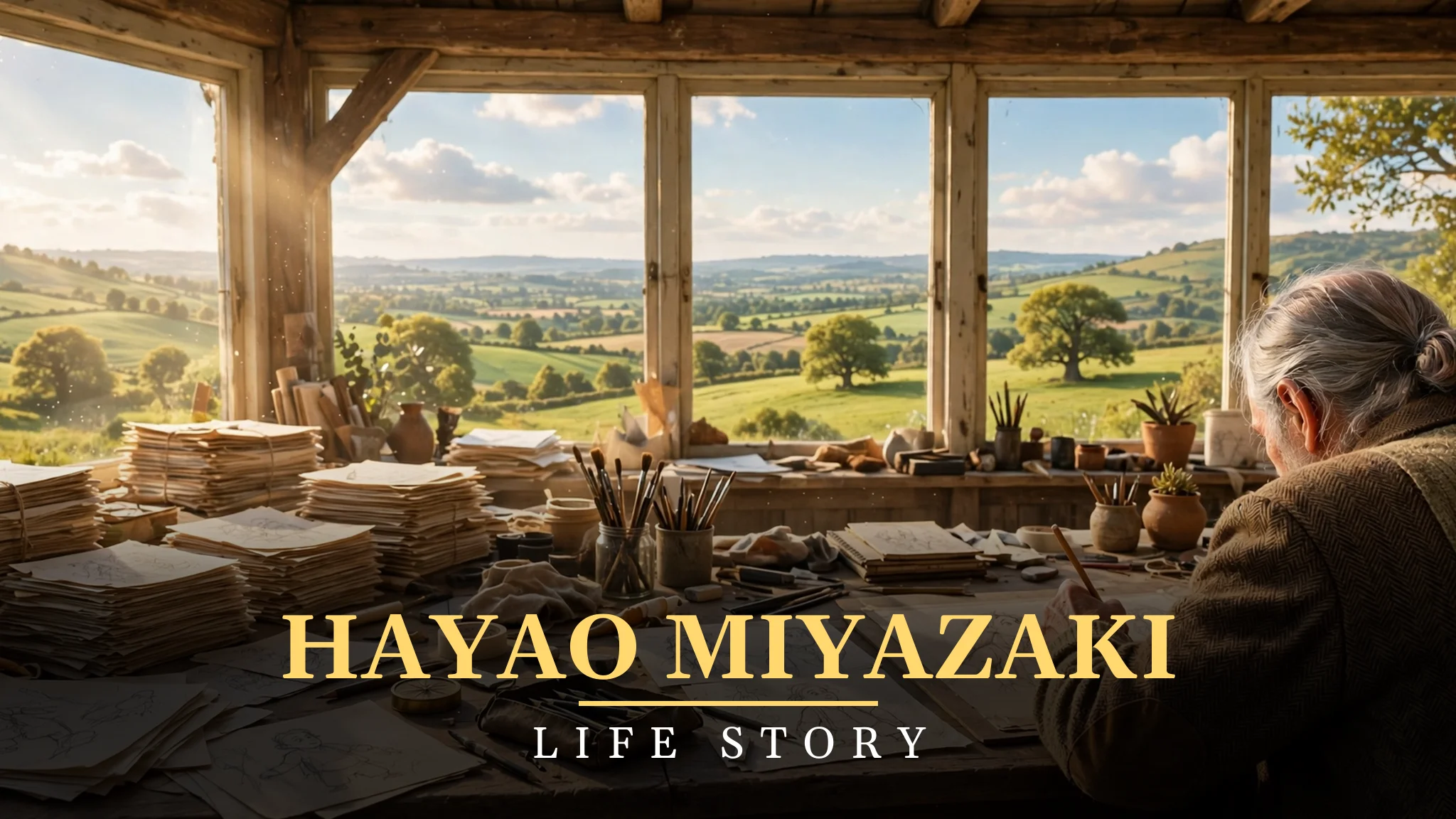
In the end, what I take from Hayao Miyazaki is the image of a man at a desk, drawing by hand, in a sunlit room full of paper. He has been at that desk for more than sixty years, and he is still there. He has given the world Totoro, Chihiro, Nausicaa, Kiki, and many more, and he has done it by caring about the world and about the people in it. His life teaches me that a single person, working slowly and honestly, can change the way millions of people see the world. That is a rare and beautiful achievement, and it is one I will always admire, even as I remember the costs that came with it.
I also think about the Ghibli Museum, because it is a physical place that shows what Miyazaki cares about. The museum in Tokyo, which he helped to design, is not a normal museum. It is a place full of wonder, with small details, hidden rooms, and a rooftop garden. Children love it, and adults love it too, because it feels like walking into one of his films. The museum is a gift to the public, a place where people can see how animation is made, and where they can feel the magic of his world. I think that museum says a great deal about him. He did not only make films. He made a place where people could experience his world in person, and he gave it to them with care. That generosity is part of who he is.
His relationship with Isao Takahata is another part of his story that I think about. Takahata was his colleague, his friend, and sometimes his rival, and the two men worked together for decades at Ghibli. Takahata made Grave of the Fireflies, a film that is as great as any of Miyazaki’s, and the two men pushed each other to be better. Their partnership was not always easy, but it was fruitful, and it produced some of the greatest films in animation history. Takahata died in 2018, and Miyazaki lost a friend and a partner. I think about that loss, and about how it must have felt for a man in his seventies to lose someone he had worked with for so long. It is a reminder that even a great career is built on relationships, and that those relationships matter as much as the work itself.
I also think about the environment, because it is the cause that Miyazaki cares about most. His films are full of forests, rivers, and animals, and they carry a clear message: nature is precious, and we must protect it. Nausicaa shows a world poisoned by war and pollution. Princess Mononoke shows a forest being cut down by humans. My Neighbor Totoro shows children who love a forest spirit. These are not only stories. They are warnings, and they are pleas. Miyazaki has spent sixty years telling the world to care for nature, and he has done it through beautiful films that millions of people love. That is a powerful way to deliver a message, and it has changed how many people think about the natural world.
There is also the question of who will follow him. His son Goro is a director at Ghibli, and other artists at the studio are learning the craft. But Miyazaki is a rare talent, and his combination of drawing skill, storytelling, and moral seriousness may not come again soon. I think about that, and I feel both sad and hopeful. Sad, because the world may not see another Miyazaki. Hopeful, because his films will inspire young artists for generations, and one of them may carry his spirit forward in a new way. His influence is already visible in animation around the world, and it will continue to grow, even after he stops making films.
Finally, I want to say something about his age and his energy. He is in his eighties, and he is still working. He won an Academy Award at eighty-two, for a film about loss and memory, and he is still drawing. That is a wonderful thing, because it shows that creativity does not have to fade with age. It can grow deeper, richer, and more personal. The Boy and the Heron could only have been made by a man who has lived a long life and thought deeply about it. I hope young artists look at that film and understand that their best work may still be ahead of them, even when they are old. Miyazaki’s life proves it, and his films prove it, one drawing at a time.
I also think about his early years at Toei Animation, because they are the foundation of everything. He joined Toei in 1963, and he worked as an in-between animator, drawing the frames that sit between the key poses. It is slow, humble work, and it teaches a person how movement really happens. He also worked on the television series Heidi, Girl of the Alps, and on Future Boy Conan, and those early jobs taught him how to tell a long story in pictures. I admire that he started at the bottom and stayed there long enough to learn. Many famous directors never learn the craft that deeply. Miyazaki learned it frame by frame, and that is why his films move the way they do. When a character in his film runs, or eats, or looks at the sky, the movement feels real, because the man who drew it once drew thousands of small movements for other people.
His friendship with Isao Takahata is another part of the story that moves me. Takahata was his teacher, his partner, and his rival, and together they built Studio Ghibli. They did not always agree. Takahata’s films, like Grave of the Fireflies, are sadder and more realistic than Miyazaki’s, and the two men pushed each other to be better. I think about how rare that kind of friendship is, a friendship between two great artists who are different but who respect each other. Miyazaki has spoken with sadness about Takahata’s death in 2018, and it is clear that the loss was deep. A studio is not only a company. It is a place where people who love the same art work together for decades, and when one of them is gone, the place is never the same. Ghibli without Takahata is still Ghibli, but it is a quieter place, and Miyazaki’s later films carry that quietness in them.
I also think about the Ghibli Museum in Mitaka, because it shows what Miyazaki believes about children and about art. The museum is not a place where you sit and watch. It is a place where you walk, where you look, and where you imagine. He designed it himself, and he wanted it to feel like a forest house full of strange things. That tells me something important about him. He does not think of animation as something to sell. He thinks of it as something to share, something that belongs to children and to anyone who still has a child’s curiosity. The museum is small, and tickets are hard to get, but that is part of the point. He wanted a place that felt personal, not a theme park. I respect that choice, because it shows a man who protects his art from becoming only a business.
I also think about the young artists who watch Miyazaki’s films and want to make films like his. They see Totoro, they see Chihiro, and they want to draw like him. That desire is a gift, because it means his work is inspiring a new generation. But I also worry for those young artists, because Miyazaki’s standard is very high, and it is easy to feel small next to it. I would tell them what I think Miyazaki would tell them: do not copy him. Make your own films, tell your own stories, and draw in your own way. He did not become great by copying someone else. He became great by being himself, by drawing what he loved, and by telling stories that mattered to him. Young artists should do the same, and his films should inspire them to be original, not to imitate.
His films about war are another thing I think about, because they are so honest. He was a child during the war, and he saw what it did to his city. His films do not make war look exciting. They make it look wasteful, sad, and frightening, and that is the truth about war. In a world where war is often shown as adventure, Miyazaki’s honesty is important. He reminds us that war destroys forests, homes, and lives, and that the people who suffer most are ordinary people, especially children. That message is as important now as it was when he first made Nausicaa, and it will be important for as long as wars are fought. His films are not only art. They are a plea for peace, made beautifully, and that plea deserves to be heard.
Finally, I think about the simple pleasure of watching his films. I have watched Totoro with children, I have watched Spirited Away alone, and I have watched Kiki’s Delivery Service when I needed to feel hopeful. Each time, the films gave me something I needed. That is the mark of great art. It does not only impress you once. It stays with you, and it gives you something new each time you return to it. Miyazaki’s films do that, because they are full of small details, of kindness, and of wonder. A man who has spent sixty years drawing has given the world a gift that will keep giving, long after he stops working. That is a life’s work, and it is one of the greatest lives in the history of film.
Frequently Asked Questions
When was Hayao Miyazaki born?
Hayao Miyazaki was born on 5 January 1941 in Tokyo, Japan. He grew up during the war, and his father ran a company that made parts for aeroplanes, which gave him a lifelong love of flight.
What is Studio Ghibli and when was it founded?
Studio Ghibli is the animation studio Miyazaki helped to found in 1985, together with Isao Takahata and the producer Toshio Suzuki. The studio became famous for hand-drawn films including My Neighbor Totoro and Spirited Away.
Which Hayao Miyazaki films won Academy Awards?
Spirited Away won the Academy Award for Best Animated Feature in 2003, and The Boy and the Heron won the same award in 2024. Spirited Away became the highest-grossing film in Japanese history at the time.
What is My Neighbor Totoro about?
My Neighbor Totoro, released in 1988, is about two young sisters who move to the countryside with their father while their mother is ill in hospital, and who meet a great forest spirit called Totoro. It is one of the most loved films in the world.
Did Hayao Miyazaki really retire?
He announced his retirement after The Wind Rises in 2013, but he returned to filmmaking and released The Boy and the Heron in 2023. He has announced retirement more than once and has come back each time.
Why are the heroines in Miyazaki’s films so strong?
Miyazaki has said that his mother, who was ill for many years but strong in spirit and full of opinions, shaped his view of women. His heroines are brave, hard-working, and independent, and they do not wait to be rescued.


