Heidi Klum: The Life Story Behind the Supermodel Star
In this post
- Bergisch Gladbach, 1973: A Childhood in Germany
- Model 92: The Contest That Changed Everything
- Victoria’s Secret and the Angel
- Sports Illustrated and the Swimsuit Cover
- Project Runway and the Emmy
- Germany’s Next Topmodel and the Mentor
- America’s Got Talent and the Judge
- The Businesswoman and the Brand
- Seal, Tom Kaulitz and the Family
- The Halloween Costumes and the Fun
- The Model, the Host and the Brand
- The Legacy of the Angel and the Emmy
- My Take:
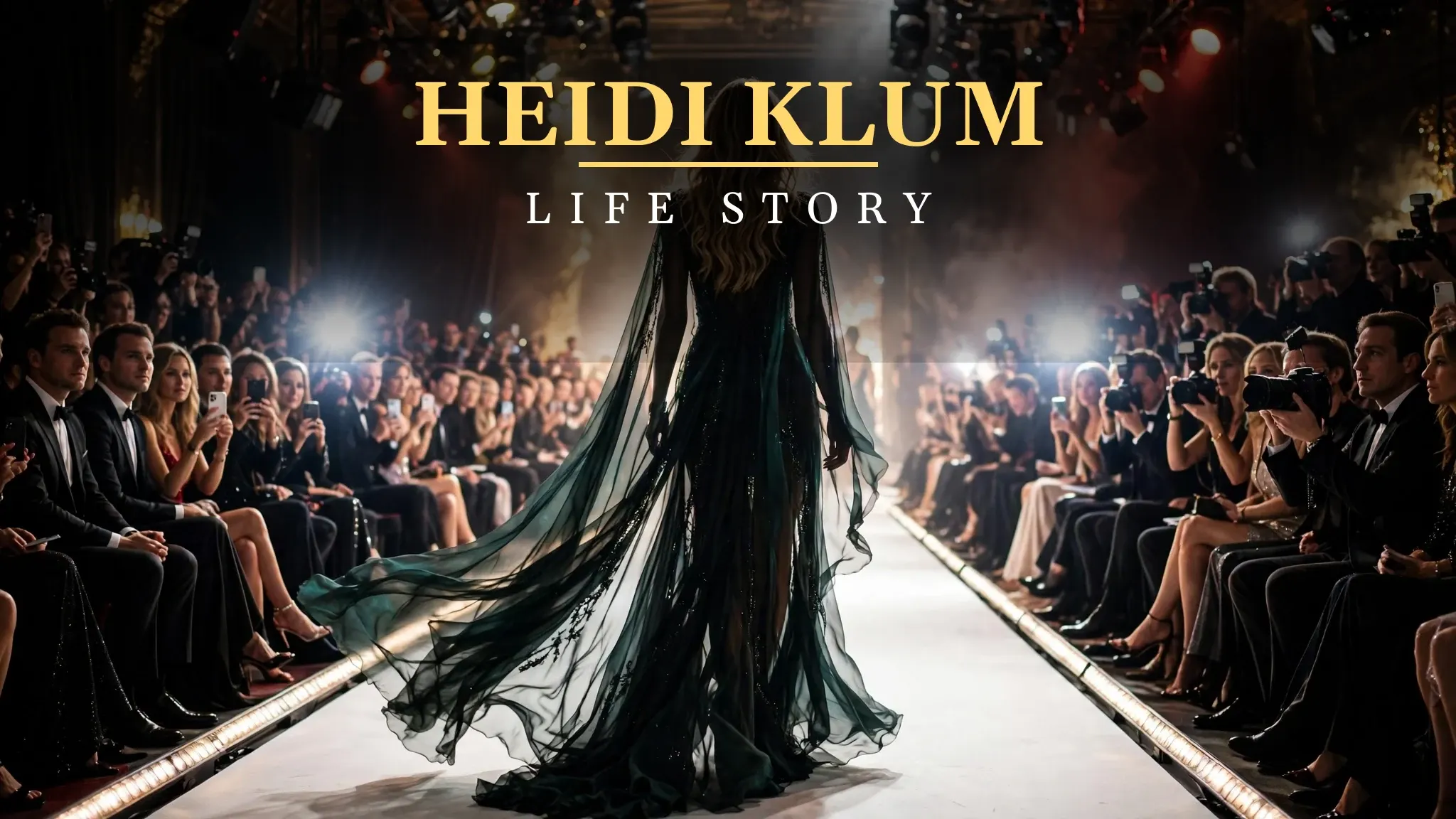
Heidi Klum was nineteen when she won a modelling contest in Germany, and the win is still the centre of her story, the moment against which every other moment is measured. She was born on 1 June 1973 in Bergisch Gladbach, a town near Cologne in Germany, and she grew up in a family that was ordinary, with a father who worked in a cosmetics company, and a mother who was a hairdresser, and she did not dream of being a model, she dreamed of being a dancer, and she entered a contest on a whim, with a friend, and she won, beating thousands of other entrants, and the win changed her life. She moved to the United States, she became a Victoria’s Secret Angel, she appeared on the cover of the Sports Illustrated Swimsuit Issue, she hosted Project Runway, she judged America’s Got Talent, she hosted Germany’s Next Topmodel, and she became, for thirty years, one of the most famous models in the world, a woman who is not just a model, but a businesswoman, a television star, and a brand.
Bergisch Gladbach, 1973: A Childhood in Germany
Heidi Klum was born in Bergisch Gladbach in 1973, when West Germany was a country of economic success, of a society that was rebuilding, and when a girl from a small town near Cologne could dream of being a dancer, of performing, of being on a stage, without knowing how. She grew up in a family that was close, with a father, Günther, who worked for a cosmetics company, and a mother, Erna, who was a hairdresser, and the house was a place of beauty, of hair, of make-up, of a mother who knew how to make people look good, and the knowing is the foundation: Klum learned, young, that beauty is a job, a craft, and not a gift, and that the job is to make the audience look, and to make them remember. She took dance lessons, she wanted to be a dancer, and the dancing is the foundation of her modelling: she moves well, she knows her body, she knows how to hold a pose, and the knowing is the performance.
The small town matters because it gave Klum a sense of being ordinary, of being from a place that is not a fashion capital, and the ordinariness is the foundation of her appeal: she is a model who is also a girl from Bergisch Gladbach, a woman who is funny, who is warm, who is not a diva, and the audience loves her for it, because she is relatable, because she is real, and because she does not pretend to be something she is not. The town is the anchor, the place she comes from, and the anchor holds, even when the fame pulls hard, even when she is in New York, in Los Angeles, in Paris, and the audience that knows her best knows that she is still the girl from Bergisch Gladbach who wanted to dance.
Model 92: The Contest That Changed Everything
In 1992, when Klum was nineteen, she entered Model 92, a national modelling contest in Germany, run by the late-night show Gottschalk, and she won, beating thousands of other entrants, and the win came with a contract, with a modelling agency, and with a career, and the career began, almost overnight, a girl from Bergisch Gladbach who was now a model, who was now being photographed, who was now travelling, and who was, for the first time, famous. The contest matters because it shows Klum’s luck and her talent: she entered on a whim, with a friend, and she won, because she was beautiful, because she was tall, because she was photogenic, and because the judges saw something in her, a spark, a warmth, that the other contestants did not have, and the spark is the career.
The win also gave her a choice: she could stay in Germany, or she could go to the United States, and she chose the United States, she moved to New York, she signed with an agency, and she began to work, in fashion shows, in magazines, in catalogues, and the work was hard, it was long hours, it was rejection, and it was, for a young woman from Germany, a new world, a world of English, of American fashion, of a different culture, and Klum learned it, quickly, because she is a fast learner, because she is determined, and because she wanted it. The contest is the beginning, and the beginning is the story of a girl who entered a contest and won, and who never looked back.
Victoria’s Secret and the Angel
In 1997 Klum first walked in the Victoria’s Secret Fashion Show, and in 1999 she became a Victoria’s Secret Angel, the first German Angel, and the role made her famous around the world, a woman in wings, in lingerie, on a runway, in front of millions of viewers, and the Angel is the image that most people associate with her, a beautiful woman, a confident woman, a woman who is not afraid to be sexy, and who is, at the same time, a professional, a model who knows her job, and who does it well. She was an Angel until 2010, for more than a decade, and the decade is the proof of her longevity: a model who is an Angel for eleven years is a rare thing, and Klum is that rare thing, because she is reliable, because she is professional, and because the audience loves her.
The Angel matters for another reason, which is that it gave Klum a global audience, an audience that did not read fashion magazines, that watched television, that saw the Victoria’s Secret show, and that knew her face, her name, her walk, and the knowing is the fame. The show is a spectacle, it is a fashion show and a concert, and Klum, as an Angel, was the centre of it, a woman who could walk, who could smile, who could make the audience look, and the looking is the job, and Klum does the job better than almost anyone, because she enjoys it, because she is not a diva, because she is a girl from Bergisch Gladbach who is having fun, and the fun is visible, and the audience loves it.
Sports Illustrated and the Swimsuit Cover
In 1998 Klum appeared on the cover of the Sports Illustrated Swimsuit Issue, one of the most famous magazine covers in the world, a cover that makes a model famous, that puts her face in every newsagent, that makes her a household name, and the cover is the proof of her status: she was not just a Victoria’s Secret Angel, she was a Sports Illustrated cover girl, a woman who could sell magazines, who could be photographed in a swimsuit, and who could do it with a confidence, a warmth, and a professionalism that made the photograph iconic. The cover was a moment, and the moment mattered, because it showed that Klum was not just a runway model, but a commercial model, a woman who could sell, and the selling is the business of modelling, and Klum is good at business, as her later career proves.
The cover also gave her a reputation as a model who is not afraid of her body, who is comfortable, who is confident, and the confidence is the point: a model who is comfortable in a swimsuit is a model who is comfortable in herself, and Klum is comfortable, because she is a dancer, because she knows her body, and because she does not hide it, she shows it, with pride, and the pride is the performance. The Sports Illustrated cover is now part of fashion history, and Klum’s face on it is part of why, and the face is known around the world, and the knowing is the fame.
Project Runway and the Emmy
In 2004 Klum became the host and a judge of Project Runway, an American reality television series about fashion designers, in which she hosted, judged, and, with Tim Gunn, mentored young designers, and the show became a hit, it ran for many seasons, and Klum became a television star, a woman the audience knew not as a model, but as a host, as a judge, as a mentor, and the transformation is the point: she was no longer just a face, she was a voice, a personality, a woman who could talk, who could judge, who could be funny, and who could do it in English, in front of an American audience, and the audience loved her for it, because she is warm, because she is direct, and because she is honest.
The show earned Klum an Emmy Award in 2013, for Outstanding Host for a Reality or Reality-Competition Program, shared with Tim Gunn, and the Emmy is the proof that she is not just a model, but a television professional, a woman who can host, who can judge, and who can do it well enough to win the highest honour in American television. The award matters because it is official, it is the industry’s way of saying that Klum is good at television, and the saying is deserved, because Project Runway worked because of her, because of her warmth, her humour, her ability to make young designers feel safe, and to make the audience care about fashion, and the caring is the show.
Germany’s Next Topmodel and the Mentor
In 2006 Klum became the host and a judge of Germany’s Next Topmodel, the German version of the modelling competition, and the show has run for almost twenty years, and Klum has been its face, its voice, its mentor, for all of them, and the longevity is the proof of her commitment: a woman who hosts a show for twenty years is a woman who cares about it, who believes in it, and who is willing to do the work, year after year, season after season. The show is about young German women who want to be models, and Klum, who was once a young German woman who wanted to be a model, is the perfect mentor, because she knows what it is like, she knows the rejection, the hard work, the long hours, and she tells the young women the truth, with a warmth, a honesty, and a humour that the audience loves.
The show matters for another reason, which is that it keeps Klum connected to Germany, to her home, to the country where she was born, and the connection is the point: she lives in America, she works in America, but she returns to Germany every year, to host the show, to mentor young women, and to remind the German audience that she is still theirs, that she is still a girl from Bergisch Gladbach, and that the girl has not forgotten where she came from. The show is a homecoming, and the homecoming is the reason the German audience loves her, and the reason she keeps doing it, year after year.
America’s Got Talent and the Judge
In 2013 Klum became a judge on America’s Got Talent, one of the biggest talent shows in the United States, in which she judges singers, dancers, magicians, comedians, and the show is a spectacle, it is watched by millions, and Klum, as a judge, is a woman who is funny, who is kind, who is honest, and who is, in many ways, the heart of the panel, the judge who is warm, who encourages, who laughs, and who is, at the same time, a professional, a woman who knows talent when she sees it. She has been a judge for more than a decade, and the longevity is the proof of her popularity: an audience that loves a judge will keep watching, and the audience loves Klum, because she is herself, because she is not a diva, because she is a girl from Bergisch Gladbach who is having fun, and the fun is visible.
The judging matters because it shows Klum as a television personality, a woman who is not just a model, but a star, a woman who can sit on a panel, who can talk, who can judge, and who can do it in a way that makes the audience laugh, and that makes the contestants feel safe. The show is a different kind of television from Project Runway, it is bigger, it is louder, and Klum adapts to it, because she is a professional, because she knows how to be herself in any format, and the knowing is the talent: a model who becomes a television star is a rare thing, and Klum is that rare thing, because she is warm, because she is funny, and because she is real.
The Businesswoman and the Brand
Klum is not just a model and a television star; she is a businesswoman, a woman who has built a brand, with lines of clothing, of lingerie, of jewellery, of children’s clothing, and the business is part of her career, part of who she is, a woman who understands the market, who knows what her audience wants, and who gives it to them, with a professionalism that is rare for a model. She has launched Heidi Klum Intimates, a lingerie line, she has designed for other brands, she has been a spokesperson, and the business is successful, because Klum is trusted, because the audience believes in her, and because she does the work, she designs, she promotes, she shows up, and the showing up is the business.
The business matters because it shows Klum’s intelligence, her understanding that a model’s career is short, that a woman who is famous for her face must build something that lasts, and Klum has built it, a brand, a business, a career that is not just modelling, but entrepreneurship, and the entrepreneurship is the future, a woman in her fifties who is still working, still designing, still selling, and still, at fifty-two, a star. The business is the proof that Klum is not just a pretty face, but a smart woman, and the smartness is the reason she has lasted for thirty years, when many models last for five.
Seal, Tom Kaulitz and the Family
Klum was married to the singer Seal from 2005 to 2014, and the couple had three children together, Henry, Johan and Lou, and Klum has a daughter, Helene, known as Leni, from an earlier relationship, and the family was, for a time, one of the most famous in the world, a model and a singer, four children, a life that was photographed, and that was, for a time, happy, and then it ended, as marriages often do, and Klum spoke about it with a dignity, and then returned to her work. She is now married to Tom Kaulitz, a German musician from the band Tokio Hotel, whom she married in 2019, and the marriage is a happy one, a woman in her forties who found love again, and who is, in many ways, a new chapter, a woman who is still, at fifty-two, in love, and who is not afraid to show it.
The family matters because it is the anchor, the place Klum returns to after the filming, after the shows, after the fame, and the anchor holds. She has spoken about motherhood with a warmth that is genuine, about the joy of being a mother of four, about the way her children have changed her view of her work, and about the importance of being present, and the honesty is refreshing, because a model who talks about motherhood as a job, as a responsibility, is a woman who has grown up, and Klum has grown up, from the nineteen-year-old who won a contest to the fifty-two-year-old mother of four who still hosts, still judges, and still, at fifty-two, is a star. Her daughter Leni has followed her into modelling, and the following is the proof that the career continues, in a new generation.
The Halloween Costumes and the Fun
Klum is famous for her Halloween costumes, elaborate, creative, over-the-top outfits that she wears to her annual Halloween party in New York, costumes that have included a worm, a peacock, a clone of herself, and the costumes are a tradition, a woman who loves Halloween, who loves dressing up, who loves making people laugh, and who does it with a commitment that is total, spending hours in make-up, in prosthetics, and the commitment is the point: Klum does not do Halloween by halves, she does it fully, and the fullness is the fun, and the fun is the reason the press covers it, year after year, and the reason the audience loves it, because it shows a model who is not a diva, who is willing to look silly, to be a worm, to be laughed at, and the willingness is the charm.
The Halloween tradition matters because it shows Klum’s sense of humour, her willingness to be funny, to be self-deprecating, and to enjoy herself, and the enjoyment is the reason she has lasted: a model who enjoys her work, who has fun, will keep working, and Klum has fun, every year, at Halloween, and every day, on television, on the runway, and the fun is visible, and the audience loves it, because it is real, because it is not performed, because it is Klum, a girl from Bergisch Gladbach who loves to dress up, and who never stopped.
The Model, the Host and the Brand
Klum’s place in fashion and television is secure, and it is a place that no one else occupies. She is a Victoria’s Secret Angel, a Sports Illustrated cover girl, a Project Runway host, an America’s Got Talent judge, a Germany’s Next Topmodel host, and a businesswoman, and the combination is unique. She has shown that a model can become a television star, that a television star can become a businesswoman, and that a woman from Bergisch Gladbach can become one of the most famous people in the world, and the showing is the achievement. The legacy is not just the covers; it is the permission she gives to other models, to be more than a face, to host, to judge, to build a brand, and the permission is the gift, and it will last.
The Legacy of the Angel and the Emmy
The legacy of Klum’s career is the Angel and the Emmy, a Victoria’s Secret Angel who became an Emmy-winning host, a model who became a television star, and the two together are the proof of her talent. The audience that watches Project Runway now still loves Klum, still trusts her, still laughs with her, and the loving is the legacy, and it will last. The audience that watches America’s Got Talent still sees Klum, still enjoys her, still believes in her, and the believing is the legacy, and it will last, because great television does not fade, it grows, and Klum’s television has grown, year after year, into the classics it is.
My Take:
The first thing to say about Heidi Klum is that she won a contest on a whim, and the whim changed her life. She entered Model 92 with a friend, she won, beating thousands of other entrants, and the win came with a contract, and the contract came with a career, and the career has lasted thirty years. The whim matters, because it shows that Klum did not plan to be a model, she did not dream of it as a child, she wanted to be a dancer, and she entered a contest, and she won, because she was beautiful, because she was tall, because she was photogenic, and because the judges saw something in her, a spark, a warmth, that the other contestants did not have. The spark is the career, and the career is the proof that sometimes, a whim is enough, if the talent is there.
The second thing is the Angel, and what it meant. Klum became a Victoria’s Secret Angel in 1999, the first German Angel, and she was an Angel for eleven years, and the longevity is the achievement, because a model who is an Angel for eleven years is a rare thing. The Angel is the image that most people associate with her, a woman in wings, in lingerie, on a runway, and the image is powerful, but it is also incomplete, because Klum is more than an Angel, she is a host, a judge, a businesswoman, and the more is the point. The Angel gave her a global audience, and the global audience gave her a career, and the career is now television, business, and modelling, all at once, and the all at once is the achievement.
The third thing is Project Runway, and the Emmy. Klum hosted Project Runway from 2004, she judged, she mentored, and she won an Emmy in 2013, shared with Tim Gunn, for Outstanding Host, and the Emmy is the proof that she is not just a model, but a television professional. The show worked because of her, because of her warmth, her humour, her ability to make young designers feel safe, and to make the audience care about fashion, and the caring is the show. A model who becomes an Emmy-winning host is a rare thing, and Klum is that rare thing, because she is warm, because she is direct, and because she is honest, and the honesty is the reason the audience trusts her.
The fourth thing is the warmth, and how it shapes everything. Klum is warm, she is funny, she is direct, and the warmth is visible in everything she does, on Project Runway, on America’s Got Talent, on Germany’s Next Topmodel, and the warmth is the reason the audience loves her. She is not a diva, she is not cold, she is a girl from Bergisch Gladbach who is having fun, and the fun is visible, and the audience loves it, because it is real, because it is not performed, because it is Klum. The warmth is also the reason young designers trust her, the reason contestants on America’s Got Talent feel safe, and the reason the German girls on Topmodel listen to her, because she is kind, and the kindness is the talent.
The fifth thing is Germany’s Next Topmodel, and the mentor. Klum has hosted the show since 2006, for almost twenty years, and the longevity is the proof of her commitment: a woman who hosts a show for twenty years is a woman who cares about it, who believes in it, and who is willing to do the work. The show is about young German women who want to be models, and Klum, who was once a young German woman who wanted to be a model, is the perfect mentor, because she knows what it is like, she knows the rejection, the hard work, and she tells the young women the truth, with a warmth that the audience loves. The mentoring is not a separate thing from the modelling; it is the modelling, grown older, grown wiser, and willing to give back.
The sixth thing is America’s Got Talent, and the judge. Klum has been a judge since 2013, for more than a decade, and the longevity is the proof of her popularity: an audience that loves a judge will keep watching, and the audience loves Klum, because she is herself, because she is funny, because she is kind. The show is bigger, louder, than Project Runway, and Klum adapts to it, because she is a professional, because she knows how to be herself in any format, and the knowing is the talent. A model who becomes a judge on America’s Got Talent is a rare thing, and Klum is that rare thing, because she is warm, because she is funny, and because she is real.
The seventh thing is the businesswoman, and the brand. Klum has built a brand, with lines of clothing, of lingerie, of jewellery, and the business is part of her career, part of who she is, a woman who understands the market, who knows what her audience wants, and who gives it to them. The business matters because it shows Klum’s intelligence, her understanding that a model’s career is short, that a woman who is famous for her face must build something that lasts, and Klum has built it, a brand, a business, a career that is not just modelling, but entrepreneurship, and the entrepreneurship is the future. The business is the proof that Klum is not just a pretty face, but a smart woman, and the smartness is the reason she has lasted for thirty years.
The eighth thing is the Halloween costumes, and the fun. Klum is famous for her elaborate Halloween costumes, a worm, a peacock, a clone of herself, and the costumes are a tradition, a woman who loves dressing up, who loves making people laugh, and who does it with a commitment that is total. The tradition matters because it shows Klum’s sense of humour, her willingness to be funny, to be self-deprecating, and to enjoy herself, and the enjoyment is the reason she has lasted: a model who enjoys her work will keep working, and Klum has fun, every year, at Halloween, and every day, on television, and the fun is visible, and the audience loves it, because it is real.
The ninth thing is the family, and the motherhood. Klum has four children, and she has spoken about motherhood with a warmth that is genuine, about the joy of being a mother, about the way her children have changed her view of her work, and about the importance of being present. The honesty is refreshing, because a model who talks about motherhood as a job, as a responsibility, is a woman who has grown up, and Klum has grown up, from the nineteen-year-old who won a contest to the fifty-two-year-old mother of four who still hosts, still judges, and still, at fifty-two, is a star. Her daughter Leni has followed her into modelling, and the following is the proof that the career continues, in a new generation.
The tenth thing is the German identity, and how it survives. Klum is German, she comes from Bergisch Gladbach, she hosts Germany’s Next Topmodel, and she has kept that identity even as she became a star in America, even as she lived in New York and Los Angeles. The identity matters, because it gives her a home, a language, a place that is hers, and the home is the anchor. The American fame could have made her an American only, but she is also German, and the two identities together make a woman who belongs to Germany and to America, and the belonging is the point. The audience in Germany claims her, and the audience in America claims her, and both claims are true.
The eleventh thing is the longevity, and how rare it is. Klum has been famous for thirty years, from Model 92 in 1992 to America’s Got Talent in the 2020s, and the longevity is the achievement, because modelling is a young person’s business, and a model who is still relevant at fifty-two is a rare thing. The longevity is not an accident; it is the result of work, of hosting, of judging, of building a brand, and of knowing when to model and when to host, when to be a face and when to be a voice. The girl from Bergisch Gladbach who won a contest is still working, and the working is the proof.
The twelfth thing is the voice, and how it carries the career. Klum’s voice is German, it is warm, it is accented, and it is immediately recognisable, and it is a voice that can host, that can judge, that can be funny, and that can do it in English, in front of an American audience. The voice is the instrument, and Klum plays it well, and the audience hears it and knows, at once, that this is Heidi Klum, and that there is no one else who sounds like her. The voice is not a model’s voice; it is a host’s voice, a judge’s voice, and the voice is the reason she became a television star, not just a model.
The thirteenth thing is the range, and how wide it is. A Victoria’s Secret Angel and an Emmy-winning host have nothing in common, except the woman, and the same woman was both, and was both well. The range is not a trick; it is a discipline, the discipline of a woman who learned by working, who worked on the runway, on television, in business, and who never lets one role bleed into the next. The audience that watches the Victoria’s Secret show and then watches Project Runway is watching two different women, and the fact that they are the same woman is the point. Klum’s range is the range of a serious professional, and it is rare.
The fourteenth thing is the future, and what it might hold. Klum is in her early fifties, she hosts Germany’s Next Topmodel, she judges America’s Got Talent, she runs a business, and she has the freedom to choose, and the choices she has made suggest that she will keep hosting, keep judging, and keep building a brand that is hers. The audience should expect more television, more of the warmth and the humour that have marked her career, and the expectation is a happy one, because Klum has earned it. The girl from Bergisch Gladbach who won a contest became one of the most famous models in the world, and the becoming is not over.
The fifteenth thing is the influence, and how it is already visible. Young models cite Klum as an influence, young women see that a model can become a television star, can become a businesswoman, and the seeing is the influence. The influence is not a matter of copying; it is a matter of permission, of Klum giving other artists permission to be more than a face, to host, to judge, to build a brand, and to be themselves. The permission is the gift, and it is a gift that will last longer than any single cover, because it changes what other artists believe is possible.
The sixteenth thing is the legacy, and what it will be. Klum’s legacy is the Angel and the Emmy, a Victoria’s Secret Angel who became an Emmy-winning host, a model who became a television star, and the two together are the proof of her talent. The legacy is not just the covers; it is the proof that a model can be a host, a judge, a businesswoman, and that the work, done patiently, is the way. The audience that watches Project Runway now still loves Klum, and the loving is the legacy, and it will last.
The seventeenth thing, and the last, is the lesson. Klum’s career says that a girl from Bergisch Gladbach can become one of the most famous models in the world, that a model can become a television star, and that the work, done patiently over decades, is the way. She won a contest, she became an Angel, she hosted Project Runway, she judged America’s Got Talent, she built a brand, and she never stopped, and the never stopping is the point. The lesson is not that talent will always be recognised, but that the work, done with warmth and with a smile, is its own reward, and that the reward, when it comes, is deserved. Klum’s reward has come, in the form of an Emmy, of a global audience, of a career that is hers, and the audience that watches her now knows that it is watching a great professional, and that the greatness was earned, in Bergisch Gladbach, in New York, in Los Angeles, and in every show where she was herself and made the audience laugh.
Frequently Asked Questions
How did Heidi Klum become famous?
She won the Model 92 contest in Germany in 1992 at nineteen, beating thousands of entrants, which gave her a modelling contract and launched a career that took her to New York and to Victoria’s Secret.
What was Heidi Klum’s role at Victoria’s Secret?
She became a Victoria’s Secret Angel in 1999, the first German Angel, and she walked in the Victoria’s Secret Fashion Show until 2010, becoming one of the most recognisable faces of the brand.
What Emmy did Heidi Klum win?
She won the Emmy for Outstanding Host for a Reality or Reality-Competition Program in 2013, shared with Tim Gunn, for hosting Project Runway, the fashion design competition she hosted from 2004.
What shows does Heidi Klum host and judge?
She has hosted Germany’s Next Topmodel since 2006 and has been a judge on America’s Got Talent since 2013, alongside her earlier work hosting and judging Project Runway.
When was Heidi Klum on the Sports Illustrated Swimsuit cover?
She appeared on the cover of the Sports Illustrated Swimsuit Issue in 1998, one of the most famous magazine covers in the world, which made her a household name.
Who is Heidi Klum married to?
She is married to Tom Kaulitz, a German musician from Tokio Hotel, whom she married in 2019. She was previously married to the singer Seal from 2005 to 2014, and she has four children.


