How Do Airplanes Fly? Explained Simply
In this post
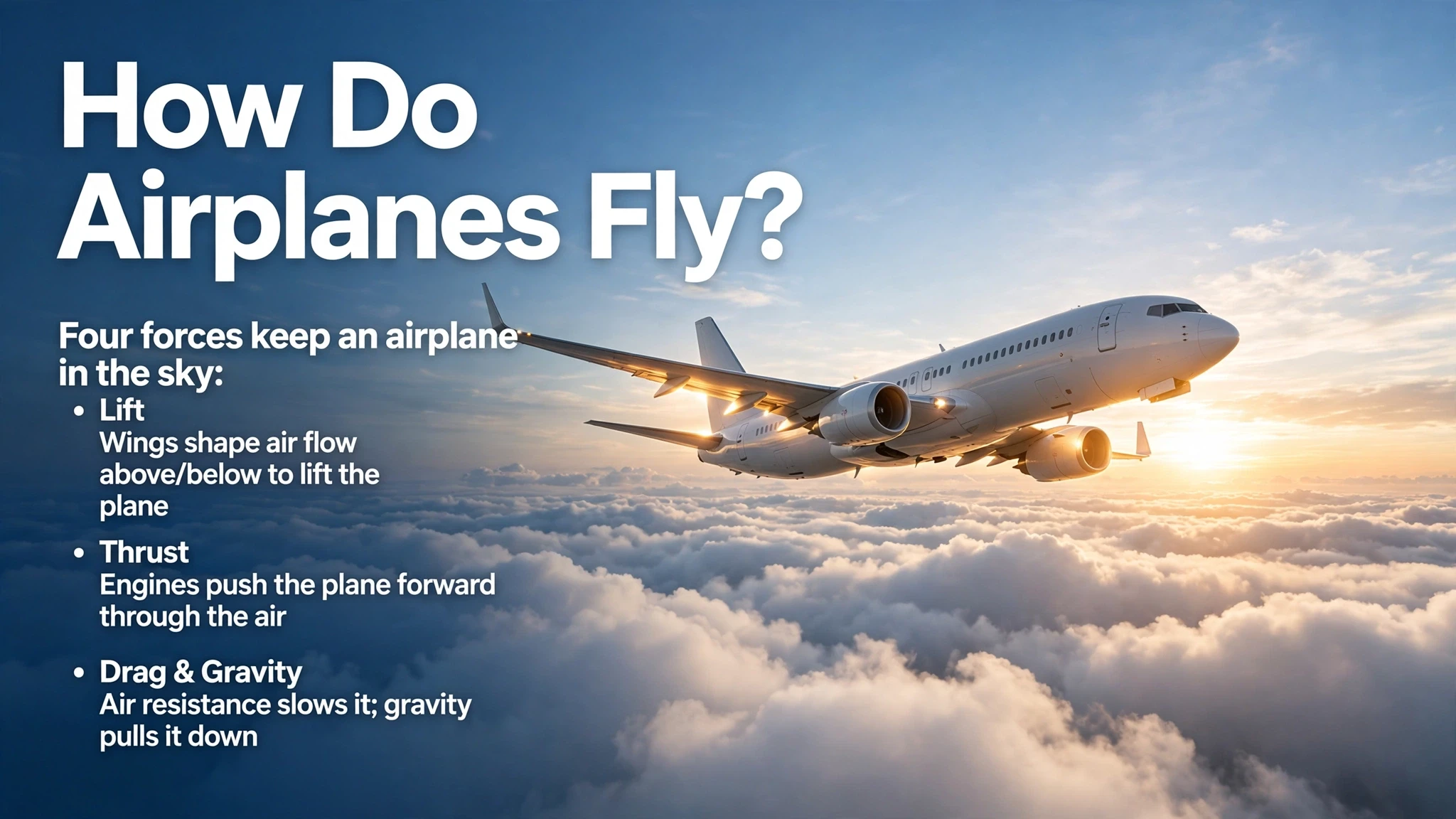
A passenger jet weighs more than four hundred tonnes when it is fully loaded, which is roughly the weight of eighty elephants, and yet it lifts off the ground, climbs to ten kilometres and stays there for hours. The first time you feel that push in your seat on takeoff, it is natural to wonder what is actually holding the machine up, because there is nothing visible underneath it. The answer is air itself. An aeroplane does not fly by magic or by flapping, it flies because its wings and engines shape the air around them, and the air pushes back. Four forces act on every aeroplane in flight: lift pulls it up, weight pulls it down, thrust pushes it forward, and drag pulls it back. When lift equals weight and thrust equals drag, the aeroplane flies straight and level. When lift is greater than weight, it climbs. When thrust is greater than drag, it speeds up. Everything else in aviation, from the curve of a wing to the roar of a jet engine, is a way of managing those four forces, and once you understand them, the whole machine starts to make sense.
The Four Forces That Decide Everything
Lift is the upward force made by the wings as air flows over them, and it is the force that does the most obvious work. Weight is the downward pull of gravity on the whole aeroplane, including the metal, the fuel, the passengers and the luggage, and it never switches off. Thrust is the forward push from the engines, whether they are jet engines on a large airliner or propellers on a small training aircraft. Drag is the resistance of the air itself, the friction and pressure that try to slow the aeroplane down, and it grows quickly as speed increases. A pilot thinks in these four forces the way a driver thinks in steering, braking and accelerating, because every control in the cockpit changes one or more of them. Pulling back on the controls increases the wing’s angle to the air and creates more lift, but it also creates more drag, so the aeroplane needs more thrust to keep its speed. That trade is the heart of flying.
How a Wing Makes Lift
A wing is not a flat board, it is a curved shape called an airfoil, with a rounded front edge, a curved top surface and a flatter bottom. As the wing moves forward through the air, the air splits at the front edge and travels over the top and under the bottom, rejoining at the back. The air travelling over the curved top has further to go, so it speeds up, and faster-moving air pushes down less hard, which means the pressure above the wing is lower than the pressure below it. That pressure difference pushes the wing upward, and that push is lift. This is the part of the explanation often linked to Bernoulli’s principle, named after the Swiss scientist Daniel Bernoulli, who described how faster fluid flow is linked to lower pressure. The explanation is useful, but it is not the whole story, because a flat wing held at a slight angle can also fly, and an aeroplane can fly upside down for a short time.
The other half of the story is the angle of attack, which is the angle between the wing and the air flowing towards it. When a wing is tilted slightly upward, it deflects air downwards as it passes, and by Newton’s third law, the air pushes the wing upward in return, just as pushing water down with your hand in a swimming pool pushes your hand up. Pilots control lift mainly by changing this angle and by changing speed, because lift grows with the square of speed, which means doubling the speed makes four times the lift. That is why takeoff speed matters so much: a Boeing 737 needs to reach roughly two hundred and fifty kilometres per hour before its wings make enough lift to carry its weight. Flaps, the hinged panels on the back of the wing that extend during takeoff and landing, increase the curve of the wing so it makes more lift at slower speeds, which is why you can hear and feel them move as the aeroplane prepares to land.
Engines: Where Thrust Comes From
A jet engine works by sucking in air at the front, squeezing it, mixing it with fuel, burning the mixture, and blasting the hot gas out of the back at high speed. The forward push comes from the reaction to that backward blast, the same principle that pushes a balloon forward when you let the air escape. Inside a modern turbofan, the type used on almost all airliners, a large fan at the front does most of the work: it pushes a huge volume of air around the engine core, like a giant propeller hidden inside a tube, and that bypass air provides most of the thrust while using less fuel. A Boeing 787’s engines each produce more than thirty tonnes of thrust, which is enough to push the aeroplane forward even though the whole machine weighs more than two hundred tonnes. The engines do not lift the aeroplane directly, except in a few military jets that can point their exhaust downward, they give it the speed that lets the wings make lift.
Propeller aircraft work differently but on the same idea: the propeller is itself a small rotating wing, and each blade makes lift in the forward direction, which pulls or pushes the aeroplane through the air. A small training aircraft such as a Cessna 172 uses a single piston engine and a propeller, cruises at around two hundred kilometres per hour, and needs a much shorter runway than a jet. Gliders have no engine at all, and they fly by trading height for speed, using rising air called thermals to climb, which proves that wings alone can keep an aircraft in the sky if the air is moving in the right way. Whatever the engine, the job is the same: overcome drag, reach flying speed, and keep the wings moving through fresh air, because a wing that stops moving through air stops making lift, and that is the one condition no aeroplane can survive.
Takeoff: The Moment Lift Wins
Takeoff begins with the aeroplane lined up on the runway, the engines pushed to full power, and the pilot holding the controls steady while the speed builds. At first the wings make almost no lift, and the whole weight rests on the wheels, so the ride feels like a fast car. As the speed passes about one hundred kilometres per hour, the controls start to feel alive, because air is now flowing over the tail and the wings fast enough for them to work. The pilot waits for the rotation speed, called Vr, which for a large airliner is roughly two hundred and fifty kilometres per hour, and then pulls back gently on the controls. The nose rises, the angle of attack increases, lift grows past weight, and the wheels leave the ground, usually with a soft bump as the landing gear unloads. The aeroplane climbs at a steep angle, the landing gear folds away to reduce drag, and the flaps retract once the speed is high enough for the clean wing to carry the load.
The reason runways are so long is that an aeroplane needs both distance to reach flying speed and extra distance to stop safely if an engine fails during the takeoff roll. A fully loaded Boeing 777 can need more than three kilometres of runway on a hot day at a high-altitude airport, because thin hot air gives the wings less to push against, so pilots calculate the required length before every departure using the weight, the temperature, the wind and the altitude. A headwind helps, because it increases the airflow over the wings even before the aeroplane moves, which is why aeroplanes almost always take off into the wind. Passengers feel the push in their seat because the engines are accelerating a heavy machine, and they feel the lift as a lightness when the wheels leave the ground. That sequence, power, speed, rotation, climb, is the same on every flight, from a two-seat trainer to the largest airliner.
Staying Up: Cruising at Ten Kilometres
Once an airliner reaches its cruising altitude, usually between ten and twelve kilometres, it levels off, the engines throttle back, and the aeroplane settles into the balance where lift equals weight and thrust equals drag. The air at that height is thin, which reduces drag and saves fuel, but it also means the wings must fly faster to make the same lift, so a cruising airliner travels at around nine hundred kilometres per hour. The cabin is pressurised to feel like an altitude of about two thousand metres, because the air outside is too thin to breathe, and the temperature outside is around minus fifty degrees Celsius, while the engines and the air conditioning keep the cabin comfortable. Pilots follow airways in the sky, which are invisible routes defined by navigation beacons and satellites, and air traffic controllers keep aeroplanes separated by several kilometres horizontally and by hundreds of metres vertically.
Turbulence, the bumpy air that worries many passengers, is usually caused by the aeroplane flying through rising and falling currents of air, or through the wake left behind another aircraft, and it shakes the machine without threatening the wings, which are built to flex and to handle forces far greater than any turbulence a passenger will feel. The wings of a large airliner can bend upward by several metres at the tips during flight, and they are tested on the ground to bend far beyond anything they meet in service. Fuel is carried in tanks inside the wings, which keeps the weight near the centre of lift and helps the structure, and a long-haul aeroplane can carry more than one hundred tonnes of fuel, which is most of what it burns during the climb. Cruising is the calmest and most efficient part of the flight, and it is where the four forces spend most of their time in perfect balance.
Turning, Climbing and Landing Again
An aeroplane turns by banking, which means rolling one wing down and the other up, so that some of the lift now points sideways and pulls the aeroplane around the turn. The pilot uses the ailerons, the hinged panels on the outer wings, to start the roll, and the rudder on the tail to keep the nose pointing in the right direction. A gentle turn banks the wings by about fifteen degrees, while a steep turn in training can reach forty-five degrees, and passengers feel the turn as a slight increase in weight pressing them into their seats. Climbing works the other way: the pilot increases the angle of attack or adds power, lift grows greater than weight, and the aeroplane rises, trading speed for height unless the engines add thrust. Descending is the reverse, with lift slightly less than weight, and the aeroplane glides downward in a controlled way rather than falling.
Landing is the reverse of takeoff, and it is the most demanding part of the flight because the aeroplane must slow down while still making enough lift to stay in the air. The pilot extends the flaps and the slats on the front of the wing, which increase lift at low speed, lowers the landing gear, and follows a gentle descent path called the glide slope, usually about three degrees, towards the runway. The speed at touchdown for a large airliner is roughly two hundred and forty kilometres per hour, and the pilot flares, raising the nose slightly just before the wheels touch, so the main wheels land first and the nose wheel settles gently afterward. Spoilers on top of the wings then pop up to destroy lift and press the weight onto the wheels, the brakes engage, and on many aircraft the engines reverse their thrust to help slow the machine. A smooth landing is not luck, it is the result of managing lift, drag and speed so that all four forces arrive at the runway together.
Why Flying Is So Safe
Commercial flying is the safest form of long-distance travel ever measured, with the chance of a fatal accident on a scheduled flight running at roughly one in tens of millions of flights, far lower than the risk of a car journey of the same distance. The safety comes from layers: aeroplanes are designed with more than one engine, more than one hydraulic system and more than one computer, so a single failure rarely matters; pilots train for engine failures, fires and bad weather in simulators every six months; and air traffic control keeps aircraft separated by strict rules. Maintenance is scheduled by flying hours rather than by waiting for something to break, and every part has a recorded life, so a wing or an engine is inspected and replaced on a timetable, not on a guess. Weather is the most common cause of delays rather than danger, because pilots and dispatchers plan routes around storms and carry extra fuel to reach an alternative airport if the destination closes. The next time you feel nervous on takeoff, remember that the push in your seat is the sound of four forces working exactly as engineers intended, and that thousands of people, from the designers to the controllers, have spent their careers making that moment routine.
My Take:
I used to think an aeroplane stayed up because the engines were powerful, and the wings were just there to hold them, which is backwards in a way that many people share. The engines only give the aeroplane speed, and speed gives the wings something to work with, and it is the wings, those curved pieces of metal, that actually do the lifting. Once I understood that, flying stopped feeling like a trick and started feeling like a trade: air moving fast over a curve pushes less hard, air pushed downward pushes the wing upward, and a heavy machine rides on a difference in pressure that you cannot see. I find that more impressive than any engine, because it means the sky is not empty, it is a material you can shape, and the wing is the tool that shapes it.
My strongest feeling about flight is how ordinary it has become, and how extraordinary that ordinariness is. We climb into a metal tube, we are served a drink at ten kilometres, and we complain about the legroom, as if crossing a continent in five hours were a normal human right. It is not normal, it is the result of a hundred years of people testing wings in wind tunnels, crashing prototypes, learning from accidents, and refusing to accept that a machine heavier than air could not fly. I think we should be more amazed, not less, and I think the best way to recover that amazement is to watch a takeoff from a window seat and feel the exact second when the wheels stop mattering, because that second is the moment the air takes over.
I also believe the four forces are a useful way to think about much more than aeroplanes, because they describe any situation where you are trying to move forward against resistance. Thrust is the effort you put in, drag is everything that slows you down, lift is the thing that carries you when your effort and your shape are right, and weight is the load you cannot pretend away. A student, a business and a traveller all have their own versions of these forces, and the ones who succeed are usually the ones who reduce drag and increase lift rather than simply pushing harder. An aeroplane that tries to fly by thrust alone, without a proper wing, will burn fuel and go nowhere, and I think people do the same when they work harder without changing their shape.
Another thing I care about is how pilots talk about flying, because they rarely talk about heroics and almost always talk about planning. A good pilot spends more time before the flight than during it, checking the weight, the weather, the runway length and the fuel, because the flight itself is mostly the execution of a plan made on the ground. I respect that, and I think it is the opposite of how most of us live, where we start things and then try to solve the problems as they appear. The pilot’s version is better: decide the speed you need before you need it, know your alternative airport before you leave, and never let a small problem become a big one by ignoring it. If more of us flew our days the way pilots fly aeroplanes, with a checklist and a backup plan, fewer days would end in a mess.
Finally, I think the fear many people feel about flying comes from not seeing what holds them up, and understanding the wing is the best cure for that fear. You cannot see lift, but you can see its effects: the wing bends, the air moves, the machine climbs, and thousands of flights do the same thing every day without drama. Turbulence feels frightening because it is invisible too, but it is only the aeroplane moving through uneven air, like a boat moving through waves, and the boat does not sink because the water is rough. I am not saying fear is foolish, because fear is a real feeling, but I am saying that knowledge is a better companion than worry, and the next time you fly, watching the wing flex and the flaps move will tell you more about safety than any reassurance ever could.
I also think the history of flight deserves more respect than it gets, because the Wright brothers did not have computers, wind tunnels, or government funding, they had a bicycle shop, a wind tunnel made of wood, and a willingness to test every idea in the air. They crashed, they rebuilt, and they learned from each failure, and their first flight in 1903 lasted twelve seconds and covered thirty-six metres, which is less than the length of a modern airliner. That small flight changed the world, because it proved that a machine heavier than air could fly, and once that was proved, everything else followed. I find that inspiring, because it shows that a big change does not need a big start, it needs a correct idea, tested honestly, and repeated until it works.
Another belief I hold is about the way we talk to children about flying, because a child who understands the wing will not be afraid of it. When a child asks why the aeroplane stays up, the worst answer is, do not worry, and the best answer is, look at the wing, see how it is curved, and imagine the air pushing it up. That answer gives the child a picture, a reason, and a sense of control, and it turns fear into curiosity. I think adults need the same thing, because fear grows in the dark, and knowledge is a light. The next time you fly with a child, point out the wing, the flaps, and the way the wing bends, and watch the fear turn into wonder, because wonder is the opposite of fear, and it is the reason humans learned to fly in the first place.
Frequently Asked Questions
How do airplanes fly if they are heavier than air?
An aeroplane flies because its wings make lift as they move through air. The curved wing and its angle push air downward and create lower pressure above the wing, and that upward push is strong enough to balance the weight.
What is lift in simple words?
Lift is the upward push on the wings caused by air moving over and under them. Faster air above the wing and air deflected downward below it combine to push the wing up.
Do the engines lift the airplane?
No, the engines provide thrust, which is forward push. Thrust gives the aeroplane the speed its wings need to make lift, but the wings do the lifting in normal flight.
Why do airplanes need such long runways?
An aeroplane must reach flying speed before its wings make enough lift, and the runway must also be long enough to stop safely if takeoff is abandoned, so large jets need two to three kilometres.
What causes turbulence?
Turbulence is caused by uneven air, such as rising and falling currents, wind over mountains, or the wake of another aircraft. It shakes the aeroplane but the wings are built to handle forces far greater than turbulence produces.
Why do airplane wings bend during flight?
Wings are designed to flex, and the tips of a large airliner can bend upward by several metres in flight. Flexing spreads the load and helps the wing handle changing forces without breaking.