How Do Movie Stunts Work? Behind the Scenes Explained
In this post
When a hero jumps from a burning building, or a car flips through the air, or two people fight on the roof of a moving train, you are watching a stunt, and you are watching people whose job is to make danger look real while staying alive. Stunt performers are the invisible artists of cinema. You rarely see their faces, you almost never hear their names, and yet without them, action films would be impossible. This guide explains how movie stunts actually work, from the person who designs them to the equipment that keeps performers safe.
It covers the stunt coordinator, the doubles, the planning and rehearsal, the rigs and wires, the different kinds of stunts, and the role of CGI. It also looks at the history of stunts, from the silent era to today, and at the risks that performers still take. By the end, you will watch action scenes differently, because you will know what you are really seeing, and who is really doing it.
Who Actually Performs a Stunt
Most stunts are performed not by the actor you see on screen, but by a stunt double, a trained performer who matches the actor’s height, build, and movement, and who wears the same costume, and the same wig, so that the camera cannot tell the difference. The double is a specialist, trained in falling, fighting, driving, or whatever the scene requires, and they may spend years learning a single skill, such as high falls, or car stunts, before they are trusted with a major film.
Some actors do perform their own stunts, most famously Tom Cruise, who has built a reputation on doing dangerous work himself, from hanging off aeroplanes to riding motorcycles off cliffs. But even he works with a team, and even he uses doubles for the most dangerous shots. The distinction matters less than people think: whether it is the actor or the double, the stunt is performed by a real person, taking a real risk, and the skill is the same. The double is not a lesser performer. They are often the more skilled one, and they deserve to be recognised as such.
Rehearsal: Where Stunts Are Really Made
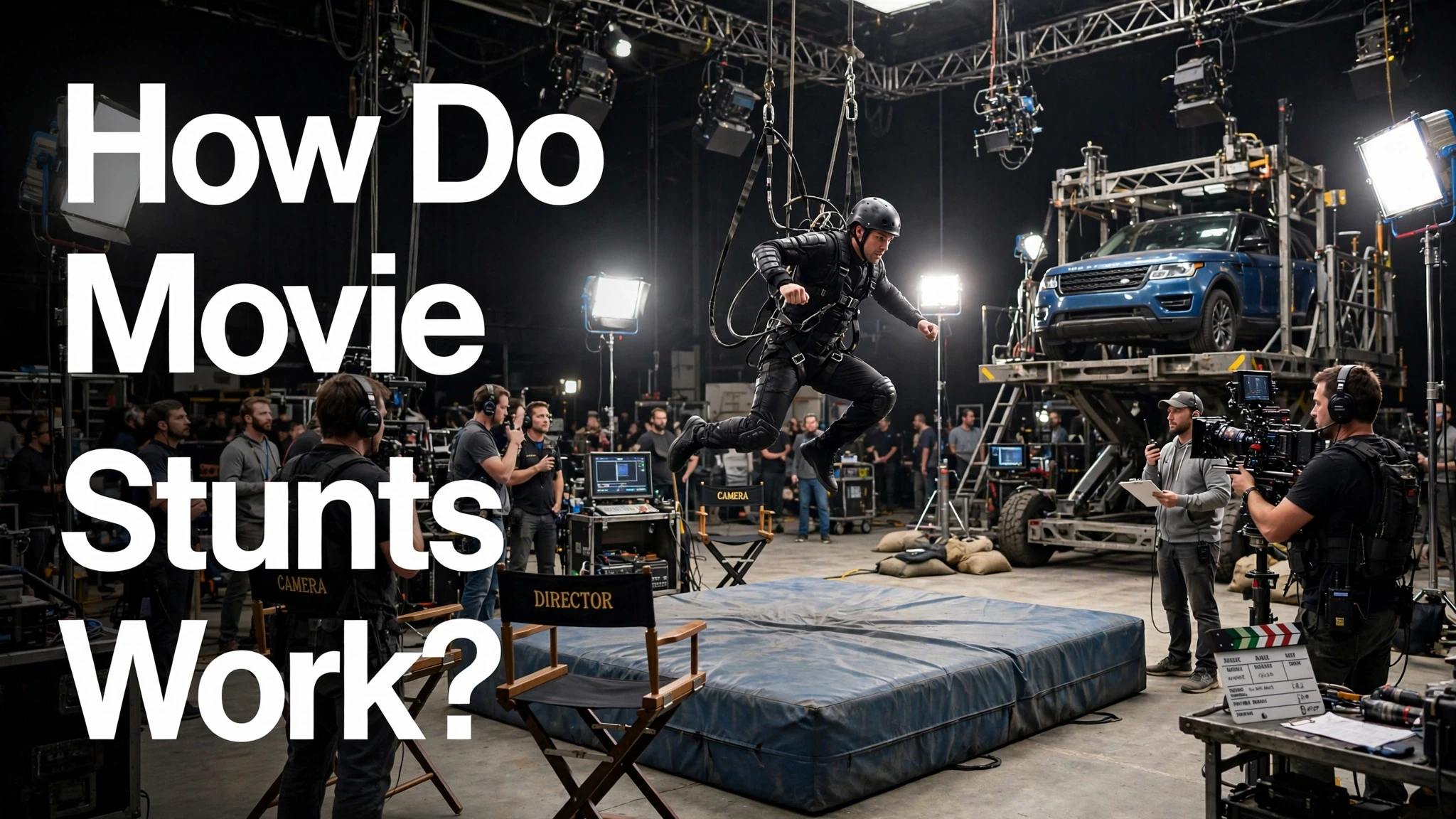
A stunt that looks spontaneous is almost always the result of weeks of rehearsal. The process begins with the stunt coordinator, who reads the script, and designs the action, working out what is possible, what is safe, and what will look best on camera. They then build a rehearsal space, often with mats, crash pads, and a mock-up of the set, and the performers practise the stunt, slowly at first, then at full speed, until it is smooth, and safe.
Rehearsal is where the danger is managed. A fall that will be filmed from a great height is first practised from a low height. A fight is first choreographed slowly, move by move, like a dance, and only sped up when everyone knows it perfectly. A car chase is first driven slowly, on a closed road, with the camera positions worked out in advance. By the time the cameras roll, the performers have done the stunt many times, and they know exactly what will happen. That is why most stunts look effortless: the effort happened in rehearsal, where the audience cannot see it.
Safety Rigs, Pads and Wires
The safety equipment used in stunts is extensive, and it is hidden by the camera. A performer who falls from a height will land on an airbag, or a pile of cardboard boxes, which is then hidden by the angle, or removed in editing. A performer who is thrown through the air will wear a wire rig, attached to a harness under their costume, which controls the fall, and which is then erased by CGI. A performer in a fight will wear padding under their clothes, and the floor will be padded, even when it looks like concrete.
The most important safety tool is the planning itself. Before a stunt is filmed, the coordinator, the director, and the safety team will go through it step by step, asking what could go wrong, and what will be done if it does. There will be medics on set, and there will be a plan to stop filming immediately if something goes wrong. That planning is why serious injuries are rare, relative to the danger, though they do still happen, and every injury is a reminder that the risk is real. Safety is not a single device. It is a system, and it depends on everyone on set taking it seriously.
Fight Scenes: Choreography, Not Chaos
A film fight looks chaotic, but it is choreographed as carefully as a dance. The fight coordinator designs each move, the performers learn it step by step, and the camera is placed so that the punches look as if they land, when in fact they miss by a safe distance. The sound of the impact is added later, in editing, and it is that sound, more than the image, that convinces the audience that a punch was real. Without the sound, a film fight would look like what it is: two people moving in a pattern, missing each other by inches.
The performers must also sell the reaction: the person who is hit must move as if they were hit, at exactly the right moment, and with exactly the right force. That timing takes practice, and it is why fight scenes are rehearsed so many times. A good fight scene is also a story: it shows who is winning, who is losing, and how the balance changes, and it uses the space, the furniture, and the environment, to make the fight feel real. The best fight scenes are not the longest, or the most violent. They are the ones that tell you something about the characters, through the way they fight.
Car Chases and Practical Effects
A car chase is one of the most complex stunts to film, because it involves real vehicles, real roads, and real risk, and it must look fast, and dangerous, while being controlled. The cars are often modified, with roll cages, reinforced brakes, and a second set of controls, so that a stunt driver can drive from the roof, or from a pod attached to the car, while the actor sits inside, pretending to drive. The roads are closed, the speeds are planned, and the sequence is filmed in short sections, which are then edited together to look like a single, continuous chase.
Practical effects, meaning effects done for real, rather than by computer, are still used because they look better. A real car, sliding around a corner, has a weight, and a physicality, that a computer-generated car cannot match, and audiences can tell the difference, even if they cannot explain it. That is why the best action films still use real cars, real explosions, and real stunts, and use CGI only to enhance them, by removing wires, or extending a background. A chase that is entirely computer-generated feels weightless, and forgettable. A chase that is real, even partly, feels thrilling, because it is.
When Computers Help and When They Don’t
CGI has changed stunts, but it has not replaced them. Its main use is to remove the evidence of safety: the wires, the rigs, and the pads, which are erased frame by frame, so that a performer who was safely supported appears to be falling freely. CGI is also used to extend a set, to add a background, or to make a safe stunt look more dangerous, by adding fire, or debris, or a height that was not really there. Used this way, CGI is a tool that serves the physical performance, and the result is better than either could achieve alone.
But CGI can also be used badly, when it replaces the performance entirely. A fully computer-generated fight, or chase, often feels weightless, because there is no real body, no real weight, and no real risk, and the audience senses that, even if they cannot say why. The best modern action films understand this, and they use CGI sparingly, to enhance, not to replace. The rule is simple: if a stunt can be done for real, safely, it should be done for real, and CGI should be used only for what cannot be done, or cannot be done safely. That balance is the future of action cinema, and it respects both the performers, and the audience.
The People Behind the Action
Stunt performers are among the least recognised people in cinema, despite doing some of the most dangerous work. They are rarely credited prominently, they are paid less than the actors they double for, and they have no Oscar category, despite a campaign that has lasted for decades. That lack of recognition is unfair, because without them, there would be no action films, and the films we love would be very different. A stunt performer is an athlete, an artist, and a technician, and they spend years training in gymnastics, martial arts, driving, and falling, to do work that most people could not do at all.
The next time you watch an action film, look for the names in the credits, and think about the people you never saw. The fall, the fight, and the chase were performed by someone who trained for years, who rehearsed for weeks, and who risked their safety, so that you could feel thrilled for a few seconds. That is a remarkable thing, and it deserves to be recognised. Stunt performers are the invisible artists of cinema, and they have been since the first days of film. Remember them, and enjoy their work, knowing what it cost, and what it took, to create it.
The History of Stunts: From Silent Films to Today
Stunts are as old as cinema itself, and the first stunt performers were the actors themselves, who performed dangerous feats because there was no one else to do them. In the silent era, stars such as Buster Keaton and Harold Lloyd performed their own stunts, and they did things that seem astonishing today: hanging from a clock tower, falling from a building, or standing on a moving train. They did it without safety equipment, without CGI, and often without rehearsal, and they were injured frequently. Keaton broke his neck during a stunt, and did not know it for years. That was the reality of early cinema: danger was real, and the performers accepted it, because the audience expected it, and because there was no other way to create the spectacle.
As films became more complex, stunt performers became specialists, and the profession grew. In the 1930s and 1940s, stuntmen such as Yakima Canutt developed techniques that are still used today, including the fall from a horse, the fight choreography, and the use of safety equipment. Canutt’s work on films such as Stagecoach set a standard for action, and his innovations, such as the use of a safety harness, saved lives. The profession was dangerous, and it was poorly paid, and stunt performers were often uncredited, but they were essential to the films they worked on, and their skill was respected by those who understood it.
The 1970s and 1980s were a golden age for stunts, with films that featured car chases, explosions, and falls that were performed for real, without CGI. Stunt coordinators such as Hal Needham, who directed Smokey and the Bandit, pushed the boundaries of what was possible, and they created sequences that are still admired today. But the danger was also real, and there were injuries and deaths, which led to calls for better safety, and for recognition. Stunt performers began to organise, to demand better pay and safer conditions, and to ask for an Oscar category, a campaign that continues today, and that has not yet succeeded.
The arrival of CGI in the 1990s changed stunts again, because it allowed filmmakers to create action that was impossible, or too dangerous, to perform for real. At first, CGI replaced many stunts, and some feared that the profession would disappear. But the opposite happened: audiences began to value real stunts more, because they could tell the difference, and filmmakers began to use CGI to enhance, rather than to replace, practical action. The best modern action films combine real stunts with CGI, using the computer to remove wires, to extend a background, or to make a safe stunt look dangerous, while keeping the physical performance at the centre. That combination is the future of stunts, and it is a tribute to the performers who have always been at the heart of action cinema.
Today, stunt performers are more skilled, better trained, and safer than ever before, but the work is still dangerous, and it still requires courage, discipline, and a deep understanding of risk. They train in gymnastics, martial arts, driving, and falling, and they spend years learning their craft. They are athletes, artists, and technicians, and they deserve recognition for what they do. The next time you watch an action film, remember that the most spectacular moments were performed by real people, who risked their safety to entertain you, and who have been doing so since the first days of cinema. That history is worth knowing, and those people are worth celebrating.
My Take:
The history is what stays with me, because it reminds me that stunts are not a modern invention, but a tradition that goes back to the first days of cinema, and that the people who perform them have always been brave, skilled, and underappreciated. Buster Keaton hanging from a clock, Yakima Canutt falling from a horse, and the stunt performers of today risking their safety for a shot that lasts a few seconds: they are part of the same story, and it is a story of courage, of craft, and of a willingness to do what others cannot. I think we should remember that, and we should respect it, because without stunt performers, there would be no action cinema, and the films we love would be very different.
I also think the campaign for an Oscar for stunt performers deserves support, because it is a recognition that is long overdue. Stunt performers are essential to filmmaking, they risk their lives, and they are often uncredited, and unrecognised, while the actors they double for receive awards and praise. An Oscar would not make the work safer, but it would acknowledge its importance, and it would give stunt performers the respect they deserve. The fact that the campaign has continued for decades, without success, is a sign of how undervalued the profession is, and it is something that should change. If you love action films, you should support the people who make them possible, and that support starts with recognition.
Another point I would make is about the difference between real and fake, and why it matters. Audiences can tell when a stunt is real, and they respond to it, because there is a physical truth to it that CGI cannot replicate. A real fall, a real car chase, and a real fight have a weight, a speed, and a danger that feels authentic, and that authenticity is part of the pleasure. CGI has its place, and it can do things that are impossible in real life, but it should enhance, not replace, the physical performance. The best action films understand that, and they use both, in balance. The worst rely on CGI alone, and they feel weightless, and forgettable. Trust your eye, and value the real.
And the final thing I would say is to watch the credits, and to look for the names of the stunt performers, the coordinators, and the teams who made the action possible. Those names are often buried, but they are there, and they deserve to be seen. When you watch a film, take a moment to appreciate the people you never see, who performed the falls, the fights, and the chases, and who did it with skill, courage, and professionalism. They are the invisible artists of cinema, and without them, the movies would be a great deal less exciting. Remember them, respect them, and enjoy the work they do. That is the least we can do, for the people who risk so much, to entertain us.
The future of stunts is a real debate in the film industry, and it is worth following. On one side, computer effects can now do things that were once impossible, and they can keep performers safe. On the other side, audiences can tell the difference between a real car chase and a digital one, and many directors still prefer the real thing, because it looks better, and it feels more exciting. The likely future is a mix: practical stunts for the moments that matter, and digital help for the moments that would be too dangerous, or too expensive, to do for real. That balance is already how most big films are made.
There is also a long-running campaign for stunt performers to be recognised at the Oscars, with their own award, and it is a cause worth supporting, because stunt work is a craft, and the people who do it risk their bodies for our entertainment. Safety has improved a great deal over the years, with better rigs, better rehearsal, and better planning, but the risk has not disappeared, and it never will. The next time you watch an action scene, remember that someone trained for months to make it look easy, and that their name is rarely on the poster. That is the real story of stunts: invisible skill, in the service of a story, performed by people who love their work.
Frequently Asked Questions
How do movie stunts work?
A stunt is planned by a coordinator, rehearsed with the performers, protected with rigs, mats, wires, and padding, and then filmed, often in several takes and from angles that hide the safety equipment. CGI is then used to remove wires and enhance the result, while the physical performance stays real.
Are movie stunts dangerous for performers?
Yes, stunts carry real risk despite careful planning, and performers are sometimes injured. Safety has improved greatly with better equipment, rehearsal, and regulation, but the danger is never zero, which is why stunt work requires years of training and discipline.
Do actors do their own stunts?
Some do, especially actors known for action roles who train for it, but most dangerous stunts are performed by professional doubles who match the actor’s build and movement. The camera, editing, and costuming make the switch invisible to the audience.
How are fight scenes filmed safely?
Fight scenes are choreographed like dances, rehearsed slowly, and filmed with careful camera angles and timing so that hits look real while missing by a safe distance. Padding, pulled punches, and sound effects complete the illusion.
What does a stunt coordinator do?
The stunt coordinator designs every action sequence, hires and trains the performers, plans the safety equipment, runs rehearsals, and works with the director to get the shot. They are responsible for both the spectacle and the safety of everyone involved.