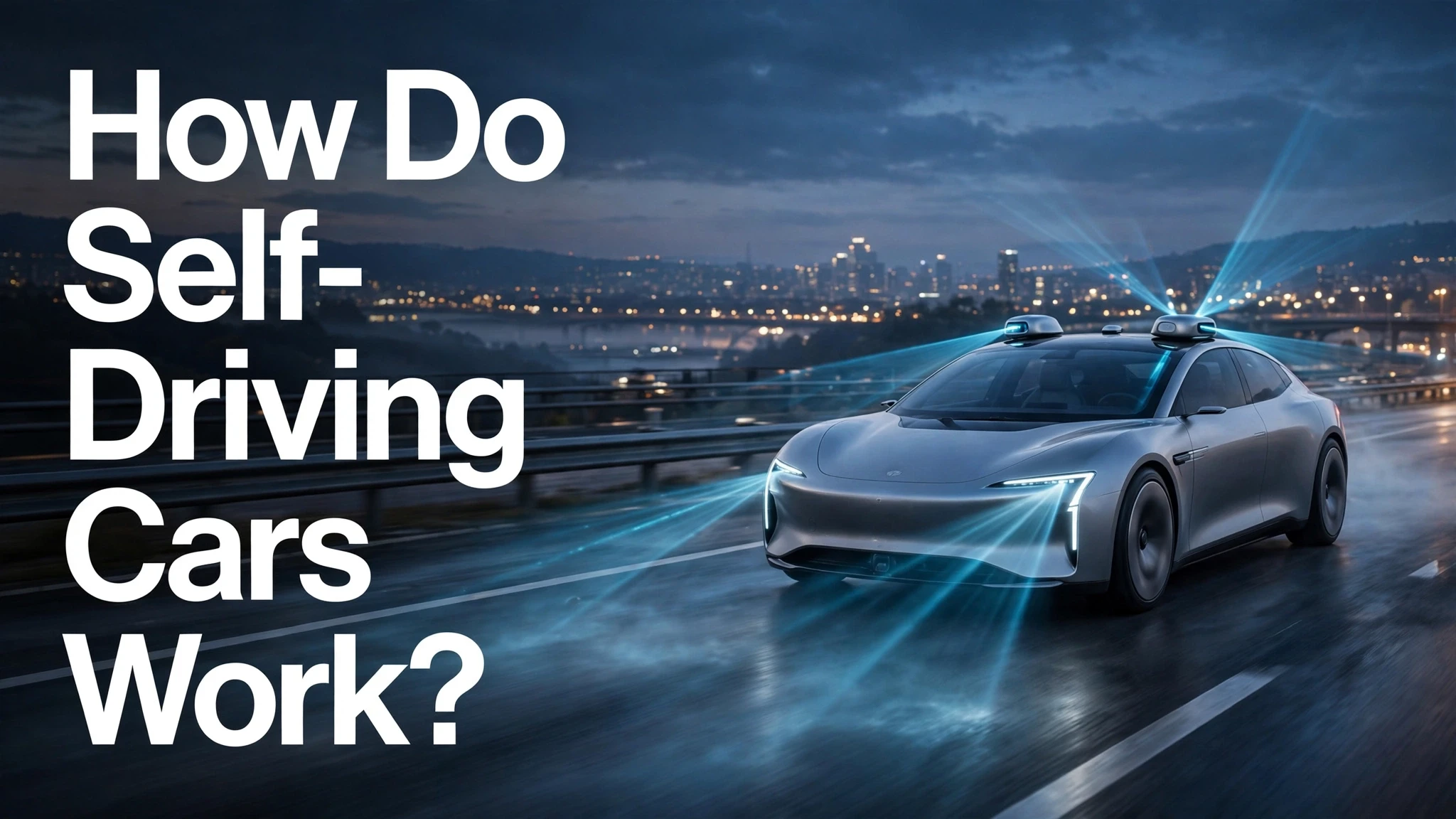
How Do Self-Driving Cars Work? Explained Simply
In this post
A self-driving car is a vehicle that can sense its surroundings and drive itself, with little or no help from a human driver. In practice, what people notice first about a self-driving car is cameras, radar and lidar reading the road, since it sets how daily life feels out on a motorway or in city traffic and the faith passengers rest in it. While the car runs well with cameras, radar and lidar reading the road on a motorway or in city traffic, nobody thinks about a self-driving car in the least; one failure, though, dominates memory and shapes each later call. Getting a grip on cameras, radar and lidar reading the road before buying, using or judging a self-driving car spares you squandered hours, money and aggravation later, and turns a tangled subject into a plain decision.
It uses sensors to see the road, a computer to decide what to do, and motors to steer, brake and accelerate. Look closely at cameras, radar and lidar reading the road and the picture of a self-driving car grows sharper, since this single detail ties into almost every other aspect of a self-driving car. That is why some people love a self-driving car and others doubt it, and why cameras, radar and lidar reading the road can shine in one setting, say out on a motorway or in city traffic while faltering badly elsewhere. Once that bond inside cameras, radar and lidar reading the road is clear, the rest of a self-driving car falls into place, and the claims you meet about a self-driving car are easier to judge calmly and honestly.
A Car That Drives Itself: The Simple Idea
Cameras act as the eyes of the car, reading traffic lights, road signs, lane markings and the faces of the road ahead. This is also where most misunderstandings about a self-driving car start, since the breezy retelling quietly drops cameras, radar and lidar reading the road, the very piece that counts. Readers echo the breezy retelling of a self-driving car, hand it along, and before long the breezy retelling passes for settled fact among cameras, radar and lidar reading the road. The longer version of a self-driving car repays the extra attention, laying bare the limits, the compromises and the genuine drivers behind the slogans around cameras, radar and lidar reading the road.
Radar uses radio waves to measure the distance and speed of other cars, even in fog, rain or darkness. A beginner should hold on to cameras, radar and lidar reading the road, because it gives a passenger trusting the car a simple way to test claims about a self-driving car. If a claim does not fit cameras, radar and lidar reading the road, it is probably exaggerated or wrong about a self-driving car. If it does fit cameras, radar and lidar reading the road, you can lean on the fuller account about a self-driving car more. That small test with cameras, radar and lidar reading the road builds a handy reflex, one that serves a self-driving car alongside plenty of other machines you will come across.
Lidar uses laser light to build a detailed 3D map of the surroundings, showing the shape of cars, people and trees. There is a practical side to a self-driving car too, since it shapes your next move out on a motorway or in city traffic. Knowing cameras, radar and lidar reading the road helps a passenger trusting the car pick wisely, keep more cash in pocket, and dodge a familiar blunder around a self-driving car. A person who misses cameras, radar and lidar reading the road risks landing on the wrong model, the wrong approach, or fretting over the wrong danger with a self-driving car. What sets buyers apart is rarely cleverness, merely grasping this single strand of the story behind a self-driving car, and that piece is cameras, radar and lidar reading the road.
Ultrasonic sensors help with parking, because they detect objects very close to the car, such as a wall or a bollard. The history of a self-driving car helps here, because cameras, radar and lidar reading the road grew out of real needs. A self-driving car emerged from past headaches, past prototypes and past blunders, with every iteration moulding cameras, radar and lidar reading the road into the form on shelves now. Grasping that backstory, the present shape of a self-driving car seems less arbitrary, more a direct reply to a genuine headache engineers once endured with cameras, radar and lidar reading the road and tried to solve.
Eyes of the Car: Cameras, Radar and Lidar
GPS tells the car roughly where it is, while a detailed map tells it the shape of the road, the lanes and the speed limit. Put a self-driving car beside a human driver and the choice becomes sharper. A human driver might cost less, feel simpler or sit closer to habit, yet they stumble precisely where cameras, radar and lidar reading the road succeeds for a self-driving car. That is why experts keep returning to cameras, radar and lidar reading the road, and why a good guide to a self-driving car has no business glossing over it, however keen the reader is to jump to the verdict.
The computer combines all the sensor data into one picture of the world, a process called sensor fusion. Finally, remember that this detail, cameras, radar and lidar reading the road, stands far from a stray factoid concerning a self-driving car. This detail, cameras, radar and lidar reading the road, threads into the coming section, into the queries readers raise around a self-driving car, plus the verdict you will reach eventually. Keep hold of cameras, radar and lidar reading the road while you continue, since later passages rest upon it and grow far easier to follow once this groundwork beneath a self-driving car is in place.
Artificial intelligence in the car learns to recognise a pedestrian, a cyclist, a bus and a traffic cone from millions of examples. In everyday use, the opening thing passengers register about a self-driving car is cameras, radar and lidar reading the road, since it colours the comfort felt out on a motorway or in city traffic and the confidence passengers put in it. While the car behaves well with a self-driving car on a motorway or in city traffic, nobody gives it a second thought; one glitch, though, lodges in memory. This is why getting to grips with cameras, radar and lidar reading the road before buying, using or judging a self-driving car cuts wasted hours, cash and irritation down the road, turning a muddled subject into a straightforward pick.
The car predicts what other road users might do next, for example whether a pedestrian will cross the road. Look closely and the picture of a self-driving car becomes clearer, because this detail, cameras, radar and lidar reading the road, ties into every other strand of the tale behind a self-driving car. It is cameras, radar and lidar reading the road that explains why some people love a self-driving car and others doubt it, and why a self-driving car can dazzle somewhere yet flop somewhere else. Once you grasp that link inside cameras, radar and lidar reading the road, the rest of a self-driving car slots neatly into place, and the slogans you hear grow simpler to weigh with a steady, candid gaze.
The Brain: AI, Maps and Decisions
The planning system chooses a safe path, such as staying in lane, changing lane, or stopping at a red light. Most misunderstandings about a self-driving car likewise start right here, since the breezy retelling omits the crucial element, namely cameras, radar and lidar reading the road. The short version of a self-driving car keeps circulating from mouth to mouth, hardening into accepted fact, although the fuller account behind cameras, radar and lidar reading the road reveals a richer picture. The fuller telling is well worth the effort for a self-driving car, since it exposes the limits, the compromises and the genuine drivers behind the slogans about cameras, radar and lidar reading the road.
The control system then turns the steering wheel, presses the brake and pushes the accelerator to follow that plan. For a beginner, this detail, cameras, radar and lidar reading the road, stands out as the keeper, since it hands a passenger trusting the car a yardstick for checking whatever they hear about a self-driving car. A claim about a self-driving car that does not fit cameras, radar and lidar reading the road likely overstates matters or misses the mark. Should a claim line up with cameras, radar and lidar reading the road, the rest of the explanation about a self-driving car earns more trust. Testing a self-driving car with that small check on cameras, radar and lidar reading the road builds a handy reflex, serving well here and across plenty of other machines you will encounter.
Level 0 means no automation, and the human driver does everything, including steering and braking. There is a practical side to cameras, radar and lidar reading the road too, since it steers your next step around a self-driving car. A person who understands cameras, radar and lidar reading the road tends to pick smarter, keep more money, and sidestep a familiar pitfall with a self-driving car. Missing cameras, radar and lidar reading the road can leave a passenger trusting the car facing the wrong model, the wrong approach, or fretting over the wrong hazard amid a self-driving car. What divides buyers is rarely brainpower, merely grasping cameras, radar and lidar reading the road and how it shapes a self-driving car.
Level 1 means one helper, such as cruise control or lane keeping, but the driver still controls the car. History helps with a self-driving car, because cameras, radar and lidar reading the road did not appear by accident. A self-driving car in its present form sprang from old frustrations, old prototypes and old errors, each round refining cameras, radar and lidar reading the road into its current shape. Once that backstory sinks in, the modern form of a self-driving car comes across as less of a fluke, more a plain response to a true headache engineers once battled and sought to fix with cameras, radar and lidar reading the road.
Levels 0 to 5: How Self-Driving Is It?
Level 2 means the car can steer and control speed together, but the driver must watch the road and be ready to take over. Compare a self-driving car with a human driver and the stronger pick soon stands out. The rival, a human driver, might come cheaper, plainer or nearer to habit, yet it collapses right where cameras, radar and lidar reading the road succeeds with a self-driving car. Experts keep returning to cameras, radar and lidar reading the road with good cause, and any solid guide to a self-driving car ought to cover it, however eager the reader is to race toward the verdict.
Level 3 means the car can drive itself in certain conditions, such as a motorway, but the driver must take over when asked. Finally, remember that this detail about a self-driving car does not stand alone from cameras, radar and lidar reading the road. This detail about cameras, radar and lidar reading the road threads forward into the next section, into the queries readers put about a self-driving car, plus the final verdict. Bear cameras, radar and lidar reading the road close at hand while you press on, since the later passages lean on it and turn far simpler to grasp once this bedrock beneath a self-driving car is in place.
Level 4 means the car can drive itself in a defined area, such as a city centre, without a driver in the seat. In practice, what people notice first about a self-driving car is cameras, radar and lidar reading the road, since it settles how daily life feels out on a motorway or in city traffic and the faith passengers soon place in the car. Once the car runs smoothly with cameras, radar and lidar reading the road on a motorway or in city traffic, nobody thinks about a self-driving car in the slightest; a lone glitch, though, sticks in memory and shapes each later judgement. Grasping cameras, radar and lidar reading the road before buying, using or judging a self-driving car steers you toward a smarter purchase, fewer wasted pounds and a calmer decision overall.
Level 5 means full self-driving everywhere, in all conditions, with no steering wheel needed, and no such car is sold yet. Look closely at cameras, radar and lidar reading the road and the picture of a self-driving car sharpens considerably, since this single mechanism ties into nearly every other aspect of a self-driving car. That is why some people love a self-driving car and others doubt it, and why cameras, radar and lidar reading the road can excel in a single spot, say out on a motorway or in city traffic while falling short elsewhere. Once that tie inside cameras, radar and lidar reading the road is clear, the rest of a self-driving car clicks into place, and the slogans you meet about a self-driving car grow simpler to size up with a steady eye.
How a Self-Driving Car Handles a City
A self-driving car in a city must handle traffic lights, roundabouts, pedestrians, cyclists, parked cars and roadworks. This is also where most misunderstandings about a self-driving car start, since the tidy retelling quietly leaves out cameras, radar and lidar reading the road, the very bit that counts. People echo the tidy retelling of a self-driving car, hand it onward, and soon the tidy retelling stands as gospel in plenty of heads about cameras, radar and lidar reading the road. The longer version of a self-driving car repays the trouble, laying out the limits, the trade-offs and the true causes behind the headlines concerning cameras, radar and lidar reading the road.
A car that cannot see a road marking in heavy rain may slow down or ask the human driver to take over. A beginner should hold on to cameras, radar and lidar reading the road, because it gives a passenger trusting the car a simple way to test claims about a self-driving car. If a claim does not fit cameras, radar and lidar reading the road, it is probably exaggerated or wrong about a self-driving car. If it does fit cameras, radar and lidar reading the road, you can trust the fuller story about a self-driving car more. That small test with cameras, radar and lidar reading the road forms a handy routine, one that helps with a self-driving car alongside many other machines you will meet down the road.
Snow, fog and heavy rain can confuse cameras and lidar, which is why weather is one of the hardest problems. There is a practical side to a self-driving car too, since it guides your next move out on a motorway or in city traffic. Knowing cameras, radar and lidar reading the road helps a passenger trusting the car choose more wisely, save cash, and dodge a routine blunder with a self-driving car. A person who misses cameras, radar and lidar reading the road could settle for the wrong model, the wrong method, or fret about the wrong hazard with a self-driving car. What separates shoppers is seldom intellect, merely understanding this single thread of the tale for a self-driving car, and that piece is cameras, radar and lidar reading the road.
A self-driving car is tested for millions of kilometres in simulation, where the computer practises rare and dangerous situations. The history of a self-driving car helps here, because cameras, radar and lidar reading the road grew out of real needs. A self-driving car sprang from earlier troubles, earlier mock-ups and earlier slip-ups, each stage shaping cameras, radar and lidar reading the road into the edition we use now. With that past in mind, the current build of a self-driving car reads as less haphazard, more a straight answer to a real nuisance engineers once faced with cameras, radar and lidar reading the road and tried to solve.
Safety, Accidents and Who Is Responsible
Safety is measured by comparing crashes per kilometre with human drivers, but the data is still limited and debated. Put a self-driving car beside a human driver and the choice becomes sharper. A human driver could be lower-priced, plainer or closer to habit, yet they falter exactly where cameras, radar and lidar reading the road succeeds for a self-driving car. That is why experts keep returning to cameras, radar and lidar reading the road, and why a good guide to a self-driving car must not leave it out, however impatient the reader is to reach the verdict.
When a self-driving car crashes, the question of who is responsible, the owner, the maker or the software, is still being decided in law. Finally, remember that this detail, cameras, radar and lidar reading the road, counts as far more than a stray snippet concerning a self-driving car. This detail, cameras, radar and lidar reading the road, reaches into the next section, into the questions people raise about a self-driving car, plus the choice you will settle on finally. Hold fast to cameras, radar and lidar reading the road while you keep reading, since later sections build upon it and grow far plainer once this base beneath a self-driving car is in place.
Regulators in different countries set different rules, so a car allowed in one city may not be allowed in another. In daily use, the earliest thing passengers pick up on about a self-driving car is cameras, radar and lidar reading the road, since it shapes the ease felt out on a motorway or in city traffic and the trust passengers rest in it. As long as the car behaves well with a self-driving car on a motorway or in city traffic, nobody spares it a thought; a lone breakdown, though, stays lodged in memory. That is why mastering cameras, radar and lidar reading the road before buying, using or judging a self-driving car saves squandered time, money and annoyance down the line, turning a perplexing topic into a plain pick.
A self-driving taxi, called a robotaxi, already carries passengers in some cities, with no driver in the front seat. Look closely and the picture of a self-driving car becomes clearer, because this detail, cameras, radar and lidar reading the road, joins up with every other thread of the narrative behind a self-driving car. It is cameras, radar and lidar reading the road that explains why some people love a self-driving car and others doubt it, and why a self-driving car can triumph somewhere yet flop elsewhere. Once you spot that link inside cameras, radar and lidar reading the road, the rest of a self-driving car snaps into focus, and the claims you hear become simpler to assess with a cool, candid eye.
Limits, Weather and the Road Ahead
The future of self-driving cars depends on better sensors, clearer laws, and public trust built over time. Most misunderstandings about a self-driving car likewise kick off here, since the neat retelling drops the vital piece, which is cameras, radar and lidar reading the road. The short version of a self-driving car keeps getting echoed and handed along, till it hardens into gospel in plenty of heads, though the complete account behind cameras, radar and lidar reading the road tells a fuller tale. The extended telling is worth the trouble for a self-driving car, as it reveals the limits, the trade-offs and the true roots behind the headlines covering cameras, radar and lidar reading the road.
The best way to understand a self-driving car is to see it as a careful student driver, with many eyes and a very fast brain. For a beginner, this detail, cameras, radar and lidar reading the road, ranks as the one to keep close, since it offers a passenger trusting the car a benchmark for weighing whatever they are told about a self-driving car. A claim about a self-driving car that does not fit cameras, radar and lidar reading the road probably stretches the truth or gets it wrong. When a claim matches cameras, radar and lidar reading the road, the rest of the explanation about a self-driving car earns more trust. Testing a self-driving car with that small check on cameras, radar and lidar reading the road counts as a handy routine, and it holds here just as it does for many other things you will come across.
A self-driving car is a vehicle that can sense its surroundings and drive itself, with little or no help from a human driver. There is a practical side to cameras, radar and lidar reading the road too, since it colours your next step with a self-driving car. A person who understands cameras, radar and lidar reading the road will pick smarter, spend more carefully, and steer clear of a common blunder with a self-driving car. Missing cameras, radar and lidar reading the road can leave a passenger trusting the car stuck with the wrong pick, the wrong method, or fretting about the wrong peril amid a self-driving car. What marks buyers out is rarely smarts, simply grasping cameras, radar and lidar reading the road and how it shapes a self-driving car.
It uses sensors to see the road, a computer to decide what to do, and motors to steer, brake and accelerate. History helps with a self-driving car, because cameras, radar and lidar reading the road did not appear by accident. A self-driving car in their modern guise grew from past snags, past drafts and past missteps, each advance sculpting cameras, radar and lidar reading the road into the shape it holds today. Knowing that past makes the current build of a self-driving car feel less random, more a clear reply to a genuine problem engineers once faced and worked to fix with cameras, radar and lidar reading the road.
My Take:
A self-driving car is not a magic car, it is a set of sensors, a map and a computer making decisions very fast. My view of a self-driving car has grown stronger the more I have looked at the details of cameras, radar and lidar reading the road, because the facts keep pointing the same way. A headline or a promise about a self-driving car can impress anyone, but the quiet details in cameras, radar and lidar reading the road decide whether it works in real life for a passenger trusting the car. I would rather trust the details of cameras, radar and lidar reading the road than a slogan for a self-driving car, and admit what is still unknown than pretend a self-driving car has a simple answer.
Lidar and cameras together make sense, because each sensor covers the weakness of the other. I say this not to dismiss the other side of a self-driving car, but because the trade-off in cameras, radar and lidar reading the road is real and it deserves to be named. With a self-driving car, something is always given up, and knowing the trade-off in cameras, radar and lidar reading the road leads to a better decision than hearing only the benefits. That is why I keep coming back to cameras, radar and lidar reading the road, and why I think it should be part of any honest discussion of a self-driving car.
The levels from 0 to 5 are the most important idea here, because Level 2 is not self-driving, no matter what it is called. From my own reading about a self-driving car, the strongest argument is not the loudest one, but the one that survives a closer look at cameras, radar and lidar reading the road. When I test a claim about a self-driving car against the facts in this article, some claims fall away quickly, while others hold up against cameras, radar and lidar reading the road. The claims that hold up when tested against cameras, radar and lidar reading the road are the ones I trust about a self-driving car, and the ones I would pass on to a friend who asked for a straight answer.
A car that asks the driver to take over in a second is a dangerous design if the driver was not watching. What matters most to me here is how an ordinary person experiences a self-driving car on a motorway or in city traffic, not an expert with perfect conditions. A version of a self-driving car that shines in a demonstration but fails on a motorway or in city traffic is not really working for a passenger trusting the car. I test a self-driving car by asking whether it helps on a busy day, in a real home, with real limits, and that is the test I apply to cameras, radar and lidar reading the road before recommending anything.
Weather is the honest test, and a car that only works on a sunny day is not ready for real roads. I also think the future of a self-driving car depends on the choices people make now, not only on what inventors build next for cameras, radar and lidar reading the road. When buyers ask better questions about a self-driving car, users demand clearer labels, and makers listen to a passenger trusting the car, the next version of a self-driving car will be better. If nobody asks hard questions about a self-driving car, the same mistakes will be repeated and the same promises about cameras, radar and lidar reading the road will return with a new name.
Simulation is clever, but a million simulated kilometres are not the same as one real child running into the road. It is tempting to treat a self-driving car as simply good or bad, but the truth in cameras, radar and lidar reading the road is more interesting than that. A self-driving car can be excellent for one person and wrong for another, and the difference is often their home, their budget, their habits or their needs. A single recommendation for everyone about a self-driving car is usually poor, because the details of cameras, radar and lidar reading the road differ for each person, so a personal answer is better.
Safety numbers are still small and debated, and I would not trust a single figure from any company alone. That view of a self-driving car has grown stronger the more I have looked at cameras, radar and lidar reading the road, because the facts keep pointing in the same direction. It is easy to be impressed by a headline or a promise about a self-driving car, but the quiet details of cameras, radar and lidar reading the road are the ones that decide whether it works in real life on a motorway or in city traffic. I would rather trust cameras, radar and lidar reading the road than a slogan about a self-driving car, and I would rather admit what is still unknown than pretend the answer is simple when it is not.
Responsibility in a crash must be clear before the cars are everywhere, not after the first serious accident. I do not say this to dismiss the other side of a self-driving car, but because the trade-off behind cameras, radar and lidar reading the road is real and deserves naming. Every choice about a self-driving car gives something up, and a person who knows what they are giving up with cameras, radar and lidar reading the road decides better than a person who only hears the benefits. That is why this detail, cameras, radar and lidar reading the road, keeps coming up here, and why any honest discussion of a self-driving car should include it.
Robotaxis in a few cities are real progress, yet a city centre is not the whole world. In my own reading on a self-driving car, the argument that holds up is not the loudest one, but the one that survives a closer look at cameras, radar and lidar reading the road. Testing a claim about a self-driving car against the facts here makes some claims fall away quickly, while others hold up when checked against cameras, radar and lidar reading the road. The claims about a self-driving car that hold up against cameras, radar and lidar reading the road are the ones I trust, and they are the ones I would pass on to a friend who asked me for a straight answer.
Public trust will decide this technology more than the sensors will, because people must feel safe to ride. What matters most to me about a self-driving car is the experience of an ordinary person on a motorway or in city traffic, not an expert with perfect conditions. A version of a self-driving car that only works in a test room or a showroom, and not on a motorway or in city traffic, is not really working for a passenger trusting the car. The test for a self-driving car is whether it helps on a busy day, in a real home, with real limits, and that is the test I apply to cameras, radar and lidar reading the road before I recommend anything.
The future is not a car with no driver everywhere, it is a car that drives itself where it is safe, and asks for help where it is not. The future of a self-driving car also depends on the choices people make now about cameras, radar and lidar reading the road, not only on what inventors build next. If buyers ask better questions about a self-driving car, if users demand clearer labels for cameras, radar and lidar reading the road, and if makers listen, the next version will be better. If nobody asks about cameras, radar and lidar reading the road, the same mistakes with a self-driving car will be repeated, and the same promises will be made again with a new name.
In the end, my view of a self-driving car comes down to one simple test: with cameras, radar and lidar reading the road, does it help a passenger trusting the car in a real day on a motorway or in city traffic, or does it only sound good in a description? I have used that test on every fact here about a self-driving car, and I would ask the reader to do the same before spending money on a self-driving car, changing a habit, or repeating a claim about cameras, radar and lidar reading the road. A reader who checks cameras, radar and lidar reading the road, asks how it behaves on a motorway or in city traffic, and keeps the costs in view will learn far more about a self-driving car than a reader who only remembers a headline. Using what you have read here about a self-driving car in that careful way is the honest approach, and it is the way I would use it myself with cameras, radar and lidar reading the road.
Frequently Asked Questions
How do self-driving cars work in simple words?
They use cameras, radar and lidar to see the road, combine that data into a picture of the world, use AI to decide what to do, and then steer, brake and accelerate by themselves.
What sensors do self-driving cars use?
They use cameras to read signs and lights, radar to measure distance in fog and rain, lidar to build a 3D map with lasers, ultrasonic sensors for parking, and GPS with detailed maps for location.
What are the levels of self-driving?
Level 0 is no automation, Level 1 is one helper, Level 2 is steering and speed together with a watching driver, Level 3 is self-driving in some conditions, Level 4 is self-driving in a defined area, and Level 5 is full self-driving everywhere.
Are self-driving cars safe?
Self-driving cars are tested heavily and can react faster than a human, but they still struggle with bad weather, unusual roads and rare events. Safety data is still limited, and the technology is not perfect.
Can self-driving cars drive in rain or snow?
They can in light rain, but heavy rain, snow and fog can confuse cameras and lidar. Many systems slow down or ask the driver to take over in bad weather.
When will fully self-driving cars be common?
Fully self-driving cars at Level 5 are not sold yet and are likely years away. Robotaxis already work in some cities, but wider use depends on better sensors, clearer laws and public trust.