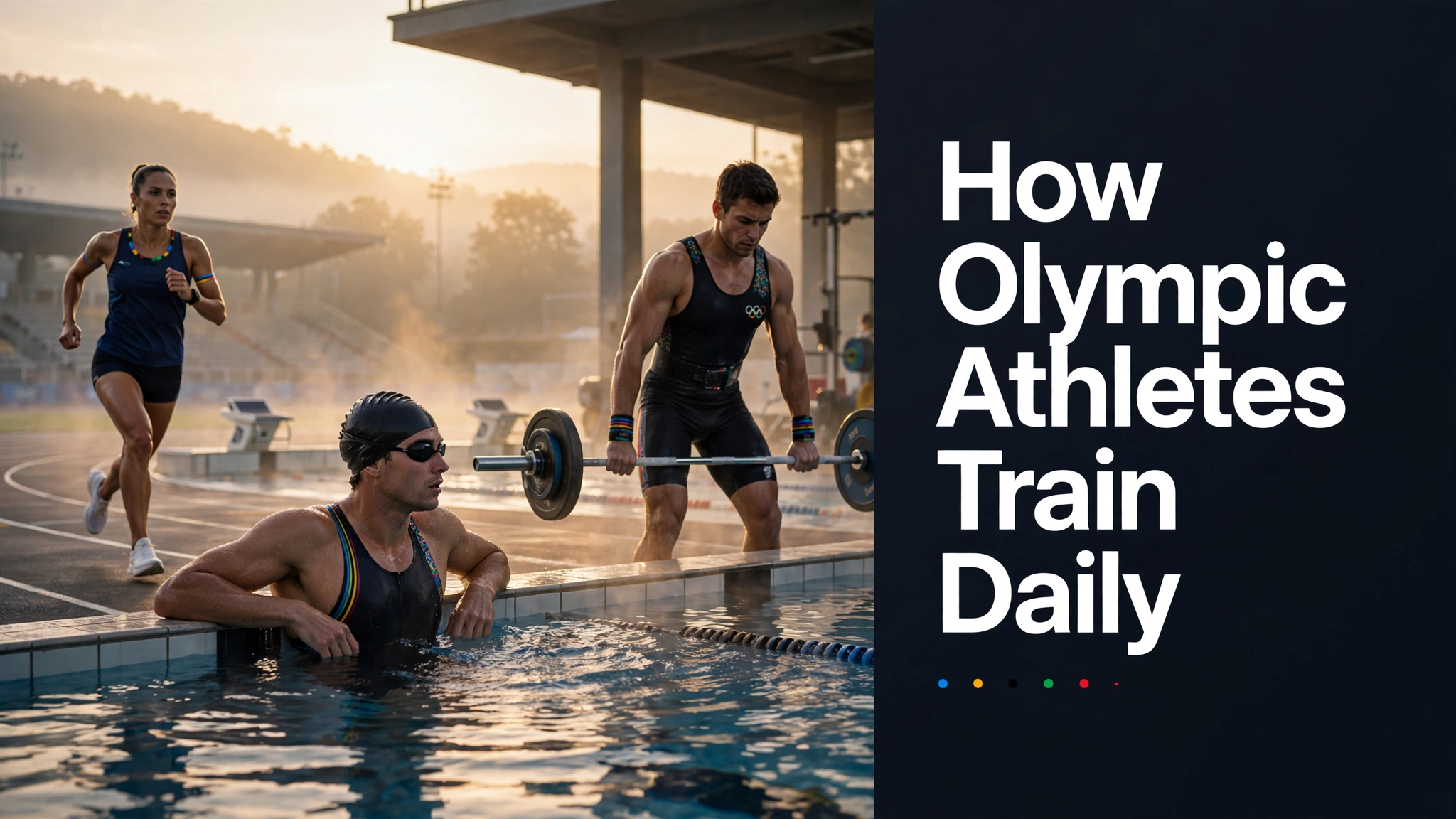
How Olympic Athletes Train Daily
In this post
- The Morning: First Session and Daily Preparation
- Strength, Speed and Skill: Different Sessions, Different Goals
- The Second Session and the Afternoon Routine
- Nutrition: Eating as Part of Training
- Recovery: The Hidden Half of Training
- Mental Training and Handling Pressure
- Coaches, Teams and Support Staff Behind the Athlete
- Travel, Altitude and Competing in Different Conditions
- A Week in Olympic Training and the Four-Year Cycle
- Injuries, Setbacks and the Long Road Back
- Daily Life Beyond Training: Balance and Sacrifice
- My Take:
An Olympic athlete’s day looks nothing like a normal workout. It is a carefully planned system of training, recovery, eating, sleeping, and mental preparation, repeated for years with small adjustments. Most Olympic athletes train twice a day, sometimes three times, and every session has a purpose: strength, speed, skill, endurance, or recovery. The difference between a good athlete and an Olympic athlete is rarely one magical workout. It is the ability to train hard, recover fully, and repeat that process for thousands of days without breaking down or losing motivation.
The Morning: First Session and Daily Preparation
Most Olympic athletes wake early, often between 5 and 7 in the morning, depending on their sport and training venue. The first part of the day is not training itself but preparation: hydration, a light meal or snack, mobility work, and a check-in with coaches or physiotherapists about sleep, soreness, and readiness. Athletes learn to read their bodies honestly, because training hard on a day when the body is exhausted can cause injury rather than improvement. Coaches use simple markers, such as resting heart rate, sleep quality, and muscle soreness, to decide whether to push, maintain, or ease off.
The first training session is often the most technical or intense session of the day. Swimmers may complete a long pool session, runners may do intervals on the track, gymnasts may practise routines, and weightlifters may work on heavy lifts while fresh. Morning sessions benefit from higher focus and cooler temperatures in many climates, but they also require a proper warm-up, because muscles and joints are stiffer after sleep. Athletes spend significant time on activation exercises, stretching, and drills that prepare specific movements, rather than jumping straight into maximum effort. That discipline separates elite training from casual exercise.
Strength, Speed and Skill: Different Sessions, Different Goals
Olympic training is divided into qualities that must all improve together. Strength sessions build the force an athlete can produce, using weights, resistance, and bodyweight exercises tailored to the sport. A thrower needs different strength from a marathon runner, and a gymnast needs different strength from a rower. Coaches therefore design strength programmes around the movements of the sport, not around generic gym routines. Technique in the gym matters as much as weight lifted, because poor lifting technique causes injuries that ruin seasons.
Speed and power sessions focus on explosive movement: sprints, jumps, throws, and quick changes of direction. These sessions are short but intense, with long rest periods so that each effort is performed at maximum quality. Skill sessions are different again. They focus on technique, timing, and decision-making: a fencer practises footwork and blade work, a judoka repeats throws, a shooter practises breathing and trigger control, and a footballer practises passing patterns. Elite athletes repeat basic skills thousands of times, because under Olympic pressure, only deeply learned movements remain reliable.
The Second Session and the Afternoon Routine
After the morning session, athletes eat a recovery meal, rest, and often receive treatment. Physiotherapy, massage, ice baths, stretching, and mobility work are part of the daily routine, not luxuries added after injury. Many athletes take a short nap in the early afternoon, because sleep during the day improves alertness and recovery, especially when morning training started early. The afternoon is also used for video analysis, tactical meetings, mental training, and lighter technical work.
The second main session is often shorter or less intense than the first, but it still has a clear purpose. It may focus on endurance, technique, or a different quality from the morning. For example, a runner who did speed intervals in the morning may do an easy endurance run in the afternoon, while a swimmer who did a hard pool session in the morning may do dry-land strength work later. Coaches balance hard and easy days across the week: two or three hard days, mixed with moderate and recovery days, produce better long-term improvement than training at maximum intensity every day. This principle, called periodisation, is central to Olympic preparation.
Nutrition: Eating as Part of Training
Olympic athletes eat to fuel performance, not only to satisfy hunger. Daily energy needs vary hugely by sport: an endurance athlete may need far more calories than a gymnast or a weight-category athlete, and needs change between heavy training periods and competition periods. Meals are planned around training times, with carbohydrates before and after hard sessions for energy, protein for muscle repair, and a wide range of fruits, vegetables, and healthy fats for overall health. Hydration is equally planned, with water and electrolytes adjusted for climate, sweat rate, and session length.
Weight-category sports add complexity. Wrestlers, judokas, boxers, and weightlifters must manage body weight carefully without harming health or performance. Responsible programmes avoid extreme weight cutting and focus on gradual, supervised changes, with medical checks and nutritionist guidance. In all sports, athletes learn that under-eating harms training quality, recovery, and immunity, while over-eating without purpose adds unnecessary weight. The best approach is individual: a dietitian adjusts meals to the athlete’s sport, body, training load, and personal preferences, rather than copying a famous athlete’s diet from social media.
Recovery: The Hidden Half of Training
Recovery is where improvement actually happens. Training creates stress and small damage to muscles; rest, sleep, and nutrition repair that damage and make the athlete stronger. Without recovery, training only accumulates fatigue and injury risk. Olympic athletes therefore treat recovery as seriously as training itself. Sleep is the most important recovery tool, with most elite athletes aiming for eight to ten hours per night, plus naps when needed. Sleep quality matters too: consistent bedtimes, dark rooms, limited screens before bed, and cool temperatures all help.
Other recovery methods include active recovery, such as easy walking, swimming, or cycling, which promotes blood flow without adding stress. Stretching, foam rolling, mobility work, and breathing exercises help muscles and joints recover. Cold water immersion, contrast baths, and compression garments are used by some athletes, though evidence varies and coaches select methods that suit the individual rather than using every trend. Most importantly, athletes learn to report pain early. A small pain ignored for weeks can become a season-ending injury, while early treatment often solves the problem quickly.
Mental Training and Handling Pressure
Olympic pressure is extreme: four years of work can depend on a race lasting seconds or a routine lasting minutes. Mental training is therefore part of daily preparation, not an afterthought. Athletes practise visualisation, imagining successful performances in detail, including the venue, the crowd, and the feeling of executing skills correctly. They practise routines before competition, such as breathing patterns, self-talk, and focus cues, so that pressure does not disrupt familiar habits. They also practise coping with setbacks, such as a poor start, a judging decision, or a mistake mid-performance, so that one error does not destroy the whole event.
Psychologists and coaches help athletes set process goals rather than only outcome goals. Instead of focusing only on winning a medal, an athlete focuses on executing a start correctly, maintaining pace, or staying calm between rounds. Process goals give the athlete control, while outcome goals depend partly on opponents and judges. Athletes also learn to manage social media, family expectations, and media attention, which can add pressure in the weeks before the Games. Support from family, teammates, and coaches matters enormously, because Olympic preparation is lonely as well as demanding.
Coaches, Teams and Support Staff Behind the Athlete
No Olympic athlete trains alone, even in individual sports. Behind every athlete stands a team: a head coach, assistant coaches, strength and conditioning coaches, physiotherapists, doctors, nutritionists, psychologists, analysts, and often family members who manage daily life. Each specialist contributes a piece of the programme, and the head coach coordinates those pieces so that training, recovery, and competition preparation do not conflict. Communication within that team is crucial: a strength coach who adds heavy lifting on a week when the technical coach planned intense skill work can overload the athlete, while a physiotherapist who spots early soreness can prevent a coach from pushing too hard.
Athletes must also learn to trust and communicate with that team. Reporting fatigue, pain, anxiety, or personal problems is not weakness; it is information that helps coaches adjust the plan. The best coach-athlete relationships are built over years, with honest conversations about goals, fears, and limits. In team sports, the dynamic is more complex, because coaches must balance individual needs with team tactics, selection, and chemistry. An Olympic team that trusts its staff, shares information openly, and respects each athlete’s individual programme tends to perform more consistently than a team where athletes hide injuries or coaches impose identical training on everyone regardless of need.
Travel, Altitude and Competing in Different Conditions
Olympic preparation often involves travel to training camps, altitude centres, and competition venues that differ from home conditions. Altitude training is used by endurance athletes because training where oxygen is thinner can improve red blood cell production and endurance at sea level, though the benefits vary by individual and must be timed carefully. Heat training prepares athletes for hot Olympic venues by improving sweat response and tolerance, while cold-weather athletes train in snow, ice, and wind conditions that cannot be replicated indoors. Travel itself adds fatigue, jet lag, and disruption to sleep and eating routines, so teams plan arrival times, light exposure, and training loads to help athletes adapt before competition.
Equipment, venue, and surface differences also matter. A cyclist must adapt to track surfaces and wind, a sailor to water and weather, a shooter to light and range conditions, and a runner to track surfaces and spikes. Elite athletes therefore practise in varied conditions rather than only in perfect home facilities, so that competition-day surprises do not destroy performance. Coaches simulate pressure by creating mock competitions, crowd noise, and judging scenarios, helping athletes practise routines under stress. Adaptability, built through varied training, is one of the most underrated Olympic skills.
A Week in Olympic Training and the Four-Year Cycle
A typical training week is not the same every week. Hard weeks build fitness and skill, while easier weeks allow recovery and adaptation. Before major competitions, athletes taper: they reduce training volume while keeping intensity, so that they arrive fresh, sharp, and hungry to compete. Tapering feels strange, because athletes train less but feel better, and trusting the taper requires confidence in the coach’s plan. After the Olympics, many athletes take a break to recover physically and mentally before starting a new cycle.
The four-year Olympic cycle itself is planned in phases. Early years focus on building base fitness, learning skills, and gaining experience. Middle years focus on qualifying standards, major championships, and refining weaknesses. The final year focuses on peaking at the right time, managing injuries, and preparing specifically for Olympic conditions, opponents, and venues. Athletes who peak too early may fade before the Games, while athletes who peak too late may miss qualification. Coaches therefore work backwards from the Olympic date, planning each phase to build toward that single moment.
Injuries, Setbacks and the Long Road Back
Injuries are an unavoidable part of Olympic training, because elite performance pushes the body close to its limits. Stress fractures, tendon problems, muscle tears, and overuse injuries can interrupt months of preparation and threaten qualification itself. How athletes and teams handle injury often decides whether a career continues or ends early. Good practice involves early reporting, accurate diagnosis, a rehabilitation plan that rebuilds strength gradually, and psychological support during the frustrating period when an athlete can watch but cannot train fully. Rushing back for one competition can turn a short injury into a career-ending one, while patient rehabilitation, though painful in the short term, often produces a stronger return.
Setbacks also include non-selection, poor performances, and funding problems. An athlete who misses qualification by a fraction of a second, or who loses funding after a disappointing season, faces a choice: quit, or rebuild with a new plan. Many Olympic stories involve such rebuilding, with athletes changing coaches, events, or training bases, and returning stronger four years later. Support from family, teammates, and federations during those low periods matters enormously, because motivation is hardest to sustain when results are absent. The public usually sees only the final success, but the long road back, with its daily rehabilitation exercises and quiet doubts, is where Olympic character is truly formed.
Daily Life Beyond Training: Balance and Sacrifice
Olympic training shapes daily life far beyond the training venue. Athletes plan social life, study, work, and family time around training and recovery, often sacrificing normal routines that other young people take for granted. Meals are timed, sleep is protected, travel is frequent, and holidays are rare during heavy preparation periods. That sacrifice can be rewarding when it leads to personal bests and Olympic selection, but it can also feel isolating, especially for teenagers who miss school events, family gatherings, and friendships. Good programmes therefore help athletes maintain education, hobbies, and relationships alongside sport, so that identity does not depend entirely on performance. An athlete with interests beyond sport copes better with injury, defeat, and retirement, because life after competition already has foundations.
My Take:
My take is that Olympic daily training teaches a lesson far beyond sport: progress comes from boring consistency, not from dramatic effort on one day. When people see an Olympic final, they see seconds or minutes of brilliance, but they do not see the thousands of mornings, the repetitive drills, the careful meals, and the early nights that made those seconds possible. I respect that hidden work more than the medal itself, because medals can depend on weather, judges, injuries, and luck, while daily discipline is fully within an athlete’s control. Anyone trying to improve at anything, whether study, work, or fitness, can borrow that principle: small, correct actions repeated daily beat occasional heroic efforts.
I also believe recovery deserves more respect in how we talk about athletes. Fans often praise athletes who train hardest, but the smartest athletes are those who sleep well, eat well, report pain early, and rest when coaches tell them to rest. Overtraining is not toughness; it is often a shortcut to injury and burnout. Coaches who protect young athletes from excessive loads are not holding them back, they are extending their careers. Parents of young athletes should watch for this too: a child who trains every day without rest, proper food, or joy is not on a faster path to the Olympics, but on a faster path to quitting or getting hurt.
Another point I feel strongly about is mental health in Olympic preparation. Athletes carry enormous expectations from themselves, families, federations, and countries, and the pressure peaks in Olympic year. Talking about anxiety, fear, and disappointment should be normal, not a sign of weakness. The athletes who cope best are usually those who have support, routines, and perspective: they know that their worth is not decided by one race or one routine. I hope future Olympic coverage shows more of that human side, because young viewers need to see that even champions feel nervous, make mistakes, and need help sometimes.
I also believe the support team deserves more public recognition. When an athlete wins, cameras focus on the individual, but the coach who planned the programme, the physiotherapist who treated injuries at midnight, the nutritionist who adjusted meals, and the family who supported years of sacrifice all contributed to that moment. Recognising that team does not diminish the athlete; it explains how excellence is actually built. Young athletes should therefore choose coaches and support people carefully, listen to medical advice, and build relationships based on trust rather than only on results. A good team can carry an athlete through injury, defeat, and doubt, while a poor team can undermine even the most talented individual.
Another lesson concerns adaptability. Olympic athletes rarely compete in perfect conditions, and the ability to adjust to heat, altitude, travel, judges, opponents, and unexpected setbacks often decides medals. Training only in comfortable, familiar settings leaves an athlete unprepared for reality. The same applies outside sport: people who practise under varied conditions, seek feedback, and adjust plans when circumstances change tend to cope better than those who only succeed when everything is perfect. Flexibility is not a lack of discipline; it is discipline applied wisely to changing conditions.
Finally, I think ordinary people can take practical lessons from Olympic routines without copying their extreme volume. You do not need to train twice a day to benefit from warming up properly, sleeping consistently, eating around exercise, and setting process goals. A daily walk, a regular sleep time, a simple strength routine, and a calm pre-work routine can improve health and focus for anyone. The Olympic athlete’s day is extreme because the goal is extreme, but its principles are universal: plan the day, train with purpose, recover fully, eat to support the work, and repeat with patience. That is a model worth admiring, and worth adapting to normal life. I would add one more reflection on setbacks, because they are the part of Olympic life that television rarely shows. When an athlete is injured, or misses selection, the world moves on to the next story, but the athlete must still wake up, rehabilitate, and rebuild without applause. That lonely work requires a different kind of courage from competing in a stadium, and it deserves respect. Coaches, families, and federations should support athletes during those periods with medical care, honest planning, and emotional support, rather than only celebrating them when they win. An athlete who returns from injury with patience and good guidance often becomes a better competitor, because the experience teaches body awareness, humility, and gratitude for the chance to compete again. Those lessons stay long after medals fade, and they are part of why Olympic training, at its best, builds people as well as performances. I also think funding inequality deserves honest discussion, because Olympic daily training looks very different depending on a nation’s wealth. Athletes from wealthy federations may have full-time coaches, modern facilities, sports science teams, and financial support, while athletes from poorer nations may train with limited equipment, part-time coaching, and jobs alongside sport. That gap does not mean talent is unequal; it means opportunity is unequal, and it makes the achievements of underfunded athletes even more remarkable. International federations, sponsors, and governments should therefore invest in coaching education, basic facilities, and athlete support in underrepresented nations, not only in medal ceremonies for wealthy teams. A fairer Olympic system would measure success partly by how many nations can prepare properly, not only by which nations win most medals, because the Olympic ideal promises participation and excellence for all, not only for those who can afford perfect preparation. Finally, I would encourage readers to apply one Olympic habit this week, whether it is a consistent bedtime, a planned warm-up before exercise, a balanced meal after training, or a process goal for a difficult task. You do not need Olympic talent to benefit from Olympic discipline, and small, repeated habits compound over months into real change. Choose one habit, practise it daily, and notice how it affects your energy, focus, and confidence. That experiment, modest as it sounds, captures the true spirit of Olympic training better than any extreme workout ever could.
Frequently Asked Questions
How many hours do Olympic athletes train per day?
Most train four to eight hours per day across two or sometimes three sessions, depending on the sport, training phase, and whether it is a hard or recovery day.
Do Olympic athletes train every day?
They train most days, but weeks include recovery days and lighter sessions, because rest is essential for improvement and injury prevention.
What do Olympic athletes eat in a day?
Meals are planned around training, with carbohydrates for energy, protein for muscle repair, fruits and vegetables for health, and hydration adjusted for climate and sweat losses.
How much sleep do Olympic athletes need?
Most aim for eight to ten hours per night, plus naps when training starts early, because sleep is the most important recovery tool.
How do Olympic athletes handle pressure?
They use visualisation, pre-performance routines, process goals, breathing techniques, and support from coaches, psychologists, family, and teammates.
Can ordinary people follow an Olympic routine?
Ordinary people can borrow the principles, such as warm-ups, consistent sleep, balanced meals, and process goals, without copying the extreme training volume of elite athletes.