How to Build a Healthy Plate Without Counting
In this post
- Why Counting Feels Hard for Most People
- The Plate Idea in Plain Words
- Half the Plate: Vegetables and Fruit
- A Quarter for Protein Foods
- A Quarter for Grains and Starchy Foods
- Fats, Water and the Small Extras
- Building the Plate at Home, at Work and When Eating Out
- When the Plate Does Not Look Perfect
- My Take:
Most people know what healthy eating looks like in general, yet they still find it hard to do at every meal. The usual advice does not help much. It talks about grams and calories, it asks you to weigh your rice, it asks you to log every bite in an app, and after a few days most people give up, because real life does not work like that. You are hungry, the food is already on the table, the children are waiting, and nobody wants to open a phone app before eating. That is why the plate method is worth knowing. It is a way of building a balanced meal by eye, using the plate itself as the guide. You do not need a scale, you do not need a chart, and you do not need to count anything. You just look at the plate and give each kind of food its fair share of space.
The idea is simple, but it is not a trick. A balanced plate gives your body a mix of foods that work together. Vegetables and fruit give you fibre, water and a wide range of vitamins. Protein foods help you feel full and support your muscles. Grains and starchy foods give you steady energy. A little fat helps your body use some vitamins and makes food taste satisfying. Water keeps everything moving. When one of these is missing, the meal still fills your stomach, but it does not serve you as well. A plate of only rice fills you up for a while, then leaves you hungry again. A plate of only meat is heavy and leaves you thirsty. A plate with a bit of everything keeps you satisfied for longer and gives your body more of what it needs across the day. This article explains how to build that kind of plate, meal by meal, in plain words, with examples from ordinary kitchens.
Why Counting Feels Hard for Most People
Counting calories sounds scientific, and for a short time it can teach you a lot about food. The problem is that it asks for a kind of attention that most people cannot keep up for months. Every snack needs to be weighed or guessed. Every restaurant meal needs to be estimated. Every family dish needs to be broken down into its ingredients. A mother cooking for five people cannot weigh each portion separately. A labourer eating lunch on a work site cannot open an app with dusty hands. A student eating in a canteen cannot ask the cook for the recipe. Counting works in a laboratory, but it falls apart in a busy kitchen, and when a method falls apart, people blame themselves instead of blaming the method.
There is another problem with counting. It turns food into numbers, and numbers make some people anxious. They start to see a meal as a pass or a fail. They feel guilty about a second helping. They worry about a spoonful of oil as if it were a serious mistake. That kind of worry does not make eating healthier. It makes eating stressful, and stress makes people eat in a rushed, careless way. The plate method works differently. It does not ask whether you ate exactly the right number. It asks whether the meal looked balanced. That is a kinder question, and it is one you can answer in two seconds just by looking down at your plate.
Counting also misses something important about food. Two meals can have the same number of calories and be very different for your body. A biscuit and a bowl of lentils with vegetables might carry similar energy, but the lentils keep you full for hours, while the biscuit leaves you hungry again in half an hour. A plate built by eye catches that difference, because it looks at what the food actually is, not just how much energy it holds. It rewards the foods that fill you up and give you fibre and nutrients, and it quietly limits the foods that give you energy and little else. That is why health guidance in many countries now teaches the plate idea to ordinary people. It is not a shortcut for people who cannot be bothered. It is a practical tool that fits real life.
The Plate Idea in Plain Words
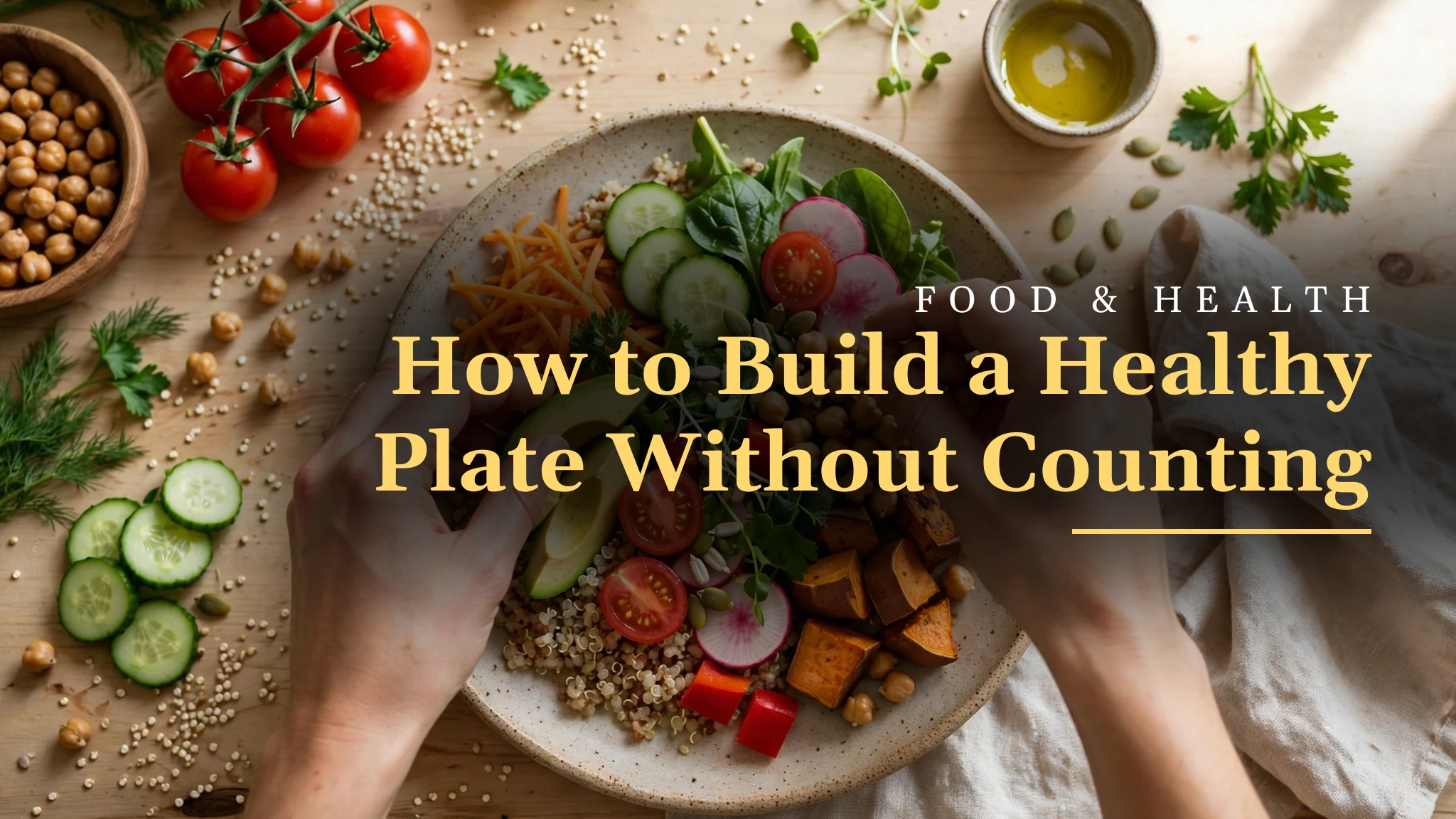
Picture an ordinary dinner plate, the kind you use every day, not a small side plate and not a huge serving dish. Now imagine drawing a line down the middle. One half of the plate is for vegetables and fruit. The other half is divided again into two quarters. One quarter is for protein foods, and the other quarter is for grains and starchy foods. That is the whole method. Half vegetables and fruit, a quarter protein, a quarter grains. Beside the plate, a glass of water. That picture is the guide, and once you have seen it a few times, you can build a plate like that without thinking about it.
The size of your hand can help too, because plates come in different sizes and so do people. Your palm is a rough guide for a portion of protein food, such as a piece of chicken or fish, or a scoop of beans. Your fist is a rough guide for a portion of grains, such as rice or bread. Two open handfuls are a rough guide for vegetables. Your thumb is a rough guide for a spoonful of oil or butter. These are not exact measures, and they do not need to be. They are a quick way to check that one food has not taken over the whole plate. A child needs smaller portions, and a tall, active adult needs larger ones, but the balance on the plate stays roughly the same.
It is worth saying clearly what this method is not. It is not a diet plan with a name, and it is not a promise that you will lose weight or cure anything. It is a way of arranging food so that a meal is more likely to be balanced. Some days your plate will look exactly like the picture, and some days it will not, and that is normal. A birthday dinner, a meal at a wedding, a plate of food cooked by a relative who insists you eat more, all of these will look different, and that is fine. The plate idea is a habit for ordinary days, not a rule for every single meal. If most of your ordinary meals look balanced, you are doing well.
Half the Plate: Vegetables and Fruit
Half the plate sounds like a lot of vegetables, and for many people it is the hardest part of the method. Most of us grew up with vegetables as a small side dish, a spoonful of salad next to a mountain of rice, or a few slices of tomato on the edge of the plate. The plate method asks you to turn that picture around. Vegetables become the main event, and the rice or bread becomes the side. That sounds strange at first, but it works because vegetables are light. They fill the plate without filling you with heavy energy. You can eat a large pile of salad, cooked greens, carrots, cucumbers, cabbage or beans and still have room for the rest of the meal. They also give the meal colour and crunch, which makes it more enjoyable to eat.
You do not need expensive or unusual vegetables to fill half a plate. The ordinary ones are the best, because they are cheap and you already know how to cook them. A salad of cucumber, tomato and onion takes five minutes. Cooked spinach, cabbage, okra, green beans, carrots or peas all count. A lentil and vegetable curry counts too, because it is full of vegetables and beans, though it also gives you protein. Fruit can take part of this half as well. An orange with lunch, a few slices of apple, or a small bowl of seasonal fruit beside the meal all belong here. The point is variety across the week rather than perfection at one meal. If you eat green vegetables one day, orange ones the next, and a mixed salad the day after, your body gets a wider mix of nutrients than if you eat the same single vegetable every day.
There are a few practical tricks that make this half easier. First, serve the vegetables first, before the rice or bread goes on the plate, so the space is already taken. Second, keep a simple salad ready. A bowl of chopped cucumber and tomato in the fridge takes two minutes to prepare and lasts for a day. Third, cook vegetables in a way you enjoy. If you dislike plain boiled vegetables, try them lightly fried with onion, garlic and a little oil, or roasted with spices. Food you enjoy is food you will eat again. Fourth, remember that frozen vegetables count. Peas, green beans and mixed vegetables from the freezer are picked ripe and frozen quickly, and they are often cheaper than fresh ones out of season. They are a perfectly good way to fill half the plate on a busy day.
Some people worry that eating so many vegetables will leave them hungry. That rarely happens, because the other half of the plate, the protein and the grains, is there to keep you full. Vegetables add bulk and water to the meal, and their fibre slows down digestion, so you feel satisfied rather than stuffed. The real risk is the opposite one: a plate with almost no vegetables leaves you hungry again soon after eating, because there is nothing to slow the meal down. If you find yourself reaching for snacks an hour after lunch, look at your plate. A plate with more vegetables and a proper share of protein usually keeps you going until the next meal.
A Quarter for Protein Foods
Protein is the part of the meal that keeps you full and helps your body repair and build muscle. It comes from animal foods like chicken, fish, eggs, meat, milk and yoghurt, and from plant foods like beans, lentils, chickpeas, peas and nuts. A quarter of the plate is enough for most people at one meal, and that is a useful thing to know, because many people eat far more meat than they need, while others eat far less protein than they need. A piece of chicken the size of your palm, a small fish fillet, two eggs, or a generous scoop of lentils all fit the quarter-plate guide.
Beans and lentils deserve a special mention, because they are cheap, filling and full of fibre as well as protein. A plate of rice with a good serving of lentils is a complete, satisfying meal for many people, and it costs very little. Chickpeas in a salad, beans in a stew, or a simple bowl of lentil soup all count. If you eat meat, you do not need it at every meal. A day with beans or lentils instead of meat is not a poorer day. It is a cheaper one, and it gives your stomach a rest from heavy food. Fish is also a good choice a couple of times a week, if it is available and affordable, because it is lighter than red meat and gives you nutrients that are hard to get elsewhere.
The way you cook protein matters as much as how much you eat. Grilled, boiled, steamed or baked protein is lighter than the same food deep-fried. A piece of chicken cooked in a little oil with vegetables is a different meal from the same chicken coated and fried until it soaks up fat. That does not mean fried food is forbidden. It means that the everyday version should be the lighter one, and the fried version should be the occasional treat. The same goes for processed meat, such as sausages and cured meats, which are salty and heavy. They can be enjoyed sometimes, but they are not a good everyday protein, because they give you salt and fat without the balance that fresh food gives.
If you are vegetarian, or if you eat meat only sometimes, the quarter plate still works. Fill it with beans, lentils, chickpeas, eggs, yoghurt, cheese or a mix of these. A meal of rice, lentils and vegetables is balanced. A meal of bread, eggs and salad is balanced. A meal of potatoes, beans and cooked greens is balanced. The names of the foods change, but the shape of the plate stays the same, and that is the beauty of the method. It works in any kitchen, in any country, with whatever foods are cheap and familiar there.
A Quarter for Grains and Starchy Foods
Grains and starchy foods give you energy, and that is their job. Rice, bread, chapati, pasta, potatoes, sweet potatoes, corn and oats all belong in this quarter. They are the foods that keep you going through the afternoon, and they are the foods most of us love best. The problem is not that we eat them, but that we eat too much of them and too little of everything else. A plate that is three quarters rice and one quarter everything else is a common picture, and it is the picture the plate method is trying to change. When grains take only a quarter, there is room for vegetables and protein, and the meal becomes more balanced without you having to give up the foods you enjoy.
Choosing whole grains when you can makes a real difference. Brown rice, whole wheat bread, whole wheat chapati and oats give you more fibre than their white versions, and fibre slows digestion, so the energy lasts longer. That does not mean white rice or white bread is bad. In many families white rice is the normal food, it is what people grew up eating, and it is what is affordable. You do not need to throw it away. You can mix it with a little brown rice, or you can simply keep the portion to a quarter of the plate and fill the rest with vegetables and protein. The balance of the plate matters more than any single ingredient.
Portion size is where most people slip, because grains are easy to serve in large amounts. A mound of rice looks normal when the plate is big, but the same amount looks huge on a smaller plate. That is why using a normal-sized plate helps. If you use a very large plate, even a quarter of it can be a lot of food. If you use a small plate, the whole meal shrinks without you feeling deprived. Serving the grains last also helps, because the vegetables and protein are already on the plate, and there is only a quarter of the space left. A simple habit like that does more than willpower, because it changes the situation instead of asking you to fight your own hunger.
Starchy vegetables like potatoes and sweet potatoes sit in this quarter too, even though they are vegetables. A plate with potatoes and rice together is really two grain portions, not a grain and a vegetable. That is a common mistake, and it is easy to fix once you know it. If potatoes are the starchy food, the vegetable half should be something else, like salad or cooked greens. The same goes for corn and peas, which are starchy enough to count towards the grain quarter. None of this needs to be exact. It is a rough guide to help you see the balance, not a test you have to pass.
Fats, Water and the Small Extras
Fats are not a separate quarter of the plate, but they still matter, because a meal with no fat at all tastes dry and leaves you unsatisfied. A little oil in cooking, a spoonful of yoghurt, a few nuts, or a drizzle of oil on a salad all add flavour and help your body use some of the vitamins in vegetables. The key word is little. One or two spoonfuls of oil for a whole family meal is enough. A small handful of nuts is enough. A thin spread of butter is enough. When fat is used as a flavouring rather than as a main food, it does its job without taking over the meal.
Water belongs beside the plate, not on it, but it is part of the picture. A glass of water with your meal helps you chew slowly, helps digestion, and helps you notice when you are full. Many people drink very little water during the day and then feel tired or hungry when what they really need is a drink. Keeping a bottle or jug of water where you can see it is a simple habit that supports the plate method. Sweet drinks, on the other hand, add energy without adding fullness, and they do not belong in the daily picture. A sweet drink with a meal is a treat, not a replacement for water, and it is better kept for special occasions.
Salt, sugar and sauces are the small extras that can quietly change a meal. A pinch of salt in cooking is normal. A plate drowned in salty sauce or sweet chutney is a different matter. You do not need to ban sauces and seasonings. You need to use them in small amounts, so that the taste of the food itself still comes through. Herbs, spices, lemon juice, garlic, onion and chilli give food a lot of flavour without adding much salt or sugar, and they are cheap. Learning to season food with these instead of reaching for the salt pot or the sugar jar is a small skill that improves every meal you cook.
Snacks fit into the same picture. A snack is really a small plate, and it can be balanced too. An apple with a few nuts, a small bowl of yoghurt with fruit, a boiled egg with a tomato, or a piece of bread with beans all make better snacks than a packet of biscuits or crisps. That does not mean biscuits are forbidden. It means that the everyday snack should be a real food, and the biscuit should be the occasional one. If you keep fruit and nuts where you can reach them, you will eat them. If you keep biscuits on the table, you will eat those instead. The plate method is partly about food, and partly about making the good choice the easy choice.
Building the Plate at Home, at Work and When Eating Out
At home, the plate method is easiest, because you control the cooking. The trick is to build the plate in the right order. Put the vegetables on first, then the protein, then the grains. If you serve food from shared dishes in the middle of the table, take a spoonful of vegetables first and let that set the balance. Cook a large pot of vegetables or a big salad so that there is always enough to fill half the plate. If you are cooking for children, let them help fill their own plates using the same picture. Children who build their own plate are more likely to eat what is on it, and they learn the habit early, which is worth more than any lecture about healthy eating.
At work, the plate method still works, though the food is less under your control. A packed lunch is the easiest option. A box with salad, a piece of chicken or some beans, and a small portion of rice or bread follows the picture exactly. If you buy lunch from a canteen or a shop, look for the meal that already looks like a plate: a main dish with a visible pile of vegetables, a protein food, and a modest portion of rice or bread. If the only option is a heavy meal with no vegetables, add a piece of fruit or a small salad from another stall. It is not perfect, but it moves the meal towards balance, and that is what counts.
Eating out is the hardest place to build a balanced plate, because restaurant portions are large and vegetables are often an afterthought. A few small choices help. Ask for extra salad or vegetables if you can. Share a large main dish with someone else and order a salad to go with it. Drink water instead of a sweet drink. Eat slowly and stop when you feel full, even if food is left on the plate. Leaving food is not wasteful when you are already full. Eating past fullness is the real waste, because it leaves you uncomfortable and tired. A restaurant meal is a treat, and treats are allowed, but even a treat can be built a little more like a plate.
Travel and festivals need the same flexible thinking. You cannot control the food at a wedding or on a long journey, and you should not try to. Eat what is offered, enjoy it, and return to the plate picture at the next ordinary meal. One unbalanced meal does not undo a week of balanced ones, just as one balanced meal does not fix a week of heavy ones. The plate method is a pattern across the week, not a rule for every single plate. That is what makes it possible to keep for years instead of days.
When the Plate Does Not Look Perfect
Some days the plate will not look like the picture, and it helps to know why, so that you do not give up. If you are short of money, vegetables and beans are usually the cheapest foods in the shop, and they are the ones the plate method asks you to eat most of. Rice and bread are cheap too, but meat is expensive, and the plate method asks for only a quarter of it, which saves money. A meal of rice, lentils and cabbage costs very little and follows the picture well. A meal built around a large piece of meat with little else costs more and follows the picture badly. The plate method is not an expensive way to eat. It is one of the cheapest, because it puts the cheap, filling foods at the centre.
If you are short of time, the plate can still work. A plate does not need a cooked meal. Bread with eggs and a tomato, yoghurt with fruit and a few nuts, or a bowl of leftover vegetables with rice all count as balanced plates. The method does not ask for new recipes. It asks you to arrange the food you already have in a better balance. If you have only two kinds of food in the house, use those two and add the third at the next meal. Perfection at one meal matters less than balance across the day. A lunch with no vegetables can be balanced by a dinner with plenty of them.
If you have a health condition, or if a doctor has given you specific advice about food, that advice comes first. The plate method is general information, not a personal plan. People with certain conditions may need to limit some foods, and that changes the picture. The same goes for allergies. If you cannot eat a food, replace it with another from the same group, and the plate still works. A person who cannot eat dairy can use beans or lentils for protein. A person who cannot eat wheat can use rice or potatoes for grains. The method is flexible because it is about groups of foods, not about one specific food.
The most important thing is to start small and keep going. Choose one meal a day, usually lunch or dinner, and build that plate by the picture. Do it for a week. Notice how you feel after eating. Most people notice that they feel full for longer, that they are less tired in the afternoon, and that they reach for snacks less often. Those small changes are the sign that the method is working. After a week, add a second meal. After a month, the picture becomes a habit, and you will build a balanced plate without thinking about it. That is the goal: not a perfect plate, but a plate that is balanced most of the time, built in seconds, by eye.
My Take:
If you ask me what I think of the plate method, my answer is simple: it is the best piece of healthy eating advice I know, because it is the only one that ordinary people can actually use every day. I have seen many diets come and go. They all have rules, they all have charts, and they all work for a few weeks until real life gets in the way. The plate method has no chart and no app. It has a picture, and a picture is something you carry in your head. You look at your plate, you see the balance, and you adjust it in two seconds. That is why I think it lasts. Advice that fits into a busy life is advice that people keep. Advice that needs a scale and a phone app is advice that people drop.
I think the reason counting fails is that it asks the wrong question. It asks how much energy is in your food, and that is a question for a laboratory, not for a kitchen. The plate method asks a better question: does this meal have a bit of everything? That is a question a cook can answer, a mother can answer, a labourer can answer, and a child can answer. I like advice that respects the person using it. The plate method does that. It does not treat you as someone who needs to be controlled by numbers. It treats you as someone who can look at a plate and make a sensible choice. That respect matters, because people follow advice they feel good about, and they quietly resist advice that makes them feel judged.
There is another reason I like this method, and it is about money. Healthy eating has a reputation for being expensive, and that reputation stops many families from even trying. But look at the plate picture again. Half of it is vegetables, and vegetables are usually the cheapest food in the shop. A quarter of it is beans or lentils, and those are among the cheapest protein foods in the world. Only a small quarter is meat, and meat is the expensive part. So the plate method does not ask you to spend more. It asks you to spend less on meat and more on the cheap foods that fill you up and keep you healthy. For a family watching every rupee, that is good news. I think we should say it plainly: eating well does not have to mean buying expensive things. Sometimes it means buying cabbage, lentils and rice, and arranging them well on a plate.
I also think the plate method teaches something important about hunger. Many people eat a large plate of rice and feel hungry again an hour later, and they think the answer is to eat more rice. The plate method gives a different answer. It says the meal was not balanced, so it did not keep you full. Add vegetables, add protein, and the same amount of food lasts longer in your stomach. I have seen this in my own eating. A plate of only rice leaves me restless and looking for a snack. A plate with salad, lentils and a small portion of rice keeps me satisfied until the next meal. The difference is not the amount of food. It is the balance. Once you learn that, you stop fighting your hunger and start feeding it properly.
I want to be honest about what the plate method cannot do. It will not fix a diet that is built on sweet drinks, heavy fried food and almost no vegetables, unless you are willing to change those habits. It will not make you lose weight on its own, because weight depends on how much you eat across the whole day, how active you are, and many other things. It will not cure any illness, and anyone who tells you a plate picture can do that is not being honest with you. What it does is simpler and better: it makes your ordinary meals more balanced, and balanced meals, repeated day after day, are the foundation of good health. I prefer that honest version to any big promise, because a promise that fails makes people stop trusting good advice altogether.
I think the best place to start is with one meal a day. Do not try to change every meal at once. Pick lunch or dinner, whichever meal you cook most often, and build that plate by the picture for a week. Serve the vegetables first. Put the protein in its quarter. Keep the grains to their quarter. Drink water with it. At the end of the week, ask yourself how you felt. Were you full for longer? Did you feel less tired in the afternoon? Did you reach for snacks less often? If the answer is yes, even a little, then the method is working for you, and you can add a second meal. If the answer is no, look at the plate again. Perhaps the vegetable half was really a spoonful, or the grain quarter was really a mountain. The picture is forgiving, but it only works if you follow it honestly.
Children are the part of this I care about most. A child who learns to build a plate by eye learns something that will protect them for the rest of their life. They learn that vegetables are not a punishment, but the main part of the meal. They learn that a meal has different foods in it, and that each one has a job. They learn to eat until they are full, not until the plate is empty. These are lessons no app can teach. If you have children, let them fill their own plates using the picture. Do not make a speech about it. Just show them the picture once, and let them try. Children like pictures, and they like doing things themselves. A child who builds their own plate will eat more of it, and that is a small victory worth having every day.
I also want to say something about the days when the plate does not look perfect, because those days will come. A wedding, a festival, a meal cooked by a relative who insists you eat more, a day when there is only rice in the house, all of these will break the picture. That is not a failure. It is life. The plate method is a pattern across the week, not a rule for every single meal. One heavy meal does not undo a week of balanced ones. What matters is what you do at the next ordinary meal. If you return to the picture, you are still on track. People give up on healthy eating because they think one mistake ruins everything. It does not. The people who succeed are not the ones who never make a mistake. They are the ones who return to the habit after the mistake, without drama and without guilt.
There is a small detail I think is worth mentioning, and it is the size of the plate. A very large plate makes even a balanced meal look small, and it invites you to pile on more food. A normal plate, or even a slightly smaller one, makes the same meal look generous. This is not a trick to fool yourself. It is a way of working with your eyes instead of against them. Your eyes judge how much food there is, and a full small plate looks like plenty. A half-empty large plate looks like not enough, even when the amount is the same. Use a normal plate, fill it by the picture, and you will find that you are satisfied with less food, because your eyes and your stomach agree.
Finally, I want to say why I think this method matters more than the latest diet book or the latest food trend. Food trends change every year. One year a food is praised, the next year it is blamed. The plate method does not change, because it is not a trend. It is a simple picture of balance, and balance has always been the heart of healthy eating. Vegetables, protein, grains, a little fat, water, that is what a body needs, and it is what people have eaten in different forms in every country for a very long time. I trust advice that has lasted, and I trust advice that works in a poor kitchen as well as in a rich one. The plate method does both. It is simple, it is cheap, and it is honest. In my view, that is exactly the kind of advice worth keeping.
If a friend asked me how to eat better without making life complicated, I would not give them a diet plan. I would draw them a plate on a piece of paper, divide it into halves and quarters, and say: build your meals like this, most of the time, and see how you feel after two weeks. I would tell them not to buy anything new, not to download anything, and not to weigh anything. I would tell them to use the foods they already buy, to cook them the way they already cook, and to change only the balance on the plate. That is the whole advice, and it is enough. A small change, repeated every day, is worth more than a big change that lasts a week. The plate method is that small change, and I think it is one of the best a person can make.
I also think the plate method is a good teacher for people who say they cannot cook. You do not need to learn complicated recipes to build a balanced plate. You need a few simple skills: how to chop a salad, how to boil rice, how to cook lentils, how to fry an egg, how to steam vegetables. Those are small skills, and each one takes an afternoon to learn. Once you can do those five things, you can build a hundred different balanced plates, just by changing the vegetables or the protein. A person who can make a salad and a pot of lentils is already a good cook, even if they have never followed a recipe from a book. I think we should tell people that, because many people believe cooking is a talent you are born with. It is not. It is a set of small habits, and the plate method gives those habits a shape.
There is also something good about eating from a plate that looks cared for. A plate with colour on it, green vegetables, orange carrots, a golden piece of chicken or a bowl of red lentils, looks like a meal someone took trouble over. A plate that is all one colour, usually white or brown, looks like a meal that was thrown together in a hurry. That is not a small thing. We eat with our eyes as well as with our stomachs, and a colourful plate makes us slow down and enjoy the food. It also makes the meal feel like a proper pause in the day, rather than something to rush through while looking at a phone. I think that matters more than people admit. A meal eaten slowly, with attention, is more satisfying than the same food eaten in a hurry, and the plate method encourages that slowness, because it asks you to look at the plate before you start.
I want to say one more thing about fad diets, because the plate method is often compared with them, and the comparison is unfair to the plate. A fad diet tells you to cut out a whole group of foods, or to eat only at certain hours, or to buy special products. It works for a while, because any big change works for a while, and then it fails, because it asks too much. The plate method asks for nothing to be cut out. It asks for balance, and balance is something you can do for the rest of your life. It does not have a start date or an end date. It does not have a book to buy or a powder to order. It is just a picture, and a picture does not expire. I trust advice like that far more than advice that needs to be sold to you. If someone is trying to sell you a diet, ask yourself whether the plate picture would do the same job for free. Usually, it would.
Frequently Asked Questions
Is how to build a healthy plate without counting something I should think about every day?
Yes, in a light way. You do not need to think about it hard at every meal, but it helps to glance at your plate once a day, usually at lunch or dinner, and check that half of it is vegetables and fruit, a quarter is protein food, and a quarter is grains or starchy food. Once the picture becomes a habit, you will build a balanced plate without thinking about it at all. The goal is a quick look, not a daily worry.
How long does it take to notice anything from how to build a healthy plate without counting?
Most people notice a difference within one to three weeks of building most of their ordinary meals this way. The usual signs are feeling full for longer after a meal, feeling less tired in the afternoon, and reaching for snacks less often. These changes come gradually, not after a single meal. If nothing changes after a few weeks, check the plate honestly, because the vegetable half is often smaller than people think, or the grain quarter is larger than it looks.
Can how to build a healthy plate without counting fit into a busy workday?
Yes, it can, because the method needs no weighing, no app and no extra time. A packed lunch with salad, a protein food and a small portion of rice or bread follows the picture exactly. If you buy lunch, choose the meal that already looks like a plate, with a visible pile of vegetables and a modest portion of grains. Even adding a piece of fruit or a small salad to a heavy bought lunch moves it towards balance.
What is the simplest way to start with how to build a healthy plate without counting?
Start with one meal a day, usually lunch or dinner. Put the vegetables on the plate first, so they take up half the space, then add the protein food in one quarter and the grains in the other quarter. Drink a glass of water with the meal. Do that for a week before changing anything else. One small, repeatable step is better than trying to change every meal at once and giving up after two days.
Does how to build a healthy plate without counting work the same way for everyone?
No, it does not feel or work the same for everyone, because people differ in size, activity, appetite and health. A tall, active adult needs larger portions than a small child, though the balance on the plate stays roughly the same. People with a health condition or an allergy may need to change some foods, and a doctor’s advice comes first. The plate is a general guide for ordinary meals, not a personal plan for one person’s situation.
What should I do if how to build a healthy plate without counting does not suit me?
If it does not suit you, stop forcing it and return to what worked before. The plate method is a general guide, and general information can never replace advice about one person’s situation. If a meal leaves you uncomfortable, hungry all the time, or unwell, look at which part of the plate is causing the problem, try a different food from the same group, and if the problem continues, speak to a qualified health professional rather than pushing through.
Sources
- NHS — Eat Well
- World Health Organization — Nutrition
- Centers for Disease Control and Prevention — Nutrition
- Healthline — Nutrition
- Mayo Clinic — Nutrition and Healthy Eating
This article is general information only. It is not medical advice and it does not diagnose, treat, or cure anything. For personal concerns, speak to a qualified health professional.


