How to Earn From YouTube as a Beginner 2026
In this post
Earning from YouTube as a beginner in 2026 is possible, but it rarely happens quickly, and it almost never happens by accident. The creators who earn steadily usually share one habit: they treat YouTube as a small business from the start, even while their channel is tiny. They choose a clear topic, publish on a schedule they can actually keep, learn what their viewers want, and build several small income streams instead of waiting for one big payout. This guide explains how YouTube income really works, what the platform requires before it pays you, and how a beginner can build a realistic first year without spending a fortune or chasing trends that disappear in a week.
The first truth to accept is that views alone do not equal income. A video can be watched thousands of times and earn very little if the audience is not in a market advertisers pay to reach, if viewers skip quickly, or if the video is not eligible for ads. On the other hand, a smaller channel with a loyal audience in a valuable topic can earn more than a larger channel with random viewers. That is why choosing a topic you can sustain matters more than chasing a viral idea you cannot repeat. Advertisers pay for attention from people likely to buy, so channels about money, technology, education, health, and business often earn more per thousand views than general entertainment, although exact rates vary widely by country, season, and video length.
The second truth is that YouTube pays creators through several different routes, and beginners should understand all of them. Advertising revenue through the YouTube Partner Program is the most famous route, but it is not the only one, and for many small creators it is not the first one. Affiliate links, sponsorships, digital products, memberships, and services can all pay before a channel reaches advertising thresholds. A beginner who depends only on ads will wait longest and feel most discouraged. A beginner who builds useful content and a trusting audience can earn earlier through a product recommendation, a small service, or a simple digital download that solves a real problem.
The third truth is about time. Most successful channels take months of regular publishing before income becomes meaningful, and many take a year or more. That does not mean the work is wasted. Early videos teach you how to speak on camera, how to edit, how to title videos, and how to read audience data. Those skills compound. A creator who publishes fifty useful videos learns far more than a creator who publishes five and waits. The realistic goal for a beginner year is not to replace a salary in month one. It is to build a library of helpful videos, reach monetization requirements honestly, and create one or two income streams beyond ads.
How YouTube Actually Pays Creators
YouTube’s best-known payment route is advertising. When a video is monetized, YouTube may show ads before, during, or after it, and the creator receives a share of the advertising revenue. The commonly discussed metric is RPM, or revenue per thousand views, which means the money a creator earns per thousand monetized views after YouTube’s share. RPM is not fixed. It changes with the viewer’s country, the topic, the time of year, the length of the video, and how many viewers actually see ads. For example, advertising demand often rises near major shopping periods, which can raise rates, while quieter months may pay less. Beginners should therefore expect income to fluctuate rather than grow in a straight line.
To earn advertising revenue, a channel must join the YouTube Partner Program, which has eligibility requirements that change over time, so beginners should check YouTube’s official help pages for the current rules rather than trusting an old video. In general, the program has required a minimum number of subscribers and a minimum amount of watch time or Shorts views within a set period, plus compliance with YouTube’s policies, an AdSense account, and two-step verification. Meeting the numbers is only part of the test. Channels must also follow rules about reused content, misleading claims, and copyright. A channel that reuploads other people’s videos, uses stolen clips without adding original value, or repeatedly breaks community rules may be rejected even if its numbers look good.
Shorts have their own economics. Short-form videos can reach large audiences quickly, but they usually earn less per view than longer videos because ad formats and viewer behaviour differ. Shorts can still be valuable for a beginner: they help new viewers discover a channel, they test ideas cheaply, and they can feed viewers toward longer videos, products, or services. The mistake is to judge a Shorts-only channel by long-video income expectations. A balanced beginner strategy often uses Shorts for discovery and longer videos for depth, trust, and higher-value income.
Beyond ads, YouTube offers other built-in features for eligible channels, such as channel memberships, Super Chat and Super Thanks, and shopping features. These depend on audience loyalty rather than raw view counts. A small audience that genuinely values a creator may support memberships or send tips, while a large passive audience may do neither. Beginners should not build a strategy around these features alone, but they should understand that loyal viewers are worth more than casual viewers. Every feature YouTube offers rewards the same thing: content people choose to return to.
Choosing a Topic You Can Sustain for a Year
Topic choice is the most important beginner decision, and it is often made backwards. Many beginners choose a topic because it seems profitable, then discover they have nothing original to say about it after ten videos. A better test is to ask three questions. First, can you make fifty videos about this topic without repeating yourself? Second, do you understand the audience’s real problems, not just the topic’s headlines? Third, is there a way for the topic to earn money beyond ads, such as a product, a service, or an affiliate recommendation? If the answer to all three is yes, the topic is promising. If the answer to the first is no, no amount of advertising potential will save the channel.
Narrow topics usually beat broad topics for beginners. A channel about “technology” competes with huge established channels. A channel about budget home recording for beginner musicians, or about simple vegetable gardening on balconies, competes with fewer channels and speaks directly to a specific viewer. Narrow does not mean tiny forever. A channel can start narrow, earn trust, and expand gradually as its audience grows. The audience also tells you what to make next through comments, search terms, and watch time. Listening to that feedback is more useful than guessing what will go viral.
Beginners should also consider their own unfair advantage. That may be a skill, a language, a profession, a hobby, or a life experience. A nurse explaining health topics in simple language, a mechanic showing basic car care, or a teacher explaining exam topics all bring credibility that a general creator cannot copy quickly. Personal experience also makes content easier to produce, because the creator is explaining something they already know rather than researching every video from zero. Authenticity is not a marketing trick on YouTube. It is a production advantage.
Finally, check whether the topic has search demand. YouTube is partly a search engine, and beginners benefit most from answering questions people actually type. Tools inside YouTube Studio, such as search suggestions and audience analytics, can reveal what viewers look for. A beginner should balance two kinds of videos: searchable videos that answer a specific question and bring steady views over time, and browse videos that entertain or inspire and may reach new viewers through recommendations. Searchable videos build a reliable foundation. Browse videos add growth. A channel with only one type is harder to grow.
The Beginner Equipment and Setup That Actually Matters
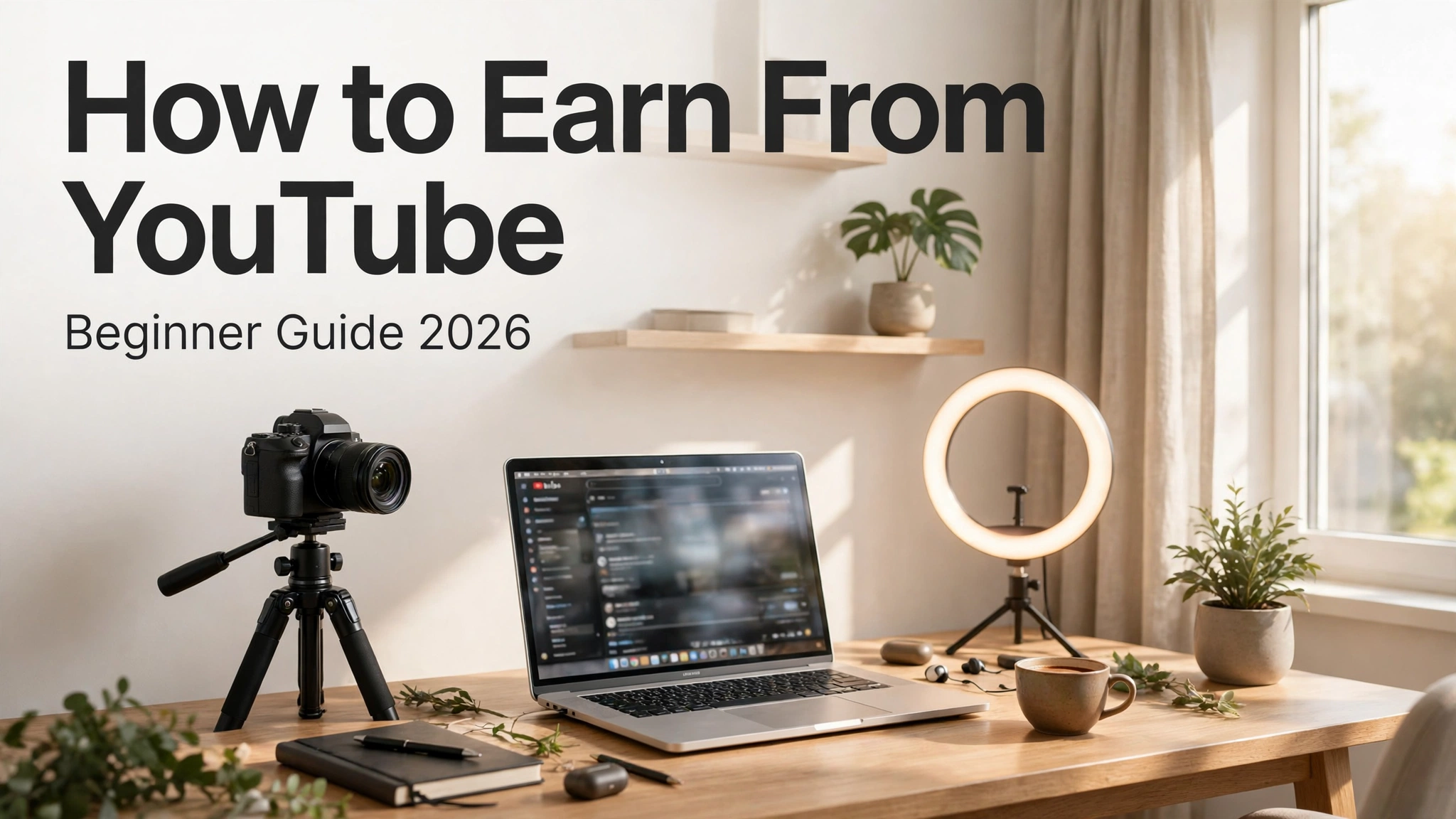
Beginners often overspend on equipment before they have proven they will publish regularly. The honest requirement for a first video is much smaller than camera advertisements suggest. A modern smartphone records good enough video for most beginner channels, natural window light looks better than a cheap harsh light, and a quiet room matters more than an expensive camera. Sound is the exception worth spending on early. Viewers forgive slightly soft video, but they abandon videos with echo, buzzing, or muffled speech quickly. A modest lavalier microphone or a USB microphone, depending on the format, is usually the best first purchase.
The recording space should be simple and repeatable. A creator who must rebuild a set for every video will publish less often. Choose one corner, keep the background tidy but personal, and use the same setup each time so recording becomes a habit rather than a project. Backgrounds do not need to be fancy. A bookshelf, a clean wall with a plant, or a workbench suited to the topic all work. What matters is that the background does not distract, the creator’s face or hands are well lit, and the framing is consistent from video to video.
Editing is where beginner videos improve fastest. Free or low-cost editors are enough to cut pauses, add simple text, insert B-roll, and improve sound levels. Beginners should learn a few core skills: cutting dead air, keeping shots steady, using clear captions or titles, and ending videos cleanly. Over-editing with constant effects often hurts more than it helps, because it distracts from the message. A good rule is that editing should make the video easier to follow, not louder. As the channel grows, editing can become more polished, but clarity should always come first.
Thumbnails and titles deserve as much attention as recording, because they decide whether anyone clicks. A thumbnail should be readable at small sizes, show one clear idea, and match the video honestly. A title should promise a specific benefit or answer, not merely describe the topic. For example, a title that names the viewer’s problem and the outcome is usually stronger than a vague title. Misleading thumbnails and titles may win a click once, but they damage trust and watch time, which harms the channel over time. Beginners should test two or three thumbnail styles, watch click-through data, and keep what works.
Growing an Audience Without Buying Views
Audience growth for beginners comes from a simple loop: make a video people want, help the right viewers find it, and give them a reason to return. Search helps with discovery, but retention keeps viewers watching. YouTube promotes videos that hold attention, so the first minute matters enormously. A strong opening states the problem, promises the answer, and starts delivering it quickly. Long introductions, channel trailers inside every video, and slow apologies for absence all lose viewers. Beginners should respect the viewer’s time from the first seconds.
Consistency matters more than frequency. Publishing once a week for a year beats publishing daily for three weeks and then disappearing. Viewers and the recommendation system both respond to reliable patterns. A beginner should choose a schedule that survives busy weeks, illness, and low motivation. That may mean one video per week, or even one every two weeks, with Shorts in between. The schedule should be written down and treated as an appointment. If a video is late, the next one still goes out. Channels are built by returners, not by bursts.
Community is the beginner’s growth advantage over large channels. Replying to comments, asking viewers what problem to solve next, and featuring viewer questions in videos builds loyalty that algorithms cannot fake. Small creators can answer nearly every comment, which large creators cannot. That personal connection turns a viewer into a subscriber and a subscriber into a returning viewer. Beginners should also collaborate with similar small creators, appear as guests, or share audiences honestly, rather than trying to compete with everyone in their niche.
Beginners must avoid shortcuts that harm the channel. Buying views, subscribers, or engagement violates platform policies and creates an audience that does not watch, which damages performance data. Clickbait that misleads viewers, copied content, and misleading medical or financial claims can lead to strikes or removal. Growth that is slow and honest is more valuable than growth that looks impressive for a week and then collapses. The channel’s reputation with viewers and with YouTube is an asset that takes months to build and days to damage.
Income Streams Beyond Advertising
Affiliate marketing is often the first real income for beginners. It works like this: a creator recommends a product or service they genuinely use, includes a special link, and earns a commission if a viewer buys through that link. The key word is genuinely. Audiences quickly detect recommendations made only for commission, and trust lost this way is hard to recover. Beginners should recommend only products they have used, explain both strengths and limits, and disclose affiliate links clearly. Disclosure is both honest and, in many countries, legally required. A small honest recommendation to a trusting audience can outperform a large dishonest promotion.
Sponsorships are another stream, and they arrive earlier than many beginners expect, especially for niche channels. A brand may pay a creator to mention a product, even on a small channel, if the audience matches the brand’s customers. Beginners should set a simple rate based on average views, audience quality, and the work involved, and should refuse products that conflict with their values or that they would not use. A written agreement covering what will be said, how long the video stays live, and payment terms protects both sides. It is better to decline a poor sponsorship than to publish a video that confuses or disappoints the audience.
Digital products and services scale well for knowledge channels. Examples include a simple guide, a template, a course, a preset pack, or a one-to-one consultation. The product should solve one clear problem that the channel’s videos already address. A beginner does not need a large product catalogue. One good product, mentioned naturally in relevant videos, can earn more than months of ad revenue. Pricing should reflect the value and the audience’s budget, and the product should be genuinely useful rather than a repackaging of free videos. Viewers pay for structure, convenience, and results, not for information alone.
Other streams include freelance work gained through the channel, speaking or teaching opportunities, merchandise for loyal fans, and licensing content. A creator who teaches design may gain clients. A creator who explains cooking may sell a recipe book. The channel becomes a portfolio that proves skill to the world. Beginners should therefore think of each video as both content and evidence of expertise. Even before monetization, a channel can open doors if it demonstrates real knowledge clearly and consistently.
A Realistic First-Year Plan and Common Mistakes
A realistic first year has phases, not a single launch moment. In the first three months, the goal is learning: publish regularly, test topics, improve sound and editing, and study which videos hold viewers. Income is unlikely to be meaningful, and that is normal. In months four to six, the creator should double down on what works, refine thumbnails and titles, and start adding one extra income stream, such as affiliate links for products already used. In months seven to twelve, the focus shifts to building a library, approaching small sponsorships if the audience fits, and possibly creating a simple product. By the end of the year, a healthy channel has a clear niche, a reliable schedule, and data showing what its audience values.
Common mistakes are predictable and avoidable. The first is comparing a beginner channel to a creator with five years of videos. That comparison ignores the library, skills, and audience built over time. The second is changing topics every few videos because growth is slow. Topic-hopping confuses the audience and the recommendation system. The third is spending months perfecting one video instead of publishing and learning. Perfectionism feels like quality, but on YouTube, published feedback teaches more than private polishing. The fourth is ignoring analytics. Watch time, click-through rate, and audience retention are not vanity numbers. They show exactly where viewers leave and what they want more of.
Money mistakes deserve special care. Beginners should keep channel income and expenses separate in a simple record, understand tax obligations in their own country, and avoid spending expected income before it arrives. YouTube payments can be delayed, thresholds must be met, and income fluctuates. A creator who quits a job based on one good month risks serious harm. The safer path is to treat YouTube income as a growing side income until it is stable for many months. Professional advice from a local tax professional is worth seeking once income becomes regular, because rules differ by country and change over time.
Burnout is a real business risk for creators. Publishing pressure, negative comments, and slow growth can exhaust even enthusiastic beginners. Sustainable creators protect their energy: they batch record when possible, take planned breaks, limit comment reading when needed, and remember that a channel is a long project. A break announced honestly rarely harms a small channel. A creator who burns out and disappears harms it far more. The goal is a channel that can run for years, not a channel that shines for a month.
My Take:
My honest opinion is that YouTube is a wonderful opportunity and a terrible lottery ticket, and beginners must decide which one they are buying. If you treat it as a lottery, you will chase trends, copy viral formats, and feel bitter when luck does not arrive. If you treat it as a craft and a business, you will publish useful videos, learn from data, and build something that can actually pay. I think the difference is not talent. It is patience plus a topic you can sustain. The creators I respect most are not the loudest. They are the ones who answered the same audience question better, week after week, until the audience trusted them.
I also believe beginners overvalue equipment and undervalue sound, titles, and the first minute. A phone in a quiet room with a clear promise will beat an expensive camera in an echoing room with a rambling introduction. I would spend the first money on sound, the first energy on understanding the viewer’s problem, and the first months on publishing rather than polishing. Viewers do not reward the creator who worked hardest in private. They reward the creator who made their problem smaller in public. That is a hard truth for perfectionists, but it is liberating once accepted, because it means the next video can be better without the previous one being perfect.
On monetization, my view is that ads should be the last income stream a beginner worries about, not the first. Ads reward scale, and beginners do not have scale. Affiliate links, a small service, or a simple product reward usefulness, and beginners can be useful from video one. I think a beginner who helps ten viewers solve a real problem has already built more business value than a beginner who entertains ten thousand viewers who forget the channel name. Usefulness compounds into trust, trust compounds into income, and income from trust is more stable than income from a single viral video.
I am also sceptical of income claims in the creator economy. Screenshots of large payouts rarely show the years, the team costs, the failed channels, or the tax bill behind them. I would ignore any guru who promises a fixed monthly income from a fixed number of subscribers, because RPM varies by country, topic, and season, and because sponsorship rates depend on audience quality rather than headcount. A beginner should plan with ranges, not promises, and should celebrate progress in skills and library size, not only in money. A channel with fifty good videos is an asset even before it pays well.
On niche choice, my advice is to start narrower than feels comfortable. A narrow channel feels limiting at first, but it makes every decision easier: what to film, what title to write, which product to recommend, and which brand to work with. Broad channels sound ambitious, but they force the creator to compete with everyone and to satisfy no one in particular. I think a beginner should own a small corner completely, then expand outward as the audience asks for more. Expansion driven by audience demand is growth. Expansion driven by boredom is usually the start of a decline.
I also think consistency should be redefined for beginners. Consistency does not mean daily uploads. It means a promise kept. If you promise one video a week, keep it for six months, and viewers will learn to return. If you promise daily and vanish, viewers learn not to trust your schedule. I would rather see a creator publish one excellent, useful video every week for a year than thirty rushed videos in a month followed by silence. The algorithm may reward frequency, but the audience rewards reliability, and in the long run the audience is the algorithm’s teacher.
On sponsorships, my opinion is firm: refuse more than you accept in the first year. A bad sponsorship teaches your audience that your recommendation cannot be trusted, and trust is the only asset a small channel has. I would accept only products I use, from brands whose customers match my viewers, with terms I understand in writing. I would also disclose everything clearly, because undisclosed promotion is not clever marketing. It is a breach of the relationship that makes future income possible. Short-term sponsorship money is expensive if it costs long-term credibility.
Finally, I believe the best reason to start a YouTube channel in 2026 is not money alone. It is that a channel forces you to learn, to explain, and to build publicly, and those skills open doors beyond YouTube itself. Clients, jobs, collaborations, and products all follow from a clear public record of competence. Money may follow slowly, and it may never replace a full salary, and that honesty matters. But a beginner who builds a useful library, a trusting audience, and a small honest income stream has built something real, whether or not it ever goes viral. That, to me, is the point.
I also think beginners should judge their channel by a wider scoreboard than monthly revenue. How many videos in the library genuinely help someone? How many viewers return without being reminded? How many comments ask a deeper question than the video answered? Those signals predict future income better than a single good month, because they show whether the channel is becoming a habit for its audience. A channel that people return to has a future. A channel that people stumble upon once has only a moment. I would trade a viral month for a loyal year every time, because loyalty can be built upon and virality usually cannot be repeated on demand.
On analytics, my view is that data should guide, not govern. Watch time and retention reveal where viewers lose interest, and click-through rate reveals whether a title and thumbnail made a clear promise. But data cannot tell a beginner what is worth saying. If a creator only follows data, the channel slowly becomes a copy of whatever already works, and originality disappears. I think the healthy balance is to use data to improve delivery while letting the creator’s own judgment choose the subject. A video that performs modestly but says something true and useful still strengthens the channel’s identity, and identity is what makes later videos easier to promote.
Frequently Asked Questions
How long does it take a beginner to earn from YouTube?
It varies widely, but most beginners should expect several months of regular publishing before meaningful income, and often a year before income becomes stable. Early earnings, if any, usually come from affiliate links or services rather than ads. Progress depends on niche, publishing consistency, and audience trust, not on a fixed timeline.
Do I need 1,000 subscribers to earn anything?
Subscribers and watch time matter for the YouTube Partner Program and ad revenue, but they are not the only route to income. Affiliate marketing, services, and digital products can earn before a channel reaches ad monetization thresholds. Always check YouTube’s current official requirements, as they can change.
How much does YouTube pay per 1,000 views?
There is no fixed rate. Revenue per thousand views varies by viewer country, topic, season, video length, and ad availability. Educational, business, and technology topics often earn more per view than general entertainment, but individual results vary greatly and fluctuate month to month.
Can I earn from YouTube with just a phone?
Yes, for many formats. A modern phone records good video, and clear sound matters more than an expensive camera. A quiet room, good window light, and a modest microphone are usually enough to start. Upgrade equipment only after you have proven you will publish regularly.
Should beginners focus on Shorts or long videos?
Both can help, but they serve different purposes. Shorts can bring fast discovery, while longer videos usually build deeper trust and higher-value income. A balanced beginner approach often uses Shorts to attract new viewers and longer videos to answer questions in depth.
Is buying subscribers or views a good shortcut?
No. Bought engagement usually violates platform policies, creates an audience that does not watch, and damages the channel’s performance data. Honest, slower growth builds a real audience that returns, which is what long-term income depends on.