How to Improve Your Swimming Technique
In this post
Most swimmers who want to get faster make the same mistake: they try harder instead of swimming better. They thrash their arms, kick frantically, and breathe in a panic, then wonder why they are exhausted after two lengths while a relaxed swimmer glides past them looking barely tired. Swimming is different from running or cycling because water is roughly 800 times denser than air, so poor technique is punished immediately. Every extra movement that pushes water in the wrong direction creates drag, and drag is what makes swimming feel so hard. The good news is that technique improvements pay off faster than fitness improvements. A swimmer who fixes body position, breathing, and stroke timing can often swim further and faster within weeks, without getting fitter at all, simply by wasting less energy.
This guide focuses on freestyle, also called front crawl, because it is the stroke most adults learn first and the one used in most fitness swimming and triathlons. The same principles apply to other strokes, but freestyle gives the clearest lessons: stay horizontal, breathe without lifting your head, catch the water early, and let your hips and shoulders rotate together. You do not need expensive equipment to improve. A pair of goggles that fit, a swim cap if you want one, and access to a pool are enough. Fins, paddles, and snorkels can help later, but they should support good technique, not hide bad technique. Work through the sections in order, practise one change at a time, and be patient: swimming technique changes feel strange before they feel better.
Body Position: The Foundation of Everything
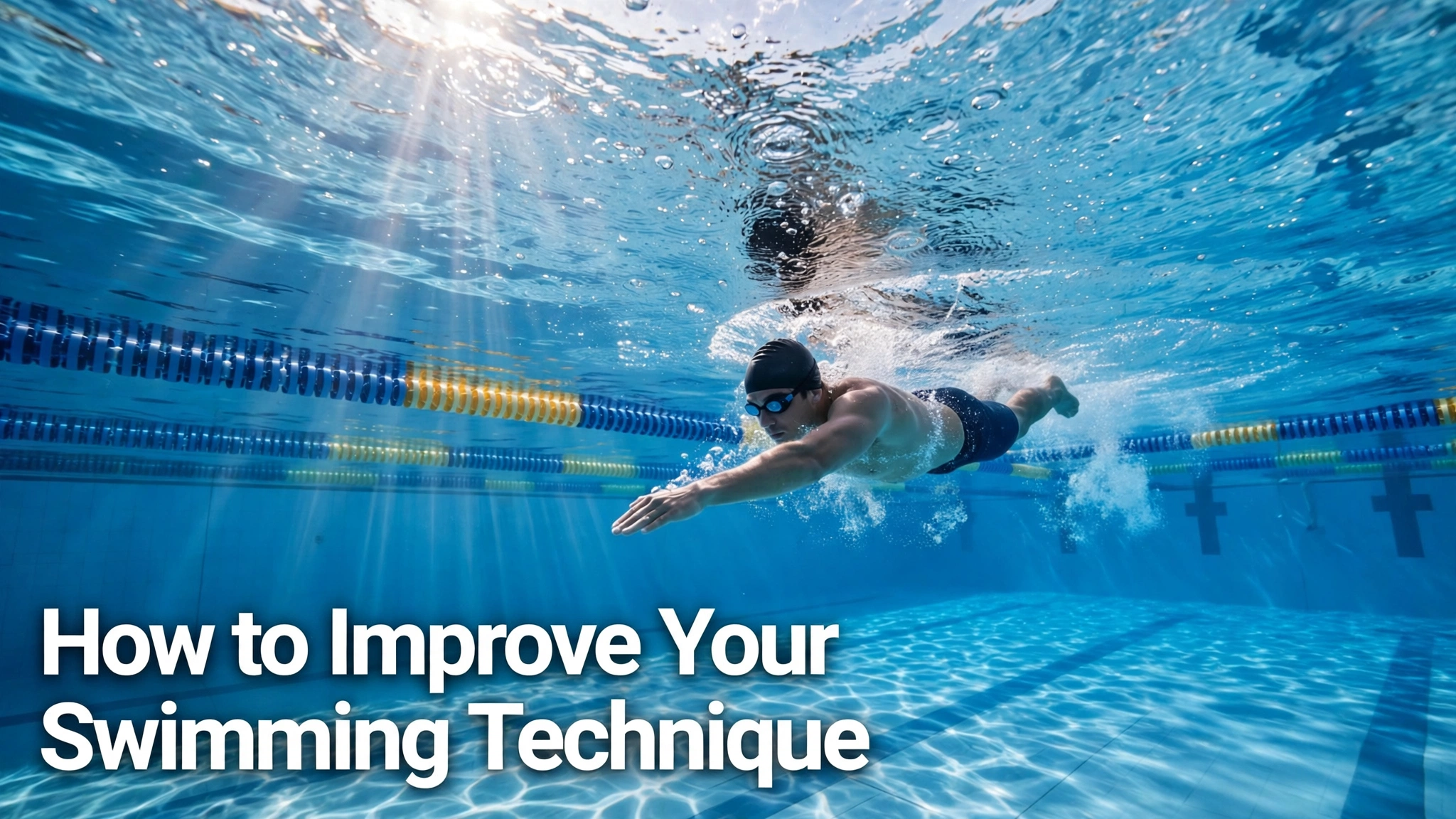
Body position is the single most important part of swimming technique, and it is where most beginners lose the most speed. If your hips and legs sink, your body acts like a brake, pushing a wall of water ahead of you. If you stay horizontal, near the surface, water flows past you smoothly. The fix starts with your head. Look at the bottom of the pool, not ahead of you. When you lift your head to look forward, your hips drop automatically, like a seesaw. Keep your head neutral, with water roughly at your hairline, and let your body follow. Press your chest gently down into the water; this small movement lifts your hips toward the surface, which feels counterintuitive but works for almost everyone.
Your legs should trail behind you near the surface, kicking from the hips with relatively straight legs and loose ankles, not from the knees with a bicycle motion. Think of kicking as a small, fast flutter that keeps your legs up and your rhythm steady, not as the main engine of your swimming. In freestyle, the arms provide most of the propulsion, while the kick mainly stabilises the body and supports rotation. If your legs sink even when your head is down, try a pull buoy between your thighs for a few lengths to feel what a horizontal position is like, then remove it and try to recreate that feeling without help. Core strength matters too: a firm, engaged middle section keeps your body straight instead of snaking from side to side, which wastes energy and makes breathing harder.
Breathing Without Breaking Your Stroke
Breathing is the skill that makes or breaks freestyle for most adult learners. The key idea is that breathing should happen as part of your stroke rotation, not as a separate emergency action. As your arm recovers and your body rolls to one side, turn your head just enough for your mouth to clear the water, take a quick breath, and return your face to the water before your hand enters again. Your head should roll with your body, not lift up independently. Lifting your head pushes your hips down, breaks your rhythm, and often causes a gulp of water, which leads to coughing and panic. Practise breathing every two strokes on one side first, then learn bilateral breathing, every three strokes, alternating sides, which keeps your stroke balanced and helps you breathe on either side in open water or crowded lanes.
Exhale steadily underwater through your nose or mouth while your face is down, so that when you turn to breathe you only need to inhale. Many swimmers hold their breath underwater and then try to exhale and inhale in the same short moment, which feels rushed and stressful. A slow, continuous exhale, with a small burst at the end, makes the inhale feel easy. If you feel breathless, the problem is rarely lung capacity; it is usually timing, tension, or swimming too fast. Slow down, shorten your swims into intervals with rest, and practise breathing drills such as swimming with a snorkel, or doing one-arm freestyle with breathing to one side. Calm breathing transforms swimming from a struggle into something you can sustain for thirty minutes or more.
The Catch, Pull, and Recovery
Once your body position and breathing are reasonable, the next improvement is how your arm moves through the water. The most effective part of the stroke is the catch: the moment your hand enters the water and begins to hold it rather than slip through it. Enter with your hand in front of your shoulder, fingers together but relaxed, wrist slightly flexed, and elbow slightly bent. Then bend your elbow early so your forearm becomes vertical early in the stroke, like an anchor or a paddle, rather than pushing straight down with a straight arm. This early vertical forearm is what coaches call a high elbow catch, and it is the difference between strong swimmers who seem to grip the water and weaker swimmers whose arms slide through without moving them forward.
The pull itself should follow a path under your body, finishing near your hip, with your hand accelerating through the stroke rather than starting fast and fading. Avoid crossing your hand over the centre line in front of your head, which causes your body to snake, and avoid pulling too wide, which strains the shoulders. The recovery, when your arm returns above the water, should be relaxed, with a bent elbow and a loose hand, so your shoulder gets a brief rest before the next catch. A tense, straight-arm recovery looks powerful but tires the shoulders quickly and often throws off timing. Think of the stroke as a rhythm: catch and hold, pull and accelerate, recover and relax, then repeat. Drills such as catch-up drill, where one hand waits in front until the other catches up, and single-arm freestyle help you feel each phase separately before combining them at full speed.
Kicking, Rotation, and Timing
Good freestyle is a full-body movement, not just an arm exercise. Your hips and shoulders should rotate together around your body’s long axis, roughly 30 to 45 degrees to each side, like a log rolling in water. This rotation does several things at once: it brings your shoulder out of the water for an easier recovery, it puts your breathing side in position naturally, and it lets your larger back and core muscles contribute to the pull instead of relying only on your arms. Swimmers who stay flat, with shoulders square to the bottom, have to lift their arms awkwardly, breathe by lifting their heads, and tire quickly. Swimmers who over-rotate, rolling almost onto their sides, lose forward direction and waste time. Aim for a smooth, moderate roll driven from the hips, with your head staying neutral while your body turns around it.
Timing ties rotation and arms together. In efficient freestyle, the opposite arm starts its catch as the recovering arm passes the head, and the body roll supports that catch rather than fighting it. Your kick should match this rhythm: a two-beat kick, one kick per arm stroke, suits distance swimming and saves energy, while a six-beat kick, three kicks per arm stroke, suits sprinting and gives more propulsion at a higher energy cost. Most fitness swimmers benefit from learning a relaxed two-beat or four-beat kick first, because it encourages a long, gliding stroke instead of frantic splashing. If your kick feels like your main workout, it is probably too big; shorten it, relax your ankles, and let your legs follow your body rotation rather than leading it.
Common Mistakes and How to Fix Them
Several mistakes appear again and again in adult swimmers, and each has a simple fix. The first is overreaching and crossing over in front of the head, which causes snaking and shoulder pain. Fix it by aiming each hand entry at about shoulder width, as if swimming between two rails. The second is a dropped elbow during the pull, where the arm pushes water downward instead of backward. Fix it with sculling drills and fingertip drag drill, in which your fingertips brush the water during recovery, encouraging a high elbow. The third is kicking from the knees with bent legs and stiff ankles, which creates drag and exhaustion. Fix it with vertical kicking or kicking with fins, focusing on loose ankles and hip-driven movement.
The fourth common mistake is holding the breath and rushing the stroke when tired. When fatigue arrives, swimmers often shorten their strokes, lift their heads, and sprint the last lengths badly. The better response is to slow down slightly, lengthen the stroke, and return to bilateral breathing if you can. The fifth mistake is ignoring turns and streamlining. A good push-off in a tight streamline position, arms extended overhead, head between arms, and a few dolphin kicks or flutter kicks before the first stroke, can save seconds per length and teaches body position better than any drill. Finally, many swimmers train only at one speed. Mix steady swims with intervals, technique drills, and occasional faster efforts, so your body learns efficient movement at different paces rather than memorising one rushed stroke.
A Simple Four-Week Technique Plan
Improvement needs structure, but it does not need complexity. In week one, swim three times for 20 to 30 minutes, focusing only on head position and relaxed breathing, with frequent rests. Use intervals such as four sets of 50 metres with 30 seconds rest, and include one drill per session, for example catch-up drill or single-arm freestyle. In week two, add body rotation and a two-beat kick focus, keeping the same interval structure but slightly longer swims, such as four sets of 100 metres with rests. Film yourself if possible, even with a phone from the poolside, because what swimming feels like and what it looks like are often very different, and video reveals dropped elbows, crossing over, and sinking legs instantly.
In week three, practise the high elbow catch with sculling and paddle-free drills, then swim longer continuous sets of 200 metres at a comfortable pace, checking that your stroke count per length stays stable or falls as you get more efficient. A falling stroke count at the same speed means you are travelling further per stroke, which is real improvement. In week four, combine everything in mixed sessions: a warm-up, a drill set, a main set of intervals at varied speeds, and a cool-down. Swim with a friend or join a coached group session if you can, because a coach watching from the deck can spot in seconds what months of solo practice might miss. After four weeks, repeat your original test, such as timing 400 metres or counting strokes per length, and compare honestly. Most swimmers see clear progress, and that evidence keeps motivation high for the next block of training.
Staying Safe, Strong, and Consistent
Swimming is low impact and kind to joints, which is why it suits a wide range of ages and fitness levels, but it still deserves respect. Never swim alone in open water, learn basic water safety, and build distance gradually rather than jumping from short swims to very long ones. Shoulder pain is a warning sign, not a badge of toughness: if a stroke change causes sharp pain, stop, rest, and seek advice from a coach or health professional rather than pushing through. This article gives general information only, not medical advice, and anyone with a health condition, injury, or concern should check with a qualified professional before starting a new training plan. Warm up with easy swimming and gentle mobility, cool down the same way, and stretch shoulders, hips, and ankles after sessions.
Consistency beats intensity in swimming. Two or three shorter sessions per week will improve technique far more than one exhausting session every fortnight, because motor learning depends on repetition with feedback. Keep a simple log: date, distance, main drill, stroke count per length, and how the swim felt. Over months, that log shows patterns, such as better efficiency after drill-focused weeks, and it helps you set realistic goals, whether that is swimming a kilometre without stopping, completing a triathlon swim, or simply enjoying the pool without gasping. Technique, patience, and regular practice are the real secrets of good swimmers, and none of them requires talent you do not already have.
My Take:
My honest take is that most adult swimmers are closer to good technique than they think, and the reason they feel stuck is that they practise the wrong thing. They practise going faster, when they should practise going easier. I have seen swimmers spend months building fitness while keeping a head-up, legs-down position that wastes every bit of that fitness, and then feel frustrated that effort is not rewarded. The moment they fix head position and breathing, swimming suddenly feels like a different sport: quieter, longer, calmer. That transformation is why I always put body position first in this guide, even though it is the least glamorous part. Nobody posts a video of their head position, but head position is what makes the rest possible.
I also think the swimming world sometimes makes technique sound more complicated than it needs to be. Terms like early vertical forearm and stroke phases are useful for coaches, but for a fitness swimmer the useful version is simpler: look down, press your chest down, let your hips rise, breathe by rolling, and hold the water with a bent elbow instead of pushing down with a straight arm. If you can remember those five cues during a swim, you are doing most of what matters. The drills in this guide are there to help you feel those cues, not to become a separate hobby. Do one drill well for a few lengths, then swim normally and notice whether the feeling carries over. If it does not, repeat the drill briefly rather than doing twenty lengths of drill with no transfer to normal swimming.
Another opinion I hold strongly is that video feedback is underrated and underused by everyday swimmers. We would never try to improve a golf swing or a tennis serve without watching it, yet swimmers happily train for years without ever seeing their own stroke. A single short poolside video, taken by a friend, often reveals the real problem in seconds: a crossing hand entry, a dropped elbow, a bicycle kick, or a head that lifts on every breath. You do not need professional analysis software; you need one honest look at what you actually do versus what you think you do. If your pool allows it, film yourself once a month, keep the clips, and compare them over time. That habit alone will accelerate your progress more than any new piece of equipment.
I am also sceptical of equipment as a shortcut, though I am not against equipment itself. Fins can teach ankle flexibility and kick timing, paddles can teach the catch, and a snorkel can let you practise body position without breathing worries. But each tool can also hide a flaw: fins can hide sinking legs, paddles can hide a dropped elbow if they are too large, and a pull buoy can hide a weak kick. My rule is simple: use a tool for a specific drill and a short time, then take it away and check whether your normal swimming improved. If it only feels good while the tool is on, the tool is doing the work, not you. Good technique should feel better without equipment, even if it feels slower at first while new movements become automatic.
On training plans, my view is that consistency and patience matter more than heroic sessions. Swimming technique is a motor skill, like learning an instrument, and motor skills improve through frequent, focused repetition with rest, not through occasional exhaustion. Three calm sessions a week, each with a clear focus and a log entry, will beat a single punishing session every weekend. I also think swimmers should celebrate efficiency gains, not just speed gains. If you swim the same distance with fewer strokes, or finish a swim less tired, that is progress, even if your time has not dropped yet. Speed usually follows efficiency, but only if you give it time and resist the urge to thrash harder the moment you feel tired.
I also want to address a fear that stops many adults from improving: the fear of looking foolish in a public pool. Nobody at a public swim session is judging your stroke as harshly as you imagine, and most regular swimmers are focused on their own workout. If drills feel awkward, remember that every good swimmer once did those same drills badly. Doing a drill slowly, with concentration, is not embarrassing; it is exactly how improvement works. If self-consciousness is a barrier, try quieter sessions, swim with a friend, or join a coached group where drills are normal for everyone. The pool is one of the few places where adults of all ages and abilities train side by side, and that shared effort is part of its appeal rather than something to fear.
Finally, I want to say something about enjoyment, because technique guides can make swimming sound like homework. The real reward of better technique is not a faster time on a spreadsheet; it is the feeling of gliding through water without fighting it, of breathing calmly, of finishing a swim refreshed rather than exhausted. That feeling is available to ordinary swimmers, not only to athletes, and it is worth the weeks of strange-feeling drills. Be patient with yourself, fix one thing at a time, film yourself occasionally, and trust that small, correct changes compound. Swimming rewards the swimmer who stays relaxed, stays horizontal, and keeps showing up. That is the whole secret, and it is simpler than the swimming world sometimes makes it sound.
One last practical thought: measure progress in more than one way, because a single number can mislead you. Time over a fixed distance is useful, but so is stroke count per length, so is how tired you feel afterwards, and so is whether you can hold a conversation after a swim that once left you gasping. Some weeks your time will improve while your stroke count stays the same, because fitness improved; other weeks your stroke count will fall while your time stays the same, because efficiency improved and you are still learning to sustain the new movement at speed. Both are progress, and both deserve recognition. Keep a simple log with all three measures, review it monthly rather than daily, and judge yourself over a season rather than a single session. Swimming improvement is rarely a straight line, but over months the trend for a consistent, technique-focused swimmer is almost always upward, and that trend is a more honest reward than any single fast swim.
Frequently Asked Questions
How long does it take to improve swimming technique? Most swimmers notice a difference within a few weeks of focused practice, especially after fixing head position and breathing, but lasting technique changes usually take several months of regular sessions. One change at a time, plus occasional video feedback, produces faster progress than trying to fix everything at once.
Why do my legs sink when I swim freestyle? Legs usually sink because the head is lifted to look forward, which drops the hips like a seesaw. Looking at the pool bottom, pressing the chest gently down, and kicking from the hips with loose ankles usually lifts the legs, and a pull buoy can help you feel the correct horizontal position.
Should I breathe every two strokes or every three strokes? Breathing every two strokes is easier and suits most beginners and longer swims, while breathing every three strokes, known as bilateral breathing, keeps the stroke balanced and lets you breathe on either side. Learn one side first, then practise bilateral breathing in drills and easier swims.
What is a high elbow catch in swimming? A high elbow catch means bending the elbow early after your hand enters the water so your forearm becomes vertical and holds the water like a paddle, instead of pushing down with a straight arm. It is one of the most effective ways to increase propulsion without extra effort.
How can I swim further without getting tired? Slow down slightly, lengthen your stroke, breathe calmly with a steady underwater exhale, and keep your body horizontal to reduce drag. Interval training with rests, plus technique drills, builds distance more effectively than struggling through one continuous exhausting swim.
Do swimming paddles and fins help technique? They can help when used briefly for specific drills, such as fins for ankle flexibility or small paddles for feeling the catch, but they can also hide flaws like sinking legs or a dropped elbow. Use them for short drill sets, then swim without them to check that the improvement carries over.