How to Survive a Long-Haul Flight in 2027
In this post
A long-haul flight can be 10, 14, or even 18 hours in a metal tube, with dry air, little space, and no proper bed. It can leave you tired, stiff, dehydrated, and jet-lagged, even before your holiday starts. Yet millions of people fly long-haul every year, and many of them arrive feeling fine. The difference is not luck. It is preparation, and a set of small habits that make a long flight survivable, even comfortable.
This guide explains how to choose a seat, what to pack, how to sleep, eat, and move on a long flight, and how to beat jet lag when you land. It is practical, not glamorous, and it is based on what experienced travellers actually do.
Before You Fly: The Choices That Matter Most
A long flight starts before you board, with the seat, the flight time, and the packing.
In practice, Choose your seat carefully. An aisle seat gives you freedom to move, while a window seat gives you a wall to lean on and a view. An exit row or a bulkhead seat gives more legroom, but it may cost more. Avoid a seat near the toilets if you want quiet, and avoid a seat at the very back if you want to get off quickly. So the seat is the first decision, and it affects the whole flight, so it is worth choosing well. The aisle seat and the water bottle are the long-haul flyer’s quiet tools, and once I understood that, a ten-hour flight stopped looking like an ordeal and started looking like a plan.
Look closer and Choose a flight time that fits your sleep. A night flight lets you sleep on the plane, while a day flight lets you watch films and arrive in the evening. A night flight is often better for jet lag, because you arrive in the morning and can start your day. That timing can change how you feel when you land. So the flight time is not just a schedule; it is a sleep strategy, and it should be chosen with that in mind. A good long flight is not one trick; the seat, the water, the sleep, and the sunlight work together, and the way setting your watch to destination time helps your brain proves the small choices add up.
The key point is that Pack a small bag with the essentials: a neck pillow, an eye mask, earplugs or noise-cancelling headphones, a water bottle, snacks, and a charger. Those small items make a big difference on a long flight. Pack them in a bag you can reach easily, not in the overhead locker. So packing is preparation, and a well-packed carry-on is the difference between a comfortable flight and a miserable one. Up close, surviving a long flight looks less like endurance and more like preparation, where water, movement, and sleep turn a cramped cabin into a manageable day.
Seats, Space, and Comfort
Economy seats are small, but there are ways to make them more comfortable.
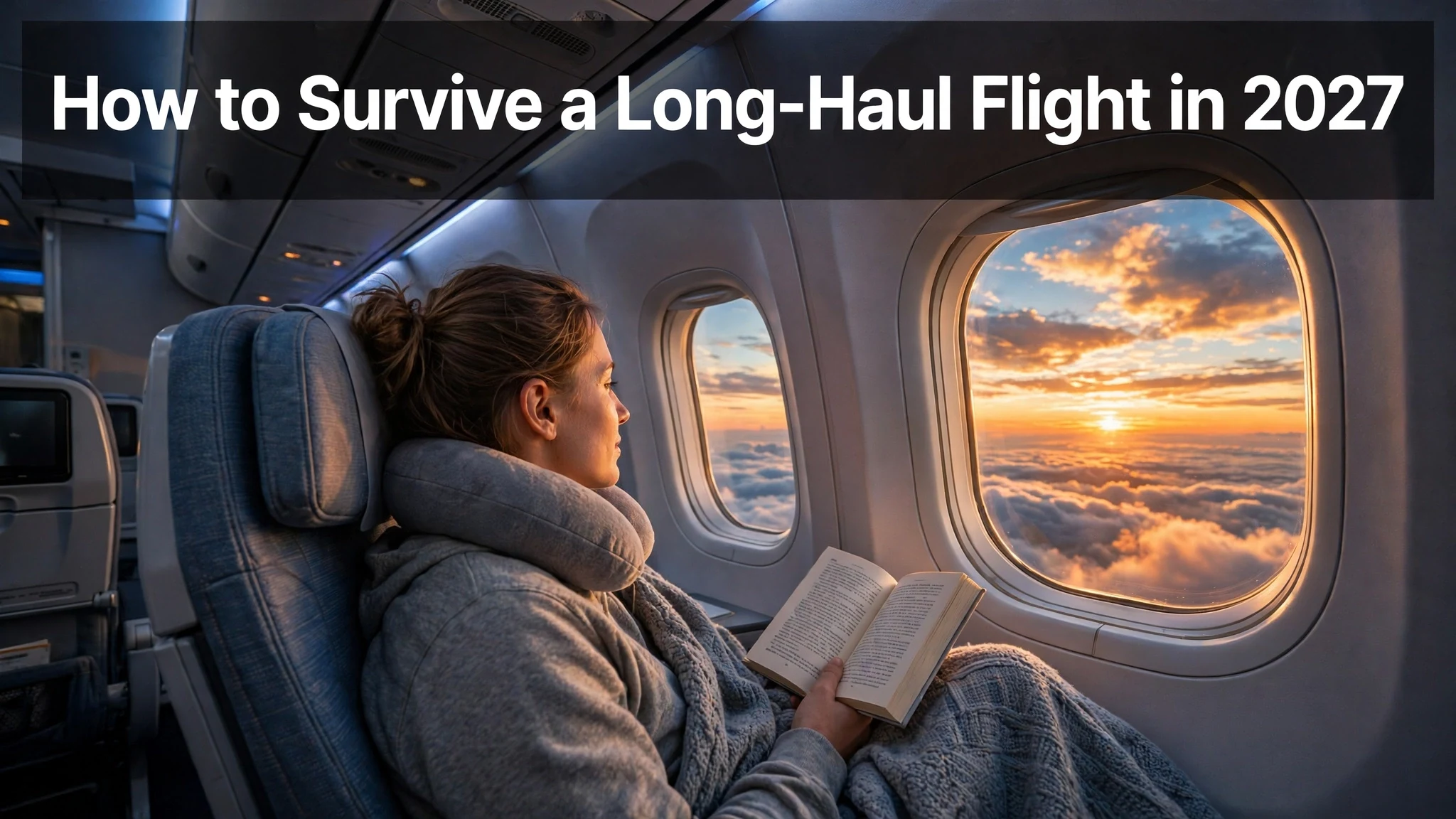
What makes this work is that Use a neck pillow that supports your head, not one that pushes it forward. A good neck pillow lets you sleep without your head falling to one side. An eye mask and earplugs help you block out light and noise, which are the main enemies of sleep on a plane. So comfort is about blocking the world out, and a few small items can create a private, dark, quiet space. People dread the middle hours and forget the preparation, yet the seat choice, the water, and the first day’s sunlight are what actually decide whether you arrive fresh or exhausted.
Step back for a moment and Wear loose, comfortable clothes, and layers, because planes can be cold. A hoodie, a scarf, and warm socks are useful, and they can also be used as a blanket or a pillow. Avoid tight clothes and shoes that are hard to take off. So dressing for a flight is dressing for comfort, not for fashion, and loose layers are the right choice. One long flight packs seating, sleeping, eating, and jet lag into a single cabin, and the traveller spends their energy so carefully that standing up and stretching becomes a real strategy.
The surprising part is that Move your seat, if you can, and adjust the lumbar support. A small cushion or a rolled-up jumper behind your lower back can help. That support reduces back pain, which is a common problem on long flights. So a little support goes a long way, and it is worth taking a few minutes to get comfortable before the flight starts. Link the seat to the water to the sunlight, and the separate tips, before you fly, on the plane, and after you land, join into one story about arriving human.
Sleeping on a Plane: How to Actually Do It
Sleeping on a plane is hard, but it is possible, and it is the best way to pass a long flight.
In practice, Try to sleep at the same time as night at your destination, if you can. That helps your body adjust to the new time zone before you land. Set your watch to destination time as soon as you board, and act as if you are already there. So sleep is not just rest; it is jet lag preparation, and timing your sleep is part of that. The aisle seat and the water bottle are the long-haul flyer’s quiet tools, and once I understood that, a ten-hour flight stopped looking like an ordeal and started looking like a plan.
Look closer and Avoid caffeine and alcohol before you try to sleep, because they disrupt sleep. Drink water instead, and eat a light meal, not a heavy one. A heavy meal can make you uncomfortable and make sleep harder. So what you eat and drink before sleep matters, and a light, calm approach works best. A good long flight is not one trick; the seat, the water, the sleep, and the sunlight work together, and the way setting your watch to destination time helps your brain proves the small choices add up.
The key point is that Use the blanket, the pillow, and the eye mask to create a sleep routine, even if it is a short one. Put on the eye mask, put in the earplugs, and tell yourself it is bedtime. That routine signals to your brain that it is time to sleep, even in a strange place. So sleep on a plane is partly about habit, and a small routine can help your body understand what to do. Up close, surviving a long flight looks less like endurance and more like preparation, where water, movement, and sleep turn a cramped cabin into a manageable day.
Food, Water, and Staying Healthy
The air on a plane is dry, and the food is often salty, so you need to drink and eat carefully.
What makes this work is that Drink water regularly, even if you do not feel thirsty, because the dry air dehydrates you. Bring an empty water bottle through security and fill it on the plane, or ask the crew for water often. Avoid too much alcohol and caffeine, because they dehydrate you further. So water is the most important thing on a long flight, and it is the simplest way to feel better when you land. People dread the middle hours and forget the preparation, yet the seat choice, the water, and the first day’s sunlight are what actually decide whether you arrive fresh or exhausted.
Step back for a moment and Eat light meals, and avoid heavy, salty food if you can. Bring your own snacks, such as nuts, fruit, or a sandwich, so you are not dependent on plane food. That control over food helps you feel better, and it avoids the discomfort of a heavy meal. So food is a choice, and a light, familiar snack is often better than a plane meal. One long flight packs seating, sleeping, eating, and jet lag into a single cabin, and the traveller spends their energy so carefully that standing up and stretching becomes a real strategy.
The surprising part is that Move regularly, even if it is just a walk to the toilet and back. Sitting still for hours can cause stiffness, swelling, and, rarely, blood clots. Stand up, stretch, and walk every couple of hours, and do ankle exercises in your seat. So movement is medicine on a long flight, and a short walk every few hours is a simple, effective habit. Link the seat to the water to the sunlight, and the separate tips, before you fly, on the plane, and after you land, join into one story about arriving human.
Entertainment and Passing the Time
A long flight is also a long time to fill, and a good plan for entertainment helps.
In practice, Download films, shows, music, and books before you fly, because plane Wi-Fi can be slow or expensive. A downloaded film is reliable, and it does not depend on the plane’s system. Bring headphones, a charger, and a book, so you have options. So entertainment is preparation, and downloading before you fly is the key to a smooth flight. The aisle seat and the water bottle are the long-haul flyer’s quiet tools, and once I understood that, a ten-hour flight stopped looking like an ordeal and started looking like a plan.
Look closer and Use the time to do something useful, such as planning your trip, learning a few words of the local language, or writing a journal. That use of time makes the flight feel productive, not wasted. A long flight can be a good time to plan, because you have no distractions. So the flight is not lost time; it is a chance to prepare, and that preparation can make your trip better. A good long flight is not one trick; the seat, the water, the sleep, and the sunlight work together, and the way setting your watch to destination time helps your brain proves the small choices add up.
The key point is that Take breaks from screens, and look out of the window, especially at sunrise or sunset. A view from a plane can be beautiful, and it is a reminder that you are travelling. That moment of looking out can be a highlight of the flight, not just a way to pass time. So entertainment is not only about screens; it is also about the view, and the view is free. Up close, surviving a long flight looks less like endurance and more like preparation, where water, movement, and sleep turn a cramped cabin into a manageable day.
Jet Lag: What It Is and How to Beat It
Jet lag is the tiredness and confusion you feel when your body clock does not match the local time.
What makes this work is that Jet lag happens because your body has an internal clock, and flying across time zones confuses it. Your body thinks it is night when it is day at your destination, or vice versa. That confusion causes tiredness, poor sleep, and difficulty concentrating. So jet lag is a clock problem, and beating it means resetting your clock, not just getting more sleep. People dread the middle hours and forget the preparation, yet the seat choice, the water, and the first day’s sunlight are what actually decide whether you arrive fresh or exhausted.
Step back for a moment and The best way to beat jet lag is to adjust to destination time as soon as possible. Eat, sleep, and go outside in daylight at the local time, even if you feel tired. Sunlight is the strongest signal for your body clock, and it helps reset it faster. So daylight is medicine for jet lag, and spending time outside on your first day is one of the best things you can do. One long flight packs seating, sleeping, eating, and jet lag into a single cabin, and the traveller spends their energy so carefully that standing up and stretching becomes a real strategy.
The surprising part is that Avoid napping for too long on your first day, because a long nap can make jet lag worse. A short nap of 20 to 30 minutes is fine, but a long sleep in the afternoon can delay your adjustment. Stay awake until a reasonable bedtime, even if you are tired. So the first day is the hardest, but pushing through it pays off, and you will adjust faster. Link the seat to the water to the sunlight, and the separate tips, before you fly, on the plane, and after you land, join into one story about arriving human.
Arriving Fresh: The First Day at Your Destination
How you spend your first day can set the tone for your whole trip.
In practice, Drink water, eat a good meal, and get some sunlight on your first day. Those three things help your body recover from the flight and adjust to the new time. Avoid heavy drinking or a big, late meal on your first night. So the first day is about recovery, and a simple, healthy day is better than a busy one. The aisle seat and the water bottle are the long-haul flyer’s quiet tools, and once I understood that, a ten-hour flight stopped looking like an ordeal and started looking like a plan.
Look closer and Take a gentle walk, not a long tour, on your first day. A walk helps your body move after hours of sitting, and it helps you see the place. That gentle start is better than a packed schedule, which can leave you exhausted. So the first day should be light, and it should be about settling in, not about seeing everything at once. A good long flight is not one trick; the seat, the water, the sleep, and the sunlight work together, and the way setting your watch to destination time helps your brain proves the small choices add up.
The key point is that Go to bed at a normal local time, even if you are tired earlier. That normal bedtime helps your body clock adjust, and it gives you a good night’s sleep. A good first night’s sleep is the best cure for jet lag. So the first day ends with a normal bedtime, and that normal bedtime is the start of a good trip. Up close, surviving a long flight looks less like endurance and more like preparation, where water, movement, and sleep turn a cramped cabin into a manageable day.
My Take:
I have taken long flights, and I know how they feel. The first hour is exciting, the middle hours are boring, and the last hour is a test of patience. Yet I have also learned that a long flight does not have to be miserable. It can be comfortable, even pleasant, if you prepare well, if you drink water, if you move, and if you sleep when you can. This guide is the advice I wish someone had given me before my first long flight, written in plain language, without any pretence.
I think water is the most important advice in this guide. Drinking water regularly is simple, cheap, and it makes a real difference to how you feel when you land. It is a reminder that the simplest advice is often the best, and that we ignore it because it sounds too easy. Water is the advice I keep coming back to, because drinking regularly is simple, cheap, and it makes a real difference to how you feel when you land. Long flights are no longer an ordeal in my head; they are a test of preparation, and I think about that test whenever I pack for a journey.
The seat choice is the decision I would spend most time on. An aisle seat, a window seat, and an exit row seat are different trips, even on the same plane. Choosing well is worth the effort, because you will live with that choice for 10 hours or more. For me, the honest test for surviving a long-haul flight in 2027 is simple. Clever-sounding advice alone does not convince me; I only keep advice that would change how I actually fly. I trust long-haul advice when it lets me predict the flight, like knowing sunlight on the first day will reset my body clock, and this guide kept predicting well. A long-haul detail of that kind is one I would share with a first-time flyer, so the aisle seat becomes a practical choice, not just a preference.
I also like the idea of setting your watch to destination time as soon as you board. It is a small, psychological trick, but it helps your brain start adjusting before you land. That is a good example of how a tiny change in mindset can help your body cope with a big change in time. Understanding long flights took me longer than a boarding pass, because the seat, the sleep, and the jet lag all have to be planned before the plane leaves. For me, learning about surviving a long-haul flight in 2027 was not one dramatic moment. A seat choice here, a walk down the aisle there, a watch set to destination time, and the separate tips gradually added up to a flight I could actually survive. I no longer feel silly asking simple long-flight questions, because wondering why water matters took me to cabin air, dehydration, and tiredness.
The jet lag advice about sunlight stayed with me. Sunlight is the strongest signal for your body clock, and spending time outside on your first day is the best cure. It is a natural, free remedy, and it is more effective than any pill or drink. If a friend asked about a long flight, I would tell them to move, because standing up, walking, and stretching are worth more than any entertainment system. Ask what sitting still costs your legs, who gains from an aisle seat, and what sunlight does on the first day, and the flight turns into a set of small, useful choices. My old view of long flights was hours of boredom to endure, and the prepared, paced flight that replaced it is calmer and far more bearable to me.
If I could give one tip to a first-time long-haul traveller, it would be to move. Stand up, walk, stretch, and do ankle exercises, because sitting still for hours is bad for your body. That movement is simple, and it is the difference between arriving stiff and arriving fresh. Learning about long flights has made me slower to blame the airline for everything, because much of how I feel on arrival depends on what I did in the cabin. The more I learn about flying long-haul, the less I trust the idea that a flight is something you survive by luck, and that shift feels like a useful correction. A long-haul flight done well rewards travellers who look twice every time. What stays in my mind is a simple instruction: move, drink water, and set your watch, and the rest of the flight becomes far easier to bear.
The lesson I take from long flights is about preparation. A long flight is not something you survive by luck. It is something you prepare for, with a good seat, a good bag, water, and a plan. I think that is true of many hard things in life: preparation does not remove the difficulty, but it makes it manageable, and that is enough. If I could keep one long-haul lesson, it would be preparation, because a long flight is not something you survive by luck, it is something you prepare for. When I tried to explain long flights without the guide, the vague part showed up fast: how jet lag actually works and how sunlight resets it.
Going back to the opening section about the choices that matter most, I noticed how much of a flight depends on decisions made before boarding, not in the air. The entertainment system is less telling than the water advice, because a film passes the time while water changes how you actually feel. Water, of all things, turned out to be the hero of the piece, and that surprises me because it is the simplest, cheapest advice in the whole guide.
The seat section changed how I talk about long flights, because it gave me a concrete choice, aisle, window, or exit row, to discuss instead of a vague dread. My long-flight conversations now begin with seats, move through water and sleep, and finish with my own view of the flight. Seats first, sleep second: that sequence lets the listener picture their own flight before hearing my conclusion. It also lets the listener pick a different seat, and a flight discussion that welcomes that choice beats one that demands a single answer.
Sleeping on a plane, read last, gave the whole piece a shape I had not seen on my first pass through it. Preparation kept showing up in different forms, in the seat, in the water, and in the sunlight, until the whole flight felt like a single, careful plan. Preparation is a habit that travels beyond flying, so I will keep this guide and look at it again before my next long journey. I will set my watch to destination time on my next long flight, and I expect that small act to change how the whole journey feels.
Frequently Asked Questions
How can I sleep on a long-haul flight?
Choose a comfortable seat, use a neck pillow, eye mask, and earplugs, wear loose clothes, and try to sleep at night time at your destination. Avoid caffeine and alcohol before sleeping, and drink water instead.
How do I beat jet lag after a long flight?
Adjust to destination time as soon as possible, spend time in daylight on your first day, eat and sleep at local times, and avoid long naps. Sunlight is the strongest signal for resetting your body clock.
Should I drink alcohol on a long flight?
It is best to avoid or limit alcohol, because it dehydrates you and disrupts sleep. Drink water regularly instead, and save alcohol for when you arrive.
How often should I move on a long flight?
Stand up, stretch, and walk every couple of hours, and do ankle exercises in your seat. Moving helps prevent stiffness, swelling, and blood clots on long flights.
What should I pack for a long-haul flight?
Pack a neck pillow, eye mask, earplugs or noise-cancelling headphones, water bottle, snacks, charger, and a change of clothes in your carry-on. Download films and books before you fly.
Is it better to take a night flight or a day flight?
A night flight is often better, because you can sleep on the plane and arrive in the morning. A day flight lets you watch films and arrive in the evening. Choose the time that fits your sleep and your plans.