How TV Shows Are Made Behind the Scenes
In this post
From an Idea to a Show People Can Watch
Every television show begins as an idea that must survive many stages before it reaches a screen, and most ideas do not survive at all. A creator may start with a character, a place, a question, or a situation, such as a family running a business, a hospital ward, a school, or a group of strangers forced to work together. That idea is then developed into a short pitch, a longer treatment, and eventually a script. The pitch must answer questions that executives, producers, and later audiences will ask: who are the central characters, what do they want, what stands in their way, why does this story need to be a series rather than a single film, and what will keep viewers returning week after week or episode after episode.
Development is not only creative work. It is also a business decision. A broadcaster or streaming service considers audience, budget, schedule, existing shows, and international appeal. A show that is expensive to film, requires a large cast, or depends on a very specific cultural reference may be harder to sell than a show set in a single location with a small cast. That does not mean ambitious ideas fail, but it means creators often revise their idea to fit practical limits, such as filming in one city, reducing locations, or designing a story that can continue for several seasons. Writers learn to balance originality with sustainability: a brilliant first episode is not enough if the story cannot generate a second, tenth, or fiftieth episode without repeating itself.
Once a project is approved, a pilot or first episode is often made to test the concept, cast, and tone. A pilot is a costly experiment. It must introduce characters, establish the world, and promise future stories, all while feeling complete enough to judge. If the pilot works, the show may be ordered for a full season. If it does not, it may be revised, recast, or abandoned, even after significant money has been spent. This high failure rate is part of television production, and it explains why shows that reach the screen often feel carefully shaped. They have survived selection, revision, and testing that the audience never sees.
Writing Rooms, Scripts, and Story Arcs
Writing a television series is usually a team activity, unlike writing a novel. A showrunner, who is often the creator or lead writer, oversees the overall story, tone, and direction, while a room of writers breaks stories, writes drafts, and revises each other’s work. The room discusses character arcs, episode plots, and season structure, often using boards, cards, or documents to track who knows what, who is in conflict with whom, and which questions remain open. This collaborative process allows a series to produce many episodes quickly, but it also requires discipline. Without a clear showrunner and a shared understanding of character, a series can drift, with characters behaving inconsistently from one episode to the next.
Scripts go through multiple drafts before filming. A first draft may focus on story structure, a second on character voice, and later drafts on pacing, clarity, and practical filming needs, such as reducing a scene that would require an expensive location or a difficult effect. Dialogue is rewritten to sound natural when spoken, not only when read, and actors may suggest changes during rehearsals. Some shows use a writers’ room that plans a whole season in advance, with a clear arc from beginning to end. Others plan episode by episode, responding to audience reaction, actor availability, or production constraints. Both approaches can work, but the planned-arc approach usually produces tighter seasons, while the episode-by-episode approach allows more flexibility and surprise.
A key concept in series writing is the difference between episodic and serialised storytelling. An episodic show tells a mostly self-contained story each week, so a new viewer can join at any episode. A serialised show tells one long story across episodes, so missing an episode means missing important plot developments. Many modern shows mix the two: each episode has its own problem, while a larger story develops slowly in the background. Writers must also plan cliffhangers, season finales, and character growth in a way that rewards loyal viewers without alienating new ones. That balance is one of the hardest parts of television writing, and it explains why some shows start strongly but lose momentum when the central mystery is solved or the main relationship is resolved too early.
Casting, Rehearsal, and Finding the Right Faces
Casting is often described as the most important decision after writing, because the wrong actor can make even a good script feel false, while the right actor can make a thin script feel alive. Casting directors audition many actors for each role, considering not only talent, but also chemistry with other cast members, physical suitability for the role, availability for a long production schedule, and public image. For a series, casting is a long-term commitment. An actor may play the same character for years, so producers look for someone who can grow with the role, handle both comedy and drama if needed, and work well within a team over a long period.
Rehearsal for television is usually shorter than for theatre, because production schedules are tight. Actors may receive scripts only days before filming, and they must learn lines, understand character motivation, and coordinate movement with cameras quickly. Directors run rehearsals to block scenes, which means planning where actors stand, move, and look, so cameras and lights can capture the action cleanly. Blocking is a practical art: a scene that feels natural on screen often requires precise, unnatural positioning in real life, so that faces are visible, microphones can pick up dialogue, and the camera can move without revealing crew or equipment.
Chemistry tests, where actors perform together before final casting, help producers see whether a supposed family, couple, or team feels believable. A pair of actors may be excellent individually but unconvincing together, while a less famous pair may create a spark that carries a show. That is why casting news sometimes surprises audiences: the chosen actor may not be the most famous candidate, but may be the one who worked best with the rest of the cast. Once filming begins, the cast’s working relationship also matters, because long days, repeated takes, and public attention create pressure that can affect performance if the team does not support each other.
Filming: Sets, Locations, Cameras, and Long Days
Filming a television episode is a complex logistical operation. A single episode may be shot over several days, often out of story order, to make efficient use of locations, actors, and daylight. Scenes set in the same location are usually filmed together, even if they appear in different episodes, and actors may film an emotional farewell in the morning and a joyful reunion in the afternoon. This out-of-order filming requires careful continuity: costumes, hairstyles, props, and set dressing must match across takes and days, and a continuity supervisor tracks those details so the audience does not notice a jacket changing colour or a cup moving between shots.
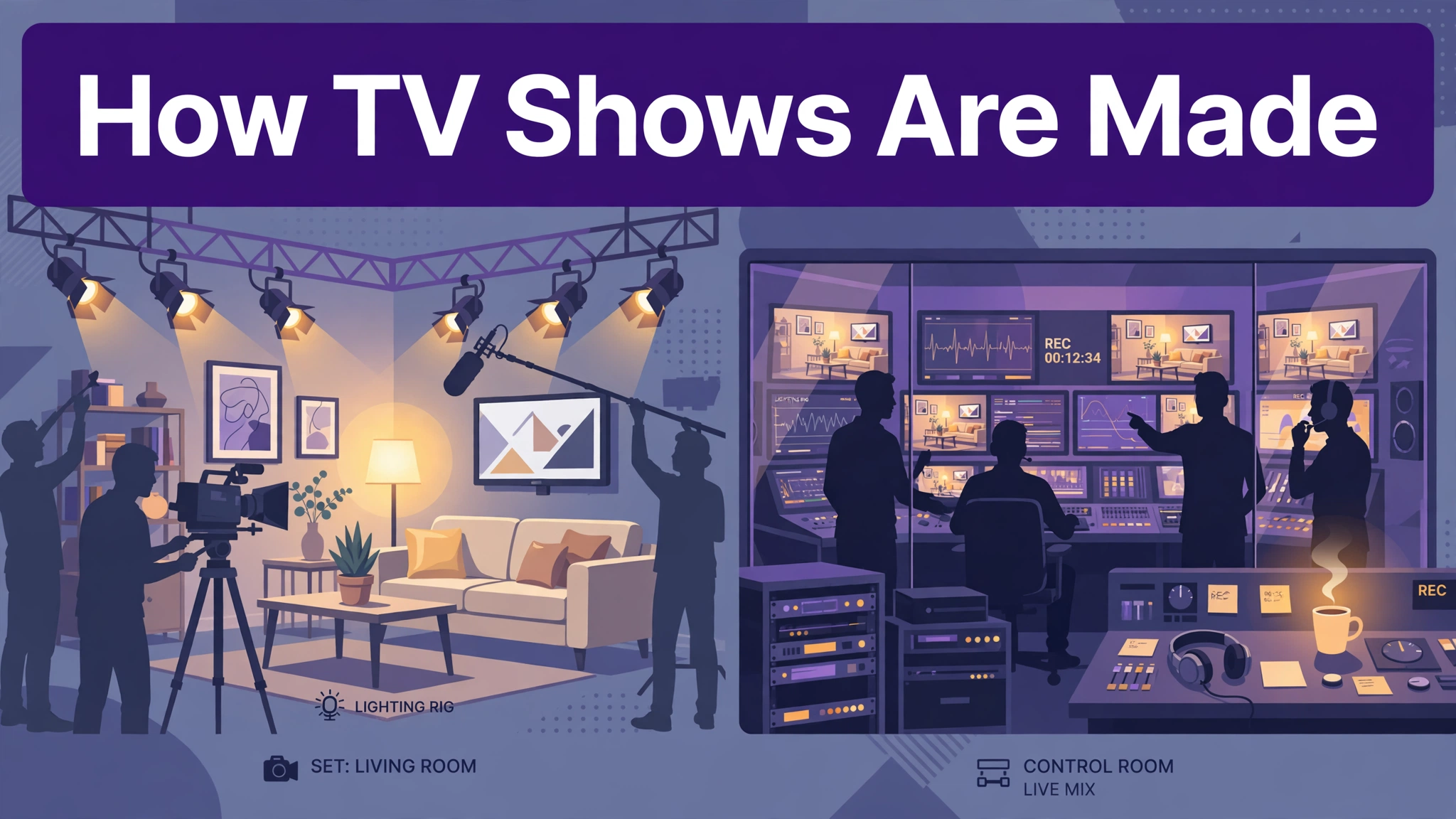
Sets and locations each have advantages. A built set, such as a living room, office, or hospital ward, gives the crew control over light, sound, and camera movement, and can be reused across a season. A real location, such as a street, a school, or a countryside house, gives authenticity and visual variety, but brings noise, weather, permits, and limited space. Many shows mix the two, filming exteriors on location and interiors on a set designed to match. Set designers, lighting technicians, and camera operators work together to make that mix seamless, so the audience believes the interior and exterior belong to the same place. Good production design is often invisible, which is why viewers may not notice it unless something goes wrong.
A filming day is long and highly structured. The crew arrives early to set up lights and cameras, actors go through hair, makeup, and costume, and the director rehearses the scene before filming multiple takes. Each take may be filmed from different angles: a wide shot showing the whole scene, medium shots of groups, and close-ups of individual faces. Later, the editor will choose among these angles to shape pace and emotion. Between takes, the crew resets props, checks focus, and records sound, while actors rest or prepare for the next setup. A single page of script can take an hour or more to film, depending on complexity, which is why a 45-minute episode may require a week or more of filming, plus preparation and post-production.
Editing, Sound, Music, and Visual Effects
Editing is where a television show truly takes shape. An editor assembles the best takes, in story order, and builds rhythm through the length and sequence of shots. A scene may be filmed with many angles, but the editor decides when to stay on a face, when to cut to a reaction, and when to move to a new location. That decision changes meaning: holding on a silent face can suggest doubt or grief, while cutting quickly can suggest panic or comedy. Editors also work with the director and showrunner to remove scenes that slow the story, clarify confusing plot points, and ensure that each episode has a satisfying shape, even when it is part of a longer arc.
Sound design and music are added after the picture edit, and they shape emotion as strongly as images. Dialogue recorded on set may be re-recorded in a studio if it was unclear, a process called ADR, and background sounds, such as footsteps, doors, traffic, or weather, are added to make scenes feel real. Music may be composed specifically for the show, giving it a recognisable theme and emotional language, or licensed from existing recordings, which can create nostalgia or cultural association. A show’s sound is carefully mixed so dialogue remains clear, music supports rather than overwhelms, and effects feel natural. Viewers often notice music only when it is too loud or too sentimental, but its absence would make most scenes feel flat and unfinished.
Visual effects, from simple set extensions to complex computer-generated worlds, are also part of post-production. Effects artists may remove modern objects from a historical scene, extend a location, create weather, or build a creature that could not be filmed in reality. The best effects are those the audience does not notice, because they serve the story rather than showing off technology. Post-production also includes colour grading, which adjusts the look of the footage for consistency and mood, and title design, which introduces the show’s identity. All of these stages take time, which is why an episode filmed in one month may not be ready to broadcast for several weeks afterwards.
Release, Audiences, and Why Shows End
Once episodes are finished, they are delivered to a broadcaster or streaming platform, which decides scheduling, marketing, and release strategy. Traditional television often releases one episode per week, creating anticipation, discussion, and a shared viewing rhythm. Streaming platforms may release a whole season at once, allowing binge-watching, or use a hybrid model, releasing a few episodes first and then weekly. Each model shapes how audiences experience a story. Weekly release encourages speculation and social discussion between episodes. Binge release encourages immersion, but can also make a series feel consumed quickly and forgotten, because there is less time for conversation between episodes.
Marketing plays a large role in whether a show finds its audience. Trailers, posters, interviews, and social media clips introduce characters and tone, but they can also mislead, by emphasising action in a quiet drama or comedy in a serious story. A show’s success is measured in different ways depending on the platform: traditional ratings, streaming views, completion rates, critical response, awards, and social discussion all matter, but no single measure tells the whole story. A show with modest ratings but a loyal, vocal audience may survive, while a show with strong initial views but low completion may be cancelled, because viewers did not stay to the end.
Shows end for many reasons, including falling audiences, rising costs, creative exhaustion, actor departures, or a deliberate decision to finish a story well. A planned ending, where writers know in advance that a season will be the last, usually produces a more satisfying finale than a sudden cancellation, where storylines remain unresolved. That is why fans often value shows that end on their own terms, even if they wish there were more episodes. Behind every finale is a team that has worked together for months or years, and the end of a show means the end of jobs, routines, and creative relationships, as well as the end of a story for its audience. Understanding that human side makes the finished show feel less like a product and more like a collective effort.
My Take:
My view is that knowing how television is made should increase respect for the finished product, not spoil its magic. Some viewers worry that learning about editing, multiple takes, or out-of-order filming will break the illusion, but in my experience the opposite happens. When you know that a simple conversation at a table required careful blocking, lighting, sound, and editing, you appreciate the skill that made it feel effortless. The illusion is not a trick to be exposed. It is a craft to be admired, and understanding the craft makes rewatching more interesting, because you start to notice choices you missed the first time, such as a camera move that mirrors a character’s change of mind, or a sound that quietly signals danger before the plot reveals it.
I also think audiences should be more forgiving of the practical constraints behind television. A show may reuse a location, limit its cast in an episode, or resolve a storyline quickly because of budget, scheduling, or an actor’s availability, not because its writers lacked imagination. Those constraints are part of the medium, and many creative solutions come from working within them. A bottle episode, set in a single location with a small cast, is often dismissed as filler, but it can produce some of the best character writing in a series, precisely because spectacle is unavailable and dialogue must carry the story. Judging a show only by its most expensive episodes misses the ingenuity that smaller episodes reveal.
Another point I feel strongly about is the value of the team behind the camera. Actors receive most public attention, but writers, editors, cinematographers, designers, composers, and crew members shape a show just as deeply. When a show feels consistent across seasons, that consistency is often the work of a showrunner and a stable team who understand the world they have built. When a show changes tone suddenly, that change may reflect a new team, a new platform, or a new commercial pressure, rather than a failure of imagination. Recognising those forces helps viewers discuss television more fairly, and helps them support the kinds of shows they want to see more of, by understanding what makes those shows possible.
Finally, I believe the way we watch television affects how we value it. Binge-watching can be enjoyable, but it can also flatten a series, making episodes blur together and reducing time for reflection. Weekly viewing, or at least pausing between episodes to discuss or think, preserves the serial experience that television was designed for: anticipation, speculation, and gradual attachment to characters. My advice is not to abandon binge-watching, but to use it thoughtfully, choosing when immersion serves a story and when slower viewing would serve it better. Television is a collaborative art made by hundreds of people over months. Giving it the attention its makers gave it is the simplest way to honour that work, and the most reliable way to enjoy it more deeply.
Another aspect worth noting is how streaming has changed writing and pacing. When episodes were released weekly, writers could build anticipation, plant clues, and trust that audiences would discuss and speculate between episodes. When a whole season is released at once, writers know many viewers will watch several episodes in a row, so they may pace reveals differently, with fewer recaps and more continuous storylines. Neither model is inherently better, but they produce different kinds of shows, and viewers who understand the difference can choose a viewing style that suits the show. A weekly show watched in a binge may feel slow in places designed for discussion, while a binge-designed show watched weekly may feel fragmented. Matching viewing pace to production design is a small choice that improves enjoyment.
I also think audiences should notice how much television depends on invisible labour that is rarely celebrated in awards or interviews. Location managers who secure a street at dawn, costume assistants who maintain continuity across weeks, sound mixers who make dialogue audible over traffic, and production assistants who coordinate hundreds of small tasks, all shape the final product. When a show feels seamless, it is because those people did their jobs well, not because filmmaking is naturally smooth. Recognising that labour does not require knowing every job title. It only requires remembering, when a scene works, that many hands made it work, and that a flaw in one area, such as unclear sound or a continuity error, is often a sign of time pressure rather than carelessness.
A further point is about representation behind the camera, not only on screen. Writers, directors, and producers from different backgrounds bring different stories, humour, and perspectives, and a show’s authenticity often depends on who is in the room when stories are broken. A show about a particular community, profession, or experience will usually feel truer when people with lived experience of it are involved in writing and production, rather than only consulted briefly. Audiences can support that by noticing credits, supporting shows with diverse creative teams, and asking, when a portrayal feels off, whether the team behind it had the knowledge to get it right. That question is not about policing creativity. It is about recognising that good storytelling requires knowledge, and knowledge comes from experience and research as well as imagination.
Finally, I believe television deserves to be discussed as an art form with its own strengths, rather than as a lesser cousin of cinema. Television’s length allows character development over years, its serial form allows stories to evolve with audiences, and its domestic setting allows intimate, everyday stories that cinema rarely has time for. A television show that uses those strengths well, developing a character slowly, returning to a place over seasons, or building a community the audience comes to know, can achieve effects no two-hour film can. Judging television only by cinematic standards, such as visual spectacle or a single climax, misses what makes the medium distinctive. The best television, in my view, embraces its own form, and viewers who embrace it too will find rewards that are uniquely televisual.
Frequently Asked Questions
How long does it take to make one TV episode?
Filming alone can take several days to more than a week, depending on complexity, and writing, preparation, editing, sound, and effects add weeks before and after filming. A single episode therefore represents many weeks of work by a large team, even if it feels effortless on screen.
Why are TV scenes filmed out of order?
Scenes are grouped by location, actor availability, and lighting needs to save time and money. Filming all scenes in one location together is more efficient than returning to the same place repeatedly, and continuity supervisors ensure costumes, props, and appearance match across takes.
What is a showrunner?
A showrunner is the lead writer and executive producer who oversees a series’ overall story, tone, and creative direction. The showrunner guides the writers’ room, works with directors and editors, and makes key decisions about character arcs and season structure.
What is the difference between episodic and serialised TV?
An episodic show tells a mostly self-contained story in each episode, so new viewers can join easily. A serialised show tells one long story across episodes, so missing an episode can mean missing important plot developments. Many modern shows mix both approaches.
Why do some TV shows get cancelled suddenly?
Shows may end because of falling audiences, rising costs, low completion rates on streaming platforms, creative exhaustion, or actor departures. A sudden cancellation often means writers did not know in advance that the season would be the last, so storylines may remain unresolved.
Do actors really film a whole episode in one day?
No. A typical episode is filmed over several days, with each scene shot multiple times from different angles. Dialogue, movement, and camera work are repeated until the director has the material needed for editing, which is why filming days are long and structured.